

The FullStack Alpha research desk tests AI trading bots on paper and live accounts. Reviewed and edited by Jay Rocco, Founder and Editor.
Published October 21, 2026, 7:55 a.m. ET | By FullStack Alpha Editorial Team | Reviewed by Jay Rocco, Chief Editor
The CFTC Frontier Forum on super intelligence and AI trading agents runs on October 28, 2026, from 1:00 to 4:00 p.m. on the published agenda, and it streams live on CFTC.gov. The agenda published with Release 9312-26 splits the CFTC Frontier Forum into two sessions: super intelligence in derivatives markets, and agentic trading, where panelists will discuss whether and how CFTC rules should apply when AI agents transact on behalf of market participants. It is a roundtable, not a rule, so nothing changes for your bot on October 28. What it signals is the question regulators will press next: who answers for an order an AI agent sends on its own?
On Monday, October 20, 2026, the Commodity Futures Trading Commission published Release 9312-26, the agenda for its October 28 Frontier Forum on super intelligence, AI trading agents and derivatives markets. No new rule. No registration change. No bot got banned.
What the CFTC did is narrower and, for anyone running automated strategies in futures or options, more useful. It told the market exactly which questions it plans to ask. Regulators write rules out of the questions they ask first.
Quick answer
The CFTC Innovation Task Force will hold its first Frontier Forum on October 28, 2026, streamed live on CFTC.gov. The agenda centers on two questions: how super intelligence could change price discovery and risk management in derivatives, and how autonomous AI agents could trade inside CFTC-regulated infrastructure. It is a listening session, not a rulemaking, but it marks the first time the agency has put agentic trading on a formal public agenda.
Key facts
- Release 9312-26 (Oct 20, 2026) sets the agenda for the inaugural CFTC Frontier Forum on Oct 28, 1:00 to 4:00 p.m., in two 75 minute sessions.
- Organizer: the CFTC Innovation Task Force, which announced the Frontier Forum series on September 21, 2026.
- Two core questions: super intelligence and market operations (price discovery, risk management), and agentic trading systems inside regulated infrastructure.
- Named participants include leaders from Ornn, Architect and Liquid Compute, firms working on compute markets, AI infrastructure and trading technology.
- Chairman Michael S. Selig: “Super intelligence is poised to transform our financial markets.”
What exactly did the CFTC publish in Release 9312-26?
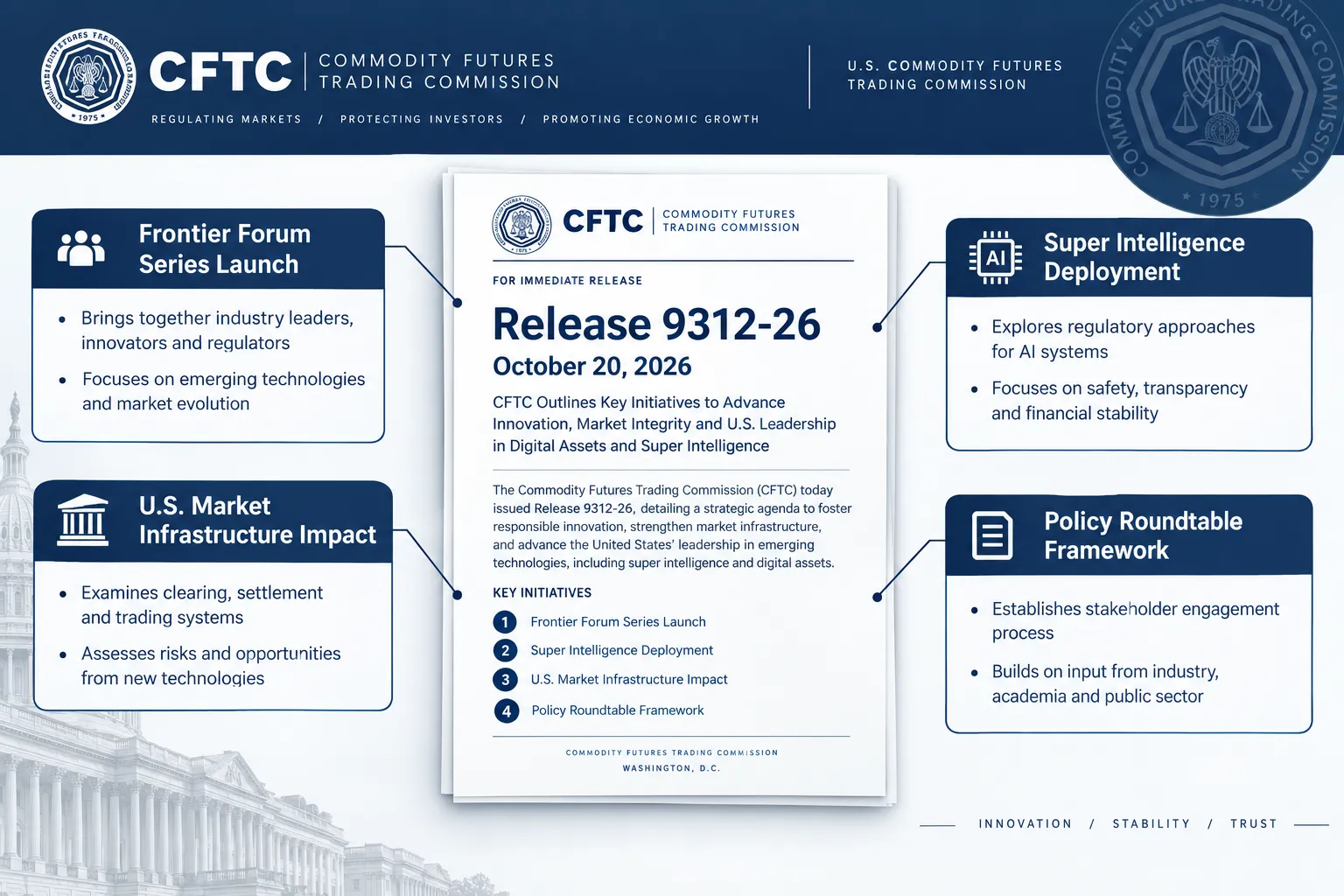
Release 9312-26 lays out the agenda for the first event in the agency’s Frontier Forum series. The forum looks at how super intelligence is being built and deployed, how its spread may affect U.S. markets, and how the Commission can support responsible adoption while protecting market participants from risks it has not seen before.
Translation: this is a listening exercise with a transcript. Transcripts like this one tend to become advisories, then staff interpretations, then rules.
The forum falls under the AI and autonomous systems theme on the agency’s Innovation page. Event contract traders should also track the CFTC proposal to define event contracts as swaps.
Why does a forum agenda count if nothing is being regulated yet?
Agendas are leading indicators. Rulebooks are lagging ones.
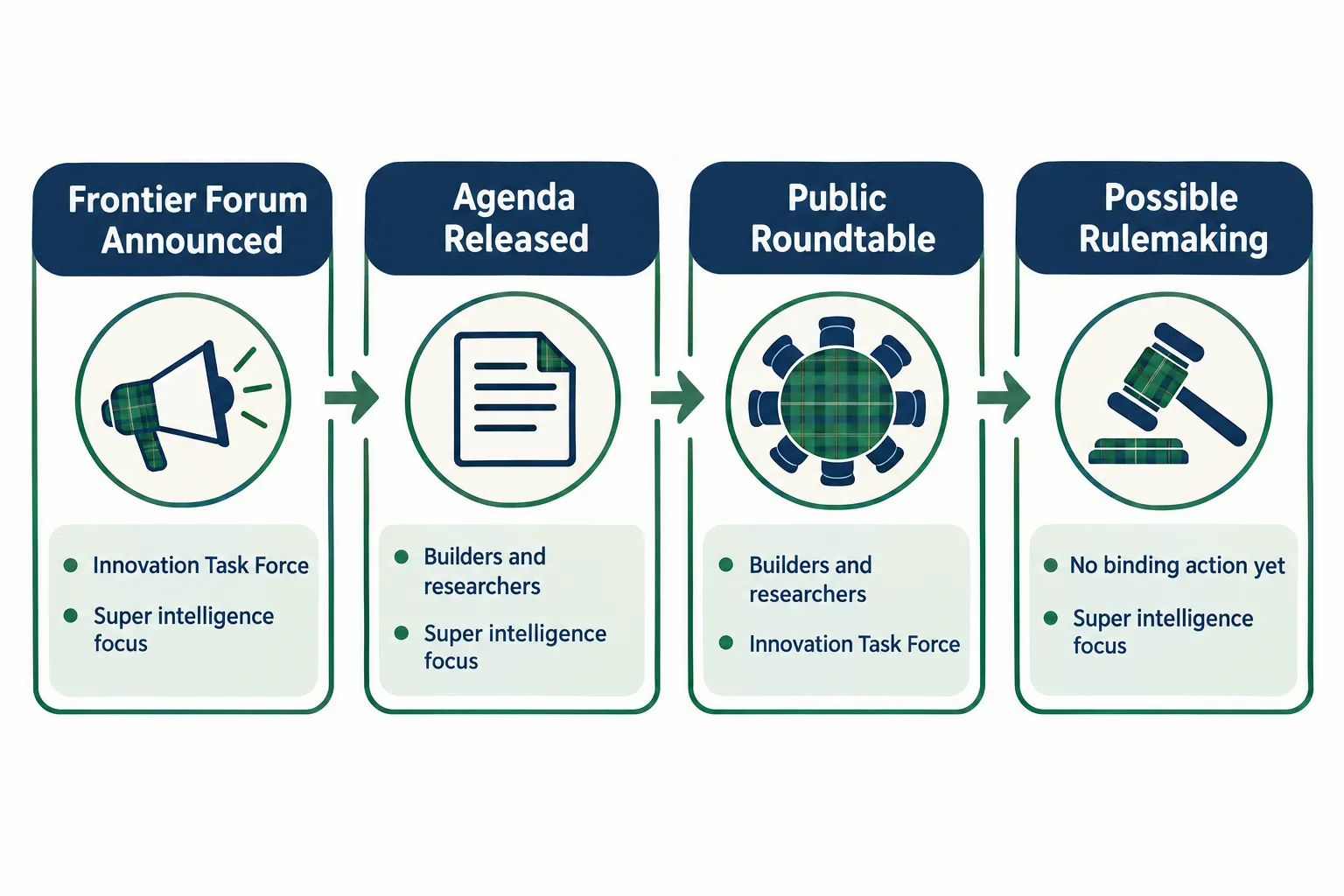
The September announcement framed Frontier Forums as roundtables meant to inform policy, interpretation and potential rulemaking. Nothing on October 28 binds anyone. But these two questions are the ones that end up in compliance manuals.
Question one is about price discovery and risk management. Price discovery is how a market figures out what something is worth through live bids and offers. If a growing share of those bids and offers come from models reacting to each other instead of the underlying contract, the mechanism changes.
Question two is about agentic trading systems. “Agentic” means software that decides and acts on its own instead of waiting for you to click. That question is about accountability. Who is the customer, who is the trader, and whose name is on the order ticket when the model sends it at 3:07 a.m.?
Who is in the room on October 28?
Named industry participants include leaders from Ornn, Architect and Liquid Compute. That mix tells you where the agency’s head is. These are not legacy exchanges or clearing members. They are firms building compute markets, AI infrastructure and trading technology.
The CFTC has been building toward this for months. In its August 19, 2026 compute derivatives release, Selig argued the United States cannot win the AI race without a strong derivatives market for compute.
Brokers are already moving: BGC Group began over-the-counter trading in compute and memory capacity in June 2026.
The full Frontier Forum agenda lists eight panelists: Kush Bavaria (Ornn), Brett Harrison (Architect), Ronit Jain (Liquid Compute), Nick Elliott (Innovation Council Action), Brendan Ryan (Tempo), Andrew Kayiira (Investment Company Institute), Kelly Littlepage (OneChronos) and Nilmini Rubin (Hedera). The agenda states that taking part does not mean the CFTC endorses any of those organizations.
| Track | What it covers | Who it touches first | Retail relevance today |
|---|---|---|---|
| Super intelligence and market operations | Price discovery, risk management, model concentration | Exchanges, clearinghouses, large funds | Low, indirect |
| Agentic trading systems | Autonomous order entry inside regulated infrastructure | FCMs, brokers, bot vendors | High, rising |
| Compute as a commodity | Standardized compute and memory contracts | Interdealer brokers, AI and cloud buyers | Low today, watch 2027 |
| Event contracts and 24/7 markets | Continuous trading, clearing and settlement | Prediction market venues | Medium |
How can you watch the CFTC Frontier Forum on October 28?
You do not need an invitation. Release 9312-26 says the meeting streams live on CFTC.gov, with a phone line for anyone who cannot stream. The agenda does not print a time zone; the CFTC is based in Washington, so plan on Eastern time and check the event page that morning.
| Time on agenda | Session | What it covers |
|---|---|---|
| 1:00 to 1:15 p.m. | Welcome and keynote | Michael J. Passalacqua, Head of the Innovation Task Force; keynote by Chairman Michael S. Selig |
| 1:15 to 2:30 p.m. | Session 1: Use of Super Intelligence in Derivatives Markets | How SI could change price discovery, risk management and oversight |
| 2:30 to 2:45 p.m. | Break | |
| 2:45 to 4:00 p.m. | Session 2: Agentic Trading | Autonomous agents that conduct transactions, how they touch market infrastructure, and whether and how CFTC rules apply |
Dial-in details from the release: US toll free (833) 568-8864 or (833) 435-1820, webinar ID 165 708 9557, passcode 669856. The release also says panelists speak for themselves, not for the Commission, so treat any single comment as one voice, not policy.
How to use the 75 minutes of Session 2 at the CFTC Frontier Forum: write down every time a panelist names a specific control (a pre-trade limit, an identity check, an audit log field). Those nouns are the raw material of any future staff guidance. Then compare them against what your own setup already logs.
How does this connect to the AI trading agents retail traders already use?
Directly. The infrastructure question on the agenda is not theoretical, because the products already shipped.
Brokers spent 2026 pushing agents into live accounts. We covered the wave in Robinhood and Public letting AI agents trade while you sleep and in our Robinhood agentic trading breakdown, where the agent can place trades without a separate sign-off depending on settings. On the institutional side, Jump Trading runs GPT-6 Astra agents with human review at the gate. Same technology, very different guardrails.
Performance is not kind either. In the ClawStreet experiment, only 27% of AI agents beat the S&P 500, and the busiest did worst.
The CFTC is asking who is responsible for an autonomous order. Ask the same question of your own account before they answer it for you. If your agent has discretion, you need an external kill switch that does not depend on the agent agreeing to stop.
What does the forum mean for futures and options traders?
Futures are the CFTC’s house. Stocks belong to the SEC. If you trade equities only, the CFTC Frontier Forum reaches you secondhand through shared brokers, shared vendors and shared models.
If you trade futures, micro contracts or anything cleared through an FCM, the agenda maps onto your paperwork. Supervision standards, recordkeeping for model-generated orders and disclosure of how much autonomy an agent has are the likeliest places early requirements show up.
The agency is moving fast on adjacent files too, including October 5 relief for true perpetual stock index futures.
What CFTC rules already apply to a futures trading bot?
Fewer than most people assume, and they sit in a different place. In June 2020 the Commission voted 3-2 to withdraw its proposed Regulation AT, the rule that would have reached algorithmic traders directly, according to CFTC Release 8188-20. In its place it proposed electronic trading risk principles for designated contract markets (the exchanges): exchange rules to prevent, detect and mitigate disruptions, exchange-based pre-trade risk controls for all electronic orders, and prompt notice to the CFTC of significant platform disruptions. A final rule on those principles was on the agenda for the December 8, 2020 open meeting, per Release 8324-20.
In plain English: today the guardrails on your futures bot are built at the exchange and at your futures commission merchant, not written around your code. The CFTC Frontier Forum is the first public sign the agency wants to revisit who is accountable when the code itself is an AI agent.
Brokers already tag machine orders. NinjaTrader’s Place Order documentation tells developers to set isAutomated to true for any order placed by code or an automated process, and warns that misreporting it can violate exchange policies. That is the kind of field a future rule could lean on. If you run futures automation through that stack, our directory entry for NinjaTrader covers its plans and limits.
Decision rule: if your bot trades CFTC-regulated contracts and you cannot say which pre-trade limits your FCM applies to it, ask in writing this week. If the answer is “none beyond the exchange,” set your own: a maximum order size, a maximum daily loss and a hard stop on order count per minute.
Three moves worth making before any rule exists:
- Write down your agent’s authority. Max position size, max daily loss, allowed instruments and whether it can trade outside regular hours.
- Keep order logs you can produce. Timestamp, instrument, size and the model version that generated each order.
- Paper trade every change first. Slippage shows up in live fills, not backtests, as we covered in paper trading proves nothing until slippage shows up.
What should investors watch next?
- October 28, 2026: the CFTC Frontier Forum itself. Watch which panelists get pressed on accountability for autonomous orders.
- After the forum: any transcript, staff summary or request for comment on cftc.gov. That is the first hard sign of rulemaking intent.
- Follow-on Frontier Forums: the series is billed as ongoing, so the next agenda will show which question the agency chose to chase.
- Broker disclosure pages: quiet edits to agent disclosure language often show up before any press release does.
Our take
An agenda for the October 28 CFTC Frontier Forum is not a crackdown and it is not a green light. It is the CFTC saying out loud that it does not yet know how autonomous software fits inside rules written for humans with phones.
Our position: the risk to retail traders in 2026 is not that the CFTC moves too fast. It is that traders hand full discretion to a model before they have a written risk rule, then discover the accountability gap at the worst possible moment. We track every broker and regulator move on agent trading at AI Stock Trading Bots for exactly that reason.
Next step, today: open your agent’s settings, write its authority limits on one page, confirm you can kill it from outside the app, and export last month’s order log. If any of those take more than ten minutes, that is your weak point, not the regulation. Process over prediction.
Built a bot you would happily explain to a regulator?
We test every submitted bot against its own documentation before we write a word about it.
This article is for education only and is not financial, legal or investment advice. Trading futures, options and stocks with automated tools carries risk of loss.
Sources
- CFTC Release 9312-26: Innovation Task Force Announces Agenda and Panelists for Inaugural Frontier Forum on Super Intelligence (Oct 20, 2026)
- CFTC Frontier Forum agenda, October 28, 2026 (PDF)
- CFTC Innovation page
- CFTC Release 8188-20: Regulation AT withdrawn, electronic trading risk principles proposed (June 25, 2020)
- CFTC Release 8324-20: December 8, 2020 open meeting agenda
- CFTC Release 9286-26 on compute derivatives (Aug 19, 2026)
- CoinDesk: U.S. CFTC sets agenda for AI forum, exploring trading and agentic finance (Oct 20, 2026)
Your market edge starts with the right tool. Stay alpha.
Frequently Asked Questions
What is the CFTC Frontier Forum on October 28, 2026?
It is the first public roundtable in a series run by the CFTC Innovation Task Force. Release 9312-26, published October 20, 2026, set its agenda on super intelligence, AI trading agents and derivatives markets. It streams live on CFTC.gov.
Is Release 9312-26 a new rule for AI trading bots?
No. It publishes the agenda for a roundtable meant to inform policy, interpretation and potential rulemaking. Nothing on October 28 creates a requirement for traders or brokers.
What does agentic trading mean in the CFTC's framing?
Software that decides and places trades on its own inside regulated infrastructure such as exchanges and futures commission merchants, instead of a person entering each order.
Does the Frontier Forum affect stock traders or only futures traders?
The CFTC oversees futures and derivatives, while the SEC oversees stocks. Brokers, bot vendors and AI model providers overlap across both markets, so standards discussed here can spread to equity tools over time.
What should bot traders do before any AI agent rules exist?
Write down your agent's authority limits, keep exportable order logs with timestamps and model versions, confirm you can stop the agent from outside the app, and paper trade every change before it touches real money.
Is this article financial advice?
No. This article is for education only and is not financial, legal or investment advice. Trading with automated tools carries risk of loss.
The FullStack Alpha research desk tests AI trading bots on paper and live accounts. Reviewed and edited by Jay Rocco, Founder and Editor.
