
October 8, 2026, 8:00 a.m. ET | By Jay Rocco, Founder and Editor, FullStack Alpha
Quick answer
On October 6, 2026, OpenAI published a customer case study showing how Jump Trading, the Chicago-based quantitative trading firm, uses GPT-6 Astra agents to run research tasks that can last for days. The headline detail for bot builders is the gate at the end: Jump says a human review step validates critical results, and any trading signal an agent produces is treated as one input among many inside a controlled execution environment. The agents research. They do not get a straight line to the order book.
Key facts
- What: OpenAI case study titled “How Jump Trading is scaling quant research with ChatGPT.”
- When: Published October 6, 2026, on openai.com.
- Who: Lucas Baker, Head of LLM R&D at Jump Trading, who leads the firm’s agentic research and development.
- Model: GPT-6 Astra, which OpenAI says Jump uses for long-running work from day-to-day coding to quantitative studies.
- Control point: Human review and acceptance of critical results, plus a “stringently reviewed and controlled execution environment” for any agent-generated signal, per OpenAI’s write-up.
- What is missing: No performance numbers, no returns and no figures on how much of Jump’s research now runs through agents. This is vendor marketing material, so read it as a company account, not an independent audit.
What did OpenAI say Jump Trading is doing with GPT-6 Astra?
Jump builds predictive models from market data, news, events and alternative data. According to the case study, Baker’s view is that predicting only slightly better than a coin flip, at scale, can be enough to support a working strategy.
That framing matters. Nobody at Jump is pitching a crystal ball. The edge is small and statistical, and the agents exist to search for more of it, faster.
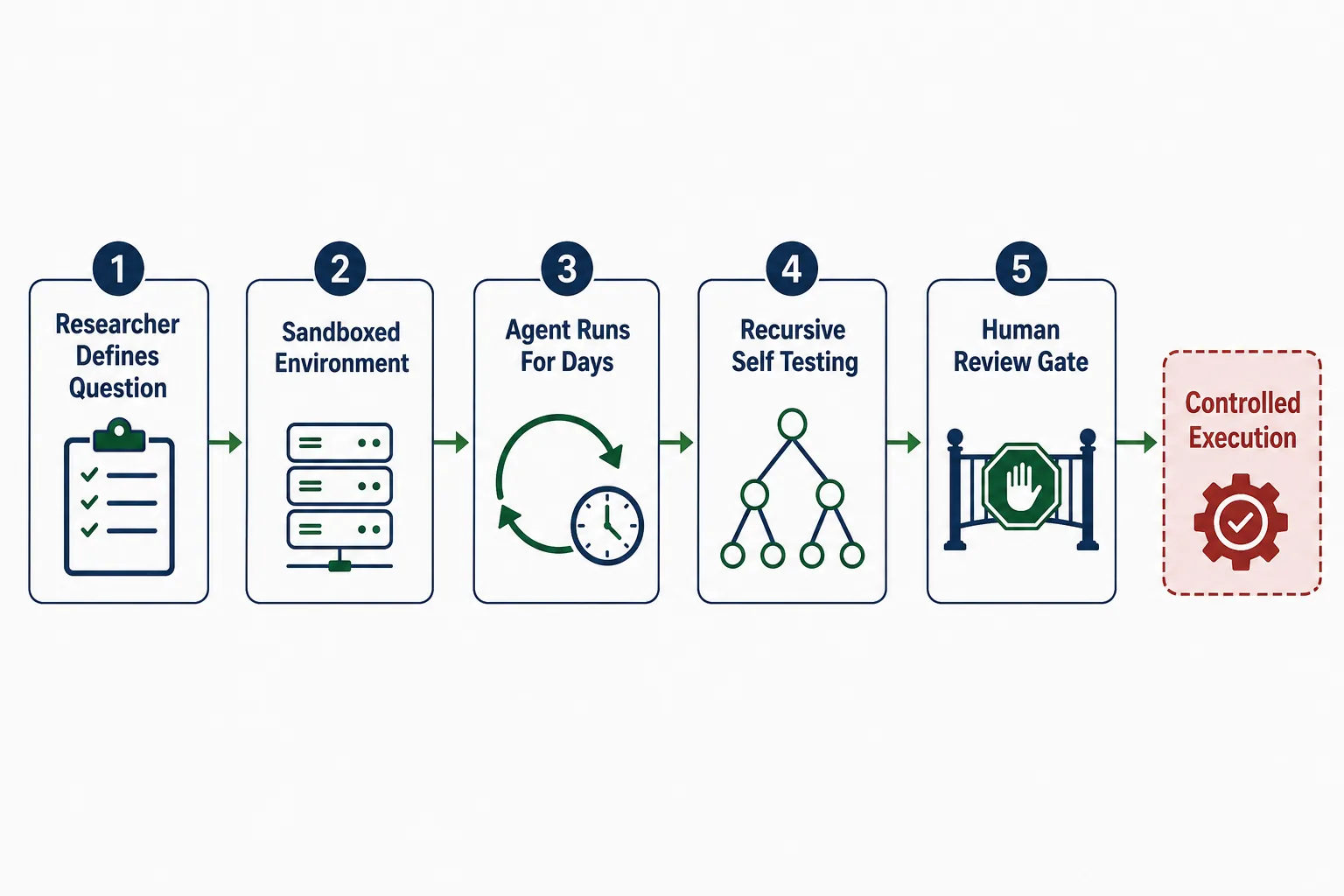
The new part is duration. Baker told OpenAI: “You can define something that needs to run for days.” Researchers set the problem, the work environment and the scoring criteria, then steer one or many agents as they pull data, test ideas and stack small improvements on top of each other.
Baker also described the goal as building “a secure and well-monitored environment with clear goals” and letting the agents find their own way inside it. Read that twice. The freedom lives inside the fence, not outside it.
How does Jump keep AI agents away from unchecked trades?
This is the section every retail bot builder should screenshot.
Baker’s own words: “If you have a safe environment where the agent or system is free to produce any output that it needs, but there is also a human review process at the end of it where critical validation takes place with human acceptance, that’s what gives us confidence.”
OpenAI’s write-up adds that a signal produced by an agent is scoped and reviewed like any other output, as something “usually informative but potentially wrong,” and blended with every other signal before it reaches execution.
Three controls stand out:
- Sandboxed research. Agents can explore freely, but inside a defined environment with set data sources and evaluation rules.
- Human acceptance at the end. Critical results get validated by a person before they count.
- Signals, not orders. An agent’s output feeds a larger, reviewed system. Nothing in the case study describes an agent firing trades on its own say-so.
Even the longest runs still include regular check-ins with the person who defined the task, according to the case study. That covers what data to pull, how long to run and whether the intermediate results make sense.
Why does a quant firm’s AI setup matter to retail bot traders?
Because the incentives point the other way on the retail side.
Jump has a full research bench and works in what the case study calls a heavily regulated industry. It still keeps a human between the model and the money. Meanwhile, retail brokers have spent 2026 shipping agents that can act on customer accounts, and some can place trades without approval on each order. We covered that tradeoff in our Robinhood Agents breakdown and the wider AI trading agent risks every bot owner faces.
So who needs the review gate more: a firm with a risk desk, or a solo trader running a bot from a laptop?
The answer is obvious. Yet plenty of retail setups wire the model straight to the broker API because it feels efficient. It is efficient, right up until a stale data feed, a bad prompt or an AI-written backtest with look-ahead bias turns into a live order.
The lesson from Jump is not “use GPT-6 Astra.” It is architecture. Research and execution are separate jobs, and the handoff between them is where the discipline lives.
What should investors watch next?
- October 15, 2026, about 4:00 p.m. ET: Interactive Brokers reports third-quarter results, with a call at 4:30 p.m. ET. Listen for any update on how clients use its AI and agent connections.
- October 27, 2026, after the close: Robinhood reports third-quarter results, with a call at 5:00 p.m. ET. Agentic account adoption is the number bot watchers will want.
- Follow-up disclosures from Jump or OpenAI: The case study gives no metrics. Any hard numbers on research speed or error rates would be the first real evidence beyond the marketing page.
Our take
One of the most quantitative firms in the business is not handing AI the keys. It is handing it the lab.
That is the right model for anyone running a bot. Let the AI generate ideas, code and signals. Keep a human, or at minimum a hard rule set, between that output and a live order.
Your next step: open your bot’s order path and find the line where a signal becomes a trade. If nothing checks it there, add a gate this week. Start with a daily loss cap, a max position size and a manual approval step for anything new, then test the whole chain on paper trading with realistic slippage before it touches real money.
Process beats prediction. Jump just showed you what that looks like at a professional quant shop.
Built a bot that keeps a human between the signal and the order? Show us. Our testing method is published on the How We Test page, and every submission is reviewed against it. Submit your bot
This article is for education and information only. It is not financial, investment or trading advice, and it is not a recommendation to buy or sell any security. Trading involves risk, including the loss of principal. Do your own research and consider speaking with a licensed professional.
Sources
- OpenAI, “How Jump Trading is scaling quant research with ChatGPT,” October 6, 2026: https://openai.com/index/jump-trading/
- Interactive Brokers, “Interactive Brokers Group to Host Third Quarter Earnings Conference Call,” September 24, 2026: https://www.businesswire.com/news/home/20260924921911/en/Interactive-Brokers-Group-to-Host-Third-Quarter-Earnings-Conference-Call
- Robinhood, “Robinhood Markets, Inc. to Announce Third Quarter 2026 Results on October 27, 2026”: https://investors.robinhood.com/news-releases/news-release-details/robinhood-markets-inc-announce-third-quarter-2026-results
Your market edge starts with the right tool. Stay alpha.
Frequently Asked Questions
What did OpenAI publish about Jump Trading?
On October 6, 2026, OpenAI published a customer case study titled "How Jump Trading is scaling quant research with ChatGPT." It describes Jump using GPT-6 Astra agents for long-running research work, from day-to-day coding to quantitative studies that can run for days.
Does GPT-6 Astra place trades for Jump Trading?
The case study does not say so. It describes agents doing research and producing signals, with human review of critical results. An agent-generated signal is treated as usually informative but potentially wrong and is combined with other signals inside a stringently reviewed and controlled execution environment.
Who is Lucas Baker?
Lucas Baker is Head of LLM R&D at Jump Trading, according to OpenAI's case study. He leads the firm's agentic research and development work.
Did the case study include performance numbers?
No. It gives no returns, accuracy rates or figures on how much of Jump's research runs through agents. It is vendor marketing material, so treat it as a company account rather than an independent audit.
What can a retail bot trader copy from Jump's setup?
Separate research from execution. Let AI generate ideas, code and signals, but put a review gate between that output and a live order: a daily loss cap, a max position size and manual approval for anything new. Test the full chain on paper trading before using real money.
Is this article financial advice?
No. This article is for education and information only. It is not financial, investment or trading advice and is not a recommendation to buy or sell any security. Trading involves risk, including loss of principal.
Contributing writer at AI Stock Trading Bots.
