

Jay Rocco is the Founder and Editor of FullStack Alpha. He has tested 200+ AI stock tools since 2022 and run 15+ AI trading platforms on live accounts with his own money. He reviews the software. He does not tell you what stocks to buy.
Last updated: August 30, 2026
Most traders don’t blow up because they picked the wrong stock. They blow up because they had no plan for being wrong. Paper trading gives you a warm blanket of false confidence. You print money in a simulator, switch to a live account, and watch your edge evaporate. The culprit isn’t your strategy. It’s slippage. You think you have a system, but you just had a simulator that charged you nothing and filled you instantly.
Key Takeaways
- Paper trading teaches mechanics, not execution edge.
- Slippage is the gap between your expected fill price and the actual price you pay.
- Simulators give you the midpoint price; live markets give you the worst available price.
- Fees, spreads, and borrow costs silently erase paper profits.
- Psychology changes completely when real money is on the line.
- Treat your simulator results as an upper bound, then validate live.
What Is Paper Trading, and What Does It Actually Simulate?
Paper trading is a simulator that lets you practice buying and selling stocks, options, and ETFs with virtual funds. It models price movement and order mechanics but completely ignores the friction of real execution. You get to experience active trading risk-free, but the simulation stops at the point where real trading actually begins: the order queue.
When you start paper trading, you learn the plumbing. You learn where the buttons are. You learn to read the tape and identify support and resistance. This is valuable. You can test strategies without blowing up your savings. Platforms like moomoo offer paper trading with virtual funds, and its desktop app shows real-time Nasdaq Basic data. That is enough to see price action.
TradeZero is another option. You can paper trade on any of their platforms, including TZ1, ZeroPro, ZeroFree, and ZeroMobile. They let you practice short selling and offer 80+ technical indicators, with zero financial risk. Trading educators can also use these accounts to teach new students.
But here is the market truth: the simulator is a sandbox. It does not model the queue. When you click buy in a paper trading account, the system assumes you get filled. In the real market, you are competing against algos, institutions, and other retail traders for liquidity. A simulator cannot replicate that fight.
The practical takeaway: use free paper trading tools to learn the interface and test your logic. Do not use them to calculate your expected income.
Why Does a Paper Trading Account Fill Every Order Instantly?
A paper trading account fills orders instantly because the simulator assumes you get the midpoint price between the bid and ask. In a live market, you enter a queue, and market makers fill you at the worst available price. This gap between your signal and your fill is called slippage, and it is the main reason paper results never match live results.
How simulators assume the midpoint price is the core flaw. If a stock has a bid of $10.00 and an ask of $10.05, the midpoint is $10.025. If you place a market order in a simulator, you get filled at $10.025. In reality, a market order to buy hits the ask. You pay $10.05. If you are buying size, you blow through the ask and eat into the next price levels. That is how partial fills happen, and why size changes everything.
Independent testing finds a 10 to 30 percent slippage cost gap between sim and live. Options are even worse. In a simulator, you often get mid-price fills on options contracts. Live options trading means you deal with wide spreads and illiquid contracts. You put in a market order, and you get filled at the worst side of the spread.
Thinkorswim paper trading, specifically paperMoney, uses algorithmic fills that are often unrealistically favorable. Users on Reddit frequently complain about ridiculous fills in thinkorswim paper trading. OnDemand orders sometimes do not execute properly, or quote gaps create too good fills.
The practical takeaway: if your strategy relies on getting filled at the exact midpoint, you do not have a strategy. You have a simulator artifact.
Which Paper Trading Platforms Model Real Fills, and Which Do Not?
No paper trading platform models real fills perfectly, but some are worse than others. Webull and TradingView give instant, optimistic fills, while thinkorswim and Interactive Brokers offer slightly more realistic order routing but still lack true slippage. You have to know the limitations of your paper trading app before you trust the results.
Webull paper trading is known for instant fills with no queue. You click, and you get the price you see. It does not model the queue of orders waiting ahead of you. Paper trading interactive brokers is closer to reality because IBKR routes orders to actual exchanges, but the fills are still simulated. Charles Schwab paper trading, after the TD Ameritrade move, has similar issues, though their interface is solid. The TradingView paper trading simulator relies on chart-based entries, which means it just grabs the price on the chart at the moment you click.
Here is a comparison of the top paper trading platforms:
| Platform | Fill Realism | Data Delay | Options & Futures | Cost |
|---|---|---|---|---|
| Webull | Low (Instant) | Real-time | Yes | Free |
| thinkorswim | Medium (Favorable) | Real-time | Yes | Free |
| Interactive Brokers | Medium (Routed) | Real-time | Yes | Free |
| Charles Schwab | Low to Medium | Real-time | Yes | Free |
| TradingView | Low (Chart Price) | Varies by plan | Limited | Free & Paid |
The market truth is that no simulator can fake the order book. You can learn the platform, but you cannot see the queue.
The practical takeaway: pick a platform that forces you to use limit orders. If your simulator lets you market in and out with zero friction, you are building bad habits.
What Are the Best Paper Trading Platforms for Realistic Practice?
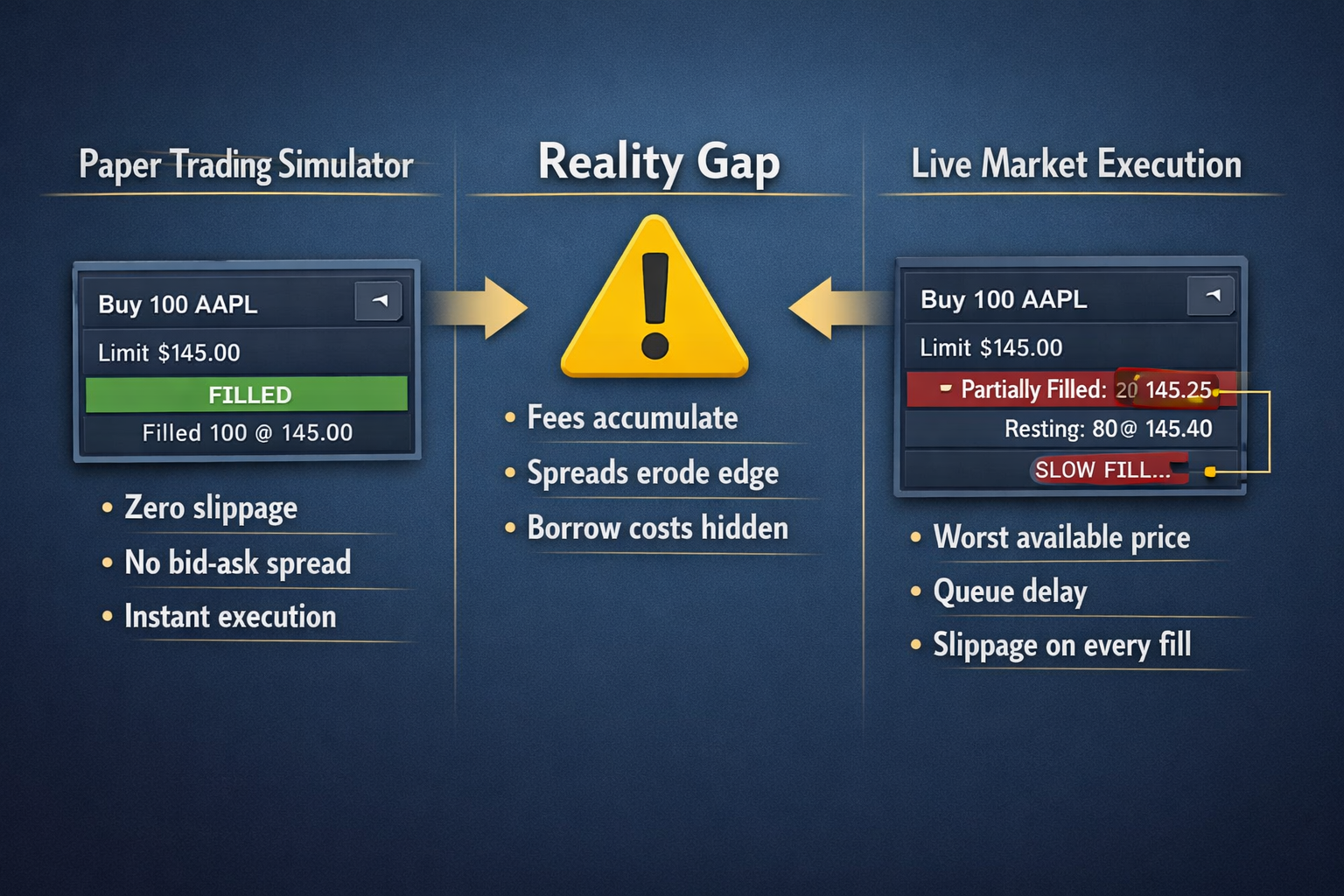
The best paper trading platforms for realistic practice are those that force you to use limit orders, charge simulated commissions, and use real-time data. Thinkorswim and Interactive Brokers are the closest to reality because they expose you to complex order types and routing logic, even if the fills are still too generous.
Is a paper trading simulator free version good enough? Yes, for learning the buttons. No, for proving an edge. Free platforms like ZeroFree or the free tier of TradingView are great for beginners. You get access to charts, indicators, and the ability to test strategies. But you need to understand the limitations.
When you use paper trading, you are trading stocks, ETFs, and options in a vacuum. You are not paying borrow costs. You are not paying regulatory fees. The market data you get is real-time, but the execution is fake. You need to add realism manually. Set your simulator to charge commissions if it has the option. Only use limit orders. Never use market orders.
The market truth: a free simulator is a practice ring. It is not the main event. You use paper trading to build muscle memory, not to calculate your future tax bracket.
The practical takeaway: spend a month on a free simulator. Once you can execute your plan without looking at the buttons, you are ready to move to a live account with real money.
How Much Do Fees and Spreads Change Your Paper Results?
Fees and spreads can turn a profitable paper trading strategy into a losing live strategy. Commissions, contract fees, and regulatory fees add up, while the bid-ask spread you never paid in the simulator silently erodes your edge. The math that worked at zero cost falls apart when reality takes its cut.
Commissions are the obvious cost. Many brokers offer zero-commission trading, but they still pass on regulatory fees. The SEC and the Financial Industry Regulatory Authority (FINRA) charge tiny fees per sale. They add up. Options trading has contract fees. If you trade options, you pay per contract. In a simulator, you pay nothing.
The bid-ask spread is the hidden tax. If a stock is $10.00 bid and $10.02 ask, the spread is two cents. In a simulator, you buy at $10.01. In reality, you buy at $10.02. If you sell immediately, you sell at $10.00. You just lost two cents, or 0.2 percent, just for crossing the spread. On a low float stock with choppy tape, the spread can be ten cents or more. That is a 1 percent loss on every round trip.
Borrow costs and short locates are another issue. If you short sell, you pay borrow fees. Hard-to-borrow stocks have high fees. In a simulator, you can short anything instantly. In reality, your broker might not have the shares. You get a locate fee, or you get bought in.
The market truth: your paper trading profits are a gross number. Your live profits are a net number. The difference is the cost of doing business.
The practical takeaway: subtract 1 percent from every paper trade you make. If the strategy still makes money, it might survive. If it doesn’t, you don’t have an edge. You have a gross margin that gets eaten by friction.
Why Does Paper Trading Break Your Psychology, Not Just Your Math?
Paper trading breaks your psychology because it removes the fear of loss. You take risks with position sizing you would never risk with real money, and revenge trading does not exist when the stakes are zero. The simulator teaches you to be reckless because the pain of being wrong is missing.
Position sizing is the first casualty. In a paper trading account, you might buy 1,000 shares of a stock because you have $100,000 in virtual funds. When you go live, you might only have $5,000. You can’t buy 1,000 shares. You buy 50 shares. The dynamics change. Your profit per tick is smaller. You get impatient. You overtrade.
Revenge trading is a real psychological trap. You take a loss, you get angry, and you double down to get it back. In a simulator, a loss doesn’t hurt. You just reset the account. You never learn to manage the emotion of seeing red on your screen. When real money is on the line, a loss feels like a punch to the gut. You panic. You freeze. You hold a loser too long because you hope it comes back. You cut a winner too fast because you fear it will reverse.
Paper trading for beginners still matters anyway. You need to learn the mechanics without the stress of losing your rent money. But you have to graduate. You have to feel the pressure.
The market truth: the market is a machine for transferring money from the impatient to the patient. A simulator doesn’t test your patience. It tests your typing speed.
The practical takeaway: when you go live, expect your psychology to be your biggest obstacle. Your system is fine. Your brain is the problem.
How Do You Bridge Paper Trading to a Live Account Safely?
You bridge paper trading to a live account safely by cutting your size to one-tenth, logging every trade, and tracking slippage as its own metric. Treat your paper results as an upper bound, then validate live with money you can afford to lose.
Here is the step-by-step process to transition from paper to live:
Step 1: Cut your size to one-tenth. If you paper traded 1,000 shares, trade 100 shares live. If you paper traded 10 contracts, trade 1 contract. The goal is to learn the live execution environment without blowing up your account. You need to see how fills work. You need to feel the spread.
Step 2: Log every trade in a trading journal or spreadsheet. You need data over noise. Write down the entry, the exit, the profit, and the reason for the trade. Did you follow your setup? Did you get stopped out? Did you let winners run? A journal forces you to be honest with yourself.
Step 3: Compare expected fill to actual fill. When you place a live order, note the price you expected. Then note the price you actually got. The difference is your slippage. If you expected $10.00 and got $9.98, that is two cents of slippage. Track this over 50 trades. You will see the real cost of your strategy.
Step 4: Track slippage as its own metric. Slippage is not random. It is higher in fast markets, lower in slow markets. It is higher in illiquid stocks, lower in highly traded names. If your slippage is eating your profit, you need to change your strategy. You need to trade more liquid names, or you need to use limit orders instead of market orders.
The market truth: the gap between paper and live is measurable. If you don’t measure it, you are flying blind.
The practical takeaway: start small. Track the data. Adjust. Systems over hacks. Process over prediction.
Final Verdict: What Paper Trading Proves and What It Never Will
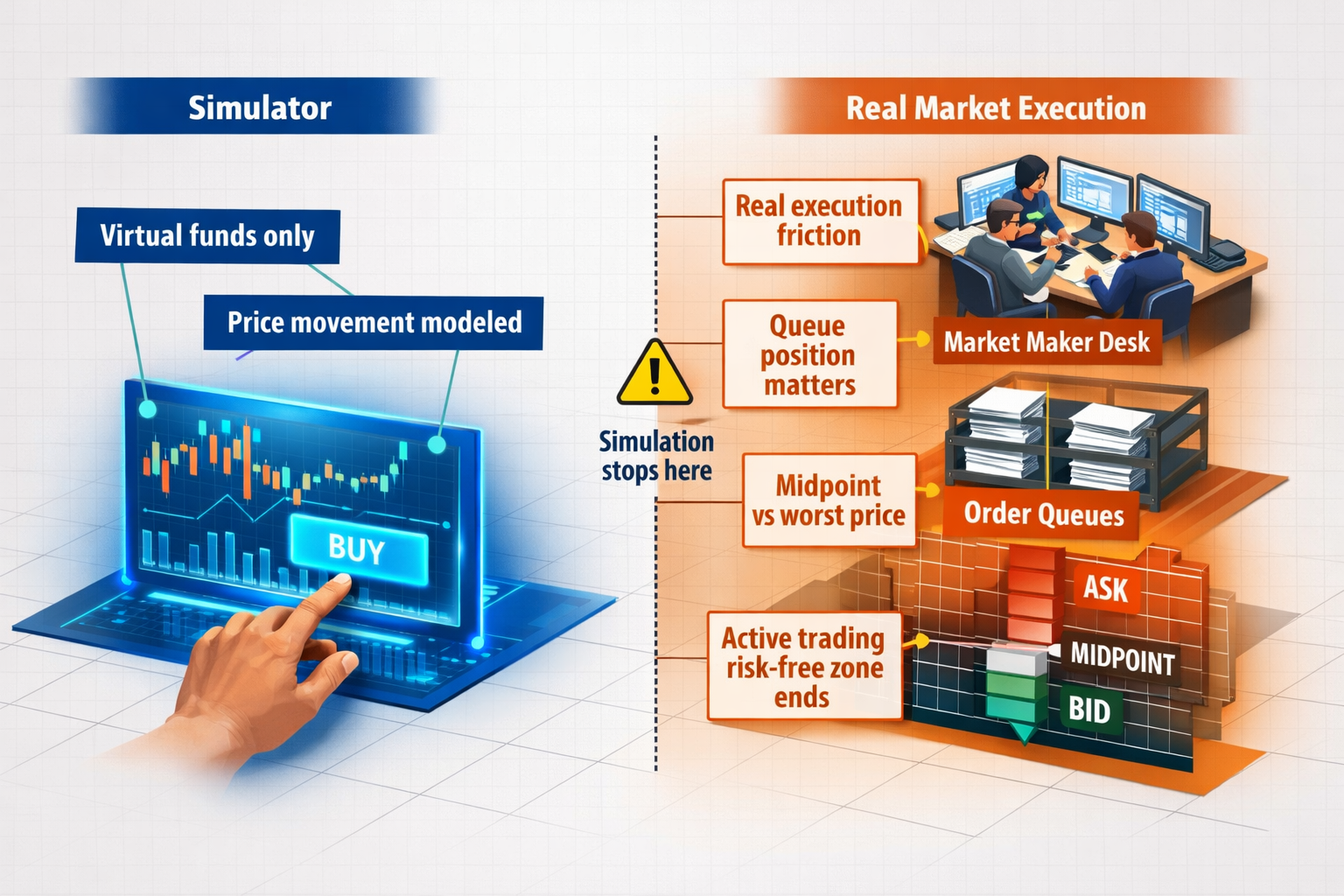
Paper trading proves you know where the buy button is. It proves you can read a chart. It proves you understand the basic mechanics of a trade. It does not prove you have an edge. It does not prove you can make money. It does not prove you can survive the psychology of a live market.
The gap between paper and live is slippage, fees, and fear. The simulator gives you the midpoint. The market gives you the worst price. The simulator charges you nothing. The market charges you a spread, a commission, and a regulatory fee. The simulator feels like a game. The market feels like a job.
If you just lost money in your first month after a strong paper run, that is normal. You didn’t do anything wrong. You just met the market. The setup was clean, but the execution cost money. Your risk management was fine on paper, but your position sizing was too big for a live account.
Your next move is simple. Cut your size. Track your slippage. Log your trades. Stop pretending the simulator is a crystal ball. It is a flight simulator. It teaches you how to fly the plane. It does not teach you how to land in a thunderstorm.
FullStack Alpha cuts the noise so you can keep the alpha. See the AI tools, scanners, and systems we actually rate at aistockpickerapp.com.
Affiliate disclosure: Some links in this article may be affiliate links that compensate the publisher at no cost to the reader.
References
- Watch
- Paper Trading Fills Pretty Unrealistic
- How Accurate Are Paper Trading Fills In
- Is It Possible To Force A Fill Successful Order
- The Realities Of Paper Trading In Thinkorswim
- Ondemand Orders Not Executing
- Ridiculous Fills In Thinkorswim Paper Trading
- Watch
- How Realistic Is Are The Fills For Options
- Watch
- Thinkorswim Guide
- Issues With Papermoney
- Ib Thinkorswim Paper Trading Vs Real Fills
- Watch
- How Realistic Are Papertrading Fills With
- Paper Trading Vs Live Trading
- Paper Trading Vs Live Trading Options
- Paper Trading Vs Live Trading
- Execution Comparison For Dex
- Paper Trading Vs Live Trading
- How Do Fills Compare Live Vs Paper Trading
- Filling Differences Between Paper Trading And
- Paper Trading Vs Live Trading
- Paper Trading Vs Live Trading Why Results Differ
- Paper Trading
- Demo Account Fill Quality Measuring Your Broker S Execution
- Rithmic Latency Secrets Live Sim Fills 2025
- Paper Trading Vs Live Trading Whats The Difference
- A9d4fcfd 69c7 4561 Ad64 E30bfc3d8f59
- Paper Trading Vs Live Trading Key Differences And What To Expect
- Papertrader
- Paper Trading Account
- Paper Vs Real Trading On Webull
- Request Paper Trading Account
- Paper Trading
- Using Ibkrs Paper Trading Account
- Does Interactive Brokers Have Paper Trading
- 11069 Paper Trading
- Paper Trading Vs Real Account
- How To Open An Ibkr Paper Trading Account
- How To Sign Up For An Interactive Brokers Paper Trading Account
- What Does My Account Say Simulated Trading Even
- Sandbox Paper Trading And Fill Execution Quality
By Jay Rocco, Founder and Editor, FullStack Alpha.
Stay alpha.
Frequently Asked Questions
How does paper trading work?
Paper trading works by letting you place simulated trades using virtual money instead of real capital. The platform tracks your positions and calculates profit and loss based on real-time market prices, but no actual shares are bought or sold. It is a risk-free way to learn how to use a trading platform and test basic strategies.
Can you make $1000 a day with day trading?
Yes, it is possible to make $1000 a day with day trading, but it requires a large account size and a proven edge. To make $1000 a day consistently without risking ruin, you generally need an account of $50,000 to $100,000. Most retail traders lose money. The old $25,000 pattern day trader minimum was retired in June 2026, so account size is now a risk question, not a rule.
Can I paper trade for free?
Yes, you can paper trade for free on almost every major brokerage platform. Webull, thinkorswim, Interactive Brokers, and TradingView all offer free paper trading simulators. You do not need to fund a live account to access the simulator on most platforms, making it easy to practice without financial risk.
Is $100 enough for day trading?
No, $100 is not enough for day trading stocks due to margin requirements and the impact of fees on small positions. While you can trade fractional shares or some options with $100, you cannot day trade effectively. The old $25,000 pattern day trader minimum was retired in June 2026, but $2,000 is still the standard margin minimum.
What is Paper Trading?
Paper trading is the practice of simulated trading. You use a software platform to place buy and sell orders for stocks, options, or ETFs using virtual funds. The simulator updates your account balance based on live market price changes, allowing you to practice trading mechanics without risking real money.
Why Paper Trade on TradeZero?
You should paper trade on TradeZero because they offer zero-commission trading and direct market access routing. Their simulators, including ZeroPro and ZeroFree, let you test short selling and use 80+ technical indicators. It is a solid choice if you want to practice active trading strategies in a simulated environment.
Is TradeZero Paper Trading 100% free to use?
Yes, TradeZero Paper Trading is 100% free to use. You can sign up for a ZeroFree account without depositing any funds. You get access to their trading platform and virtual funds to practice. You do not need a funded account to maintain access to the paper trading simulator.
How to access Paper Trading on TradeZero?
To access Paper Trading on TradeZero, you sign up for a ZeroFree account on their website. Once your account is approved, you download the ZeroPro or ZeroFree desktop software. You log in with your credentials, and the platform opens with a virtual balance ready for simulated trading.
Jay Rocco is the Founder and Editor of FullStack Alpha. He has tested 200+ AI stock tools since 2022 and run 15+ AI trading platforms on live accounts with his own money. He reviews the software. He does not tell you what stocks to buy.
