

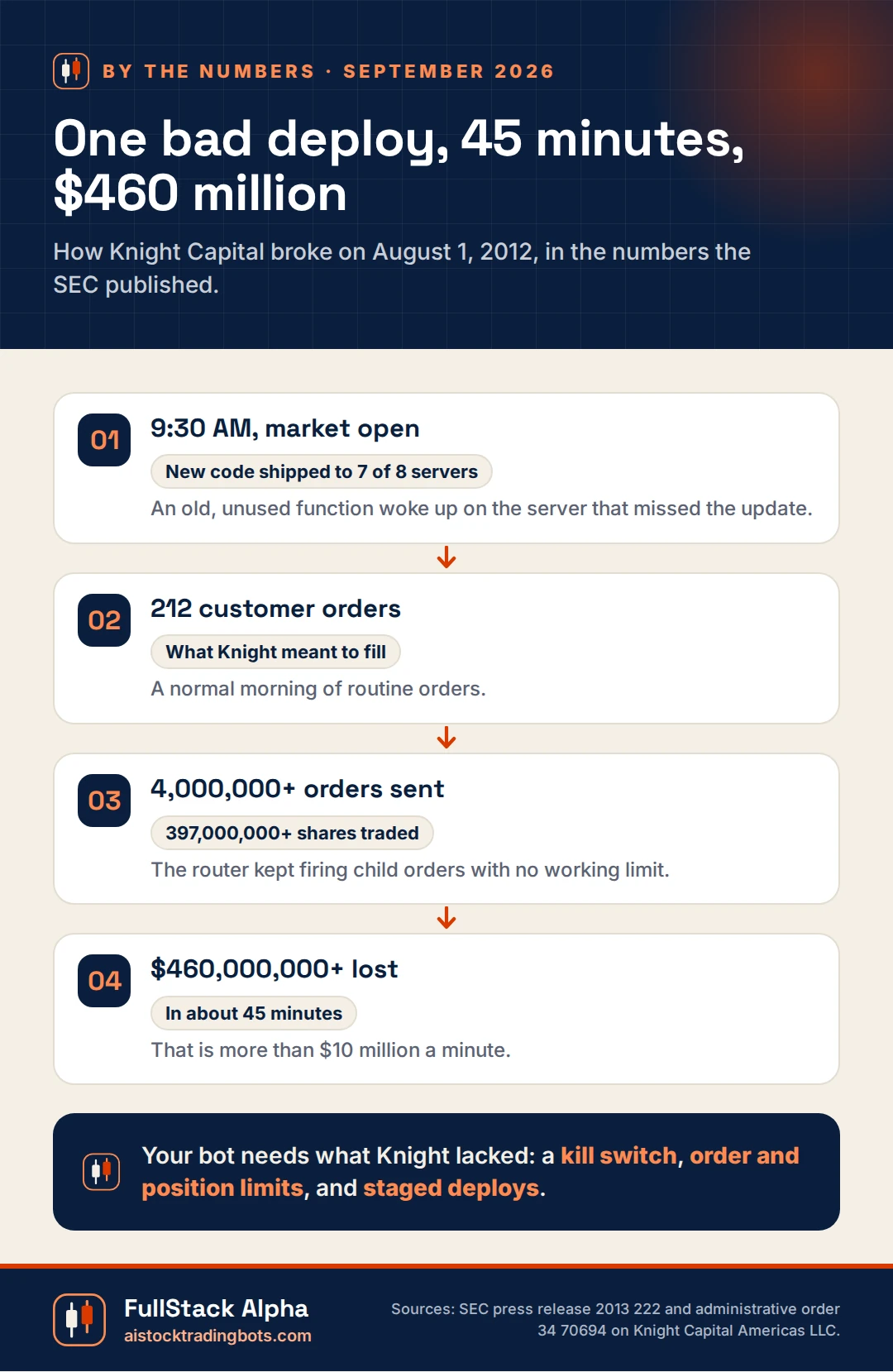
The short answer, from FullStack Alpha: Trading bots fail from overfitting, ignored costs, partial fills, broker disconnects, leaked API keys and missing kill switches far more often than from bad AI. The most famous case is Knight Capital, which lost more than $460 million in 45 minutes in 2012 after a faulty software release. FullStack Alpha’s fix list: realistic backtests in QuantConnect or TradingView, weeks of paper trading at Alpaca or Interactive Brokers, and a trade journal such as TraderSync, TradesViz or Edgewonk that compares every fill with the plan.
By the numbers: why trading bots fail
Four numbers that frame this topic, each linked to its source. Checked September 2026 and reviewed monthly.
212 → 4M
customer orders Knight meant to fill, and the child orders its router actually sent.
Source: SECReal failures, and the tools that catch them
Two public case studies first, then the tools we would use to catch each failure before it costs money.
Updated September 30, 2026 by Jay Rocco for FullStack Alpha. Picks are reviewed monthly. Prices were checked on vendor sites in September 2026 and change often, so confirm before you pay.
| Failure | Named example or tool | What to do |
|---|---|---|
| Bad software release | Knight Capital, 2012 | Kill switch and staged rollouts |
| Model risk | Nof1 Alpha Arena, 2025 | Small size and hard loss limits |
| Overfitting and ignored costs | QuantConnect | Model fees and slippage; test out of sample |
| Repainting signals | TradingView | Alert on confirmed bar closes |
| Partial fills and position drift | Alpaca | Stream fills and reconcile positions |
| Disconnects | Interactive Brokers | Reconnect logic and alerts |
| No review of live fills | TraderSync, TradesViz, Edgewonk | Journal every trade |
Knight Capital (2012)
What happened: A faulty deployment of trading software
Cost: More than $460 million in 45 minutes
On August 1, 2012, Knight Capital released new trading code, old logic reactivated on one server, and the firm lost more than $460 million in 45 minutes. A professional firm with professional engineers, undone by a deployment. Your bot is not too small for this. Ship every change to paper first, and keep a kill switch that works without the bot’s cooperation.
Read next: Trading Bot Basics: What Runs While You Are Away
Nof1 Alpha Arena (2025)

What happened: Six AI models traded $10,000 each in real money
Result: Four finished with losses
Official site: nof1.ai
Same market, same starting capital, and four of six models lost money. Model risk is real risk. Position limits and a daily loss cap belong outside the model, where it cannot talk its way past them.
Read next: Is AI Trading Legit? Yes. The Real Question Is Does It Work.
QuantConnect

Catches: Overfitting and ignored costs
Cost: Free tier with unlimited backtesting
Official site: quantconnect.com
Most bots die from backtests that pretend trading is free. QuantConnect’s LEAN engine models fees, slippage and fill behavior, so the gap between backtest and live shrinks before you spend a dollar. Hold out a date range you never touch while tuning.
Read next: QuantConnect: What LEAN Runs That Your Laptop Cannot
TradingView

Catches: Repainting indicators and unrealistic fills
Cost: Free Basic plan; Bar Magnifier on higher plans
Official site: tradingview.com
Repainting indicators look perfect on history and fire differently live. Base alerts on confirmed bar closes, and on plans that include it, turn on Bar Magnifier so the Strategy Tester fills orders using lower timeframe data instead of guessing.
Read next: Pine Script Strategy: Turn an Indicator Into a Backtest That Trades
Alpaca

Catches: Partial fills, position drift, key leaks
Cost: Free paper trading
Official site: alpaca.markets
Partial fills break position math. Alpaca streams order and fill updates, so a bot can reconcile what it thinks it owns against what the broker says it owns. If those numbers disagree, the bot should stop. Keep paper and live keys separate, and out of your code.
Read next: Alpaca API Keys: Generate, Store, and Rotate Them Safely
Interactive Brokers

Catches: Disconnect handling, tested on paper
Cost: Free paper account
Official site: interactivebrokers.com
IBKR gateways log out and restart on a schedule, and a bot that keeps deciding while disconnected sends orders out of sync. Build reconnect logic, alert yourself on every disconnect, and rehearse the whole routine on IBKR’s free paper account.
Read next: Interactive Brokers Paper Trading: Setup, Limits, and Bot Testing
TraderSync

Catches: Live results drifting from the plan
Type: AI trading journal
Official site: tradersync.com
A trading journal that imports fills from your broker and uses AI to flag patterns in your results. For a bot, the value is blunt: it shows whether live fills match what the backtest promised.
Read next: Paper Trading Proves Nothing Until Slippage Shows Up
TradesViz

Catches: Slippage, trade by trade
Cost: Free forever tier; Pro $19.99 a month
Official site: tradesviz.com
A journal with a free tier, AI analytics and a built in simulator. Good for checking slippage on every trade without paying first.
Read next: Paper Trading Proves Nothing Until Slippage Shows Up
Edgewonk

Catches: Bad exits and behavior leaks
Cost: About $12 a month billed yearly; no free plan
Official site: edgewonk.com
Built around behavior analysis. Its trade management module tests alternative stops and targets against your own trade history, which is the honest way to tune exits.
Read next: Options Backtesting: Why Your Win Rate Is Not Real
The eight mistakes we see most
- Overfitting. The rules were tuned until the backtest looked perfect. The market never repeats perfectly.
- Look ahead bias. The test used data the bot could not have seen at decision time, like the day’s close at the open.
- Ignoring slippage and costs. Every order pays a spread and a commission. High frequency strategies feel it most.
- Partial fills. The bot assumed it bought 100 shares. It got 40. Now every size calculation after that is wrong.
- API disconnects. The broker connection drops, the bot keeps thinking, and orders go out of sync.
- No kill switch. When something breaks, there is no fast way to stop it.
- Exposed API keys. Keys pasted into code, pushed to a public GitHub repo, and found within hours.
- Skipping paper trading. Going live on day one, because the backtest looked great.
How to catch them before they cost you
- Backtest with realistic costs and test on data the strategy never saw. Start with Backtesting.
- Paper trade through real sessions, including a volatile open. See Paper Trading.
- Log every order and fill. If the bot’s position and the broker’s position disagree, stop trading.
- Set a daily loss limit the bot cannot override.
- Scope API keys to trading only and store them outside your code. See Broker APIs.
When it is the bot, not you
Sometimes the product is the problem: delayed signals, silent outages, or a strategy that changed without notice. We track those in our AI Trading Bot Reviews and report outages and pricing changes in AI Trading News.
If a platform is pressuring you to deposit fast or promising a fixed return, that is not a failure mode. It’s a scam pattern. See AI Trading Bot Scams.
One bad deploy, 45 minutes, $460 million
Real trader pain points, answered
Real comments from Trustpilot and the App Store, quoted as posted. Each one gets a straight answer from FullStack Alpha and a link to the guide that fixes it.
 Trustpilot
 App Store
2 times composer did not execute the change in the next change window (which is already a lag since it only happens at the end of the day). It cost me $100s.
App Store review of the Composer by SoFi iPhone app, July 2026. Quoted as posted.
Know exactly when your platform trades, and check the fills the next morning. A missed rebalance should trigger an alert, not a surprise on your statement.
Read: Trading Bot BasicsI contacted Composer right away to cancel, but they took two full days to respond and there was no option to stop or unwind the position myself (at least at that time).
Trustpilot review, December 2025. Quoted as posted. Read the original
Never run a bot you cannot stop yourself. Before you fund it, find three controls: pause the strategy, close the positions, revoke the API key. If one is missing, walk.
Read: Alpaca API KeysLately the system has been lagging causing to enter and exit trades late.
App Store review of the TradingView iPhone app, September 2026. Quoted as posted.
Lag is a failure mode, not bad luck. Use limit orders, set a maximum slippage rule, and have the bot skip any trade that fills too far from the signal price.
Read: Paper Trading AppFrom the FullStack Alpha blog
Related guides on this site, written and edited by Jay Rocco:
- Paper Trading Proves Nothing Until Slippage Shows Up
- Options Backtesting: Why Your Win Rate Is Not Real
- Alpaca API Keys: Generate, Store, and Rotate Them Safely
- Algorithmic Trading Reddit Advice: What Holds Up and What Burns Cash
- Trading Bot Basics: What Runs While You Are Away
Our take
Bots rarely blow up in one dramatic moment. They bleed. A slightly worse fill here, a missed reconnect there, a position size that drifts after one partial fill nobody noticed. The traders who survive are not the ones with the smartest strategy. They are the ones who log every order, compare it against the broker, and stop the bot the second those numbers disagree. Boring discipline beats clever code. Start with the list above, and check it against every bot you run, including the one you built yourself.
Quick answers
Why do most trading bots lose money?
Most trading bots lose money because the strategy was tuned to past data, costs were ignored, or the bot broke during real market conditions. Slippage, partial fills, and outages hit live accounts in ways a simple backtest never shows.
What are common backtesting mistakes?
The most common backtesting mistakes are overfitting, look ahead bias, survivorship bias, ignoring commissions and slippage, and testing on the same data used to build the strategy. Each one makes a backtest look better than live trading will be.
How do I stop a trading bot fast?
Build a kill switch before you go live: one command or button that cancels open orders and stops new ones. Test it on paper. Know where your broker’s own cancel all orders button is, and keep a daily loss limit the bot cannot override.
Edited by Jay Rocco, Founder and Editor of FullStack Alpha. Educational content only, not financial advice. Trading involves risk of loss.
Stay alpha.
Frequently Asked Questions
What is slippage?
The gap between the price your bot expected and the price it actually got. On fast or thin stocks it can erase a strategy's entire edge.
What is overfitting?
Tuning a strategy so tightly to historical data that it memorizes the past instead of learning a rule that holds going forward. It looks brilliant in a backtest and fails live.
What is a kill switch?
One action that stops the bot and cancels its open orders. Every bot that trades live needs one, and you should know how to use it without looking it up.
Why do most trading bots lose money?
Most trading bots lose money because the strategy was tuned to past data, costs were ignored, or the bot broke during real market conditions. Slippage, partial fills, and outages hit live accounts in ways a simple backtest never shows.
What are common backtesting mistakes?
The most common backtesting mistakes are overfitting, look-ahead bias, survivorship bias, ignoring commissions and slippage, and testing on the same data used to build the strategy. Each one makes a backtest look better than live trading will be.
How do I stop a trading bot fast?
Build a kill switch before you go live: one command or button that cancels open orders and stops new ones. Test it on paper. Know where your broker's own cancel all orders button is, and keep a daily loss limit the bot cannot override.
Explore Why Trading Bots Fail

Options Backtesting: Why Your Win Rate Is Not Real
Options backtesting inflates win rate through mid price fills, stale IV, and ignored assignment. Learn the five mechanisms and how to fix ea…
Learn More →
Paper Trading Proves Nothing Until Slippage Shows Up
Paper trading teaches mechanics, not execution. See why slippage, fees, and psychology erase paper profits on a live account, and how to bri…
Learn More →