

The short answer, from FullStack Alpha: An AI trading bot is likely a scam if it promises fixed returns, asks you to deposit money with the bot company instead of a regulated broker, or makes withdrawals hard. Real cases prove the pattern: the CFTC charged Mirror Trading International over roughly $1.7 billion in bitcoin taken with a claimed trading bot, and the SEC fined two advisers in 2024 for false AI claims. FullStack Alpha’s check: look up any firm on FINRA BrokerCheck or NFA BASIC before you send a dollar.
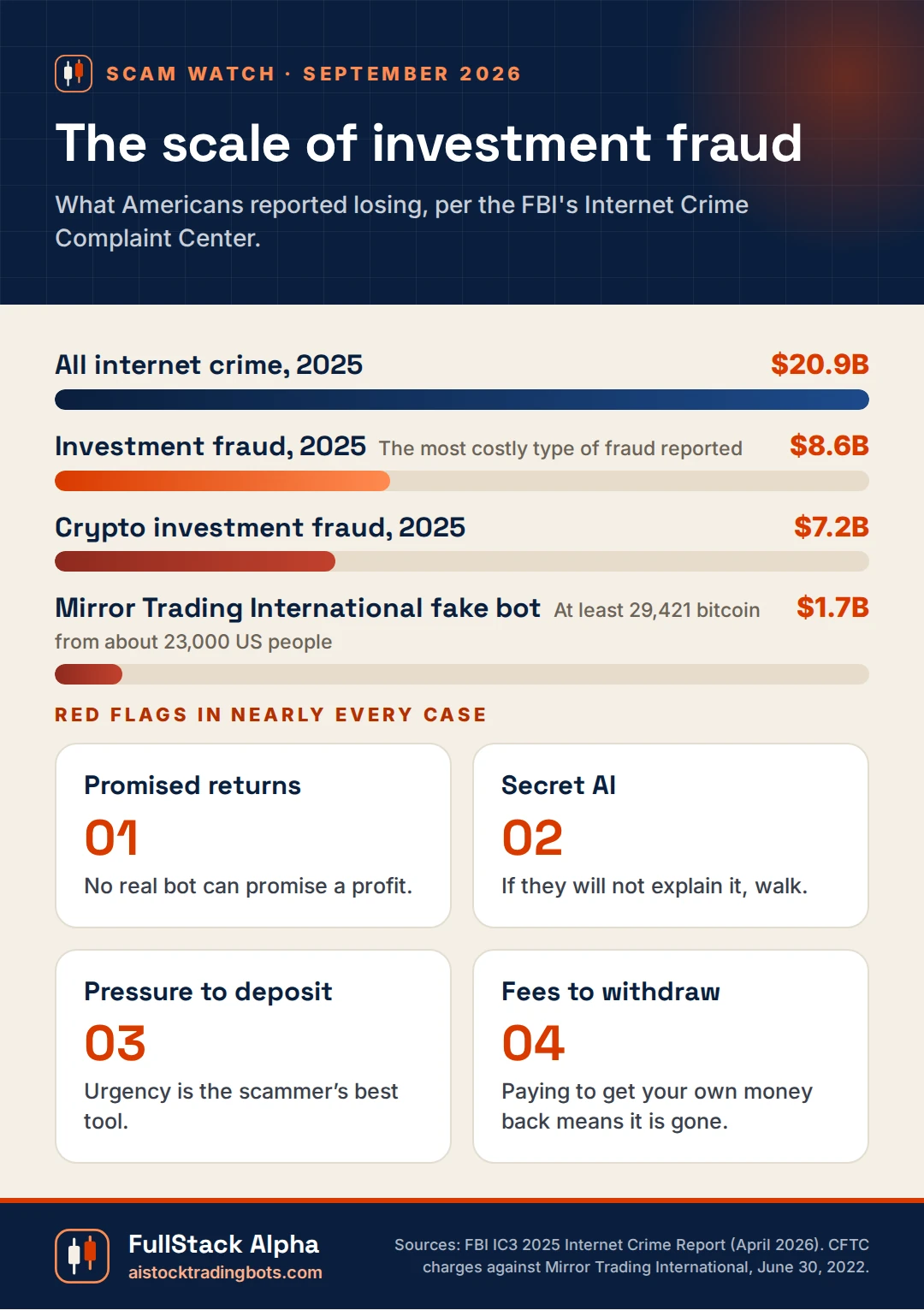
By the numbers: AI trading bot scams
Four numbers that frame this topic, each linked to its source. Checked September 2026 and reviewed monthly.
$8.6B
of that was investment fraud, the costliest type reported.
$1.7B
in bitcoin taken by Mirror Trading International’s fake trading bot from about 23,000 US people.
Source: CFTCReal cases, and the free tools that expose them
Named enforcement actions first, then the free lookups that flag the same pattern before it reaches your account. We do not show logos here on purpose. Scammers do not get brand exposure on this site.
Updated September 30, 2026 by Jay Rocco for FullStack Alpha. Picks are reviewed monthly. Prices were checked on vendor sites in September 2026 and change often, so confirm before you pay.
| Name | What it is | Date |
|---|---|---|
| Mirror Trading International | CFTC fraud case over a claimed forex trading bot, about 29,421 bitcoin | Charged June 30, 2022 |
| Delphia and Global Predictions | SEC settlements over false AI claims, $400,000 total | March 18, 2024 |
| CFTC customer advisory | ”AI Won’t Turn Trading Bots into Money Machines” | January 25, 2024 |
| FINRA BrokerCheck | Free lookup of brokers and advisers | Always available |
| NFA BASIC | Free lookup of futures and forex firms | Always available |
| Investor.gov | SEC adviser search and investor alerts | Always available |
Mirror Trading International (CFTC case)
Charged: June 30, 2022
Size: About 29,421 bitcoin, worth over $1.7 billion at the time
The CFTC charged Mirror Trading International and its CEO, Cornelius Steynberg, with taking bitcoin from roughly 23,000 people in the United States through a claimed forex trading bot. It was the largest bitcoin fraud ever charged in a CFTC case. In April 2023 a court ordered about $1.7 billion in restitution plus an equal civil penalty. The tells were textbook: deposits sent to the company, promised returns and referral rewards.
Read next: Is AI Trading Legit? Yes. The Real Question Is Does It Work.
Delphia and Global Predictions (SEC)
Settled: March 18, 2024
Penalties: $225,000 and $175,000
The SEC settled charges against two investment advisers for false and misleading statements about their use of artificial intelligence. Regulators call this AI washing. The lesson for bot shoppers: AI powered on a website is a marketing claim until someone shows you how it works.
Read next: AI Trading on TikTok: 5 Disclosure Rules 98% of Creators Break
CFTC advisory on AI trading bots
Published: January 25, 2024
Title: AI Won't Turn Trading Bots into Money Machines
The CFTC warned that scammers use AI buzz to sell trading bots that promise outsized returns. If a pitch sounds like the ad the regulator described, walk away.
Read next: Algorithmic Trading Reddit Advice: What Holds Up and What Burns Cash
FINRA BrokerCheck
Cost: Free
Checks: US brokers and investment advisers, including disciplinary history
Official site: brokercheck.finra.org
If the company holding your money is not a registered broker, that is your answer. Search the firm name and every person named on the sales call.
Read next: Is AI Trading Legit? Yes. The Real Question Is Does It Work.
NFA BASIC
Cost: Free
Checks: Futures and forex firms and individuals, including CFTC registration and actions
Official site: nfa.futures.org
Most bot schemes pitch forex or futures. A legitimate firm in those markets should appear here with its registration status.
Read next: AI Trading Bot Free Tiers: The 8 Caps Nobody Lists
Investor.gov (SEC)
Cost: Free
Checks: Adviser registration and investor alerts
Official site: investor.gov
Look up advisers and read the SEC’s investor alerts on AI and investment fraud before you sign up for any platform that promises returns.
Read next: Is AI Trading Legit? Yes. The Real Question Is Does It Work.
The red flags
- Guaranteed or fixed returns. “2 percent a day” is not a strategy. It’s a script.
- You deposit with the bot, not a broker. Legit bots trade your account at a regulated broker. Scams ask you to send money to them.
- Withdrawal trouble. Fees, taxes, or “release payments” required before you can take money out.
- Pressure and urgency. Limited spots, countdown timers, a “mentor” in your DMs.
- Black box with a perfect curve. No rules, no methodology, only a smooth equity line.
- Requests for full account access. Passwords, withdrawal permissions, or remote access to your device.
- Referral heavy rewards. When recruiting pays more than trading, look closely.
- No company you can verify. No address, no named team, no regulatory registration where required.
The legitimacy checklist
Before you pay for or connect any AI trading bot:
- It connects to a broker you already use, and your money stays there
- API permissions are trading only, never withdrawals
- It offers paper trading or a free trial
- Pricing is published and cancellation is clear
- It explains its rules or methodology
- Independent reviews exist outside its own site
- It makes no return promises
Crypto is where many of these start
A lot of AI trading bot scams began in crypto, where deposits are fast and hard to reverse. We reference those cases so stock traders can spot the same pattern when it moves to their side of the market.
If you think you have been targeted
- Stop sending money, even to “release” a withdrawal.
- Revoke API keys and change passwords.
- Contact your broker or bank right away.
- Report it to the SEC, CFTC, or FTC in the US, or your local regulator elsewhere.
We track new schemes and warnings in AI Trading News. Check a platform’s score in AI Trading Bot Reviews, and read Do AI Trading Bots Work to know what realistic results look like.
The scale of investment fraud
Real trader pain points, answered
Real comments from Reddit, Trustpilot and the App Store, quoted as posted. Each one gets a straight answer from FullStack Alpha and a link to the guide that fixes it.
 Reddit
 Trustpilot
 App Storer/swingtradingDisguised ads
100% this is a disguised ad for Sentimentick.
Reddit thread. Quoted as posted. Read the original
Disguised ads are how most bot scams start. Check the poster's history, look for a product link, and search the pitch in other subreddits. Real users post their losses too.
Read: AI Trading on TikTokHe claims unbelievable past performance in his model portfolio, but he admits that it would be too costly to have an accounting firm audit his claims.
App Store review of the Prospero.ai iPhone app, January 2026. Quoted as posted.
Unaudited returns are marketing. Ask for broker statements or a third party audit. The SEC fined two advisers in 2024 for AI claims they could not back up.
Read: Is AI Trading Legit? Yes. The Real Question Is Does It Work.If you're suspicious about them, try to find any unrealistic promises they make. They aren't selling any kind of secret; you don't need their platform to be successful.
Trustpilot review, August 2025. Quoted as posted. Read the original
A good test for any bot. Promised returns, secret algorithms and pressure to deposit fast show up in nearly every CFTC fraud case we cover.
Read: Algorithmic Trading Reddit AdviceFrom the FullStack Alpha blog
Related guides on this site, written and edited by Jay Rocco:
- Is AI Trading Legit? Yes. The Real Question Is Does It Work.
- AI Trading on TikTok: 5 Disclosure Rules 98% of Creators Break
- AI Trading Bot Free Tiers: The 8 Caps Nobody Lists
- Algorithmic Trading Reddit Advice: What Holds Up and What Burns Cash
Our take
AI is the newest costume on the oldest scam in finance: send us your money and we will make it grow. The technology changed. The script did not. Promised returns, pressure to deposit fast, and trouble withdrawing are the tells, whether the pitch mentions machine learning or not. If a platform needs your money in its account instead of yours, you do not need a better AI. You need a different platform.
Quick answers
Is the AI trading bot legit?
An AI trading bot is more likely to be legit if it connects to a regulated broker you control, publishes pricing, explains its rules, offers paper trading, and never promises returns. If you must deposit money with the bot company itself, treat it as a red flag.
Are AI trading bots legal?
Yes. Using an AI trading bot on your own brokerage account is legal in the US when the broker allows automated trading. What is illegal is fraud: promising returns, taking deposits under false pretenses, or selling unregistered investment products.
Why are AI trading scams growing?
Because the AI label makes old promises sound new. Scammers borrow the credibility of real AI progress to sell returns that sound guaranteed, often through social media and messaging apps. Regulators have warned about exactly this pattern, so treat any AI trading pitch that promises profits with suspicion.
Edited by Jay Rocco, Founder and Editor of FullStack Alpha. Educational content only, not financial or legal advice.
Stay alpha.
Frequently Asked Questions
Are AI trading bots a scam?
Not all of them. Many are legitimate software with real limits. Scams use the AI label to sell promised returns, collect deposits, or harvest account access. The red flags below separate the two.
Have regulators warned about AI trading bot scams?
Yes. The CFTC and the SEC have both published investor alerts warning that fraudsters use AI claims to promote trading bots and investment schemes.
What should I do if I think I was scammed?
Stop sending money, revoke any API keys or account access you granted, contact your broker or bank, and report it to the SEC, CFTC, or FTC as appropriate, or to your local regulator outside the US.
Is the AI trading bot legit?
An AI trading bot is more likely to be legit if it connects to a regulated broker you control, publishes pricing, explains its rules, offers paper trading, and never promises returns. If you must deposit money with the bot company itself, treat it as a red flag.
Are AI trading bots legal?
Yes. Using an AI trading bot on your own brokerage account is legal in the US when the broker allows automated trading. What is illegal is fraud: promising returns, taking deposits under false pretenses, or selling unregistered investment products.
Why are AI trading scams growing?
Because the AI label makes old promises sound new. Scammers borrow the credibility of real AI progress to sell returns that sound guaranteed, often through social media and messaging apps. Regulators have warned about exactly this pattern, so treat any AI trading pitch that promises profits with suspicion.
Explore AI Trading Bot Scams

AI Trading on TikTok: 5 Disclosure Rules 98% of Creators Break
We reviewed 136 AI trading TikToks and only 2 disclosed the ad. Here are the 5 FTC rules most creators break and how to spot an undisclosed…
Learn More →