

Jay Rocco is the Founder and Editor of FullStack Alpha. He has tested 200+ AI stock tools since 2022 and run 15+ AI trading platforms on live accounts with his own money. He reviews the software. He does not tell you what stocks to buy.
Last updated: August 31, 2026
Quick Answer: Out of 136 AI trading TikToks reviewed by FullStack Alpha, exactly 2 carried any form of disclosure. That is a 98.5% non-compliance rate. The Federal Trade Commission requires paid creators to disclose material connections clearly, prominently, and before the pitch. Most ai trading tiktok content does none of those three things.
Key Takeaways
- FullStack Alpha reviewed 136 ai trading tiktok videos. Only 2 included any form of FTC-required disclosure. That is 98.5% without one.
- The FTC Endorsement Guides require creators to disclose any material connection, including payment, free access, affiliate commissions, and discounts, before they endorse a product.
- A hashtag buried in a caption does not satisfy the FTC’s “hard to miss” standard.
- TikTok’s own branded content disclosure tool generates a “Paid partnership” or “Promotional content” label, but creators must activate it manually, and most do not.
- Showing a paper trading or demo account without labeling it as simulated is a separate disclosure failure that affects every viewer who mistakes screen profits for real money.
- The SEC and FINRA have jurisdiction over promotions tied to registered investment products and advisers, meaning some undisclosed trading content carries regulatory risk beyond the FTC.
- Before downloading any AI trading app promoted on TikTok, check whether the tool pays affiliates, whether the results shown came from a live account, and whether the creator disclosed the relationship at the start of the video.
What the FTC Actually Requires From Paid Creators
The FTC requires any creator with a material connection to a brand to disclose that relationship clearly and conspicuously, in a place and format that viewers cannot reasonably miss.
The Endorsement Guides in Plain English
The FTC Endorsement Guides are not a suggestion list. They are the agency’s interpretation of what counts as deceptive advertising under the FTC Act. When a creator receives payment, free product access, affiliate commissions, or any other benefit in exchange for promoting something, that relationship must be disclosed. The disclosure has to accompany the endorsement itself, not live somewhere else on the creator’s profile.
For ai trading tiktok content, this means: if a creator earns a commission every time someone downloads a trading app through their link, that relationship is a material connection. It must be disclosed in the video, not just in the bio.
What Counts as a Material Connection
A material connection is anything that might affect how a viewer weighs the recommendation. Payment is the obvious one. But free subscriptions to trading tools, discounted access to courses, equity stakes in the company being promoted, and even close personal relationships with founders all qualify. The FTC’s standard is whether a reasonable viewer, knowing about the connection, might view the endorsement differently.
Most ai trading tiktok ads involve affiliate marketing, where the creator earns a cut of every signup. That is a textbook material connection.
Why a Hashtag in the Caption Is Not Enough
The FTC is explicit: disclosures buried in profile pages, stacked hashtags, or behind a “more” click do not meet the standard. TikTok captions collapse after the first line. A viewer watching a 30-second video about a trading app that “called every move” is not stopping to expand the caption and read the hashtags. The FTC knows this. The guidance says disclosures must be hard to miss, placed with the endorsement, and in clear language.
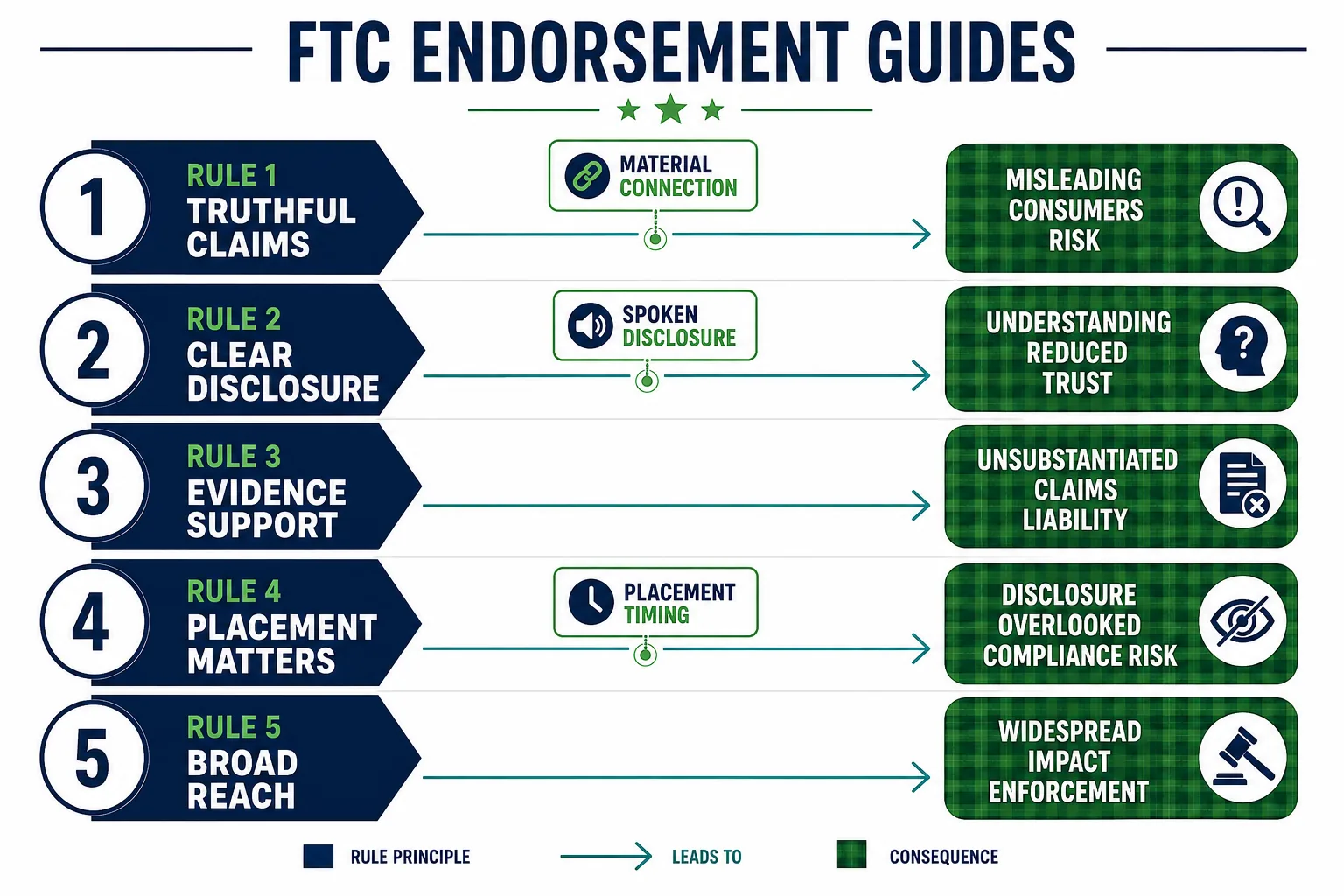
Rule 1: Disclose the Connection, Not Just the Link
The rule: Creators must explicitly state the nature of their relationship with the brand. Saying “link in bio” does not disclose that the link pays a commission.
The FTC says the disclosure should make it obvious when a financial relationship exists. Words like “ad,” “sponsored,” or “paid partnership” work. Vague phrases like “check this out” or “my favorite tool” do not.
What Creators Say Instead
The most common pattern in the 136 videos reviewed: the creator shows a profit screenshot, names the tool, and drops a link. No mention of whether they are paid to do this. Some add a generic disclaimer at the end of the caption, well below the fold, using language like “this is not financial advice.” That phrase addresses investment liability, not advertising disclosure. They are two different things.
If you want to understand which AI trading tools have actually been tested rather than just promoted, see The Best AI Trading Tools of 2026 Put Head to Head for a comparison built on hands-on review, not affiliate incentives.
Rule 2: Put the Disclosure Where Viewers Actually See It
The rule: The disclosure must appear with the endorsement, in a place viewers are likely to look, at a size and contrast they can read.
For short-form video, that means on screen, in the first few seconds, in text large enough to read on a phone. TikTok’s branded content toggle generates a platform-level label, but TikTok itself warns that the tool is meant to help creators comply with FTC and TikTok guidelines, not replace their own disclosure obligations.
Buried in the Caption Does Not Count
TikTok captions are truncated by default. The FTC’s guidance is clear that disclosures requiring extra clicks to find do not meet the standard. A “Paid partnership” label generated by TikTok’s disclosure toggle does appear on screen, but only if the creator activates it. In the 136 videos reviewed, the toggle was active in 2 cases.
The practical test: watch the video with the sound off and without expanding the caption. If you cannot tell it is a paid promotion in those conditions, the disclosure is not working.
Rule 3: Say It Out Loud in the Video
The rule: For video content, a disclosure that only appears as on-screen text fails viewers who watch without sound, which on TikTok is a substantial portion of the audience.
The FTC’s guidance on multi-modal content says that if the endorsement is delivered verbally, the disclosure should also be verbal. On-screen text alone does not cover the audio channel.
Why On-Screen Text Alone Fails
TikTok’s own data has shown that a significant share of users watch videos muted, particularly in public settings. A disclosure that flashes as small white text in the corner for two seconds, while the creator is talking about profit percentages, does not meet the “hard to miss” standard. Compliance guides published in 2026 consistently flag this as one of the most common failures in short-form financial content.
The fix is simple: say it out loud, at the start. “This video is sponsored by [tool name]” takes three seconds and satisfies both the audio and visual channels.
Rule 4: Disclose Before the Pitch, Not After
The rule: The disclosure must accompany the endorsement, which means it should appear before or at the start of the promotional content, not as a footnote after the creator has already made the case for the product.
A disclosure that appears after 45 seconds of profit screenshots and enthusiastic claims is not a disclosure. It is a legal afterthought that most viewers never reach.
The Placement Most Videos Get Wrong
The most common placement in the reviewed sample: a brief “not financial advice” or “sponsored” tag in the final two seconds of the video, or in the last line of the caption. By that point, the viewer has already seen the profit numbers, heard the pitch, and either clicked the link or formed an impression. The FTC’s position is that the disclosure needs to be present when the endorsement is being made, not after.
TikTok’s August 2026 guidance updated its creator help pages to state that the commercial content disclosure setting can be turned on before or after posting, but the content itself still needs to carry the disclosure at the point of the endorsement. Platform tooling and FTC compliance are not the same thing.
Rule 5: Never Imply Results You Did Not Get
The rule: Creators cannot present trading results as their own if those results came from a simulated account, a demo environment, or a backtest. Presenting paper trading profits as real money is a material misrepresentation.
This rule sits at the intersection of FTC endorsement guidance and SEC/FINRA rules on performance advertising. For unregistered promoters of trading tools, the FTC side applies directly.
Simulated Accounts Presented as Real Money
A paper trading account, sometimes called a demo account, uses fake money to simulate trades. The positions are real, the prices are real, but no actual capital is at risk. Most AI trading apps offer a demo mode precisely so users can test the tool without risking money. That is a legitimate feature.
The problem is when a creator records their demo account, shows a balance that has grown from $10,000 to $14,000, and presents that as evidence the tool works. No disclosure that the account is simulated. No mention that the results cannot be replicated with real money because slippage, fees, and emotional execution do not exist in a demo environment.
For a grounded look at what AI trading bots actually produce in live conditions, see Do AI Trading Bots Actually Make Money: We Ran the Real Numbers.
The Demo Mode Nobody Labels
Most trading platforms label their demo environment clearly within the app. The balance shows “paper” or “simulated” in the interface. Creators who record these screens often crop or zoom past that label. Whether intentional or not, the result is a viewer who believes they are watching real money move. That is a disclosure failure under Rule 5, and it compounds every other rule broken in the same video.
How We Reviewed 136 AI Trading Videos
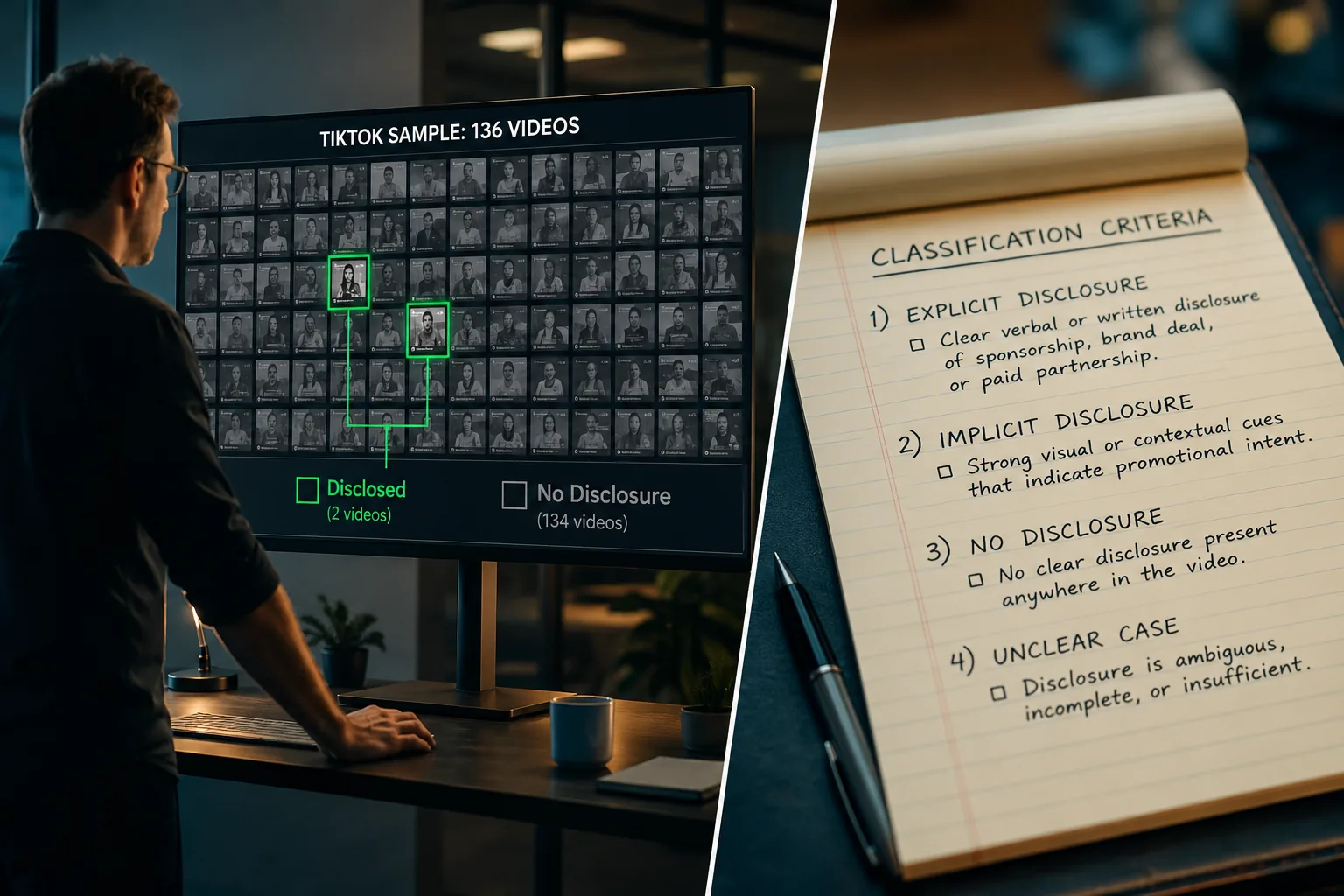
FullStack Alpha reviewed 136 videos from TikTok’s public feed that promoted a specific AI trading tool, app, or service. The review was conducted over a four-week window in mid-2026. This was a single sample, not a census of all AI trading content on the platform.
What Was Counted and Over What Window
Videos were identified through TikTok’s search function using terms associated with AI trading app promotion, including tool names, trading signal apps, and related phrases. The sample included videos from accounts with follower counts ranging from under 1,000 to over 500,000. The four-week window was chosen to capture a cross-section of content rather than a single viral moment.
A video was included in the sample if it named or demonstrated a specific AI trading tool and included either a direct link, a call to action directing viewers to download or sign up, or visible affiliate link language in the caption or bio.
How a Video Was Classified as Promotional
A video was classified as promotional if it met at least one of the following criteria: the creator’s bio contained an affiliate link to the tool being shown, the caption included a referral code or affiliate link, the creator verbally directed viewers to sign up using their link, or the video was tagged with TikTok’s branded content disclosure toggle. Videos that appeared to be purely educational with no commercial call to action were excluded from the sample.
What 98.5 Percent Actually Means
Two of the 136 videos carried any form of disclosure. Both used TikTok’s branded content toggle, generating a platform-level “Paid partnership” label. Neither creator verbally disclosed the relationship, and neither disclosed it in the first few seconds of the video. By the FTC’s full standard, even those two videos were only partially compliant.
The 98.5% figure describes the absence of any disclosure, even a minimal one. It does not prove that every creator in the sample received payment. Some may be promoting tools they genuinely use without compensation, in which case no disclosure is required. What the number shows is that the category, as a whole, treats disclosure as optional. That is the finding.
Comparison Table: What Disclosure Looks Like Done Right and Done Wrong
| Element | What the FTC Expects | What Most Videos Do Instead |
|---|---|---|
| Placement | With the endorsement, at the start of the video, before the pitch begins | Last two seconds of the video, or buried in the caption below the fold |
| Wording | Clear language: “ad,” “sponsored,” “paid partnership,” or equivalent plain statement | Vague hashtags, “not financial advice,” or no disclosure language at all |
| Spoken vs. On screen | Both channels covered: verbal statement and visible on-screen text | Small on-screen text only, invisible to viewers watching without sound |
| Timing before the pitch | Before or at the moment the endorsement begins | After the profit screenshots, after the call to action, or not at all |
| Results shown | Labeled as simulated if from a demo or paper trading account; real results require context | Demo account profits shown without any “simulated” label, presented as real performance |
How Do You Spot an Undisclosed AI Trading Ad?
Most undisclosed ai trading tiktok ads share three tells. None of them require legal expertise to spot.
Reading the Bio Against the Video
Check the creator’s bio before trusting the video. If the bio contains a referral link, an affiliate code, or a “use my link for a discount” line for the same tool being shown in the video, the video is almost certainly promotional. The FTC’s material connection standard covers affiliate relationships regardless of whether the creator received direct payment. A commission on signups is a financial relationship.
Spotting a Paper Trading Account on Screen
Most trading platforms display a clear indicator when an account is in demo or paper trading mode. Look for labels like “Paper,” “Simulated,” “Practice,” or an unusually round starting balance (exactly $10,000 or $100,000 are common defaults). If the account balance shown does not match what a realistic funded account looks like, and there is no label confirming it is real money, treat the results as unverified.
For a deeper look at how to evaluate AI trading tools before putting real capital behind them, see AI Trading App: What to Check Before You Download One.
Checking Whether the Tool Pays Affiliates
Most AI trading apps and signal services run affiliate programs. A quick search for “[tool name] affiliate program” will confirm whether the creator could be earning a commission. If the program exists and the creator has a link to the tool, the burden of proof shifts: assume the relationship is commercial until the creator says otherwise. That is not cynicism. That is how the FTC frames it too.
What This Means If You Are the One Watching
If you found an ai trading tiktok video that made a tool look compelling, the numbers on screen are not evidence of anything until you know where they came from.
Why the Numbers on Screen Are Not Evidence
A profit screenshot proves a number existed on a screen at a moment in time. It does not prove the account was real, the trades were live, the results are repeatable, or the creator was not paid to show you exactly that screenshot. Play stupid games, win stupid prizes: downloading a trading app because a 30-second video showed a green number is not a process. It is a coin flip with a subscription fee attached.
Signal over noise means asking one question before you act: what is the actual evidence that this tool produces results in a live account, with real money, over a meaningful time period? If the answer is “a TikTok,” the evidence is not there yet. See AI Trading Signals: How Accurate Are They Really for what real signal evaluation looks like.
Questions to Ask Before You Download Anything
- Does the creator have a disclosed material connection to this tool?
- Are the results shown from a live account or a demo?
- Is there an audited track record, or only screenshots?
- Does the tool have independent reviews from users who have no affiliate relationship?
- What does the tool actually do, and does that match what the video claims?
For independent, tested reviews of AI trading tools with no house product at the top of the rankings, the FullStack Alpha directory is a starting point. For a side-by-side look at what the category actually offers, see We Tested 10 AI Trading Tools So You Don’t Have To: Here’s the Verdict.
Our Take
Two disclosures out of 136 videos. That number is not an indictment of individual creators. It is a description of a category that has normalized the absence of transparency.
The five rules above are not obscure legal technicalities. They are the FTC’s plain-English answer to a simple question: does the viewer know they are being sold to? In 98.5% of the ai trading tiktok sample, the answer was no.
That is not in our bingo card for a category that touches real money, real accounts, and real people who are just trying to figure out which tools are worth their time.
The viewer’s job, until disclosure becomes the norm, is to treat every confident profit screenshot as unverified, every enthusiastic tool recommendation as potentially paid, and every demo account balance as simulated until proven otherwise. Systems over hacks. Data over noise. That applies to the content you consume as much as the trades you place.
One tool reviewed in depth is one data point. The FullStack Alpha directory has 200+ AI stock tools catalogued by category and price, scored on five pillars with no house product at the top. Browse the full directory at aistockpickerapps.com
FullStack Alpha includes affiliate links to some tools reviewed on this site. Those relationships are disclosed at the point of recommendation. This article contains no affiliate links.
References
- Disclosures 101 Social Media Influencers
- Endorsements Influencers Reviews
- Ftc Influencer Disclosure Rules 2026 Guide
- What Are Ftc Disclosure Rules For Influencers In 2026 Complete Guide Examples
- Ftc Influencer Disclosure Guide
- Blog Post
- About The Content Disclosure Setting For Creators
- Ftc Targets Influencers For Promoting Trade Associations On Tiktok And Instagram
By Jay Rocco, Founder and Editor, FullStack Alpha.
Stay alpha.
Frequently Asked Questions
Do TikTok creators have to disclose paid promotions?
Yes. TikTok's own guidelines require creators to use the commercial content disclosure setting when posting branded content or paid promotions. The FTC Endorsement Guides independently require disclosure of any material connection, including affiliate commissions, regardless of platform. Both obligations apply simultaneously.
What does the FTC require in an influencer disclosure?
The FTC requires the disclosure to be clear, conspicuous, and placed with the endorsement itself. It must use plain language such as "ad" or "sponsored," appear before or at the start of the pitch, and be visible or audible in the same format as the endorsement. Buried hashtags and end-of-video footnotes do not meet this standard.
Is hashtag ad enough to disclose a paid partnership?
Not reliably. The FTC's guidance says disclosures must be hard to miss. A hashtag stacked among other hashtags in a collapsed TikTok caption does not meet that standard. The disclosure needs to be in the video itself, in clear language, at a point where viewers will see it.
How can you tell if a trading video is sponsored?
Check the bio for affiliate links to the tool shown. Look for referral codes in the caption. Search for the tool's affiliate program. If any of those exist and the creator did not disclose the relationship at the start of the video, the content is likely undisclosed ai trading tiktok advertising.
Are AI trading TikToks regulated by the SEC or the FTC?
Both agencies can have jurisdiction, depending on what is being promoted. The FTC covers endorsement and advertising disclosure for any commercial product. The SEC and FINRA have jurisdiction when the promotion involves registered investment products, investment advisers, or broker-dealers. An unregistered person promoting a trading signal app faces FTC exposure. The same person promoting a registered investment product faces SEC and FINRA exposure as well.
What happens to creators who do not disclose?
The FTC can issue warning letters, demand corrective advertising, and pursue civil penalties. In 2026, the FTC has continued to send warning letters to influencers and the brands that pay them. TikTok can remove or restrict posts that violate its commercial content policies. Neither consequence is guaranteed for any individual creator, but the regulatory framework for enforcement exists.
Is showing a paper trading account misleading?
Showing a demo or paper trading account without labeling it as simulated is a material omission. The FTC's standard covers implied claims, not just explicit ones. A viewer who reasonably concludes from the video that the results represent real money has been misled, even if the creator never said the word "real."
How do you verify a trading result posted on social media?
You largely cannot, which is the point. Screenshots can be edited. Demo accounts can be recorded to look like live accounts. The only results worth weighing are those with an audited track record, a named broker statement, or third-party verification. For context on what real performance data looks like versus what gets posted on social media, see How to Backtest a Trading Strategy Without Fooling Yourself.
Jay Rocco is the Founder and Editor of FullStack Alpha. He has tested 200+ AI stock tools since 2022 and run 15+ AI trading platforms on live accounts with his own money. He reviews the software. He does not tell you what stocks to buy.
