

The best ai for trading isn’t the model that picks stocks, it’s the one that writes code you can audit without crying.
Quick Answer
Across nine completed seasons of the only public multi-model benchmark we could find, only 46.2% of model-seasons were profitable, according to the TradeRank LLM trading benchmark. So nobody has an audited live edge, and the best ai for trading question is really an engineering question. For retail bot builders, the practical answer in 2026 is Claude for code quality and tool use, GPT for cheap high-frequency research, Gemini for giant-context document analysis, and Grok for long-running agents. Pick by engineering fit, not by leaderboard.
Key Takeaways
- TradeRank gives each model $10,000 in simulated capital, identical data, and one decision cycle per day. 56 models made 2,826 trades across roughly $910,000 of paper capital, per the TradeRank benchmark page. See the methodology.
- Gemini leads the four families on average return at roughly +2.89% per season, per TradeRank’s four-model comparison page, and Claude finished with an aggregate ending value near $7,556 from $10,000, per TradeRank’s nine-season review.
- Gemini 3.5 Flash posted +13.76% in Season 5 (May 23 to June 20, 2026) versus Claude Opus 4.7 at +2.67%, Grok 4.3 at +0.48% and GPT-5.5 at +0.38%, per TradeRank’s four-way comparison.
- API costs now differ by 100x. GPT-6 Luna runs $0.10/$0.50 per million tokens, GPT-6 Astra $10/$50, per OpenAI’s GPT-6 model guide.
- Trade Ideas, a paid alternative, lists $127/mo Standard and $254/mo Premium, with Holly AI signals on Premium (trade-ideas.com, checked October 2026).
- The SEC’s 2026 examination priorities name automated investment tools, AI technologies, and trading algorithms directly.
- ASIC’s finalized algo rules require kill switches, pre-deployment testing, and seven years of records, effective March 2028, per Ashurst’s analysis.
What does an AI model actually do in a trading bot?
An AI model in a trading bot does one of three jobs: it writes the code, it reads unstructured news and filings, or it approves and rejects orders inside rules you already wrote. It does not divine price. Everything else is a wrapper.
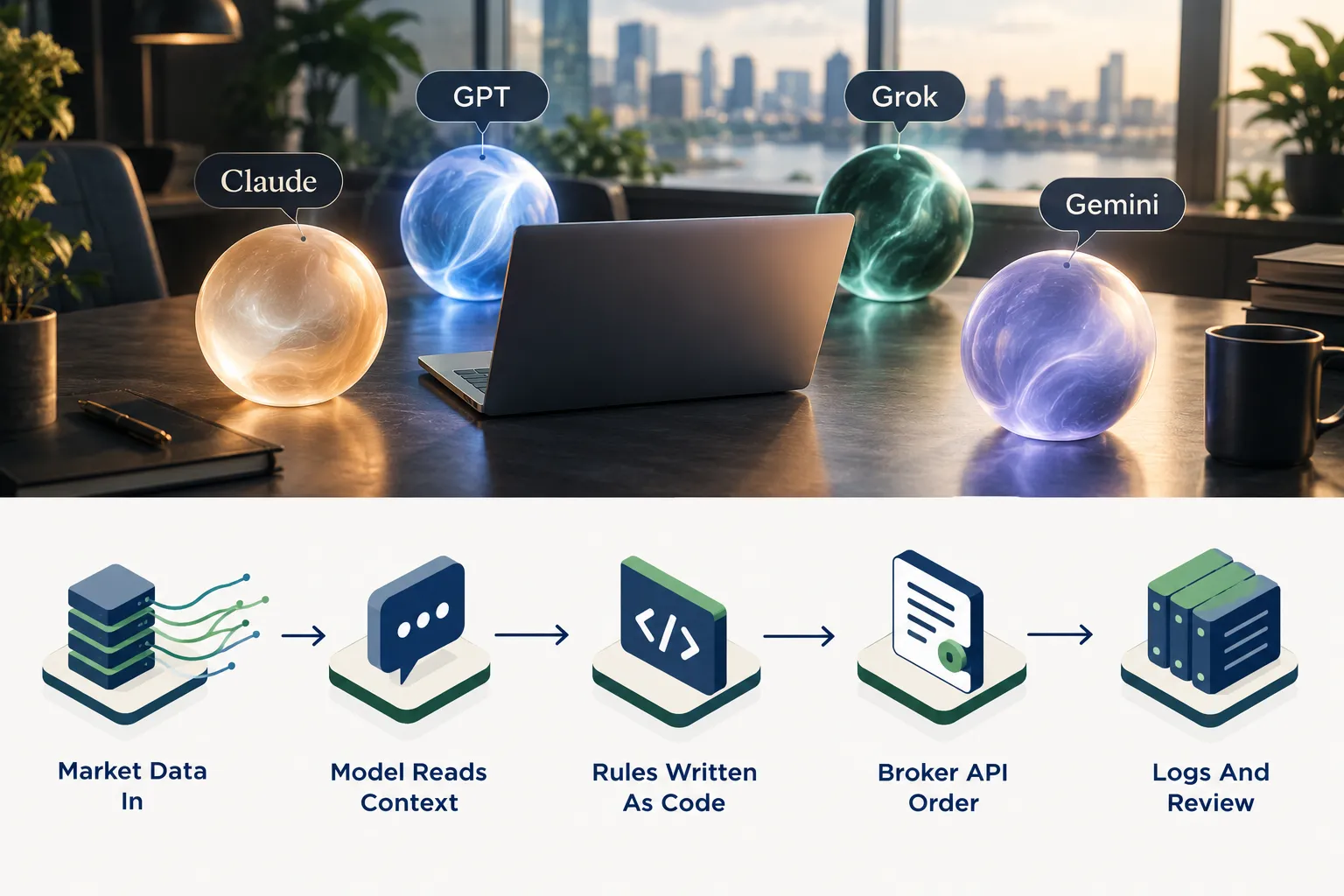
Think of it like a kitchen. The model is the line cook. You’re still the one who wrote the recipe, bought the ingredients, and decided nobody gets served undercooked chicken.
The three real jobs, in order of how well they work:
- Code generation. You describe a strategy in plain English and the model produces Python that talks to a broker API. This is where model choice matters most.
- Analysis of messy text. Earnings calls, 8-Ks, Fed statements. Large context windows shine here.
- Tool use and order routing. The model calls functions. One function fetches price data, another checks position sizing, another places a paper trade.
Where it falls apart is prediction. A language model guessing tomorrow’s close is reading tea leaves with extra steps. Our breakdown of what retail traders get wrong about algorithmic trading AI covers that gap.
The practical takeaway: use the model as an engineer, not an oracle. That framing is the first filter for picking the best ai for trading.
best ai for trading
The best ai for trading depends on which job you’re hiring it for. Claude Sonnet 5 wins on code you can actually read. GPT-6.1 Sol wins on cost per research pass. Gemini 3.8 Flash wins on context size. Grok 4.6 wins on agents that run for days.
Nobody has a verified live edge picking instruments. That’s the whole ballgame, and every honest comparison, including TradeRank’s four-way model page, lands in the same place.
Here’s how the four stack up for bot builders, with prices last.
| Model | Context | Best job in a bot | Known weakness | API price per 1M in/out |
|---|---|---|---|---|
| Claude Sonnet 5 | Large | Writing and refactoring strategy code, broker tool use | Over-explains, occasionally too cautious to place an order | $2 / $10 |
| GPT-6.1 Sol | Large | High-frequency research, portfolio monitoring | Default template-y strategy logic, needs tight prompts | $2 / $10 |
| Gemini 3.8 Flash | Very large | Reading full filings, correlation models across many tickers | Fewer mature broker examples | $0.75 / $3.75 intro through Dec 31, 2026 |
| Grok 4.6 | Large | Long-running trading agent, news reaction loops | Thinner community code samples, config-heavy reasoning | $2 / $6 starting price |
Prices come from Anthropic’s Claude Sonnet 5 announcement, OpenAI’s GPT-6.1 Sol post, Google’s Gemini 3.8 Flash release and xAI’s Grok 4.6 notes. Gemini’s intro rate rises to $1.50/$7.50 in 2027.
Decision rule: if you’re writing your first bot, use Claude. If you’re monitoring 200 tickers every 15 minutes, use a cheap tier like GPT-6 Luna for the sweep and a stronger model only for trade approval.
Best AI for trading compared: features, cost and broker connections
Consumer plan is what you pay to chat. API price is what your bot pays. Broker connections are live today, not roadmap promises.
| Model / app | Best job in a trading bot | Consumer plan per month | API price per 1M in/out | Coding strength | Live market data | Broker connections available | Drawbacks |
|---|---|---|---|---|---|---|---|
| Claude (Sonnet 5) | Writing and auditing strategy code | Pro about $20, Max $100 or $200 | $2 / $10 | Strongest of the four for broker code | None unless connected | IBKR connector (AI drafts, you approve), Webull connector, Alpaca official MCP server | Cautious, over-explains |
| ChatGPT (GPT-6.1 Sol) | Research passes, second-opinion code review | Plus about $20, Pro about $200 | $2 / $10 (Luna tier $0.10 / $0.50) | Strong, needs tight prompts | None unless connected | IBKR connector, Webull connector, Alpaca MCP setup for ChatGPT | Template-y logic, guardrails can block trades |
| Grok (4.6) | Long-running agents, reacting to news and X posts | SuperGrok about $30, Heavy about $300 | $2 / $6 starting price | Good, thinner public samples | Live X posts, no price feed unless connected | IBKR connector, Webull connector | Priciest plan, noisy social data |
| Gemini (3.8 Flash) | Reading full 10-Ks and long backtest logs | Google AI Pro about $20, Ultra about $250 | $0.75 / $3.75 intro, $1.50 / $7.50 in 2027 | Good, fewer broker examples | None unless connected | IBKR lists Gemini as coming soon; Alpaca MCP via Google’s Antigravity CLI | Thinnest broker ecosystem, intro price expires |
Broker sources: Interactive Brokers’ July 28, 2026 MCP announcement, Webull’s ChatGPT, Claude and Grok connector launch and Alpaca’s official MCP server. Consumer prices are approximate, per this 2026 price roundup.
One detail matters more than price. IBKR’s AI only drafts instructions, and you convert each one to an order. Webull’s chat connectors read balances, positions and market data. For a bot that places paper orders, Alpaca is the cleanest path.
How did Claude, GPT, Grok and Gemini do in public paper trading tests?
Gemini came out ahead in the only standardized public test, but the sample is small and short. Nine seasons, 56 models, under half of them profitable. That’s not an edge, that’s noise with a leaderboard. If a leaderboard is your only evidence for the best ai for trading, you are picking on noise.
The TradeRank arena hands every model $10,000 simulated, the same market data, the same prompts, the same fees, position limits and invalidation rules, in a daily paper-trading cycle. Per TradeRank’s about page, the engine executes at live prices from Binance for crypto and Yahoo Finance for US equities.
Aggregate ending values from $10,000 across nine seasons, per TradeRank’s nine-season review:
- Gemini: about $12,765
- Grok: about $8,488
- GPT: about $8,355
- Claude: about $7,556
Three of four families ended below starting capital. The AI trading leaderboard updates as seasons close, and independent write-ups like SixMind’s 2026 AI trading benchmark review reach similar conclusions about persistence.
One more data point worth seeing. A separate 2026 comparison of Claude, ChatGPT, Gemini and Grok for trading also treats model choice as a workflow decision rather than an alpha source.
The edge case nobody mentions: TradeRank’s crypto markets trade around the clock, which is a different animal from a US equity tape with an open and a close. Crypto trading results don’t transfer cleanly to stocks. Crypto appears here only as a reference point.
Which model writes the most reliable trading bot code?
Claude currently writes the most readable, least hallucinated broker integration code for retail bot builders, based on the volume of working public walkthroughs. For most builders, the best ai for trading is the model whose code you can audit line by line. GPT is close behind and cheaper for bulk work. Gemini and Grok lag on broker-specific examples.
Claude’s product page in October 2026, where the Pro plan and the connector-ready desktop app start.
Evidence from the real world, not vibes:
- Ray Fu’s Complete Guide to building an AI Trading Bot with Claude for Beginners walks through Claude plus Alpaca paper trading end to end.
- Nate Herk’s I Turned GPT-6 Astra Into a 24/7 Stock Trader wires the model to an Alpaca account. The video description was later updated to note that Astra was blocking financial actions like placing trades. That’s a guardrail, not a bug, and it’s the kind of thing you only discover after wiring it up.
Both videos make the same point from different directions: the model is the easy part. The broker API, the order types, the error handling, and the logging are where weeks go.
What to grade a model on if you want a working trading bot:
- Does it get the broker SDK right on the first pass, or invent methods that don’t exist?
- Does it write a stop loss that actually fires, or a comment that says
# add stop loss here? - Does it handle a rejected order without crashing the loop?
- Does it log every fill so you can audit what happened at 9:47 a.m.?
Our Claude trading bot walkthrough covers that build in detail, and paper trading slippage explains why your backtest looked better than your fills.
Common mistake: shipping a chat-built bot straight to live money. A bot that has never been stress-tested against a halted ticker is a liability, not a system. Paper trade it first.
Is ChatGPT good for trading?
ChatGPT is good for trading research, code and technical analysis explanations. It’s not good as a price predictor, and it should never hold your API keys without a kill switch. Treat it like a sharp junior analyst with no risk management instincts. ChatGPT can be the best ai for trading research on a budget, as long as the risk rules live in your code.
The ChatGPT homepage in October 2026, with deep research and paid plans one click away.
What ChatGPT handles well right now:
- Translating a strategy idea into working Python
- Summarizing an earnings call into the key points you need before the open
- Explaining jargon like basing, the breakout, or a gap fill on the spot
- Running volatility analysis across a watchlist when fed clean data
What it handles badly:
- Real-time signals. Push notifications from a chat app are not a market data feed.
- Position sizing discipline unless you hard-code the math
- Knowing when it’s wrong
The SEC’s 2026 priorities make the compliance angle concrete: examiners are checking whether AI-related representations are accurate and whether controls match disclosures. If you’re running anything for other people, that matters more than your Sharpe ratio.
Is Grok good for trading?
Grok does one thing the others can’t: it reads X in real time. That makes it a fast first look at why a ticker is moving, and a firehose of opinions. Opinions are not a signal.
Grok’s homepage in October 2026, with a speed selector beside the prompt box.
Use it for news reaction loops and long-running agents. It connects to IBKR and Webull. Never let a trending post place an order. Make it tag the headline, then let your coded rules decide.
Is Gemini good for trading?
Gemini is the best of the four at reading a lot at once. Drop a full 10-K, the last earnings call and your trade log into one prompt and it keeps the thread. That context window is the whole pitch.
The Gemini web app in October 2026, on a light Flash model until you sign in.
The weak spot is plumbing. IBKR lists Gemini as coming soon, and public broker walkthroughs are thin.
What are the free AI trading tool options?
Free tiers from Claude, ChatGPT, Gemini and Grok all handle strategy code and research well enough to get a paper bot running. For market data, Alpaca paper trading accounts and free charting cover most of what beginners need. An ai trading tool free of charge is usually enough for your first 90 days. The best ai for trading on a zero budget is whichever free tier writes code you understand.
A workable free stack:
- A free model tier for code and analysis
- Alpaca paper trading for execution, no money at risk
- Free stock charts compared across TradingView, Finviz and Yahoo for price action
- Our free trading tools and calculators for position sizing and expectancy
- Free AI trading bots if you’d rather not write code at all
The honest limit: free tiers rate-limit you, and cached context resets. That’s fine for a swing process checked once a day. It’s not fine for day trading at the open.
How to build your first paper-trading bot with the best AI for trading in 7 steps
The whole build, in plain English, with zero dollars at risk. Any model from the table works.
- Get your Alpaca paper keys. Open a free Alpaca account, switch to paper, and generate a key and secret. Our Alpaca API keys walkthrough shows every screen. Never paste the keys into a chat window.
- Point everything at the paper endpoint. Paper orders go to paper-api.alpaca.markets, not the live address. Tell the model, then confirm it in the code. Alpaca’s MCP server is set to paper by default.
- Write three rules before you prompt. Example: SPY, daily bars. Buy when the 20-day simple moving average crosses above the 50-day, sell when it crosses back below. Max 10% of paper equity, stop 5% under entry.
- Ask the model for the code. Ask for Python using Alpaca’s official SDK, logging every signal and order, with a kill switch that flattens positions. If it invents a method, make it cite the docs.
- Review it for look-ahead bias. The classic bug: using today’s close to decide a trade placed at today’s open. Signals use completed bars only; orders fill on the next bar. Read our look-ahead bias guide, then paste the code into a second model and ask it to hunt for that exact bug.
- Run 30 sessions on paper, hands off. Run once a day after the close. Every tweak resets the clock; a changed bot is a new bot.
- Log, then decide. Track signal price, fill price, slippage, win rate, average win versus average loss, and max drawdown. At session 30: kill it, change one rule and restart the clock, or go live at a size you can lose without flinching.
Most people quit at step 5. That’s the step that separates a system from a screenshot.
Which model for which job: the best AI for trading by task
One model for everything is how you overpay. Here’s who we would hire for each seat.
- Research: Gemini 3.8 Flash. It reads a full 10-K plus the call transcript in one pass, at the lowest intro API rate of the four. Ask what changed since last quarter, not what the stock will do.
- Coding: Claude Sonnet 5. The cleanest broker code and the most public Alpaca walkthroughs. When the bot breaks at 9:31 a.m., readable code is the feature.
- News sentiment: Grok 4.6. Live X access makes it fastest at spotting why a name is moving. Have it tag headlines positive, negative or noise. For cheap bulk tagging, GPT-6 Luna at $0.10/$0.50 works too.
- Backtest review: Claude, with Gemini as the second reader. Claude catches logic bugs like look-ahead bias. Gemini reads the full trade log. Two models disagreeing is your cue to look harder.
- Risk checks: none of them alone. Limits, stops and the kill switch belong in code. Use GPT-6.1 Sol or Claude as a reviewer that can say no, never the only thing that can say yes.
Top 5 favorite features for bot builders in 2026
The five features that actually change how a bot behaves are tool calling, large context, configurable reasoning depth, cached input pricing, and tiered model routing. Everything else on a spec sheet is marketing. These five decide the best ai for trading far more than any benchmark score.
- Tool calling. The model calls your functions instead of guessing. This is what turns a chatbot into a trading agent.
- Long context. A large context window lets Gemini 3.8 Flash read a full 10-K alongside your notes in one pass.
- Configurable thinking levels. Dial reasoning up for trade approval and down for routine monitoring, where the vendor supports it.
- Cached input pricing. OpenAI’s GPT-6.1 Sol post prices cached input far below standard input. If your prompt header never changes, that’s a real saving.
- Tiered routing. Cheap model watches, expensive model decides. OpenAI’s own guide points at this architecture.
What we like and what we don’t like
What works: four frontier models at prices that make a retail trading bot viable, mature tool calling, and honest public benchmarks. What doesn’t: zero audited live edge, loud marketing, and outright fraud riding the same hype.
What we like
- Claude Sonnet 5 at $2/$10 is affordable enough to iterate on strategy code all week
- Gemini’s large context handles filings analysis no screener touches
- TradeRank publishes its methodology, including fees and invalidation rules
- Kill switches and audit logs are becoming standard expectations, not nice-to-haves
What we don’t like
- Model leaderboards get read as predictive. Nine seasons is not a track record.
- Guardrails can silently block trades, as the GPT-6 Astra experiment showed
- Paid signal services charge like a Bloomberg terminal and deliver a public API with a login
- The fraud problem is real. The SEC’s September 29, 2026 complaint over an alleged AI trading bot scheme alleged no actual trading occurred and that account profits were fabricated. See also our piece on the fake Claude trading bot scam.
What do real users say?
Experienced algo traders say the models help with data analysis and instrument building, but only if you already know what you’re doing. That caveat is the whole finding.
“Can an enterpise frontier model help with massive amounts of data analysis and instrument building if you know what you are doing - yes.” u/LaZeR_Strike, r/algotrading
Read that twice. The conditional does the heavy lifting. If you don’t know what a correlation model is or why your backtest overfits, a better model just produces more convincing garbage faster.
Competitors and alternatives to raw model APIs
If you don’t want to write code, the alternatives are commercial scanners like Trade Ideas, no-code builders, and signal services. They cost more per month and give you less control, but they ship working software on day one.
| Option | What you get | Two real drawbacks | Price |
|---|---|---|---|
| Trade Ideas AI | Holly AI signals, scanning, backtesting | Steep learning curve, Holly signals only on the higher plan | $127/mo Standard, $254/mo Premium (annual $1,068 / $2,136), Oct 2026 |
| Raw model API plus Alpaca | Full control, auditable code | You own every bug, needs real Python skill | Token cost only, usually small for a once-a-day swing process |
| No-code strategy builders | Visual logic, hosted execution | Limited custom indicators, platform lock-in | Varies, check the official pricing page |
Trade Ideas pricing is from trade-ideas.com, checked October 2026. Verify before you subscribe. For the wider field, we keep a running comparison of the best AI trading tools of 2026 put head to head and a view on what AI trading software costs versus what you get. If you want a verdict on whether any of this holds up, start with is AI trading legit. For non-coders, the best ai for trading may not be a model at all, but a packaged scanner.
Looking for the best ai day trading platform or the best ai trading tool for a swing process? Those are different questions with different answers, and the best ai for day trading usually comes down to data latency, not model IQ.
Prebuilt AI bots vs DIY with an AI model
Prebuilt sells finished software and a monthly bill. DIY sells control and a learning curve. Neither sells an edge.
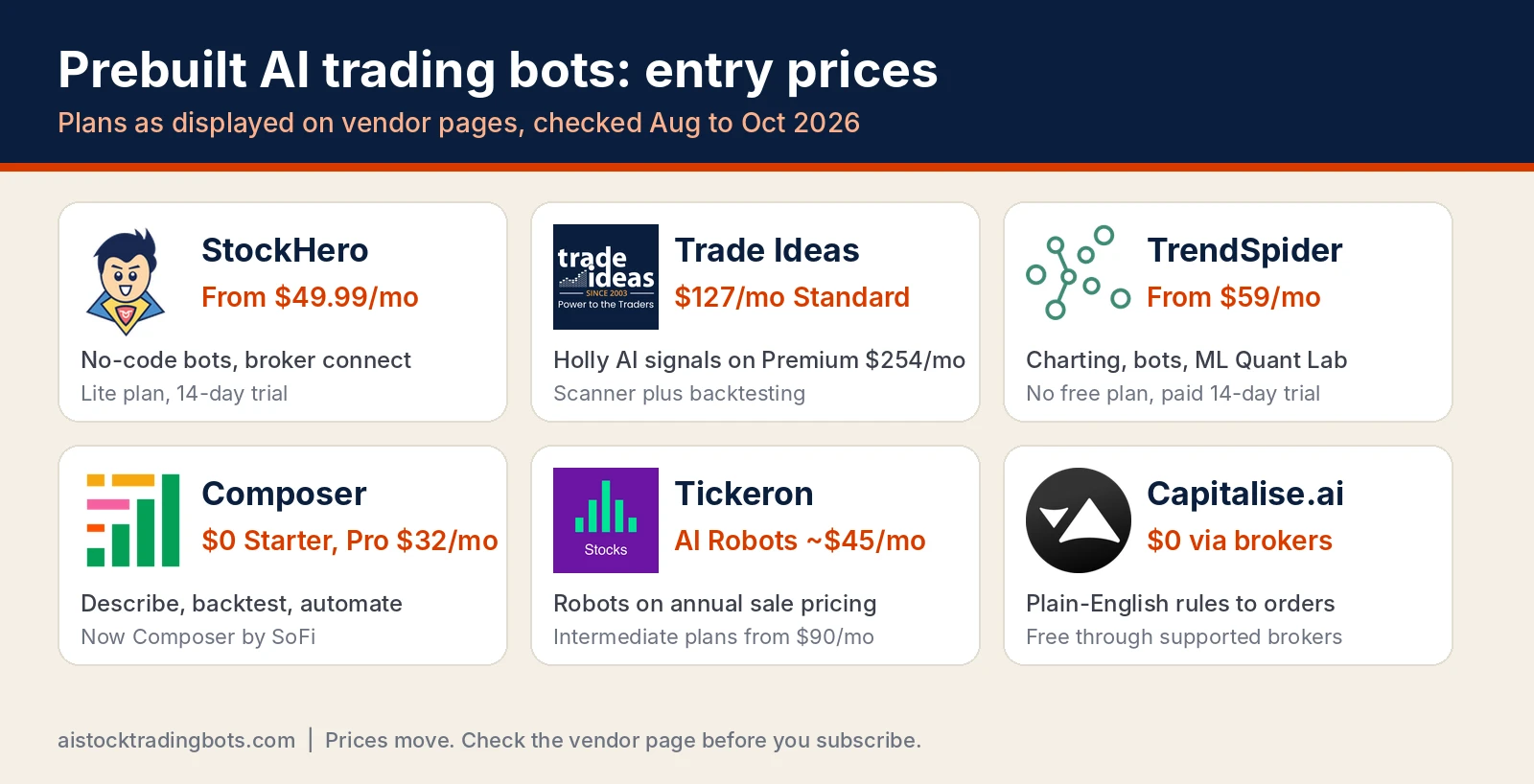
Entry prices as displayed on vendor pages:
- StockHero: Lite from $49.99/mo, 14-day trial.
- Trade Ideas: $127/mo Standard. Holly AI signals need Premium at $254/mo.
- TrendSpider: Standard from about $59/mo, no free plan.
- Composer by SoFi: $0 Starter, Pro $32/mo billed yearly.
- Tickeron: AI Robots around $45/mo on annual sale pricing.
- Capitalise.ai: $0 through supported brokers.
None of them publishes an audited live track record we could verify. Treat any win rate on their sites as vendor-claimed.
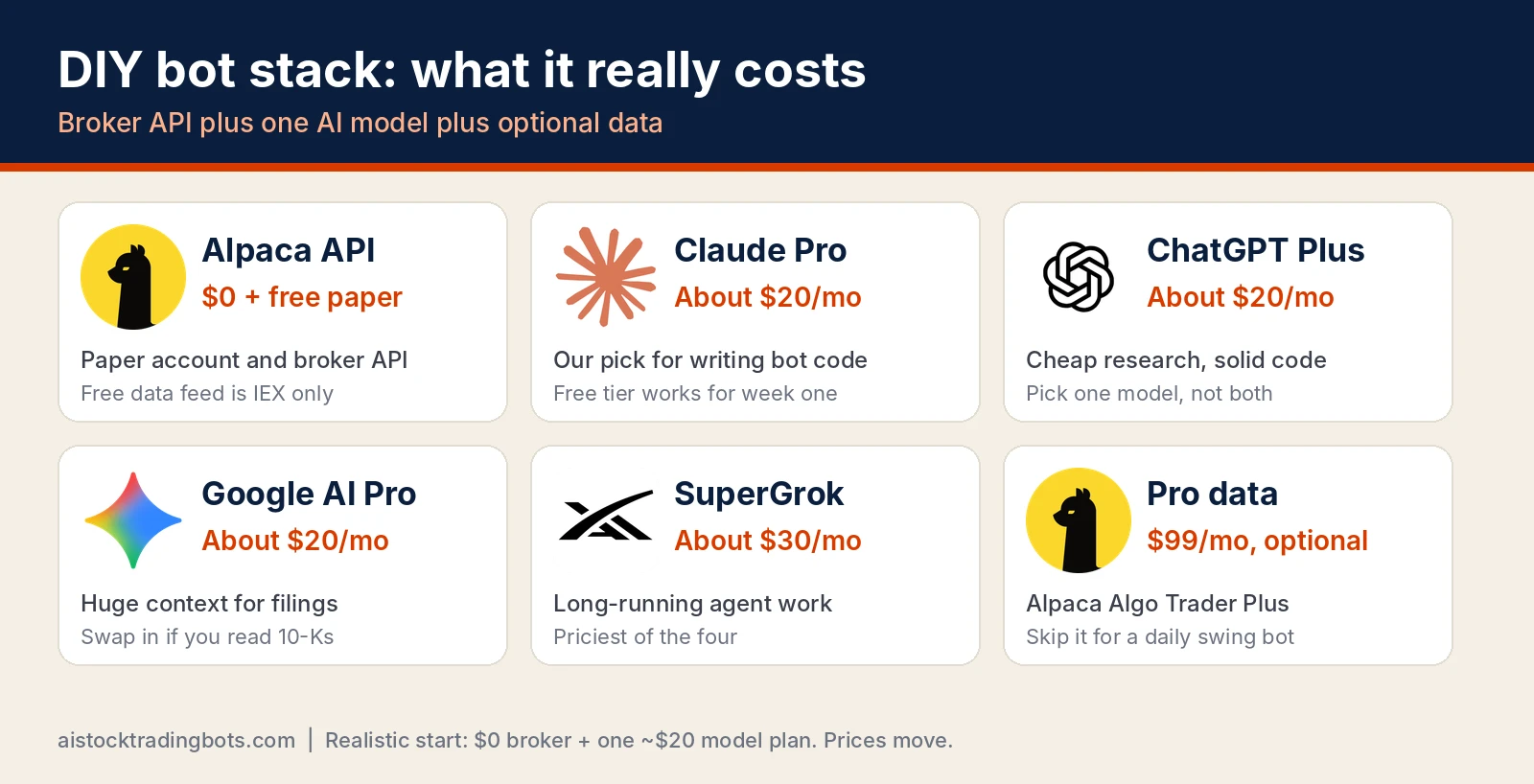
The DIY stack: Alpaca’s API and paper account cost $0. Claude Pro or ChatGPT Plus runs about $20/mo. Free Alpaca data covers IEX only; Algo Trader Plus at $99/mo adds every US exchange, which a daily swing bot can skip.
Year one, roughly: about $240 DIY versus $600 for StockHero Lite or $1,068 for Trade Ideas Standard annual. Buy prebuilt if your time is worth more than the gap. Build if you want to know why every order fired.
Why is my trading bot losing money, and who should use AI for trading at all?
Most AI trading bots lose money for four boring reasons: overfit rules, slippage, no risk management, and revenge trading by the human who keeps overriding the code. AI for trading suits self-directed traders who can already read a chart and write a rule. It does not suit people hunting a shortcut. Even the best ai for trading cannot fix an overfit rule.
The usual failure list:
- Overfitting. The strategy was tuned on 2024 data and 2026 doesn’t rhyme.
- Slippage. Paper fills at the mid, live fills at the ask.
- No kill switch. ASIC is mandating them by March 2028 for a reason.
- Human interference. You turned it off during the drawdown and back on after the recovery.
Who should use it: anyone building a repeatable process who wants to remove emotion from execution. Who shouldn’t: anyone who can’t explain their edge in one sentence. Our guide to finding a trading edge before you risk a dollar is the honest starting point, and how to backtest without fooling yourself is step two.
Getting started as a beginner, in order: open a paper account, write three rules, let a model code them, run 30 sessions, review the log. Systems over hacks.
Our Take
The best ai for trading in 2026 is Claude for writing bot code, with GPT-6.1 Sol as the cost-efficient research workhorse and Gemini 3.8 Flash when you need to read everything at once. Grok earns its place on long-running agents. Nobody earns it on stock picking.
Pick the model that makes your code auditable, then spend your real effort on risk management, position sizing, and logging. The leaderboard will change. Your discipline is the part that compounds.
One tool at a time, scored on what it does, not what it claims. Compare the full field in the FullStack Alpha reviews directory, sorted by category, price and use case.
Related reading
- Best AI trading app, tested and ranked
- Best AI trading bots of 2026
- How accurate are AI trading signals, really
Conclusion
Four frontier models, one honest verdict: choose on engineering fit, not on a nine-season leaderboard. Claude for code, GPT for cheap research passes, Gemini for context, Grok for agents.
Your next three steps, in order:
- Open a paper account and write three rules on paper before you prompt anything.
- Have a model code those rules, including a stop loss and a kill switch, then run 30 sessions untouched.
- Review the log. If expectancy is negative, fix the strategy, not the model.
Fewer tabs, fewer alerts, one clean process. The best ai for trading is the one that fits that process.
Prices are subject to change in this fast AI market. If a number moved, blame the robots, or Black Friday.
This article is education, not financial advice. Nothing here is a recommendation to buy or sell any security.
Your market edge starts with the right tool. Stay alpha.
Frequently Asked Questions
Is ChatGPT good for trading?
ChatGPT is good for trading research, bot code, and explaining technical analysis in plain English. It is not a reliable price predictor and has no built-in risk management. Use it to write and audit your rules, then enforce stops and position sizing in code rather than in a chat window.
Is AI trading profitable?
There is no audited evidence of a persistent model-specific edge. TradeRank reports only 46.2% of model-seasons were profitable across nine seasons and 2,826 trades. Profitability still comes from your strategy, costs, and risk management. AI reduces execution errors and research time, which helps, but it does not manufacture an edge.
Is AI a good tool for trading?
Yes, as an engineering and research tool. AI handles code generation, filings analysis, news summarizing, and rule enforcement well. It handles prediction badly. Traders who already know what a valid setup looks like get the most value. Beginners without a process tend to automate their mistakes faster.
Is there any AI for stock trading?
Plenty. Commercial options include Trade Ideas with Holly AI signals at $127 to $254 per month. Builders wire Claude, GPT, Gemini or Grok to a broker API like Alpaca for paper trading. Free model tiers plus a paper account cover most beginner needs without a subscription.
Can you make $1000 a day with day trading?
It is mathematically possible and statistically unlikely. A $1,000 daily target needs a large account, consistent edge, and tight risk control. Most day traders lose money over time. Treat any tool or service promising a fixed daily figure as a red flag, not a plan.
Is trading with AI profitable?
Same answer, different wording: the tool does not create profit, the system does. AI improves speed, consistency, and record keeping. It cannot fix an overfit strategy or bad position sizing. Measure your own expectancy over at least 30 logged sessions before adding real money.
Which AI is best for day trading?
For day trading, data latency matters more than model intelligence. Use a cheap, fast tier such as GPT-6 Luna or Gemini 3.8 Flash for monitoring, and a stronger model only for exception handling. A signal that arrives four minutes late is a history lesson, not a trade.
Is there a free AI trading tool?
Yes. Free tiers of ChatGPT, Claude, Gemini and Grok handle strategy code and research. Alpaca offers free paper trading accounts, and free charting covers price action. Rate limits make free stacks better suited to swing processes than to fast intraday work.
Is Trade Ideas AI worth it?
It depends on what it replaces. Trade Ideas lists $127/mo Standard and $254/mo Premium, or $1,068 and $2,136 billed yearly, with Holly AI signals on Premium, as of October 2026. Worth it if scanning speed is your bottleneck. Hard to justify if a free screener and a model-written scanner already cover your watchlist.
Contributing writer at AI Stock Trading Bots.
