

The FullStack Alpha research desk tests AI trading bots on paper and live accounts. Reviewed and edited by Jay Rocco, Founder and Editor.
November 17, 2026, 10:05 AM ET. By FullStack Alpha Editorial Team | Reviewed by Jay Rocco, Chief Editor
Quick answer
On November 17, 2026, a BNY AI agent and a Microsoft treasury AI agent negotiated terms on a US Treasury trade, and human operators approved the deal before it was accepted. BNY calls the system its Agentic Negotiation Protocol and describes the trade as the first of its kind. No trade size, yield or cost comparison was disclosed, so this is a working demo, not proof that agents trade better.
Key facts
- Who: BNY (Bank of New York Mellon) and Microsoft’s corporate treasury team.
- What: Two AI agents bargained over a US Treasury trade and reached terms. Humans approved before acceptance.
- How: Microsoft gave its agent a set of acceptable boundaries first. The negotiation ran through a BNY control layer that decides which agents may talk, what they may do and under what conditions.
- Safety step: After bargaining, both agents confirm they read the security, price and terms the same way.
- What was not disclosed: trade size, maturity, yield, spread or any transaction cost benchmark.
- Next for BNY: tests in repo, foreign exchange payments, collateral terms and contract negotiations.
What exactly happened between BNY and Microsoft?
Microsoft’s treasury function handed its agent a description of what an acceptable deal looked like. A BNY agent negotiated against those limits, the two landed on terms, and people on both sides signed off.
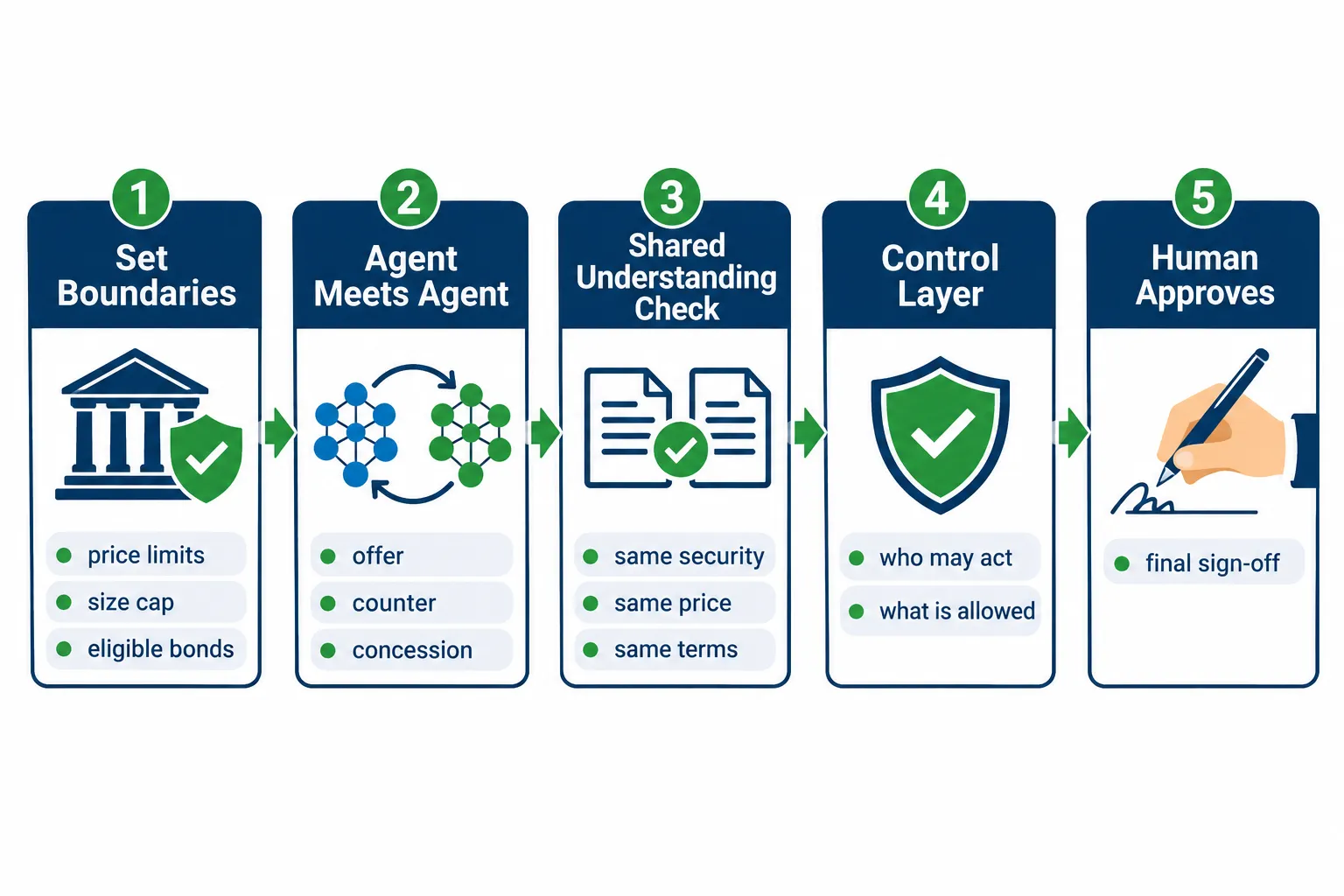
The plumbing is BNY’s Agentic Negotiation Protocol. It works like a rulebook plus a referee. The rulebook decides which agents are authorized and what they can do. The referee makes both sides confirm they agree on what was agreed.
That confirmation step is the smartest part of the design. Two language models can agree on the same sentence and still mean different things. Catching that before money moves is worth more than any speed gain.
Laide Majiyagbe, BNY’s global head of markets, told Bloomberg, “We are not suggesting high-touch goes away.” She called it “the start of a really important evolution in the market.” Traders quoted in the same report said the agents “aren’t quite there yet.”
Why is negotiating a trade different from executing one?
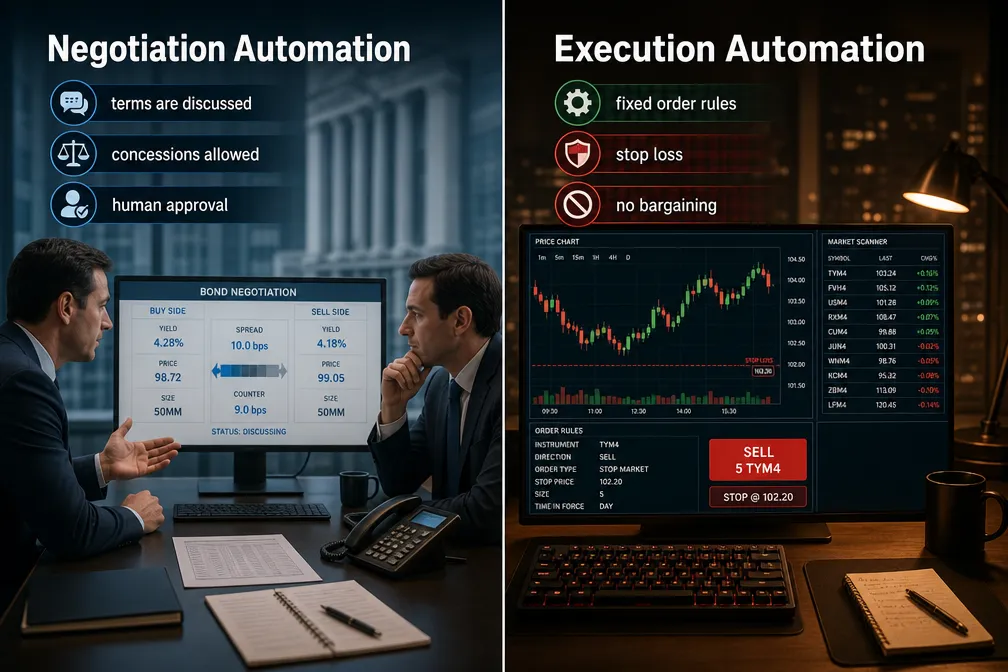
Algorithms have placed Treasury orders for decades. Execution is not the new part.
What is new is an agent interpreting a goal, making concessions and searching for terms both sides accept. A bot running a VWAP schedule is a clerk following orders. An agent that gives up a sliver of price to close the deal is doing something closer to judgment.
| Dimension | Execution automation (what bots do now) | Negotiation automation (what BNY showed) |
|---|---|---|
| Core job | Fill a decided order efficiently | Agree on what the order is |
| Inputs | Size, time window, venue rules | Objectives, limits, allowed concessions |
| Counterparty | Exchange or matching engine | Another agent with its own mandate |
| Failure mode | Bad fills, slippage | Misread terms, runaway concessions |
| Human role | Set parameters, monitor | Approve final terms |
Retail traders do not negotiate. You take the displayed price or you pass. This protocol is not coming to your order ticket. The value for you is in how it was built.
What does this mean for retail bot traders?
Three lessons, none of them about buying anything.
The standard is human-led, agent-operated. A bank with BNY’s custody business at stake still put a person at the approval gate. If it will not let its agent accept terms unsupervised, why does your bot have full trading permissions and no kill switch?
Constraints beat cleverness. Microsoft’s agent got its boundaries before it was allowed to speak. That is position sizing and risk limits in a different suit. The agent could not agree to something outside the box because the box came first.
Confirmation beats speed. Most retail automation reads a signal and fires an order. The first time you learn the signal was malformed is when the fill prints. A pre-trade check that asks “does this order match my rules?” is the cheapest insurance in trading.
For the broader map of what agents are allowed to do at brokers today, see our guide to agentic trading and what 4 brokers let you do.
Was BNY’s agent work already in place before this trade?
Yes. The groundwork was built over years, and the bank automated the boring work first.
BNY’s Eliza platform has run agents internally since at least early 2025, when the head of its AI Hub described about 13 agents that “negotiate with each other” to build product recommendations, with heavy emphasis on guardrails and explainability. Microsoft has since reported that Eliza supports more than 300 AI solutions at BNY, mostly onboarding, settlement inquiries and payment repair.
None of those are trading results. Most retail traders do the reverse, automating entries before they have a journal, a rulebook or a sizing formula.
How does this compare to what brokers let retail bots do today?
| Layer | Status, November 2026 | What it means for you |
|---|---|---|
| BNY Agentic Negotiation Protocol | One human-approved Treasury trade, no metrics | Proof of concept, not a product |
| Broker APIs (Alpaca, IBKR) | Widely available with keys and rate limits | Where retail automation actually lives |
| Broker-hosted AI agents | Rolling out, thin adoption | See how few Robinhood users let AI trade |
| Outside agents using your login | Restricted at some brokers | See Schwab blocking outside AI agents |
| Prop and quant desks | Deep agent use already | See Jump Trading’s agent work |
A custody bank showing agent negotiation grants you no new permissions anywhere. It does raise the odds that brokers standardize agent identity and audit trails, because regulators will ask for them. The CFTC has already floated that idea, covered in our piece on know-your-agent rules.
What should investors watch next?
- BNY transaction metrics. Trade size, negotiation rounds, latency or a cost comparison would turn a demo into evidence.
- BNY’s next tests in repo, FX payments and collateral. Repo is the one to watch. It is huge, it is negotiated, and stress there spreads fast.
- Regulator language on agent identity. Watch FINRA, the SEC and the CFTC for rule text that names agent authorization directly.
- Broker policy on outside agents. That is the change that actually reaches your account.
Our take
This is a real engineering milestone wrapped in a press moment. BNY built the guardrails before the autonomy, and the shared-understanding check is a design every bot builder should steal.
What it is not: proof that agents trade better. Without size, spread or a cost benchmark, nobody outside the two firms can tell price improvement from a polite handshake. The real test is a disorderly tape or a failed auction, not a calm Tuesday with a friendly counterparty.
Your next step: open your bot’s settings this week and write down, in plain language, the three limits it cannot cross and the one check that runs before any order goes live. If you cannot name them, you do not have a system. You have a slot machine with an API key.
Does your bot have limits a bank would sign off on?
We have reviewed more than 200 AI trading tools since 2022, and every submission is scored against the same guardrail checklist before anything is published.
This article is for education only and is not financial advice. Nothing here is a recommendation to buy, sell or hold any security. Trading involves risk, including loss of principal.
Sources
- Bloomberg, “AI Agents in Bond Market Arrive With a Stealthy Microsoft Trade,” Sridhar Natarajan, November 17, 2026: https://www.bloomberg.com/news/articles/2026-11-17/ai-agents-in-bond-market-arrive-with-a-stealthy-microsoft-trade
- Yahoo Finance syndication of the Bloomberg report, November 17, 2026: https://finance.yahoo.com/markets/options/articles/ai-agents-bond-market-arrive-120007777.html
- VentureBeat interview with BNY’s AI Hub on the Eliza platform, February 2025
- Microsoft financial services blog on BNY’s Eliza platform, September 2026
Your market edge starts with the right tool. Stay alpha.
Frequently Asked Questions
Did the AI agents trade Treasuries without any human involvement?
No. Microsoft set the acceptable boundaries in advance, and humans approved the negotiated terms before acceptance.
What is the BNY Agentic Negotiation Protocol?
A bank control layer that decides which AI agents may negotiate and on what terms, then makes both sides confirm they read the deal the same way.
Can retail traders use this protocol?
Not today. It is an institutional workflow between BNY and its clients, and retail automation still runs through broker APIs.
Did the agents get a better price than a human trader would?
Unknown. No trade size, yield, spread or cost comparison was disclosed, so price improvement cannot be checked.
What should bot traders copy from this trade?
Hard limits set before the bot acts, a check that the order matches your rules before it fires, and human sign-off on anything large.
Is this article financial advice?
No. It is education only and does not recommend buying, selling or holding any security.
The FullStack Alpha research desk tests AI trading bots on paper and live accounts. Reviewed and edited by Jay Rocco, Founder and Editor.
