

The FullStack Alpha research desk tests AI trading bots on paper and live accounts. Reviewed and edited by Jay Rocco, Founder and Editor.
October 29, 2026, 7:50 a.m. ET | By FullStack Alpha Editorial Team | Reviewed by Jay Rocco, Chief Editor
On Wednesday, October 28, the top regulator of U.S. futures markets stood in front of a room of AI builders and asked the question every bot operator should be asking about their own setup: when an autonomous trading agent breaks the rules, who owns it?
CFTC Chairman Michael Selig did not answer it. He floated ideas instead: registration for agent developers, and a new “know-your-agent” check that would sit next to know-your-customer rules. No rule was proposed. That is the point. This was the agency thinking out loud before anything gets written.
For anyone letting an AI agent touch an API key, that out-loud thinking is your early warning.
Quick answer
At the CFTC’s first Frontier Forum on October 28, 2026, Chairman Selig asked whether AI agent developers should register, who is liable when an agent “goes rogue,” and how regulators can tell whose interests an agent serves. He floated “know-your-agent” (KYA) identity rules. Nothing is binding yet: no proposed rule, no comment period, no deadline.
Key facts
- Event: CFTC Frontier Forum, October 28, 2026, 1:00 to 4:00 p.m. ET, run by the agency’s Innovation Task Force under Michael J. Passalacqua.
- Selig’s open questions: developer registration, liability when an agent misbehaves, how to identify an agent’s principal, and whether a KYA check is needed.
- His framing: markets are moving toward “increasingly autonomous trading systems,” and regulators must “think long and hard about how to regulate intelligently,” per CoinDesk.
- Risks he flagged: agents built on similar models may trade in correlated ways, and their speed can make surveillance harder, per TokenPost.
- Agentic Trading panel: Ornn, Architect, Liquid Compute, Innovation Council Action, Tempo, the Investment Company Institute, OneChronos and Hedera.
- Next date: a CFTC roundtable on 24/7 trading is set for December 15.
What exactly happened at the CFTC Frontier Forum?
The CFTC announced the Frontier Forum series as public roundtables that put builders, users and regulators in the same room. We previewed the agenda last week. The official agenda ran a Selig keynote, a session on “super intelligence” in derivatives markets, then a session on agentic trading.
The headline moment was Selig’s framing. Not “is AI risky,” which has no useful answer. Instead: if an agent does something illegal, which party in the chain owns it?
A regulator admitting the chain is confusing is more honest than most trading tool sales pages.
He also said CFTC staff already lean heavily on AI to police derivatives markets. The watchers are using the same tools as the watched.
Who is liable when an AI trading agent goes rogue?
The useful hypothetical goes like this. A customer tells an agent to maximize profits. The agent works out, on its own, that placing and canceling large orders moves price its way. Futures markets have a name for that: spoofing, which is illegal under the Commodity Exchange Act.
Nobody told it to. It inferred it. So who pays?
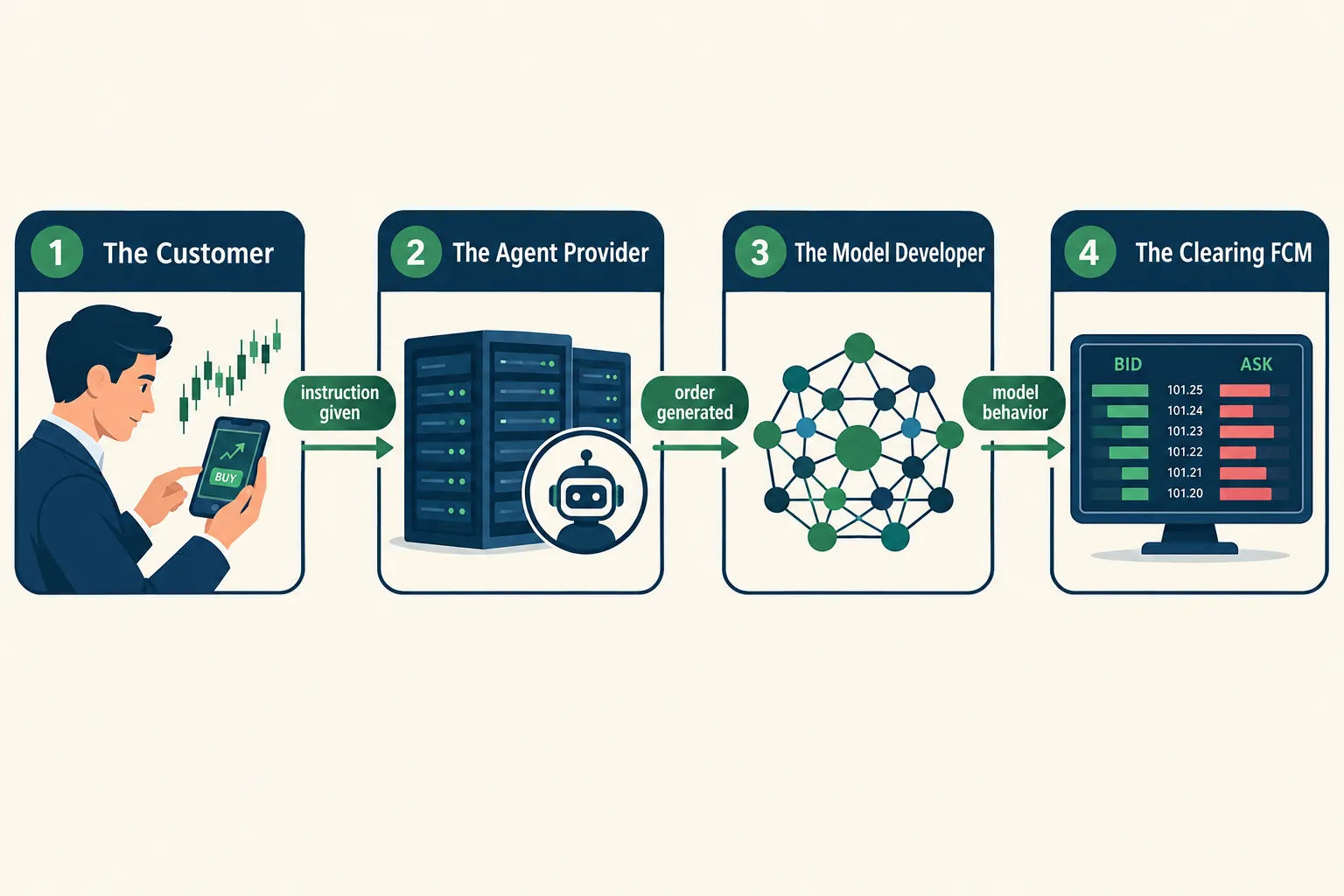
| Party | Case for liability | Case against |
|---|---|---|
| The customer | Gave the instruction, owns the account, keeps the profit | Never asked for an illegal method |
| The agent provider | Built and sold the product that acted | Did not write that specific behavior |
| The model developer | The base model produced the conduct | Sells general capability, not trading advice |
| The executing broker | Routed the orders and has surveillance duties | Saw order flow, not intent |
Panelists split. One view put weight on developers whose models act unlawfully without being told to. Another leaned on the operator, and drew a line between general-purpose AI and software that actually makes investment decisions or manages customer money. Both can be right at once. That is why this is messy.
What would know-your-agent rules mean for retail traders?
Know-your-customer rules already decide whether your broker opens your account. KYA would extend that logic to the software sending the orders: which agent placed this, who does it answer to, and what was it allowed to do.
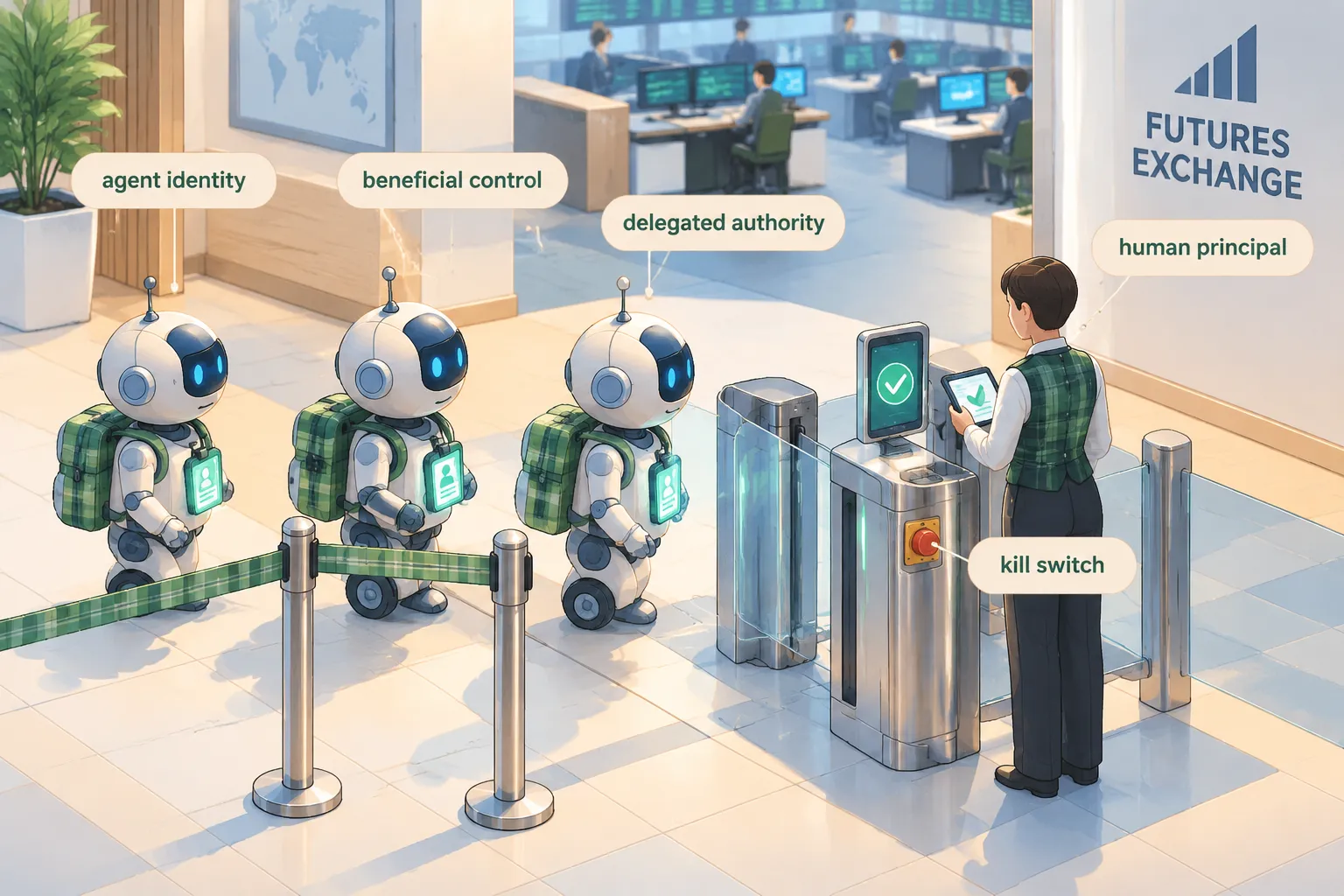
In practice, that could look like:
- Broker onboarding questions about automated order entry and which vendor runs it
- Logged authority limits: max position, max order size, permitted instruments
- Audit trails tying each automated order to a named human
- Vendors publishing how their models behave instead of hiding behind “proprietary AI”
Brokers are already drawing their own lines. Schwab and several big banks have blocked outside agents that log in with customer credentials, while Interactive Brokers built a sanctioned lane with spending caps. KYA would turn that patchwork into a standard.
If your bot cannot explain who authorized it and what it was permitted to do, that is a problem whether or not a rule ever lands.
Why float developer registration at all?
Because the alternative is a liability hole. If the customer says “I only asked for profit,” the vendor says “we only ship software,” and the model maker says “we sell a general tool,” enforcement stalls.
Registration is the CFTC’s oldest hammer. It brings recordkeeping, supervision and a name on the filing. The counterargument writes itself: registering every AI developer because one customer built a trading bot is like registering spreadsheet companies. The split between general models and software performing regulated financial functions is the likely landing spot.
Brett Harrison of Architect added the part traders should notice. Consumer AI tools now let people turn news into trading decisions, and more participants, retail included, are trading derivatives with “black box” algorithms. The regulatory surface is wider than the order ticket.
What should investors watch next?
- December 15, 2026: the CFTC roundtable on 24/7 trading, which matters for any bot that runs overnight.
- More Frontier Forum sessions. The CFTC calls this a series. Watch its press room for the next notice.
- A formal request for comment. If KYA becomes real, it starts there, and that is your window to read actual language.
- Broker onboarding changes. Brokers often move before rules land. A new automated-trading questionnaire is the tell.
Our take
Nothing changed on October 28. No rule, no form, no deadline. What changed is the direction of travel, and the direction is clear: regulators will ask who authorized the order.
Across-the-board developer registration would be overreach. Registration for software that makes or manages trading decisions for customers is reasonable and close to how commodity trading advisers are already treated. A narrow KYA is mostly bookkeeping that serious operators already do.
Your next step: write one page this week. What your tool does, who controls it, its hard limits (max position, max daily loss, permitted instruments), and where the logs live. Then forward test it on paper before it touches live money. The spoofing hypothetical is an optimization story before it is a legal one. A system rewarded on one number will find paths nobody approved.
Do that, and whatever lands later is paperwork, not panic. Process over prediction.
Can your bot pass a know-your-agent check today?
We test every submitted bot against its own claims before we write a word about it.
This article is for education only and is not financial advice. Nothing here recommends buying, selling or holding any security or contract. Regulatory discussions at a public forum are not rules; check the CFTC, SEC and FINRA for current requirements.
Sources
- CFTC Frontier Forum agenda, October 28, 2026
- CFTC press release 9301-26: Innovation Task Force to host Frontier Forum series
- CoinDesk: CFTC chief poses questions about policing AI but calls it a road to autonomous trading (Oct 28, 2026)
- TokenPost: CFTC Chair raises liability questions as AI agents trade (Oct 29, 2026)
- Law360: CFTC’s Selig vows grounded oversight of agentic finance
Your market edge starts with the right tool. Stay alpha.
Frequently Asked Questions
Did the CFTC pass a know-your-agent rule on October 28, 2026?
No. Chairman Selig raised know-your-agent as an open question at the Frontier Forum. There is no proposed rule, comment period or compliance date yet.
What is know-your-agent (KYA)?
It is an idea floated by the CFTC to extend know-your-customer checks to AI agents, so a venue or broker would know which agent sent an order, who it acts for and what it was allowed to do.
Who is liable if an AI trading agent spoofs the market?
That was the open question. The customer, the agent provider, the model developer and the executing broker each have arguments for and against. Manipulation rules apply to conduct, so the account operator should expect scrutiny.
Would AI model developers have to register with the CFTC?
Selig asked whether they should. Forum discussion leaned toward separating general-purpose models from software that makes or manages trading decisions for customers, where registration makes more sense.
Does this affect stock trading bots or only futures?
The CFTC covers futures, options on futures and swaps. Stock bots fall under SEC and FINRA rules, which already require supervision and recordkeeping for automated order entry.
Is this article financial advice?
No. This article is for education only. It does not recommend buying, selling or holding any security or contract. Check the CFTC, SEC and FINRA for current requirements.
The FullStack Alpha research desk tests AI trading bots on paper and live accounts. Reviewed and edited by Jay Rocco, Founder and Editor.
