

The FullStack Alpha research desk tests AI trading bots on paper and live accounts. Reviewed and edited by Jay Rocco, Founder and Editor.
Published October 28, 2026, 7:55 a.m. ET | By FullStack Alpha Editorial Team | Reviewed by Jay Rocco, Chief Editor
Quick answer: Robinhood reported its third quarter 2026 results after the bell on Tuesday, October 27. About 200,000 customers have opened Agentic Trading Accounts, and those accounts have driven more than $1.6 billion in notional trading volume. Total net revenue rose 12% to $1.42 billion, but net income fell 14% and shares slid roughly 7% after hours. For bot traders, the headline number measures activity, not results.
Key facts
- Release: Robinhood Q3 2026 results, October 27, 2026, 4:05 p.m. ET, with the earnings call at 5:00 p.m. ET.
- Agentic Trading Accounts: about 200,000 opened to date, more than $1.6 billion in notional trading volume.
- Agentic balances: management said on the call that agentic accounts hold more than $250 million.
- Revenue: $1.42 billion, up 12% year over year. Transaction-based revenue rose 19% to $867 million.
- Profit: net income fell 14% to $476 million. Diluted EPS fell 16% to $0.51.
- Stock reaction: HOOD closed at $94.56 and traded near $87.60 after hours, down about 7%.
What exactly did Robinhood report in Q3 2026?
Total net revenue reached $1.42 billion, a 12% increase year over year. Transaction-based revenue, the money Robinhood makes when you trade, climbed 19% to $867 million.
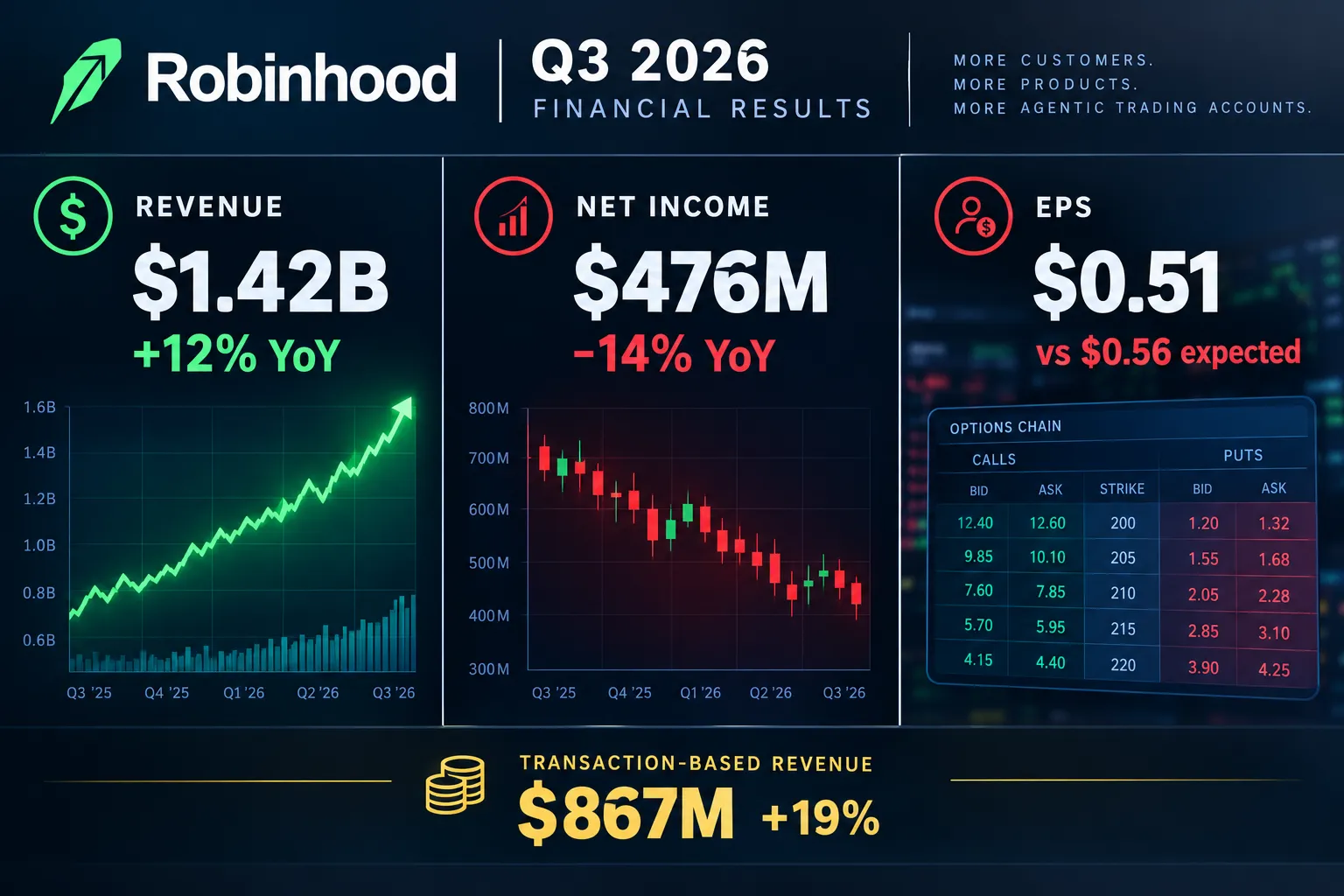
Profit went the other way, and the stock fell about 7% after hours as investors weighed a slight revenue miss and early signs that trading is cooling in Q4.
The mix underneath matters more than the top line:
| Revenue line | Q3 2026 | Year over year |
|---|---|---|
| Total net revenue | $1.42B | +12% |
| Transaction-based revenue | $867M | +19% |
| Options | $399M | +31% |
| Equities | $121M | +41% |
| Event contracts | $173M | Sharply higher |
| Crypto | $120M | -55% |
Robinhood’s growth is concentrated in the fastest, most leveraged products its customers can touch. Options and prediction markets carried the quarter, with a record 16.4 billion event contracts traded. Diversification is real, but it is showing up in prediction markets, not in AI.
What are Robinhood Agentic Trading Accounts, and how do they work?
At the HOOD Summit in late September, Robinhood announced built-in agents that can research securities, analyze a portfolio, build a strategy, and place trades. You pick the underlying large language model, write instructions and limits, and fund a separate Agentic Account.
Separate is the key word. An agent can only trade inside that dedicated account, not your main brokerage or retirement accounts. You can pause it, disable individual skills, or disconnect it entirely.
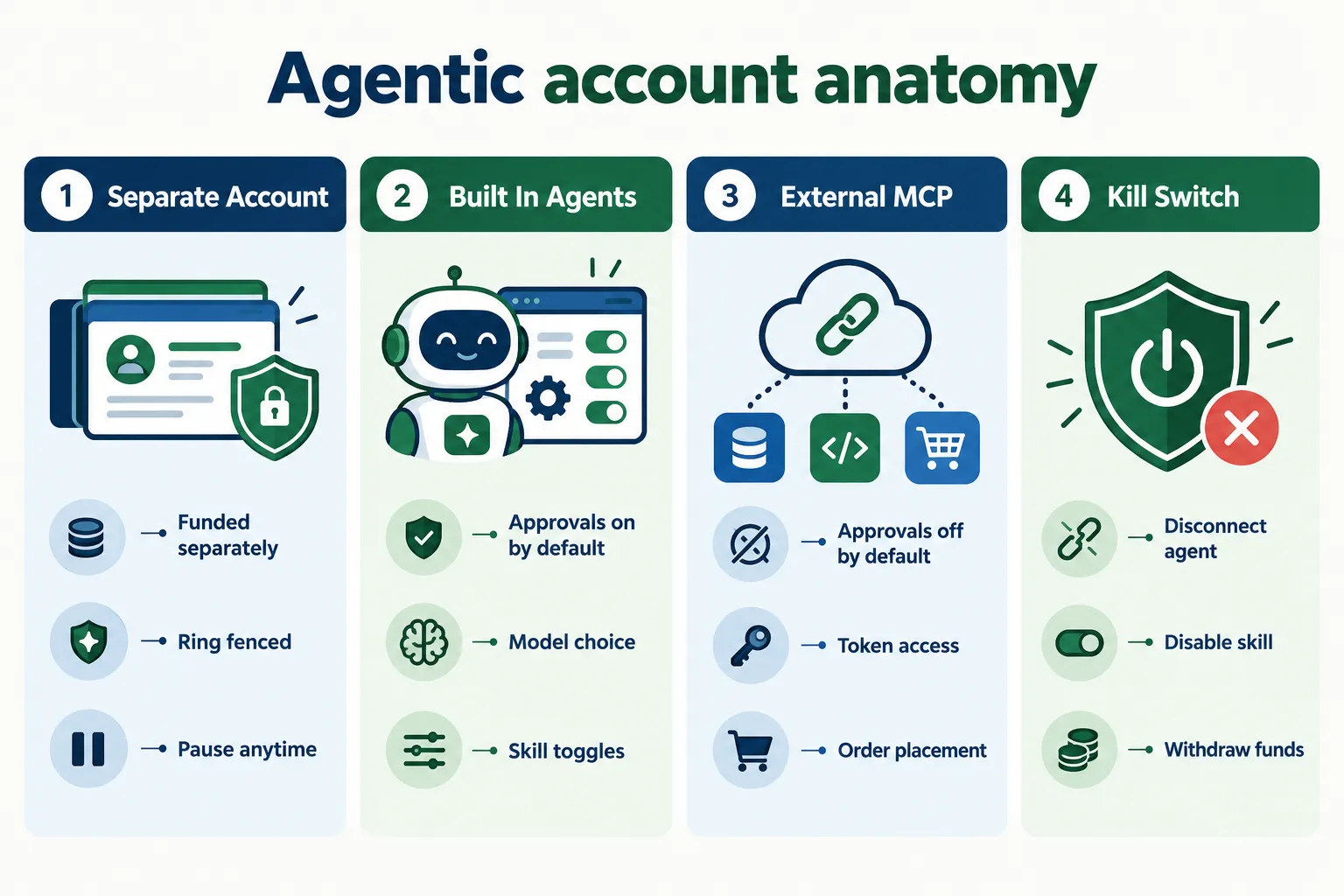
Robinhood also opened the door to outside agents. Its Trading MCP works with tools like Claude Code and OpenAI Codex, letting an external agent pull approved Robinhood data and send orders through an authenticated connection. On the call, management said MCP connectivity now extends to Robinhood Legend too. We walked through that setup in how to connect Claude to Robinhood safely.
Here is the setting that decides your risk:
| Setup | Trade approvals default | What that means |
|---|---|---|
| Built-in Robinhood Agents | Enabled | Agent proposes, you confirm each trade |
| External MCP (Claude Code, Codex) | Reportedly disabled | Agent can place orders without a manual check |
| Legend platform agentic | Check in-app settings | Verify before funding |
If you connect an external agent and never open the settings panel, you may have handed order entry to a language model with no human gate. Check the approval toggle before you fund the account, not after.
Does $1.6 billion in notional volume mean agentic traders are making money?
No. And the distinction is the entire point.
Notional volume is the gross face value of trades placed. Buy $5,000 of an ETF, sell it, buy it again, and you have generated $15,000 of notional volume on $5,000 of capital. Options magnify this further, because a single contract controls 100 shares.
Spread $1.6 billion across roughly 200,000 accounts and you get about $8,000 of cumulative notional per account. Management’s $250 million balance figure works out to roughly $1,250 per account. That is a small, active pool of money, not proof of skill.
Notional volume measures how much the machine traded. It says nothing about whether the machine was right.
Robinhood did not disclose agentic account revenue, profitability or returns. When a company shares the number that flatters adoption and skips every number that measures outcome, treat that as information. Bot vendors run the same play, as we showed in are trading bots profitable.
What do the Robinhood Q3 results mean for AI trading bot users?
Four things, and none of them involve rushing to fund an account.
1. Agentic trading just got institutional cover. When a broker at Robinhood’s scale names a user count on an earnings call, agentic trading stops being a GitHub hobby. Interactive Brokers is moving the same way, covered in IBKR autonomous AI trading, and Jefferies already argued that these tools will lift market volumes in our Jefferies breakdown.
2. The incentive structure deserves a hard look. Robinhood is paid when you trade. Your bot’s turnover rate is a line item on your broker’s income statement.
3. Announced is not available. Management said 24/7 U.S. equity trading is expected later in 2026, and earnings contracts are still in development. Do not build a strategy around a feature that lives in a slide deck.
4. Options are where the damage happens. Options revenue grew 31% to $399 million. Point an agent at options without position sizing rules and you are not automating a strategy. You are automating leverage.
How should you test an agentic account without torching capital?
Treat it like a new hire with trading authority. Small mandate, tight supervision, written rules.
- Fund the minimum you can stand to lose entirely. The account is ring-fenced for a reason.
- Leave trade approvals on for at least 30 trades.
- Write the limits first. Max position size, max daily trades, allowed instruments, hard stop loss.
- Set a drawdown ceiling. Our max drawdown guide shows where to draw the line.
- Paper trade the logic first with a 30-day paper test.
What should investors watch next?
- Q4 2026 results (early 2027): whether Robinhood breaks out agentic revenue, balances or performance, or repeats account counts only.
- 2027 plan (January and February 2027): management said it will share its 2027 outlook then.
- 24/7 equity trading (expected later in 2026): whether it ships to customers or stays an announcement.
- External MCP approval defaults: whether regulators push for a change.
- Competing brokers: whether Schwab, Webull and IBKR match the feature set, and whether any of them publish outcomes instead of volume. Schwab’s quarter is in our Schwab Q3 breakdown.
Our take
Robinhood built something useful and then measured it with the one metric that cannot embarrass anyone. Two hundred thousand accounts and $1.6 billion notional is a usage stat dressed up as a success stat.
The product design is better than most retail bot platforms. A ring-fenced account, skill toggles and a kill switch beat half the subscription bots we have tested since 2022.
The weak spot is the default on external connections. Shipping agent order entry with approvals off, to an audience where most day traders lose money, puts all of the risk management on a settings screen most people skip.
Agentic trading does not fix the thing that breaks retail accounts. It automates it faster. An LLM with brokerage access just executes your lack of a system at machine speed.
Your next step: if you test it, fund it small, force approvals on, log every trade, and judge the agent after 30 trades on realized P&L after fees. Not on how many orders it placed. Systems over hacks.
Got an agent trading on Robinhood, or a Claude Code setup wired to a broker?
We have tested more than 200 AI trading tools since 2022, and reader setups are next on the bench.
Send us your bot or agent setup
This article is for education only and is not financial advice. Nothing here is a recommendation to buy, sell or hold any security. Trading involves risk, including the loss of principal.
Sources
- Robinhood Reports Third Quarter 2026 Results (Robinhood Investor Relations, Oct 27, 2026)
- Robinhood Q3 2026 earnings call transcript (The Motley Fool)
- Earnings call transcript: Robinhood Q3 2026 revenue tops $1.4 billion, stock falls (Investing.com)
- Robinhood Markets Q3 2026 earnings call transcript (Benzinga)
Your market edge starts with the right tool. Stay alpha.
Frequently Asked Questions
How many Robinhood Agentic Trading Accounts are there?
Robinhood said in its Q3 2026 results on October 27, 2026 that about 200,000 customers have opened Agentic Trading Accounts, driving more than $1.6 billion in notional trading volume.
Is $1.6 billion the amount of money in Robinhood agentic accounts?
No. It is cumulative notional trading volume, the gross face value of trades placed. Management said on the earnings call that agentic accounts hold more than $250 million in balances.
Did Robinhood say whether agentic traders made money?
No. Robinhood did not disclose returns, profitability or revenue for Agentic Trading Accounts. Account counts and volume measure activity, not results.
Can a Robinhood AI agent trade my main account?
No. Agents trade only inside a separate, separately funded Agentic Account. You choose how much to fund and can pause the agent, disable skills or disconnect it.
Why did Robinhood stock fall after Q3 2026 earnings?
Net income fell 14% to $476 million and diluted EPS fell 16% to $0.51. Shares dropped about 7% after hours as investors weighed a slight revenue miss and signs of cooling Q4 trading activity.
Is this article financial advice?
No. This article is for education only. Nothing here is a recommendation to buy, sell or hold any security. Trading involves risk, including the loss of principal.
The FullStack Alpha research desk tests AI trading bots on paper and live accounts. Reviewed and edited by Jay Rocco, Founder and Editor.
