

The FullStack Alpha research desk tests AI trading bots on paper and live accounts. Reviewed and edited by Jay Rocco, Founder and Editor.
October 27, 2026, 7:55 a.m. ET | By FullStack Alpha Editorial Team | Reviewed by Jay Rocco, Chief Editor
Five of the biggest retail brokers in America handed their order tickets to software in roughly a month. Wall Street’s reaction was to upgrade its volume math.
That is a thesis about broker engagement, not about your P&L. More volume means more order flow for brokers. It does not mean more profit for you.
Quick answer
Jefferies published a report on Monday, October 26, 2026, arguing that AI agent trading tools at Interactive Brokers, Robinhood, E*TRADE, Schwab and Coinbase could lift market trading volumes. Investing.com summarized it on October 27. The logic is friction: agents shrink the gap between an idea and an order, and less friction has always meant more trading. For bot traders, the real story sits in the guardrails each broker chose.
Key facts
- Report date: Jefferies note published Monday, October 26, 2026, a follow-up to its June analysis of broker AI tools.
- IBKR Autonomous Trading launched October 21, 2026. AI Partitions are capped at 10% of account equity, with a $1,000 minimum and a $25,000 aggregate maximum.
- Robinhood reported more than 150,000 agentic trading accounts as of September 29, 2026, with agents calling its tools close to 30 million times a day.
- E*TRADE launched MCP connectors to third-party AI models on October 8, 2026.
- Schwab began a phased rollout of its Charley assistant in October and is testing MCP tools with one LLM provider.
- Coinbase added U.S. stocks and ETFs to its agent stack in September.
What exactly does the Jefferies report say about broker AI agents?
The note frames the agent rollouts as a structural driver of trading volume, not a gimmick. Agents can research, screen, draft a strategy and submit an order inside one conversation. Fewer steps, more orders.
Jefferies also flagged the institutional side. Nasdaq launched an agentic AI operating environment inside Calypso in September 2026, which could lift automated workflow volume even where no retail order is ever placed.
Agents do not create conviction. They create throughput.
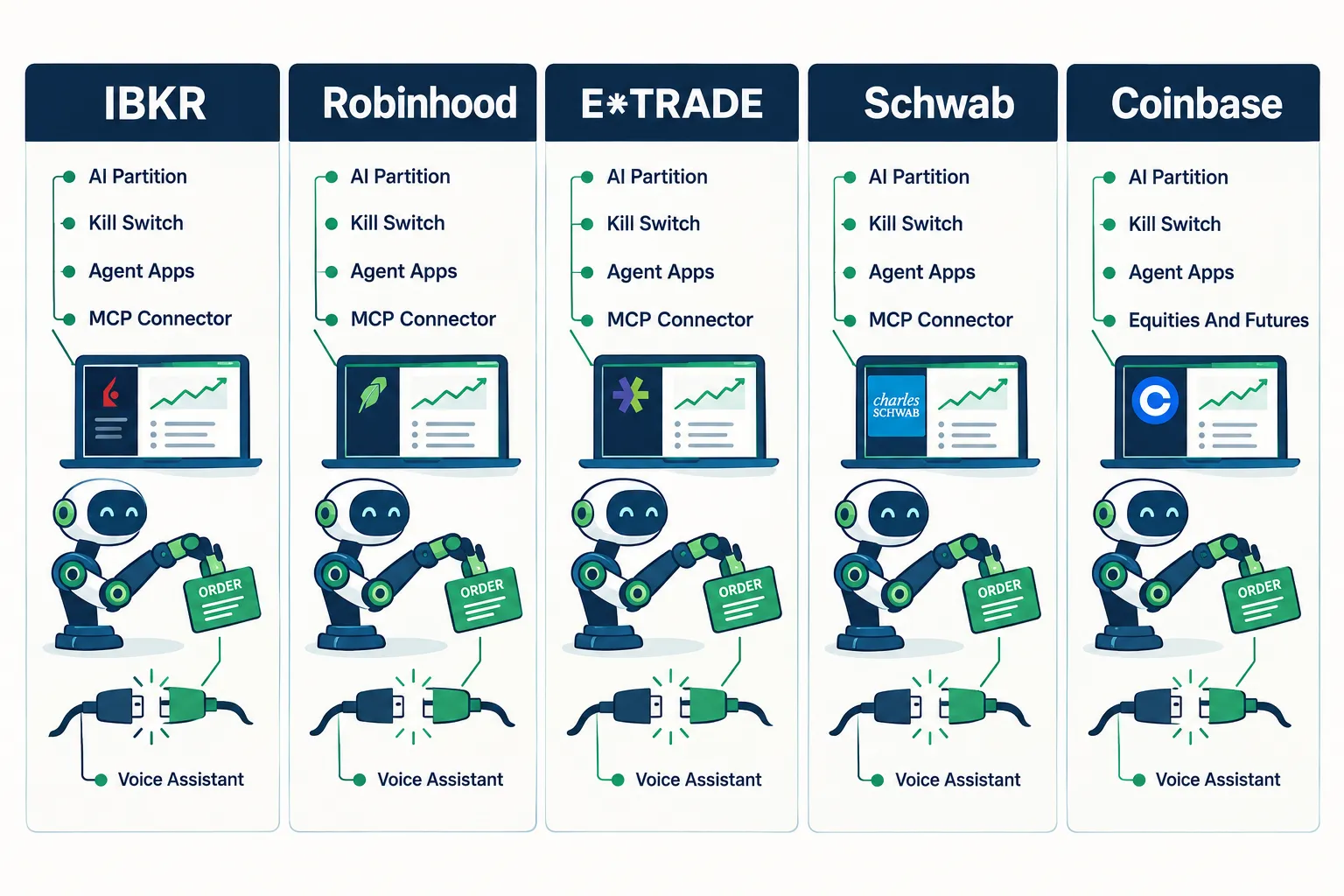
Here is what each broker shipped, as of October 2026.
| Broker | What launched | Date | Can it place trades? | Limits disclosed |
|---|---|---|---|---|
| Interactive Brokers | Autonomous Trading, AI Partition | Oct 21, 2026 | Yes, stocks and equity options | 10% of equity, $1,000 min, $25,000 max, kill switch |
| Robinhood | Robinhood Agents, Agent Apps | Sep 29, 2026 | Yes, equities, options, crypto | Approvals on by default |
| E*TRADE | MCP connectors to third-party AI | Oct 8, 2026 | Account data and permitted actions via MCP | Trading permissions thinly documented |
| Schwab | Charley assistant, separate MCP pilot | Phased, Oct 2026 | Charley is not described as an autonomous trader | Pilot agent cannot move money |
| Coinbase | Coinbase for Agents, U.S. equities and ETFs | Sep 2026 | Yes | Order previews, disconnect option |
Two things jump off that table.
One: IBKR’s capital controls are the most explicit. A $25,000 ceiling is a firm telling you, in writing, that it does not fully trust the output yet. Per Interactive Brokers, clients must also complete at least 10 manually approved trades over two weeks before the agent runs on its own. Training wheels, enforced. Our IBKR autonomous AI trading explainer has the full mechanics.
Two: Schwab drew the sharpest line. Schwab’s announcement describes Charley as voice and text access to quotes, watchlists, alerts, research and account info. Its MCP pilot blocks money movement outright. We covered the launch in Schwab’s Charley AI assistant.
How could AI agent trading tools boost market volumes?
Friction is the only thing standing between most retail traders and their worst instincts. Agents remove it.
Think of cooking dinner versus ordering delivery. Same hunger, wildly different frequency. The app did not make you hungrier. It made acting on the hunger take nine seconds instead of forty minutes.
That is the Jefferies thesis in one analogy.
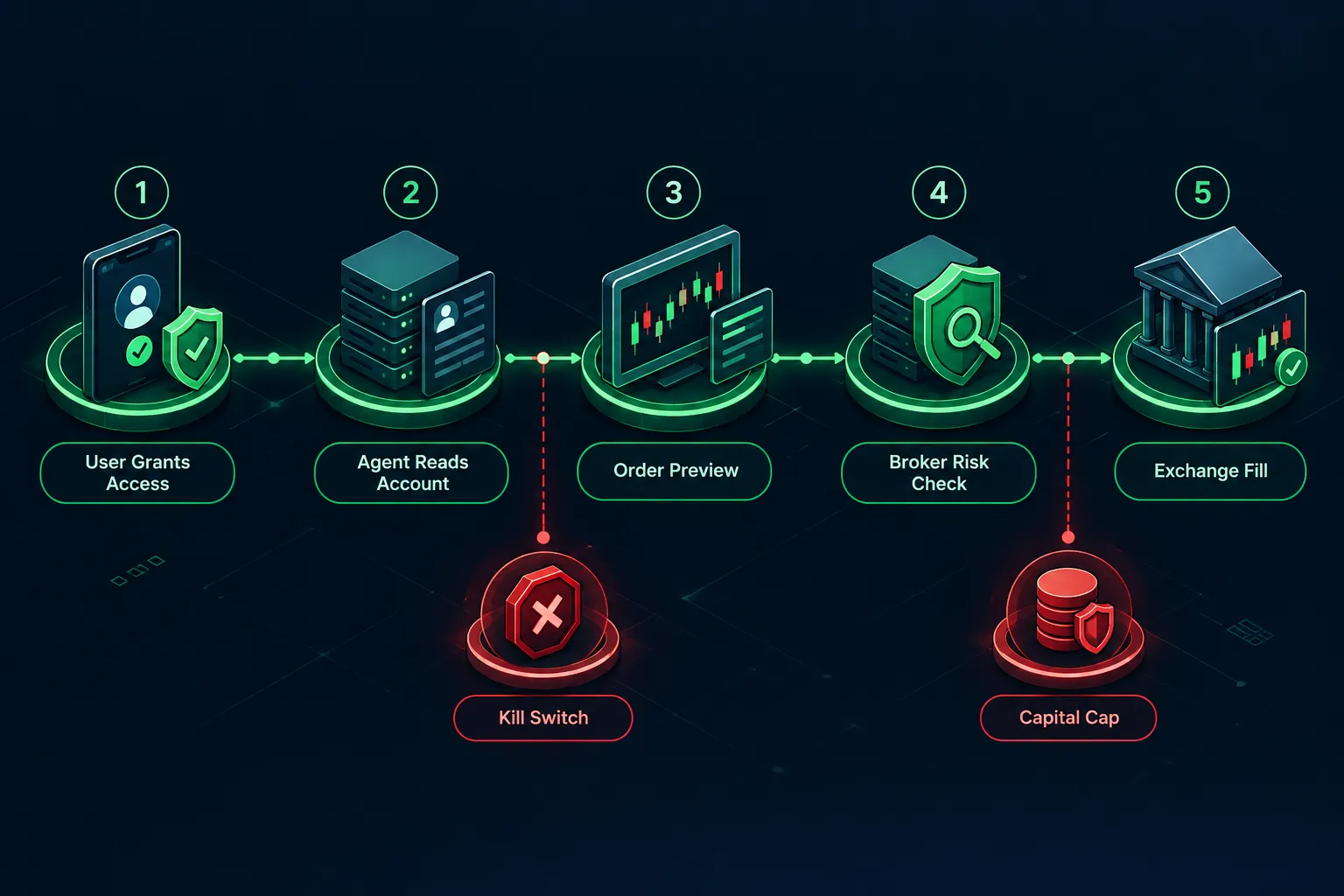
Read Robinhood’s numbers carefully. Thirty million daily tool calls are not 30 million trades. An agent that pulls a quote, checks a position and drafts a plan fires three calls and places zero orders.
Still, engagement leads volume, and volume leads broker revenue. Here is where the extra activity comes from:
- More trades per user. Lower effort per order means more orders.
- New users. Someone who never learned an options chain can now ask for a strategy in plain English.
- Institutional automation. Nasdaq’s Calypso environment adds machine-driven volume upstream of retail.
Market truth: broker volume and trader profit are two different scoreboards. That is why Investor.gov’s active trading guidance leads with costs and discipline, not speed.
What are the real risks for retail bot traders?
Start with the one nobody advertises: you own the losses. Coinbase’s agent materials state users remain responsible for unintended transactions, even when ChatGPT, Claude, Grok or Perplexity placed the order. Assume the same everywhere.
Permission creep. Robinhood’s agentic accounts ship with trade approvals on, and users can switch them off. That toggle is the whole ballgame. One click separates a research assistant from an unsupervised trader.
MCP exposure. Connectors like E*TRADE’s let an outside AI app see account data and take permitted actions. That is more power than a chatbot has ever had over a brokerage account. Our breakdown of AI trading agent risks covers what to lock down first.
Overtrading in a new outfit. Revenge trading used to require you to be angry and awake. An agent with loose instructions can churn while you sleep.
How should traders respond?
Treat an agent like a new hire with a terminal login and no track record. You would not hand that person 40% of the account on day one. IBKR already decided you shouldn’t.
- Paper trade it first. Two weeks minimum. Our paper trading app guide lists free options.
- Keep approvals on. Turning off confirmations is a decision for after 50 logged trades, not onboarding day.
- Cap the allocation. If your broker allows more than 5% of equity in month one, use less than it allows.
- Write the rules before you connect. Max position size, max daily orders, instrument exclusions, hard stop.
- Find the kill switch before you need it. Know the exact clicks cold.
- Grade the process, not the outcome. A winning trade from a broken rule is still a broken rule.
What should investors watch next?
- Robinhood Q3 2026 results, due October 27, 2026. Look for updated agentic account counts and trades per funded account.
- CFTC Frontier Forum on agentic trading, October 28, 2026. Our coverage of the forum announcement lays out what is on the table.
- IBKR’s next controls. The firm has said future limits may include order-frequency caps and maximum order sizes.
- Regulator posture. The SEC and FINRA have not issued agent-specific retail trading rules. Any guidance on supervision or disclosure would reshape every rollout above.
Our take
Jefferies is probably right about volumes, and that is not a compliment to the product. Brokers make money when you trade. Agents make trading take nine seconds. Those two facts fit together a little too neatly.
The encouraging part is restraint. IBKR’s cap and mandatory approval period, plus Schwab blocking money movement, are firms admitting the models are not ready to run free. Those guardrails are worth more than any feature on the launch slide.
Use agents for research, screening and journaling, where they are strong. Keep approvals on. Keep the allocation small. The trader who gets hurt in 2027 will be the one who turned off confirmations in week one and learned their system was never a system.
Your next step: open a paper account this week, connect the agent with written rules, and let it run for two weeks untouched. Then read the log.
Five brokers just shipped AI agents. Most traders cannot tell which ones are worth connecting.
FullStack Alpha has tested more than 200 AI stock tools since 2022.
Read the AI trading tool reviews
This article is for education only and is not financial advice. Trading involves risk, including the loss of principal. Do your own research before connecting any AI tool to a brokerage account.
Sources
- Investing.com: Jefferies sees AI trading tools boosting market volumes (Oct 27, 2026)
- Interactive Brokers: AI order placement is here
- Charles Schwab: Meet Charley
- Robinhood Newsroom: HOOD Summit 2026
- Robinhood: Third Quarter 2026 Results date announcement
- Investor.gov: Investor bulletin on active trading
Your market edge starts with the right tool. Stay alpha.
Frequently Asked Questions
What did the Jefferies report say about AI agent trading tools?
Jefferies published a report on October 26, 2026 arguing that AI agent tools at brokers including Interactive Brokers, Robinhood, E*TRADE, Schwab and Coinbase could lift market trading volumes by cutting the friction between an idea and an order.
Does more trading volume mean AI agents make traders money?
No. The report is about volumes and broker engagement, not retail profitability. Higher volume benefits brokers through more order flow. It says nothing about individual trader outcomes.
How much money can an IBKR AI Partition control?
Clients can generally allocate up to 10% of account equity to AI Partitions, with a $1,000 minimum and a $25,000 aggregate maximum. Margin is excluded.
Can Schwab's Charley place trades on its own?
Schwab describes Charley as voice and text access to quotes, watchlists, alerts, research and account information. It is not described as an autonomous trader, and Schwab's separate MCP pilot blocks money movement.
Who is responsible if an AI agent places a trade I did not want?
The account holder. Coinbase's agent materials state users remain responsible for unintended transactions. Assume the same at every broker unless a regulator says otherwise.
Is this article financial advice?
No. This article is for education only. It does not recommend buying, selling or holding any security, and you should do your own research before connecting any AI tool to a brokerage account.
The FullStack Alpha research desk tests AI trading bots on paper and live accounts. Reviewed and edited by Jay Rocco, Founder and Editor.
