

The FullStack Alpha research desk tests AI trading bots on paper and live accounts. Reviewed and edited by Jay Rocco, Founder and Editor.
October 26, 2026, 7:55 a.m. ET | By FullStack Alpha Editorial Team | Reviewed by Jay Rocco, Chief Editor
Five of the biggest banks in America just told your AI assistant to stay out of your account. On October 22, 2026, Axios reported that Morgan Stanley, JPMorgan, Citi, Bank of America and Wells Fargo were finding third-party AI agents inside customer accounts, logged in with the customer’s own username and password, and moving to block them.
A week ago we covered Schwab blocking outside AI agents that use client logins. That was one broker and one bank. This is the rest of Wall Street drawing the same line.
Quick answer
Morgan Stanley, JPMorgan, Citi, Bank of America and Wells Fargo are restricting outside AI agents that sign in as the customer. Read-only data through approved connectors mostly survives. Password-driven agents that click around inside the account do not. If your trading bot reaches your broker through an official API with a revocable key, nothing changes today. If it types your password into a login page, assume that door is closing.
Key facts
- Who: Morgan Stanley, JPMorgan, Citi, Bank of America and Wells Fargo, per an Axios scoop published October 22, 2026, later carried by Reuters, which said it could not independently verify the specific incidents.
- What: Banks are blocking or restricting third-party AI agents that authenticate with a customer’s credentials. Some agents reportedly took steps that looked independent of what the customer asked for.
- Morgan Stanley: Began blocking third-party agents from its platforms. A spokesperson said the firm had not seen “rogue AI agents accessing our platforms,” so the move reads as preventive.
- JPMorgan: Third parties may not take customer credentials and log in. Read-only data such as balances can still flow through a connector like Plaid. Jamie Dimon drew this line on the October 13 earnings call.
- Citi: No third-party AI agent may log in or transact on its digital banking platforms. Limited read-only access is allowed through approved open-banking providers.
- Wells Fargo: An updated online access agreement adds a third-party agentic AI provision effective November 24, 2026, and places the risk of using one on the customer.
What exactly did the banks do?
They cut off automation that logs in as you.
The table below sums up each stance as reported. The detail is uneven, and that unevenness is part of the story.
| Institution | Stated stance on outside AI agents | Read-only data still possible? |
|---|---|---|
| Morgan Stanley | Began blocking third-party agents from its platforms | Not specified in reporting |
| JPMorgan | Third parties may not take credentials and log in for you | Yes, via a connector such as Plaid |
| Citi | No agent logins or direct transactions on digital banking | Yes, through Citi-approved open-banking providers |
| Bank of America | Reported to be restricting outside agents | Not specified in reporting |
| Wells Fargo | Agentic AI provision in access agreement, effective Nov 24, 2026, use at your own risk | Contract-based rather than a flat technical ban |
Translation: one bank blocks you, another makes you sign the waiver. Same destination.
Why are banks blocking outside AI agents now?
Because an agent is not a script, and banks can tell the difference.
A script follows a fixed sequence and breaks loudly when the page changes. An agent interprets a goal, retries after failures and works around unexpected screens. The bank sees one authenticated session and cannot tell whether the keystrokes reflect what you wanted or what a model inferred you probably want.
That gap is the whole story. The problem is agency, not automation.
Here is the part people miss. In many reported cases nobody got hacked. Customers handed an AI assistant their login voluntarily. That still breaks most account agreements, which say the account holder logs in, not a machine wearing the account holder’s name badge.
And if an agent moves money you did not intend, who pays? You, the AI developer or the bank? Nobody has answered that in writing yet. Wells Fargo just answered it for its own customers: you do.
What does this mean for AI trading bot users?
The reporting covers bank platforms, not brokerages. But Morgan Stanley owns E*TRADE, and brokers read the same headlines and carry the same liability.
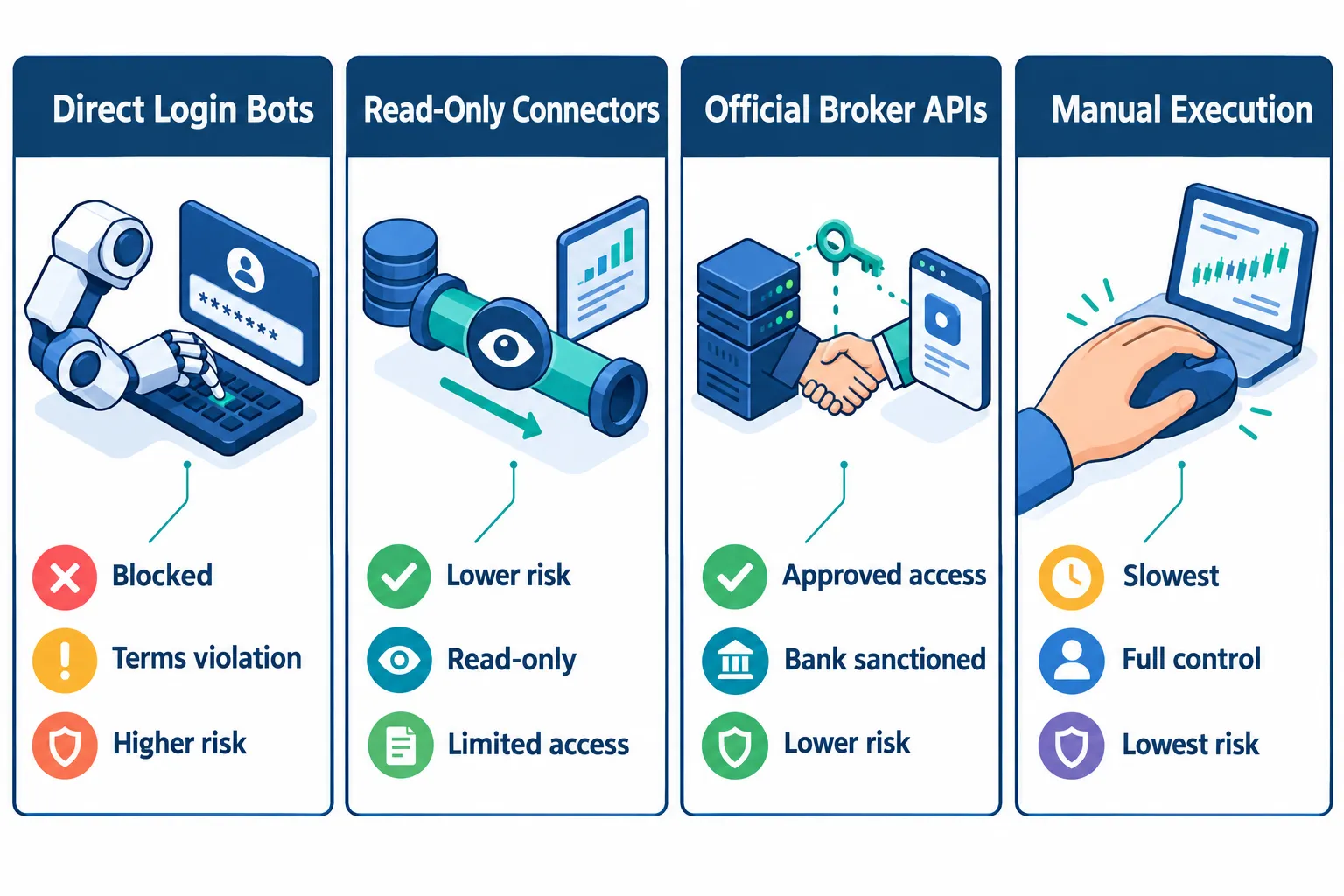
Interactive Brokers, Alpaca, Schwab, Tradier and E*TRADE’s own API all publish sanctioned paths so nobody needs to screen-scrape a login page. IBKR went furthest last week, letting agents trade inside a capped partition. Read what IBKR Autonomous Trading actually permits before you assume your agent is covered.
Three categories, three different futures:
- Official API bots. Scoped keys, documented endpoints, revocable permissions. Lowest exposure. Keep going.
- Read-only aggregators. Pull balances and positions for analysis and place nothing. Still viable under the Citi and JPMorgan carve-outs.
- Credential-driven browser agents. The thing being blocked. Expect friction, account flags and no recourse if something goes wrong.
FINRA is not treating any of this as a new frontier. Its agentic AI guidance describes systems that analyze markets, generate strategies and execute trades, and says technology-neutral rules still apply. There is no carve-out for “the model did it.”
How should you audit your own setup this week?
Open the tool. Look at how it connects. Then act.
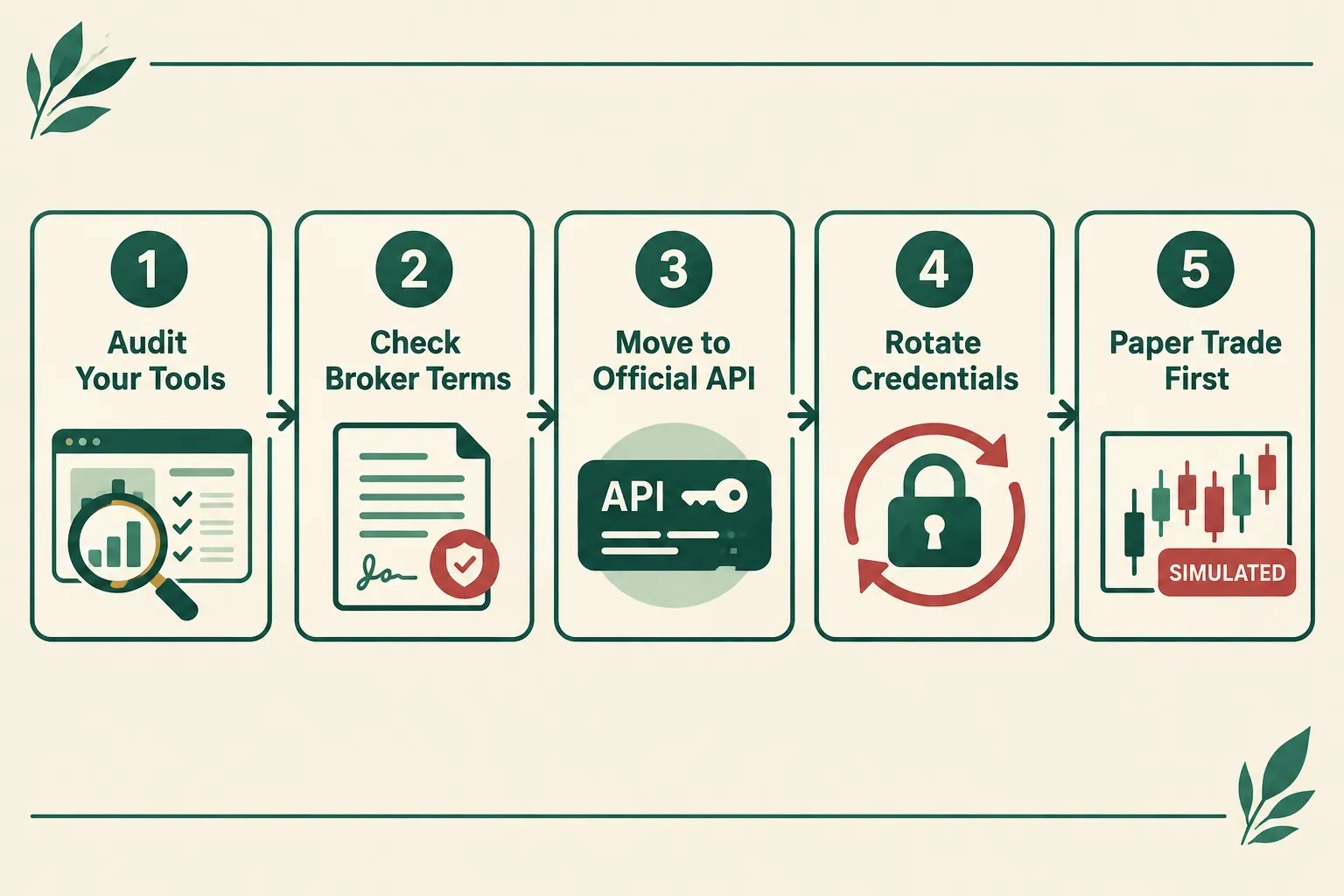
- List every tool holding a credential. Portfolio trackers, tax apps, AI assistants, forgotten browser extensions.
- Sort each into API, read-only connector or password login. If the vendor’s docs are silent, treat it as password login.
- Check your broker’s terms. Search for “automated,” “agent” and “credentials.” Most people never open the agreement.
- Rotate anything shared. Change the password, turn on two-factor, revoke stale sessions.
- Paper trade anything you rebuild. New connection, new behavior. Verify fills and order types in simulation first.
Never paste live API keys into code you did not write and cannot read. The risks of handing an AI agent your account have not changed. Only the consequences got sharper.
Does a read-only connection still do anything useful?
More than most traders expect. Read-only access gives an AI tool your positions, cost basis and trade history. That is enough to flag concentration risk and tell you that 40% of your account sits in one sector.
The thing retail traders keep outsourcing is the one thing they should keep: the decision to press the button. Our agentic trading explainer shows where each broker still wants a human to sign off.
Discipline beats prediction. It also beats delegation.
What should investors watch next?
- October 27, 2026: Robinhood reports third-quarter results. Watch for agentic account numbers and any comment on third-party agent controls.
- October 28, 2026: The CFTC hosts its Frontier Forum on AI trading agents. Agent supervision and liability are fair game.
- November 24, 2026: Wells Fargo’s agentic AI provision takes effect. Read the clause, because it assigns the risk to you.
- Through Q4 2026: Whether Bank of America and Morgan Stanley publish written policies instead of reported positions, and whether brokers such as Fidelity, Robinhood and Webull update their automation language.
Our take
This was coming, and it is the right call. Handing a general-purpose model your bank login is like giving a houseguest your car keys and a vague instruction to “handle errands.” The banks did not ban AI. They banned impersonation.
The traders who get hurt are the ones who built a workflow on a shortcut and called it a system. If your edge disappears because a login method got blocked, that was never an edge. It was a loophole with a subscription fee.
The fix is boring and permanent: official APIs, scoped keys, read-only where execution is not needed, and a human reviewing anything that moves money. Your next step is the five-step audit above, done before Friday’s close.
Does your bot connect the right way, or the way five banks just shut down?
We have tested 200+ AI stock tools since 2022, and every submission is checked before it gets covered.
This article is for education only and is not financial advice. FullStack Alpha does not recommend buying, selling or holding any security. Do your own research and consider a licensed professional before acting.
Sources
- Axios: Unvetted AI agents are accessing U.S. bank accounts (Oct 22, 2026)
- Reuters via Investing.com: US banks are blocking third-party AI agents’ access to customer accounts (Oct 22, 2026)
- Yahoo Finance / Gadget Review: Five major banks are blocking AI agents from logging into customer accounts (Oct 22, 2026)
- The Decoder: Major US banks are locking out AI agents that log in with customer credentials
- Fortune: Jamie Dimon bars outside AI agents from JPMorgan accounts (Oct 15, 2026)
- FINRA: Observations on AI agents
- Robinhood: Third quarter 2026 results date (Oct 27, 2026)
Your market edge starts with the right tool. Stay alpha.
Frequently Asked Questions
Which banks are blocking outside AI agents?
Axios reported on October 22, 2026 that Morgan Stanley, JPMorgan, Citi, Bank of America and Wells Fargo are blocking or restricting third-party AI agents that log in with a customer's own username and password.
Did any of these banks report a breach?
No confirmed breach was reported. A Morgan Stanley spokesperson said the firm had not seen rogue AI agents on its platforms, so its block reads as preventive.
Can an AI tool still see my bank balance?
Often yes. JPMorgan allows read-only data such as balances through a connector like Plaid, and Citi allows limited read-only access through approved open-banking providers.
Does this affect brokerage accounts and trading bots?
The reporting covers bank platforms. Morgan Stanley owns E*TRADE, and most broker agreements already restrict credential sharing, so bots that log in with your password carry the most risk. Bots on official APIs with scoped keys are the safer path.
Who is liable if an AI agent makes a trade or payment I did not want?
That question is still open. Wells Fargo's updated access agreement, effective November 24, 2026, says use of third-party AI agents is at the customer's own risk.
Is this article financial advice?
No. This article is for education only. FullStack Alpha does not recommend buying, selling or holding any security. Do your own research and consider a licensed professional before acting.
The FullStack Alpha research desk tests AI trading bots on paper and live accounts. Reviewed and edited by Jay Rocco, Founder and Editor.
