

The FullStack Alpha research desk tests AI trading bots on paper and live accounts. Reviewed and edited by Jay Rocco, Founder and Editor.
October 19, 2026, 7:50 a.m. ET | By FullStack Alpha Editorial Team | Reviewed by Jay Rocco, Chief Editor
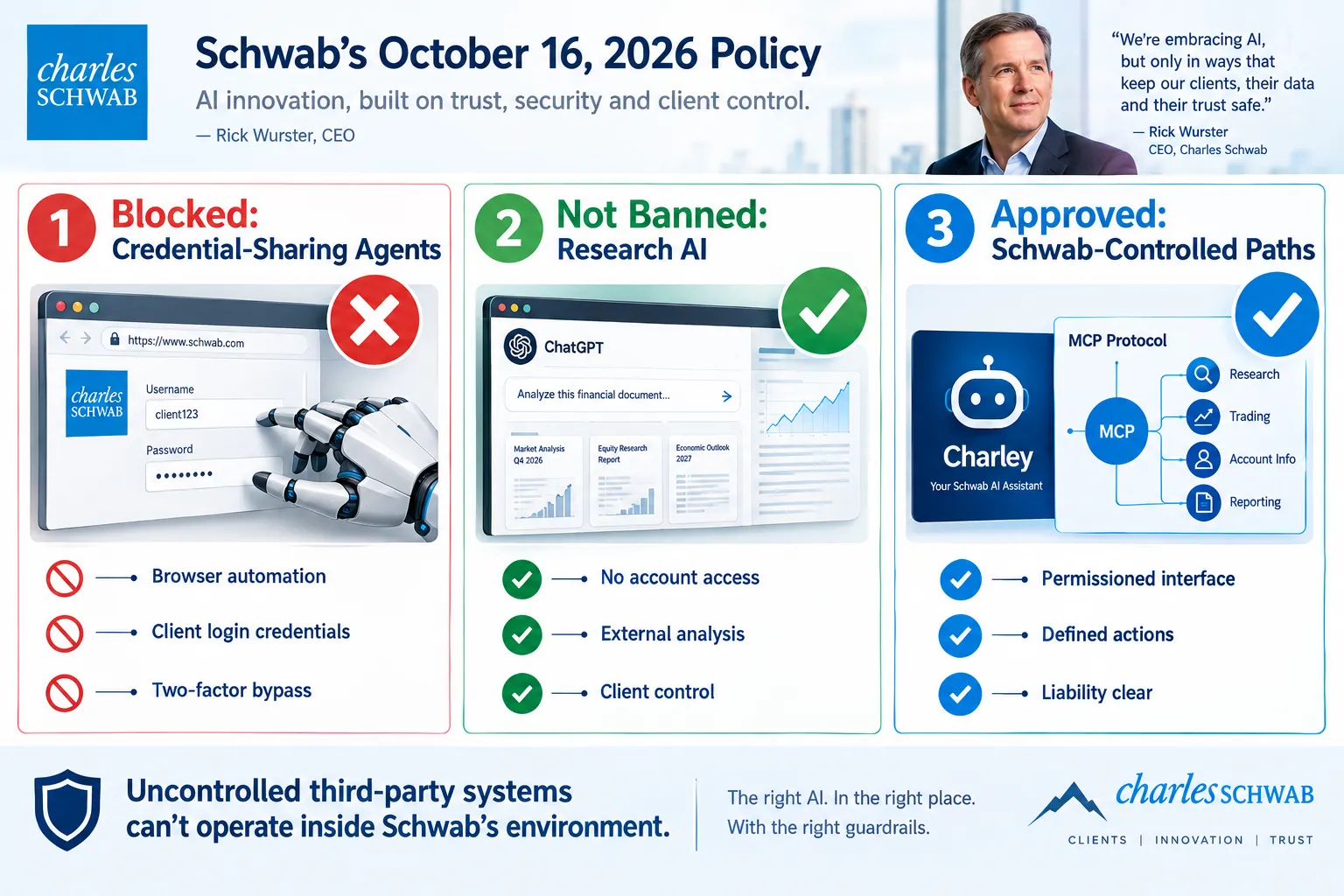
Schwab blocks outside AI agents that sign in with a client’s username and password or drive a browser session inside the account, CEO Rick Wurster said on October 15 and 16, 2026, and those attempts run in the tens and twenties each week. Clients who want AI help get two approved doors instead: Charley, Schwab’s own assistant, and Schwab-controlled MCP servers that can read balances and run research but cannot move money. JPMorgan’s Jamie Dimon drew the same line on October 13. If an AI tool asks for your Schwab password, the answer is now no, and under Schwab’s own Security Guarantee you would carry any loss it caused.
Charles Schwab is kicking third-party AI agents out of client accounts, and it happens dozens of times a week.
Quick answer
Schwab now blocks any outside AI agent that signs in with a client’s username and password or drives a browser session inside the account. Clients who want AI help get Charley, or later a Schwab-controlled MCP connection where outside models can read balances and do research but cannot move money. Read-only research tools are unaffected. Password-sharing bots are done.
Key facts
- Who: Charles Schwab CEO Rick Wurster, speaking to Bloomberg Television and reported October 15 and 16, 2026.
- What is blocked: Schwab blocks outside AI agents using client login credentials or browser automation, including do-it-for-you agents like Meta’s Muse. Wurster said blocked attempts run in the tens and twenties each week.
- Approved path 1: Charley, announced September 30, 2026 and rolling out in phases to eligible U.S. retail clients. It handles information and small admin tasks like an address change.
- Approved path 2: Schwab-controlled MCP servers, where a client’s own model can check balances and run research. Money movement is off the table.
- JPMorgan: on its October 13 earnings call, Dimon said the bank will not let just any outside agent operate inside its systems. A spokeswoman confirmed third parties cannot take customer banking credentials and log in for them.
What exactly did Schwab announce?
Wurster’s point was narrow and worth getting right. Schwab is not banning AI. When Schwab blocks outside AI agents, it is banning uncontrolled third-party software acting inside its systems with a client’s own login.
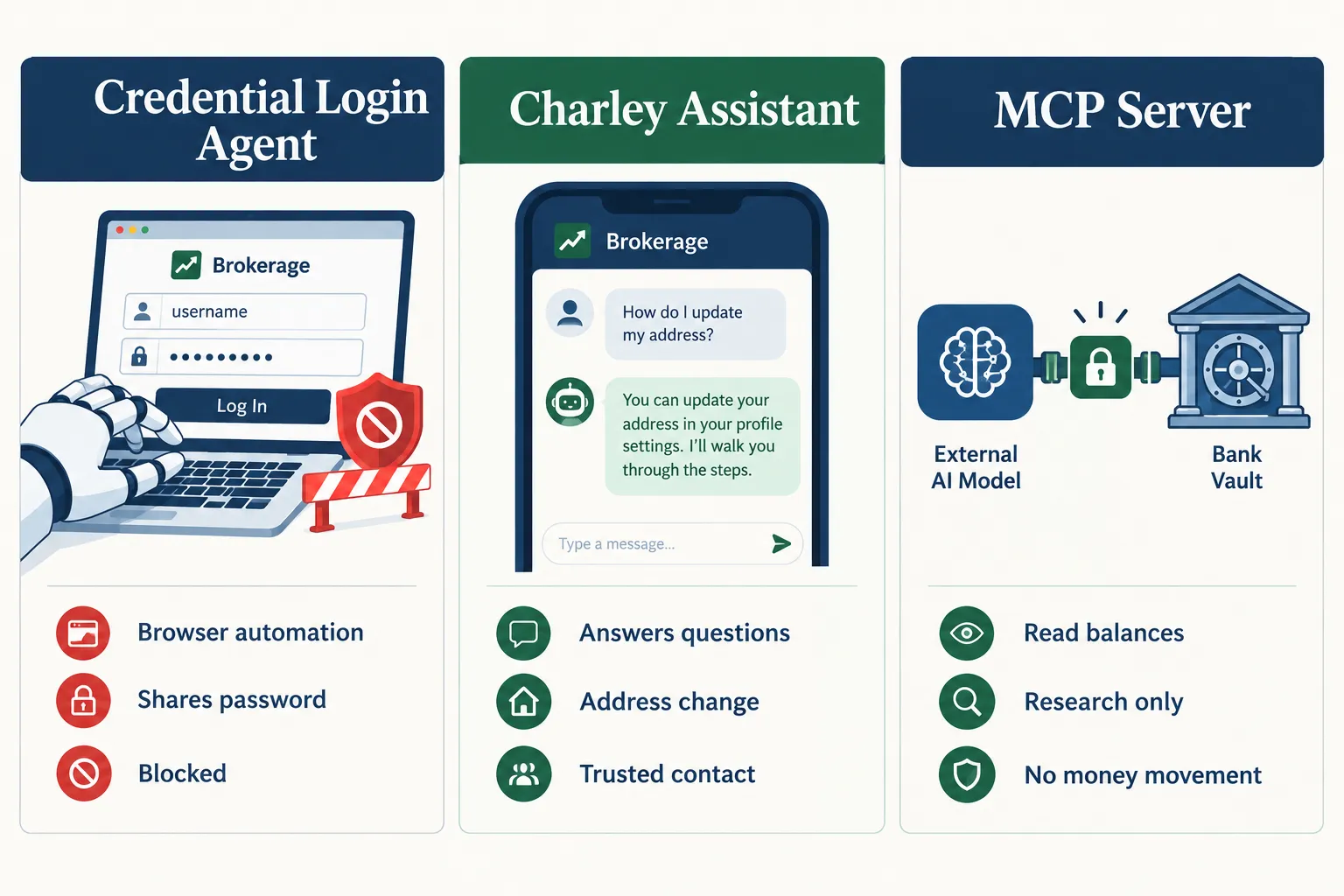
Think of an agent that opens a browser, types your password, clears two-factor and starts clicking around. Schwab flags those sessions and shuts them down.
A chatbot tells you something. An agent authenticates and acts. One is a research tool. The other is a stranger holding your keys.
Wurster said selected large language models can still connect to Schwab, and trading access may expand over time. What stays locked is money movement and credential-based access. Schwab wants to own the permissions, full stop.
Why block the agents instead of warning clients?
Because a warning does not answer the only question that counts: who pays?
Wurster put it plainly: “We can’t control it, the client can’t control it, something could go wrong and who’s liable?” The agent maker? The client who installed it? The broker whose systems it walked through? No one signed anything.
Sharing credentials also defeats the point of two-factor authentication. Handing them to an autonomous agent is the same mistake, just faster.
Not every motive is defensive. Tim Welsh of Nexus Strategies told Financial Planning: “An outside agent works for the client. Charley works for Schwab.” Schwab reported roughly $493 billion in cash-sweep balances in Q3. Keeping the assistant in-house keeps the relationship, the data and that cash inside the firm.
Does giving an AI agent your Schwab login void the Schwab Security Guarantee?
For practical purposes, yes. Read the conditions on Schwab’s Security Guarantee page before you hand a password to anything. The guarantee covers losses from unauthorized activity, and it asks clients to safeguard their account access information, defined to include login ID, password, PIN and transaction codes.
The key sentence: “If you share this information with anyone, we will consider their activities to have been authorized by you.” An AI agent counts as anyone. So the liability question Wurster asked out loud already has a written answer, and it points at the client. Read that way, the reason Schwab blocks outside AI agents looks less like a new policy and more like enforcement of an old one.
The FAQ on the same page goes further. If you authorize account access through a third-party app (except one Schwab has partnered with on its platforms) and that access leads to a loss, the guarantee does not apply. Aggregators and the firms they share your data with are treated as your authorized persons, so what they do with your account is considered authorized by you.
A worked example. You give a browser agent your login so it can rebalance a $40,000 account. It misreads a prompt and sells a position you meant to hold. Under those terms, the sale would count as authorized by you, because you shared the access information. The agent’s maker is a separate fight, on its own terms of service.
Decision rule: never type a brokerage password into an AI product. Use only connections the broker built or partnered with (OAuth apps from Schwab’s developer portal, Charley, or the coming MCP servers), and keep a list of every one you have approved.
What breaks in practice when you move off password access:
- Screen-scraping bots stop working outright. They were built around the login page Schwab now polices.
- Saved passwords stay exposed. Revoking a tool does not delete what it stored. Change the password after you disconnect it.
- API connections expire on purpose. Token refresh is a feature, not a bug, which is why our Schwab API guide spends so long on re-authentication.
What can Charley do, and what can’t it?
Charley pulls Schwab’s research and account information into a chat window, plus a few admin tasks like naming a trusted contact. Placing trades is not on the opening menu, which we flagged in our breakdown of Schwab’s Charley AI assistant.
Here is the access map as of October 2026:
| Access path | Read balances | Run research | Place trades | Move money |
|---|---|---|---|---|
| Charley (Schwab’s assistant) | Yes | Yes | Not at launch | No |
| Schwab-controlled MCP server | Yes, intended | Yes, intended | May expand | No |
| Schwab developer API (OAuth) | Yes | Yes | Yes, with approval | Limited |
| Third-party agent using your password | Blocked | Blocked | Blocked | Blocked |
| JPMorgan via aggregator (read-only) | Yes | n/a | n/a | No |
Table reflects stated company positions as of October 2026 and will change.
Building on Schwab’s developer stack instead? Our Schwab API guide covers why bots on that pipe keep logging themselves out.
How is the MCP path different from sharing a password?
MCP stands for Model Context Protocol, an open standard that lets an AI model connect to an outside system through a defined, permissioned door. Instead of the AI pretending to be you at the login screen, it knocks on a door the broker built, and the broker decides which rooms it can enter.
- Credential sharing: the agent becomes you. Full access, no audit trail separating your clicks from its clicks.
- MCP connection: the broker issues scoped permissions. Read balances, yes. Wire $40,000 out, no.
Scoped access beats total access every time. That rule predates AI by forty years.
What did JPMorgan and Jamie Dimon say?
On the October 13 call, Dimon warned against letting “just any outside agent to come in inside the company” and added, “You don’t want rogue agents, and it could be thousands of them.”
The bank left one lane open. Agents can still reach some account data, such as balances, through aggregators like Plaid. They cannot send money or pay bills.
Two of the largest U.S. financial firms drew the identical line in the same week. That is an industry standard forming in real time.
What does this mean for traders running AI tools right now?
1. Any tool that asks for your Schwab password is now a dead end. Not risky. Blocked. Schwab blocks outside AI agents at the login itself, so the connection will break, and you will have shared your credentials for nothing.
2. OAuth and API-key tools are the surviving category. If a tool connects through an official developer program with a token you can revoke from your broker’s settings, it sits on the approved side of the fence.
3. Read-only AI research is barely touched. Scanners, screeners and filing readers that never log in were always fine.
4. Autonomous execution moves to brokers that allow it in writing. Alpaca and Interactive Brokers have documented programmatic trading for years, and IBKR just opened autonomous AI trading to its first clients. That is a signed arrangement, not an agent faking a browser session.
Run this audit this week. Open your broker’s security settings, review connected apps, revoke anything you do not recognize, and change your password if any AI product has it stored. Ten minutes. Zero cost.
What should investors watch next?
- Charley’s first trade feature. Watch for the announcement that Charley can place a trade, and the guardrails that come with it. Nothing confirmed as of October 19.
- Schwab’s MCP server going live. Wurster described intent, not a shipped product, and until it ships Schwab blocks outside AI agents with no MCP door for outside models. Watch for a published spec with permission scopes.
- The next Schwab earnings call. Q3 already drew attention from the automation crowd, covered in our Schwab Q3 2026 earnings read for bot traders. Expect agent policy questions next time.
- Fidelity, Vanguard, Robinhood and E*TRADE. Two majors have spoken. Robinhood already lets its own agents trade. The rest will have to pick a side.
Our take
Schwab and JPMorgan made the right call, for a mix of good reasons and self-interested ones.
Handing your brokerage login to an autonomous agent is giving a stranger your ATM card and PIN because they promised to be careful. Until someone writes down who is liable when it goes wrong, a broker saying no is doing you a favor it also profits from.
Where we push back: Schwab blocks outside AI agents today while Charley still cannot trade. Clients get the restriction now and the replacement later. Our Charles Schwab review covers what the platform does offer while that gap lasts. The MCP path is the one to watch, because it is the only version that gives clients real choice instead of one house-brand front door.
Next step: keep AI on the research side, keep execution on a connection you authorized and can revoke in one click, and read our checklist of AI trading agent risks before you connect anything new. Every broker policy change like this one lands on AI Stock Trading Bots the week it happens.
If you want a broker that documents programmatic access in writing, our tools directory puts Alpaca vs Public side by side.
Got an AI trading tool that connects the right way, with no password required?
We have tested 200+ AI stock tools since 2022, and every submission gets checked against the broker’s own access rules before we write a word.
This article is for education only and is not financial advice. FullStack Alpha reviews software and reports news. We do not tell you what to buy or sell.
Sources
- American Banker, “Schwab blocks unauthorized AI agents, points clients to Charley,” October 15, 2026 (updated October 16): https://www.americanbanker.com/news/schwab-blocks-unauthorized-ai-agents-points-clients-to-charley
- The Next Web, “Schwab and JPMorgan are blocking AI agents from moving customer money,” October 16, 2026
- Charles Schwab, Schwab Security Guarantee and FAQ: https://www.schwab.com/schwabsafe/security-guarantee
- Cybernews, “JPMorgan blocks outside AI agents from customer accounts,” October 14, 2026: https://cybernews.com/security/jpmorgan-chase-blocks-outside-ai-agents/
- Newsquawk headline, October 16, 2026, 12:38 UTC: https://www.newsquawk.com/headlines/charles-schwab-schw-ceo-says-seeing-record-levels-of-interest-in-fixed-income-brokerage-is-blocking-unauthorised-ai-agents
- Financial Planning, Tim Welsh comments: https://www.financial-planning.com/news/schwab-blocks-unauthorized-ai-agents-points-clients-to-charley
Your market edge starts with the right tool. Stay alpha.
Frequently Asked Questions
Why is Schwab blocking outside AI agents?
CEO Rick Wurster said the issue is control and liability. When an outside agent logs in with a client's password and acts, neither Schwab nor the client controls it, and nobody has agreed who pays if something goes wrong.
Can I still use ChatGPT or Claude for Schwab research?
Yes. Asking a model to explain a filing or a chart touches nothing in your account. The block targets agents that sign in with your credentials or drive a browser session inside your account.
What is Charley?
Charley is Schwab's own AI assistant, announced September 30, 2026 and rolling out in phases to eligible U.S. retail clients. At launch it handles information and small admin tasks, not trades.
What is a Schwab MCP server?
MCP, or Model Context Protocol, is a permissioned connection the broker controls. Schwab says outside models will be able to read balances and run research through it, but not move money. It was described as a plan, not a shipped product, as of October 19, 2026.
Did JPMorgan do the same thing?
Yes. On its October 13, 2026 earnings call, Jamie Dimon said JPMorgan will not let outside agents operate inside its systems. Read-only data through aggregators like Plaid still works, but agents cannot send money or pay bills.
Is this article financial advice?
No. This article is for education only. FullStack Alpha reports news and reviews software, and does not tell anyone what to buy, sell or hold.
The FullStack Alpha research desk tests AI trading bots on paper and live accounts. Reviewed and edited by Jay Rocco, Founder and Editor.
