

Jay Rocco is the Founder and Editor of FullStack Alpha. He has tested 200+ AI stock tools since 2022 and run 15+ AI trading platforms on live accounts with his own money. He reviews the software. He does not tell you what stocks to buy.
Robinhood agentic trading is worth a small, ring-fenced test account and nothing more… at least until the approval defaults and the liability language change. The headline is the warning: Robinhood Agentic Trading Review | It Can Trade Without Your Sign-Off. Robinhood is the only major broker in this wave where human sign-off on an AI order is a setting you can switch off. That one design choice separates it from everything else shipped in 2026. The Full Stack Alpha desk has tested 200+ AI stock tools since 2022, and this is the first one where the AI holds the order ticket.
Quick Answer
Robinhood agentic trading lets you build an AI agent inside the Robinhood app, point it at a dedicated cash-settled account, and have it research, build watchlists, and place trades. Robinhood announced the in-app version on September 29, 2026 at HOOD Summit, with over 150,000 agentic accounts already open and connected agents calling Robinhood tools almost 30 million times a day. Trade approvals are on by default. You can turn them off, and if you do, every dollar of risk sits with you.
Key Takeaways
- More than 150,000 agentic accounts hold $100M+ in assets, per PYMNTS reporting in October 2026.
- Agent Apps run $5 to $30 a month, topping out at $30 for Unusual Whales “Options Trader,” with Nasdaq, SpotGamma, Wendy and Quiver at $10 each, per Robinhood’s launch page.
- Robinhood says it does not “control, supervise, monitor, recommend, or audit” the agents, stated in its own agent overview.
- 57% of investors say they’re uncomfortable with AI acting on their portfolios, per a Vanguard survey reported by Business Insider on October 1, 2026.
- Webull Cloud MCP, tastytrade MCP and IBKR MCP all confirm each order. Robinhood is the outlier.
- The agentic account is cash-settled, so schedulers can run a buy or a sell, not sell-and-buy chains.
- 24/7 weekend equity trading is in the same release, per CNBC, which means an agent can act when you’re asleep.
What is Robinhood agentic trading and who is it for?
It’s an AI agent built inside the Robinhood mobile app that can analyze markets, build a watchlist, and place orders in a separate agentic account. It’s for self-directed traders who already understand position sizing and want to automate research, not for beginners hunting a shortcut.
The difference between a chatbot and an agent is agency. A chatbot answers. An agent reads your request, calls tools, generates an order, and can send it. CoinDesk framed it as retail getting a version of automation that used to live at hedge funds and quant shops.
Who it’s not for: anyone whose honest answer to “what’s my edge” is a shrug. Automating a process you don’t have just means losing money faster, with better latency.
Robinhood agentic trading
Robinhood agentic trading works in three moves: create an agent, choose an underlying large language model, fund the dedicated agentic account. The robinhood agentic trading AI can view data across your other Robinhood accounts but can only trade inside the agentic one, per Robinhood’s agent overview.
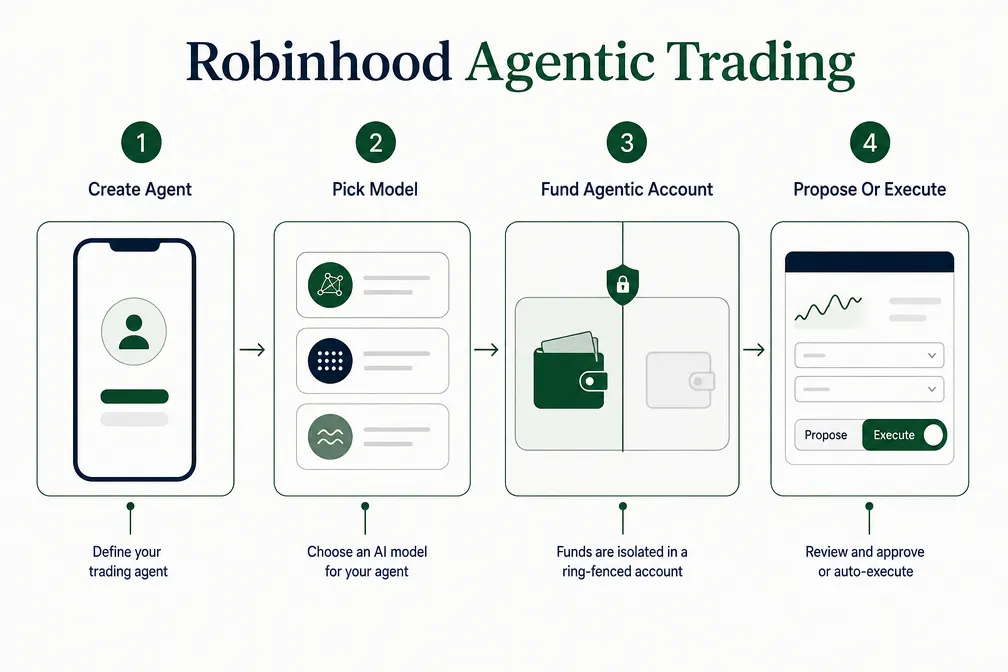
The ring fence is the single best design decision here. You decide how much money crosses into agent territory. That caps the blast radius. It does not cap market risk, execution risk, or the model doing something stupid at 3 a.m.
The May 2026 version only let technically sophisticated users connect outside AI clients through Model Context Protocol tools. The September release put it in the app for everyone eligible in the U.S. Fortune covered the pivot as Robinhood plugging OpenAI and Anthropic models straight into a retail brokerage, which is the actual news. A Fortune 500 broker handing an LLM an order ticket was not on anyone’s 2026 bingo card.
If you want step-by-step setup, our Robinhood Cortex and agent tooling breakdown and our robinhood ai trading bot setup guide cover the mechanics. This piece is the review.
What can the AI actually do inside a Robinhood agentic account?
Inside a Robinhood agentic account the AI can research holdings, build watchlists and strategies, place orders, and with the announced Loops feature, run standing instructions on a schedule. It can’t chain a sell into a buy, because the account is cash-settled and funds need to settle first.
What it does well:
- Pull and summarize data across your accounts without you tabbing between screens.
- Draft a strategy from a plain-English prompt, then show the orders it wants to place.
- Run a scheduled check, for example a morning market scan or an overnight condition.
What breaks: Loops can place, modify or cancel trades while you’re offline, and stopping a Loop does not reverse trades it already placed. Yahoo Finance’s segment on the automation and 24/7 cycle makes the same point: the clock no longer protects you.
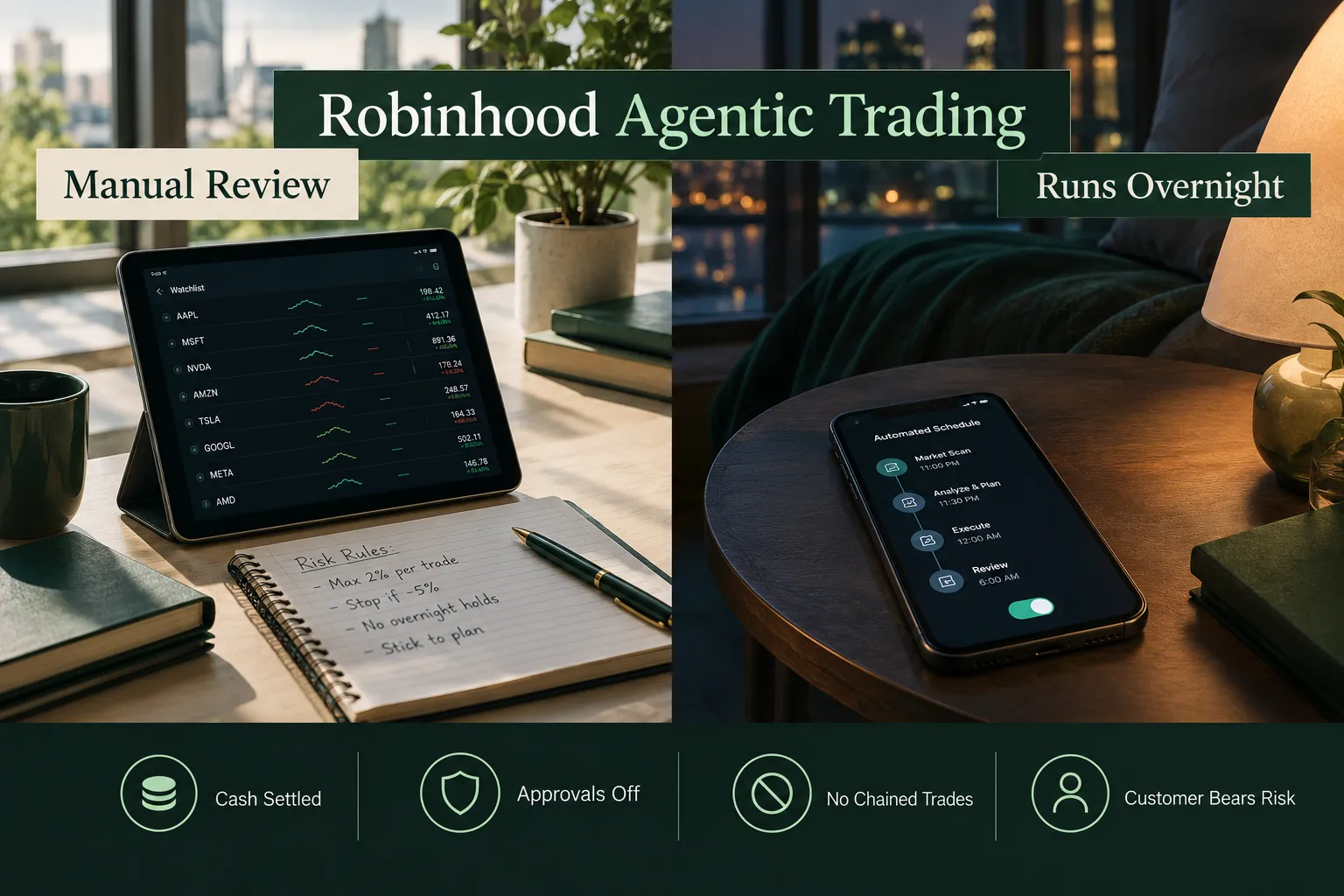
Edge case worth knowing: equities, ETFs and options are the core. Crypto and the new perpetual futures live under separate Robinhood affiliates, and the perps carry up to 10x leverage on BTC and ETH per the launch page. Leverage plus autonomy is a combination that deserves a hard no until you’ve watched the agent behave for months.
How much does Robinhood agentic trading cost and what do the Agent Apps charge?
The agent itself sits inside the Robinhood app, and the paid layer is the Agent Apps marketplace: roughly $5 to $30 per month per app, most with a one-month trial. Robinhood Gold pricing is separate and listed on Robinhood’s own pricing page, which is where you should confirm any number before you subscribe.
| Plan | What you get | Best for | Monthly |
|---|---|---|---|
| Agent + brokerage account | Agent creation, model choice, agentic account trading | Testing the workflow | Included with account |
| Unusual Whales “Options Trader” | Options flow data for the agent | Options-first traders | $30 |
| Nasdaq / SpotGamma / Wendy / Quiver | Market data, gamma levels, sentiment, alt-data | Adding one data edge | $10 each |
| Visual Crossing | Weather data feeds | Commodity-adjacent ideas | $5 |
| Narravance | Transaction and location alt-data | Alt-data experimenters | $8 |
Eleven providers were listed at or shortly after launch, including Token Terminal, SkyFi, Carbon Arc, Fiscal.ai and Quiver Quantitative. Stack four apps and you’re at $60 a month before a single fill. That’s real money against a $2,000 account.
How does Robinhood agentic trading compare to Webull Cloud MCP?
Robinhood is the only broker in this group where order confirmation is a default you can disable. Webull Cloud MCP, tastytrade MCP and IBKR MCP all require a confirmation on each order, which makes them slower and considerably harder to blow up.
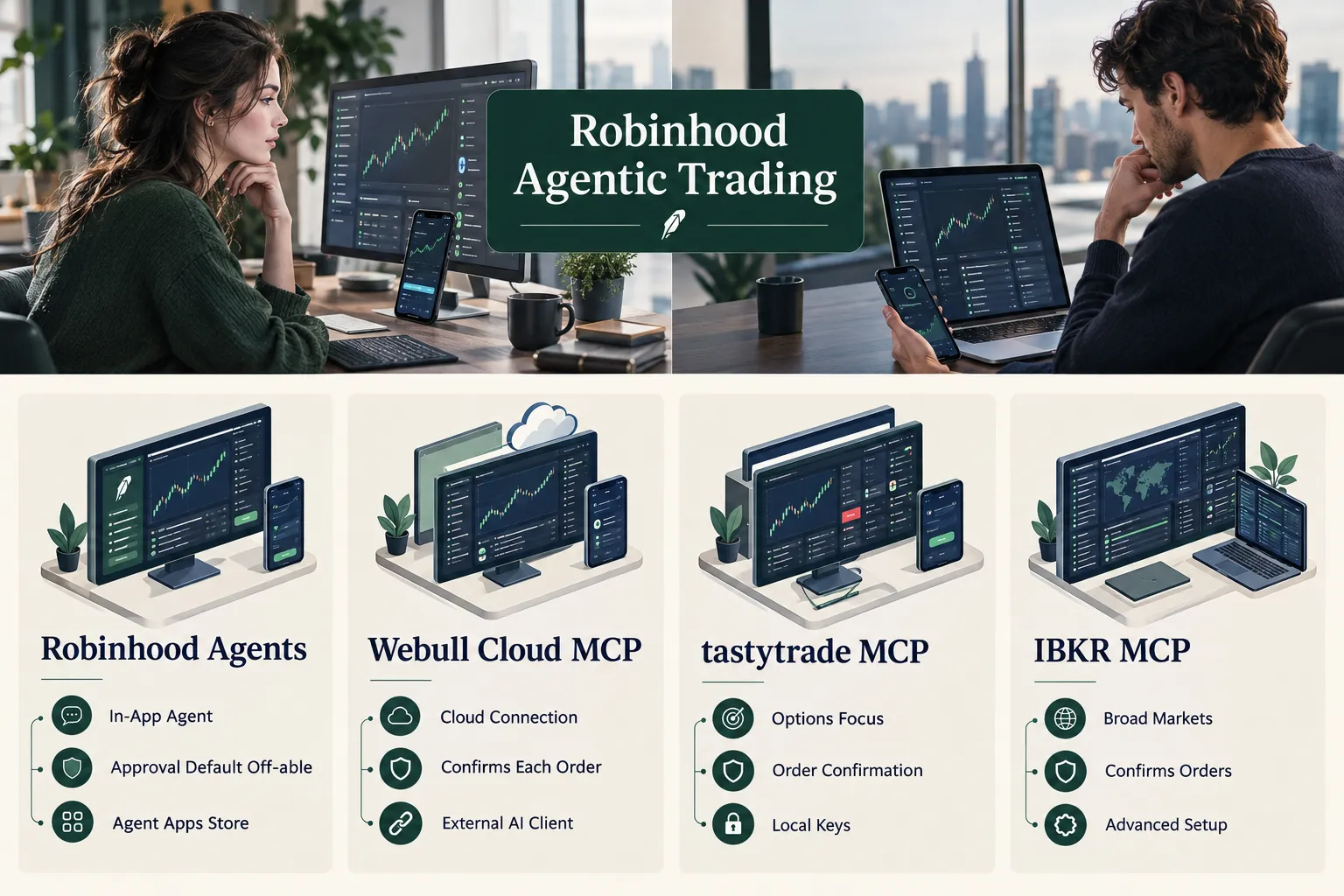
| Broker | AI clients | Order confirmation default | Where login keys live | Cost |
|---|---|---|---|---|
| Robinhood Agents | In-app, choose the model | On, can be switched off | Inside Robinhood | Agent Apps $5 to $30/mo |
| Webull Cloud MCP (Sep 29, 2026) | External MCP client | Confirms every order | Cloud connection | Broker fees |
| tastytrade MCP (Aug 31, 2026) | External MCP client | Confirms every order | Local to your client | Broker fees |
| IBKR MCP (Jul 28, 2026) | External MCP client | Confirms every order | Local to your client | Broker fees |
Decision rule: if you want the AI to do research and you want to press the button, any of the MCP brokers is a cleaner fit. If you specifically want hands-off execution, Robinhood is the only one that offers it, and that’s the whole argument against it too.
What are the risks of letting an AI agent trade your account?
Robinhood Agents is offered through regulated brokerage affiliates, but Robinhood Labs supplies the agent technology and is not a broker-dealer or investment adviser. Robinhood states customers assume all risk for AI agent trades and for how third-party model providers use data.
The risks, plainly:
- All risk is yours. The disclosure language is unusually direct about it.
- No supervision of the agent. Robinhood says it does not audit them.
- Overnight action. With 24/7 equity ambitions and Loops, trades can happen while you sleep.
- Model drift and hallucination. An LLM confidently wrong about a ticker is still an order.
- Data sharing. Your holdings pass through an outside model provider.
Common mistake: people turn approvals off during a calm tape and forget about it before earnings season. A choppy tape plus an unsupervised agent is how a small account gets cooked. If you’ve read our take on what retail traders get wrong about algorithmic AI trading, this is the same failure in a new wrapper.
Who should not use it: anyone under $2,000, anyone who can’t name their stop loss, and anyone treating it as retirement money. This is education, not advice, and an agentic account is not a retirement plan.
Top 5 Favorite Features
The five things that genuinely work: the ring-fenced account, model choice, the Agent Apps marketplace, the approval toggle existing at all, and in-app setup with no external client.
- Ring-fenced agentic account. Caps how much the agent can touch.
- Model choice. You pick the LLM rather than accepting a black box.
- Agent Apps. Paid data feeds the agent can call, with trials.
- Approvals on by default. The safe setting is the starting setting.
- No separate AI product to wire up. Lower friction than MCP setups.
What we like and what we don’t like
Worth paying attention to: the architecture is thoughtful, the pricing is transparent, and the disclosures are honest to the point of being uncomfortable. Worth refusing: disableable approvals and zero agent oversight.
Like: ring-fenced funds, clear Agent App pricing, honest legal language, trials on most apps.
Don’t like: approvals can be switched off with no cooling-off period, and Robinhood provides no auditing or performance reporting on agent decisions. Add a third: cash settlement blocks sell-and-buy chains, so a lot of strategies simply won’t run.
What do real users say on Reddit?
Sentiment on Reddit is mostly hostile, with a thin slice of curiosity. The most-upvoted comments mock the premise rather than the execution. Treat these as sentiment, not performance data.
“I can lose money on my own, thanks.” 713 upvotes, r/StockMarket
“This smells like rugpulls just waiting to happen” 249 upvotes, r/investing
“I’ve seen other people say that so far it’s performed slightly better than SPY but it does carry a small fee that basically makes it a wash.” 64 upvotes, r/investing
“I’m using Claude and I’m up 13% in about 80 days.” 11 upvotes, r/RobinHood
“I can’t get mine to execute trades without me, even with scheduler, etc. Making it useless.” 15 upvotes, r/RobinHood
That last one is the robinhood agentic trading reddit theme nobody expected: half the complaints are that it won’t act, not that it acts too much. The 13% claim is a user claim, 80 days, unverified, and we have not checked it. What to do with these: read them as a warning about expectations, then paper trade it first.
Competitors and alternatives
If you want AI research without handing over the order ticket, the alternatives are better. Robinhood’s advantage is autonomy, which is also its biggest liability.
| Tool | Best for | Key strength | Key weakness | Starting price |
|---|---|---|---|---|
| Robinhood Agents | Hands-off execution | Ring-fenced account, in-app | No agent oversight | Agent Apps from $5/mo |
| Composer | No-code strategy building | Backtest before live | Limited asset coverage | See pricing page |
| Trade Ideas Holly | Intraday scanning | Defined scan logic | Steep learning curve | See pricing page |
| Danelfin | Transparent AI scores | Published factor model | Thin public discussion | See pricing page |
| Trader type | Pick | Why |
|---|---|---|
| Newly active small account | MCP broker with confirmations | Approval friction is a feature |
| Options-focused | Robinhood + Unusual Whales app | Flow data feeds the agent |
| Swing trader with a system | Composer or similar | Backtest, then deploy |
| Research-first investor | AI stock picker tools | Signal without execution |
Our broader work on whether AI trading bots actually make money and AI trading bots to know before you automate is the sanity check to read next.
Our Take
Robinhood built the most capable retail agent of 2026 and bolted it to the most dangerous default. Keep approvals on, fund the agentic account with money you can lose, and let it propose trades for 30 days while you log what you would have done differently. Discipline beats prediction, and it beats automation too.
Can you turn it off? Yes. Switching the approval toggle back on, or moving cash out of the agentic account, stops autonomous execution immediately. Trades already placed stay placed.
Built a bot, or paying for one you’re not sure about? Send it in. Every submission gets checked before it gets covered. Submit your bot: https://aistocktradingbots.com/contact/?topic=submit-bot
FAQ
How does Robinhood agentic trading work?
You create an agent in the app, pick an underlying large language model, and fund a dedicated agentic account. The agent reads market and portfolio data, proposes trades, and with approvals disabled can place eligible orders itself. The account is cash-settled, so sell-and-buy chains won’t run.
How to use Robinhood agentic trading?
Open the Robinhood app, create an agent, choose its model, and move a small amount into the agentic account. Leave trade approvals on, give the agent a plain-English instruction, and review every order it proposes. Our setup guide walks through it step by step.
What is a Robinhood agentic account?
It’s a separate, cash-settled brokerage account that the AI agent is allowed to trade in. The agent can see data across your other Robinhood accounts but can only place orders inside this one, which caps how much money the agent can ever touch.
Is Robinhood agentic trading safe?
It’s regulated brokerage infrastructure with an unregulated decision-maker on top. Robinhood says it does not supervise or audit agents and that all risk falls on the customer. The safety levers are yours: keep approvals on, fund it small, and treat every agent idea as a proposal.
What do the Agent Apps cost?
Agent Apps run about $5 to $30 per month each, most with a one-month trial. Unusual Whales “Options Trader” is $30. Nasdaq, SpotGamma, Wendy and Quiver are $10 each. Visual Crossing is $5 and Narravance is $8. Confirm current figures on Robinhood’s official pages before subscribing.
Can the AI trade without my approval?
Yes, if you switch approvals off. Approvals are on by default, and some trades still require manual submission. Robinhood says it does not supervise or audit agents and that all risk falls on the customer. Webull Cloud MCP, tastytrade MCP and IBKR MCP confirm every order instead.
Conclusion
This is the most interesting broker product of 2026 and the one that most deserves a slow hand. The architecture protects your main accounts. The defaults protect you until you turn them off. Nothing protects you from a model that sounds certain and is wrong.
Next step: fund a small agentic account, leave approvals on, and keep a written log of every trade the agent proposed and whether you’d have taken it. After 30 days you’ll know whether this is signal or noise.
Prices are subject to change in this fast AI market. If a number moved, blame the robots, or Black Friday.
This article is education, not financial advice.
Your market edge starts with the right tool. Stay alpha.
Frequently Asked Questions
How does Robinhood agentic trading work?
You create an agent in the app, pick an underlying large language model, and fund a dedicated agentic account. The agent reads market and portfolio data, proposes trades, and with approvals disabled can place eligible orders itself. The account is cash-settled, so sell-and-buy chains won't run.
How to use Robinhood agentic trading?
Open the Robinhood app, create an agent, choose its model, and move a small amount into the agentic account. Leave trade approvals on, give the agent a plain-English instruction, and review every order it proposes.
What is a Robinhood agentic account?
It's a separate, cash-settled brokerage account that the AI agent is allowed to trade in. The agent can see data across your other Robinhood accounts but can only place orders inside this one, which caps how much money the agent can ever touch.
Is Robinhood agentic trading safe?
It's regulated brokerage infrastructure with an unregulated decision-maker on top. Robinhood says it does not supervise or audit agents and that all risk falls on the customer. The safety levers are yours: keep approvals on, fund it small, and treat every agent idea as a proposal.
What do the Agent Apps cost?
Agent Apps run about $5 to $30 per month each, most with a one-month trial. Unusual Whales Options Trader is $30. Nasdaq, SpotGamma, Wendy and Quiver are $10 each. Visual Crossing is $5 and Narravance is $8. Confirm current figures on Robinhood's official pages before subscribing.
Can the AI trade without my approval?
Yes, if you switch approvals off. Approvals are on by default, and some trades still require manual submission. Robinhood says it does not supervise or audit agents and that all risk falls on the customer. Webull Cloud MCP, tastytrade MCP and IBKR MCP confirm every order instead.
Jay Rocco is the Founder and Editor of FullStack Alpha. He has tested 200+ AI stock tools since 2022 and run 15+ AI trading platforms on live accounts with his own money. He reviews the software. He does not tell you what stocks to buy.
