

The FullStack Alpha research desk tests AI trading bots on paper and live accounts. Reviewed and edited by Jay Rocco, Founder and Editor.
By FullStack Alpha Editorial Team | Reviewed by Jay Rocco, Chief Editor
Agentic trading is trading where an AI agent plans and carries out several steps toward a goal (pull data, screen, draft an order and, if the broker allows it, place it) instead of answering one question at a time. In 2026, Robinhood, Webull, Tradier and Alpaca all let an AI agent connect to your account, but they draw the line in different places: Webull requires you to confirm every order in its app, Robinhood confines agents to a dedicated Agentic account with approvals on by default, and Tradier and Alpaca let a connected agent send orders with paper modes you switch on yourself. FINRA’s 2026 oversight report names the risks, from agents that “act without human validation” to misaligned incentives. Start agentic trading in paper mode, keep approval on, and cap how much money the agent can reach.
Key insights
- Agentic trading chains research, screening, order drafting and sometimes execution; classic algorithmic trading runs fixed, pre-coded rules.
- Webull’s Cloud MCP creates order instructions that require confirmation in the Webull app or desktop, per Webull’s developer docs.
- Tradier’s MCP server can place equity, multileg option, OCO, OTO and OTOCO orders, and its docs describe no built-in confirmation step.
- Alpaca’s MCP server offers $100,000 in simulated funds, and you go live by swapping API keys.
- FINRA defines AI agents as systems “capable of autonomously performing and completing tasks on behalf of a user” and flags six risk areas, summarized below.
What Is Agentic Trading?
Agentic trading is the use of AI agents that pursue a goal across several steps, deciding what to look up and what to do next, rather than returning a single answer. Ask a chatbot for Apple’s P/E ratio and you get a number. Give an agent the goal “flag oversold large-cap tech names and draft limit orders,” and it pulls data, filters it, builds orders and hands them to you, or sends them if you have allowed that.
That chaining is the whole story. One step is a lookup. Several steps toward a goal, with the model choosing the next step, is an agent.
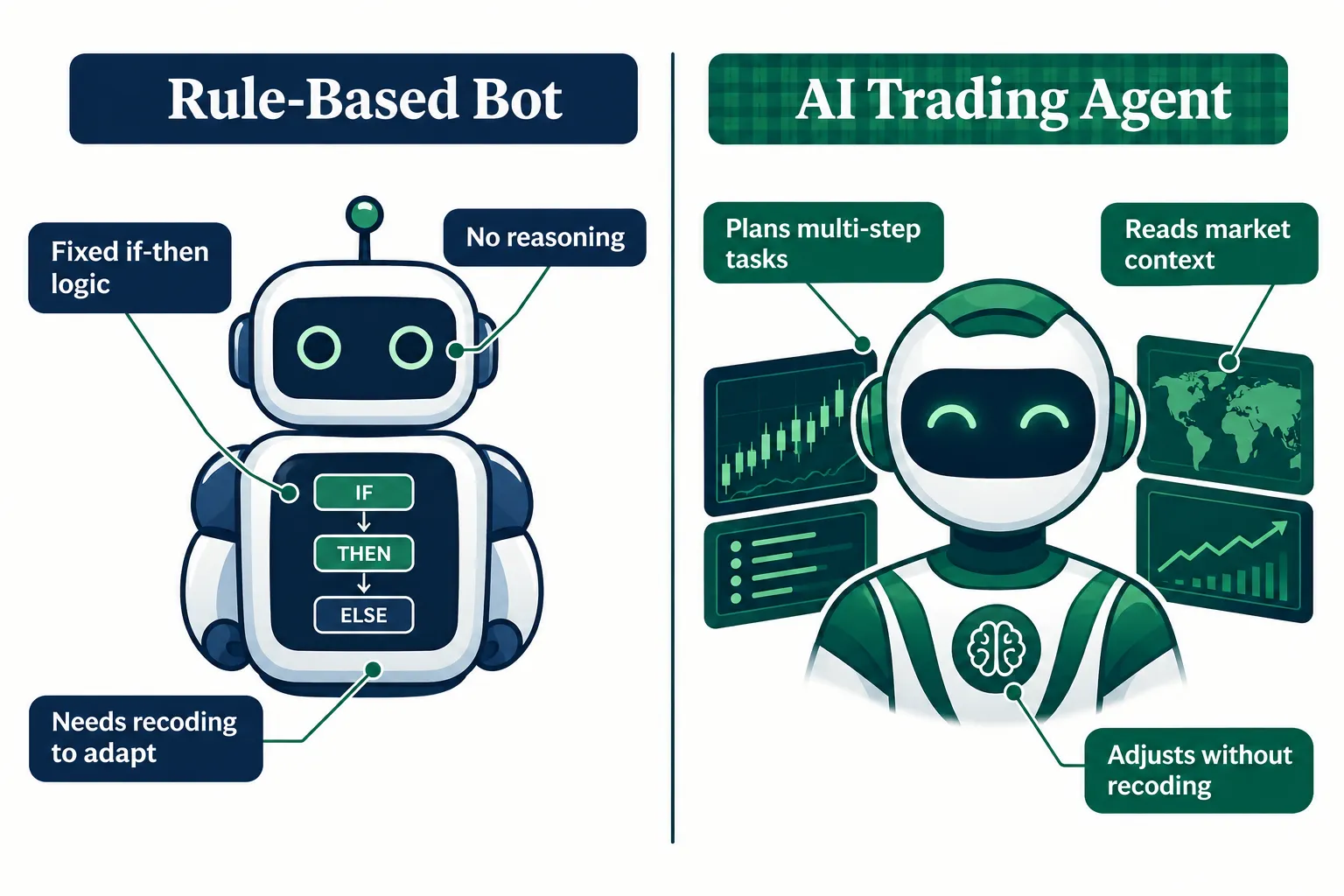
How is an AI agent different from a trading bot?
A trading bot runs fixed rules: if price crosses the 50-day average, buy 100 shares. An AI agent reads a goal in plain language and works out the steps itself, adapting when something unexpected comes up.
Think of a thermostat versus a building manager. The thermostat does one thing when the temperature hits a number. The building manager weighs occupancy, weather and cost and decides what to do, including in situations no one planned for. That flexibility is the appeal. It is also where the risk lives, because flexible reasoning is harder to audit than a fixed rule. A bot is predictable and dumb. An agent is adaptable and harder to audit. Neither is automatically better; they fail in different ways, and you test them differently.
What does FINRA say about AI agents?
FINRA’s 2026 Annual Regulatory Oversight Report, released December 9, 2025, defines AI agents as “systems or programs that are capable of autonomously performing and completing tasks on behalf of a user.” The report does not ban or bless agentic trading. It names where firms should look for trouble:
- Autonomy and scope creep: agents “may act without human validation” and may exceed the user’s intended scope or authority.
- Auditability and transparency: long chains of agent actions can be hard to reconstruct.
- Sensitive data: agents may retain or reveal sensitive or proprietary data.
- Domain knowledge: general-purpose agents may lack the industry knowledge complex tasks need.
- Misaligned incentives: poorly designed reward functions can lead agents to optimize in ways that harm investors, firms or markets.
- General AI risks: bias, hallucinations and privacy still apply.
The report is written for broker-dealers, not retail traders. But every item on it is a question you should ask before you connect an agent to your own account.
How Can Agentic AI Be Used in Trading?
Agentic AI in trading usually does four jobs: data lookup, screening, order drafting and, where the broker allows it, order placement. Each layer adds autonomy, and each is a separate choice about how much control you hand over.
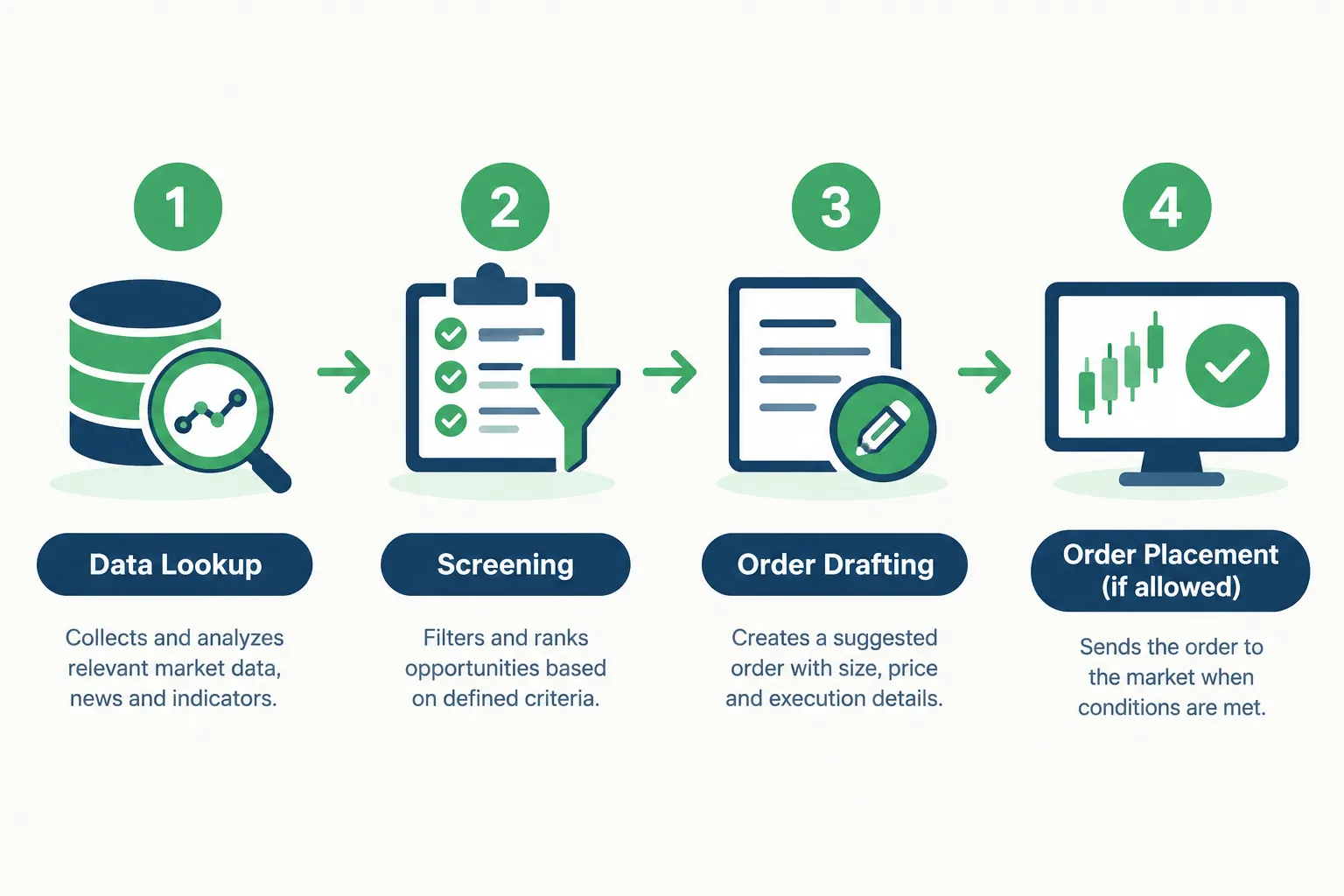
- Data lookup: positions, balances, buying power, order history and quotes, pulled on request.
- Screening: filtering stocks or options against criteria you describe in plain English.
- Order drafting: the agent builds a specific order (ticker, size, type, limit, stop) and shows it to you.
- Order placement: the agent submits the order, after your confirmation or on its own if you have allowed it.
Only the last step risks money without a click from you. Everything before it is research. Most agent setups in 2026, even at brokers marketing “autonomous” features, still keep a human at that last step by default.
What a good agentic trading task looks like
Vague goals produce vague, risky behavior. A tight task has five parts:
- Universe: “the 30 largest US tech stocks by market cap.”
- Signal: “RSI(14) under 30 on the daily chart and price above the 200-day average.”
- Action: “draft a limit buy at the prior close, 2% of account value, with a stop 5% below entry.”
- Boundary: “do not submit orders; do not trade anything outside the universe.”
- Report: “list each draft with the data timestamp and the source of every number.”
That task is the difference between an assistant and a loose cannon. FINRA’s “scope creep” risk is exactly what happens when step four is missing.
How Is Agentic Trading Different From Algorithmic Trading?
Algorithmic trading executes rules a human wrote in advance; an agent decides some of the steps itself. That one difference changes how you test, audit and trust the system.
| Question | Algorithmic bot | AI agent |
|---|---|---|
| Who writes the logic? | You, in code, before it runs | You set a goal; the model picks steps at run time |
| Same input, same output? | Yes, every time | Not guaranteed; wording and model version can change the answer |
| How do you test it? | Backtest the exact rules on history | Paper trade the whole loop, log every decision, repeat |
| What breaks it? | Market regime changes the rules did not expect | Bad data, ambiguous instructions, injected text, model updates |
| How do you audit a bad trade? | Read the rule that fired | Read the log of what the agent saw and why it acted |
The practical answer for most traders is a hybrid. Let deterministic code own the parts that must never change (position size, stops, daily loss limit, the list of tradable symbols), and let the agent handle the parts that benefit from judgment (reading filings, summarizing news, drafting candidates). That is how the most careful public builds work, and it maps cleanly onto FINRA’s concern that agents “may act without human validation.”
Why backtests matter less for agents
A rule-based strategy can be backtested over ten years in minutes. An agent cannot, at least not honestly, because the model has read about much of that history in its training data and because its answers vary run to run. Paper trading forward is the only clean test. Plan on weeks, not hours, and keep the model version fixed while you test.
What Do 4 Brokers Let an AI Agent Do?
Robinhood, Webull, Tradier and Alpaca all support AI agents in 2026, but the asset coverage, approval model and paper mode differ sharply. The table reflects what each broker’s own pages say in 2026. Where a page does not state something, we say so instead of guessing.
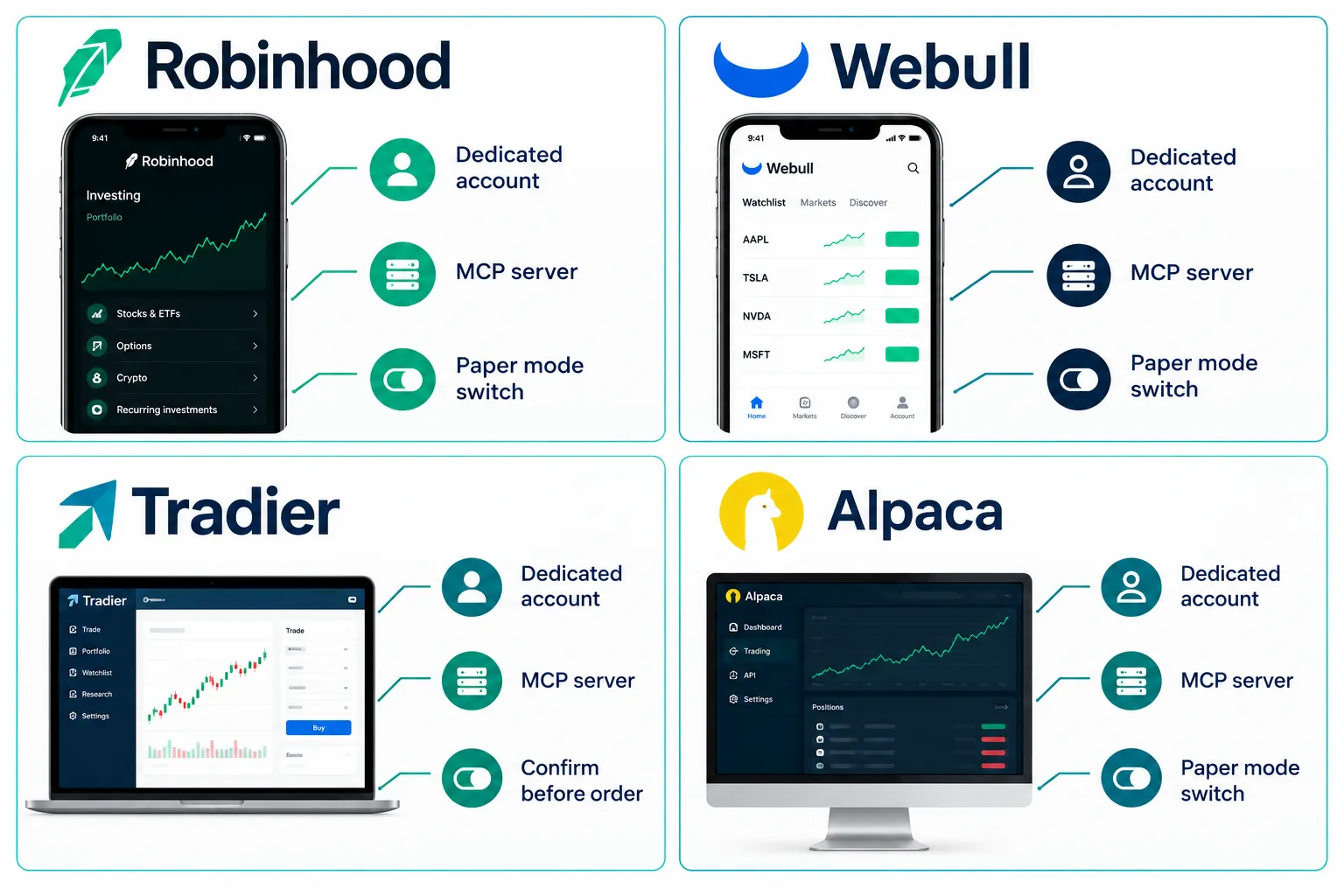
| Feature | Robinhood | Webull | Tradier | Alpaca |
|---|---|---|---|---|
| How agents connect | In-app agent, or external agents via Robinhood's Trading MCP | Cloud MCP at api.webull.com/mcp, OAuth sign-in, no API keys | MCP at mcp.tradier.com/mcp with your API token | MCP server you run with uv and your API keys |
| Assets | Equities, options, crypto | Stocks, ETFs, single and multi-leg options, futures, crypto, event contracts | Equities, single-leg and 2 to 4 leg options | Fractional equities, ETFs, multi-leg options, crypto |
| Order types noted | Depend on asset and account eligibility | Order instructions, confirmed in app | Equity, option, multileg, OCO, OTO, OTOCO, cancel | Standard and multi-leg options |
| Paper mode | Not mentioned on the agents page | Not mentioned on the MCP page | Yes, PAPER_TRADING true with a paper token | Yes, $100,000 simulated; live by swapping keys |
| Approval step | Approvals on by default; you can turn them off | Every order confirmed in the Webull app or desktop | No confirmation step described in the docs | Shows every prompt, parameter and order payload |
| Cost notes | In-app agent chat billed from a prepaid token balance | Not stated; US eligible users only | Some AI clients need a paid plan for MCP | Free paper; paid SIP data optional |
Robinhood: a separate account and approvals on
Per Robinhood’s agents overview, you can build an agent in the Robinhood app or connect an external one through Robinhood’s Trading MCP. Either way, it trades only in a dedicated Agentic account that you fund; it can view your other Robinhood accounts but not trade in them. Supported assets are equities, options and crypto. Trade approvals are on by default, and you can turn them off.
Robinhood is blunt about who owns the risk: “Robinhood does not control, supervise, monitor, recommend, or audit agents,” and “You are responsible for your agent’s actions.” Chatting with the in-app agent uses tokens paid from a separate prepaid balance. An earlier draft said customers can open up to 10 agentic accounts; the agents page we checked does not state a number, so we removed it. More detail in our Robinhood agentic trading review.
Webull: confirm every order in the app
Webull’s Cloud MCP connects ChatGPT, Claude and Grok, plus coding tools such as Codex and Cursor, through an OAuth sign-in. You do not manage API credentials, and you choose which accounts (cash, margin, IRA, futures) and which capability groups to share. Trading tools create order instructions that require confirmation in the Webull app or desktop, and you can revoke pending instructions.
Webull’s September 29, 2026 press release expanding Cloud MCP says “Each trade requires separate customer confirmation before an order can be submitted to the market” and limits availability to eligible US users. That makes Webull the most human-in-the-loop design of the four. Setup steps are in our Webull API and MCP guide.
Tradier: full order types, no confirmation step documented
Tradier’s MCP docs list a server at mcp.tradier.com/mcp that works with ChatGPT, Claude (web and desktop), Claude Code, Gemini CLI and Cursor. You authenticate with your Tradier API token. A PAPER_TRADING setting picks the environment: a paper token with true, or a live token with false.
The tool list is broad: balances, positions, orders, quotes, options chains with Greeks, and trading tools for equity orders, single-leg and 2 to 4 leg option orders, OCO, OTO and OTOCO orders, and cancellations. The docs do not describe a confirmation step, so any approval has to come from your AI client’s settings or your own habits. An earlier draft dated Tradier’s MCP to December 22, 2025; the docs page we read shows no launch date, so we left the date out.
Alpaca: paper first, live by swapping keys
Alpaca’s MCP server page lists fractional equities, ETFs, multi-leg options and crypto, with paper trading on “$100K in simulated funds and real market data.” You need Python 3.10 or higher, the uv package manager, Alpaca API keys and an MCP client. The page promises you can “See every prompt, parameter, and order payload before anything goes to market.” You switch to live by updating your API keys.
Per the open-source server’s README, ALPACA_PAPER_TRADE defaults to true, and ALPACA_TOOLSETS lets you disable groups such as trading for a read-only agent. One honest caution: because live is just a key swap, one wrong copy-paste moves you from fake money to real money. Keep live keys out of the same config file during testing. Our Alpaca API for beginners guide covers key handling.
Does Robinhood agentic trading include options?
Yes. Robinhood’s agents page lists equities, options and crypto as supported asset classes, and says available order types depend on the asset and your account’s trading eligibility. The page does not break out which options strategies an agent can place, so check your own account settings before relying on it for spreads.
Does the TradingView MCP place orders?
Not according to what we found. TradingView’s MCP server entered public beta on September 16, 2026, for paid plans from Essential up, per this report on TradingView’s news feed. It exposes quotes, historical data, screeners, watchlists, alerts, fundamentals and news, with delayed data and a limit of about 100 tool calls per minute. The report mentions no order execution or broker account access. Use it as a research layer and pair it with a broker connection for orders.
Beyond these four brokers
Agentic trading is spreading fast. Interactive Brokers has invited a first group of clients to let AI agents trade on their own (see our IBKR autonomous AI trading story), and Public offers its own AI agents. Each sets its own approval rules, so read the agent terms before you connect. For a nine-broker comparison, see AI trading platforms that connect to your broker.
What Are the Risks of Agentic Trading?
The core risks in agentic trading map onto FINRA’s list: acting without approval, exceeding scope, untraceable reasoning, mishandled data, weak domain knowledge and misaligned goals. Each has a real-world version worth picturing before you connect a funded account.
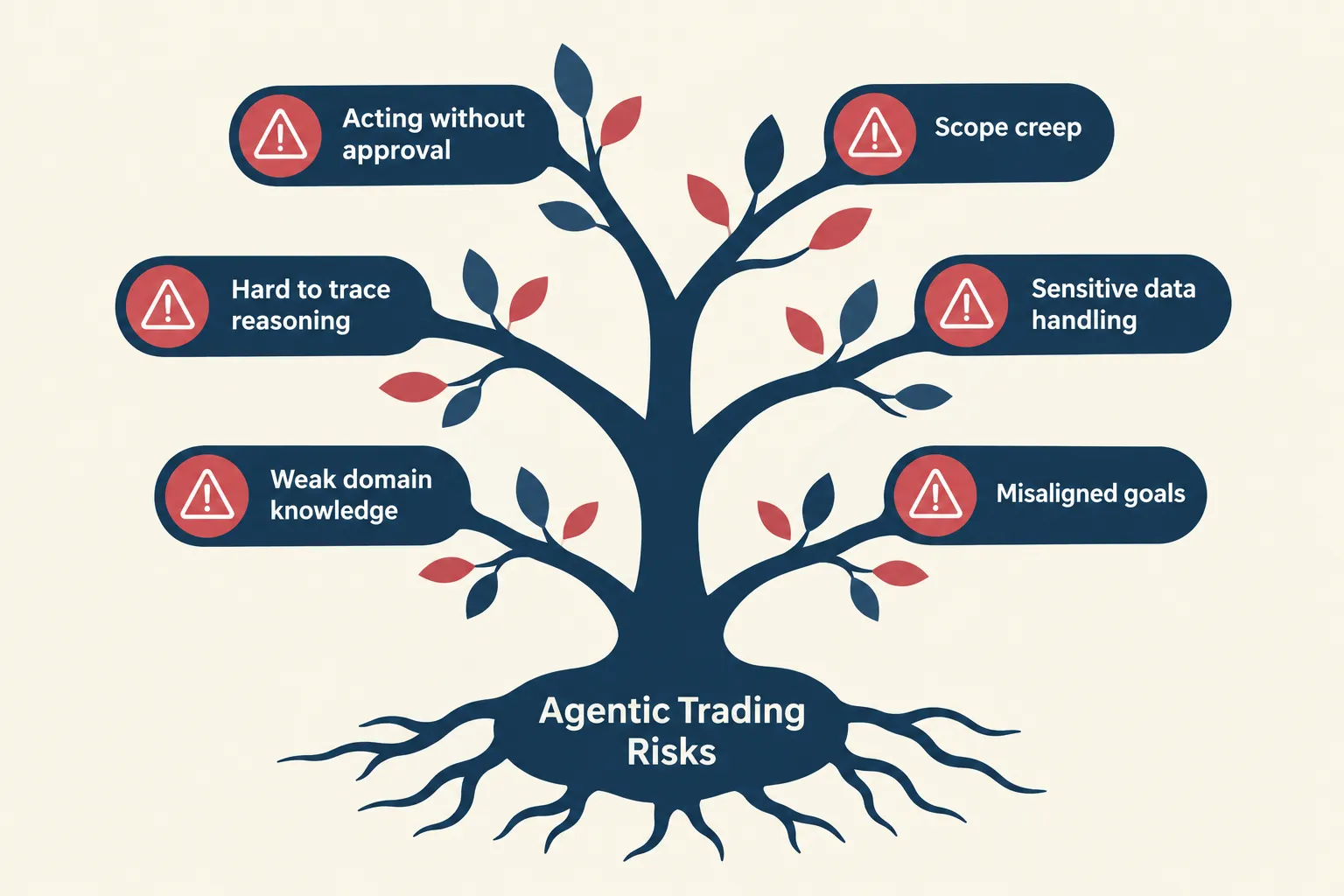
- Acting without approval: the agent places a trade you would have skipped. This is why Robinhood ships approvals on and Webull forces confirmation.
- Exceeding scope: you asked for large-cap tech and it drafts small-cap orders because the model decided they were “related.”
- Untraceable reasoning: the agent made a call and you cannot reconstruct why, so you cannot fix the real mistake.
- Data handling: balances and holdings now flow through a third-party AI connection. Webull and Robinhood let you limit which accounts an agent sees; use that.
- Weak domain knowledge: a model can sound confident about implied volatility and still be wrong. Fluent is not correct.
- Misaligned goals: you wanted steady risk control; the agent optimized for “find opportunities,” which quietly turns into overtrading.
One more risk FINRA’s list implies but traders feel first: prompt injection. An agent that reads news, filings and social posts is reading text written by strangers, and some of it can contain instructions. Keep untrusted text away from any agent that holds order permissions.
Market truth: none of this is a reason to avoid agents. It is a reason to treat it like margin or options, a tool that multiplies both your discipline and your mistakes. Our AI trading agent risks guide explains why your kill switch should live outside the agent.
What Does an AI Trading Agent Cost to Run?
The broker connection is usually free. The costs hide in three other places: the AI model, the market data and the trades themselves.
- The model. If you run your own agent through an API, you pay per token. Anthropic’s API pricing page, for example, lists Claude Sonnet 5.5 at $2 per million input tokens and $10 per million output tokens. An agent that reads 150,000 tokens and writes 10,000 per session costs (0.15 x $2) + (0.01 x $10) = $0.40 a session. Five sessions a trading day for 21 days is $42 a month.
- The app plan. Tradier’s docs note that some AI clients need a paid subscription to use MCP at all. Robinhood bills in-app agent chat from a separate prepaid token balance.
- Market data. Alpaca’s free plan uses the IEX feed; the full consolidated feed is a paid upgrade, so check which feed your agent is actually reading before you trust its quotes.
- Trading costs. Commissions, spreads and, for options, per-contract fees still apply, and an agent that trades more often pays them more often.
On a $2,000 agent account, $42 a month is a 2.1% monthly hurdle before the agent earns anything. That is the quiet reason small accounts struggle with always-on agents: the research is cheap per run and expensive in total. Run fewer, better sessions, and use your broker’s own free tools (screeners, alerts) for anything that does not need a model.
What Guardrails Should You Set Before an Agent Touches Money?
Set five guardrails before any agent connects to a funded account: paper mode first, approval on every order, a hard funding cap, alerts on every action and a kill switch you can hit in seconds. Each one closes a hole from the risk list above.
| Guardrail | Problem it fixes | Where the brokers help |
|---|---|---|
| Paper trading first | Catches bad logic before real money | Tradier PAPER_TRADING, Alpaca paper keys |
| Approval on every order | Stops actions you did not see | Webull app confirmation; Robinhood approvals on by default |
| Hard funding cap | Limits damage from scope creep | Robinhood’s separate Agentic account you fund |
| Alerts on every action | Closes the audit gap in real time | Order notifications in each broker app |
| Kill switch | Immediate stop | Revoke the MCP connection or API key |
Worked example: sizing the funding cap
Say your total brokerage balance is $40,000 and you decide an agent may control no more than 5% of it. Fund the agent’s account with $2,000 and nothing more.
- If you also cap each order at 10% of the agent account, the largest single order is $200.
- If you add a daily loss limit of 3% of the agent account, the agent stops for the day after losing $60.
- In the worst realistic week (five straight days at the limit), the agent loses about $300, or 0.75% of your total balance.
Compare that with letting an agent trade a $40,000 margin account directly: the same 3% daily limit is $1,200 a day. The separate, small account is what turns an agent’s bad week into a lesson instead of a disaster. Robinhood’s dedicated Agentic account is built for exactly this; at other brokers, open a separate small account yourself.
Which Agentic Trading Setup Should a Beginner Start With?
Beginners should start agentic trading in a paper account, with Alpaca’s simulated funds or Tradier’s paper token, and keep any live connection read-only until the agent has proven itself over weeks.
Pick Alpaca if you are comfortable installing Python tools and want $100,000 in simulated funds on day one. Pick Tradier if you want the widest set of order types and support for Claude Code, Gemini CLI and Cursor. Pick Webull if you want every order to stop for your confirmation in the app, and you are a US user. Pick Robinhood if you want an agent built into the app and are happy with a separate funded account.
Whichever you choose, the process is the same:
- Connect in paper or read-only mode.
- Give the agent one tight task with a universe, signal, action, boundary and report.
- Log every action, the reason and the data timestamp for at least four weeks.
- Review weekly and change one thing at a time.
- Go live only with a small, separately funded account and approvals on.
Process over prediction applies to machines too. The broker you pick matters less than the habits you build in the first month: tight tasks, small accounts, approvals on, and a log you actually read. If you want the API side compared head to head, see our Alpaca vs Tradier vs IBKR breakdown.
What to log during a paper test
Your log is the audit trail FINRA says agent chains often lack. For every action, record:
- Timestamp, model name and version
- The exact task or prompt the agent was working on
- Every data point it used, with source and data timestamp
- The order it drafted or placed, and whether you approved it
- The fill price from the broker, not from the agent
- Any refusal, error or retry
Review the log weekly. Look for three patterns: drafts outside the universe you set (scope creep), numbers that do not match the broker screen (bad data), and the same setup getting different answers on different days (instability). Any one of them is a reason to tighten the task before you go further.
Frequently Asked Questions
What is agentic trading?
Agentic trading is trading where an AI agent works toward a goal across several steps, such as pulling data, screening, drafting orders and sometimes placing them. It differs from algorithmic trading, where a bot runs fixed rules written in advance. In 2026 several retail brokers let agents connect to accounts.
Which brokers allow agentic trading in 2026?
Robinhood, Webull, Tradier and Alpaca all let AI agents connect in 2026, alongside Interactive Brokers and Public. Webull requires you to confirm every order in its app, Robinhood limits agents to a dedicated Agentic account with approvals on by default, and Tradier and Alpaca let a connected agent send orders. Check each broker’s agent terms before connecting.
Does Robinhood agentic trading include options?
Yes. Robinhood’s agents page lists equities, options and crypto as supported asset classes, with order types depending on the asset and your account’s eligibility. The page does not list which options strategies an agent can place, so check your account settings first.
Is agentic trading safe?
It is as safe as the guardrails around it. FINRA’s 2026 oversight report warns that agents may act without human validation, exceed their intended scope and be hard to audit. Start in paper mode, keep approval on every order and fund a small separate account.
Can I paper trade with an AI agent?
Yes, at Alpaca and Tradier. Alpaca’s MCP server offers $100,000 in simulated funds, and Tradier’s MCP uses a PAPER_TRADING setting with a paper token. Robinhood’s and Webull’s agent pages we checked do not mention a paper mode.
Does the TradingView MCP place orders?
Not based on what we found. TradingView’s MCP server, in public beta for paid plans from Essential up, exposes quotes, screeners, watchlists, alerts and fundamentals with delayed data. Pair it with a broker connection if you want an agent to place orders.
How much does agentic trading cost?
Broker connections are usually free, but the AI model, data and trades are not. An agent running five 150,000-token sessions a day on Claude Sonnet 5.5 costs about $42 a month at API rates. On a $2,000 agent account that is a 2.1% monthly hurdle before any profit.
Our Take
Agentic trading is real infrastructure now, not a demo. Four major retail brokers support it in 2026, with very different ideas about who presses the final button. Webull makes you confirm every order. Robinhood fences agents into their own account. Tradier and Alpaca hand a connected agent the full order ticket and leave the brakes to you.
“The agent can place the order” and “the agent should place the order unsupervised” are two different sentences, and most of the risk lives in the gap between them. Start in paper mode, keep approval on, and treat every autonomy toggle like a leverage setting. For more plain-English broker and bot breakdowns, start at AI Stock Trading Bots, and for a side-by-side on two of these brokers, see the Alpaca vs Public comparison.
Before you hand an agent a live key, read our Alpaca broker review on FullStack Alpha for how its paper and live setups differ.
Building an agent or a tool traders should know about? Send it to us and we will review it.
Stay alpha.
The FullStack Alpha research desk tests AI trading bots on paper and live accounts. Reviewed and edited by Jay Rocco, Founder and Editor.
