

Five major brokers shipped AI account connectivity in roughly 60 days, and most retail traders have no idea which one will actually let a model touch their money. The Full Stack Alpha desk has tested 200+ AI stock tools since 2022, and this wave is different: the AI finally reaches the order ticket. AI Trading Platforms That Connect to Your Broker | 9 Brokers Compared exists because that gap matters more than any backtest. An ai trading platform is only useful if it can read your real positions and prepare a real order, and in 2026 exactly one mainstream broker lets you switch off human approval entirely. Independent testing by StockBrokers.com found 7 of 14 brokers had first-party MCP servers by September 16, 2026, all launched that year.
Quick Answer
The brokers that currently connect to an ai trading platform through the Model Context Protocol (MCP, an open standard that lets an AI assistant call a broker’s tools) are Interactive Brokers, Webull, tastytrade, TradeStation, Alpaca, Robinhood, and Public. Robinhood Agents is the only one where human order approval is a default you can turn off. Everywhere else, you confirm every trade yourself. Charles Schwab has no first-party MCP as of October 2026.
Key Takeaways
- 7 of 14 brokers tested had first-party MCP servers by September 16, 2026, per StockBrokers.com’s AI agent broker guide, and all seven launched in 2026.
- IBKR MCP launched July 28, 2026 and broadened to essentially any MCP-compatible app on September 1, 2026. The client reviews and approves every order before submission.
- Robinhood reports 150,000+ agentic accounts since May 2026 (company figure) and is the only broker where approval can be switched off.
- Webull expanded Cloud MCP on September 29, 2026 to Claude, Perplexity, and Grok with no coding or install, per its PR Newswire announcement.
- 57% of investors are uncomfortable with AI acting on their portfolios, per a Vanguard survey reported by Business Insider on October 1, 2026.
- Finance Magnates counted at least 10 brokers or vendors connecting AI agents to live client accounts in the first half of 2026, as CMC Markets followed IG Australia into ChatGPT.
What is an ai trading platform that connects to your broker?
An ai trading platform that connects to your broker is software that links a language model directly to your live brokerage account so it can read balances and positions, build a watchlist, and either draft or place orders. The connection almost always runs through MCP, an open protocol brokers now host so outside AI clients can call their tools without you writing code.
Two architectures dominate, and the difference decides how much control you keep. StockBrokers.com separates broker-hosted MCP servers that expose trading tools to outside agents from broker-native assistants baked into the broker’s own app. The first gives you model choice. The second gives the broker tighter control over permissions and disclosures.
The practical line to watch is research assistance versus execution authority. IBKR generally has the AI draft an instruction you submit yourself. Robinhood and Alpaca offer paths where an agent places the trade inside a defined account environment. Same category, different consequences.
Decision rule: if you cannot explain in one sentence who presses the final button, do not connect the account.
ai trading platform
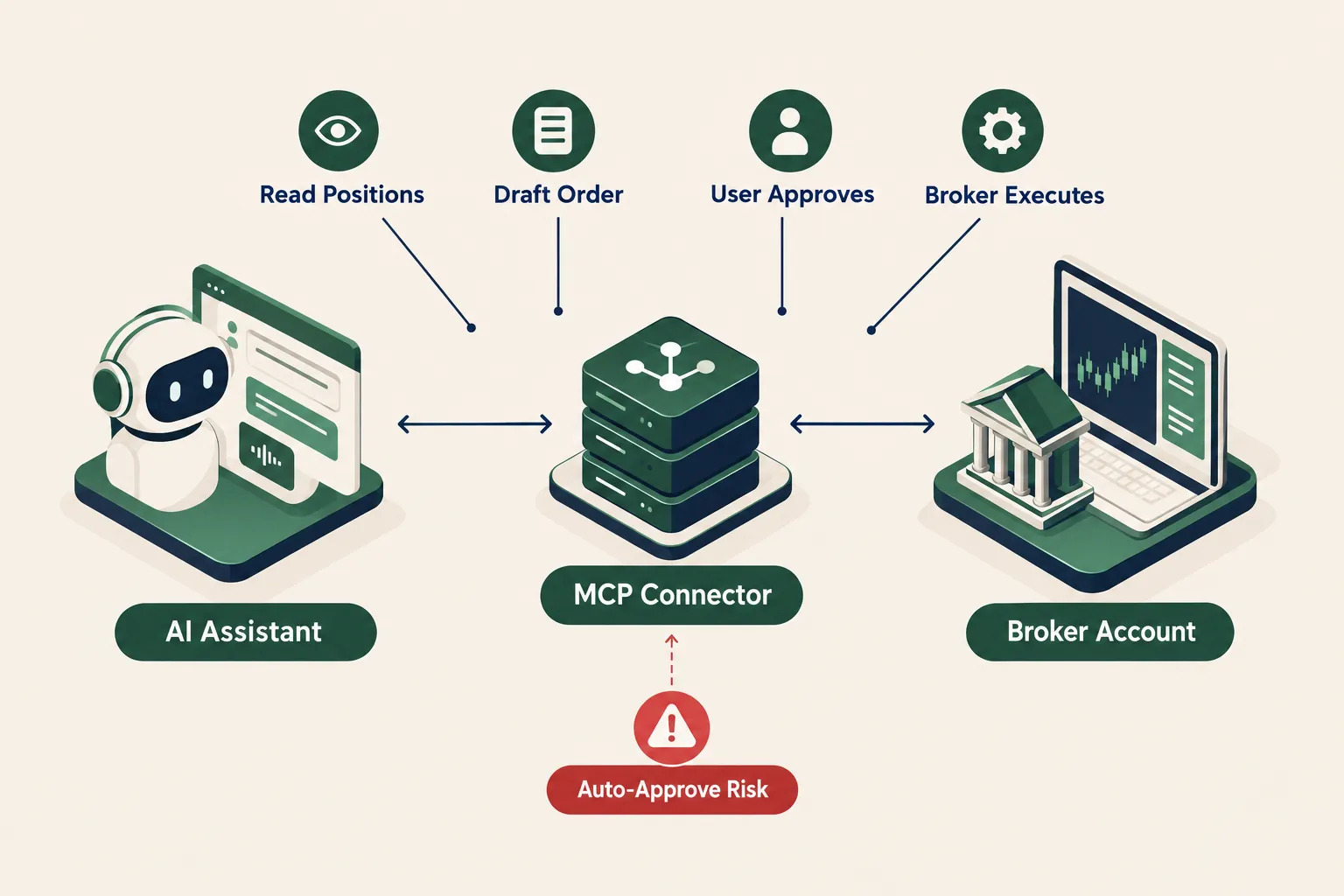
The search intent here is simple: which ai trading platform will actually work with the broker you already use, and what does it let the AI do? Short version: your existing broker probably supports one if you trade with IBKR, Webull, tastytrade, TradeStation, Alpaca, Robinhood, or Public. If you trade with Schwab, you get AI summaries, not AI orders.
What a platform in this category does well:
- Pulls your live positions, buying power, and open orders into a chat window
- Screens for setups and explains the price action behind a move
- Drafts a complete order ticket, including multi-leg options
- Logs the reasoning so you can audit the decision later
What it does not do: replace a system. A model that drafts a flawless ticket on an overextended name is still a bad trade. Our honest guide to AI stock trading for retail traders walks through where the edge actually comes from.
Research-only connections count too. TradingView opened an MCP public beta on September 16, 2026, giving Essential-tier subscribers and above OAuth 2.1 access to real-time data, screeners, watchlists, alerts, fundamentals, and filings. No broker orders. That is a workflow tool, not an execution venue.
Which brokers let AI trade your account in 2026?
Seven brokers support direct AI connectivity to live accounts as of October 2026, and only Robinhood allows unattended execution by default setting. Here is the full field, with price last.
| Broker | AI clients supported | Order confirmation default | Where login keys live | Launch date | Cost |
|---|---|---|---|---|---|
| Robinhood Agents | Robinhood Agent Apps, external agents | Human approval on by default, customer can switch it off | Robinhood (broker-side) | Sep 29, 2026 (GA) | Agent Apps: Unusual Whales Options Trader $30/mo; Nasdaq, SpotGamma, Wendy, Quiver $10/mo each, 1-month free trial |
| Webull Cloud MCP + CLI | Claude, Perplexity, Grok | Every order separately confirmed in Webull | Webull cloud, no API keys to manage | CLI Aug 4, 2026; Cloud MCP Sep 29, 2026 | No separate MCP fee published; check Webull pricing |
| tastytrade MCP | Any MCP-compatible client (open source, local) | Every order needs separate confirmation | User’s own machine | Aug 31, 2026 | Free, open source |
| Interactive Brokers MCP | ChatGPT, Claude, Claude Code, Grok, Cursor, Perplexity, Windsurf | Client reviews and approves every order before submission | Broker-side, revocable in Client Portal | Jul 28, 2026; broadened Sep 1, 2026 | No published MCP fee |
| TradeStation MCP | Claude (requires Claude Pro) | User confirms | Broker-side | Jan 13, 2026; Insights AI May 19, 2026 | Requires Claude Pro subscription |
| Alpaca MCP | Any MCP client, API-first | Developer-defined, can be automated | Developer-held API keys | MCP server live 2026 | Commission-free equities; see Alpaca pricing |
| Public AI agents | Public’s agents (Kalshi prediction markets) | User approves the fixed rules before they run | Broker-side | Sep 24, 2026 | Not separately published |
| Moomoo Engine | Native assistant | Native app flow | Broker-side | 2026 | $3.99/mo or $39.90/yr, drops to $0.99/mo with assets over $1,000 |
| Charles Schwab | None (no first-party MCP) | N/A | N/A | Portfolio Insights GenAI summaries May 5, 2026 | Included |
Two more worth knowing about if you trade CFDs or use a prop firm: Leverate released MCP for Traders on September 16, 2026, where execution requires explicit user confirmation and brokers can gate access by client group or country, and Match-Trade launched Broker Management MCP on October 1, 2026 with more than 20 actions across accounts, positions, orders, ledgers, and risk rules.
For the plumbing behind all of this, see our guide to brokers with an API.
The 9 brokers, ranked by how far an ai trading platform can go
Same nine brokers as the table above, now as a ranked list. The order measures autonomy, not quality. #1 lets the AI do the most on its own, #9 lets it do the least. More autonomy is not a higher grade. It is more rope.
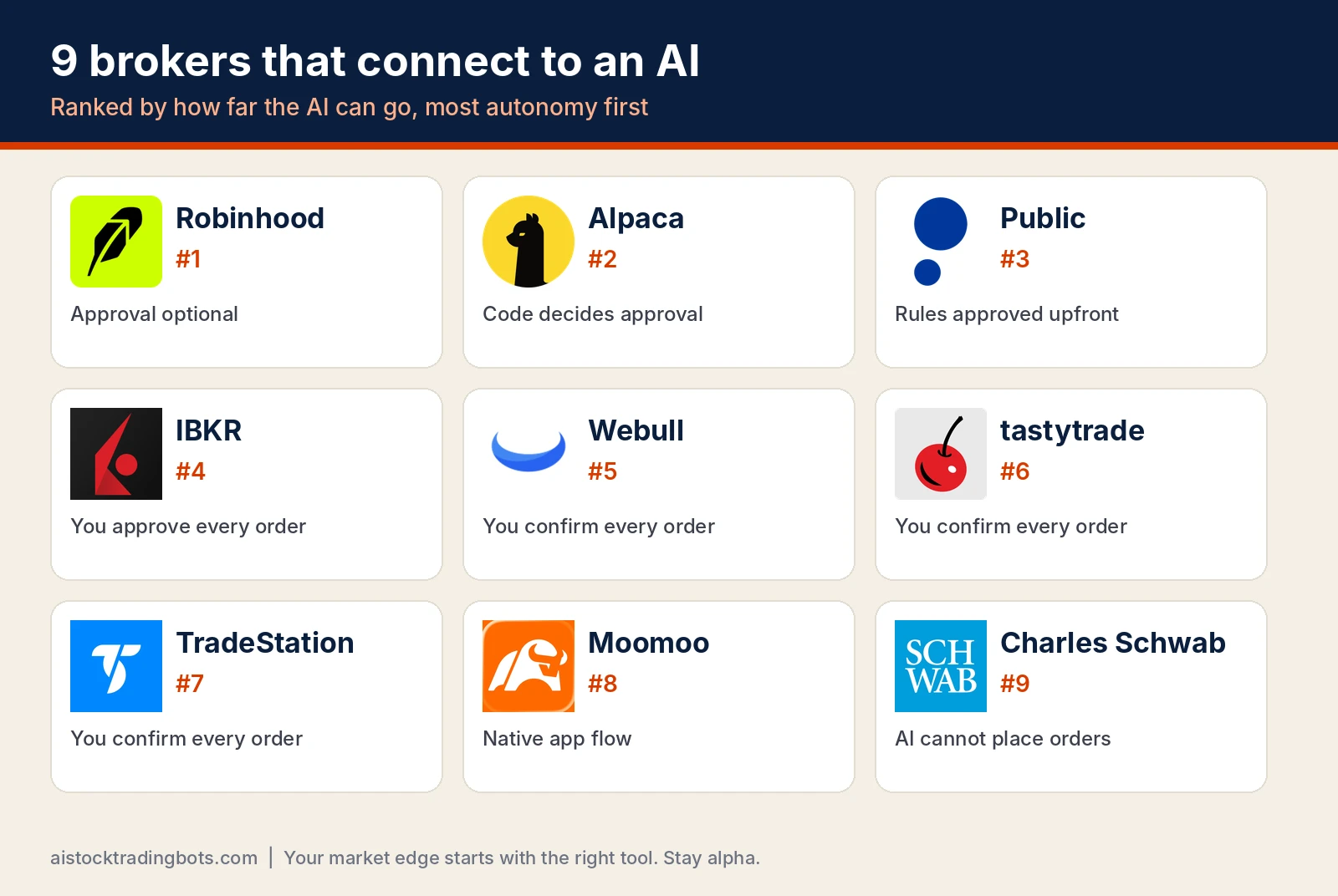
One honest note before the numbers. Brokers do not publish backtests of their own AI connections, and none of these integrations has an audited track record yet. What exists is a short list of third-party tests and company-reported adoption figures. Each one below is labeled for what it is.
The broadest public dataset is model-level, not broker-level. TradeRank.ai runs paper-trading seasons with $10,000 per model, live prices and a 0.1% fee. Across 9 completed seasons, Gemini averaged about +2.89% per season and Claude about -3.10%. Most seasons were crypto only, with US stocks tradeable in Seasons 2, 7 and 8, per TradeRank’s season write-up. Simulated capital, no broker attached. Read it as a hint about model temperament, not a broker result.
1. Robinhood: the most autonomy on the board
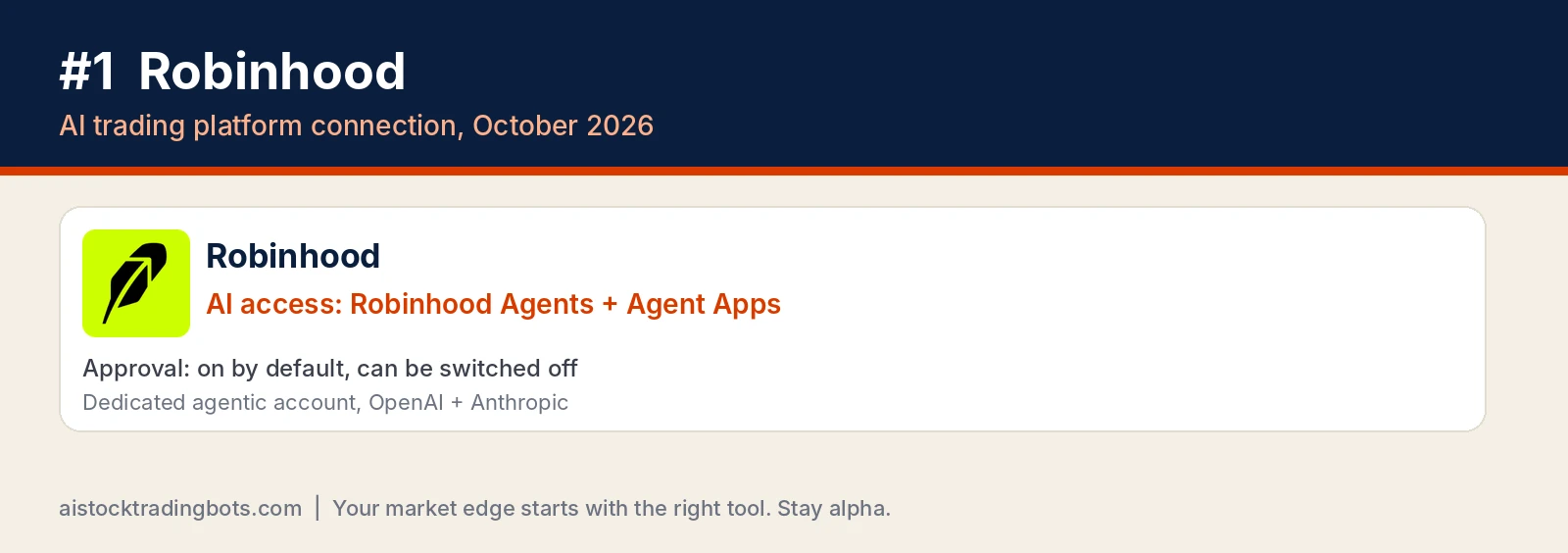
- AI access: Robinhood Agents powered by OpenAI and Anthropic models, rolling out to roughly 29 million customers, plus paid Agent Apps from partners.
- Approval model: manual approval of each trade is a setting shown during setup, and it defaults to on. You can switch it off.
- Guardrail: the agent can only touch funds in a dedicated agentic trading account, per Robinhood’s HOOD Summit 2026 announcement.
- Cost: Agent Apps run $5 to $30 per month each, with Unusual Whales Options Trader at the top and a one-month free trial at launch.
Backtest and performance data: No published backtest yet. Robinhood reports adoption, not returns: over 150,000 customers have opened agentic trading accounts, and agents use Robinhood’s tools almost 30 million times a day (company-reported, HOOD Summit post). Robinhood accounts were one of three brokers in Condor Capital’s small real-money test (see #3).
2. Alpaca: full automation, if you write the code
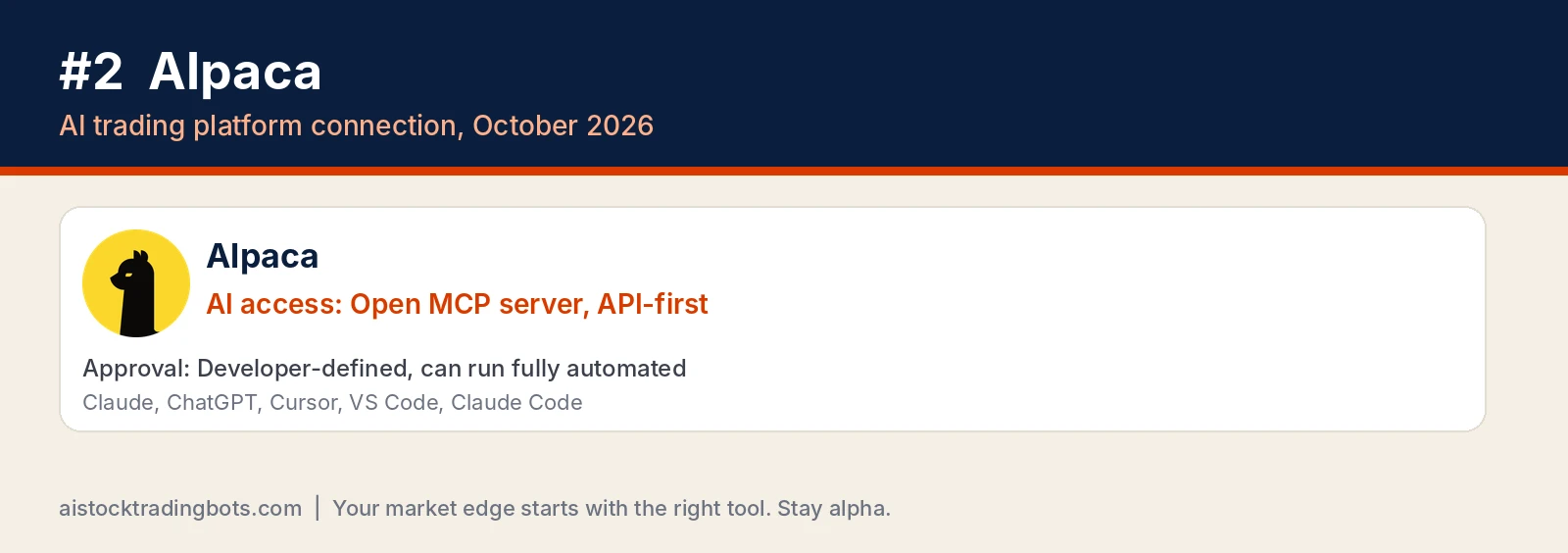
- AI access: an MCP server that works with Claude Desktop, Claude Code, ChatGPT, Cursor and VS Code, per Alpaca’s MCP page.
- Approval model: developer-defined. Your code decides whether a human ever sees the order, and it can run with no human at all.
- Keys: you hold the API keys, so key hygiene is your job.
- Testing: a free paper environment with a simulated $100K account, separate from live trading (Alpaca paper trading docs).
- Backing: raised $135M on July 16, 2026 for agent-first brokerage infrastructure.
Backtest and performance data: No published backtest yet. Alpaca hands you the paper account to build your own forward test, which is the only kind of record worth trusting here.
3. Public: you approve the rules, not each ticket
- AI access: Public’s own agents. You describe a strategy in plain English, the AI asks follow-up questions, and the agent runs once you activate it (launched March 31, 2026).
- Approval model: rules approved upfront. You can pause, stop or edit any agent workflow at any time.
- Scope: trading strategies, cash management and risk management, plus prediction-market agents via Kalshi from September 24, 2026.
- Scale: customers created 20,000 agents in the month after Public opened agents to all users, and more than $200 million in assets are overseen by AI agents, according to Public (Dow Jones via TradingView).
Backtest and performance data: Not a backtest, but the closest thing to a live head-to-head so far. Condor Capital Wealth Management gave three AI agents $500 each, using accounts at Robinhood, Webull and Public, with the same daily prompt: stocks and ETFs only, back to 100% cash by the close. After three days, Claude returned 2.9%, Gemini 0.9% and ChatGPT lost 0.7% (Dow Jones via TradingView, October 2, 2026). Three days, $1,500 total, one market regime. Interesting, not evidence.
4. Interactive Brokers: widest model choice, every order approved
- AI access: broker-hosted MCP for ChatGPT, Claude, Claude Code, Grok, Cursor, Perplexity and Windsurf.
- Approval model: the client reviews and approves every order before submission.
- Timeline: launched July 28, 2026, then opened to essentially any MCP-compatible app on September 1, 2026.
- Credentials: stay broker-side, and you can revoke consent in Client Portal without closing the account.
- Cost: no published MCP fee.
Backtest and performance data: No published backtest yet. IBKR has released no performance figures for its MCP connection.
5. Webull: no install, confirm every order
- AI access: Cloud MCP for Claude, Perplexity and Grok with no coding or install, plus a CLI from August 4, 2026.
- Approval model: each trade requires separate customer confirmation, per Webull’s September 29 release.
- Coverage: 11 order-instruction endpoints for stock, single-option, multi-leg option, futures, crypto, event and algorithmic instructions.
- Keys: no API keys to generate, store or lose.
Backtest and performance data: No published backtest yet. Webull accounts were also part of Condor Capital’s three-day test (see #3), though the report did not say which agent traded at which broker.
6. tastytrade: the most conservative setup
- AI access: an open-source MCP server that runs on your own machine with any MCP-compatible client. Launched August 31, 2026. Free.
- Approval model: every order needs separate confirmation.
- Credentials: never leave your laptop.
- Testing: tastytrade’s own options backtesting tool lets you run a strategy an AI suggests against historical data before you trade it.
Backtest and performance data: No published backtest of the AI connection yet. The backtester tests the strategy, not the model.
7. TradeStation: earliest MCP, Claude only
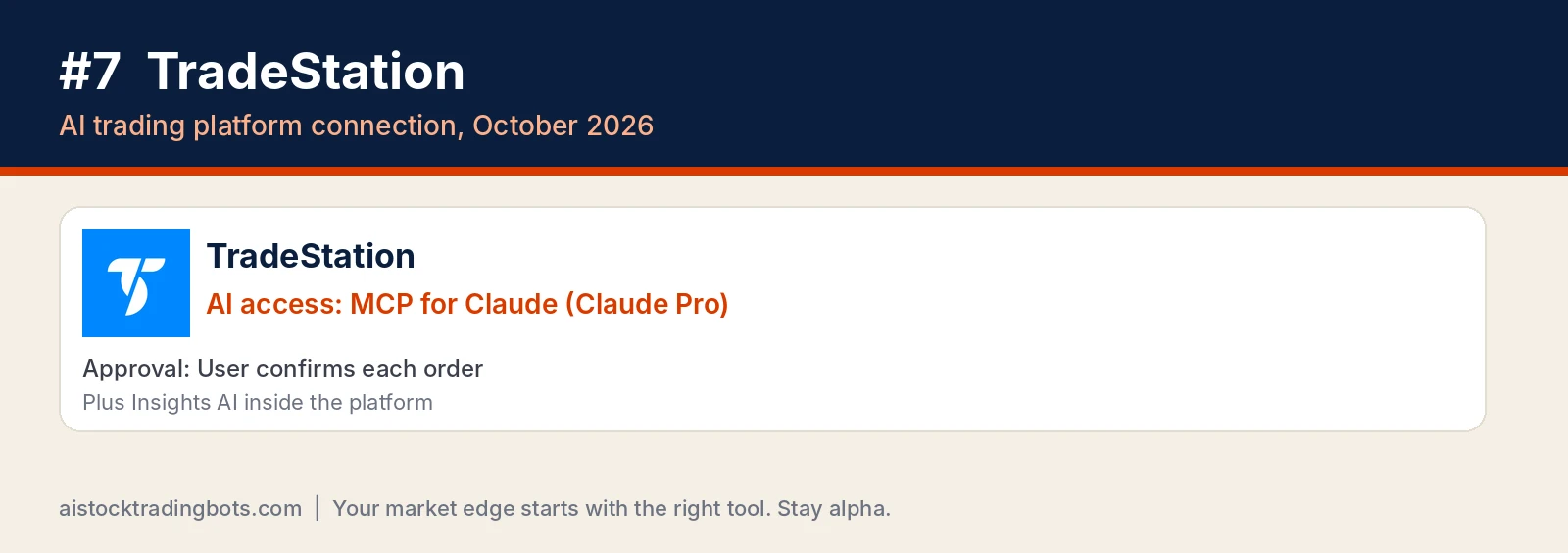
- AI access: MCP for Claude, live since January 13, 2026, the oldest connection in this group. Requires a paid Claude Pro subscription.
- Approval model: the user confirms each order.
- Also: Insights AI inside the platform since May 19, 2026.
- Testing: TradeStation’s strategy testing runs EasyLanguage strategies on historical data, and its simulated trading lets you forward test.
Backtest and performance data: No published backtest yet. Nine months live and still no public performance record for the AI connection.
8. Moomoo: a native assistant, not an open door
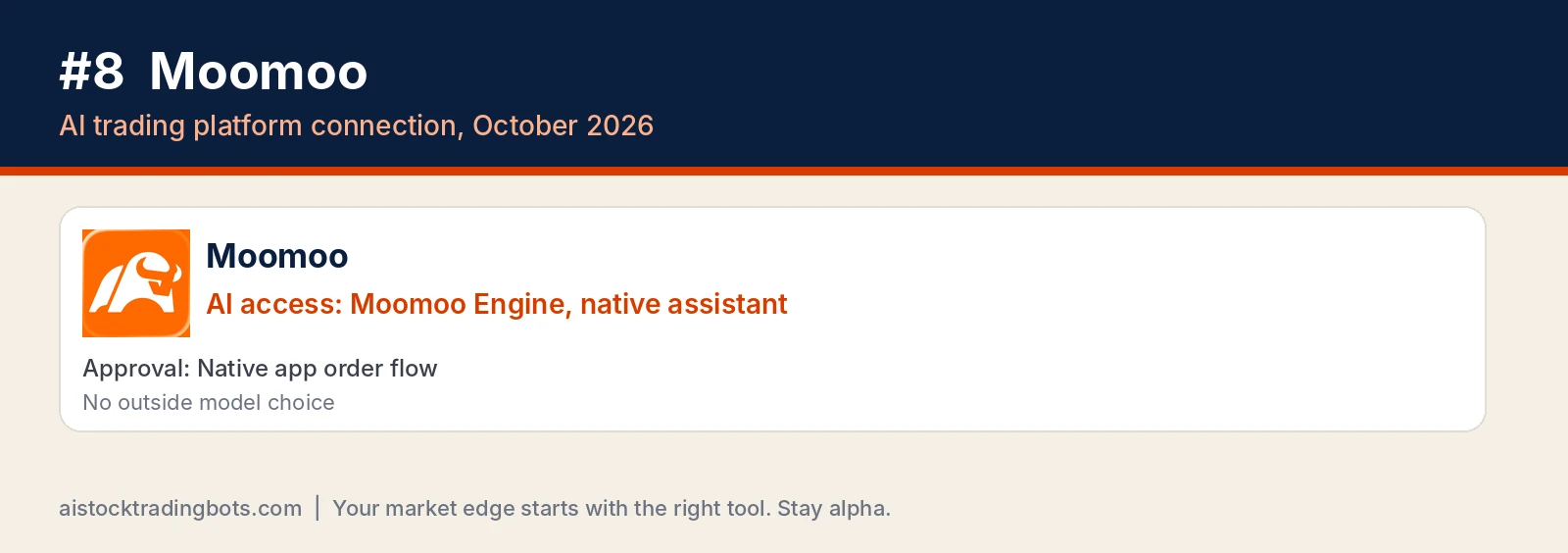
- AI access: Moomoo Engine, a native assistant inside the app. No outside model choice.
- Approval model: the native app order flow. The assistant does not run as an outside agent.
- Cost: $3.99/mo or $39.90/yr, dropping to $0.99/mo with assets over $1,000. The cheapest paid AI assistant on this list.
- Keys: broker-side.
Backtest and performance data: No published backtest yet.
9. Charles Schwab: the AI reads, you trade
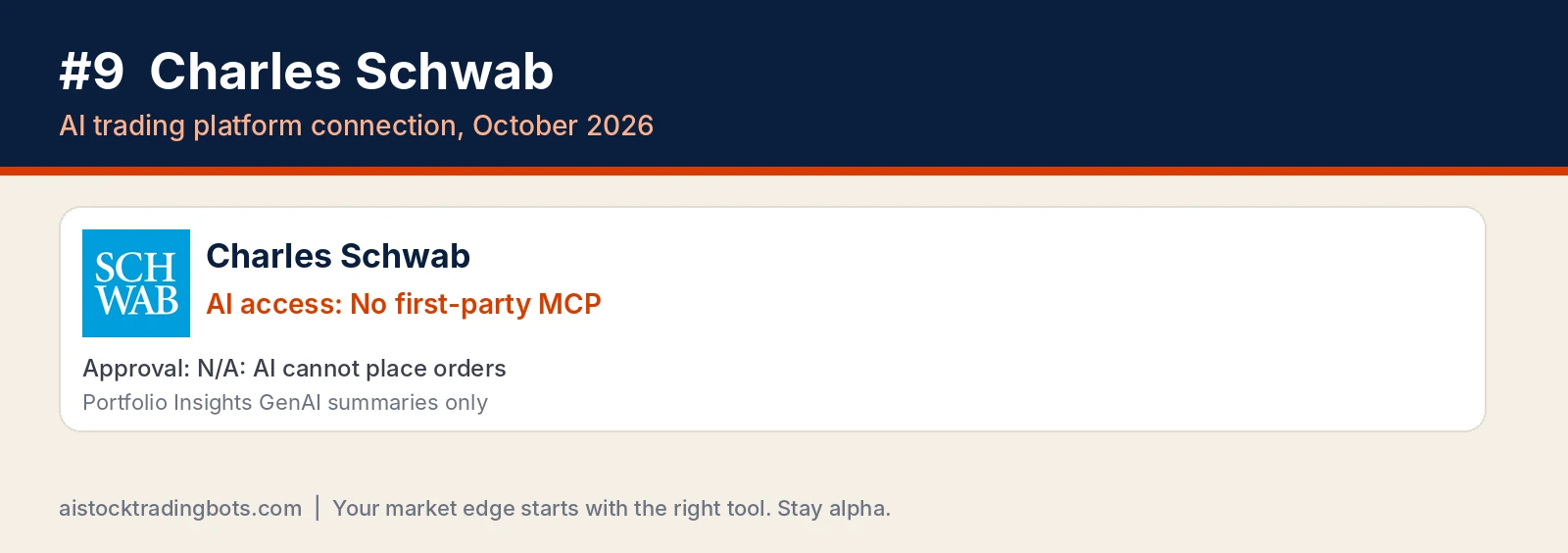
- AI access: no first-party MCP as of October 2026.
- Approval model: not applicable. The AI cannot place orders.
- What you get: Portfolio Insights GenAI summaries since May 5, 2026, included with the account.
- Testing: thinkorswim’s paperMoney is a virtual trading environment with live market data, useful for testing what an outside AI suggests.
Backtest and performance data: No published backtest. There is no AI execution to backtest.
Side by side: approval and published performance data
| # | Broker | AI connection | Order approval | Published performance data (source) |
|---|---|---|---|---|
| 1 | Robinhood | Robinhood Agents + Agent Apps | On by default, can be switched off | Adoption only: 150,000+ agentic accounts (Robinhood). Accounts used in Condor’s 3-day test (Dow Jones) |
| 2 | Alpaca | Open MCP server, API-first | Developer-defined, can be fully automated | No published backtest yet |
| 3 | Public | Public’s own agents | Rules approved upfront | Condor 3-day real-money test: Claude 2.9%, Gemini 0.9%, ChatGPT -0.7% (Dow Jones) |
| 4 | Interactive Brokers | Broker-hosted MCP | Every order approved | No published backtest yet |
| 5 | Webull | Cloud MCP + CLI | Every order confirmed | No published backtest yet. Accounts used in Condor’s 3-day test (Dow Jones) |
| 6 | tastytrade | Open-source local MCP | Every order confirmed | No published backtest yet |
| 7 | TradeStation | MCP for Claude | User confirms | No published backtest yet |
| 8 | Moomoo | Moomoo Engine, native | Native app flow | No published backtest yet |
| 9 | Charles Schwab | None | N/A | No published backtest, no AI execution |
Model-level reference, no broker attached: TradeRank paper seasons show Gemini at about +2.89% and Claude at about -3.10% average per season (TradeRank).
Practical takeaway: pick from the bottom half of this list if you want a research assistant, and from the top half only if you already have written rules for size and stops. The data says nobody has an edge yet. Your process is the edge.
How does order approval differ across these platforms?
Approval is the single most important setting here, and it decides whether you are running a research tool or the best automated ai trading platform money can rent. It splits the field into three groups: mandatory confirmation, optional confirmation, and rules-approved-upfront. Most brokers chose mandatory. One did not.
- Mandatory confirmation: IBKR, Webull, tastytrade, TradeStation, Leverate. The AI drafts, you submit. Webull’s September 29 release states each trade requires separate customer confirmation.
- Optional confirmation: Robinhood Agents. Approval is the default and the customer can turn it off. That is a real choice with real consequences. We covered the mechanics in our Robinhood Agents AI trading review.
- Rules approved upfront: Public converts a plain-English strategy into fixed rules, and the user approves the rules before they run, per Fortune. You are approving a policy, not each ticket.
- Developer-defined: Alpaca. Whatever your code says goes. It raised $135M on July 16, 2026 for agent-first brokerage infrastructure, so expect more of this.
Common mistake: assuming “confirm every order” means you read every order. Fifteen tickets into a choppy tape, people start tapping confirm like a notification. Build a rule: no confirm without a stop loss attached.
What are the risks of connecting an AI to your brokerage account?
The three real risks are unattended execution, credential exposure, and stale or unauditable data feeding the model. None of them are theoretical, and none are fixed by a disclaimer.
Unattended execution. Turning off approval means a misread prompt becomes a filled order. Position sizing limits are your only guardrail. Our breakdown of the position sizing mistake that wipes out new traders applies double here.
Credential exposure. Ask where the keys sit. IBKR keeps credentials with the broker and lets you revoke consent in Client Portal. tastytrade’s MCP is open source and locally hosted, so credentials stay on your machine. Webull’s cloud route means no API keys to generate or lose.
Stale data. General-purpose models will cheerfully cite last quarter’s numbers. Trading Central launched its MCP server on September 21-22, 2026 specifically to feed agents licensed, machine-readable research instead of unauditable scraped content.
The sentiment data backs the caution. The Vanguard survey reported by Business Insider on October 1, 2026 found 57% of investors uncomfortable with AI acting on their portfolios. That is not technophobia. That is people correctly identifying who eats the loss.
Top 5 favorite features across these platforms
The five features worth connecting an account for are revocable broker-side consent, local credential storage, multi-leg option drafting, no-install setup, and rules-based pre-approval. Each one solves a specific failure mode.
- Revocable consent (IBKR). Kill the connection from Client Portal without closing the account. Per IBKR’s release notes, credentials remain with the broker.
- Local credential storage (tastytrade). Open source, runs on your machine, nothing leaves your laptop. The most conservative design on the board.
- Multi-leg option drafting (Webull). Webull’s developer changelog lists 11 order-instruction endpoints covering stock, single-option, multi-leg option, futures, crypto, event, and algorithmic instructions. Useful if you trade spreads. Compare platforms in our best trading platform for options guide.
- No-install setup (Webull Cloud MCP). No software, no API credentials, no access keys. Webull CEO Anthony Denier put the logic plainly in the official release: “AI is rapidly becoming a preferred interface for investors to interact with their brokerage account.”
- Rules-based pre-approval (Public). You approve the written rules once, which forces you to actually define entry and exit before anything runs.
What we like and what we don’t like
The category earned the attention, and every platform here has at least two real drawbacks. Nothing in this field is finished software.
What we like:
- Brokers defaulted to human approval instead of full automation. That was not guaranteed.
- Model choice is real at IBKR, Webull, and tastytrade, so you are not locked to one vendor’s assistant.
- Credential handling is explicit and documented at IBKR and tastytrade.
- Order drafting removes the fat-finger risk of typing a four-leg ticket by hand.
What we don’t like:
- Robinhood: approval can be switched off, and the Agent Apps add $10 to $30 per month per app on top of whatever the agent costs you in bad fills.
- Webull: cloud routing means your account context passes through more hands, and no standalone MCP price is published.
- tastytrade: local install means you own the setup and the troubleshooting, and there is no hand-holding.
- IBKR: the platform’s learning curve is legendary, and MCP sits on top of it, not instead of it. Our Interactive Brokers profile covers that.
- TradeStation: requires a paid Claude Pro subscription, so the “free” connection is not free.
- Alpaca: developer-first. If you cannot read an API doc, this is not your broker.
- Public: prediction-market agents via Kalshi are a narrow use case, not general equity trading.
- Schwab: no MCP at all. Portfolio Insights gives you GenAI summaries, which is reading, not trading.
What do real users say?
Retail sentiment ranges from flat refusal to cautious experimentation, and the loudest reaction to agentic trading has been skepticism. Treat every performance claim below as unverified.
The top-voted response to Robinhood’s agentic rollout on r/StockMarket, with 713 upvotes, was blunt:
“I can lose money on my own, thanks.” (Reddit)
On the other side, u/Abject_Disaster7292 posted in r/ai_trading: “I’ve been experimenting with an agentic Robinhood setup using Claude for the past 3 months… We’re up 5.93% over the past 3 months” (Reddit). One user, one unaudited screenshotless claim, three months of a single market regime. That is an anecdote, not evidence.
Competitors and alternatives to a broker-connected ai trading platform
If you do not want an AI touching your account, three alternatives give you most of the analytical benefit with none of the execution risk: research-only MCP connections, standalone scanners, and rules-based bot platforms you configure yourself.
- Research-only: TradingView’s MCP beta covers data, screeners, alerts, and filings with no broker-order tools, per Finance Magnates’ coverage of brokers adopting AI trading tools.
- Standalone scanners: see our AI stock scanner filter guide and our swing trading tools hub.
- Rules-based bots: the fully automated AI trading bots directory covers platforms where you define the logic before anything runs. A free AI trading bot is a reasonable sandbox.
| Trader type | Pick | Why | Price |
|---|---|---|---|
| Cautious beginner | tastytrade MCP | Local credentials, mandatory confirmation | Free, open source |
| Options spread trader | Webull Cloud MCP | 11 order-instruction endpoints, no install | No separate MCP fee published |
| Multi-asset active trader | IBKR MCP | Widest client support, revocable consent | No published MCP fee |
| Developer or quant | Alpaca MCP | API-first, you define approval logic | Commission-free equities |
| Hands-off experimenter | Robinhood Agents | Optional approval, prebuilt Agent Apps | $10 to $30/mo per Agent App |
| Budget mobile user | Moomoo Engine | Cheapest native AI assistant | $3.99/mo or $39.90/yr, $0.99/mo over $1,000 assets |
Our Take
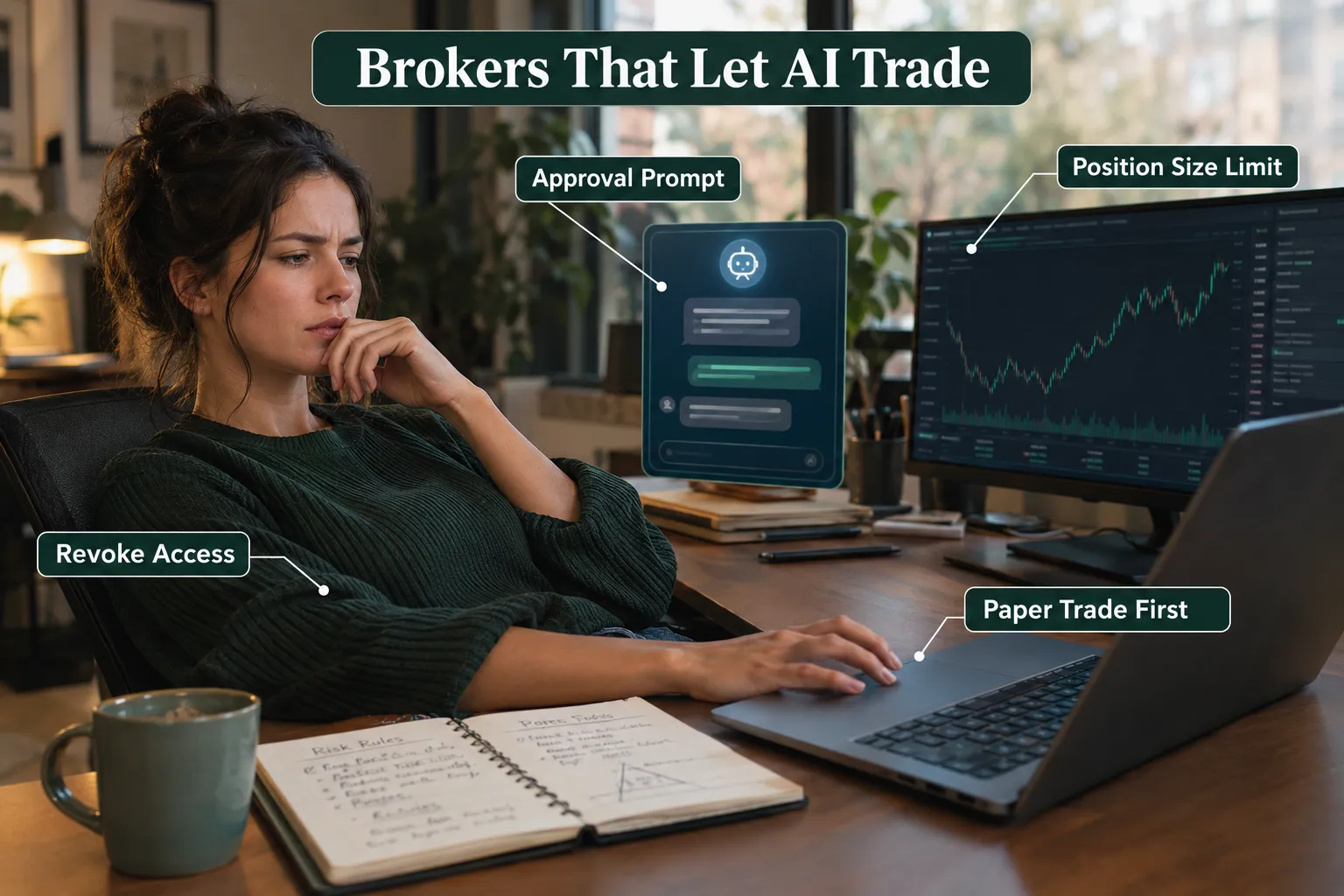
Connect one for drafting and research, keep confirmation on, and treat the model as a fast analyst with no risk management instincts. The brokers that made approval mandatory, IBKR, Webull, and tastytrade, built the safer product, and the fact that Robinhood lets you disable it is a feature only if you already have a written system with position sizing and a stop loss on every entry.
The honest read on profitability: nobody has an audited track record here because the oldest of these launched in January 2026. Anyone selling you a win rate on broker-connected AI is selling you a backtest in a trench coat. Paper trade it first, then run one connection for 30 days with notes. Discipline beats prediction.
Nine platforms compared here. Dozens more reviewed one at a time. Full editorial reviews, scored and dated, live at the FullStack Alpha desk. Read the reviews → aistockpickerapp.com/reviews
Frequently asked questions
Which AI trading platform is best?
For most active retail traders in 2026, Interactive Brokers MCP is the best ai trading platform connection because it supports seven AI clients, keeps credentials broker-side, allows revocation through Client Portal, and requires client approval on every order. Choose tastytrade MCP instead if you want credentials stored locally on your own machine.
Do AI trading platforms really work?
They reliably work at reading positions, screening, and drafting correct order tickets, including multi-leg options. Whether they produce profit is unproven: the oldest broker MCP launched January 2026, so no audited multi-year record exists. Treat any advertised win rate as vendor-claimed until a third party verifies it independently.
Is there a free AI trading app?
Yes. tastytrade’s MCP server is open source and free, launched August 31, 2026, with credentials kept on your machine. Alpaca offers commission-free equity trading with a free MCP server for developers. Moomoo Engine is paid but drops to $0.99 per month once account assets exceed $1,000.
Can I make money on AI trading?
Possibly, and you can also lose money, including more than you expect if you disable order approval. No broker or platform here promises returns, and none publish audited results. Your outcome depends on position sizing, stop placement, and whether you follow your own rules, not on which model drafts the ticket.
Can you make $1000 a day with day trading?
It is mathematically possible and statistically unlikely for small accounts. A $1,000 daily target on a $10,000 account demands a 10% daily return, which no sustainable process delivers. Our day trading math breakdown runs the real numbers on expectancy and costs.
Which brokers have an API for AI trading?
Interactive Brokers, Webull, tastytrade, TradeStation, Alpaca, Robinhood, and Public all expose AI-accessible interfaces as of October 2026. Alpaca is the most API-first. Charles Schwab has no first-party MCP server, offering only GenAI Portfolio Insights summaries shipped May 5, 2026.
Is a fully automated ai trading app safe?
Unattended execution removes your last checkpoint, so it is the riskiest configuration available. Only Robinhood Agents lets you disable approval by default setting. If you run it, cap position size, set hard stops, and review every fill daily. A Vanguard survey found 57% of investors uncomfortable with AI acting on portfolios.
Do I need coding skills to use an ai trading platform?
Not for Webull Cloud MCP, which requires no coding or installation, or for Robinhood Agent Apps and Moomoo Engine. You do need technical comfort for tastytrade’s locally hosted server and real development skills for Alpaca. Start with a no-install option, then graduate if you outgrow it.
Conclusion
The field is clear as of October 2026: seven brokers now wire an AI into your account, six of them make you confirm every order, and one lets you switch that off. Start your ai trading platform search with the broker you already fund, turn confirmation on, and run it for 30 days as a research assistant before you let it near an order ticket. Write your position sizing rules down first, because the model will not write them for you.
Then audit. Compare what the AI drafted against what you would have done, and log the difference. If the drafts are worse than your own judgment, you learned that for free. That is the whole point of a process.
These backtested results are subject to change because AI moves so quickly.
Prices are subject to change in this fast AI market. If a fee moved since we checked, blame the robots, or Black Friday.
This article is education, not financial advice. No returns are promised or implied.
Your market edge starts with the right tool. Stay alpha.
Frequently Asked Questions
Which AI trading platform is best?
For most active retail traders in 2026, Interactive Brokers MCP is the best ai trading platform connection because it supports seven AI clients, keeps credentials broker-side, allows revocation through Client Portal, and requires client approval on every order. Choose tastytrade MCP instead if you want credentials stored locally on your own machine.
Do AI trading platforms really work?
They reliably work at reading positions, screening, and drafting correct order tickets, including multi-leg options. Whether they produce profit is unproven: the oldest broker MCP launched January 2026, so no audited multi-year record exists. Treat any advertised win rate as vendor-claimed until a third party verifies it independently.
Is there a free AI trading app?
Yes. tastytrade's MCP server is open source and free, launched August 31, 2026, with credentials kept on your machine. Alpaca offers commission-free equity trading with a free MCP server for developers. Moomoo Engine is paid but drops to $0.99 per month once account assets exceed $1,000.
Can I make money on AI trading?
Possibly, and you can also lose money, including more than you expect if you disable order approval. No broker or platform here promises returns, and none publish audited results. Your outcome depends on position sizing, stop placement, and whether you follow your own rules, not on which model drafts the ticket.
Can you make $1000 a day with day trading?
It is mathematically possible and statistically unlikely for small accounts. A $1,000 daily target on a $10,000 account demands a 10% daily return, which no sustainable process delivers. Expectancy and costs decide the real number, not the headline.
Which brokers have an API for AI trading?
Interactive Brokers, Webull, tastytrade, TradeStation, Alpaca, Robinhood, and Public all expose AI-accessible interfaces as of October 2026. Alpaca is the most API-first. Charles Schwab has no first-party MCP server, offering only GenAI Portfolio Insights summaries shipped May 5, 2026.
Is a fully automated ai trading app safe?
Unattended execution removes your last checkpoint, so it is the riskiest configuration available. Only Robinhood Agents lets you disable approval by default setting. If you run it, cap position size, set hard stops, and review every fill daily. A Vanguard survey found 57% of investors uncomfortable with AI acting on portfolios.
Do I need coding skills to use an ai trading platform?
Not for Webull Cloud MCP, which requires no coding or installation, or for Robinhood Agent Apps and Moomoo Engine. You do need technical comfort for tastytrade's locally hosted server and real development skills for Alpaca. Start with a no-install option, then graduate if you outgrow it.
Contributing writer at AI Stock Trading Bots.
