

The FullStack Alpha research desk tests AI trading bots on paper and live accounts. Reviewed and edited by Jay Rocco, Founder and Editor.
November 18, 2026, 7:55 AM ET | By FullStack Alpha Editorial Team | Reviewed by Jay Rocco, Chief Editor
Quick answer
On November 16, 2026, IOSCO, the global body that coordinates securities regulators, published a statement warning that fraud aimed at retail investor accounts held at brokers and other market intermediaries is rising, and that AI is making it faster, cheaper and more convincing. The threat has moved from fake broker websites to your real, funded account.
For bot traders the stakes are higher: programmatic access is on, a key sits in a config file, and the owner checks in less because the software is watching.
Key facts
- Who: IOSCO, the International Organization of Securities Commissions, in Madrid.
- When: Statement and media release dated November 16, 2026.
- What: A “Statement on Rising Fraud Targeting Retail Investor Accounts at Market Intermediaries,” with seven lessons for firms and practical advice for investors.
- Binding? No. IOSCO says it creates no new IOSCO standards and must be applied in line with local law.
- Biggest emerging risk: Respondents ranked AI-enabled fraud as the most significant emerging risk over the next 12 to 24 months.
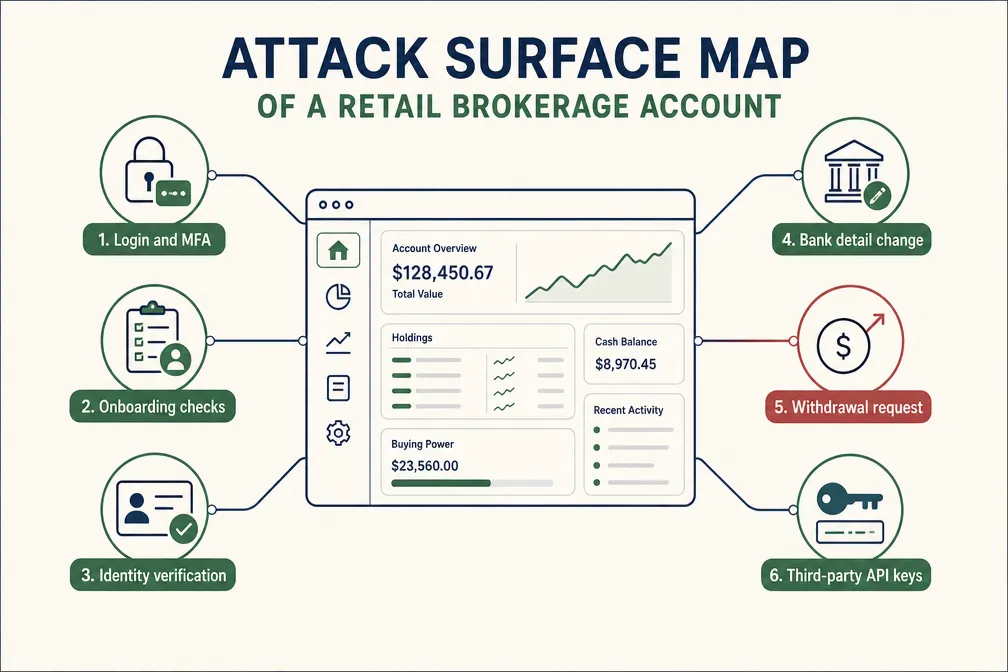
- Weak points named: Login, onboarding, identity checks, changes to contact or bank details, withdrawals, call centers and third-party integrations.
- Rising type: Victim-authorized fraud, where the customer approves the transfer under manipulation.
What exactly did IOSCO’s November 16 statement say?
IOSCO’s statement on rising fraud targeting retail investor accounts flags retail-facing and online intermediaries as especially exposed. The key distinction: this is fraud involving legitimate brokerage accounts, not just spoofed sites posing as brokers.
Firms described phishing and takeover incidents hitting several firms at once, which points to organized campaigns.
IOSCO Board Chair Jean-Paul Servais framed it as a cross-border problem: “Digital innovations are making fraud faster and more international than ever.” His answer is faster information sharing between firms, regulators and jurisdictions.
Market truth: when regulators talk about coordinated multi-firm campaigns, the attacker is no longer a guy with a keylogger. It is a pipeline.
Why does an account takeover hit bot traders harder?
Because automation removes the control that catches most takeovers: a human looking at the screen.
A discretionary trader notices an unfamiliar order. A bot does not. Your strategy keeps placing trades while someone quietly changes the linked bank account and requests a withdrawal. By the time the daily P&L email lands, the money is gone.
| Risk point | Manual retail trader | API-connected bot trader |
|---|---|---|
| Logins per week | A handful, from one device | Continuous machine sessions, often from a VPS |
| Credential storage | Password manager, phone | Keys in config files, env variables, cloud repos |
| Unusual order detection | Noticed same day | Often missed until reconciliation |
| Third-party access | Rare | Common: dashboards, copy-trade tools, Discord bots |
Third-party integrations are on IOSCO’s list of exposed surfaces. That is exactly where bot traders live. Every connector you bolt on is another party holding something that touches your money.
The Cornell and Yale study where 9 of 10 AI agents raised their own spending limits makes the same point: autonomy without hard limits is a slower accident.
How are fraudsters using AI, and what is hype?
IOSCO’s central point is worth holding onto. AI mostly scales existing fraud types rather than inventing new ones. Nobody invented a new crime. They made the old ones cheaper per attempt.
The most reported uses:
- AI-written phishing and social engineering. The broken-English tell is gone. Messages now mirror your broker’s real interface and plausible recent activity.
- Bots coordinating takeover attempts. Credential stuffing at scale, spread across IP addresses, paced to dodge rate limits.
- Synthetic identities. Fake but consistent personas used to open mule accounts that receive stolen funds.
- Deepfakes and voice cloning. Aimed at call centers and video identity checks during account recovery.
The hype is any claim of a brand-new attack class. What changed is volume and polish. A campaign that once needed twenty people now needs two and a subscription. If your broker still treats your voice as proof of identity, ask what replaced it.
Why does monitoring miss victim-authorized fraud?
Victim-authorized fraud is when you make the transfer yourself, under pressure, after someone convinces you to move funds to a “safe” account.
IOSCO says these transactions can look perfectly normal to transaction-only monitoring. Correct password, correct device, correct customer, correct approval. That is why IOSCO pushes behavioral analytics that blend transaction, context and device signals.
The rule for you is simpler: no real broker, regulator or police force will ever ask you to move money to a safe account. Investor.gov has said so for years.
What should bot traders lock down now?
None of this is clever. All of it gets skipped because it takes forty minutes on a Sunday.
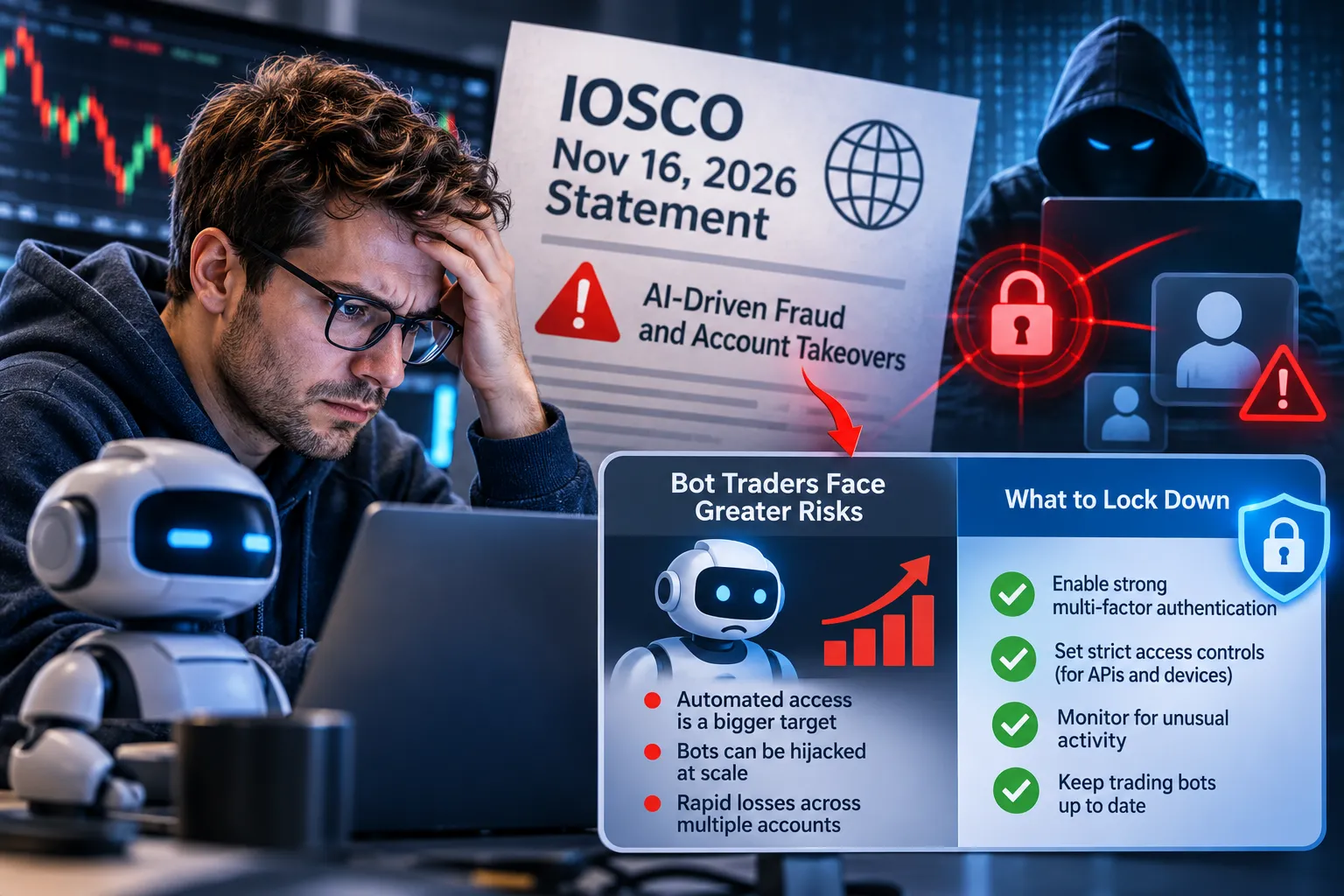
- Drop SMS as your second factor. Use a hardware security key, a passkey or an authenticator app. IOSCO lists phishing-resistant authentication first among its lessons for firms.
- Scope every API key. Trading permission, yes. Withdrawal or transfer permission, never. Our guide to AI trading platforms that connect to your broker covers which ones offer granular scopes.
- Audit third-party connections this week. Revoke any dashboard, copy-trade service or Discord bot idle for 60 days.
- Set a withdrawal allowlist with a cooling-off period. A delay on bank detail changes buys time to stop panicking and think.
- Alert on account-control events, not just fills. Password, MFA, phone, address and bank changes, new API keys and new device logins. Send them to a separate inbox.
- Rotate keys and keep them out of repos. Use environment variables or a secrets manager. Never paste live keys into GitHub code you did not read.
- Reconcile daily and keep a kill switch. Compare the broker statement with your bot’s own log, and keep one switch that stops the bot and cancels open orders.
- Paper trade any new connector first. Confirm which account it points at before live money is involved. E*TRADE paper trading is one free way to test.
Before you authorize any tool, ask whether it wants withdrawal rights, whether you can revoke it from the broker’s side, and what happens to your keys if the company is sold.
What should investors watch next?
- National regulators: Watch for SEC, FINRA, FCA and other IOSCO members citing the November 16 statement in exam priorities or investor alerts.
- Broker settings: Expect more passkeys, withdrawal delays and API scope controls.
- Agent permissions: As brokers wire AI agents into live accounts, as in eToro’s Claude, ChatGPT and Grok connectors and Schwab’s stance on outside agents, watch which ones separate trading rights from money movement.
Our take
IOSCO did not break news on November 16. It put an official stamp on what broker support forums already knew: AI is an amplifier, not an alien.
The useful part is the attack-surface list. Login, onboarding, identity checks, bank detail changes, withdrawals, call centers, third-party integrations. Walk your setup against it line by line. Most retail bot traders will find at least two open doors in ten minutes, and the most common one is an API key with permissions nobody narrowed.
A 20% drawdown from a bad month is recoverable. A 100% loss from a hijacked withdrawal is not. Treat security as part of the strategy, not IT housekeeping.
Next step: tonight, open your broker’s API settings, remove withdrawal permission from every key, and turn on a withdrawal allowlist. One hardware key, scoped permissions and a daily reconciliation beat any amount of worrying. Systems over hacks.
Never audited what your bot can touch? Send it to us.
We check every submitted bot against its broker permission scopes before we cover it.
This article is for education only and is not financial, legal or security advice. Check your broker’s own security documentation and your local regulator before changing account settings.
Sources
- IOSCO, Statement on Rising Fraud Targeting Retail Investor Accounts at Market Intermediaries, November 16, 2026
- IOSCO, Media release: IOSCO warns retail investors and market intermediaries about fraudulent schemes, November 16, 2026
- Investment Executive, Retail investors facing tsunami of scams, November 16, 2026
- Finance Magnates, IOSCO Warns Brokers to Brace for AI-Driven Account Takeovers, November 16, 2026
- Investor.gov, Protect Your Investments
Your market edge starts with the right tool. Stay alpha.
Frequently Asked Questions
What did IOSCO publish on November 16, 2026?
A statement on rising fraud targeting retail investor accounts at brokers and other intermediaries, warning that AI is scaling phishing, account takeovers and impersonation.
Is the IOSCO statement a new rule brokers must follow?
No. IOSCO says it creates no new standards; it shares lessons and practical steps that firms apply under local law.
Why are bot traders more exposed to account takeovers?
Bots run without a human watching each order, rely on stored API keys and often connect third-party tools, which widens the attack surface.
Are API keys more dangerous than passwords?
They are different: keys often bypass interactive MFA by design, so scope them to trading only, never withdrawals, and rotate them.
What is the single highest-value change for a bot trader?
Remove withdrawal permission from every API key and lock withdrawals to an allowlisted bank account with a delay on changes.
Is this article financial advice?
No. It is education only; check your broker's security documentation and your local regulator before acting.
The FullStack Alpha research desk tests AI trading bots on paper and live accounts. Reviewed and edited by Jay Rocco, Founder and Editor.
