

The FullStack Alpha research desk tests AI trading bots on paper and live accounts. Reviewed and edited by Jay Rocco, Founder and Editor.
November 12, 2026, 7:55 a.m. ET | By FullStack Alpha Editorial Team | Reviewed by Jay Rocco, Chief Editor
Robinhood just logged the biggest equity trading day in its history, and more than 200,000 of its customers now use some form of AI agent. Only a fraction of them let the agent pull the trigger.
That gap is the real story from Chief Brokerage Officer Steve Quirk’s remarks at a Wolfe Research event this week.
Quick answer
Quirk said Thursday, November 5, 2026 was Robinhood’s highest-ever equity trading day, beating its 2020 and 2021 peaks “pretty significantly.” He also said more than 200,000 customers use agentic features, a small slice of a base above 28 million, and that most use agents for research, rebalancing and tax work. Only a fraction grant the agent authority to trade.
Key facts
- Record day: Thursday, November 5, 2026, the same session the Nasdaq 100 fell 6.4%. Robinhood did not disclose the notional figure for that day.
- Agentic users: more than 200,000, against a customer base above 28 million. That is under 1%.
- What they do with agents: portfolio optimization, tax optimization, diversification, thesis development and opportunity discovery. Autonomous order execution is the minority use.
- Q3 baseline: Robinhood’s October 27, 2026 results listed about 200,000 Agentic Trading Accounts and more than $1.6 billion in cumulative notional volume. CEO Vlad Tenev said customers had placed more than $250 million into those accounts.
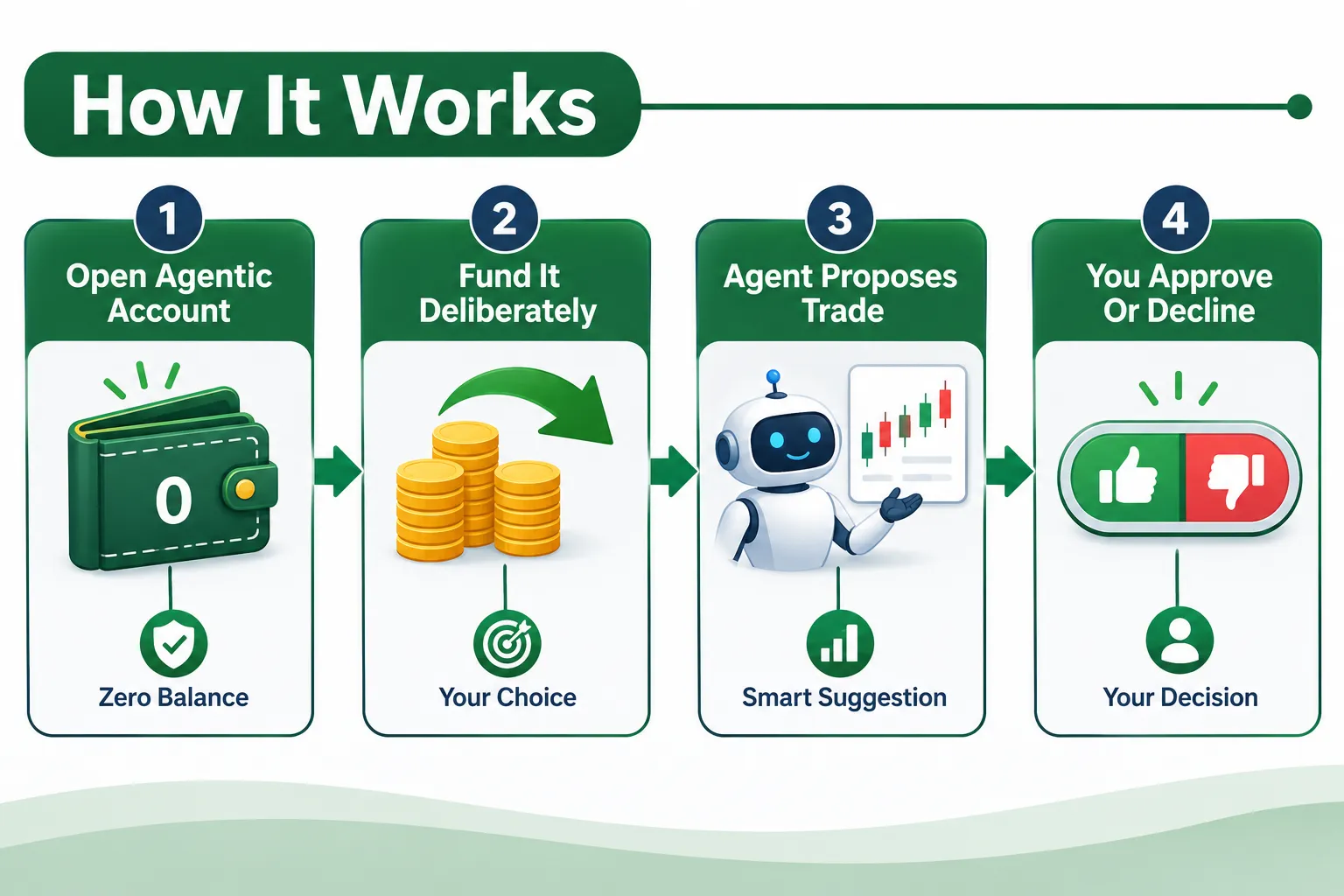
- Design: agentic accounts start at a zero balance, sit apart from the main brokerage account, and trades generally require customer approval unless that setting is switched off.
What exactly did Steve Quirk say at Wolfe Research?
Two things, and they do not point the same direction.
One: the record day. November 5 topped every prior session, including the pandemic-era frenzy. If you want the mechanics of why that session was so violent, our breakdown of how systematic funds amplified the Nov 5 Nasdaq 100 rout covers the forced selling on the other side of those retail orders.
Two: customers have been “cautiously aggressive,” buying dips rather than capitulating during fast, shallow selloffs that snap back. Quirk flagged that this behavior might not hold through a long grind lower. That is a rare caveat from a brokerage executive, and it deserves credit.
Dip buying is a strategy right up until the dip keeps dipping.
Why do so few agentic users let the AI trade?
Because people trust a second opinion more than they trust a second driver.
Every common use case Quirk listed is research or admin. None of them require the agent to route an order. Handing over discretion is a different psychological act, and retail investors are, so far, declining it.
The product makes that caution easy. Agentic accounts open with nothing in them, so you have to deliberately move money across. Agents trade only with the funds in that dedicated account, and approval is the default.
Translation: Robinhood built a sandbox and set it to “ask first.” That is closer to responsible engineering than the headlines suggest. For the same architecture question at a rival, see our look at Public’s AI agents and what they can and cannot trade.
| What agentic users actually do | How common | Risk if the AI is wrong |
|---|---|---|
| Portfolio optimization and rebalancing | Common use case per Quirk | Low. You review before acting |
| Tax optimization | Common use case per Quirk | Low to moderate. Bad lot selection costs money, not the account |
| Diversification analysis | Common use case per Quirk | Low |
| Investment thesis development | Common use case per Quirk | Low. It is research output |
| Opportunity discovery and screening | Common use case per Quirk | Low. You still decide |
| Fully autonomous order execution | Quirk says only a fraction | Highest. Sized wrong, it compounds fast |
Table reflects use cases Quirk described at the Wolfe Research event. Robinhood has not published a breakdown by category.
What do the numbers say about agentic trading at Robinhood?
They say the money is real but small. The Q3 release counted about 200,000 Agentic Trading Accounts and more than $1.6 billion in cumulative notional volume, with more than $250 million funded. We covered that release in detail in Robinhood’s Q3 agentic trading numbers.
Now hold that next to Robinhood’s preliminary October operating metrics, published November 12, 2026: roughly $325 billion in equity notional volume, 289 million options contracts, 5.9 billion event contracts and about $15 billion in net deposits for the month. Those October figures are preliminary and may be revised.
$250 million funded against $15 billion of net deposits in a single month. Agentic trading is a rounding error on Robinhood’s platform right now.
Account counts measure curiosity. Funded balances measure conviction. The conviction number is tiny.
Per Quirk, Robinhood first let customers connect outside agents, then built its own in-app agents, announced at its HOOD Summit in September. Planned 24/7 trading of selected equities adds a wrinkle for bots, which we laid out in Robinhood 24 hour trading and what it means for automation.
Is a record trading day a bullish signal or a crowding warning?
Neither, and treating it as either is how traders get hurt.
Volume records tell you participation, not direction. The same tape that produces a record day produces a record number of people entering at the wrong price.
What should you take from a record volume print? Spreads, fills and slippage get worse when everybody shows up at once. Size accordingly.
Should retail traders let an AI agent trade their account?
Our position: not yet, and not with money you need.
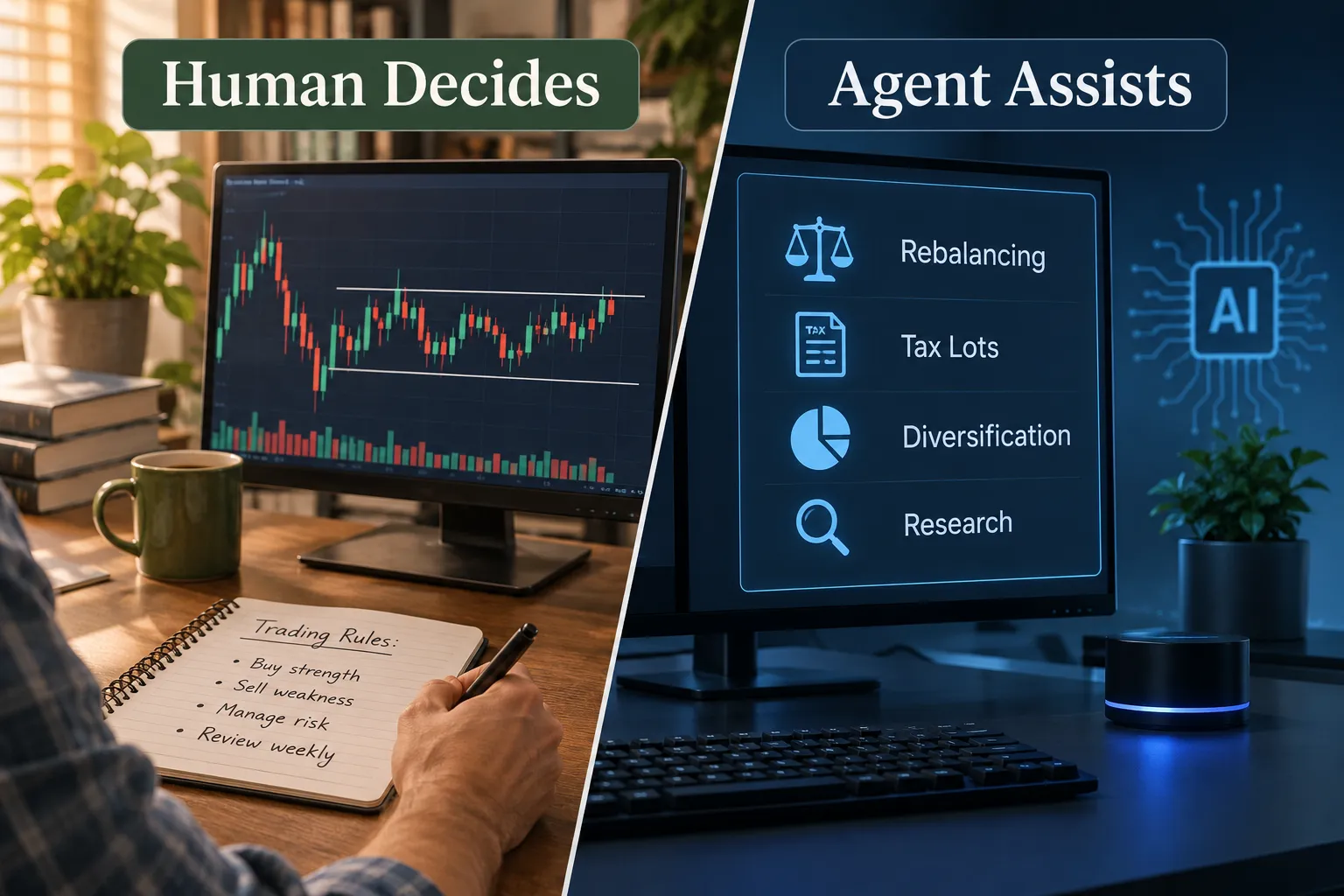
The issue is accountability, not model IQ. An agent that proposes a trade leaves you a decision point, which is where your risk management lives. An agent that executes removes that point. If you have not written down your rules for entry, exit, position sizing and stops, an autonomous agent does not fix that. It scales it.
Three guardrails, borrowed from how the product itself is built:
- Fund the agent account small and separately. Copy the zero-balance default even on platforms that do not enforce it.
- Leave approval required on. The moment you disable the confirmation step, you have promoted a research tool to a portfolio manager.
- Paper trade the strategy first. Our primer on what paper trading actually proves shows how to do it without fooling yourself, and look-ahead bias explains why AI-written backtests often look better than they are.
What should investors watch next?
- Robinhood’s November operating metrics, typically published in mid-December. Watch whether agentic funding grows faster than account count. Count without dollars means tourists.
- Q4 2026 results, expected in February 2027, for an updated Agentic Trading Account figure against the $1.6 billion in cumulative volume reported for Q3.
- Rollout dates for the September announcements, including 24/7 equities, perpetual futures and agentic trading in Robinhood Legend. Not all have confirmed dates.
- SEC and FINRA commentary on AI agents acting with trading discretion in retail accounts.
Our take
The real finding at Wolfe Research was not the record day. It was the restraint.
Robinhood built agentic tools, 200,000 people tried them, and most used them as a research assistant rather than an autopilot. Retail traders get called reckless all the time. Here they drew a sensible line, and the product design helped: separate account, zero starting balance, approval on by default.
That configuration should be the industry standard. The tools earn their keep on tax lot selection, rebalancing math and screening. They are unproven as discretionary traders across a full market cycle, and one wild Thursday is not a full cycle.
Your next step: use the AI tool you already pay for on one task you can verify this week, such as a tax lot review. Check its output against your brokerage statement. Right three times in a row, widen the mandate. Wrong once, you just saved yourself an expensive lesson.
Systems over hacks. An agent is a component in a system you already own, not a replacement for having one.
Did your AI agent trade through the Nov 5 selloff? We want the receipts.
Every submission is checked against the broker’s own disclosures before we write a word about it.
This article is for education only and is not financial advice. We review software and report news; we do not make trade recommendations.
Sources
- Yahoo Finance (MarketBeat), “Robinhood Markets Hits Record Trading Day, Sees Growth in Prediction Markets and AI Trading,” November 11, 2026: https://finance.yahoo.com/markets/stocks/articles/robinhood-markets-hits-record-trading-181516632.html
- Robinhood Investor Relations, “Robinhood Reports Third Quarter 2026 Results,” October 27, 2026: https://investors.robinhood.com/news-releases/news-release-details/robinhood-reports-third-quarter-2026-results
- FINRA, Artificial Intelligence key topics page: https://www.finra.org/rules-guidance/key-topics/artificial-intelligence
Your market edge starts with the right tool. Stay alpha.
Frequently Asked Questions
How many Robinhood customers use agentic trading?
More than 200,000 as of the Wolfe Research event in November 2026, against a customer base above 28 million.
Do Robinhood AI agents trade without permission?
Generally no. Agentic accounts are separate, start at zero, and trades typically require approval unless the customer turns that setting off.
How much money is in Robinhood agentic accounts?
Vlad Tenev said on the Q3 2026 call that customers had placed more than $250 million into agentic accounts, with over $1.6 billion in cumulative notional volume.
When was Robinhood's record equity trading day?
Thursday, November 5, 2026, per Steve Quirk, exceeding the company's 2020 and 2021 peaks.
Is agentic trading the same as algorithmic trading?
No. Algorithmic trading runs fixed rules, while an agent interprets instructions and decides how to respond, which makes it harder to backtest and audit.
Is this article financial advice?
No. It is news and education about trading tools, not a recommendation on any security.
The FullStack Alpha research desk tests AI trading bots on paper and live accounts. Reviewed and edited by Jay Rocco, Founder and Editor.
