

The FullStack Alpha research desk tests AI trading bots on paper and live accounts. Reviewed and edited by Jay Rocco, Founder and Editor.
By FullStack Alpha Editorial Team | Reviewed by Jay Rocco, Chief Editor
Forward testing means running your trading strategy on data it has never seen, in real time, either on paper or with a tiny live position, before you let it touch serious money. A backtest asks “would this have worked?” A forward test asks “does this work right now, with my broker, my data feed, my execution, and my nerves?” Those are different questions, and only one of them can be curve-fit after the fact. The four-week plan below gives you a structure: one week to set up and define pass/fail numbers, two weeks to run and log, one week to decide. No bot, no discretionary setup, no AI signal goes live until it’s survived that.
What You Should Know
- Alpaca’s ChatGPT paper-trading integration launched October 12, 2026, and Alpaca itself warns that paper trading does not model market impact, latency slippage, queue position, or regulatory fees.
- Interactive Brokers states that paper accounts simulate fills from the top of book only (documentation updated October 2026), so deep-book behavior and order types like VWAP, auction, and pegged-to-market behave differently or aren’t available.
- A study of 215 alternative-beta strategies found a median 73% deterioration in Sharpe ratio between backtested and live periods, with the most complex strategies deteriorating more than 30 percentage points worse than the simplest.
- Bailey, Borwein, López de Prado and Zhu formalized the Probability of Backtest Overfitting in work published in the Journal of Computational Finance, arguing that a simple hold-out test gets unreliable once you’ve tried many strategy variants.
- FINRA Regulatory Notice 15-09 (March 26, 2015) tells firms to test algorithms before production and monitor them after deployment. Retail traders aren’t bound by it, but the logic is identical.
What Is Forward Testing in Trading?
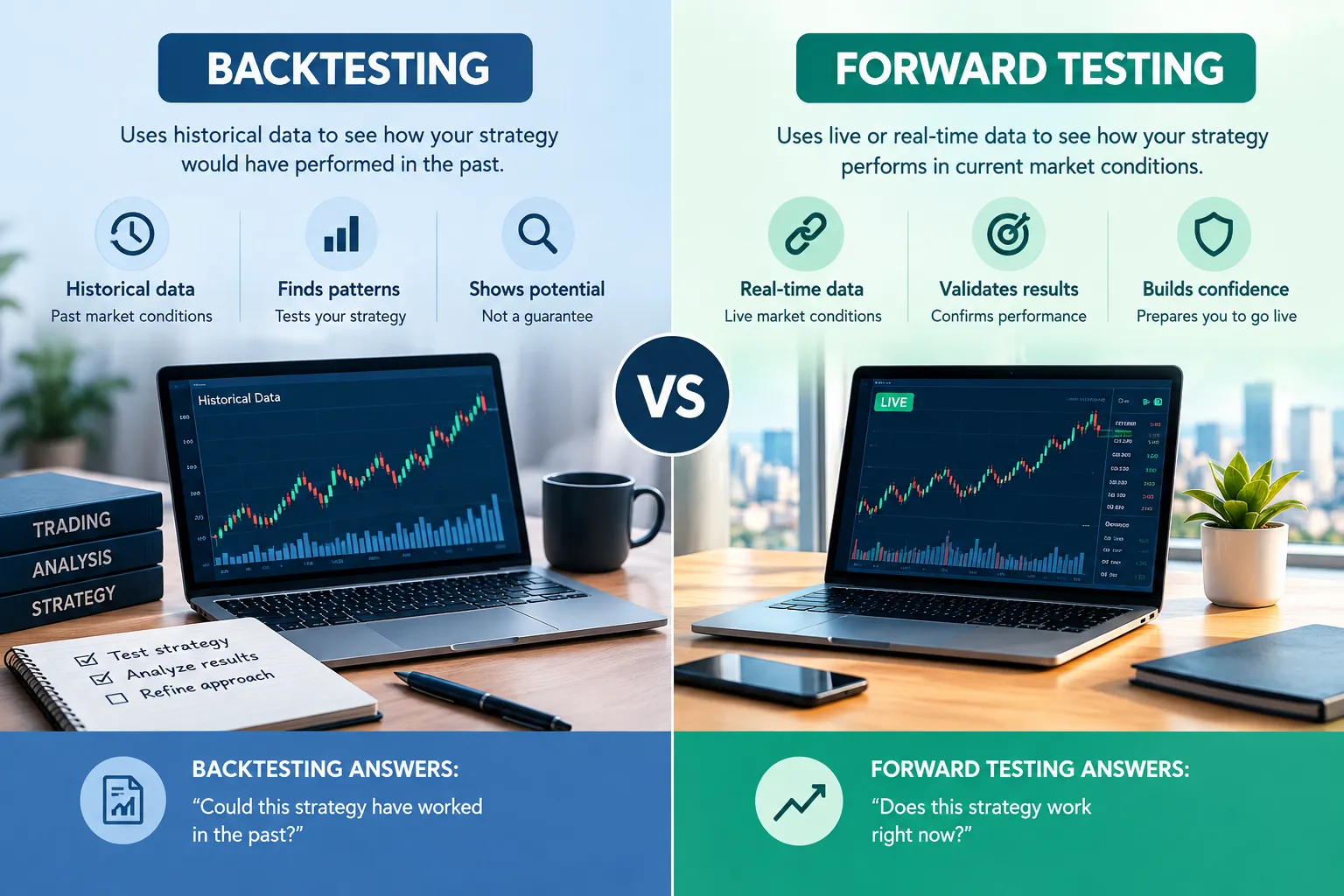
Forward testing is running a strategy forward in time on data that didn’t exist when you built the rules, either in a simulated account or with a deliberately small real position. Nothing about it involves exams or classrooms. The trading meaning is the only one that matters here.
The mechanics are simple. You freeze the rules. You write them down so a stranger could follow them. Then you let the market deliver new bars, new gaps, new halts, new earnings surprises, and you execute exactly what the rules say, logging every single result.
The point is that you can’t cheat the future. A backtest lets you nudge a parameter, re-run, and watch the equity curve get prettier. Forward testing removes that option because tomorrow hasn’t happened yet.
What does forward testing mean in trading, exactly?
Two flavors, and they’re not interchangeable:
- Paper forward test. Simulated money through a broker’s paper account or a platform’s replay engine. Zero financial risk. Also zero emotional weight, which is a real limitation.
- Small-size live forward test. Real money, real fills, real fees, sized so small that a worst-case month is an annoyance instead of a setback. One share. One micro contract. Whatever your account can shrug off.
Either way, you’re testing more than the market logic. You’re testing the data feed, the signal timing, how your order is constructed, broker connectivity, whether your logging actually captures anything useful, and whether you can follow your own rules at 9:31 a.m. with a red candle in front of you. A historical backtest can’t observe a single one of those things.
Practical takeaway: if you can’t describe your entry, exit, stop and size in one paragraph someone else could execute, you’re not ready to forward test. You’re still brainstorming.
Forward Testing vs Backtesting, What Is the Difference?
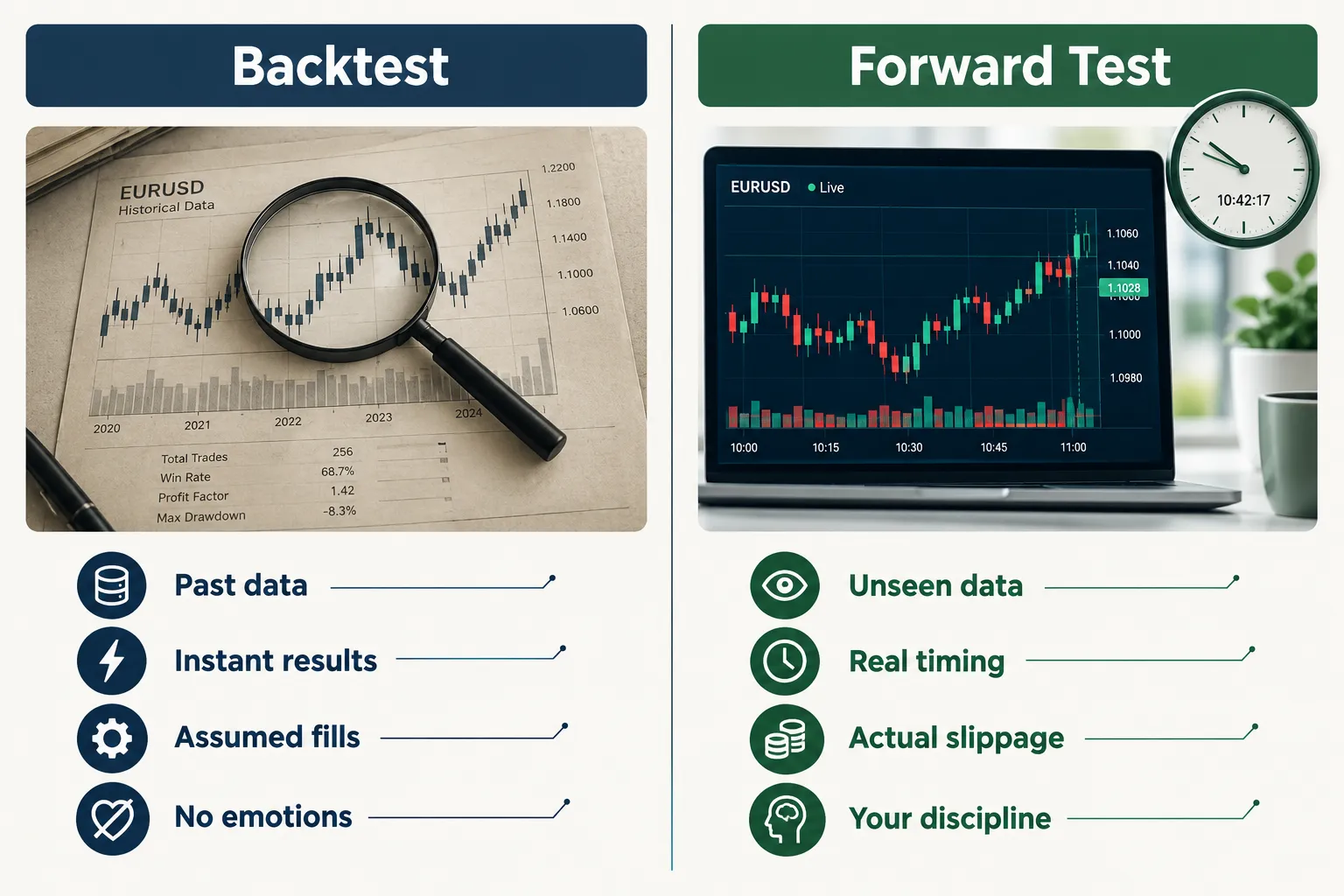
A backtest measures how a rule set would have performed on historical data. A forward test measures how it performs on data the strategy has never touched, in real time, with real execution friction. Backtest first, forward test second, live third. Skipping the middle step is where most retail algos die.
Here’s the backtest vs forward test split, question by question.
| Question | Backtest | Forward test |
|---|---|---|
| What data does it use? | Historical, already known | New data arriving in real time |
| How fast are results? | Minutes | Weeks to months |
| Can you re-run and tweak? | Yes, endlessly. That’s the danger | No. Each day happens once |
| Does it model slippage? | Only your assumption of it | Actual fills, actual spread |
| Does it test your broker connection? | No | Yes, including outages and rejects |
| Does it test your discipline? | No | Yes, and this is where many fail |
| Does it capture data-feed errors? | Rarely | Yes, they show up live |
| Sample size | Can be thousands of trades | Usually dozens |
| Main risk | Overfitting to the past | Too few trades to conclude anything |
| Cost | Cheap, sometimes free | Time. Four weeks minimum |
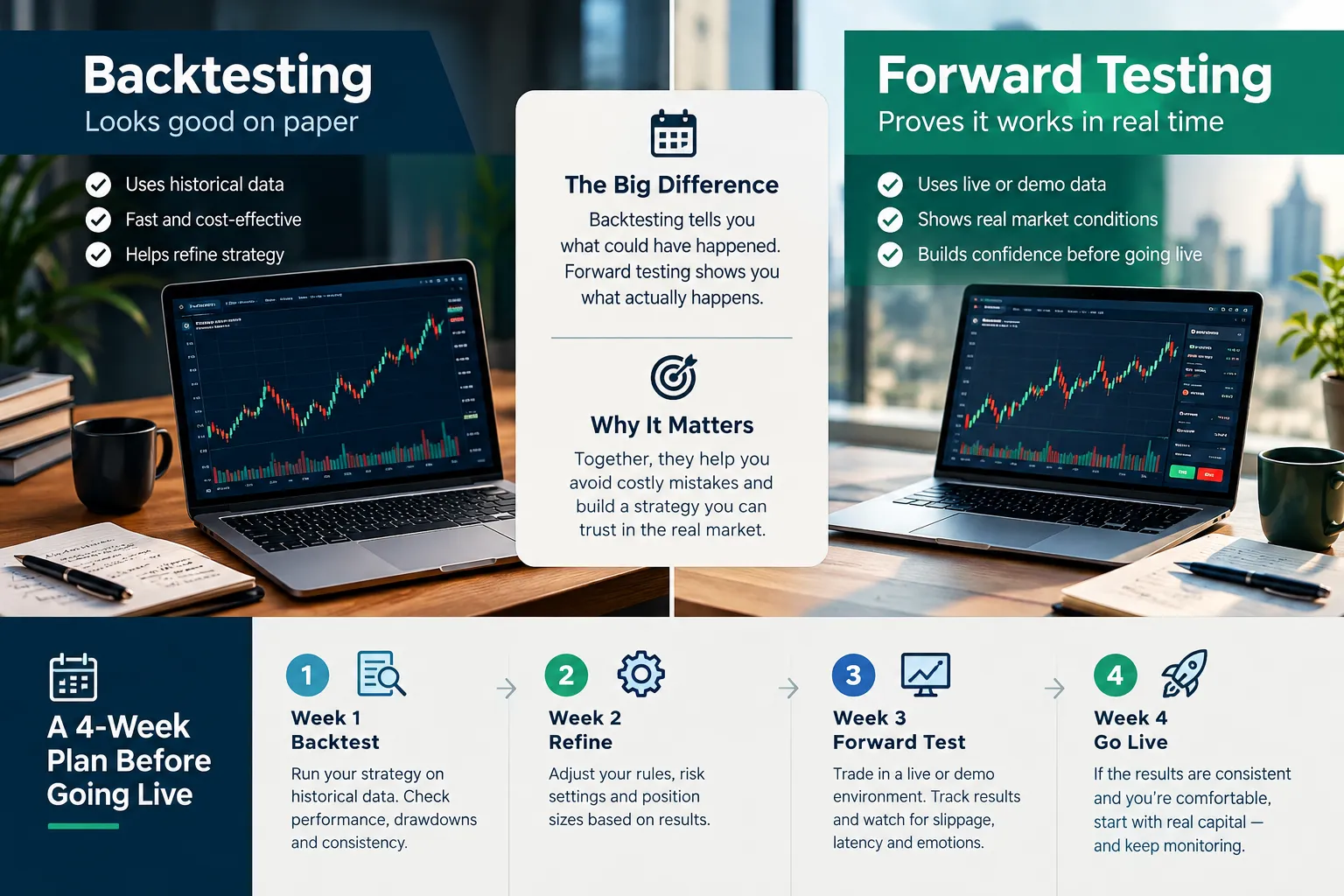
Notice the symmetry in that last block. A backtest gives you statistical power but no realism. Forward testing gives you realism but weak statistical power. You need both, which is why the question “forward testing vs backtesting, which one matters more” has an annoying answer.
Which one matters more?
Neither, individually. The backtest decides whether the idea is worth your time. Forward testing decides whether it’s worth your money. A strategy that fails the backtest doesn’t deserve four weeks of your attention. A strategy that passes the backtest and skips the forward test is an unverified assumption with a position size attached.
Decision rule: if the backtest produced fewer than roughly 100 trades, or the equity curve depends on a single lucky year, don’t bother forward testing yet. Fix the sample first.
If you’re still building the historical side, our backtesting article archive covers the mechanics across asset classes, including options backtesting and futures backtesting software.
Why Do Backtests Fail When Real Trading Starts?
Backtests fail live because historical simulations are optimistic by construction. The four usual culprits: look-ahead bias, overfitting, understated costs, and regime change. The Aalto research on 215 alternative-beta strategies put a number on the damage: a median 73% Sharpe ratio deterioration from backtest to live.
Look-ahead bias
Your code used information that wasn’t available at the moment of the trade. Classic versions: using the day’s closing price to trigger an entry at that same close, using restated fundamentals that were revised months later, or using an index constituent list that excludes companies which went bankrupt. It’s quiet, it’s common, and it manufactures returns out of nothing. We broke the mechanics down in our guide to look-ahead bias in trading backtests.
Overfitting
You tried 400 parameter combinations and kept the best one. Congratulations, you found noise. Bailey and López de Prado’s work on the Deflated Sharpe Ratio makes the point directly: the relevant question isn’t “what’s the Sharpe?” but “how many combinations did you search before you found it?” Their Probability of Backtest Overfitting framework, developed with Borwein and Zhu, exists precisely because plain hold-out testing stops being trustworthy once you’ve run enough variants.
The Aalto finding backs this up on the behavioral side. The most complex strategies in that sample deteriorated more than 30 percentage points worse than the simplest ones. Complexity isn’t sophistication. Often it’s just more places to hide a fit.
Costs you assumed instead of measured
Commission, spread, borrow fees, exchange fees, and slippage. Most backtest engines let you type in a slippage figure. Typing “0.01” doesn’t make it true. Our walkthrough on paper trading slippage covers why simulated fills flatter you, and Alpaca’s own documentation states plainly that its paper environment doesn’t model market impact, latency-related slippage, queue position, or regulatory fees.
Regime change
The strategy worked in 2017’s low-volatility grind and dies in a choppy tape. Nothing broke. The environment changed. A backtest spanning one regime tells you about one regime.
Practical takeaway: before you forward test, write down your assumed slippage per trade. Week 3 compares that number against reality. If reality is double your assumption, your backtested edge may already be gone.
What Is Out of Sample Testing and Walk Forward Analysis?
Out of sample testing means holding back a slice of your historical data, never looking at it while you build, then running the finished rules on it once. Walk forward analysis is the rolling version: optimize on a window, test on the next unseen window, slide forward, repeat. Both sit between backtesting and forward testing, and both are still historical.
Think of it as a staircase:
- In-sample backtest. You build and tune here. The most optimistic number you’ll ever see.
- Out of sample testing. One reserved block of history the strategy never saw during development. Fast, but vulnerable to regime luck. One unusually calm or unusually violent period can dominate the whole result.
- Walk forward analysis. Multiple sequential train/test splits. Each test window is unseen. Current methodology guidance commonly uses optimization windows of two to four years with validation windows of three to six months.
- Forward testing. Real time, real feed, real execution. The only step that tests you.
A 2026 arXiv study applied nine sequential walk-forward splits across 50 S&P 500 companies from 2010 to 2024 and reported its proposed GT-Score improved the validation-to-training return ratio by 98% over baseline optimization objectives. Promising, and still one study. Treat it as a direction, not a benchmark.
Out of sample testing tells you the strategy generalizes across history. Forward testing tells you it survives your broker, your latency, and your Tuesday morning.
Common mistake: peeking at the out-of-sample block, not liking the result, going back to tune, then re-testing on the same block. You just converted it into in-sample data. Once it’s burned, it’s burned. Reserve a fresh slice or accept you’ve lost that check.
Decision rule: choose a single hold-out if you tested fewer than about 20 parameter variants and have limited history. Choose walk forward analysis if you tested many variants or your strategy depends on parameters that might drift with volatility.
What Is the 4-Week Forward Test Plan?
Four weeks is the minimum useful window for most retail strategies: one week to lock rules and build your log, two weeks of live running, one week to analyze and decide. It isn’t a magic number. It’s the shortest honest period that produces a sample you can reason about without your attention span dissolving.
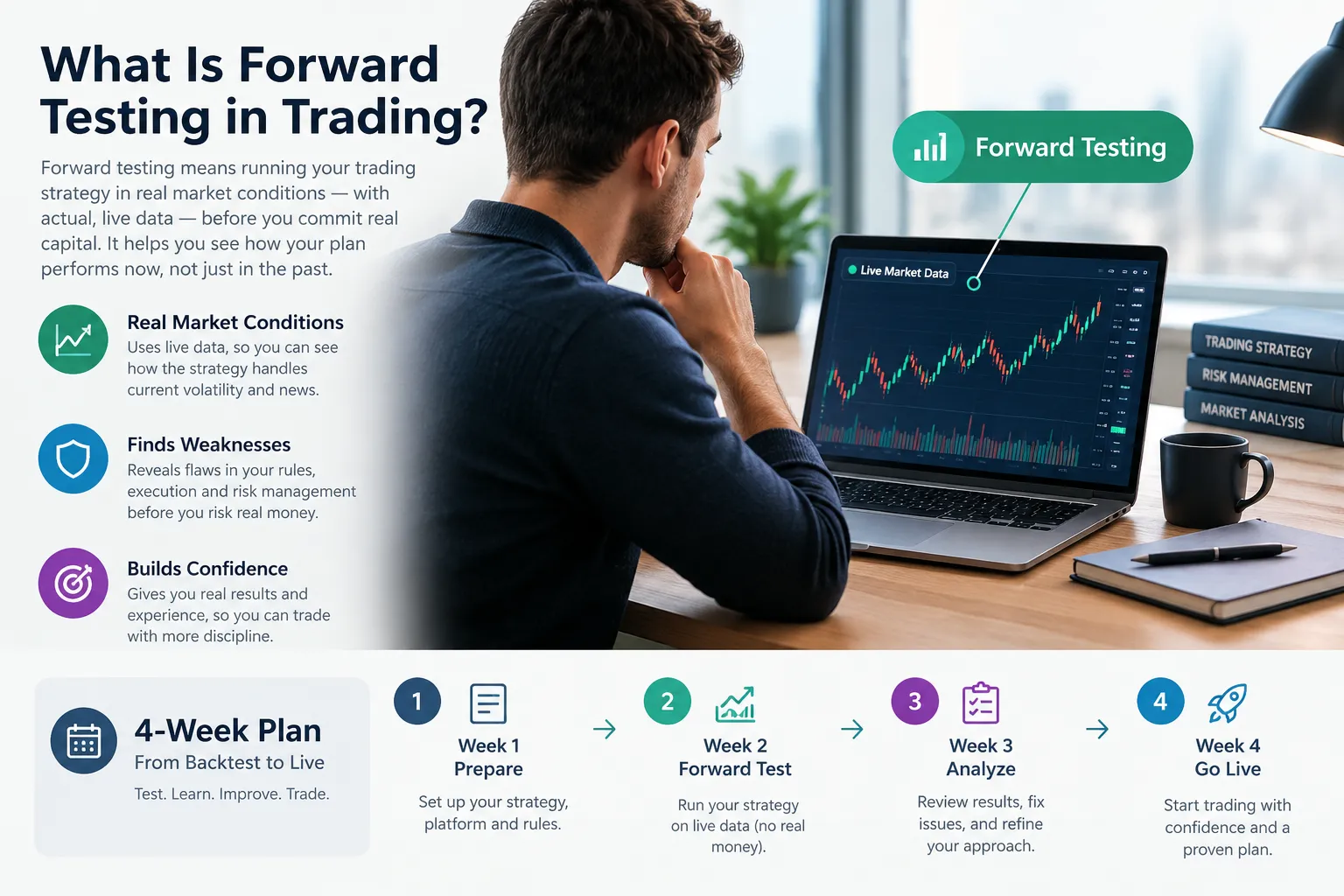
Week 1: Setup and log
You place zero trades this week. That’s the point.
- Freeze the rules in writing. Entry condition, exit condition, stop loss placement, profit target or trailing method, position sizing formula, maximum trades per day, and what you do on a gap. One page. No “I’ll use judgment here.”
- Write your pass/fail numbers before you start. Minimum trade count, maximum acceptable drawdown relative to backtest, maximum acceptable slippage versus assumption. Choosing thresholds after you see results is how people talk themselves into a losing system.
- Build the log. A spreadsheet is fine. Columns: date, time of signal, time of fill, ticker, direction, intended entry price, actual fill price, size, stop, exit price, exit reason, slippage in cents and in basis points, whether you followed the rule, and a one-line note.
- Set up the environment. Paper account or small live account. Confirm data feed matches what your backtest used. If your backtest used end-of-day data and your live feed is tick, those are different strategies.
- Check your export path. IBKR’s October 1, 2026 integration changelog notes that paper-trading accounts may not create third-party reports, so you may need to export fills and orders manually. Find that out in week 1, not week 4.
Week 2: Run
Execute, log, do not adjust. Every day, same routine.
Daily record, five minutes at the close:
- Number of signals the strategy produced
- Number you actually took, and why you skipped any
- Fill quality on each: intended price versus actual
- Any technical failure (missed alert, rejected order, feed lag, app crash)
- Running P&L in R multiples, not dollars. R means risk per trade. A trade that made twice what you risked is +2R. This keeps position size from distorting the picture
The hardest rule of week 2: no parameter changes. If you move the stop on day 4 because a trade annoyed you, the test restarts. You can’t average two different strategies and call the result evidence.
If you’re forward testing a bot, add a technical layer. Log every order the system sends, every reject, every reconnect, and every state mismatch between what the bot thinks it holds and what the broker says it holds. That desync is the single most common reason automated systems blow up in their first live month, and it never appears in a backtest.
Week 3: Review
Keep running the strategy, but now you also start measuring. Do not change anything yet.
Build four comparisons against your backtest:
- Win rate. Live versus backtested, as a percentage point gap.
- Average R per trade. The honest headline number.
- Maximum drawdown. In R, so size doesn’t flatter you.
- Slippage. Average cents per fill versus the number you assumed. This is where strategies quietly die.
Then the uncomfortable column: rule adherence. Count how many signals you took versus how many fired. If the strategy generated 22 signals and you took 14, you didn’t test the strategy. You tested a different, undocumented strategy that happens to include your mood.
Week 4: Decision
Three outcomes, and only three. No “let’s see how next month goes” unless you deliberately extend with written reasons.
- Go live, small. Metrics inside your pre-set bands, adherence above 90%, no unresolved technical failures. Start at a fraction of target size for another month.
- Extend. Not enough trades to conclude. Common for swing strategies. Run another four weeks with identical rules.
- Kill it. Metrics outside bands, or you couldn’t follow the rules, or the slippage ate the edge. Killing a strategy in week 4 costs you a month. Finding out live costs considerably more.
Practical takeaway: write your week-4 decision criteria on day 1 and screenshot them. Future-you will try to renegotiate.
What Are the Pass and Fail Numbers?
There are no industry-standard thresholds for forward testing. Anyone quoting you a universal “60% win rate = pass” is selling something. What follows is a template for setting your own numbers before you start, calibrated against your own backtest.
| Metric | Pass | Warning | Fail |
|---|---|---|---|
| Trade count in 4 weeks | At or above your pre-set minimum (e.g. 20 for day trading, 8 for swing) | 50-99% of minimum | Below half. Extend, don’t conclude |
| Win rate vs backtest | Within 10 percentage points | 10-20 points below | More than 20 points below |
| Average R per trade | At or above 70% of backtested R | 40-70% | Below 40%, or negative |
| Max drawdown vs backtest | At or below backtested max drawdown in R | Up to 1.5x backtested | Above 2x backtested |
| Slippage vs assumption | At or below assumed | Up to 2x assumed | Above 2x, or it flips the edge negative |
| Rule adherence | 90% or more of signals taken as written | 75-90% | Below 75%. You tested yourself, not the system |
| Technical failures | Zero unresolved | One or two, root cause identified | Recurring or unexplained |
Set every one of these numbers yourself, in writing, in week 1. They’re calibration tools, not benchmarks.
How do you know your strategy passed forward testing?
It passed when the live numbers sit inside bands you defined before you saw them, across a trade count large enough that one lucky winner doesn’t carry the result. That’s it. A strategy that “felt good” and made money on four trades hasn’t passed anything. It got a sample of four.
The slippage line deserves extra attention. If you assumed 2 cents per share and you’re averaging 7, recompute the backtest with 7 cents. If the edge disappears, the strategy was always fictional. Better to learn that in a paper account.
What if your forward test results don’t match your backtest?
A gap is normal. A collapse is a finding. Given the median 73% Sharpe deterioration observed across those 215 alternative-beta strategies, expect live to be worse than backtested, and plan for it.
Diagnose in this order:
- Execution gap? Compare intended fill price to actual. If slippage explains the whole shortfall, it’s a costs problem, not a logic problem. Fix sizing or trade more liquid names.
- Timing gap? Is your signal arriving late? If an alert buzzes 90 seconds after the move, the trade in your log isn’t the trade in your backtest. Our trader reaction time test gives you a baseline on how much latency you personally add.
- Adherence gap? Count skipped signals. Humans skip the ugly setups, which are often the winners.
- Data gap? Different bar timing, different adjustment for splits and dividends, different session hours.
- Overfitting? If 1 through 4 check out and the strategy still underperforms badly, you probably curve-fit. Go back to walk forward analysis with fewer parameters.
Edge case: a forward test that dramatically outperforms the backtest is also a red flag. It usually means a sample of six trades in a friendly regime, or a data error. Don’t go live on good luck either.
Can You Make Money During the Forward Testing Phase?
Yes, if you forward test with small real money. No, if you’re paper trading, since simulated profits are a scoreboard, not income. The decision between the two is a trade-off between emotional realism and risk.
Should you forward test with real money or simulated?
Start simulated for one to two weeks to catch plumbing failures, then switch to minimum real size for the remainder. That hybrid gives you the safety of paper for the bugs and the honesty of real money for the psychology.
Choose simulated if:
- The strategy is automated and you haven’t verified order handling yet
- You’re trading a product where a mistake is expensive (futures, options spreads)
- You have less than $2,000 and a bad test would meaningfully hurt
Choose small live if:
- The strategy is discretionary, where your behavior is half the system
- Paper fills in your platform look suspiciously perfect
- You’ve already run a clean paper week
The emotional argument matters more than people admit. Paper trading removes the one variable most likely to break the strategy: you. No one revenge trades a simulator. No one hesitates on a paper entry. A system that only works when nothing is at stake isn’t a system.
Is forward testing the same as paper trading?
No. Paper trading is a mode of execution (simulated money). Forward testing is a process (running frozen rules on unseen data, with a log and pass/fail criteria). You can forward test using paper trading. You can also paper trade aimlessly for six months and learn nothing, because there was no hypothesis, no log, and no decision point. The log is what makes it a test.
How Long Should You Forward Test a Trading Strategy?
Long enough to collect a meaningful number of trades, which depends entirely on your holding period. Four weeks is a reasonable floor for day trading. Swing strategies usually need eight to twelve weeks to reach a comparable sample.
Forward testing timeframe for day trading vs swing trading
| Style | Typical trades per week | Minimum forward test | Why |
|---|---|---|---|
| Intraday scalping | 15-40 | 2-4 weeks | High frequency hits sample size fast |
| Day trading | 5-15 | 4 weeks | The standard four-week plan fits |
| Swing trading | 1-4 | 8-12 weeks | Need the calendar to produce trades |
| Position trading | Under 1 | One quarter or more | Lean heavily on walk forward analysis instead |
Think in trades, not days. A four-week swing test with six trades tells you almost nothing. The same four weeks on an intraday system with 60 trades tells you quite a lot.
Edge case: a strategy that trades only around a specific catalyst, like earnings season, can’t be honestly tested in a quiet month. Extend across at least one catalyst cycle or accept that you tested the strategy’s idle state.
Which Tools Support Forward Testing?
Most major brokers and charting platforms offer paper accounts or replay engines, and the useful question is what each one doesn’t simulate. Read the limitations before you trust the fills.
- Interactive Brokers paper trading. Uses real market conditions, but IBKR’s October 2026 documentation states fills are generally simulated from the top of book, deep-book behavior isn’t represented, and certain order types (VWAP, auction, RFQ, pegged-to-market) are unavailable or simulated differently. Its October 1, 2026 changelog also notes paper accounts may not create third-party reports, so plan on manual exports.
- Alpaca. Launched ChatGPT-based paper trading and live portfolio monitoring on October 12, 2026, supporting simulated trading and natural-language interaction. Alpaca warns directly that paper trading doesn’t model market impact, latency slippage, queue position, or regulatory fees.
- TradingView. Updated its paper trading and Strategy Report documentation on October 22, 2026. Important distinction: the Strategy Report evaluates strategy-generated trades historically, while Paper Trading runs forward on simulated money. They are not the same tool and shouldn’t be treated as interchangeable evidence.
- Replay and bar-by-bar tools. Useful for rehearsing execution, but replay is still historical data. It’s practice, not forward testing, because the outcome already exists.
For the historical half of the work, we’ve covered the best free backtesting software and free option backtesting options separately.
On the signal side, if your strategy depends on alerts firing in time, the alert infrastructure is part of what you’re testing. Our breakdown of the AI stock alert apps that buzz your phone before the move covers latency differences, and if you’re evaluating a pattern scanner as your signal source, the TrendSpider review walks through what it catches. Traders building intraday systems can browse the day trading tools directory for scanner and execution options.
Pricing check: every platform changes plans and limits. Check the official page for current pricing, data entitlements, and paper account rules before you commit four weeks to one environment.
What Mistakes Ruin a Forward Test?
Most failed forward tests aren’t failed strategies. They’re failed procedures. Six common ones, with the fix attached.
- Changing parameters mid-test. Fix: freeze on day 1, write the parameters down, change nothing until week 4. Keep a “next version” note file so the urge has somewhere to go.
- Not logging slippage. Fix: log intended price and actual fill on every trade. Two extra columns. This single habit catches more dead strategies than any other metric.
- Cherry-picking signals. Fix: count signals generated versus signals taken. If adherence is under 75%, you tested your mood, not the system.
- Testing in a single market regime. Fix: note the market environment in your log. One quiet month proves the strategy survives quiet months.
- Too few trades, strong conclusion. Fix: set a minimum trade count before starting and extend rather than conclude when you miss it.
- Paper trading with fake size. Fix: use the same position size you’d trade. A $500,000 paper account teaches you nothing about managing $5,000.
The meta-mistake: running a forward test with no written pass/fail criteria. Without them, every result becomes a judgment call, and judgment calls always break in favor of the strategy you spent two months building. Sunk cost is a hell of a drug.
When Is Forward Testing Not Enough?
Forward testing isn’t enough when the sample is too small, the market environment during the test was unusually one-sided, or the strategy depends on conditions that didn’t occur. It validates plumbing and discipline well. It can’t prove a statistical edge in four weeks.
Specific cases where you need more:
- Low-frequency strategies. Twelve trades can’t distinguish skill from luck. Lean harder on walk forward analysis and extend the live period at minimum size.
- Tail-risk strategies. Anything that makes small gains most of the time and relies on surviving rare events. Your four weeks almost certainly contained zero such events.
- Capacity-sensitive strategies. Paper fills don’t model market impact. A strategy that works on 100 shares may not work on 10,000. Alpaca says this outright in its own documentation.
- Strategies built on heavily searched parameters. If you tested hundreds of combinations, the Probability of Backtest Overfitting work suggests a single clean forward test won’t rescue you. Simplify first.
Can forward testing guarantee your strategy will work live?
No. Nothing can. Forward testing reduces the odds of a predictable, preventable failure: bad data, broken orders, understated costs, rules you can’t follow. It does not predict future returns, and anyone saying otherwise is selling a course.
Is forward testing required or just recommended?
For retail traders it’s not a legal requirement. For firms, FINRA Regulatory Notice 15-09 (March 26, 2015) directs firms to test algorithms before production, validate software and controls, and monitor strategies after deployment. Retail traders aren’t bound by that notice, but it describes the governance professionals consider basic. Treat it as the standard you hold yourself to.
Frequently Asked Questions
What does forward testing mean in trading?
Running a fixed set of trading rules on new, unseen market data in real time, either on paper or at small live size, while logging every result. It’s the step between a historical backtest and full-size live trading, and it tests execution, costs, timing and your own discipline alongside the strategy’s logic.
How long should a forward test run?
Four weeks minimum for day trading, eight to twelve weeks for swing trading. Judge by trade count, not calendar days. A reasonable floor is 20 trades for intraday systems and whatever number lets one outlier not dominate your results for slower strategies.
Is forward testing the same as paper trading?
No. Paper trading is simulated execution. Forward testing is the process of running frozen rules forward with a log and pre-set pass/fail criteria. You can forward test using paper trading, but paper trading without a log, a hypothesis, and a decision date is just practice.
What is out of sample testing?
Reserving a block of historical data that your strategy never saw during development, then testing the finished rules on it once. It checks whether the strategy generalizes beyond the period you tuned on. Walk forward analysis is the rolling version, using repeated train-then-test windows across history.
Can you forward test a bot for free?
Yes. Interactive Brokers, Alpaca and TradingView all offer paper trading environments, though features and limits differ and change, so check the official page for current terms. Note that IBKR documentation says paper accounts may not generate third-party reports, so plan to export your logs manually.
What if the forward test beats the backtest?
Treat it with the same suspicion as underperformance. It usually means a small sample in a friendly regime or a data mismatch between environments. Verify your fill prices, check your trade count, and don’t scale up size on four lucky trades.
Our Take
No bot goes live before a logged forward test. Not one. Not “just a small position to see.” The backtest is a hypothesis, forward testing is the experiment, and skipping the experiment to save four weeks is how smart people convert a curve-fit spreadsheet into a real drawdown. Play stupid games.
Four weeks. One page of frozen rules. One spreadsheet. Pass/fail numbers written before you see a single fill. That’s the whole protocol, and it costs you nothing but patience.
Still choosing where to run the paper half of the test? Our Alpaca broker review on AI Stock Picker App is a good place to start.
Built a bot you think can survive it? Run the four weeks, keep the log, then submit it for review. We’ll look at the numbers, not the pitch. More systems, reviews and backtesting walkthroughs at aistocktradingbots.com.
Cut the noise, keep the alpha. Stay alpha.
The FullStack Alpha research desk tests AI trading bots on paper and live accounts. Reviewed and edited by Jay Rocco, Founder and Editor.
