

Jay Rocco is the Founder and Editor of FullStack Alpha. He has tested 200+ AI stock tools since 2022 and run 15+ AI trading platforms on live accounts with his own money. He reviews the software. He does not tell you what stocks to buy.
Last updated: August 31, 2026
Quick Answer: Options backtesting inflates win rate in five specific ways: mid-price fill assumptions, stale or modeled implied volatility, ignored assignment risk, assumed liquidity on illiquid strikes, and survivorship or look-ahead bias. Every one of these is fixable. The win rate your backtesting tool is showing you is almost certainly not the win rate you will get in a live account.
Key Takeaways
- Most options backtesting tools fill trades at the mid-price by default. In live markets, you rarely get mid. You get closer to the bid when selling and the ask when buying, and that gap alone can flip a “profitable” strategy to a losing one.
- Implied volatility in historical options chain data is often modeled or interpolated, not the actual IV that existed at that moment. Stale IV changes your Greeks and your P&L.
- Assignment and early exercise on American-style options are almost never modeled in consumer-grade backtesting platforms. For short puts and covered calls, that is a real gap.
- Open interest on far out-of-the-money strikes is often zero or near-zero. Testing a strategy on strikes that never traded is fiction.
- Survivorship bias in options universes is more severe than in stocks. Delisted tickers, acquired companies, and post-earnings volatility crushes all disappear from the record.
- A corrected backtest is a better hypothesis. It is still not a track record, and past results do not predict future ones.
- The fix is not a better tool. The fix is understanding what every tool assumes, and then stress-testing those assumptions before you size up.
What Is Options Backtesting, and How Is It Different From Stocks?
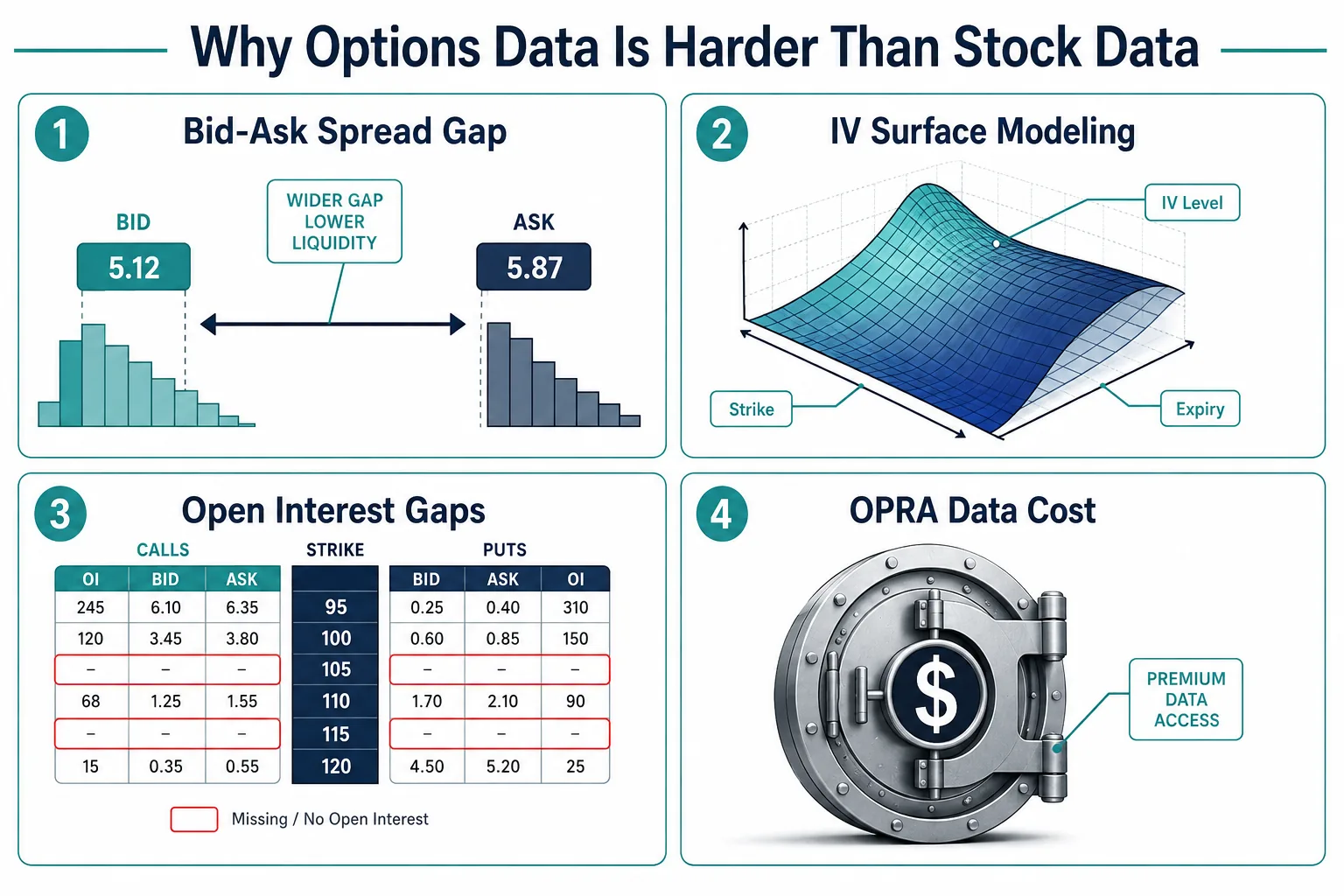
Options backtesting is the process of applying a defined set of trading rules to historical options data to see how that strategy would have performed. Unlike stock backtesting, which works on a single price series per ticker, options backtesting requires a full historical chain: every strike, every expiration, bid and ask prices, open interest, volume, and the implied volatility surface at each point in time.
That added difficulty is exactly why options backtesting is harder to do correctly, and why the results are easier to misread.
Why a Contract Is Harder to Test Than a Share
A stock has one price at any given moment. An options chain on SPY on any given day can have hundreds of strikes across dozens of expirations, each with its own bid, ask, delta, theta, vega, gamma, and implied volatility. The Options Clearing Corporation (OCC) processes settlement and assignment across all of those contracts, and the rules for American-style options include the possibility of early exercise at any point before expiration.
When you backtest a covered call or an iron condor, you are not testing one number. You are testing a multi-leg structure across a surface that changes shape every single day. Get any one of those inputs wrong, and the output is wrong.
The Data Problem Nobody Warns You About
Historical options chain data is expensive and hard to source accurately. OPRA, the Options Price Reporting Authority, is the official consolidated feed, and institutional-grade historical OPRA data costs thousands of dollars per year. Cboe DataShop sells historical SPX and VIX options data, but full chain history at tick resolution is not cheap.
Most retail-facing options backtesting platforms do not use raw OPRA data. They use end-of-day snapshots, modeled IV surfaces based on Black-Scholes interpolation, or data licensed from third-party vendors whose coverage and accuracy varies. That is not a scandal. It is just the reality of the data economics, and it matters a lot when you are trying to interpret a backtest result.
Why Does Options Backtesting Overstate Your Win Rate?
Options backtesting overstates win rate through five specific mechanisms. Understanding each one is the difference between treating a backtest as a green light and treating it as a starting hypothesis.
Mid-Price Fills You Would Never Get
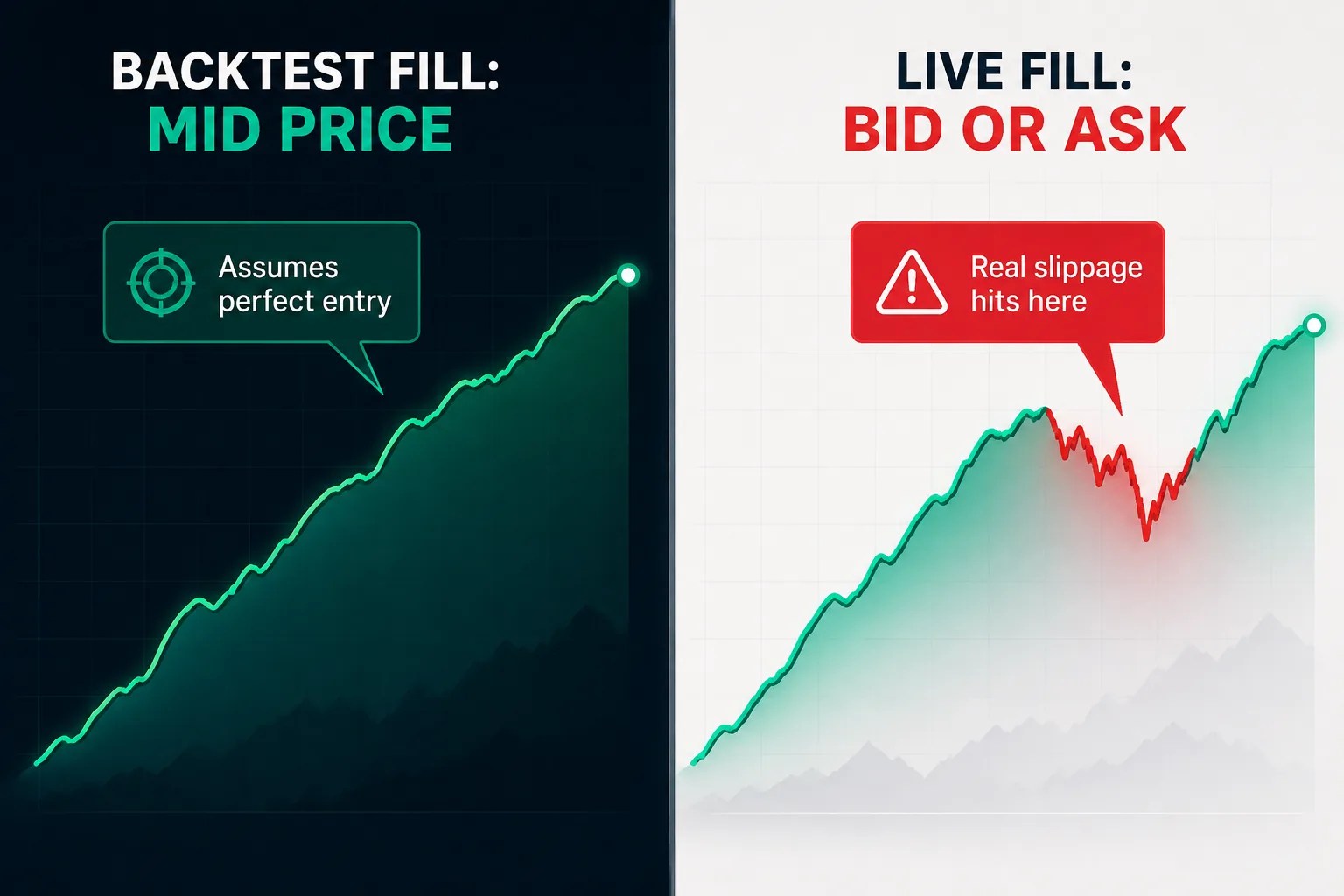
This is the single biggest source of flattery in any options backtest. Most platforms, including many well-known options backtesting tools, default to filling trades at the mid-price: the exact midpoint between the bid and the ask.
In a liquid name like SPY or QQQ with a one-cent spread, mid-price fills are close to realistic. In a less liquid name with a $0.30 wide spread, filling at mid means you are assuming you bought at $1.15 when the ask was $1.30 and the bid was $1.00. That $0.15 per contract difference is $15 per contract. On a ten-lot, that is $150 of phantom profit per trade, before commissions.
For income strategies like short puts or iron condors, where the edge is measured in small premium amounts, mid-price optimism can account for the entire apparent edge in the backtest. The strategy looks profitable because the fill model is generous, not because the strategy has real edge.
Stale or Modeled Implied Volatility
The Greeks that drive options pricing, including delta, theta, vega, and gamma, are all functions of implied volatility. If the IV in your historical data is wrong, every P&L calculation downstream is wrong.
Most retail options backtesting platforms do not store the actual implied volatility that existed at each moment in time. They reconstruct it from end-of-day prices using a Black-Scholes model, or they interpolate across the IV surface from sparse data points. During normal markets, this approximation is close enough. Around earnings, Fed announcements, or volatility spikes, it can be wildly off.
The practical effect: a short straddle entered the day before an earnings announcement looks much safer in the backtest than it was in reality, because the IV crush and the pre-event vol spike are both smoothed out in the historical data.
Assignment and Early Exercise Ignored
American-style options, which includes most equity options traded in the U.S., can be exercised at any time before expiration. The OCC handles assignment notices on a random basis among short option holders.
Almost no consumer-grade options backtesting platform models early assignment. That means every backtest on short calls, short puts, cash-secured puts, or covered calls is implicitly assuming you will never get assigned early. In reality, deep in-the-money short calls get assigned regularly, especially around ex-dividend dates. A short put that gets assigned early forces you to take a stock position you may not have planned for, at a cost basis that changes your entire risk profile.
For income traders running wheeling strategies or covered calls on dividend-paying stocks, ignoring assignment is not a minor oversight. It is a structural gap in the model.
Liquidity Assumed on Illiquid Strikes
Options backtesting platforms test whatever strikes you tell them to test. They do not always check whether those strikes actually had tradable liquidity at the time.
A 30-delta put on a mid-cap stock might have had zero open interest and zero volume on the specific date your backtest tried to enter it. In a live account, that trade either does not get filled or gets filled at a terrible price. In the backtest, it fills cleanly at mid. Multiply that across hundreds of test trades and you have a win rate built on trades that could never have been executed.
The Cboe Global Markets liquidity data shows that even on actively traded underlyings, far out-of-the-money strikes and longer-dated expirations can go days without a single trade. Testing strategies on those strikes without filtering for minimum open interest is testing against phantom liquidity.
Survivorship and Look-Ahead Bias
Survivorship bias in options universes is more severe than in stock universes. When a company gets acquired, goes bankrupt, or gets delisted, its options chain disappears from most historical databases. The strategies that would have blown up on those names never show up in the backtest. Only the survivors remain, and the survivors look better than the full universe did.
Look-ahead bias is subtler. It happens when a backtest uses information that was not available at the time of the trade. A common example: using end-of-day IV to set entry criteria for a trade that supposedly happened at 10 a.m. The IV at 10 a.m. was different. The strategy would not have triggered, or would have triggered at a worse level.
Choosing a test window that avoids 2008 or March 2020 is a form of data window bias. Those regimes are exactly where income strategies fail. Excluding them from the test period is not conservative. It is cherry-picking.
How Do You Fix an Options Backtest?
Fixing an options backtest does not require a new platform. It requires changing four specific assumptions that most traders never touch.
Fill at the Bid or Ask, Not the Middle
When selling options, fill at the bid. When buying options, fill at the ask. This is the conservative assumption, and it is the one that reflects what actually happens when you send a market order or when your limit order gets picked off.
Some platforms let you set a fill model. ORATS, for example, allows you to specify fill at bid, ask, or a percentage of the spread [see our options backtesting tools breakdown]. If your platform only offers mid-price fills, manually subtract half the average spread from every winning trade and add it to every losing trade. It is not elegant, but it is more honest than leaving the mid-price assumption in place.
Add Commission and Per-Contract Fees
A per-contract commission of $0.65 is standard at most U.S. brokers. On a ten-lot iron condor, that is $5.20 round-trip per spread, or $10.40 for the full four-leg structure. On a strategy collecting $1.00 in premium per spread, commissions are eating more than 10% of gross premium before the trade even starts.
Most options backtesting platforms do not add commissions by default. You have to turn them on manually, and you have to use realistic numbers. Check your actual broker’s fee schedule and use that number, not a round zero.
Model Assignment Explicitly
For any strategy involving short American-style options, add an assignment scenario to your testing. The simplest version: for every short put or short call that finishes in the money with more than 10 days to expiration, assume assignment occurs and calculate the resulting stock position’s P&L through the original expiration date.
This is not a perfect model. But it forces you to confront the scenarios your backtest is currently ignoring, and it will change your win rate calculation materially for strategies like the wheel or covered calls on high-dividend stocks.
Filter for Open Interest Before Testing
Before including any strike in a backtest, require a minimum open interest of at least 100 contracts and a minimum daily volume of at least 10 contracts on the entry date. This filters out the phantom liquidity problem. It will reduce your sample size, but a smaller sample of real trades is worth more than a large sample of imaginary ones.
What Options Backtesting Software Actually Models Fills?
The honest answer is that very few platforms model fills with full realism, and the ones that do require either a paid subscription or coding skills. Here is what actually exists [see our best AI options trading tools guide].
Backtesting Options on Dedicated Platforms
ORATS (Options Research and Technology Services) is one of the most cited platforms for serious options backtesting. It provides historical options chain data going back to 2007, allows fill model customization, and is used by professional traders and funds. Pricing is not cheap, starting at several hundred dollars per month for full access, but the data quality and fill flexibility are genuinely better than most alternatives.
Option Alpha offers a visual strategy builder with backtesting built in. It is more accessible than ORATS and has a free tier with limited backtesting. The fill model defaults to mid-price, which is the core limitation [see the Option Alpha review].
OptionStrat focuses on strategy visualization and has some backtesting functionality. It is better as a strategy modeler than a rigorous backtesting tool [see the OptionStrat tool page].
Market Chameleon provides historical IV data, earnings history, and some strategy backtesting. The data depth is useful for IV rank analysis and for checking whether a strategy’s IV assumptions are realistic.
Optionnet Explorer is popular among income traders running iron condors and butterflies. It has a dedicated backtesting module with end-of-day historical chain data going back over a decade.
Option Backtesting Inside a Broker Platform
Thinkorswim OnDemand from TD Ameritrade (now part of Schwab) is the most well-known broker-based backtesting tool. It replays historical market conditions including the options chain, and you can paper trade against historical data in real time. The fill model is more realistic than most dedicated platforms because it uses actual historical bid-ask prices rather than modeled data. The limitation is that it is slow, manual, and not scriptable.
Tastytrade has some backtesting functionality, but it is limited in depth and customization compared to dedicated platforms.
Coding Your Own With Historical Chain Data
QuantConnect is an open-source algorithmic trading platform that supports options backtesting in Python. It provides historical options chain data and lets you model fills, commissions, and assignment explicitly in code. This is the most flexible approach and the one that allows the most honest modeling, but it requires programming skills and familiarity with the options pricing libraries.
Cboe DataShop sells historical SPX and VIX options data that can be fed into a custom backtesting engine. For SPX-focused strategies, this is the most accurate data source available to retail traders.
For a broader look at how automated systems handle strategy testing, the automated trading bot results breakdown covers what live execution actually looks like versus what the model predicted.
Comparison Table: Options Backtesting Tools on Data and Fill Modeling
| Platform | Historical Data Depth | Fill Model | Assignment Modeling | Free Tier |
|---|---|---|---|---|
| OptionStrat | Limited chain history | Mid-price default | Not modeled | Yes, limited |
| Option Alpha | Several years EOD | Mid-price default | Not modeled | Yes, limited backtests |
| ORATS | 2007 to present, full chain | Bid, ask, or custom | Partial modeling | No |
| Market Chameleon | IV history, earnings data | Mid-price | Not modeled | Yes, basic features |
| Thinkorswim OnDemand | Several years, replay mode | Historical bid-ask | Manual only | Yes, with account |
| QuantConnect | Full chain, tick available | Fully customizable | Yes, scriptable | Yes, open source |
Is There Options Backtesting Free That Is Worth Running?
Free options backtesting exists, but it comes with real limitations that matter for strategy development. Knowing what free tools can and cannot test helps you avoid drawing conclusions from incomplete data.
Free Tools and Where the Data Stops
Several platforms offer free tiers for options backtesting. Option Alpha’s free tier allows a limited number of backtests per month on end-of-day data. Market Chameleon provides free IV rank history and some strategy analysis. Thinkorswim OnDemand is free with a Schwab account and provides historical chain replay.
For SPX-focused strategies, the Cboe Global Markets website publishes some free historical data on SPX options, including settlement prices and historical IV. This is useful for validating broad assumptions about IV rank behavior over time, though it is not a full chain backtesting dataset.
QuantConnect’s open-source platform is technically free to use, but sourcing quality historical options chain data for it is not free. The platform itself costs nothing; the data does.
For a broader look at free and paid tools across the trading stack, see the honest AI stock tool reviews for what real users actually report.
What Free End-of-Day Data Cannot Test
Free end-of-day options data cannot test intraday entries and exits. If your strategy involves entering at a specific time of day, adjusting at a specific delta threshold, or exiting when a spread hits a certain profit target intraday, end-of-day data will not capture that accurately.
It also cannot accurately model the bid-ask spread at the moment of entry. End-of-day snapshots record closing bid and ask, which may be very different from the spread that existed at 10:30 a.m. when your strategy would have triggered. For strategies that depend on tight entries, this is a meaningful gap.
Free options backtesting is worth running as a first filter. It can tell you whether a strategy is in the right ballpark. It cannot tell you whether it is actually profitable after realistic execution costs.
How Do You Validate a Strategy After the Backtest?
A backtest is the first step in a three-stage validation process. Skipping stages two and three is how traders size up on a strategy that was never actually proven.
Walk-Forward Testing Across Regimes
Walk-forward testing means splitting your historical data into an in-sample period for strategy development and an out-of-sample period for validation. You build the strategy on the first portion of data, then test it on the second portion without touching the rules.
The out-of-sample period should include at least one high-volatility regime and one low-volatility regime. A short premium strategy that only gets tested in a low-IV environment like 2017 or 2019 has not been stress-tested. Run it through a period that includes a VIX spike above 30 and see what happens to the win rate and the drawdown.
This is also where overfitting gets exposed. If a strategy has 15 parameters and was optimized on three years of data, it will almost certainly fail on new data. The more parameters, the more likely the strategy is fitting to noise rather than signal. For a deeper look at how this plays out across trading systems, the guide to backtesting a trading strategy without fooling yourself covers the mechanics in detail.
Paper Trading the Same Rules
Paper trading the exact same rules you backtested is the second validation stage. Not a modified version. Not “roughly the same.” The exact entry criteria, the exact exit rules, the exact position sizing.
Paper trading catches the execution gaps that backtesting misses: the fills you cannot get, the strikes that are not available, the adjustments that look clean in theory but require a judgment call in practice. It also catches the psychological gaps. A strategy that looks mechanical in a backtest often requires real decisions in live conditions, and those decisions are where discipline beats prediction [see the how to day trade without 25k guide for small account context].
Run at least 30 paper trades before drawing any conclusions. Thirty is not a statistically large sample for options strategies with low trade frequency, but it is enough to surface the most obvious execution problems.
Tracking Expected Versus Actual Fills
Keep a trade log that records three things for every paper trade or live trade: the fill you expected based on the backtest model, the fill you actually got, and the difference. Over 30 to 50 trades, this log will tell you your actual slippage per trade, which you can then apply retroactively to the backtest to get a more accurate picture of real-world performance.
If the average slippage is $0.10 per contract and your strategy averages $0.40 in premium collected per contract, you have lost 25% of gross premium to execution before commissions. That is information the backtest never gave you, and it is the information that determines whether the strategy is worth trading live.
Final Verdict: A Backtest Is a Hypothesis, Not a Track Record
Options backtesting is one of the most useful tools a retail trader can use. It is also one of the most misused. The five mechanisms covered here, mid-price fills, stale IV, ignored assignment, phantom liquidity, and survivorship bias, do not just nudge the numbers. They can account for the entire apparent edge in a strategy that has no real edge at all.
The fix is not finding a better options backtesting platform, though some platforms are genuinely more honest than others. The fix is understanding what every platform assumes, then stress-testing those assumptions before you size up. Fill at the bid when selling. Add commissions. Filter for open interest. Run the strategy through a volatility spike. Paper trade it before going live.
A corrected backtest is a better hypothesis. It is not a guarantee of anything. Options involve risk, and depending on the structure, that risk can be undefined. A backtest is a hypothesis test, not a track record, and past results do not predict future ones. Trade accordingly.
One tool reviewed here that is worth a direct look is Option Alpha, which offers visual strategy building alongside its backtesting module.
200+ AI stock tools catalogued and tested in the FullStack Alpha directory, filterable by category and use case. Browse the full field at aistockpickerapps.com.
Disclosure: FullStack Alpha may earn a commission on purchases made through affiliate links in this article. This does not affect editorial independence or scoring.
References
-
OptionKrafter, https://optionkrafter.com/
-
Backtest.ai, https://backtest.ai/
-
Optionnet Explorer 2026 Review Backtesting For Options Income Traders, https://contentwave.net/article/optionnet-explorer-2026-review-backtesting-for-options-income-traders
-
Best Python Backtest Engines 2026, https://bullalert.ai/blog/best-python-backtest-engines-2026
-
Options Backtesting, https://backtest.ai/learn/options-backtesting
-
Tastytrade Backtesting, https://whispertrades.com/learn/tastytrade-backtesting
-
Backtest, https://tradetron.tech/backtest
-
2026 07 01 Backtesting Traps Overfitting Survivorship Lookahead, https://tradernewbie.com/blog/2026-07-01-backtesting-traps-overfitting-survivorship-lookahead
-
Options Backtesting Free, https://www.tradealgo.com/trading-guides/options/options-backtesting-free
-
Tastytrade Backtesting, https://backtest.ai/learn/tastytrade-backtesting
By Jay Rocco, Founder and Editor, FullStack Alpha.
Stay alpha.
Frequently Asked Questions
Where can I backtest options?
Dedicated options backtesting platforms include ORATS, Option Alpha, Market Chameleon, and Optionnet Explorer. Broker-based tools include thinkorswim OnDemand, which replays historical options chains. For custom modeling, QuantConnect supports options backtesting in Python with historical chain data. Each platform differs in data depth, fill modeling, and cost.
Can ChatGPT backtest a trading strategy?
ChatGPT cannot access live or historical market data and cannot execute a real options backtest. It can help you write backtesting code in Python for platforms like QuantConnect, explain strategy logic, or walk through the mechanics of a test. The actual backtesting requires a platform with historical options chain data, which ChatGPT does not have.
How to backtest options for free?
Free options backtesting is available through Option Alpha's free tier, Market Chameleon's basic features, thinkorswim OnDemand with a Schwab account, and QuantConnect's open-source platform. Free tools generally use end-of-day data and mid-price fills. They are useful for initial screening but not for precise execution modeling. Cboe's website also publishes some free historical SPX options data.
What is the best backtesting software for options trading?
ORATS is widely cited as the most rigorous retail-accessible options backtesting platform, with historical chain data back to 2007 and customizable fill models. Thinkorswim OnDemand is the best free broker-based option for historical replay. QuantConnect is the best choice for traders who code and want full control over fill modeling and assignment logic. The right answer depends on your strategy type, budget, and technical skill level.
What is options backtesting and how does it work?
Options backtesting applies a defined set of trading rules to historical options chain data to simulate how a strategy would have performed. It requires historical bid, ask, IV, open interest, and Greeks for each strike and expiration. The output is a simulated P&L, win rate, and drawdown. The accuracy of the output depends entirely on the quality of the historical data and the realism of the fill model used.
Why is my options backtest better than my live results?
The most common reasons are mid-price fill assumptions, ignored commissions, modeled rather than actual implied volatility, and phantom liquidity on illiquid strikes. A backtest that fills every trade at mid-price and charges zero commissions will almost always show better results than a live account. Switching to bid-side fills for short options and adding realistic per-contract fees will close most of that gap.
How much historical options data do you need?
For most income strategies like iron condors, credit spreads, or short puts, a minimum of three to five years of data is needed to include at least one high-volatility regime. Ten years is better, as it includes the 2015 volatility spike, the 2018 Q4 selloff, and the 2020 crash. Strategies tested only on calm, low-IV periods will show artificially high win rates that do not survive a volatility event.
Does backtesting account for assignment risk?
Most consumer-grade options backtesting platforms do not model early assignment. This is a meaningful gap for strategies involving short American-style options, including covered calls, cash-secured puts, and the wheel. Thinkorswim OnDemand allows manual assignment simulation. QuantConnect allows scripted assignment modeling. For strategies where early assignment is a real risk, this gap needs to be addressed explicitly before going live.
Jay Rocco is the Founder and Editor of FullStack Alpha. He has tested 200+ AI stock tools since 2022 and run 15+ AI trading platforms on live accounts with his own money. He reviews the software. He does not tell you what stocks to buy.
