

Jay Rocco is the Founder and Editor of FullStack Alpha. He has tested 200+ AI stock tools since 2022 and run 15+ AI trading platforms on live accounts with his own money. He reviews the software. He does not tell you what stocks to buy.
Last updated: September 29, 2026
Quick Answer
A Claude trading bot is a piece of software you build, using Anthropic’s Claude model to write code, analyze data, or generate trade ideas inside a system you connect to a broker. Claude can wire together the logic, the API calls, and even a basic decision loop. It cannot see live prices on its own, cannot guarantee a profitable signal, and Anthropic itself frames Claude as a research and engineering assistant, not an autonomous trading engine [9]. Anything labeled a “Claude trading bot” is really your bot, built with Claude’s help, running on your risk.
On AI Stock Trading Bots: go deeper in our Claude Trading Bots guide, and see How We Test for the method behind every score.
Key Takeaways
- Claude is a language model. It has no built-in market data feed, so every Claude trading bot depends on a data source and broker API that you connect yourself [9].
- Public’s Claude Desktop and MCP integration lets Claude place real stock, options, and crypto orders when you give it that access, usually with a confirmation step before execution [7].
- Open-source projects like Claude Trading Bot and Claude Trader (the Hermes Agent) show what non-coders can assemble: multi-agent systems that pull data, reason about it, and act. None of them come with a profit guarantee [3][4].
- The5ers tells futures and prop traders to treat Claude as a research assistant, not an autonomous trader, and that’s the right frame for retail accounts too [6].
- A tool built to sound confident is not the same as a tool that’s right. Claude can misjudge position sizing and accounting logic if you don’t check its math [1][9].
- Backtest and paper trade any Claude-built strategy for weeks before funding it. Consistency over hype is the whole game here.
- Enterprise and institutional deployments of Claude come with governance and data controls that almost no retail setup replicates [5].
- Claude has no idea what “now” the market is in unless you feed it live data. It reasons about the numbers you hand it, nothing more.
This article is educational. It is not personalized investment advice.
What Is a Claude Trading Bot and How Does It Work
A Claude trading bot is a workflow, usually a script or an agent framework, that uses Anthropic’s Claude model as the reasoning layer inside a trading system you build and run yourself. Claude doesn’t “trade” on its own. Someone connects it to a data source, a broker API, and a set of rules, and Claude’s job is to read that information and decide what to do next.
Most working setups follow the same shape:
- A data pipeline pulls prices, indicators, or news into a format Claude can read
- A prompt or agent framework feeds that data to Claude with instructions (“evaluate this setup against these rules”)
- Claude returns a decision: buy, sell, hold, or flag for a human to review
- A broker API (Alpaca, Public, or similar) executes the order, or logs it for approval
The GitHub project Claude Trading Bot is a good example of the pattern in the wild: a multi-agent, mostly offline system where separate Claude-driven agents handle research, risk checks, and trade logic before anything touches a live account [3]. It’s a coding project, not a packaged product. You still own every line of logic inside it.
Practical takeaway: treat a Claude trading bot as software with a brain bolted on, not a black box that trades for you. If you can’t explain what each agent does, you don’t understand your own system yet.
Can Claude Actually Trade Stocks, or Just Talk About It
Claude can place real trades in stocks, options, and crypto when it’s connected to a broker that allows it, but it doesn’t do this by default. Out of the box, Claude is a conversation and analysis tool. Execution only happens once you wire in an API and grant permission.
Public.com built exactly that bridge. Its Claude Desktop integration, running on the Model Context Protocol (MCP), lets users ask Claude to research a stock, options position, or crypto pair, and then submit the order through Public’s platform, typically with a confirmation step before anything fills [7]. That’s a real, working example of a setup where the execution layer is a licensed broker, not a hobby script.
Separately, the Byte-Ventures “Hermes Agent” project (Claude Trader) is built as a 24/7 autonomous trader hooked directly to broker APIs, running without a human clicking “confirm” on every trade [4]. That’s a meaningfully different risk profile than Public’s confirm-first model, and it’s worth knowing which version you’re actually running before you fund it.
Decision rule: if a bot claims full autonomy with no confirmation step, that’s a higher-risk setup by design. Start with human-in-the-loop confirmation, always.
How Do You Build a Trading Bot With Claude AI
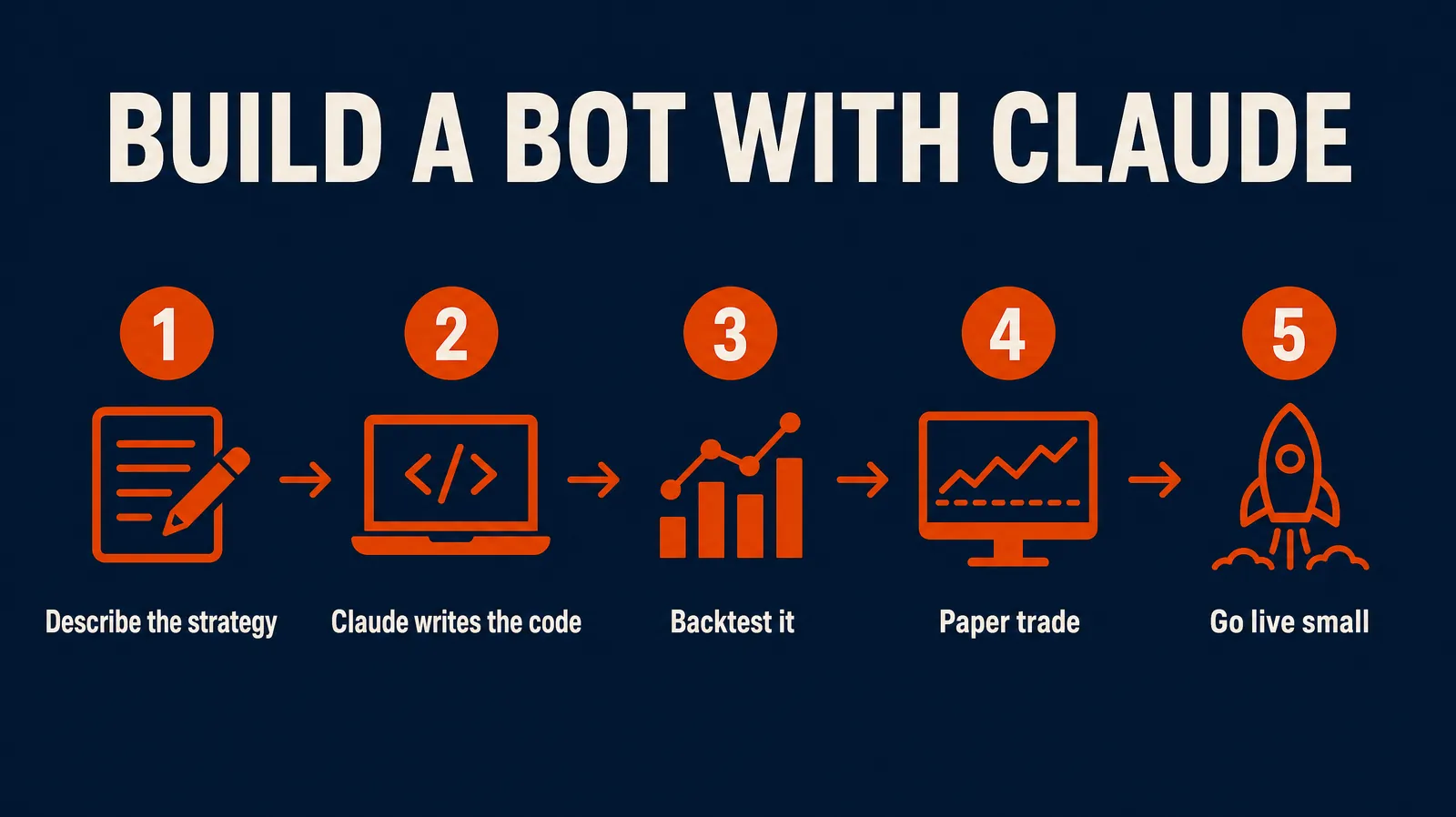
Building a Claude trading bot means writing (or having Claude help write) three pieces: a data connector, a decision prompt or agent, and a broker connection, then testing the whole chain before it touches real money. This is a coding project even when Claude writes most of the code.
A basic build path looks like this:
- Pick a data source (a market data API, a broker’s feed, or a scraper for news and filings)
- Define the rules you want Claude to apply, in plain language, not vibes (“flag a breakout above the 20-day high with volume 1.5x average”)
- Write the agent loop that feeds Claude the data on a schedule and logs its output
- Connect a broker API (Alpaca and Public are common retail choices) in paper trading mode first
- Backtest the logic against historical data before any live run
- Paper trade it first, live but with fake money, for several weeks minimum
Coursiv’s rundown on Claude for finance in 2026 makes a fair point: the accessibility here is real. Non-coders are assembling multi-bot systems that would have needed a developer five years ago [2]. Accessible isn’t the same as reliable. The bar for “it runs” is low. The bar for “it survives a bad month” is not.
If you want a walkthrough of how badly this can go without a plan, our writeup on a Claude-built trading bot that nobody fully understood is a useful gut check before you start your own build. For the broker side, see our Broker APIs guide and its API key safety checklist.
Claude Trading Bot vs Other AI Trading Bots
Claude-based bots win on flexibility and code generation. Purpose-built trading platforms win on live data, execution speed, and tested infrastructure. Here’s the honest comparison:
| Approach | Real-time data | Execution | Best for | Coding needed |
|---|---|---|---|---|
| Claude-built custom bot | No, must connect yourself | Yes, via broker API | Custom logic, research-heavy strategies | Some to moderate |
| ChatGPT-based bot | No, same limitation | Varies by integration | Prototyping, idea testing | Some |
| Composer / no-code bot builders | Yes, built in | Yes, built in | Rule-based strategies without coding | None |
| Dedicated scanner/AI picker (Trade Ideas, TrendSpider) | Yes, built in | Some, via broker link | Signal generation, screening | None |
| Fully automated retail bot platforms | Yes, built in | Yes, built in | Set-and-monitor automation | None |
For a deeper look at where no-code builders land on this spectrum, see our review of Composer’s no-code trading bot builder. And if you’re weighing legitimate tools against marketing noise before you commit real money, this breakdown of legitimate AI trading bots versus scams is worth reading first.
Practical takeaway: Claude wins when your strategy needs custom reasoning a pre-built platform can’t express. A dedicated platform wins when you just need reliable data and fast execution without writing a line of code.
Does Claude Have Real-Time Market Data Access
No. Claude has no built-in connection to live prices, order books, or breaking news. Every claim you see about a “Claude trading bot” reacting to the market in real time depends entirely on a data pipeline someone else built and connected.
Anthropic’s own documentation for financial services use cases is direct about this boundary: Claude reasons over the data it’s given, and integrators are responsible for feeding it current, accurate information through APIs or retrieval systems [9]. If your feed is delayed by even a few minutes during power hour, Claude is confidently reasoning about a market that no longer exists.
This is also where choppy tape breaks a lot of naive bots. A model reading five-minute-old data during a fast reversal will confirm a setup that’s already dead by the time the order fires.
Common mistake: assuming “AI-powered” means “live.” Check the data source’s actual latency before you trust any signal timing.
Can Claude Execute Trades Automatically or Just Give Signals
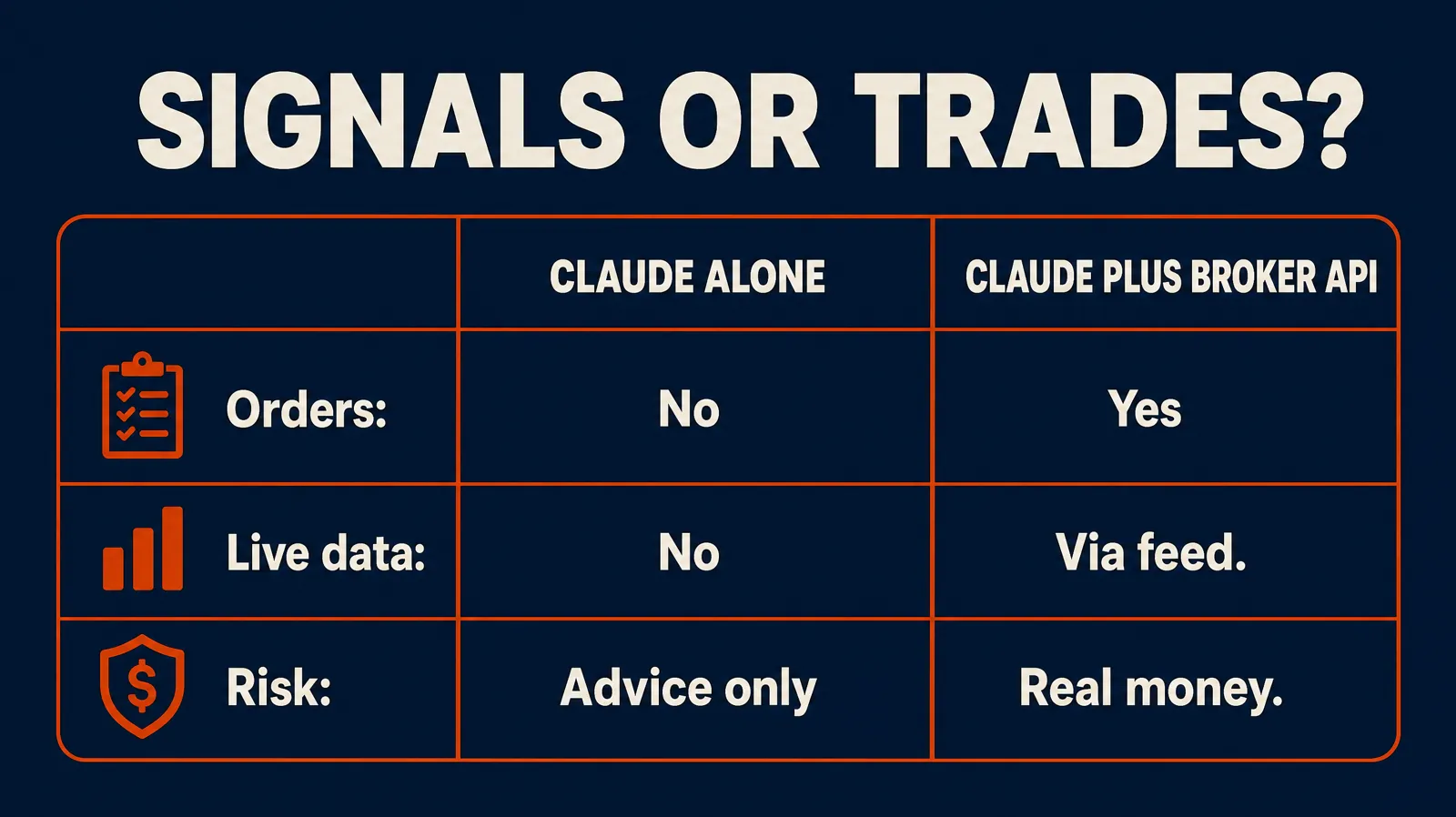
Both are possible, and which one you get depends entirely on how the bot is built. Some Claude-based systems only generate a recommendation for a human to act on. Others, like the Hermes Agent, are designed to run autonomously and place orders without a confirmation step [4].
- Signal-only mode: Claude flags a setup, you decide the entry and exit yourself. Lower risk, slower.
- Confirm-before-execute mode: Claude proposes a trade, you approve it, the broker fills it. This is Public’s Claude Desktop model [7].
- Fully autonomous mode: Claude evaluates and executes without a pause. Fastest, and the least forgiving of a coding mistake.
For the same reason position sizing matters more on autonomous bots: a bug that would just be an annoying signal in confirm-mode becomes a real fill in autonomous mode. If you’re new to any of this, our guide to what you need to know before automating trades covers the guardrails worth setting up first.
What Are the Limitations of Using Claude for Trading
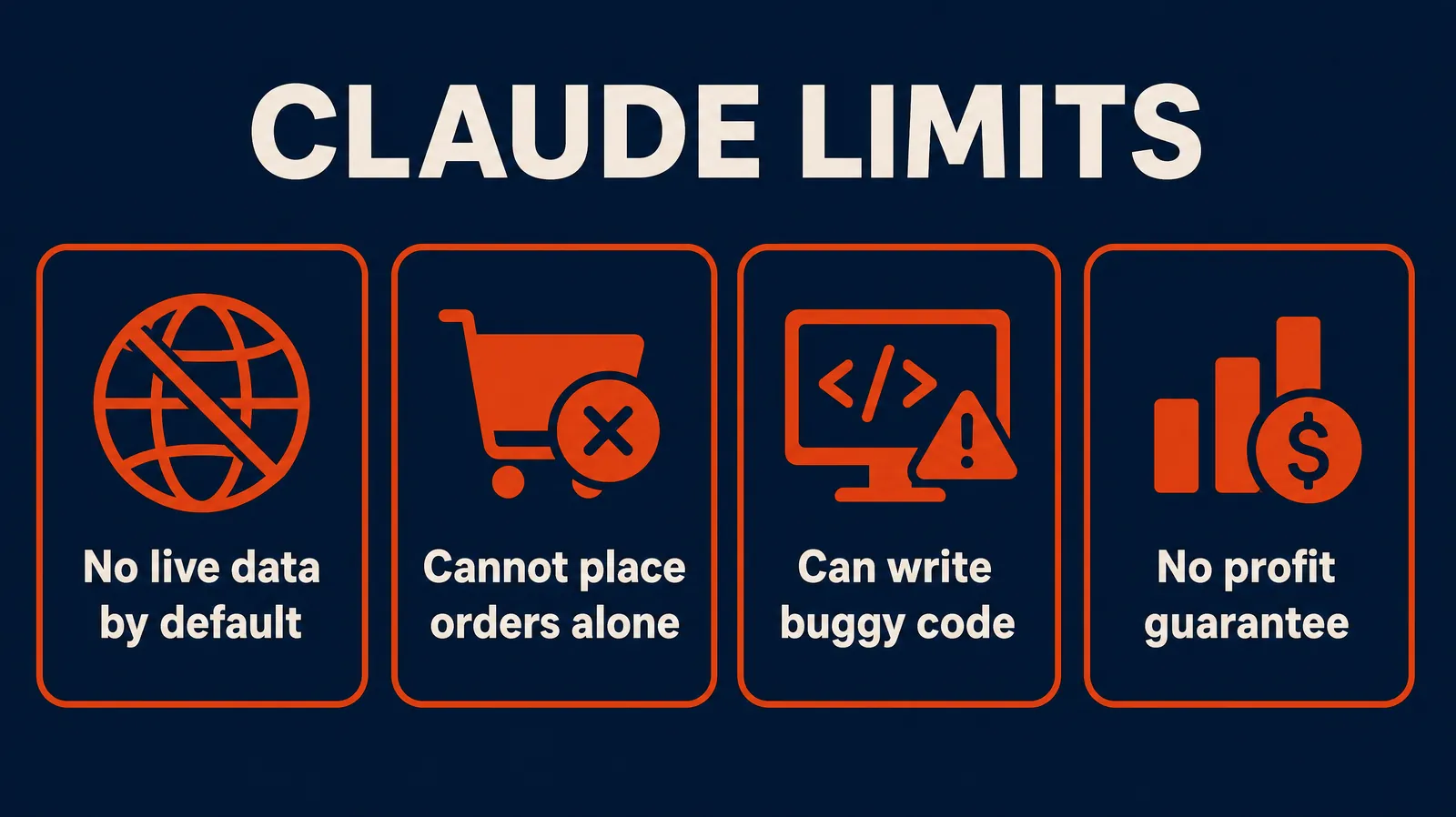
Claude’s biggest limitations for trading are simple: no live data by default, no guaranteed math accuracy on complex calculations, and no memory of markets it hasn’t been shown. It also can’t reliably predict where a stock or index goes next, no model can, and treating it like it does is how accounts get hurt.
Specific, documented friction points:
- Accounting and math errors. Users on r/algotrading have flagged cases where Claude’s position sizing or P&L logic needed manual correction before it was trustworthy [1]. Check every number it generates.
- No native real-time engine. Covered above, worth repeating: Claude needs a feed, it doesn’t have one.
- Context and document limits. Anthropic’s Claude Academy notes that large spreadsheet or multi-document workflows can strain the model’s context window, meaning very complex Excel-driven strategies may need to be broken into smaller pieces [9].
- No forecasting ability. Claude can summarize technical patterns you show it. It cannot see the future. Overextended stocks stay overextended, or they don’t, and no model resolves that uncertainty for you.
If you want the deeper version of “why does my backtest lie to me,” read how to backtest a strategy without fooling yourself before you trust any Claude-generated results.
Practical takeaway: Claude is a fast, capable coder and analyst. It is not a market oracle. Build accordingly.
How Much Does It Cost to Run a Claude Trading Bot
Running a Claude trading bot typically costs three things: an Anthropic API subscription or usage fee, a market data subscription if your broker doesn’t include one free, and your own time debugging it. There’s no single sticker price because the cost scales with how much data Claude processes and how often your bot calls the API.
Rough cost drivers to budget for:
- API usage, billed per token, scales with how often your bot queries Claude and how much data goes into each prompt
- Market data feeds, some brokers like Alpaca and Public include basic feeds free, premium real-time data often costs extra
- Broker fees, most modern retail brokers have moved to commission-free stock trading, but options and futures still carry per-contract costs
- Your time, the real cost most people skip counting
A bot that calls Claude every few seconds on live price ticks will burn through API usage fast. A bot that checks in every 15 minutes on a swing-trading time frame costs a fraction of that. For a sense of what a build actually looks like in practice, our field notes on a Claude-based algo bot’s first weeks show the kind of iteration this really takes.
Is a Claude Trading Bot Profitable or Just a Toy
Neither answer is guaranteed, and that’s the honest one. A Claude trading bot can be a genuinely useful research and execution tool, or it can be an expensive toy that loses money with extra steps. The outcome depends entirely on the strategy logic behind it, not on the fact that Claude is involved.
Anthropic’s own framing supports this: Claude is positioned for research, coding, and analysis support, not as a proven trading engine with a track record [9]. No serious source claims a Claude-based bot has a verified edge over the market. If someone’s selling you one that promises returns, that’s the FOFO trap talking, not the data.
What actually separates a useful bot from a toy:
- A tested strategy behind the code, not just “Claude will figure it out”
- Risk management rules Claude enforces, including a hard stop loss, not suggestions it can ignore under pressure
- A paper trading track record of at least a few weeks before real capital goes in
For real numbers on how AI trading bots perform in practice, not marketing claims, see our review of whether AI trading bots actually make money.
What Mistakes Do People Make Building Claude Trading Bots
The most common mistake is skipping paper trading and funding a live account on a strategy that’s never been stress-tested. The second most common is trusting Claude’s math without checking it. Both are avoidable, and both show up constantly in retail builds.
The pattern, in order of frequency:
- No backtest, or a backtest that leaks future data into the past (the strategy looks great because it’s cheating)
- No stop loss logic, so a losing trade runs until the account notices
- Overtrading, because the bot can generate signals faster than any human ever could, and volume gets mistaken for edge
- Treating Claude’s confidence as accuracy, when a fluent answer and a correct answer are not the same thing
- No kill switch, meaning no way to shut the bot down fast when it starts doing something wrong
Reddit’s r/algotrading community has flagged the accounting-error problem specifically: bots that miscalculate position size or P&L because nobody checked Claude’s output against ground truth [1]. That’s not a Claude problem exclusively, it’s a “nobody reviewed the math” problem that any AI-assisted system can have. The full list lives in our Why Trading Bots Fail guide.
For a broader look at retail mistakes with algorithmic systems generally, read what retail traders get wrong about algorithmic trading AI.
Who Should Actually Use a Claude Trading Bot
A Claude trading bot fits traders who already have a tested strategy and want help coding, monitoring, or scaling it, not beginners looking for a shortcut around learning risk management. What Claude does better than a human is process consistency: it applies the same rule the same way at 3 a.m. as it does at noon, with no fatigue and no emotional flinch on the fifth trade in a row.
Where Claude genuinely helps:
- Round-the-clock monitoring of a rule set across multiple tickers, without needing sleep
- Fast code iteration, turning a strategy idea into a working script in hours instead of weeks
- Consistent rule application, removing the temptation to override a stop loss because “this one feels different”
Where it doesn’t help:
- Judgment calls during a crisis, where price action stops behaving like history
- Reading the room on macro shifts a model has no live sense of
- Replacing a strategy you haven’t validated yourself
The5ers put it plainly for futures and prop traders: Claude belongs in the research seat, not the driver’s seat [6]. That advice holds for a swing trader with a $10,000 account just as much as it does for a funded futures trader.
Why Would a Claude Trading Bot Fail in a Real Market Crash
A Claude trading bot fails in a crash the same way any automated system without hard-coded circuit breakers fails: it keeps applying yesterday’s logic to a market that’s stopped behaving like yesterday. Speed cuts both ways. A bot that can enter fast can also compound a bad decision fast.
Specific failure modes in a real crash:
- Data lag becomes catastrophic, not just annoying, when prices are moving 5% in minutes and your feed is even slightly behind
- No liquidity assumption breaks, a bot programmed for normal spreads can get filled at prices far worse than expected in a bull trap or a sudden gap
- The model can’t distinguish a real breakdown from a dead cat bounce without live, current context it wasn’t built to have on its own
- API and broker outages happen exactly when volume spikes, and a bot with no fallback just stops working at the worst possible time
Enterprise deployments of Claude come with governance layers, data controls, and human oversight specifically because unmonitored automated decisions carry real institutional risk [5]. Almost no retail Claude trading bot replicates that layer of protection, which means the retail version is carrying more risk per dollar, not less. Catching a falling knife is bad enough with a human at the wheel. A bot that keeps buying the dip on autopilot during a real crash doesn’t know when to stop.
Our Take
Claude can genuinely help you build a trading system: it writes code fast, applies rules consistently, and can run around the clock once it’s connected to a broker. It cannot see the market on its own, cannot guarantee a winning edge, and cannot replace the risk management work that separates a real process from an expensive experiment. Systems over hacks still wins here. The model is only as good as the data feed, the risk rules, and the testing you put around it.
Before you connect any Claude-built bot to real money: backtest it, paper trade it for a minimum of a few weeks, and write down the exact stop loss and position sizing rules it has to follow no matter what. If you can’t explain your own bot’s logic in three sentences, it’s not ready for a live account yet.
There are 200+ AI trading tools catalogued in the FullStack Alpha directory, filterable by category, price, and what they actually do.
Browse the FullStack Alpha directory of 200+ AI stock tools
This article is for education only and is not personalized financial advice. Some links on this page may be affiliate links.
Keep Going
More from AI Stock Trading Bots: Claude Trading Bots · Build a Trading Bot · Broker APIs.
Written and edited by Jay Rocco, Founder and Editor of FullStack Alpha. 200+ AI stock tools tested since 2022. Educational content only, not financial advice. See our Financial Disclaimer and How We Make Money.
Free weekly email
Join the FullStack Alpha newsletter
One email a week. The AI trading tools we tested, what broke, and what is worth your money. NO BS, no stock picks. Stay alpha.
Unsubscribe anytime. We never sell your email.
Stay alpha.
References
[1] Reddit r/algotrading: Has anyone tried algo trading with Claude?
[2] Coursiv: Claude AI for Finance 2026
[3] GitHub: Claude Trading Bot
[4] GitHub: Claude Trader (Byte-Ventures)
[5] CFO Connect: How CFOs Should Evaluate Claude
[6] The5ers: AI Trading With Claude, a Realistic Guide for Futures Prop Traders
[7] Public: Trade Stocks, Options, and Crypto Using Claude
[9] Claude Academy: Claude for Financial Services Overview
Frequently Asked Questions
Is a Claude trading bot legal to use for real trading?
Yes, using Claude to help build or run a trading system is legal in the US as long as the execution goes through a licensed, regulated broker. Claude itself isn't a broker or investment adviser.
Do I need coding knowledge to build a Claude trading bot?
Some technical setup is usually required to connect data and broker APIs, though Claude can write most of the code itself if you can describe the logic clearly and test the output.
Can Claude replace a human trader entirely?
No. Claude can execute rules consistently and process data fast, but it has no live market feed by default and no proven ability to predict price direction. It's a tool for the process, not a replacement for judgment.
What's the safest way to start with a Claude trading bot?
Paper trade it first, for weeks, with a strategy you've already backtested. Confirm-before-execute mode is safer than fully autonomous execution while you learn how the system behaves.
Does Claude have real-time market data?
No. Claude only reasons over the data you feed it, so every Claude trading bot needs a separate market data source and broker API connected by you.
How is a Claude trading bot different from ChatGPT-based bots?
Both are language models without native market data access. The practical differences come down to which broker integrations, agent frameworks, and safety guardrails a specific project has built around the model, not the model itself.
Jay Rocco is the Founder and Editor of FullStack Alpha. He has tested 200+ AI stock tools since 2022 and run 15+ AI trading platforms on live accounts with his own money. He reviews the software. He does not tell you what stocks to buy.
