
October 7, 2026, 8:30 a.m. ET | By Jay Rocco, Founder and Editor, FullStack Alpha
Quick answer
U.S. regulators just let true perpetual futures onto a broad stock index. Kalshi’s US500 contract, which tracks the 500 largest U.S. companies and never expires, was deemed approved by the CFTC on October 2, 2026, and began trading on October 6. A day after that approval, CFTC staff gave exchanges such as Coinbase Derivatives a fast lane to strip the expiration dates off their existing “perpetual-style” index futures, as long as they act by October 20.
For anyone running automated strategies, this is a new kind of instrument: no quarterly roll, nearly round-the-clock weekday trading, and a daily funding payment that your bot has to account for.
Key facts
- What was approved: KalshiEX LLC filed its US500 perpetual future for CFTC review on August 18, 2026. The CFTC deemed it approved on October 2, 2026, according to CFTC Staff Letter No. 26-29.
- The underlying: the MerQube US Large Cap Index (MQ5C), a price-return index of the 500 largest U.S.-listed and U.S.-domiciled companies.
- Trading hours: 6:00 p.m. ET Sunday to 5:00 p.m. ET Friday, with no daily maintenance halt, per Kalshi’s filing.
- Funding: one payment per index business day at 4:00 p.m. ET, computed only from regular-hours data, with a 0.002% deadband and a 2.00% cap.
- Contract size: $1 per index point, a 0.05-point tick, and positions as small as one ten-thousandth of a contract.
- The fast lane: CFTC Staff Letter No. 26-29, dated October 3 and announced October 5, came in response to an October 1 request from Coinbase Derivatives. It expires October 20, 2026.
- Leverage: the filing leaves margin to Kalshi’s risk-based model. Finance Magnates reported 15.3x available at launch, subject to change.
What did the CFTC actually approve?
Two separate actions landed inside four days.
The first is a product approval. In a policy statement published June 3, the Commission said perpetual contracts on assets other than bitcoin and similar digital commodities would need a full review under Regulation 40.3. Kalshi went through that review with the US500, and the contract cleared on October 2.
The second is a shortcut for products already trading. Until this month, the rules for a true perpetual on a stock index were unsettled. So Coinbase Derivatives listed “perpetual-style” index futures instead: contracts with the same funding mechanics, but with expiration dates as far out as 25 years. In the letter’s words, the change “would effectively convert the Existing Perpetual-Style Contracts into Broad-Based Security Index Perpetual Futures Contracts.”
The relief applies to any designated contract market with broad-based index contracts of this type, not just Coinbase. It does not cover perpetual-style contracts on anything that is not a broad-based security index.
How does the Kalshi US500 perpetual work?
Think of it as an E-mini without the calendar.
A normal index future expires every quarter, so staying in the trade means rolling it and paying the spread each time. A perpetual skips that. It stays open until you close it, and a funding payment keeps its price tied to the index. It does not charge you to roll. It charges you to wait.
Here is the mechanic that matters. If the contract trades above the index, longs pay shorts. If it trades below, shorts pay longs. Kalshi measures the gap once a minute during regular U.S. market hours, averages it, and settles one payment at 4:00 p.m. ET each index business day.
Because the index is only calculated from 9:30 a.m. to 4:00 p.m. ET, overnight price action does not feed the funding rate.
Why does this matter for trading bots?
Perpetuals are built for automation: no expiry to track, one continuous price series, and a mechanical funding rule. The CFTC’s letter notes that perpetual futures trading largely developed outside the United States, on offshore venues. Now a regulated U.S. exchange offers the same structure on a 500-stock index.
Three details in Kalshi’s filing deserve a line in your code:
- Equity halts do not pause the contract. The filing says an intraday U.S. market halt “does not by itself halt trading in the Contract during that session.” Your bot can keep trading while the stocks behind the index are frozen. The exchange can still step in if the price drifts too far from the index.
- Funding is a real cost line. It is small on most days, but it is charged daily, and the 2.00% cap shows how large one day’s payment can get. A backtest that skips funding will overstate returns. Our guide to futures backtesting software covers which tools let you model it.
- The weekend still gaps. The contract closes Friday at 5:00 p.m. ET and reopens Sunday at 6:00 p.m. ET. Stop orders do not protect you from a weekend headline.
Early liquidity was thin. Finance Magnates reported $556,000 in 24-hour volume and $219,600 in open interest shortly after launch. Thin books mean wider spreads and more slippage than your paper results will show. We broke down why in paper trading slippage.
What risks should automated traders model first?
Leverage is the headline risk. At 15x, a move of roughly 6.7% against you wipes out the initial margin on that position.
Margin is not fixed in the rulebook. Kalshi sets it with a risk-based model and can change it, which means your position sizing has to read live margin numbers, not a hard-coded ratio.
The filing also sets a position accountability level at $25 million of mark-to-market value. Retail bots will not get near it.
And this is a derivative, not stock. You do not own shares, you do not receive dividends, and the price-return index excludes them. The funding rate is where that difference shows up.
If you are wiring an AI agent to this market, the guardrails we laid out in AI trading agent risks apply twice over.
What should investors watch next?
- October 20, 2026: the CFTC staff no-action relief expires. Any exchange relying on it to convert perpetual-style index contracts has to act before then.
- Coinbase Derivatives filings: under the letter, an exchange must give holders at least five calendar days’ notice, let them close out under the old terms, and file the change under Regulation 40.6(a) or 40.5. Watch the CFTC filings page for the notices.
- Kalshi margin updates: the 15.3x figure was a launch number. Changes to the margin model change every leverage assumption in your code.
- Copycat listings: the US500 review is now a template. Watch whether other exchanges file broad-index perpetuals, which would split liquidity before it has time to build.
Our take
Most traders think the hard part of automation is the signal. The hard part is the plumbing: rolls, gaps, halts, fees and margin calls.
A perpetual removes one piece of plumbing, the roll, and adds another, the daily funding payment. That is a fair trade for a bot. It is a bad trade for a bot that does not know funding exists.
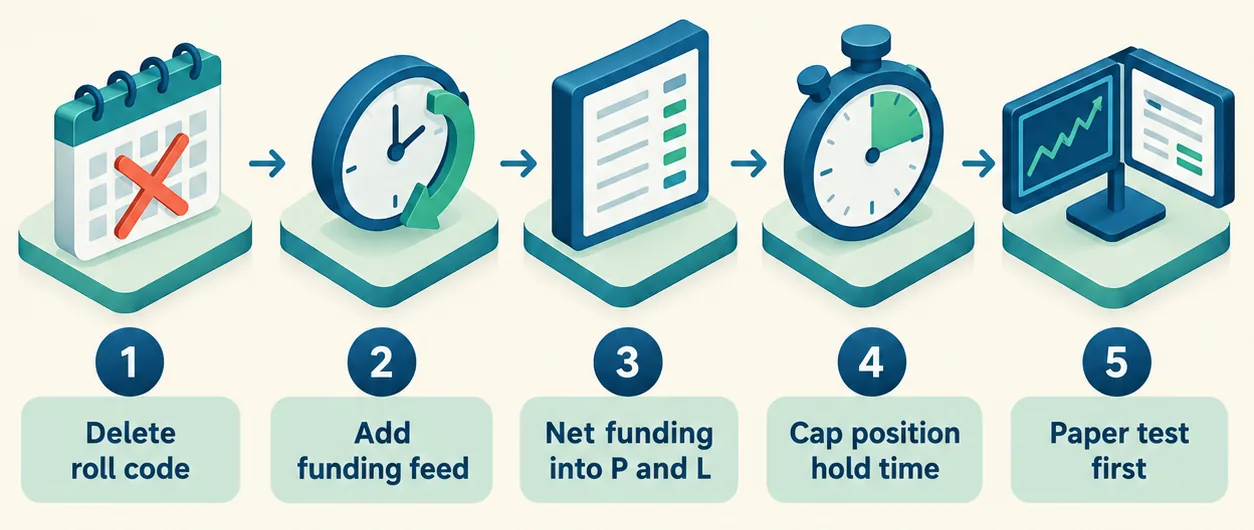
So here is the next step. Before you point any strategy at a U.S. index perpetual, rerun your backtest with three additions: a daily funding charge, a Friday-to-Sunday gap, and spreads twice as wide as you see on the E-mini. Then add a maximum hold time, because no expiry date will force you out anymore. If the edge survives all of that, paper trade it for a month. If it does not survive, you just saved real money.
Built a bot that already handles funding, gaps and halts? Put it in front of traders who care. Our directory lists automation tools by what they actually do, not what their landing page claims. Submit your bot
This article is for education and information only. It is not financial, investment or trading advice. Leveraged futures, including perpetual futures, can lose more than you expect in a short time. Do your own research and consider speaking with a licensed professional before trading.
Sources
- CFTC press release 9308-26: No-action letter on converting perpetual-style broad-based security index futures (October 5, 2026)
- CFTC Staff Letter No. 26-29 (dated October 3, 2026)
- KalshiEX LLC US500 Regulation 40.3 submission to the CFTC (August 18, 2026)
- Finance Magnates: Kalshi Takes Perpetual Futures into US Equities after CFTC Approval
- Securities.io: CFTC Staff Grants Relief to Convert Index Futures Into True Perpetuals
Your market edge starts with the right tool. Stay alpha.
Frequently Asked Questions
What did the CFTC approve for stock index perpetual futures?
The CFTC deemed Kalshi's US500 perpetual future approved on October 2, 2026. Separately, CFTC staff issued Letter No. 26-29, dated October 3, which lets exchanges remove expiration dates from existing perpetual-style broad-based security index futures on an expedited basis, subject to eight conditions.
What does the Kalshi US500 perpetual track?
It tracks the MerQube US Large Cap Index, a price-return index of the 500 largest U.S.-listed and U.S.-domiciled companies. It is cash-settled, has no expiration date and is quoted at $1 per index point.
When does the Kalshi US500 trade and how is funding paid?
Per Kalshi's filing, it trades from 6:00 p.m. ET Sunday to 5:00 p.m. ET Friday with no daily maintenance halt. Funding is calculated from regular-hours index data and paid once per index business day at 4:00 p.m. ET, with a 0.002% deadband and a 2.00% cap.
Does the CFTC relief for Coinbase apply to crypto perpetuals?
No. Letter No. 26-29 covers only perpetual-style futures on broad-based security indices. It does not apply to perpetual-style contracts on any other asset, and the no-action positions expire on October 20, 2026.
What should a trading bot change before trading index perpetuals?
Model the daily funding payment in backtests, plan for the Friday-to-Sunday weekend gap, read live margin instead of assuming a fixed leverage ratio, set a maximum hold time and paper trade before using real money. Early liquidity was thin, so expect wider spreads than on established index futures.
Is this article financial advice?
No. This article is for education and information only. It is not financial, investment or trading advice. Leveraged futures can lose money quickly, so do your own research and consider speaking with a licensed professional.
Contributing writer at AI Stock Trading Bots.
