The FullStack Alpha research desk tests AI trading bots on paper and live accounts. Reviewed and edited by Jay Rocco, Founder and Editor.
October 12, 2026 · By FullStack Alpha Editorial Team | Reviewed by Jay Rocco, Chief Editor
Quick answer: The CFTC has formally proposed defining event contracts as swaps, and the clock is now running. The proposal was announced October 9, 2026, published in the Federal Register on October 19, 2026 (91 FR 66022), and comments are due by November 18, 2026. It names sports, political, cultural and weather contracts, but it is a proposal, not a final rule. Nothing changes for prediction market traders or their bots until a final rule is adopted and takes effect.
That is the short version for anyone running automation on Kalshi or another CFTC-licensed exchange. The longer version is a jurisdiction fight between the CFTC and state gambling regulators, and the outcome decides whether your bot keeps access to the same contracts in every state. We track this kind of rule change at AI Stock Trading Bots because it moves faster than most traders notice.
Key facts
- What: a notice of proposed rulemaking, “Further Definition of ‘Swap’: Inclusions,” RIN 3038-AF82, announced in CFTC Release 9310-26.
- When: announced October 9, 2026; published in the Federal Register on October 19, 2026 at 91 FR 66022.
- Comment deadline: November 18, 2026, through Regulations.gov, by mail or by courier.
- Scope: event contracts “including” those on sports, politics, cultural and weather-related events. The list is not closed.
- Market size: the CFTC says event contract volume across reporting exchanges averaged about $1.5 billion a month in August 2026, and about $1.2 billion of that was sports.
- The CFTC’s position: Chairman Michael S. Selig said, “These products are commodity derivatives squarely within the CFTC’s regulatory remit under the Commodity Exchange Act.”
- Background: on October 1, Cointelegraph reported that the CFTC had sent this proposal for White House regulatory review, alongside a separate interim final rule that would exclude casino-style gambling products.
What did the CFTC propose on October 9?

The CFTC proposed to “further define” the term swap so that it expressly includes event contracts. In the agency’s words, these “are financial instruments that are commonly known to the trade as swaps.” The stated goal is to resolve any ambiguity about where these contracts sit. In plain terms, the agency wants event contracts as swaps written into its own rulebook, not just argued in court briefs.
Mechanically, the change is small. The proposed rule text amends the definition of “swap” in 17 CFR 1.3 by adding a new item to the list of products that already count as swaps, next to forward rate agreements and non-deliverable FX forwards. One added paragraph, a very large fight.
The release names sports, politics, cultural and weather events. It says “including,” so the list is not necessarily complete.
Why does defining event contracts as swaps matter?
Because the label decides who regulates the product.
If event contracts as swaps becomes settled law, the CFTC holds the pen. Prediction markets have been in a jurisdiction fight with state gambling regulators, especially over sports contracts. The CFTC argues that federal law gives it exclusive authority over swaps traded on its regulated exchanges. State regulators argue sports contracts fall under state gambling law. Writing event contracts into the swap definition would strengthen the CFTC’s side of that argument.
Selig framed the products as financial tools: “Americans use event contracts to hedge risks, speculate, and provide the public with information.” Expect state regulators to push back hard during the comment period.
Why are the courts split on event contracts?
The proposal itself lays out the split, and it is the clearest explanation of why the CFTC is acting now.
- Third Circuit, April 2026: a divided panel held that sports event contracts traded on a CFTC-licensed exchange “fit within the Act’s definition of ‘swaps’ subject to the CFTC’s jurisdiction” (KalshiEX v. Flaherty).
- Ninth Circuit, August 28, 2026: the court went the other way, concluding that “these sports event contracts are likely not swaps under the CEA” and calling their substance “sports gambling.” A petition for rehearing en banc has been filed.
- State actions: the proposal cites a criminal case filed by Arizona against an exchange, a New York attempt to stop an exchange from offering event contracts “within or from New York,” and state court orders to geofence sports contracts in Michigan, Washington and Nevada.
A circuit split like that usually ends at the Supreme Court or with a clearer rule. The CFTC is trying the second route. A rule defining event contracts as swaps would give courts an agency definition to weigh, though it would not bind a court that reads the statute differently.
Does this change anything for prediction market bots today?
No. A proposal to classify event contracts as swaps creates no new obligations on its own. Your exchange account, your API access and your contract list stay the same until a final rule is adopted and takes effect.
The CFTC’s own cost section says as much. It states that the agency “does not expect the Proposal to change the legal rights or obligations of market participants” and describes the main benefit as “added certainty.” Read that as a legal signal, not an operational one.
Automation on event markets is already common. Kalshi publishes an official Trade API that developers use to automate orders. If you run a bot there, read this as a long-range signal about market structure, not a reason to change code this week.
Where it could matter later is access. If federal authority over these contracts is settled, availability is less likely to vary state by state. If it is not, a bot that works today could lose access to some contracts in some states. That is our read of the dispute, not something the proposal promises.
What this means for your bot
Regulatory risk shows up in a bot as a rejected order, a market that disappears from the list, or a geofence you did not code for. You can prepare for all three without guessing the final rule.
Test against the demo first. Kalshi runs a demo environment with mock funds at demo.kalshi.co, and its recommended demo REST root is https://external-api.demo.kalshi.co/trade-api/v2. Credentials are not shared between demo and production, and Kalshi warns that demo prices and behavior may not reflect real markets. Use it to test error handling, not to validate edge.
Handle “market gone” as a normal state. If a contract becomes unavailable in a state, your bot should log it, cancel related resting orders and stop, not retry in a loop. That is the same discipline we push in our guide to AI trading agent risks and the external kill switch.
Respect the rate limits. Kalshi meters requests with token buckets. Most requests cost 10 tokens, and reads and writes draw from separate budgets. A bot that hammers the API after a rejection burns its write budget at the worst possible moment.
A worked example. Say your bot trades 40 sports contracts and 10 weather contracts, and 70% of its volume comes from users in states that are suing or geofencing. If those states win, most of your sample disappears. Write that dependency down now, so a court ruling becomes a config change, not a rebuild.
Decision rule: if your strategy depends on sports contracts in Michigan, Washington, Nevada, New York or Arizona, treat state access as a live risk and keep a fallback contract set. If you trade weather or economic contracts only, this proposal mostly changes the background, not your fills.
How does this fit with the CFTC’s other October moves?
It is the second notable CFTC action for automated traders this month. On October 5, CFTC staff announced relief letting exchanges convert perpetual-style stock index futures into true perpetual futures. We covered that, including bot guardrails, in CFTC Clears True Perpetual Stock Index Futures.
The agency is also putting AI agents on its own agenda, which we covered in the CFTC Frontier Forum on AI trading agents. And brokers are already wiring prediction market prices into consumer AI tools, as in our breakdown of Public AI agents.
Read together, these moves show the CFTC asserting authority over newer products that automated traders use. For earlier agency warnings aimed at bot users, see our SEC and CFTC warnings roundup.
How do you comment on the CFTC event contracts proposal?
Anyone can comment. The Federal Register notice lists three methods: online, mail and hand delivery.
- Go to Regulations.gov and search for RIN 3038-AF82, or the title “Further Definition of ‘Swap’: Inclusions.” The Federal Register notice gives step-by-step filter instructions.
- Submit before November 18, 2026. Use one method only (online, mail or courier).
- Leave out personal or business information you do not want public. The CFTC says comments are published without removing it.
- Be specific. “I run an automated strategy on weather contracts and a state-by-state split would cut my liquidity” is more useful than a general opinion.
What should investors watch next?
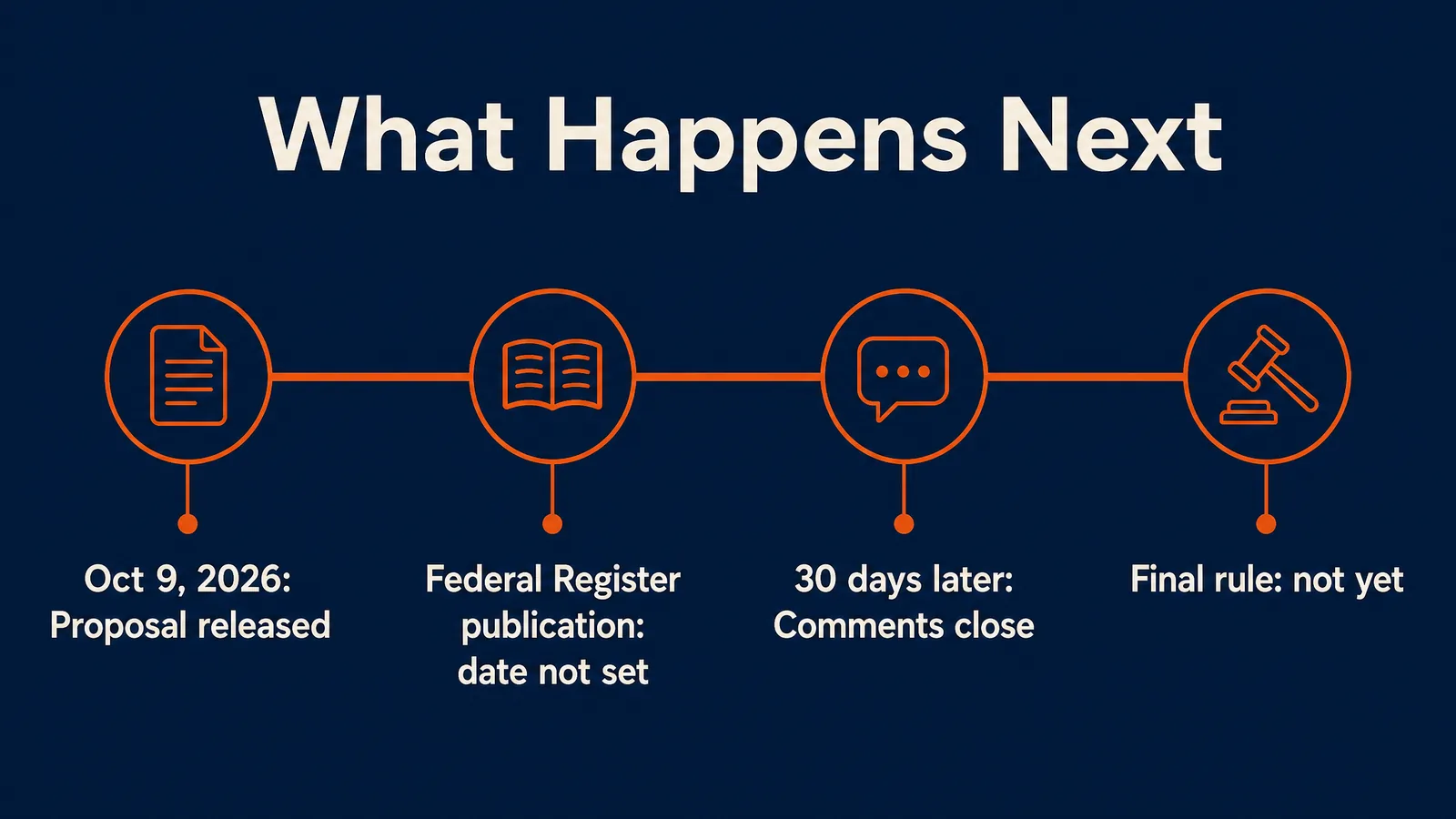
- Federal Register publication: done. The proposal ran on October 19, 2026, after this graphic was made, which set the comment deadline.
- The comment deadline: November 18, 2026. That is when state regulators, exchanges and traders put their arguments for and against treating event contracts as swaps on the record.
- The Ninth Circuit rehearing petition: if the full court rehears the case, the circuit split could narrow or deepen before any final rule.
- The casino-style exclusion: whether the separate interim final rule reported on October 1 is published, and what it carves out.
- Perpetual futures relief: the CFTC staff relief for perpetual-style index futures was set to expire October 20, 2026, per our earlier coverage. Check the CFTC staff letters page for any extension or permanent path.
Our take
This proposal is about who gets to make the rules, not about what your bot can trade tomorrow. Defining event contracts as swaps is a real step in a long fight, and the comment period plus the courts will shape it.
Automated traders should treat regulatory news the way they treat a new indicator: interesting, not actionable until it is tested. Wait for the final rule, read the terms and confirm what your exchange actually offers before you change anything. If you are still choosing where to build, our broker and platform reviews compare the venues bots actually connect to.
Practical next step: if you run a bot on an event contract exchange, write down which contracts and which states it depends on today. If access ever narrows, you will know in minutes whether your strategy is affected, instead of finding out from a rejected order.
Related: our AI trading platforms directory groups the platforms automated traders run on by category and price, if you need a fallback venue.
Running a bot on Kalshi or another event market? Tell us how it is built. We review every submission before we write about it. Submit your bot
This is education, not financial or legal advice. Regulatory proposals can change before adoption. Confirm current status with the CFTC and your exchange.
Sources
- CFTC Seeks Public Comment on Notice of Proposed Rulemaking Concerning the Inclusion of Certain Event Contracts in the Definition of Swap, CFTC Release 9310-26, October 9, 2026
- Proposed rule text, CFTC, October 9, 2026
- Further Definition of “Swap”: Inclusions, 91 FR 66022, Federal Register, October 19, 2026
- CFTC seeks to define event contracts as swaps amid prediction market fight, Cointelegraph, October 1, 2026
- Kalshi API documentation: demo environment and rate limits, Kalshi
- CFTC Clears True Perpetual Stock Index Futures, AI Stock Trading Bots, October 7, 2026
Your market edge starts with the right tool. Stay alpha.
Frequently Asked Questions
What did the CFTC propose on October 9, 2026?
The CFTC proposed a rule to further define swap so that it expressly includes event contracts, including those on sports, political, cultural and weather events.
Is the event contracts rule final?
No. It is a notice of proposed rulemaking. A final rule would come only after the public comment period and further CFTC action.
How long is the comment period?
30 days from the date the proposal is published in the Federal Register. The October 9 release did not give that publication date. Comments go through Regulations.gov.
Why does it matter if event contracts are swaps?
The label affects who regulates them. The CFTC argues it has exclusive authority over swaps on its regulated exchanges, while some state gambling regulators argue sports contracts fall under state law.
Does this change how prediction market bots work today?
No. A proposal creates no new obligations, so exchange accounts, API access and contract lists stay the same until a final rule takes effect.
Is there a carve-out for casino games?
Cointelegraph reported on October 1 that the CFTC also sent a separate interim final rule for review that would exclude casino-style gambling products. The October 9 release does not mention it.
The FullStack Alpha research desk tests AI trading bots on paper and live accounts. Reviewed and edited by Jay Rocco, Founder and Editor.