The FullStack Alpha research desk tests AI trading bots on paper and live accounts. Reviewed and edited by Jay Rocco, Founder and Editor.
Published November 24, 2026, 7:55 AM ET. By FullStack Alpha Editorial Team | Reviewed by Jay Rocco, Chief Editor
Three federal agencies hit the same Indianapolis firm inside 72 hours. Between November 18 and November 20, 2026, the Department of Justice, the Securities and Exchange Commission and the Commodity Futures Trading Commission all moved against Backward Hat Capital and its two co-founders. The pitch, per the SEC: a proprietary “AI-driven” forex algorithm that returned at least 6% a month.
The allegations are allegations. The pattern is old as dirt.
Quick answer
The SEC says Backward Hat Capital, co-founders Phillip Williams and Devin Johnson, and related parties raised about $560 million from more than 2,000 investors since July 2022 for algorithmic forex trading that barely happened. The CFTC filed a parallel case and a court appointed a temporary receiver. Federal prosecutors in Manhattan arrested both founders on November 18. None of the charges have been proven in court.
Key facts
- November 18, 2026: FBI arrests Williams and Johnson. The criminal complaint from the U.S. Attorney’s Office for the Southern District of New York describes a scheme topping $600 million.
- November 20, 2026: The SEC announces a temporary restraining order, asset freeze and expedited discovery in federal court in Indiana.
- November 20, 2026: The CFTC charges the founders and 11 companies it calls the “Backward Hat Common Enterprise,” citing more than $550 million from at least 2,100 participants. Kevin B. Duff is appointed temporary receiver.
- The pitch: investor cash converted to crypto, then used for forex arbitrage through a proprietary algorithm claimed to return at least 6% per month.
- The alleged reality: more than $250 million in Ponzi-like payments to earlier investors and more than $220 million moved to the founders or their entities.
What exactly did the SEC, CFTC and DOJ charge Backward Hat Capital with?
Three filings, three angles, one firm.
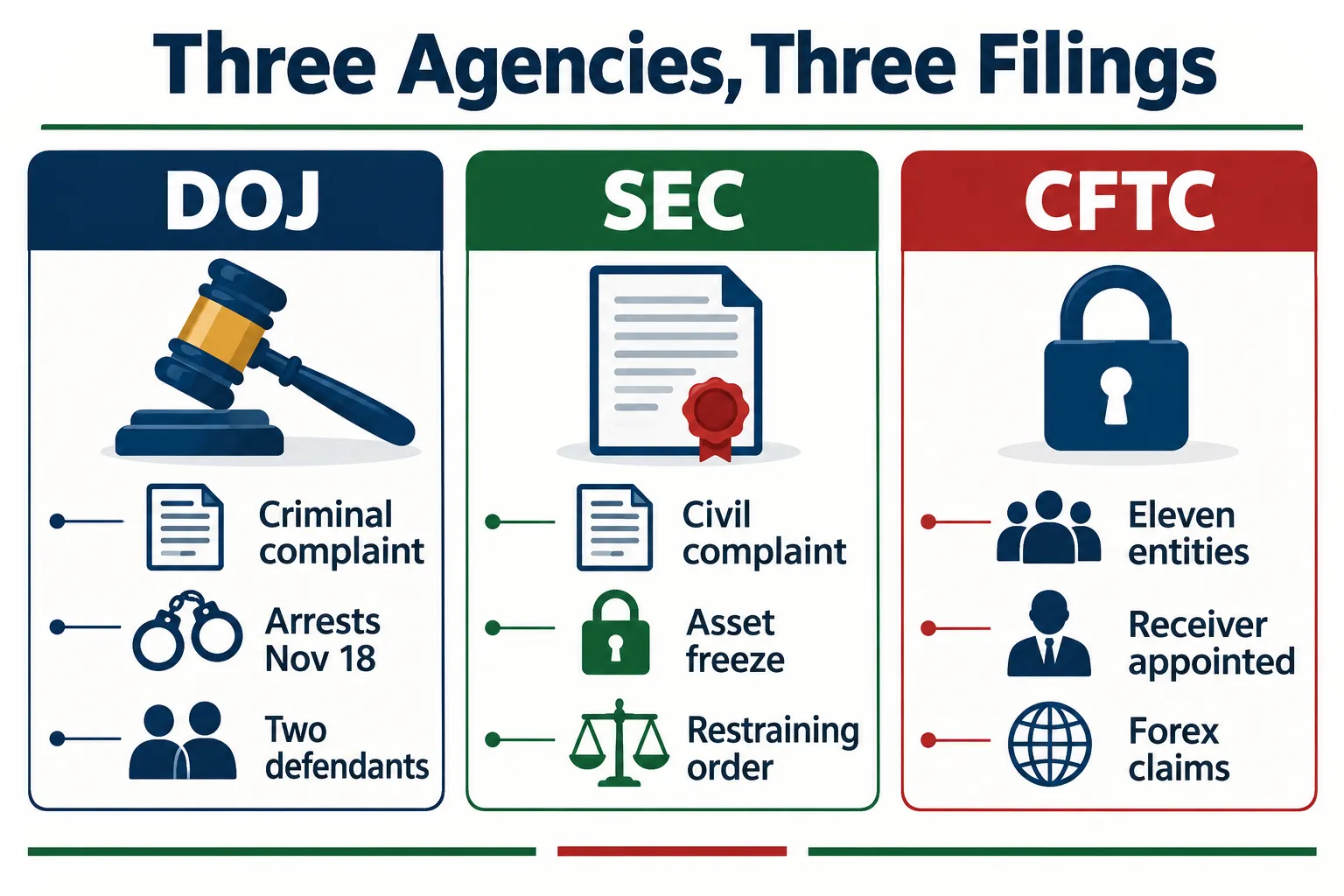
Prosecutors charged both founders with securities fraud, conspiracy to commit wire fraud and conspiracy to commit securities fraud. The SEC complaint also names Traders Point Capital and Joseph Anderson, who allegedly produced fake “audit reports” and a “quality of earnings” report that told investors the returns had been verified against bank and brokerage records.
The CFTC goes further on the trading itself. Its complaint says the defendants touted returns above 6% a month “without a single losing month,” then conducted little to no forex trading at all.
| Agency | Date (ET) | Alleged amount raised | Investors | Key relief or charge |
|---|---|---|---|---|
| DOJ (SDNY) | Nov 18, 2026 | Over $600 million | Over 2,000 | Securities fraud, two conspiracy counts, arrests |
| SEC | Announced Nov 20, 2026 | About $560 million | More than 2,000 | Restraining order, asset freeze, expedited discovery |
| CFTC | Nov 20, 2026 | Over $550 million | At least 2,100 | Asset freeze, temporary receiver appointed |
Different numbers are not a contradiction. Each agency drew its own box around entities, investor pools and time periods.
Where did the money allegedly go?
This is the part that separates a bad trader from an alleged Ponzi scheme.
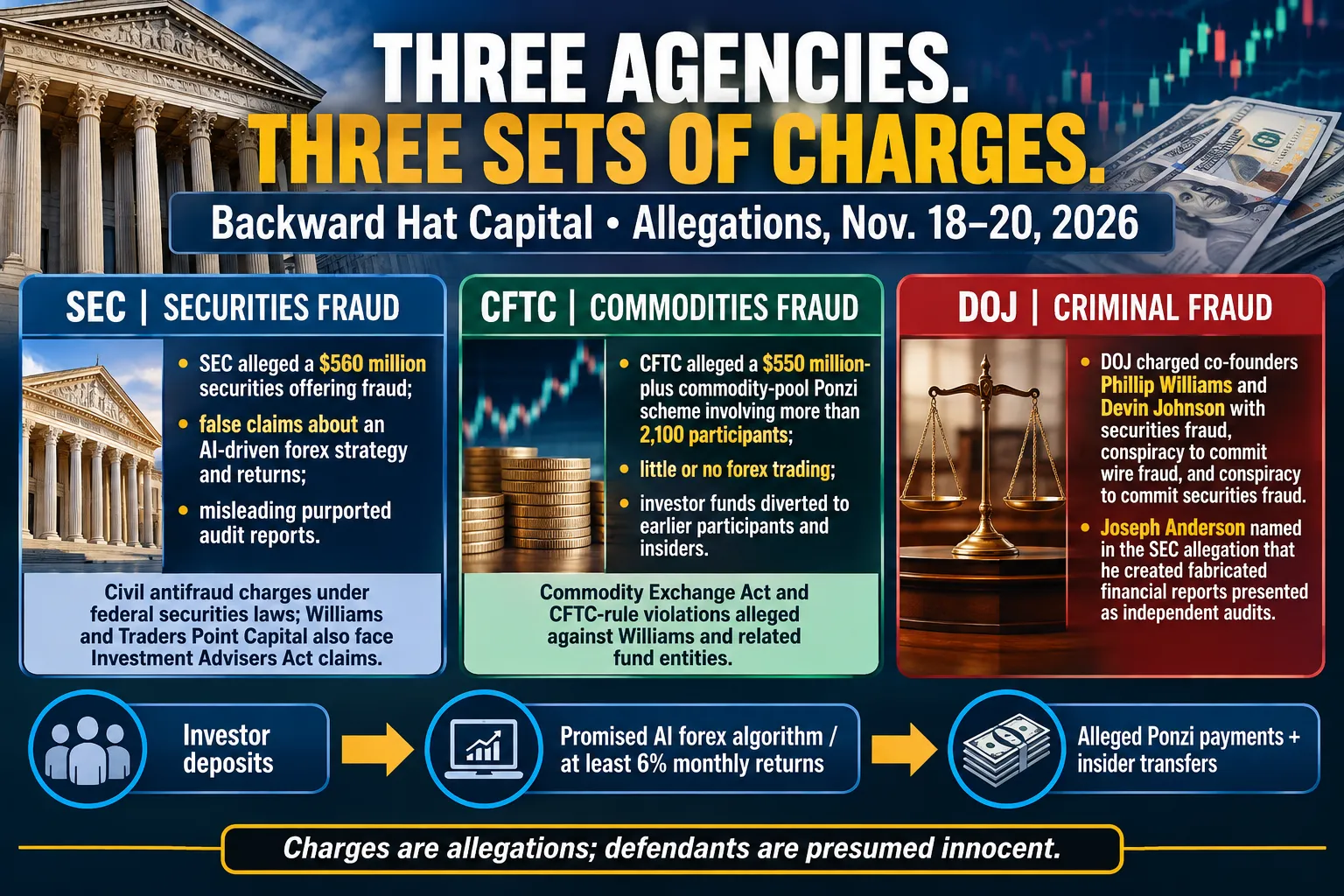
The SEC alleges more than $250 million went to Ponzi-like payments to earlier investors and more than $220 million went to Williams, Johnson or entities tied to them. That is more than $470 million of an alleged $560 million raise. The SEC says the money bought exotic cars and expensive homes, funded unrelated businesses and covered Johnson’s gambling.
The criminal complaint tells a similar story. More than $200 million of incoming cash allegedly paid redemptions, more than $130 million went to Williams and more than $40 million to Johnson.
A trading algorithm does not need four out of five deposit dollars to trade. That ratio is the whole story, if it holds up in court.
Why does the “AI forex algorithm” label keep showing up in these cases?
Because it answers every uncomfortable question before you ask it.
Why can’t I see the trade log? Proprietary. Why does the equity curve never draw down? The model adapts. Why 6% a month through a currency market that moves in regimes? The algorithm.
The SEC’s Chicago office put it plainly: a promise of low risk, a high rate of return and a complex-sounding investment should make anyone stop and think. When all three show up together, that is the moment to check, not the moment to wire.
This is not new. The SEC charged two fake AI bot operations in October, covered in our SEC fake AI trading bot charges report. The CFTC won a $288 million judgment over the EminiFX “robo-advisor” scheme, covered in our EminiFX judgment story. The costume changes. The structure does not.
How do these allegations compare to a legitimate automated trading tool?
Plenty of readers pay for bots right now and wonder which side of the line they sit on.
| Signal | Backward Hat, as alleged | What a legitimate tool looks like |
|---|---|---|
| Returns pitch | At least 6% monthly, no losing months | No return promise, drawdowns shown |
| Strategy detail | ”Proprietary” algorithm, no trade-level proof | Published rules you can read and test |
| Custody of funds | Cash pooled into fund entities | Money stays at your own regulated broker |
| Verification | ”Audit” reports from a firm with a stake in the scheme | Independent auditor or live broker statements |
| Who gets paid | A network of promoters selling fund interests | Flat subscription, no recruiting commission |
The simplest fraud filter in trading: if you hand over custody of your cash, you are not using a tool, you are betting on a person. Software that connects to your own brokerage account by API cannot run off with money it never held. Our guide to fully automated AI trading apps sorts the real products from the marketing, and our AI trading bot red flags checklist covers the rest.
What should investors watch next?
- Receiver reports. Kevin B. Duff took control of the company defendants on November 20, 2026. His first filings should show what assets actually exist, which sets realistic expectations for any recovery.
- Preliminary injunction hearings. Temporary restraining orders are short by design. Watch the Southern District of Indiana docket for the SEC and CFTC to seek longer-term orders.
- Indictment in SDNY. The criminal case started with a complaint. A grand jury indictment is the usual next step.
- Claims process. If the receiver opens one, verify it through the court docket or SEC.gov. Fake “recovery” services chase every big fraud headline.
Our take
This case is not interesting because it involves AI. It is interesting because the AI label let an old structure skip the first question every investor should ask: who holds the money?
Nothing about machine learning changes the math of a pooled fund paying old investors with new deposits. The algorithm was the costume. If the allegations hold, the structure was the crime.
Three filters, in the order they would have helped here:
- Custody. Does the money stay at your own regulated broker? If not, stop.
- Drawdown disclosure. Ask for the worst month. No worst month, no deal.
- Withdrawal test. Pull a small amount early. Friction is information.
Then paper trade anything automated before you fund it. Process beats prediction. The people who avoided this did not forecast the enforcement action. They refused to give custody to a black box.
Paying for a trading algorithm you cannot explain to a friend in one sentence? Send it to us.
We check the operator’s filings, custody setup and disclosures before we publish a word.
This article is for education only. It is not financial, legal or investment advice. The charges described are allegations, and every defendant is presumed innocent unless proven guilty. More bot news lives on the latest AI trading news page and the AI Stock Trading Bots homepage.
Sources
- SEC press release 2026-116: SEC Charges Indianapolis-Based Backward Hat Capital and Its Co-Founders (Nov 20, 2026)
- SEC complaint (PDF)
- CFTC release 9328-26: CFTC Charges 11 Companies and Two Indiana Executives in $550 Million Fraud Scheme (Nov 20, 2026)
- U.S. Attorney’s Office SDNY: Two Individuals Charged in $600 Million Ponzi Scheme (Nov 18, 2026)
- The Crypto Times: SEC Freezes Assets in Alleged $560M AI Forex Fraud (Nov 21, 2026)
- FastBull BrokersView: Two Backward Hat Founders Charged (Nov 18, 2026)
Your market edge starts with the right tool. Stay alpha.
Frequently Asked Questions
Are the Backward Hat Capital founders guilty?
No. The DOJ, SEC and CFTC filed charges between November 18 and 20, 2026, and both founders are presumed innocent unless proven guilty.
Why do the agencies report different dollar totals?
The SEC cites about $560 million, the CFTC over $550 million and the DOJ over $600 million because each case covers different entities, investors and time periods.
What does the temporary receiver do?
Kevin B. Duff, appointed November 20, 2026, controls the company defendants and certain assets, traces where money went and works to recover funds for investors.
Does this case mean AI trading tools are scams?
No. The alleged fraud involves a pooled fund holding investor cash, which is a different structure from software that connects to your own brokerage account.
What was the clearest red flag?
A claimed return of at least 6% a month with no losing months, sold as a proprietary AI forex algorithm.
Is this article financial advice?
No. It is education and news only, not financial, legal or investment advice.
The FullStack Alpha research desk tests AI trading bots on paper and live accounts. Reviewed and edited by Jay Rocco, Founder and Editor.