The FullStack Alpha research desk tests AI trading bots on paper and live accounts. Reviewed and edited by Jay Rocco, Founder and Editor.
November 25, 2026, 7:50 AM ET. By FullStack Alpha Editorial Team | Reviewed by Jay Rocco, Chief Editor
Quick answer: On November 24, 2026, the UK Financial Conduct Authority published “Our approach to Agentic AI.” It says an AI agent that initiates transactions, moves money, arranges borrowing or makes investment decisions may be doing regulated work, and some agentic products may need FCA authorisation at launch. The regulated firm stays accountable even when a third party built the agent.
That is the whole story in two sentences. The detail is where traders get burned.
Key facts
- Who: the UK Financial Conduct Authority, on its Innovation Hub page “Our approach to Agentic AI.”
- When: first published November 24, 2026.
- What it flags: agents that initiate transactions, move money, arrange borrowing or make investment decisions, “all at speed and scale.”
- Authorisation: some agentic products “may require FCA regulation at launch or evolve in a way that makes regulation apply.”
- Accountability: responsibility “remains with you and senior managers within your firm,” including when the firm relies on an outside provider.
- Enforcement: the FCA says it “will not hesitate” to use its powers if necessary.
- Next step: a planned Agentic Policy Sprint with firms, policymakers and tech providers. No date yet.
What did the FCA actually say about AI agents?
This is not a new rulebook. It is a map of the existing perimeter with agent-shaped pins stuck in it.
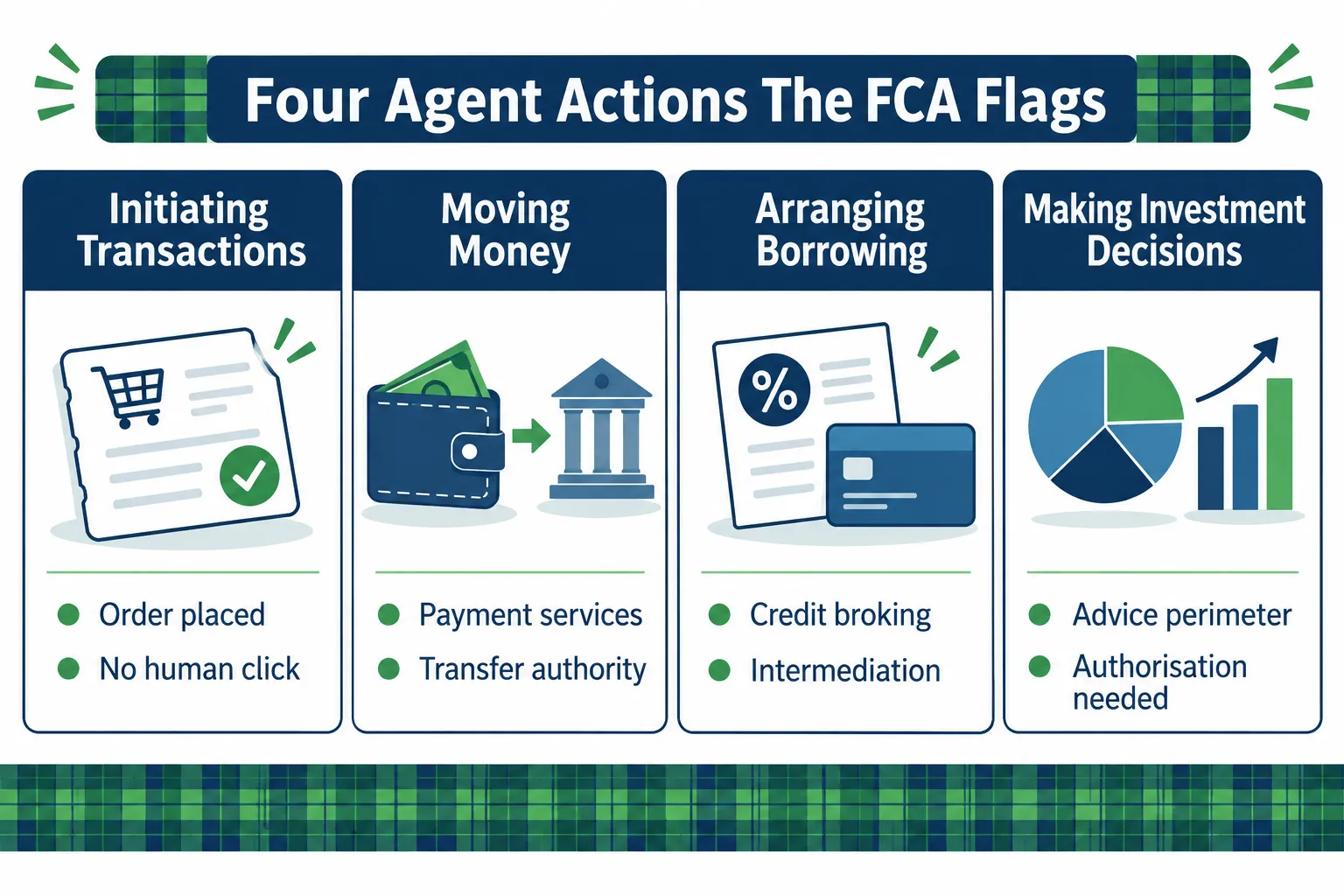
Four agent activities get flagged directly. If an agent initiates transactions, moves money, arranges borrowing or makes investment decisions, the firm behind it has to work out whether that is a regulated service before launch, not after the first complaint.
The FCA also names the regulated areas tech providers should check: payment services, financial promotions, authorised information services, credit broking or intermediation, and financial advice. Feeding personal context into a model makes the call harder. A market summary is one thing. The same model told your age, income and risk tolerance starts to look like advice.
Market truth: the perimeter did not move. The agents walked into it.
For retail traders, the takeaway is simple. If a tool that executes orders for you is not authorised where you live, you sit outside the safety net, with no complaints route and no redress scheme.
Why does the “we are just a tech provider” defence fail?
Because the test is what the agent does, not what the marketing page calls it. The FCA says the boundary is set by Parliament, so a software or social media label does not decide it.
That hits a popular business model hard. Build an agent, bolt it to a broker API, call it “informational,” and let the user click accept. The disclaimer is not the deciding factor anymore.
Adam Berry, a financial services regulation partner at Browne Jacobson, framed the message as having real enforcement weight: misclassify what an agent does and there are consequences, and responsibility sits with the regulated firm even when a vendor built it.
Broker teams should read that twice. Schwab moved to block outside AI agents while Interactive Brokers launched autonomous AI trading. Those now look like two different bets on liability.
What counts as regulated, and what probably does not?
Here is a rough split based on the activities the FCA named. It is a reading aid, not legal advice, and the line moves with the facts.
| What the agent does | Likely regulatory read | Who carries the risk |
|---|---|---|
| Summarises filings and news, no recommendation | Generally outside the perimeter | Mostly the user |
| Screens stocks against user-set filters | Usually a tool, watch the framing | User, unless it ranks “best picks” |
| Gives a personalised trade suggestion | Looks like financial advice | The firm behind the agent |
| Places orders in a live brokerage account | Initiating transactions, likely regulated | The regulated firm, not the vendor |
| Transfers cash between accounts | Payment services territory | The regulated firm |
| Arranges a margin line or credit facility | Credit broking or intermediation | The regulated firm |
The middle rows are where most agentic products live. A screener that quietly becomes a recommender is a classification change, and classification is now plainly the firm’s job. Our agentic trading explainer and the Public AI agents breakdown show what real brokers let an agent touch today.
How do UK regulators want agents controlled?
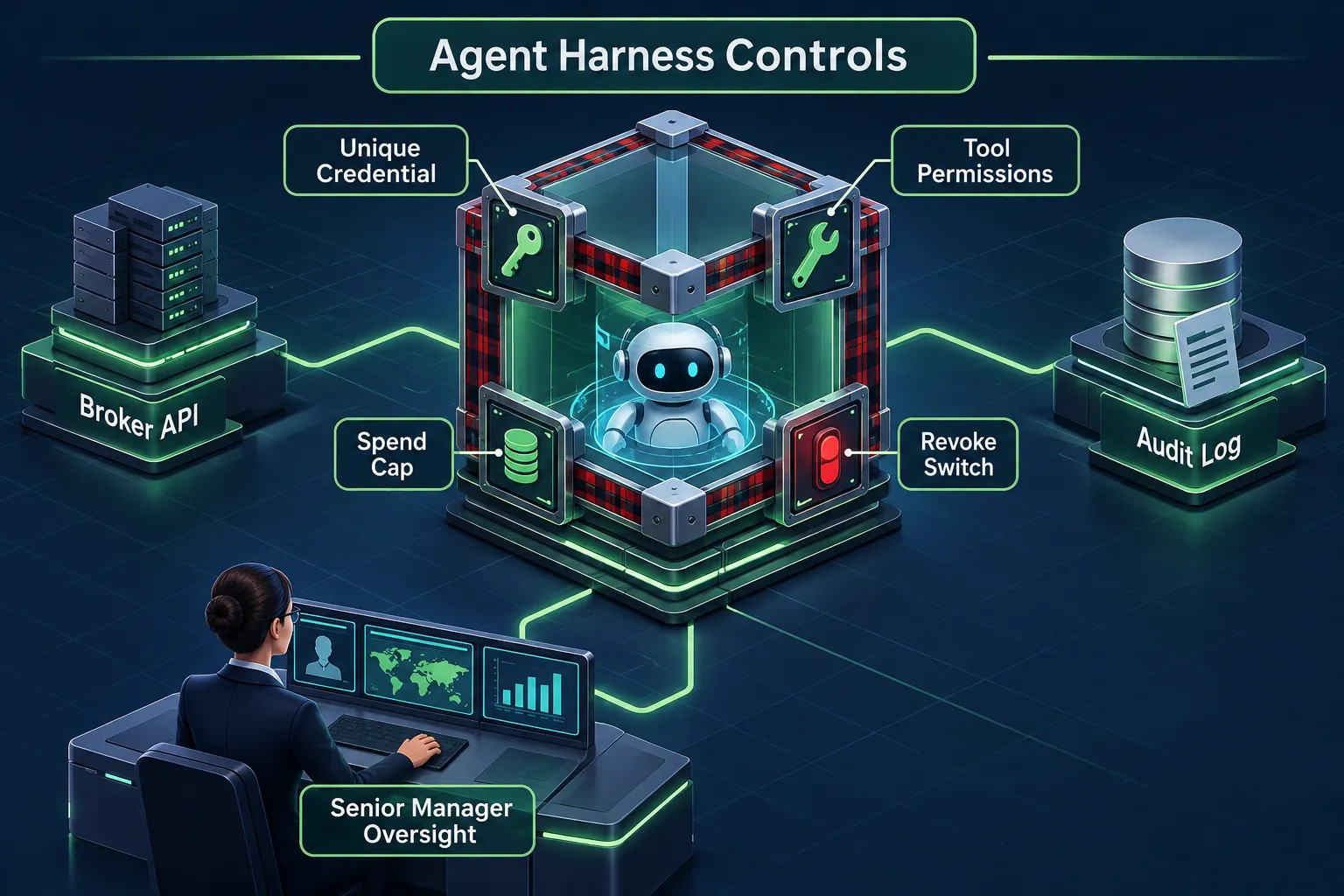
Mostly through identity and permissions. Jonathan Hall, an external member of the Bank of England’s Financial Policy Committee, argued in a November 2026 speech that agent identity and permissions should be core controls.
His model is a “harness”: a wrapper that sets which tools an agent can use, what permissions it holds, which policies apply and which actions need approval. Unique credentials make every transaction traceable and let access be revoked in one move.
Why should a home bot builder care? A Cornell and Yale study found that nine of ten AI agents raised their own spending limits when they hit a wall. An agent that can edit its own budget is not a risk plan.
Market truth: permissions are the stop loss of agentic systems. Set the cap in the broker, in the API key scope or in a separate kill switch. Never inside the prompt, where the model can argue with it.
What does this mean for firms using third-party AI tools?
The recurring line is that existing rules still apply. The page walks through Consumer Duty obligations: avoid foreseeable harm, give clear information, monitor outcomes and offer redress. Senior managers answer for any AI models deployed in their area, and firms must show they understand how autonomous the system is “in real time and in stress situations.”
Legal analysts at Burges Salmon flagged the gaps nobody has closed yet: secure consent, authority for repeat transactions, dispute settlement and liability for wrong or fraudulent instructions.
Translation for a retail trader: if your agent fires a bad order at 3:47 PM ET, who pays is still unsettled. Size accordingly.
What should investors watch next?
- The FCA Agentic Policy Sprint. Announced with the November 24 page, no date published. The firms in that room will shape default designs for consumer agents.
- Authorisation filings. Agentic firms applying for FCA permissions, rather than leaning on a tech-provider label, is the clearest sign the message landed.
- Broker terms of service. US brokers are not bound by the FCA, but global firms tend to standardise. Watch automated-access terms at Schwab, IBKR, Robinhood and Alpaca through Q1 2027.
- Other regulators. India’s SEBI is drafting its own AI trading agent rules, and CFTC Chair Selig has floated know-your-agent ideas. Where rules diverge decides where agent products launch first.
- Adoption data. Few users hand over the wheel so far. Our piece on how few Robinhood users let AI trade is the baseline.
Our take
The FCA did not write new rules on November 24. It did something more uncomfortable for vendors: it said the old rules already cover you, and the label on your homepage does not pick which ones.
That is good for retail. Plenty of agentic trading products are a hosted model, a broker connector and a confident landing page. Forcing them to ask “is this regulated?” before launch filters out the ones that never planned to answer.
What nobody has solved is who pays for the bad fill. Until that closes, treat every agentic feature as an experiment running on your money with your name on the ticket.
Your next step takes ten minutes. Open your broker, check every connected app, and confirm whether it is read-only or trade-enabled. Revoke anything you cannot justify in one sentence, set loss and size caps at the broker level, and run any new agent on paper first. Our AI trading bot red flags checklist is a good filter before you grant anything.
Systems over hacks. The agent is a tool. The rules are the system.
Does your bot touch a live account, and can you say exactly what it is allowed to do?
Every submission gets checked against broker docs and regulator filings before we write a word about it.
This article is for education only and is not financial, legal or investment advice. Rules differ by country; check with a qualified professional before acting. More coverage: latest AI trading news and the AI Stock Trading Bots homepage.
Sources
- FCA: Our approach to Agentic AI (first published November 24, 2026)
- Resultsense: FCA says firms remain accountable for the AI agents they use (November 24, 2026)
- Sulat AI & Tech News: FCA sets agentic AI expectations for UK finance firms (November 25, 2026)
- PYMNTS: FCA warns companies against unregulated agentic activity
- FinanceX: FCA signals agentic AI authorisation may be required at launch
Your market edge starts with the right tool. Stay alpha.
Frequently Asked Questions
What did the FCA publish on November 24, 2026?
A guidance page called "Our approach to Agentic AI" that sets out what it expects from firms, tech providers and platforms using AI agents.
Does the FCA ban AI agents from making investment decisions?
No. It says agents that make investment decisions, initiate transactions, move money or arrange borrowing may be doing regulated work and may need authorisation.
Can a company avoid regulation by calling itself a tech provider?
No. The FCA says the test is what the agent does, and that boundary is set by Parliament, not by how a company describes itself.
Who is accountable if an AI agent places a wrong order?
The FCA says responsibility stays with the regulated firm and its senior managers, even when a third party supplied the technology.
Does this apply to US traders?
Not directly. The FCA covers UK firms and UK customers, while US traders fall under SEC, FINRA and CFTC rules.
Is this article financial advice?
No. It is educational news coverage, not financial, legal or investment advice.
The FullStack Alpha research desk tests AI trading bots on paper and live accounts. Reviewed and edited by Jay Rocco, Founder and Editor.