The FullStack Alpha research desk tests AI trading bots on paper and live accounts. Reviewed and edited by Jay Rocco, Founder and Editor.
November 23, 2026, 8:00 a.m. ET | By FullStack Alpha Editorial Team | Reviewed by Jay Rocco, Chief Editor
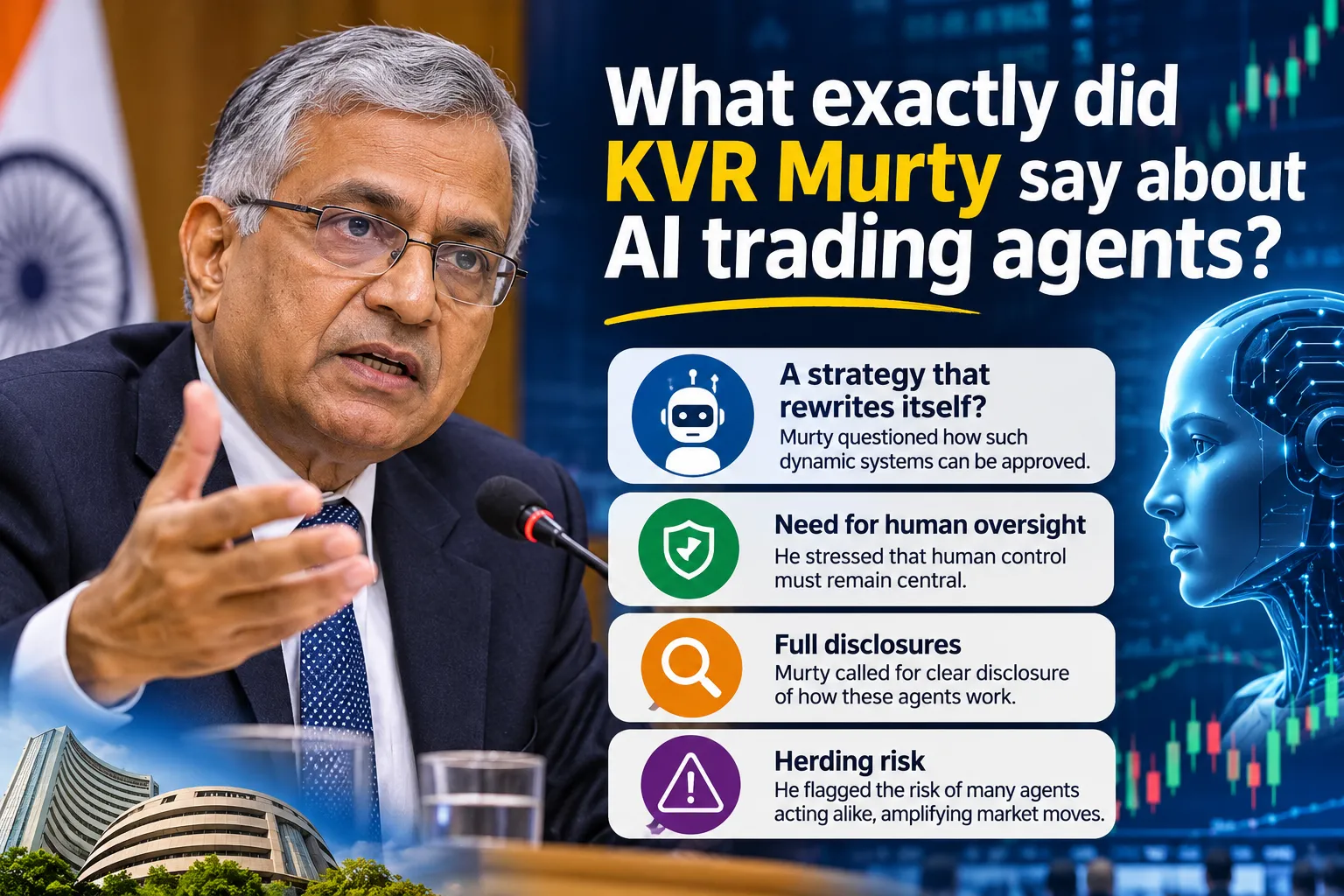
India’s market regulator is writing rules for AI trading agents, and one of its top officials just said the hard part out loud. SEBI Whole Time Member KVR Murty told an audience in Mumbai on November 19, 2026 that the regulator is preparing responsible AI guidelines covering disclosures and accountability. He framed the core problem as a question: how do you approve a strategy that rewrites itself?
Nothing has been notified yet. This is a drafting phase, not a rulebook. For anyone running or buying automated trading software, that question matters well beyond India.
Quick answer
SEBI is drafting guidelines for AI use in Indian capital markets, with a specific focus on trading agents that change their own methods as they learn. Chairman Tuhin Kanta Pandey said on November 14 that the rules will cover mandatory disclosures, accountability for regulated firms and human oversight of critical decisions. No date or final text has been published.
Key facts
- Who said it: SEBI Whole Time Member KVR Murty (Mumbai, November 19, 2026) and SEBI Chairman Tuhin Kanta Pandey (India International Trade Fair, New Delhi, November 14, 2026).
- Status: drafting. No AI agent rulebook has been notified, and registration, model update and trading limit rules are unsettled.
- Accountability line: the regulated broker, adviser or fund deploying the agent answers for it, not the model.
- Existing rules: SEBI’s February 4, 2025 retail algo circular, live since August 1, 2025, already requires exchange approval per algo, order tagging and a kill switch.
What exactly did KVR Murty say about AI trading agents?
Murty drew a line between two things that get lumped together. Conventional algorithms follow predefined rules. AI agents get a goal and can change how they trade as they learn.
That difference breaks the approval model. A regulator can read a rule based algo, test it and stamp it. An agent that adjusts its own logic between Monday’s open and Thursday’s close is a moving target, and the stamp goes stale the moment it is issued.
His other point was blunter. Someone has to answer for what an agent does. Not the model. A licensed firm with something to lose.
Market truth: “the AI did it” will not be a defense anywhere, and India just said so first.
How does this build on SEBI’s existing algo trading rules?
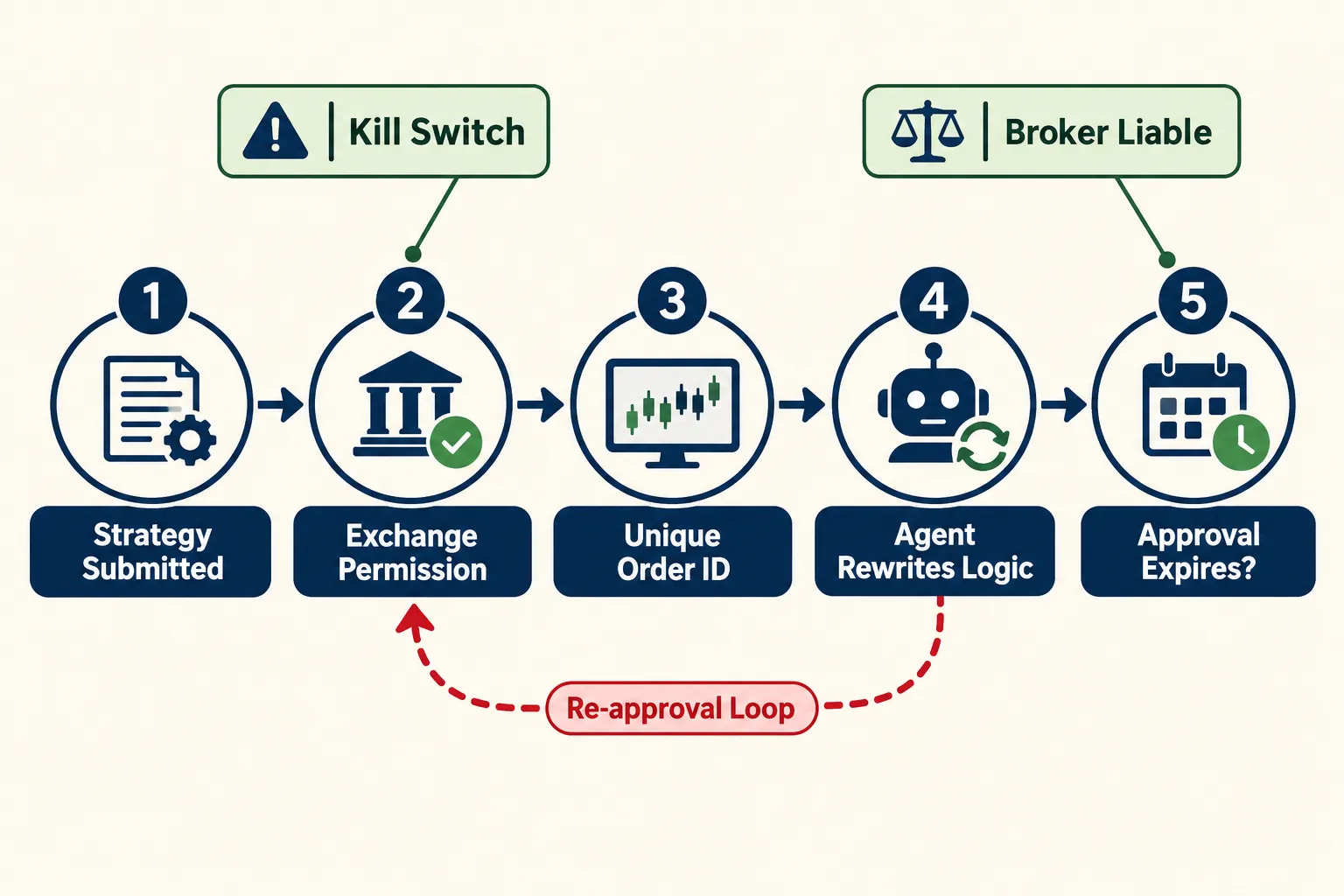
India already runs one of the stricter retail algo regimes in the world. The February 2025 circular requires exchange permission for each algo, unique identifiers on algo orders, broker responsibility for what flows through their pipes, testing, surveillance and a kill switch.
The clause that matters most here covers black box algos. When a user cannot see or replicate the logic, the provider must register as a Research Analyst, keep a detailed research report, and treat any change in the governing logic as a new algo that needs fresh registration.
Read that with an adaptive agent in mind. A change in logic equals a new approval. An agent that changes all the time would need approval all the time. That is not regulation. That is a treadmill.
| Dimension | Rule based algo | Self-rewriting AI agent |
|---|---|---|
| Logic stability | Fixed until a human edits it | Shifts as the model learns |
| Pre-approval | Approve once, then monitor | Goes stale between reviews |
| Audit trail | Order tags plus source code | Needs versioned model snapshots |
| Who is liable | Broker and algo provider | Same, per SEBI’s framing |
If you build systems, the right column is your homework. Our guide to AI trading agent risks covers the same controls from the user’s chair.
Why is herding risk the part regulators keep circling?
Because correlated behavior is how a trading problem becomes a market problem. Murty warned that if many investors run similar AI bots, they could all trade at once and cause sudden swings. SEBI’s 2025 paper went further and floated monitoring vendor concentration, possibly naming dominant providers as critical service providers.
If thousands of agents sit on the same few foundation models and data feeds, they read the same tape at the same moment. Diversified strategies that share a brain are not diversified.
We have watched a smaller version of this play out already. Systematic funds amplified the November 5 Nasdaq 100 rout, and Korea’s exchange keeps halting program orders with sidecars.
Market truth: the danger is not one rogue agent. It is ten thousand agents agreeing at 2:47 p.m.
What do SEBI’s AI trading agent rules mean for retail bot users?
More disclosure, more paperwork for vendors, and probably fewer vendors willing to sell a true black box into India.
SEBI treats third party AI as an outsourcing risk. The regulated firm using a vendor stays responsible for compliance. Your broker cannot shrug and point at the software company.
There is also a verification layer. SEBI recognized CARE Ratings as its Past Risk and Return Verification Agency, with NSE as the data centre, and regular services began May 4, 2026 for performance claims in advisory, research and algo trading. Most bot marketing dies the moment a third party checks the math.
Four questions to ask any AI trading vendor right now:
- Can you show me the logic, or only the output? Output only means black box territory.
- Who is liable if the agent misfires? Get the regulated entity’s name, not the brand name.
- How often does the model update, and are versions logged? No version history means no audit trail.
- What base model and data feeds sit underneath? Shared plumbing is herding risk in your own account.
How should US and international traders read this?
Do not file it under “India news.” Regulators copy homework.
The structural questions are the same in Washington. CFTC Chair Selig has already asked who is liable when AI trading agents go rogue, and IOSCO has warned that AI is scaling fraud against retail accounts. India’s contribution is architecture: an ID on every algo order plus a mandated kill switch. Rules like that travel once one market proves they work.
What should investors watch next?
- SEBI’s consultation draft. The usual path is a public consultation paper, then a board discussion, then a circular. No date announced as of November 23, 2026.
- Verification scope. Watch whether AI agent performance claims get folded into the CARE Ratings verification service that began May 4, 2026.
- Enforcement of the 2025 algo circular. The first actions will show how hard SEBI reads the black box clause.
Our take
SEBI asked the right question, which is rarer than it sounds. Most regulators open with “AI needs oversight” and stop. Murty went straight to the mechanical problem: approval is a snapshot, and an adaptive agent is a video.
Per-change approval cannot work for a system that changes daily. The likely answer is a shift from approving the strategy to approving the process: documented governance, logged model versions, named human owners, hard risk limits and a kill switch that works at 9:30 a.m. with real money on the line.
Your next step takes ten minutes. For any automation you run or pay for, write down four things: what the logic is, when it last changed, who is liable and how you shut it off. Then run it through a forward test before it touches live money. If you cannot answer all four, you do not have a system. You have a subscription.
Systems over hacks. More bot news lives on our latest AI trading news hub and the AI Stock Trading Bots homepage.
Built an agent that logs every version of itself? Put it in front of us.
FullStack Alpha has tested 200+ AI stock tools since 2022, and every submission gets checked before it gets covered.
This article is for education only and is not financial, legal or investment advice. Trading involves risk, including the loss of principal. Do your own research and consider a licensed professional before acting.
Sources
- NewsBytes, “India’s SEBI works on guidelines for adaptive AI trading bots,” November 19, 2026: https://www.newsbytesapp.com/news/business/indias-sebi-works-on-guidelines-for-adaptive-ai-trading-bots/tldr
- The Tribune (ANI), “SEBI preparing guidelines for responsible AI use in capital markets, including disclosures and accountability: KVR Murty,” November 19, 2026: https://www.tribuneindia.com/news/business/sebi-preparing-guidelines-for-responsible-ai-use-in-capital-markets-including-disclosures-and-accountability-kvr-murty
- MediaNama, “SEBI to set AI disclosure and human oversight rules, says chairman,” November 16, 2026: https://www.medianama.com/2026/11/223-sebi-ai-disclosure-human-oversight-rules/
- ETV Bharat, “Balancing Tech And Trust: Detailed View Of Sebi’s Upcoming AI Guidelines for Capital Markets,” November 16, 2026: https://www.etvbharat.com/en/business/balancing-tech-and-trust-detailed-view-of-sebis-upcoming-ai-guidelines-for-capital-markets-enn26111601854
- Ventura Securities, “SEBI Plans New Guidelines for AI-Powered Trading Agents,” November 20, 2026: https://www.venturasecurities.com/news/indian-markets/sebi-plans-new-guidelines-for-ai-powered-trading-agents/
- SEBI circular on safer participation of retail investors in algorithmic trading, February 4, 2025, and SEBI consultation paper on guidelines for responsible use of AI/ML, June 20, 2025 (sebi.gov.in)
Your market edge starts with the right tool. Stay alpha.
Frequently Asked Questions
Has SEBI published final rules for AI trading agents?
No. As of November 23, 2026, SEBI is in a drafting phase and no AI agent rules have been notified.
What is the difference between an algo and an AI trading agent?
An algo follows fixed rules a human wrote, while an AI agent gets a goal and can change how it trades as it learns.
Does India already regulate retail algo trading?
Yes. SEBI's February 4, 2025 circular, live since August 1, 2025, requires exchange approval per algo, order tagging and a kill switch.
What is herding risk in AI trading?
It is the chance that many bots built on the same models and data trade the same way at the same time and move the market.
Who is liable if an AI trading agent causes losses?
Under SEBI's framing, the regulated firm that deploys the agent, not the model or the software vendor.
Is this article financial advice?
No. It is education only, so do your own research and consider a licensed professional before acting.
The FullStack Alpha research desk tests AI trading bots on paper and live accounts. Reviewed and edited by Jay Rocco, Founder and Editor.