The FullStack Alpha research desk tests AI trading bots on paper and live accounts. Reviewed and edited by Jay Rocco, Founder and Editor.
November 26, 2026, 7:55 a.m. ET | By FullStack Alpha Editorial Team | Reviewed by Jay Rocco, Chief Editor
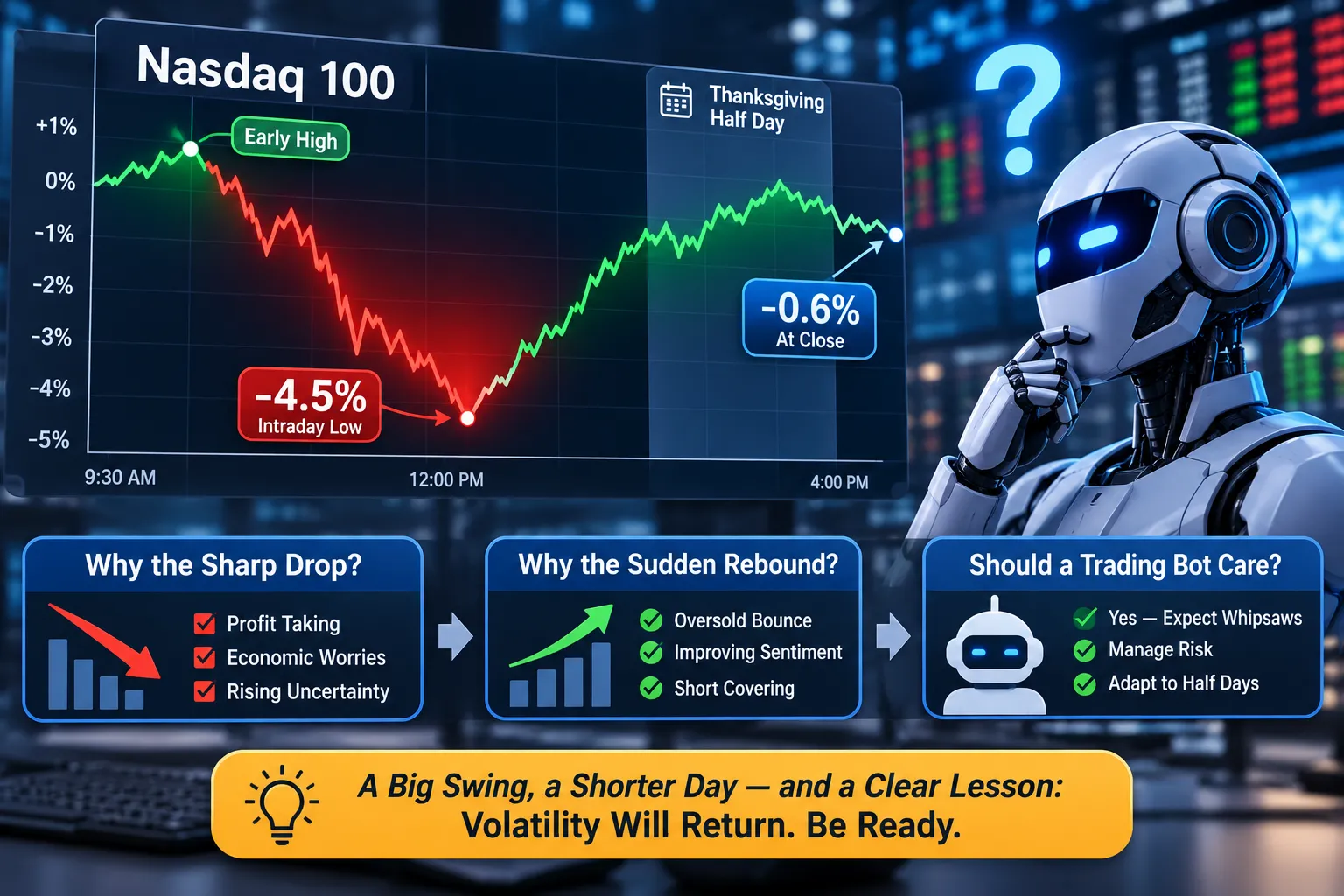
Quick answer: On Wednesday, November 25, 2026, the Nasdaq-100 fell about 4.7% at its session low and briefly crossed the 20% drawdown line from its October 6 record close. It then closed at 26,046.90, down 0.64%, so there was no bear market on a closing basis. A bot that reads intraday lows saw a regime change. A bot that reads closing prices saw a dull red day. With U.S. stocks closed today and a 1:00 p.m. ET close on Friday, this is the week to check which one you built.
Key facts
- Session low: the Nasdaq-100 touched 24,970.66 on November 25, about 20% below its October 6 record close of 31,224.47.
- Close: 26,046.90, down 0.64%. The Nasdaq Composite fell as much as 4.6% intraday and closed at 23,585.80, down 0.62%.
- Catalysts cited: a renewed U.S. tariff proposal, hotter October inflation (core PCE rose to 3.3%), Q3 GDP revised up to 4.3%, and rising odds of a December Fed hike.
- Rebound drivers cited: short covering, short-dated options activity, dealer hedging and pre-holiday bargain hunting. No new fundamental news arrived between the low and the close.
- Holiday schedule: U.S. cash equities are closed Thursday, November 26, and close at 1:00 p.m. ET on Friday, November 27.
What exactly happened to the Nasdaq on November 25, 2026?
The open was ugly. The Nasdaq-100 shed roughly 20% from its October high in about 50 calendar days, and Wednesday morning finished the job, at least for a few hours. AI-linked shares led the selling, and then they led the bounce.
A 20% drawdown that lasts four hours is not a bear market. It is a data point your system has to decide how to treat.
Peter Cardillo, chief market economist at Spartan Capital Securities, tied the macro threads together: tariffs feed inflation, and inflation works against the Fed. Dave Mazza of Roundhill Investments added doubt about what AI capital spending returns in 2028 and 2029.
Why did the market reverse so hard, and should a bot care?
Commentary pinned the rebound on mechanics, not news. Short covering, short-dated options and dealer hedging did the lifting.
That matters more than the percentage. A reversal driven by positioning is a different signal from a reversal driven by fundamentals, even though your bot sees identical candles.
If your model cannot tell a short squeeze from a change in fundamentals, it will keep buying mechanical bounces and calling it edge.
What a day like this does to automated systems:
- Correlations spike. Single names stop tracking index futures the way your backtest assumed.
- Fills cluster and worsen. Slippage peaks exactly when your stop logic is most active.
- Volatility inputs go stale. A trailing 20-day volatility window was out of date by mid-morning.
For the structural version of this, our piece on the Nasdaq 100 rout and systematic selling shows how forced sellers amplify these moves.
How does a whipsaw break a regime filter?
Most retail bots run some version of a regime switch. Trade long above the 200-day average. Go flat when the drawdown from the high passes 20%.
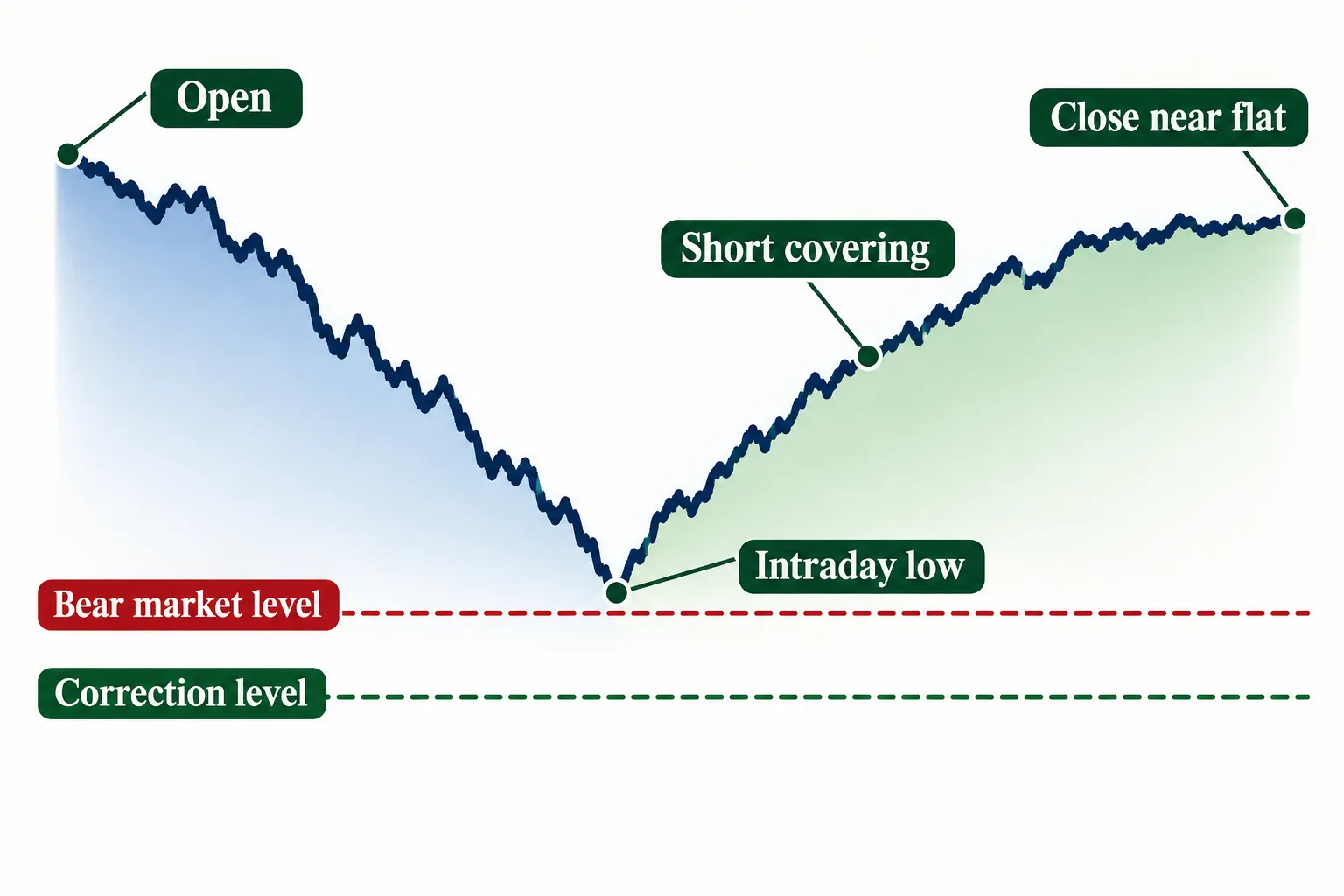
On November 25, an intraday drawdown trigger flipped to bear at the low and could have flipped back before the close. Each flip is a liquidation plus a re-entry, paid for twice in slippage on wide spreads.
| Bot design | What it saw Nov 25 | Likely behavior | Main risk |
|---|---|---|---|
| Intraday drawdown trigger | 20% breach at the low | Flipped defensive mid-session | Sold the low, re-bought higher |
| Closing-price regime filter | A 0.64% down day | No state change | Slow to react if the decline resumes |
| Percent trailing stop | Stops hit on the morning drop | Flat by mid-morning | Stopped out of positions that finished near flat |
| Volatility targeting | Realized volatility spiked | Cut size automatically | Less exposure into the recovery |
| Intraday mean reversion | Extreme oversold reading | Bought the plunge | Worked this time, until the day it does not |
Pick your data convention before the volatile session, not during it. Closing data is slower and calmer. Intraday data is faster and noisier. Both are defensible. Switching between them because you disliked yesterday’s result is not.
One more audit item. If your backtest used daily bars, it never saw that 4.7% intraday hole. Your stops look fine on paper and get shredded live. That gap between bar resolution and execution is a cousin of look-ahead bias in AI-written backtests, and it is worth pairing with a hard max drawdown limit you set in advance.
What does the Thanksgiving half day mean for trading bots?
Nasdaq’s published 2026 holiday schedule lists U.S. equities as closed Thursday, November 26, with a 1:00 p.m. ET close on Friday, November 27. That is three and a half hours of cash trading, then nothing until Monday.
Three failure modes show up every holiday week:
- Clock logic that does not know about the early close. Anything scheduled for 3:50 p.m. ET Friday fires into a closed market. Rebalancing scripts, end-of-day flattening and alerts all need a holiday calendar, not a hardcoded clock.
- Thin liquidity. Fewer participants mean wider spreads. A market order can slip well past the inside quote, and an unfilled limit order can leave you unhedged into a three-day weekend.
- “Market closed” is not “risk off.” Index futures and overseas markets keep their own hours, so your marks can move while your bot sleeps. Margin requirements do not take Thursday off.
| Session | Date (ET) | Cash equities | Bot consideration |
|---|---|---|---|
| Regular | Wed, Nov 25 | 9:30 a.m. to 4:00 p.m. | Full volatility, full liquidity |
| Holiday | Thu, Nov 26 | Closed | Futures and overseas markets still trade |
| Half day | Fri, Nov 27 | 9:30 a.m. to 1:00 p.m. | Thin tape, wide spreads, early cutoff |
| Weekend | Sat to Sun | Closed | Gap risk builds into Monday’s open |
Running anything on extended or overnight hours? Read our breakdown of Robinhood 24-hour trading and weekend risk for bots, and the Blue Ocean ATS overnight halt for what happens when an off-hours venue goes dark.
What should investors watch next?
- Friday, November 27, 1:00 p.m. ET: the early close. Confirm your broker’s own order cutoffs, which can be earlier for some order types.
- The December Fed meeting: rate expectations moved hawkish on the November 25 data. Use the Fed’s own FOMC calendar for the date, not secondhand summaries.
- The tariff proposal: it hits rates, currencies and tech multiples at once.
- A closing break of the 20% line: intraday breaches make headlines. A close below the threshold changes the official label and trips a lot of institutional rules at the same time.
How should a bot operator respond this week?
Not by rewriting the strategy on Friday morning. Do this instead:
- Pull your November 25 trade log. Count fills between 9:30 and 11:00 a.m. ET. That number tells you how reactive your system really is.
- Fix the holiday calendar. If your scheduler does not know Friday closes at 1:00 p.m. ET, that is a config bug, not a strategy problem.
- Measure slippage on the plunge. Intended price versus fill. If the gap blew out, your order types need work before the next event.
- Write down your data convention. Intraday or closing prices for regime decisions. One answer, dated.
- Test changes on paper first. New to that? Start with what paper trading is and how to use it.
If your bot did something you cannot explain, our why trading bots fail section covers the usual suspects. More briefings live on the latest AI trading news page.
Our take
November 25 was a stress test nobody scheduled. Did the Nasdaq-100 enter a bear market? It depends which number you use, and your bot already picked one for you, whether you knew it or not.
The traders who did best Wednesday were not the ones who predicted the reversal. The reversal was mechanical, which makes it close to unforecastable. The winners were the ones whose position sizing meant a 4.7% intraday hole did not force a decision.
You cannot forecast a V-shaped reversal driven by options positioning. You can size so it does not matter. Process beat prediction, twice before lunch.
The half day is the easy fix. It is a calendar entry, not a market view. Your next step: open your bot’s config today, confirm it knows about Friday’s 1:00 p.m. ET close, and write one line stating whether your regime logic uses intraday or closing prices. Then leave the strategy alone until the tape calms down.
Did your bot flip to bear and back in a single session?
We review every submitted system against the actual tape before we write a word about it, and no P&L screenshots are required.
This article is for education only and is not financial advice. Trading involves risk, including the loss of principal. Past market behavior does not predict future results. Do your own research before running any automated strategy with real money.
Sources
- ChartMill, “Stock Market Today: Nasdaq (QQQ) Plunges 4.5%, Then Claws Back Most of It as Hot PCE Data Meets an AI Scare,” Nov 26, 2026: https://www.chartmill.com/news/DE/Chartmill-59197-stock-market-today-nasdaq-plunge-recovery-hot-pce-ai-scare-2026-11-25
- ByteWire News, “Nasdaq 100 Briefly Crosses Bear-Market Threshold; Chips Drop Most,” Nov 25, 2026: https://bytewire.news/nasdaq-100-briefly-crosses-bear-market-threshold-chips-drop-most/
- Nasdaq, U.S. stock market holiday schedule: https://www.nasdaq.com/market-activity/stock-market-holiday-schedule
- Federal Reserve, FOMC meeting calendar: https://www.federalreserve.gov/monetarypolicy/fomccalendars.htm
- AI Stock Trading Bots home
Your market edge starts with the right tool. Stay alpha.
Frequently Asked Questions
Did the Nasdaq-100 officially enter a bear market on November 25, 2026?
No. The usual definition is a 20% fall from a closing peak, and the index breached 20% only intraday at 24,970.66 before closing at 26,046.90, down 0.64%.
Why does intraday versus closing data matter for a trading bot?
The same day produces different signals. An intraday drawdown trigger changed state on November 25 while a closing-price filter did not, and every flip costs slippage and commissions.
Are markets fully closed on Thanksgiving for automated systems?
U.S. cash equities are closed on Thursday, November 26, but index futures and overseas markets keep their own hours, so portfolio values and margin can still move.
What time does the U.S. stock market close on Friday, November 27, 2026?
U.S. equities close at 1:00 p.m. ET per Nasdaq's holiday schedule. Check your broker's own order cutoffs, which can be earlier for some order types.
What caused the November 25 rebound?
Market commentary credited short covering, short-dated options activity, dealer hedging and pre-holiday bargain hunting rather than new fundamental news.
Is this article financial advice?
No. It is education and news analysis for people who run trading bots. It does not recommend buying, selling or holding any security.
The FullStack Alpha research desk tests AI trading bots on paper and live accounts. Reviewed and edited by Jay Rocco, Founder and Editor.