

The FullStack Alpha research desk tests AI trading bots on paper and live accounts. Reviewed and edited by Jay Rocco, Founder and Editor.
October 22, 2026, 7:50 a.m. ET | By FullStack Alpha Editorial Team | Reviewed by Jay Rocco, Chief Editor
Blue Ocean ATS halted all overnight US stock trading for 2 hours 43 minutes, from 11:46:41 p.m. ET on October 20, 2026 to 2:30 a.m. ET on October 21, after network connectivity issues at its external network provider. Because Blue Ocean ATS carries most retail overnight flow, Korean brokers lost live US quotes, Binance adjusted funding on its US stock perps, and Alpaca switched off overnight fractional orders. The fix for bot traders is short: a stale-data kill switch, a map of which venue your broker uses after 8 p.m. ET, and a fill check when service returns.
Overnight US stock trading went dark for two hours and forty-three minutes this week. If your bot, your broker app or your 24-hour perpetual product leaned on that one pipe, you spent the window flying blind.
Quick answer
Blue Ocean ATS, the venue behind most retail overnight trading in US stocks, halted all trading at 11:46:41 p.m. ET on October 20, 2026, citing network connectivity issues at an external network provider. Trading resumed at 2:30 a.m. ET on October 21. The ripple hit Korean brokerages, which lost live US quotes into their daytime session, and Binance, which adjusted funding on its US stock perpetuals for the outage window.
Key facts
- Halt: Blue Ocean ATS stopped trading from 11:46:41 p.m. ET Oct 20 to 2:30 a.m. ET Oct 21, about 2 hours 43 minutes (roughly 03:46 to 06:30 UTC).
- Stated cause: network connectivity issues at Blue Ocean’s external network provider, per the venue’s service status page.
- Korea: many Korean brokerages saw US daytime quotes halted or delayed on October 21. Toss Securities and Meritz Securities kept quotes running.
- Orders: Korean brokers warned that unfilled orders sent to Blue Ocean could be canceled in bulk.
- Binance: excluded the outage window from the 08:00 UTC funding calculation on October 21 for its US equity perps.
- Alpaca: temporarily disabled overnight fractional-share trading, while whole-share overnight orders routed to multiple venues kept working, per Alpaca’s status updates.
What exactly happened during the Blue Ocean ATS halt?
Blue Ocean runs an ATS (alternative trading system, a private venue that matches orders outside the main exchanges) that carries much of the 8 p.m. to 4 a.m. ET session for US stocks. When its network provider’s connectivity broke, the venue stopped trading entirely instead of running a half-broken order book.
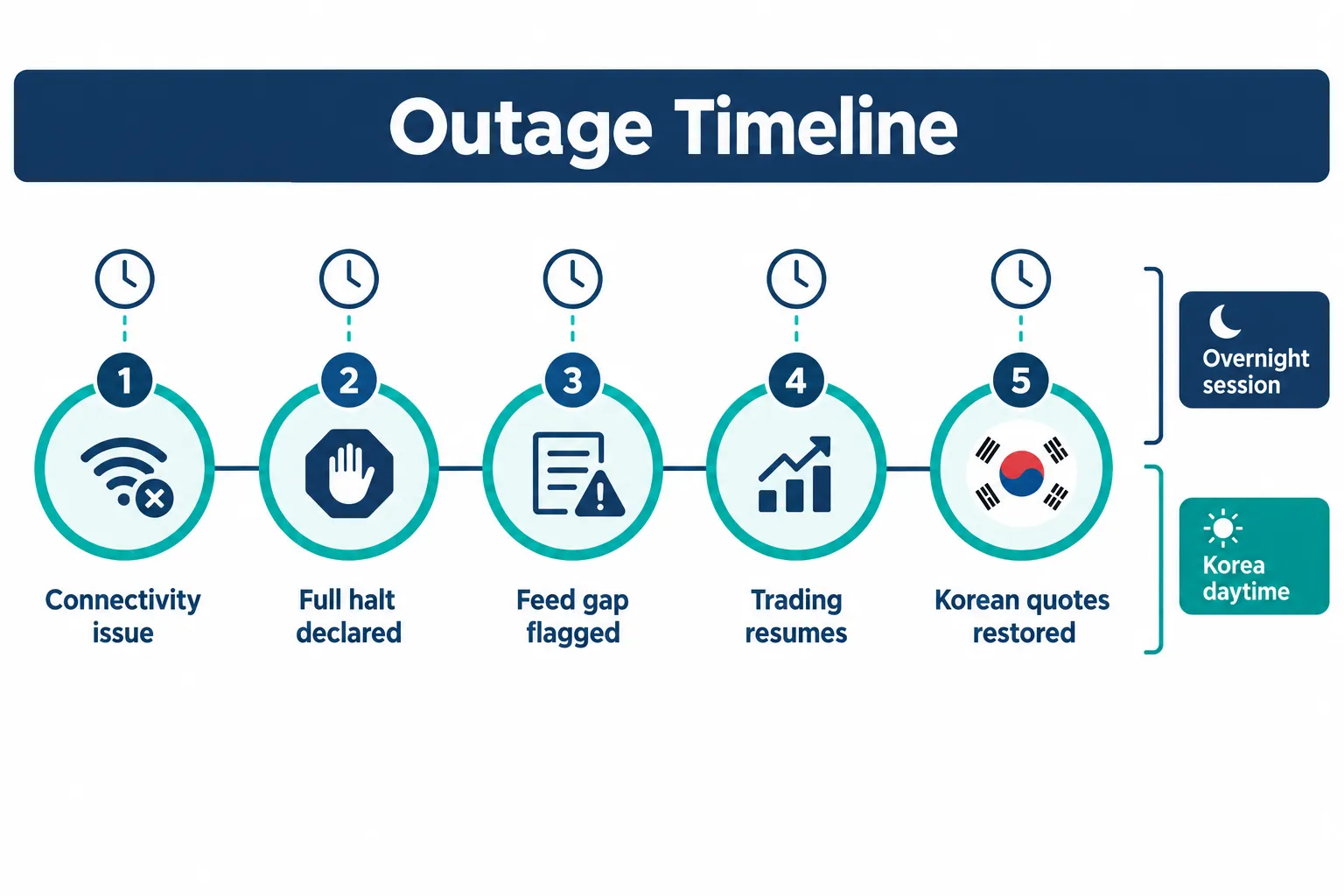
The data side added a second wrinkle. Market data vendor Databento reported a gap in Blue Ocean’s A-side feed and could not recover it from the B-side because of a separate TNS outage. It flagged the affected records as possibly bad book data.
For anyone running a systematic strategy, that flag matters more than the halt. A halt stops you for a night. Bad historical data can quietly poison a backtest for months.
Why did one provider outage take down the whole overnight session?
Because overnight US trading is thin and centralized. During regular hours, orders spread across more than a dozen exchanges and dark pools. After 8 p.m. ET, liquidity narrows to a handful of venues, and Blue Ocean carries the bulk of retail-facing overnight flow, especially from Asia.
One pipe, one point of failure. Overnight traders have seen this film before: Blue Ocean also suspended overnight trading during the August 2024 sell-off, which forced Robinhood to pause its 24 Hour Market for a night. Our look at Robinhood 24 hour trading and the retail risk covers why that pause still matters for anyone automating after dark.
How did the halt hit Korean brokers?
Korea is the biggest overseas user of US overnight trading. On October 21, real-time US quotes went missing or stale on mobile and desktop platforms at many Korean brokerages, even though orders could often still route through other ATS venues.
Two firms stayed normal: Toss Securities and Meritz Securities. Toss has blended Blue Ocean and Bruce ATS bids and offers since September 30 and leaned on Bruce data during the outage. Their edge was not better technology. It was a second supplier.
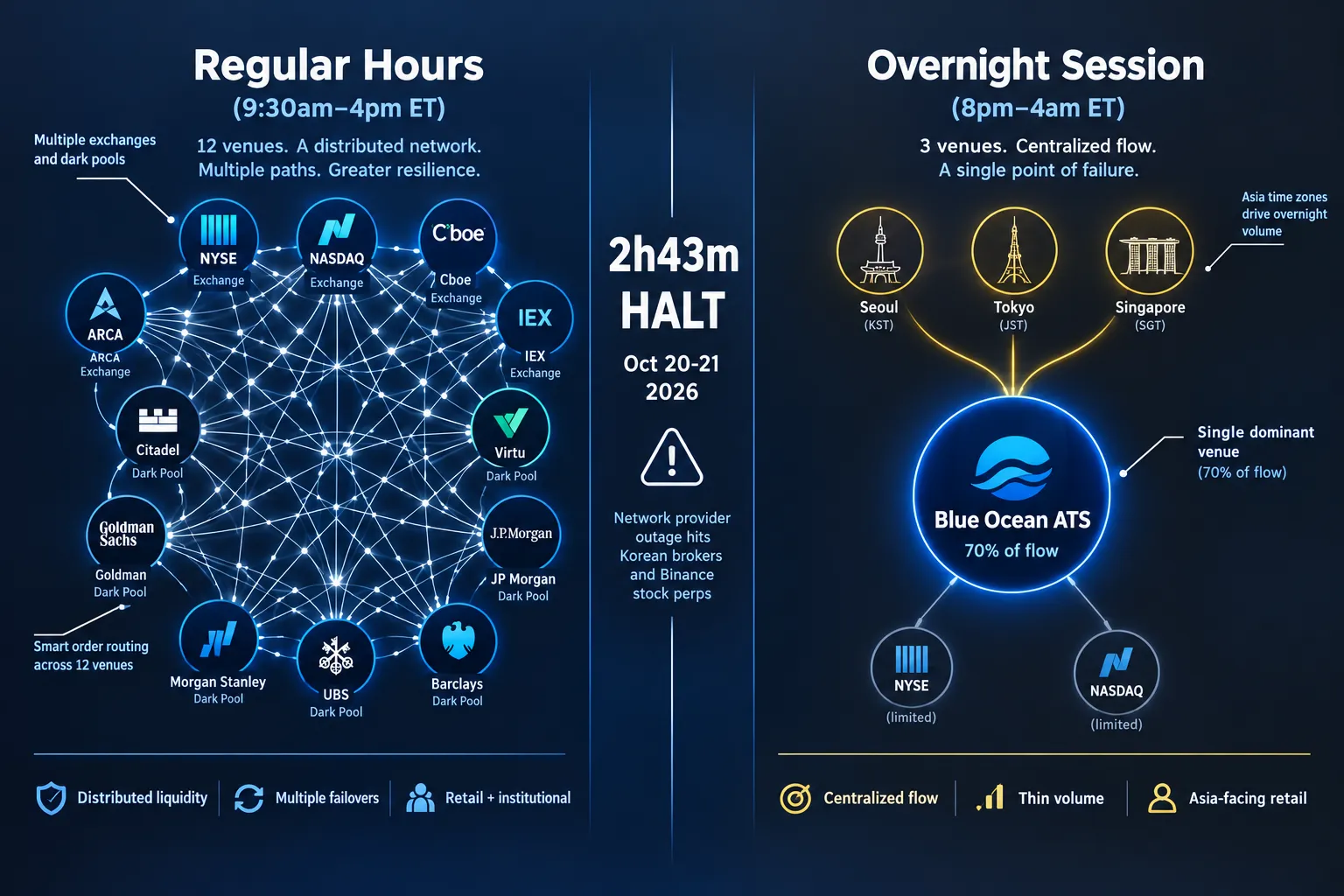
Most affected brokers still had other execution routes. What they lacked was a second source for the live quote. Redundancy that covers execution but not market data is half a plan. You can route an order to a venue you cannot see. You just should not.
What happened to Binance stock perps and Alpaca?
Binance adjusted funding on its US stock perpetual futures for the outage window, since those contracts reference US equity prices that briefly stopped updating. A perpetual with no live reference price is a derivative pointing at a frozen photograph. The same reference-price question sits under the new US-listed products in our report on CFTC clearing perpetual stock index futures.
Alpaca, the broker API that a lot of retail bots run on, paused overnight fractional-share trading while whole-share overnight orders, plus pre-market and the core session, kept working. Its incident notice gave the reason in plain terms: without reliable overnight market data, it could not accurately trigger or price certain order types such as limit and stop orders. Whole-share orders were unaffected because they route to multiple ATSs for execution. Alpaca re-enabled overnight fractional trading at 2:43 a.m. ET once Blue Ocean ATS data was flowing again. That split is the lesson. The product with a single dependency broke. The product with multiple routes did not. Our Alpaca review covers the rest of its feature set.
| Participant | What broke | What kept working |
|---|---|---|
| Blue Ocean ATS | All overnight trading, 2h43m | Nothing during the halt |
| Many Korean brokers | Live US daytime quotes | Routing via other ATS venues |
| Toss, Meritz Securities | Nothing reported | Quotes and routing |
| Alpaca | Overnight fractional shares | Whole shares, pre-market, core session |
| Binance US stock perps | Funding reference for the window | Contracts stayed listed |
What does this mean for traders running bots overnight?
If your bot trades the 8 p.m. to 4 a.m. ET window, you just got a free stress test. Did your system know it was blind, or did it keep firing orders into a void?
Most retail automation checks for an error response. It does not check whether the last quote is four minutes old. Stale data looks identical to calm data until you read the timestamp.
Three things to build into any overnight process:
- A data freshness check. If the last tick is older than a threshold you set, stop trading. Not “log a warning.” Stop.
- A venue map. Know which ATS your broker routes overnight orders to, and whether that is one venue or several. Our Alpaca API guide for beginners and broker API comparison are a good place to start.
- An order reconciliation step. When service returns, verify fills against the broker record before your system assumes its position is right.
How do you make an Alpaca bot survive the next Blue Ocean ATS halt?
Start with what the broker actually allows after dark. Alpaca’s orders documentation lists the overnight session as 8:00 p.m. to 4:00 a.m. ET, Sunday to Friday. An order is only eligible outside regular hours if you send extended_hours set to true, the order type is limit with a limit price, and time in force is day or gtc. Anything else is rejected with an error.
That rule is your first guardrail. A bot that sends market orders overnight is not trading overnight; it is generating rejections. The same page says the assets endpoint flags which symbols are tradable in the overnight session, so check it before the session rather than assuming a daytime watchlist carries over.
A worked example of the freshness check. Say your bot polls quotes every 5 seconds and treats anything older than 60 seconds as stale. On October 20 the halt hit at 11:46:41 p.m. ET, so the bot stops itself by about 11:47:41 p.m. and waits. Without the check, it had 163 minutes of frozen quotes to act on, and every limit price it computed in that window was anchored to a market that no longer existed.
What breaks in practice:
- Symbol lists change monthly. The Blue Ocean ATS status page publishes monthly halt lists. Its September list, which included SOXL, YANG and IONX, made those symbols unavailable from the August 31 session. On September 10 the venue said it would no longer halt symbols for Rule 301(b)(5) fair access reasons and put that list back in play. A bot that assumed every ticker trades overnight would have failed silently on those names for 10 days.
- The session has a warm-up. On a normal night the status page shows participants connecting and sending test trades at 7:00 p.m. ET, with the session opening at 8:00 p.m. ET. Do not schedule your first overnight order at 8:00:00 sharp.
- Fractional and notional orders are the first to go. That was Alpaca’s choice this time. If your sizing logic uses dollar amounts, add a fallback to whole shares or skip the trade.
Decision rule: trade overnight only if your bot passes all three checks (fresh quote, symbol flagged tradable overnight, limit order with extended hours set). If any check fails, the correct action is no trade. A kill switch that lives outside the bot is better still, as our guide to AI trading agent risks and the external kill switch explains.
What should investors watch next?
- Blue Ocean’s root-cause write-up. Watch the Blue Ocean ATS service status page and any regulatory filings in the coming weeks.
- Korean regulator response. Any guidance from Korea’s Financial Supervisory Service on multi-vendor quote sourcing would be the concrete outcome.
- Bruce ATS and MOON ATS share. If Korean brokers add a second overnight venue, Q4 2026 volume data will show it.
- Robinhood Q3 results, scheduled for October 27. Listen for any comment on overnight trading reliability.
- Vendor advisories. Anyone backtesting overnight strategies should check whether October 21 Blue Ocean data carries a bad-book flag before trusting results built on it.
Our take
Blue Ocean ATS going dark for 2 hours 43 minutes is not a scandal. A whole country’s brokers losing live quotes because they bought from the same shop is.
Blue Ocean halted instead of limping, which is the right instinct. The weak link sat downstream, with everyone who treated a single ATS as both the execution venue and the price oracle. Toss paid for a second feed and spent October 21 operating normally. That is not luck. That is a system.
The retail version is smaller but identical. If your watchlist, alerts and order entry all depend on one app, you have the same architecture as an affected Korean broker. That is the lens we use across AI Stock Trading Bots: what does the tool do when its one dependency fails? Next step: before tonight’s session, add a stale-quote kill switch to any bot that trades overnight, and paper trade the overnight window for two weeks before putting real size there. Our breakdown of paper trading slippage shows why those simulated fills still flatter you after dark. Systems over hacks.
If your overnight bot runs on Alpaca, the Alpaca tool profile on our directory lists its plans and the alternatives worth a look.
Does your bot know when its data goes stale?
We test trading bots against the venue and vendor documentation before we write a word about them.
This article is for education only and is not financial advice. Trading involves risk, including the loss of principal. Do your own research before using any trading bot or strategy.
Sources
- Blue Ocean ATS Service Alerts and Announcements
- Unchained: Binance Adjusts US Stock Perp Funding After Blue Ocean’s Overnight Trading Halt (Oct 21, 2026)
- Seoul Economic Daily: U.S. Blue Ocean Outage Disrupts Daytime Quotes for Korean Brokerages (Oct 21, 2026)
- Alpaca Status: Issues on Exchange Availability (Oct 21, 2026)
- Alpaca Docs: Orders at Alpaca, extended hours and overnight trading
- Alpha Biz: Blue Ocean ATS System Outage Disrupts U.S. Stock Daytime Quotes at Korean Brokerages
- CNBC: Robinhood says there will be no 24-hour trading on Monday due to issue at third-party venue (Aug 5, 2024)
Your market edge starts with the right tool. Stay alpha.
Frequently Asked Questions
How long was the Blue Ocean ATS halt?
About 2 hours 43 minutes. Blue Ocean halted all trading at 11:46:41 p.m. ET on October 20, 2026 and resumed at 2:30 a.m. ET on October 21, roughly 03:46 to 06:30 UTC.
What caused the Blue Ocean ATS outage?
Blue Ocean's service status page cited network connectivity issues at an external network provider that affected client connectivity. The venue said the issue was fully resolved before trading resumed.
Were orders canceled during the outage?
Korean brokerages warned that unfilled orders sent to Blue Ocean could be canceled in bulk. Anyone with working overnight orders should check order status directly with their broker.
Did regular US market hours get affected?
No. The halt hit the overnight session. Pre-market and the core session ran normally, though many Korean brokerages saw delayed US quotes during their own daytime hours on October 21.
What should a bot trader change after this outage?
Add a data freshness check that stops trading when the last quote is older than a set threshold, learn which venue your broker routes overnight orders to, and reconcile fills against the broker record after any outage.
Is this article financial advice?
No. This article is for education only. It does not recommend buying, selling or holding any security, and trading involves risk, including the loss of principal.
The FullStack Alpha research desk tests AI trading bots on paper and live accounts. Reviewed and edited by Jay Rocco, Founder and Editor.
