
October 5, 2026, 7:45 a.m. ET | By Jay Rocco, Founder and Editor, FullStack Alpha
Quick answer
On September 29, 2026, the SEC sued four entities behind two fake AI trading schemes, Cryptoaiml and TSAI, in federal court in Manhattan. The agency says they took more than $15 million from retail investors with AI “signals” and AI trading bots that never traded anything. Both used falsified Form D filings with the SEC to look regulated. If a bot seller points to an SEC filing as proof it is safe, treat that as a warning sign, not a credential.
Key facts
- Announced: September 29, 2026, in SEC press release 2026-95.
- Defendants: Cryptoaiml Ltd. and Cryptoaiml Capital Foundation; TSAI Pro Ltd. and TSAI Capital Foundation (also known as TSAI Exchange Ltd.).
- Court: U.S. District Court for the Southern District of New York. Case numbers 1:26-cv-08508 (Cryptoaiml) and 1:26-cv-08518 (TSAI).
- Money: At least $12.5 million from over 300 investors (Cryptoaiml) and at least $2.8 million from about 1,715 investors (TSAI), according to the complaints.
- Period: August 2024 to March 2025 (Cryptoaiml) and September 2024 to March 2025 (TSAI).
- The pitch: AI-generated trading signals in WhatsApp groups, and AI trading bots you could “rent” for fixed daily payouts.
- The reality, per the SEC: No trading took place. The profits on screen were fake.
- Relief sought: Permanent injunctions, disgorgement with prejudgment interest and civil penalties. These are allegations in the complaints, not findings by a court.
What did the SEC say Cryptoaiml and TSAI actually did?
Two schemes, one playbook. Both set up U.S. entities, filed a Form D with the SEC, registered a money services business with FinCEN, and then pointed investors at their SEC filings as proof of legitimacy.
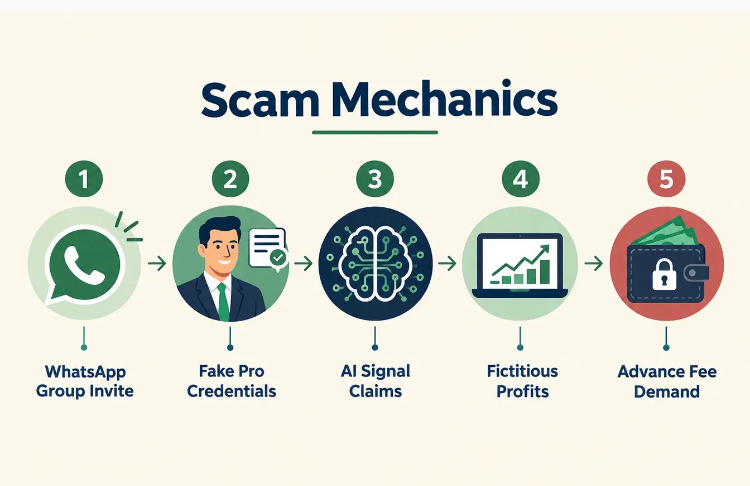
Cryptoaiml worked the group chat angle. According to the complaint, its operators ran WhatsApp groups while posing as real investment professionals, including a Raymond James adviser and the actual president of Citadel Securities. Neither firm had any involvement. The chats claimed the AI signals hit a 98% accuracy rate. Investors were steered onto a “trading platform” that showed big gains. When they asked for their money, they were told their accounts were frozen until they paid advance fees.
TSAI sold the bot itself. Its website offered AI trading bots for rent, paid in crypto such as BTC, ETH, USDT and USDC. The complaint says there were no bots at all, and deposited funds never earned a cent for investors.
How did the fake AI trading bot rentals work?
This is the part every bot buyer should study, because the numbers tell you everything.
According to the SEC complaint, TSAI’s entry-level bot cost $100 to rent. It promised $10 a day for two days, plus the $100 back. That is a 10% return per day, fixed in advance.
The top tier cost $500,000 and promised $17,500 a day for 360 days, a total of $6.3 million. A “Profit Box” product promised a minimum of 0.35% every 24 hours.
Then came the multi-level layer. Investors were promised 5% from members they recruited directly and 3% and 2% from indirect recruits, with ranks from S0 to S7. When withdrawals stalled, the complaint says TSAI cited “suspicion of illegal arbitrage” and demanded “verification payments.”
Here is the market truth. Real trading software sells you access, data or execution. It does not sell you a fixed daily yield. The moment a “bot” quotes a guaranteed number per day, you are not looking at a trading product. You are looking at a deposit box with someone else holding the key.
Why does a Form D filing not make a trading bot legit?
A Form D is a short notice a company files itself when it claims an exemption from registering a securities offering. Filing one does not mean the SEC has reviewed or approved the company or its product.
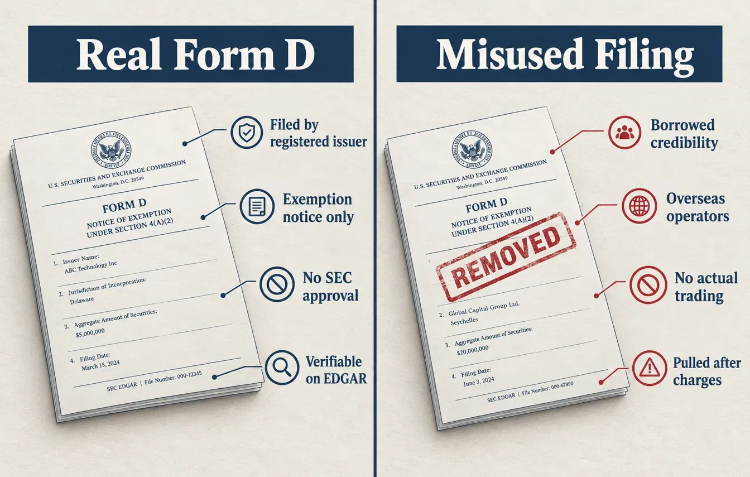
The Cryptoaiml complaint shows how easy that is to abuse. Its Form D claimed revenue of over $100 million. The listed signer, “James Peat,” does not appear to exist, and the notarization of his signature was forged, according to the SEC. TSAI went further and posted a fake “SEC certificate” on its website that referenced its own Form D.
Same story with FinCEN. A money services business registration is a filing, not a seal of approval. TSAI’s website still cited it when answering its own question, “Is TSAI legal and safe?”
The SEC has since removed both Forms D from its website. It is not the first case of its kind this quarter. On August 27, 2026, the agency charged 38 entities that allegedly made false statements in adviser filings to look like legitimate U.S. firms.
What should investors watch next?
- The two court dockets. Watch SDNY cases 1:26-cv-08508 and 1:26-cv-08518 for default judgments or penalty orders. The SEC says the operators are likely overseas, so recovering money for victims may be slow.
- More fake-filing cases. The SEC brought fake-filing actions on August 27 and September 29, 2026. Our read: this is a live enforcement theme, so watch the SEC newsroom for the next one.
- Your own feeds. Both schemes recruited through WhatsApp and Facebook. If an “adviser” invites you into a group chat to share AI signals, that is the exact pattern described in these complaints.
Our take
Many people who fall for schemes like these are not reckless. They saw an SEC filing, a polished dashboard and a chat full of happy winners, and they did what felt like due diligence. The scam was built to pass a shallow check.
So run a deeper one. Before you fund any AI trading bot, answer three questions. Which regulated broker holds your money? Can you see the orders in that broker’s own app? Does the product promise a fixed return? If the answers are “theirs,” “no” and “yes,” walk away.
Your next step: search any bot seller or “adviser” on Investor.gov and FINRA BrokerCheck before you send a dollar. Then read our AI trading bot red flags checklist and the story of the fake Claude trading bot scam. If you are still learning how real bots connect to real accounts, start with trading bot basics and our guide to brokers with an API.
Real bots place real orders at real brokers. Show us yours.
These schemes had no broker, no orders and no audit trail. If your bot has all three, we want to see it.
This article is for education only. It is not financial, legal or investment advice. The SEC’s claims are allegations, and the defendants have not been found liable by a court. Do your own research and consider speaking with a licensed professional before investing.
Sources
- SEC press release 2026-95: SEC Charges Multiple Entities in Fraud Schemes Totaling at Least $15 Million That Used WhatsApp and Other Platforms to Lure Investors (Sept. 29, 2026)
- SEC complaint: SEC v. Cryptoaiml Ltd. and Cryptoaiml Capital Foundation, No. 1:26-cv-08508 (S.D.N.Y.)
- SEC complaint: SEC v. TSAI Pro Ltd. and TSAI Capital Foundation, No. 1:26-cv-08518 (S.D.N.Y.)
- SEC press release 2026-78: SEC: 38 Entities Feigned Legitimacy as U.S. Advisers Through False Filings to Lure Retail Investors (Aug. 27, 2026)
- Investor.gov investor alert: Artificial Intelligence (AI) and Investment Fraud
- WealthManagement.com: SEC Charges Two Firms With $15M WhatsApp, Crypto Frauds
Your market edge starts with the right tool. Stay alpha.
Frequently Asked Questions
Does a Form D filing mean the SEC approved an investment?
No. A Form D is a notice a company files itself to claim an exemption from registering a securities offering. The SEC does not review, approve or vouch for it. The SEC removed the Forms D filed by Cryptoaiml Ltd. and TSAI Pro Ltd. from its website after the September 29, 2026 enforcement action.
How much money is involved in the Cryptoaiml and TSAI cases?
The SEC alleges more than $15 million total: at least $12.5 million from over 300 investors in the Cryptoaiml scheme and at least $2.8 million from about 1,715 investors in the TSAI scheme.
Have Cryptoaiml and TSAI been found guilty?
No. These are civil complaints filed September 29, 2026 in the Southern District of New York. They contain allegations, not findings. The SEC is seeking permanent injunctions, disgorgement with prejudgment interest and civil penalties.
What is the clearest sign an AI trading bot is fake?
A fixed daily return quoted up front, and any demand that you pay a fee to withdraw your own money. The SEC says TSAI advertised 10% per day on a $100 bot and that Cryptoaiml investors were told to pay advance fees to unfreeze accounts. Real brokers never charge you to take money out.
Should a real AI trading bot hold my money directly?
No. Legitimate automation connects to a brokerage account you opened yourself using API keys you issue and can revoke. Your cash stays with the regulated broker, and you can see every order in the broker's own app. If the product holds the funds, it is not automation.
Where do I report a suspected fake AI trading bot?
File with the SEC at sec.gov/tcr. You can also report to FINRA and to the FTC at reportfraud.ftc.gov. You can check any seller or adviser first on Investor.gov and FINRA BrokerCheck.
Contributing writer at AI Stock Trading Bots.
