

The FullStack Alpha research desk tests AI trading bots on paper and live accounts. Reviewed and edited by Jay Rocco, Founder and Editor.
October 20, 2026, 7:50 a.m. ET. By FullStack Alpha Editorial Team | Reviewed by Jay Rocco, Chief Editor
A federal court has ordered EminiFX and its founder, Eddy Alexandre, to pay more than $288 million for running a robo-advisor Ponzi scheme, the CFTC announced on October 19, 2026. The EminiFX judgment breaks down into $228,576,962 in restitution, $15,049,500 in disgorgement (offset by any restitution paid) and a $45,148,500 civil penalty, plus a permanent trading ban. Behind a “Robo-Advisor Assisted” account that advertised 5% to 9.99% a week, the court found EminiFX actually ran net losses of more than $49 million. The lesson for anyone shopping for a trading bot: a fixed weekly return is a payment schedule, not a strategy.
A platform promised weekly returns of 5% to 9.99% from an automated trading account. A federal court just put a nine-figure price tag on that promise.
Quick answer
On October 19, 2026, the CFTC announced that the U.S. District Court for the Southern District of New York ordered Eddy Alexandre and his firm EminiFX to pay more than $288 million for running a commodity pool Ponzi scheme. EminiFX sold a “Robo-Advisor Assisted” account that supposedly traded forex and crypto for investors. The court found the returns were not backed by real trading. Investor restitution comes before the penalty.
Key facts
- Restitution: $228,576,962 owed by Alexandre and EminiFX to defrauded investors.
- Disgorgement: $15,049,500 from Alexandre personally, offset by any restitution he pays.
- Civil penalty: $45,148,500, owed jointly.
- Trading ban: Alexandre and EminiFX are permanently barred from trading commodity interests.
- Money raised: more than $262 million from tens of thousands of investors over about eight months.
- Recovered so far: a court-appointed receiver had returned more than $98 million to over 28,000 investors as of July 2026.
- Criminal side: Alexandre is serving a nine-year prison sentence in a parallel case brought by federal prosecutors in Manhattan.
What exactly did the court order against EminiFX and Eddy Alexandre?
Three money obligations and one permanent ban. Judge Valerie E. Caproni entered the final judgment on October 8, 2026, and the CFTC made it public eleven days later.
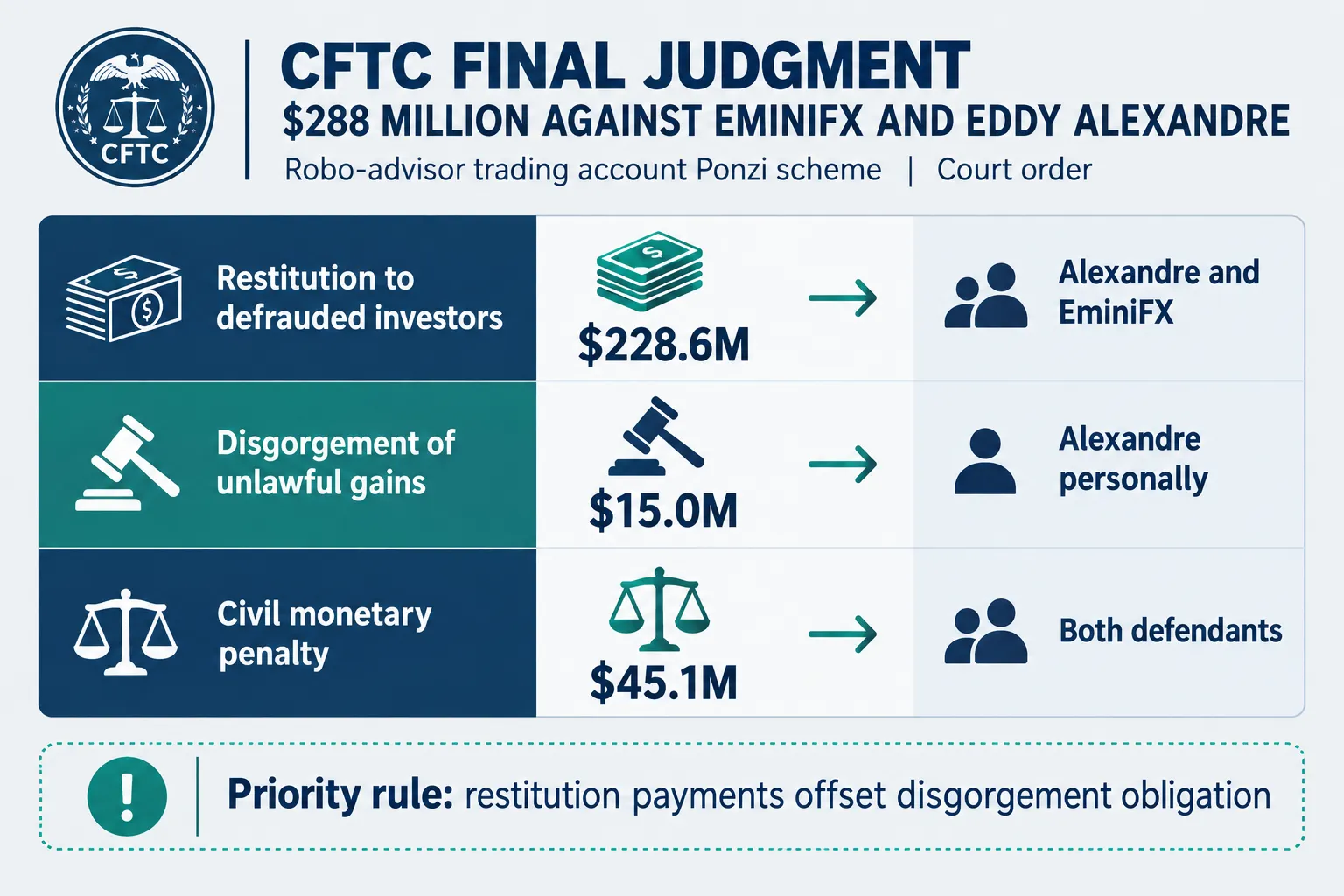
| Item | Amount | Who pays |
|---|---|---|
| Restitution to defrauded investors | $228,576,962 | Alexandre and EminiFX |
| Disgorgement of unlawful gains | $15,049,500 | Alexandre personally |
| Civil monetary penalty | $45,148,500 | Jointly |
| Trading ban | Permanent | Alexandre and EminiFX |
The $288 million headline adds all three lines together. That overstates the cash picture, because restitution payments offset Alexandre’s disgorgement. Treat it like a sticker price.
The more useful line in the order: investor claims rank ahead of the civil penalty when the receiver pays out. People first, Treasury second.
A judgment establishes who owes what. It does not refill accounts that were already drained.
Why did the CFTC call EminiFX a Ponzi scheme instead of a failed trading business?
Because money paid out to earlier investors came from newer deposits, not from trading profits. The court found investors decided to put money in based on false claims about automated trading performance.
The numbers in CFTC Release 9311-26 are blunt. While EminiFX reported weekly gains, it experienced net losses exceeding $49 million, and at least $15 million of those losses came from Alexandre taking investor money for his own use. The court’s words: “Simply put, EminiFX was a Ponzi scheme.” The case itself dates to the CFTC’s May 12, 2022 complaint (Release 8527-22), so this judgment took more than four years to land.
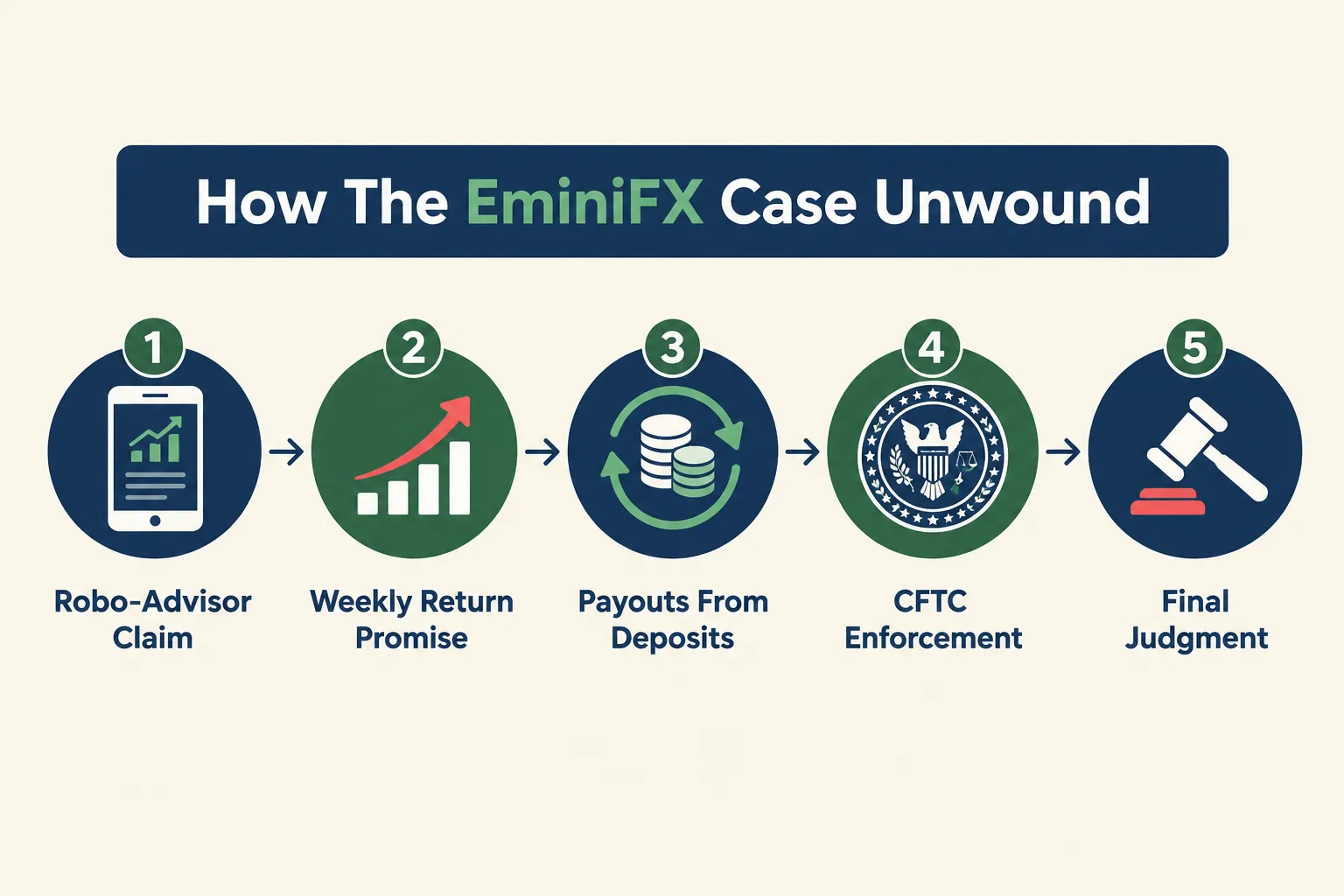
The pitch was simple. Deposit funds into the “Robo-Advisor Assisted account,” let the system trade forex and crypto, collect weekly gains. Referral bonuses pulled in the next wave.
Run the math on the low end. A 5% weekly return compounds to roughly 1,164% a year. The court called the advertised range “astonishing.” The top of that range, 9.99% weekly, produces a number too large to mean anything: about 141 times your money in a single year.
For scale, Renaissance Technologies’ Medallion fund, the most famous quant fund on record, is reported to have averaged about 66% a year before fees over decades. EminiFX claimed that kind of gain every few weeks.
How does EminiFX compare to other AI and automated trading fraud cases?
The wrapper changes every cycle. 2022 sold a “robo-advisor.” 2024 sold an “AI trading bot.” 2026 sells an “autonomous agent.” The skeleton stays the same.
| Case | Regulator | Claimed mechanism | Scale |
|---|---|---|---|
| EminiFX and Eddy Alexandre | CFTC | Robo-advisor assisted forex and crypto account | $228.6M restitution ordered |
| Cryptoaiml and TSAI | SEC | AI trading bot returns | About $15M raised |
| Fake Claude trading bot | Fraud case | Branded AI trading agent | $517K from 224 people |
We covered the SEC’s case against Cryptoaiml and TSAI over fake AI trading bots and the fake Claude trading bot that took $517,000 from 224 people. Different sizes, same parts: a black box no one can inspect, a fixed return schedule, and no audited record.
How much money have EminiFX investors received so far?
More than $98 million, paid to over 28,000 investors as of July 2026, according to the receiver.
The approved plan split claimants into classes:
- Class 3 (generally deposits above $1,000) received an initial payout of 45% of eligible deposits minus withdrawals.
- Class 3A (generally deposits of $1,000 or less) received 55% and is not currently expected to get another payment.
About 4,000 eligible users reportedly missed the first payout because they never supplied valid payment details or did not cash a check in time. They are expected to stay eligible. If that is you, the fix is paperwork: update your details with the receivership.
Getting back close to half of eligible deposits is a strong result for a Ponzi case. Most victims of these schemes recover far less. The CFTC says so itself in the EminiFX release: orders to repay victims may not always bring the money back, because wrongdoers may not have enough funds or assets.
What should investors watch next?
- 2027 (date not set): a second receivership payout is anticipated once tax and administrative items clear. No amount has been stated.
- Ongoing: whether collection on the judgment turns into cash. A judgment is a legal claim on assets, not a wire transfer.
- Ongoing: CFTC and SEC action against AI and automated trading claims. Regulators now treat “the system does the trading” as a claim that needs proof.
That last point is good news for anyone building or buying legitimate software, and bad news for anyone selling a subscribe button bolted onto a black box. See our take on why 57% of investors say no to AI trading while brokers ship it anyway.
How do you vet an automated trading product after EminiFX?
Five checks. None of them need a lawyer.
1. Is the return schedule fixed? Real trading produces losing weeks. A product quoting a routine weekly or monthly percentage is describing a payment plan, not a strategy.
2. Can you see the method? “Proprietary AI” with no methodology page and no list of what it trades is a refusal to answer.
3. Is the track record audited or just asserted? A screenshot is not a track record. A backtest is not live performance. Ask for the worst drawdown and watch whether anyone answers.
4. Who holds the money? Legitimate automation connects to your own brokerage account through an API, and you keep custody. If the pitch requires sending money into the operator’s pool, you gave away your only bargaining chip. Compare that with a broker API such as Alpaca, where the bot places orders but the cash sits in an account in your name.
5. Is the entity registered? Check CFTC and NFA registration before you deposit. It takes four minutes.
Our guides on trading bot red flags and what a trading bot should cost run the same filters in more detail. And before any bot touches real money, paper trade it first, knowing that paper trading hides slippage until live fills show up.
How do you check a trading bot’s registration before you deposit?
Check 5 above takes four minutes because the lookups are free and public. Here is the order we run them in.
- Search the firm and the person in NFA BASIC. BASIC is the National Futures Association’s free tool for researching the background of derivatives industry professionals, searchable by firm, NFA ID, individual or pool name. Search the company, the pool and the founder. No record, or a record with regulatory actions, is your answer.
- If the product touches stocks, run FINRA BrokerCheck. It shows employment history, licenses and any violations for brokers and investment advisors. A bot vendor does not need to be a broker, but the account it trades in should sit at one you can find there.
- Read the CFTC’s advisory on AI bots. AI Won’t Turn Trading Bots into Money Machines states that AI technology can’t predict the future or sudden market changes, and walks through Mirror Trading International: more than $1.7 billion in bitcoin taken from at least 23,000 people with a bot that promised at least 10% a month.
- Ask for the account statement, not the dashboard. In the Mirror Trading case, the CFTC says customer balances were faked with MetaTrader demo accounts. A dashboard is software anyone can build. A statement from a regulated broker or FCM is not.
A worked example. That Mirror Trading promise of 10% a month sounds smaller than EminiFX’s 5% a week. Compound it for 12 months and it is about 3.1 times your money, which the CFTC describes as more than 200 percent per year. Any fixed monthly figure above roughly 1% to 2% deserves the same calculator test before it gets a dollar.
Decision rule: deposit nothing until the operator shows up in the right registry, your money stays in your own brokerage account, and the track record comes from a broker statement. Miss one of the three and walk away.
Our take
The legal win is real. The cash recovery is partial and slow, which is how these cases always end.
What should stick with traders is not the dollar figure. The single biggest red flag in a $262 million fraud was a number anyone could check with a phone calculator. Five percent a week. No forensic accounting required.
The label on the box will keep changing. Robo-advisor became AI bot, and AI bot is becoming autonomous agent. The question never changes: where does the money come from, and can you see it?
Your next step today: list every automated tool or signal service you pay for. Next to each one, write its published method, its audited track record, and who holds the money. Anything with three blanks gets cancelled this week. Every tool we cover at AI Stock Trading Bots goes through those same three questions first.
Related: if you want a regulated broker holding the cash while a bot trades, start with our Charles Schwab review on AI Stock Picker App.
Paying for a bot that will not explain how it trades? Send it to us.
Every submission gets checked against registration records and its own published claims before we cover it.
This article is for education only and is not financial advice. FullStack Alpha does not tell anyone what to buy, sell or hold.
Sources
- CFTC Press Release No. 9311-26, October 19, 2026
- CFTC Press Release No. 8527-22: original EminiFX complaint (May 12, 2022)
- CFTC Customer Advisory: AI Won’t Turn Trading Bots into Money Machines
- NFA BASIC registration search
- The Crypto Times: CFTC Secures Final Judgment in $262M EminiFX Ponzi Scheme Case
- Crypto Briefing: CFTC secures $288 million judgment against EminiFX
Your market edge starts with the right tool. Stay alpha.
Frequently Asked Questions
How much does the EminiFX final judgment require Eddy Alexandre and EminiFX to pay?
The order requires $228,576,962 in restitution, $15,049,500 in disgorgement from Alexandre, and a $45,148,500 civil penalty, a combined total above $288 million. Restitution payments offset the disgorgement, so the headline figure counts part of the money twice.
When was the EminiFX judgment entered and announced?
Judge Valerie E. Caproni of the U.S. District Court for the Southern District of New York entered the final judgment on October 8, 2026. The CFTC announced it on October 19, 2026.
What was the EminiFX Robo-Advisor Assisted account?
It was EminiFX's pitch: investors deposited money into an account that supposedly traded forex and crypto automatically and paid weekly returns of 5% to 9.99%. The court found those returns were not supported by real trading, and the CFTC called the operation a commodity pool Ponzi scheme.
How much have EminiFX investors gotten back?
A court-appointed receiver had returned more than $98 million to over 28,000 investors as of July 2026. Larger depositors received 45% of eligible deposits minus withdrawals in the first payout, and smaller depositors received 55%. A second payout is anticipated, likely in 2027.
How can I tell if an AI or automated trading product is a scam?
Watch for a fixed weekly or monthly return, a secret method, no audited track record, a pitch that requires sending money into the operator's own pool, and no CFTC, NFA or SEC registration. Legitimate tools connect to a brokerage account you control.
Is this article financial advice?
No. This article is for education only. FullStack Alpha does not tell anyone what to buy, sell or hold. Talk to a licensed professional before making investment decisions.
The FullStack Alpha research desk tests AI trading bots on paper and live accounts. Reviewed and edited by Jay Rocco, Founder and Editor.
