

AI Stock Trading Bots News: SEC and CFTC Warnings After $15M Fake-Bot Charges
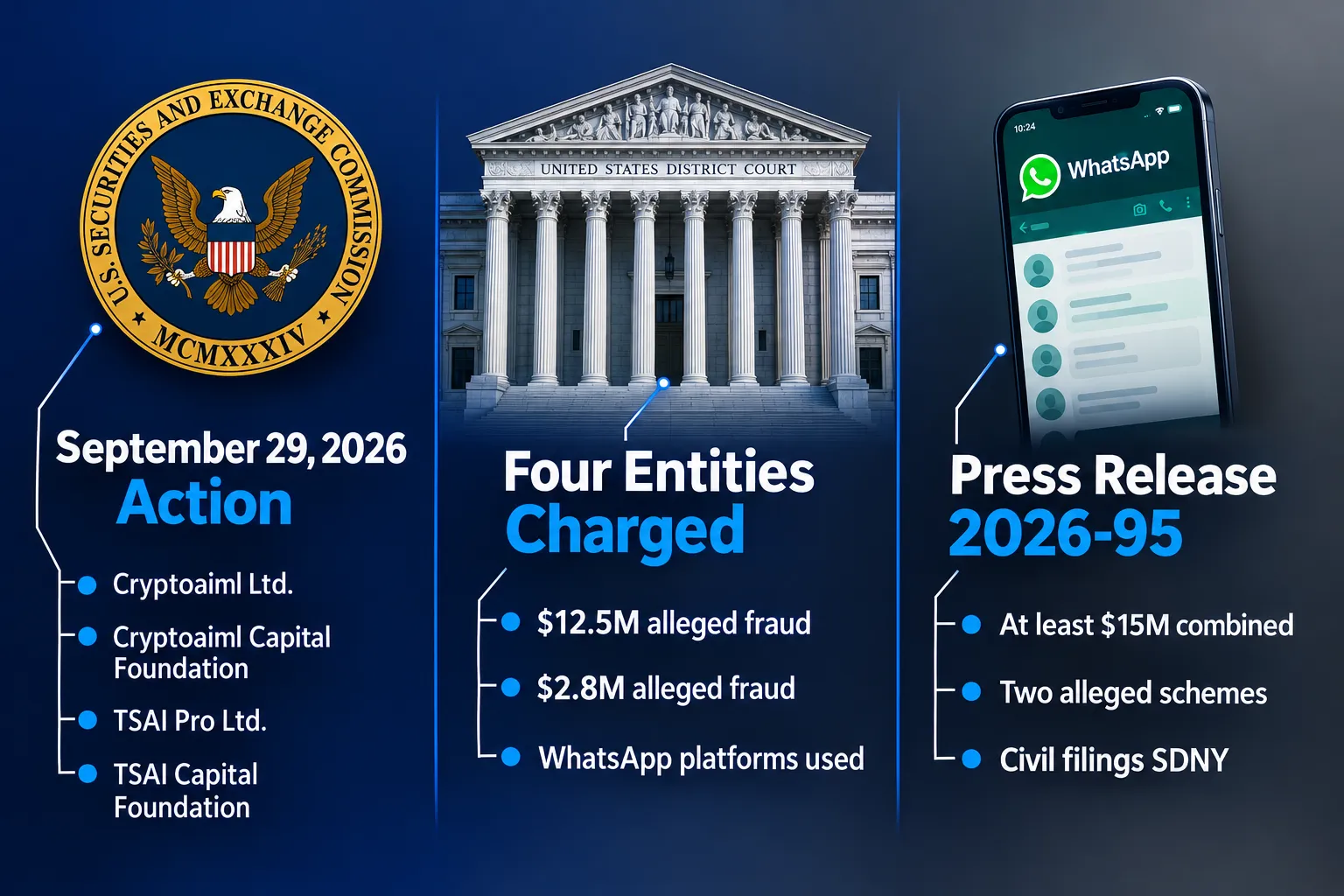
Regulators are not coming for automated trading. They are coming for the marketing. The latest ai stock trading bots news: sec and cftc warnings boils down to two filings weeks apart: on September 29, 2026, the SEC charged four entities over AI-trading schemes it says took at least $15 million from hundreds of retail investors, and on September 17, 2026, the CFTC’s Market Participants Division issued a conditional no-action position for providers of passive trading software.
Read those together and the message is simple. Software that routes your orders to a registered broker is a tool. A “rented AI bot” promoted in a WhatsApp group with screenshots of profits is usually a story, and sometimes a crime.
This is education, not financial advice.
Key Takeaways
- The SEC’s September 29, 2026 action targeted two pairs of entities. Cryptoaiml Ltd. and Cryptoaiml Capital Foundation allegedly took more than $12.5 million; TSAI Pro Ltd. and TSAI Capital Foundation allegedly took more than $2.8 million. Both cases were filed in the U.S. District Court for the Southern District of New York.
- The SEC alleges the TSAI bots did not exist at all. Investors were told they could rent AI bots trading stocks, futures, foreign exchange and crypto from September 2024 through March 2025.
- Both schemes allegedly faked SEC authorization using falsified Forms D or certificates. The SEC said the relevant Forms D were later removed from its site.
- The CFTC’s position is technology neutral. Its standing advisory says plainly that AI cannot predict the future or sudden market changes, and its September 2026 no-action relief for passive software does not bless deceptive performance claims.
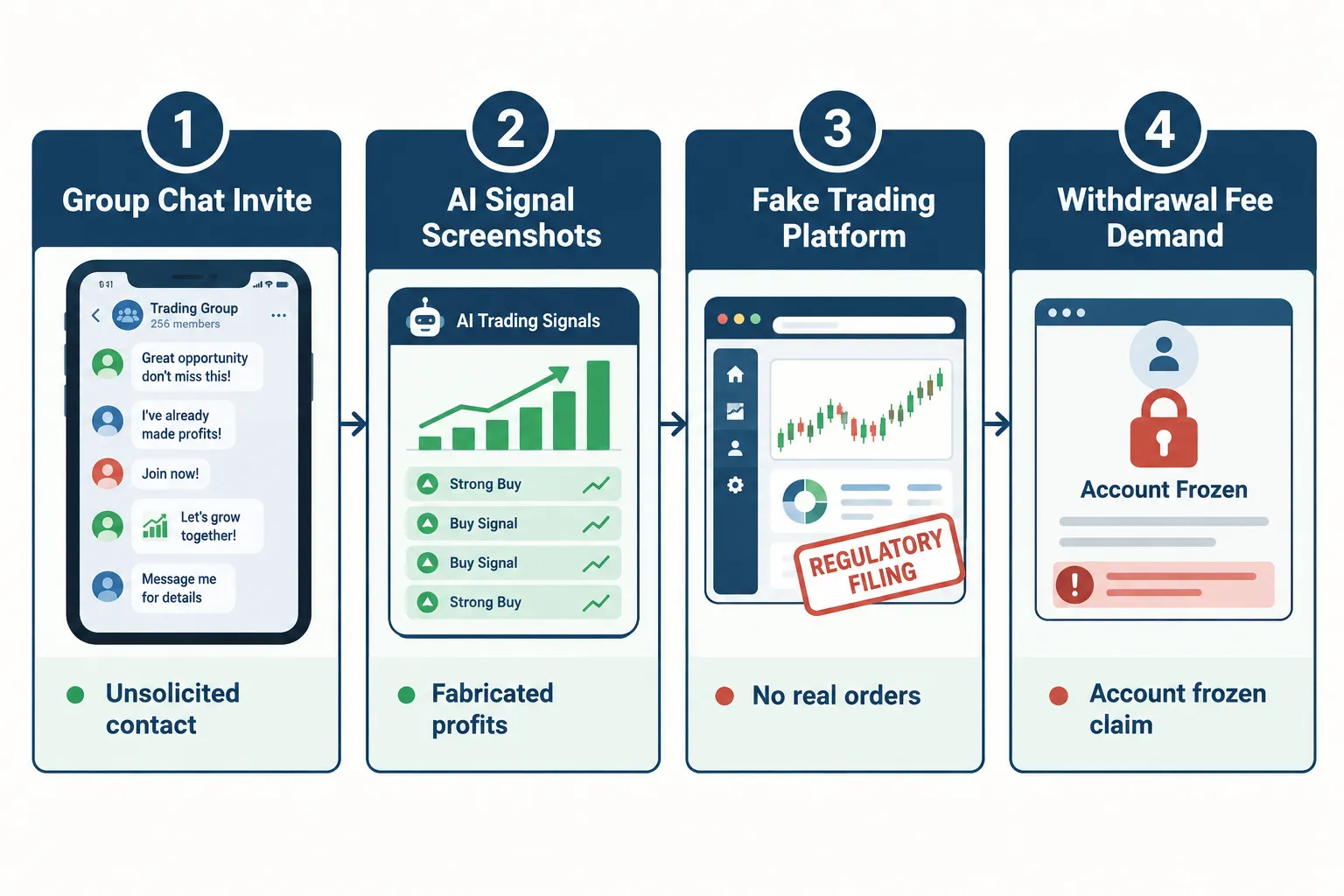
- The pattern to memorize: group chat, AI signals, fake platform, withdrawal fee. That four-step sequence appears in the SEC’s December 2025 investor alert and in these 2026 complaints.
AI Stock Trading Bots News: SEC and CFTC Warnings, What Actually Happened?
Start with the SEC’s own press release from September 29, 2026, checked October 2026. Four entities, two alleged schemes, at least $15 million combined, hundreds of retail investors, and WhatsApp as the primary funnel.
The Cryptoaiml entities allegedly showed investors fabricated profits generated by fictitious AI signals on a trading platform that was not connected to any real market. When investors tried to withdraw, the SEC says they were told to pay advance fees first, or that their accounts had been frozen.
The TSAI entities ran a different flavor of the same play. According to the SEC litigation release, TSAI promoted a program through websites, Facebook and WhatsApp between September 2024 and March 2025 that let investors “rent” AI bots trading equities, futures, foreign exchange and crypto. The SEC alleges no bots existed and the deposits were never used to trade anything.
The fraud was never the algorithm. The fraud was the account statement.
Both alleged schemes went a step further and borrowed the regulator’s own credibility. The SEC says they displayed falsified Forms D or certificates to look authorized, and that the relevant Forms D were pulled from the agency’s website. A Form D is a short notice filing for an exempt private offering. It is a receipt that a company filed paperwork, not a government seal of approval, and nobody at the SEC reviews it for quality.
If you have ever opened a pitch deck with a Form D screenshot pasted on slide two, you now know exactly what that proves. Almost nothing.
Why Does the CFTC Say AI Trading Bots Cannot Predict the Market?
The CFTC has been blunt on this since January 2024, and that advisory on AI trading bots is still the agency’s core guidance as of October 2026. The core line: AI cannot predict the future, and it cannot predict sudden market changes. Any pitch built on reliable, unusually high returns is a pitch to walk away from.
The agency’s own case study is the scale warning. The CFTC says Cornelius Johannes Steynberg’s Mirror Trading International scheme took more than $1.7 billion in bitcoin from at least 23,000 people, marketed a proprietary bot promising at least 10% monthly returns, and in reality involved little genuine trading. Run the math on 10% a month compounded and you get a number that has never existed as a durable strategy anywhere, for anyone.
That is the tell. Not the technology. The arithmetic.
The CFTC has also widened its lens from strategy claims to manufactured credibility. Its advisory on AI-enabled fraud notes that criminals can now generate convincing images, voices, live video calls, social profiles, translations, chatbots and entire websites that look like legitimate trading platforms. The due diligence habits that worked in 2015, checking that a site looks professional and that a founder appears on video, are no longer evidence of anything.
Commissioner Kristin N. Johnson framed the enforcement logic in 2025 remarks: the Commodity Exchange Act prohibits fraud and manipulation regardless of whether the wrapper is crypto, AI, or ordinary software. Swap the buzzword, keep the statute.
What Did the CFTC’s September 17, 2026 No-Action Position Actually Change?
This is the part that got buried under the fraud headlines, and it matters more to anyone actually building or using automation.
On September 17, 2026, the CFTC’s Market Participants Division adopted a no-action position for providers of passive software that helps users trade with registered futures commission merchants, introducing brokers and designated contract markets. You can read CFTC Release 9300-26 directly, checked October 2026.
Translated: if your software sits on top of a regulated intermediary and the user makes the decisions, the division has said it will not recommend enforcement action for failing to register as a particular intermediary, subject to conditions.
Three things that relief does not do:
- It does not bless deceptive performance claims. Lying about returns is still fraud.
- It does not exempt active, regulated intermediaries from the rules that already apply to them.
- It is not a license, a registration, or an endorsement. No-action relief is conditional and can be withdrawn.
Passive plumbing gets breathing room. Promises get prosecuted.
So the regulatory direction is actually coherent. Build a tool, connect it to a real broker, be honest about what it does, and the door is open. Sell a dream with a dashboard and you are on the other list.
How Do the SEC and CFTC Warnings Compare?
Two agencies, two mandates, one overlapping problem. Here is the split, based on their published materials as of October 2026.
| SEC | CFTC | |
|---|---|---|
| What it covers | Securities: stocks, ETFs, equity options, investment contracts | Derivatives: futures, options on futures, swaps, retail forex, certain commodity fraud |
| Headline 2026 action | Charges against four entities on Sept 29, 2026 over schemes totaling at least $15M | Conditional no-action position for passive trading software, Sept 17, 2026 |
| Primary fraud pattern flagged | Fake AI signals, fabricated profit dashboards, falsified Forms D, withdrawal fees | Bots promising guaranteed or unusually high returns, AI-generated fake platforms and personas |
| Core stated message | Distinguish real automation from fraudulent promotion | AI cannot predict the future or sudden market changes |
| Where to check claims | Investor.gov and EDGAR | CFTC registration and advisory pages |
| Impersonation warning | Yes, October 2026 investor materials warn of fraudsters posing as SEC, FINRA, CFTC or professionals | Yes, via AI fraud advisory on synthetic identities |
Note the asymmetry. The SEC’s recent output is mostly enforcement and investor alerts. The CFTC’s recent output is enforcement posture plus an operational carve-out for honest software vendors. Neither is anti-automation. Both are anti-fiction.
How Should Retail Traders React to the AI Stock Trading Bots News: SEC and CFTC Warnings?
Most traders read a story like this, feel briefly superior, and then subscribe to something sketchy four weeks later because the chart on the landing page was pretty. The fix is a checklist you run before money moves, not vibes.
Here is the sorting test, built from what the SEC and CFTC actually describe in their own alerts.
| Check | Looks legitimate | Looks like the complaints |
|---|---|---|
| Where you found it | You searched for it, or found it in an editorial review | A stranger added you to a group chat |
| Broker connection | Connects to a named, registered broker or FCM via API; your money stays in your account | Deposit funds to the platform’s own wallet or account |
| Performance proof | Live, dated, third-party verified or exchange-reported results, with drawdowns shown | Screenshots of profits, no drawdown, no losing months |
| Credential claims | Registration status you can verify yourself on a regulator site | A Form D image or a “certificate” of approval |
| Withdrawals | You withdraw from your own brokerage account, normal settlement | A fee, a tax, or a deposit required before release |
| What it promises | A process, a scan, an execution rule | A monthly return number |
The Investor.gov material is explicit that the warning applies to false claims, undisclosed risks, fabricated results, fake credentials, misappropriation and unregistered offerings. A bot connected to a regulated broker can be an ordinary software tool. The SEC’s alert on investment scam gateways is worth ten minutes of your evening.
If you want the longer version of the vetting process, we keep a running breakdown of which AI trading bots are legit versus scams and a primer on what to know before you automate trades.
One more habit worth adopting: paper trade it first. Not for a weekend. For a month, through a choppy tape and at least one earnings season, so you see how the system behaves when price action stops cooperating. If the vendor discourages that, the vendor is the red flag.
What Should Investors Watch Next?
Dated, verifiable items only.
- Court docket activity in the Southern District of New York. The SEC’s September 29, 2026 complaints against the Cryptoaiml and TSAI entities are civil filings. Watch for answers, default judgments, asset freezes and any receivership appointments. Allegations are allegations until a court rules.
- Conditions attached to the CFTC’s September 17, 2026 no-action position. Relief that is conditional invites follow-up staff letters and interpretive questions from software vendors. Those land on cftc.gov, not in your feed.
- Whether the SEC updates or reissues its investor alert from December 2025. That alert laid out the group-chat-to-withdrawal-fee pattern. Refreshed versions usually track new tactics.
- Impersonation warnings. The SEC’s October 2026 investor materials for World Investor Week flagged fraudsters posing as the SEC, FINRA, CFTC or investment professionals, including false claims that an account is frozen pending payment. Expect more of that language, not less.
- Form D removals. The SEC said the falsified filings tied to these entities were taken off its site. Treat any marketing screenshot of a filing as unverified until you search EDGAR yourself.
Our Take
The headline most people will take from this ai stock trading bots news cycle is “regulators are cracking down on AI trading.” That is lazy, and it is wrong.
Look at what actually happened in the same month. One agency sued people for selling bots that allegedly did not exist. The other agency made life easier for software companies whose products genuinely do. That is not a crackdown on automation. That is a crackdown on lying, and the quiet legitimization of boring, honest tooling.
Which means the burden shifts to you. The regulators have told you the pattern in plain English, twice, with numbers attached: $15 million across four entities in one filing day, $1.7 billion in the Mirror Trading case. Falling for the same four-step sequence after reading the alert is not bad luck. Play stupid games.
The rule we would write on the wall: never let software hold your money, and never pay a fee to access your own funds. Automation should touch your orders, not your custody. If the product requires a deposit into its own account, you are not buying a trading tool, you are making an unsecured loan to a stranger with a landing page.
And if a bot’s pitch leads with a return number instead of a described edge, entry and exit logic, position sizing and a stop loss, you already have your answer. Process over prediction.
Paying for a bot you are not sure about, or built one yourself? Send it over. We check every submission against broker connectivity, performance claims and registration status before it gets a word of coverage, and we have reviewed 200+ AI stock tools since 2022. Submit your bot: https://aistocktradingbots.com/contact/?topic=submit-bot
Frequently Asked Questions
Are AI trading bots illegal in the United States? No. Automated trading software is legal, and the CFTC’s September 17, 2026 no-action position actually created conditional breathing room for passive software that routes orders to registered intermediaries. What is illegal is fraud: fake results, fake credentials, misappropriated funds, and unregistered securities offerings.
Does a Form D filing mean the SEC approved a bot? No. A Form D is a notice filing for an exempt offering. Nobody at the SEC reviews or endorses it. In the September 29, 2026 cases, the agency alleges the entities displayed falsified Forms D or certificates to look regulated, and said the relevant filings were removed from its site.
What is the single most common AI bot scam pattern right now? Group chat, AI signals, fake platform, withdrawal fee. The SEC’s December 2025 alert describes unsolicited WhatsApp or similar group chats promoting AI algorithms, screenshots of purported profits, then demands for taxes, fees or extra deposits before any withdrawal is allowed.
Can any AI model reliably predict stock or futures prices? The CFTC’s standing advisory says plainly that AI cannot predict the future or sudden market changes, and it rejects claims of guaranteed or unusually high returns from bots. Pattern recognition and faster screening are real capabilities. Prophecy is not. Our walkthrough of whether AI trading bots actually make money covers the math.
How do I verify a bot provider before paying? Check registration status on regulator sites rather than on the vendor’s own page. Confirm the bot connects to a named, registered broker through an API while your funds stay in your brokerage account. Ask for dated live results including losing periods. Then paper trade it. Reviewing user feedback across multiple sources helps too, especially where solicited reviews and unsolicited forum threads disagree.
Does this news affect bots that only use broker APIs like Alpaca or IBKR? Not directly. Those are execution venues with their own registration and disclosure obligations, and software that passively connects to them is the exact category the CFTC addressed on September 17, 2026. Your own setup still deserves scrutiny: review the settings worth changing before your first automated trade and keep sizing small until the system has a track record you watched build in real time.
Conclusion
Two regulator filings, seventeen days apart, drew a line most retail traders have been squinting at for three years. Honest automation connected to a real broker is a software product. A rented AI bot promoted in a group chat with profit screenshots and a withdrawal fee is, per the SEC’s allegations, a $15 million lie.
Three things to do this week:
- Audit your tools. For every paid bot or signal service you run, write down where your money sits, which broker executes the orders, and what verified evidence exists for its results. Any blank in that list is a position to reduce.
- Bookmark the primary sources. Investor.gov for securities alerts, cftc.gov for derivatives advisories. Check them before you buy, not after you lose.
- Run one rule for 30 days. No deposits into non-broker platforms. No fees paid to access your own funds. Boring, and it eliminates the entire category of fraud described above.
The tools keep getting better. The pitches keep getting better too. Cut the noise, keep the alpha.
Stay alpha.
Meta Title: AI Stock Trading Bots News: SEC and CFTC Warnings 2026
Meta Description: The SEC charged four entities over $15M in alleged AI bot fraud and the CFTC cleared passive trading software. What both 2026 rulings mean for retail traders.
Tags: ai trading bots, sec enforcement, cftc warnings, trading bot scams, automated trading, retail investor protection, investor alerts, ai stock tools, futures regulation, whatsapp investment fraud, form d, trading bot due diligence
#aitrading #tradingbots #secwarnings #cftc #investorprotection #fullstackalpha
Contributing writer at AI Stock Trading Bots.
