

Robinhood Agents Can Now Trade Your Money While You Sleep: AI Stock Trading Bots News: Broker AI Agent Launches
Robinhood announced Robinhood Agents on September 29, 2026, at its HOOD Summit in Houston, and the headline detail buried in the fine print is this: you can turn off trade approvals entirely and let an AI place orders while you’re asleep. Five days earlier, on September 24, 2026, Public launched AI Agents wired to prediction market probabilities. That’s the real story in this round of ai stock trading bots news: broker ai agent launches have moved from developer APIs to the consumer app, and the guardrails are now optional settings rather than hard limits.
Two brokers, one week, same bet: retail traders want automation badly enough to hand over the execute button. Whether that’s a feature or a liability depends entirely on whether you’ve ever written down a risk rule.
Key Takeaways
- Robinhood Agents launched September 29, 2026, letting users build an AI agent inside the app that researches, analyzes a portfolio, builds strategies, and executes trades through a dedicated agentic account.
- Robinhood’s earlier third-party agent program, live since May 2026, had passed 150,000 customers and roughly 30 million tool calls per day as of September 29.
- The Loops feature turns a strategy into a standing instruction, and Robinhood openly warns it may place, modify, or cancel trades while you’re away from the app.
- Public launched AI Agents for prediction markets on September 24, 2026, partnered with Kalshi, a CFTC-regulated exchange, so probability thresholds can trigger stock, bond, or options orders.
- Manual trade approval is a setting, not a requirement. Switch it off and the agent trades unsupervised. That choice is where the risk actually lives.
What exactly did Robinhood launch on September 29, 2026?
Robinhood Agents is an AI agent you create inside the Robinhood app. Per Robinhood’s HOOD Summit 2026 newsroom post, checked October 2026, the agent can research markets, analyze your portfolio, develop strategies, and execute trades. It runs through a dedicated agentic account and can use models from providers including OpenAI.
The difference from May 2026 matters. The earlier version required you to connect an external agent through Robinhood’s Trading Model Context Protocol, which meant you needed some technical comfort. This one is built into the consumer app. No code, no API key, no terminal.
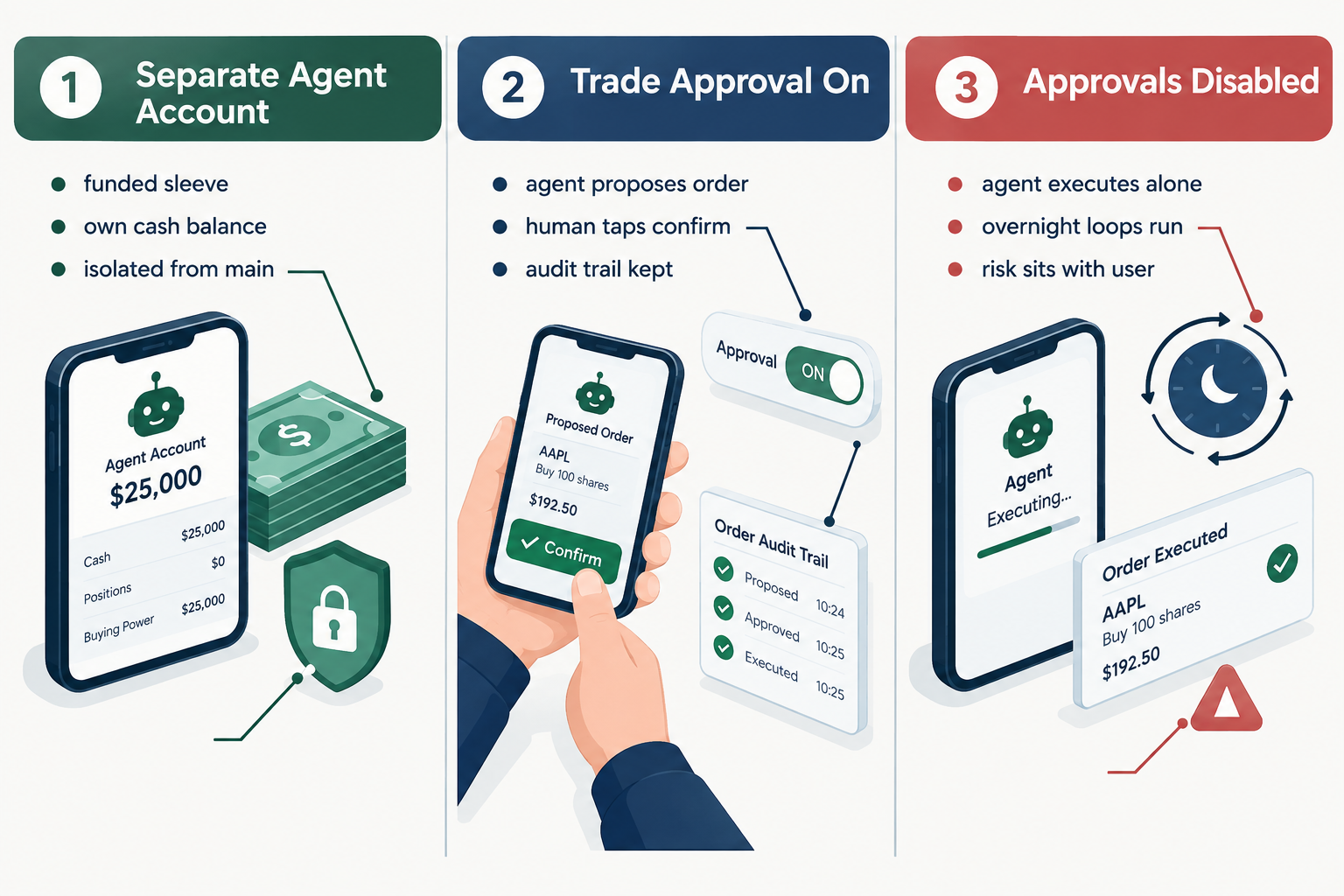
That earlier program wasn’t small. Robinhood said it had reached more than 150,000 customers, with agents hitting Robinhood tools roughly 30 million times per day by September 29. Call it a successful beta that just got a front door.
The shift isn’t technological, it’s distributional. Agentic trading went from something a Python-literate minority configured to something anyone with the app can switch on.
Loops: the part that should make you sit up
Loops turns a one-time strategy into a standing instruction. Check the market every morning. Run this strategy overnight. Robinhood’s own language says Loops may place, modify, or cancel trades while the customer is asleep or away from the app.
Read that again. The company is telling you, in writing, that orders can hit your account at 3 a.m. while you’re unconscious. That’s not a scandal, it’s a disclosure, and it’s more honest than most tool vendors manage.
Agent Apps: paid data feeds for your bot
Robinhood also announced Agent Apps, which hand agents premium market data and specialized tools. Launch partners include Unusual Whales, Nasdaq Investor Intelligence, SpotGamma, Quiver Quantitative, Token Terminal, Visual Crossing, and Narravance. Monthly costs range from the single digits to thirty dollars, and Robinhood said each app includes a one-month free trial.
The logic is sound: an agent with better inputs makes better-informed decisions. The trap is equally obvious. Stacking seven data subscriptions onto an agent you haven’t stress-tested is tool overload with an automation layer on top.
How do the new broker AI agent launches compare?
Different brokers, different philosophies. Here’s where the two September launches and the existing API-first options actually land.
| Broker / Platform | Launch or status | Who it’s built for | Execution model | Key guardrail |
|---|---|---|---|---|
| Robinhood Agents | Sept 29, 2026 | Nontechnical retail users | In-app agent, dedicated agentic account | Configurable limits, optional per-trade approval |
| Robinhood MCP (third party) | May 2026 | Semi-technical users | External agent connects via Model Context Protocol | Same account separation, external agent’s own controls |
| Public AI Agents | Sept 24, 2026 | Event-driven and probability traders | Prediction-market probability triggers portfolio orders | Position limits set per rule |
| Alpaca API | Established | Developers | Code-first REST and streaming API | Paper environment, your own code’s limits |
| Interactive Brokers TWS API | Established | Advanced and semi-pro | Local gateway, code-first | Paper account, account-level risk settings |
If you want to automate without writing code, the two September launches are the news. If you want control over every line of logic, the broker with API route still gives you more rope, for better and worse.
What did Public actually ship with prediction market agents?
Public launched AI Agents for prediction markets on September 24, 2026, per its PR Newswire announcement, checked October 2026. Members can trade event contracts directly or use prediction-market probabilities as signals for stock, bond, options, or other portfolio trades.
The examples Public gave are specific, which is rare and welcome. Automatically buy $5,000 of a healthcare stock if the probability of FDA approval goes above 75%. Buy protective puts with a $2,500 position limit if an earnings-miss probability climbs past 60%. Alert the user when rate-cut probabilities move materially.
Public partnered with Kalshi, described in the announcement as a CFTC-regulated financial exchange. Categories span crypto, commodities, climate, economics, corporate events, indices, technology, science, politics, and elections.
This is a genuinely different idea from “AI picks stocks.” It’s a conditional order engine where the condition is a crowd-sourced probability instead of a price level. If you already trade catalysts, that’s a familiar logic. If you don’t, it’s a new way to be wrong fast.
Do broker AI agents actually make money?
Nobody has a long enough track record to answer that honestly, and anyone who tells you otherwise is selling something. The closest thing to a live, funded test comes from Condor Capital Wealth Management, which ran Claude, Gemini, and ChatGPT on funded accounts at Robinhood, Public, and Webull with orders routed to live markets as part of its Digital Advice Report alongside the 17th edition of its Robo Ranking.
Over Condor’s three-day test, per Dow Jones coverage dated October 2, 2026, Claude returned 2.9%, Gemini 0.9%, and ChatGPT lost 0.7%. All three got the same instruction: maximize returns using stocks and ETFs, then go back to 100% cash by the end of each trading day.
Three days is not a sample. It’s a weather report. A 2.9% three-day result tells you almost nothing about edge and quite a lot about variance, and the spread between the best and worst agent on identical instructions is the actual finding here. Same prompt, same market, three different outcomes.
What a reader should do with this: treat it as proof that agents execute, not proof that they profit. If you want the longer argument on that gap, we laid it out in do AI trading bots work.
What are the real risks in this round of broker AI agent launches?
The risk isn’t that the AI is dumb. It’s that the controls are defaults you can switch off, and most people switch off friction.
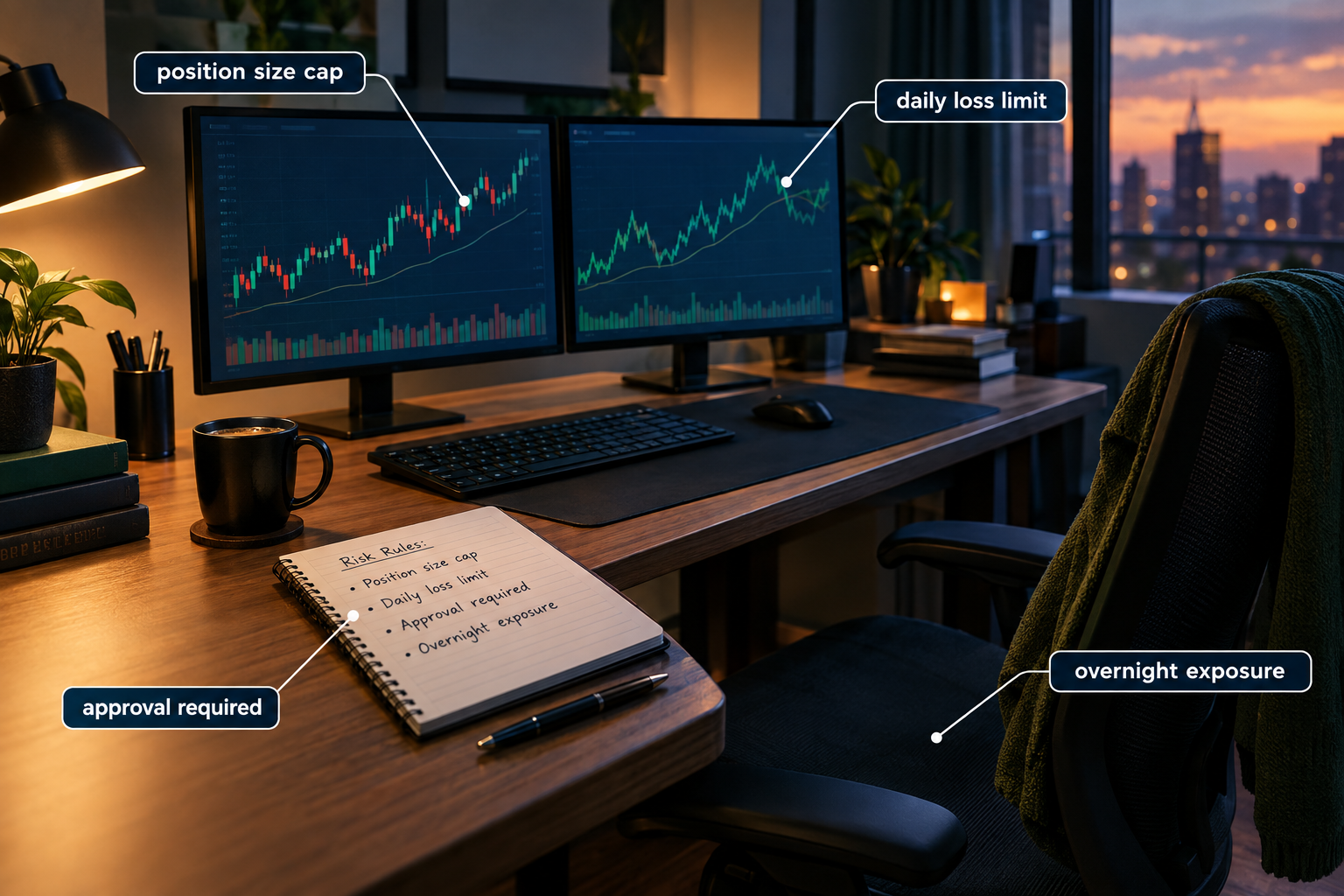
Robinhood’s stated guardrails are a separate dedicated account, configurable trading limits, and a setting that requires manual approval before every trade. Users can disable approvals, at which point agents execute orders without confirmation. That’s three layers of protection where one is a toggle and the other two are numbers you choose.
Here’s the practical problem list:
- Overnight exposure. Loops can act while you sleep. Gaps, halts, and thin overnight liquidity don’t negotiate.
- Approval fatigue. Confirm thirty trades and you’ll switch approvals off by day three. That’s human nature, not a character flaw.
- Data stacking. Seven Agent Apps feeding one agent is more inputs, not more clarity. Analysis paralysis with a credit card attached.
- Accountability. Your account, your orders, your losses. An agent acting on your instruction is still you acting.
- Leverage on top. Robinhood also announced up to 4x intraday buying power for eligible customers, plus perpetual futures and expanded options hours. Automation plus leverage compounds mistakes faster than it compounds anything else.
FINRA’s investor guidance on margin is worth reading before you let anything automated touch borrowed money, checked October 2026. Margin losses can exceed your deposit. An agent doesn’t feel that, you do.
Play stupid games. Unsupervised automation on margin, overnight, with no position sizing rule written down is the stupid game in this story.
What should investors watch next?
Concrete, dated things on the calendar:
- Robinhood 24/7 trading rollout. Robinhood announced plans for round-the-clock trading in a selected group of U.S. stocks and ETFs, including weekends, subject to regulatory review. Watch for exchange and regulator filings, and for which tickers make the list.
- Agent Apps free trials expiring. Launch partners include a one-month free trial, which means the first real billing cycle for September signups lands in late October 2026. Watch retention, not signups.
- Perpetual futures and earnings contracts. Both were announced at the Summit. Product availability dates and any CFTC commentary are the things to track.
- SEC and FINRA posture on agentic execution. No action has been announced tied to these launches. Check SEC.gov and FINRA newsrooms for guidance on supervision of AI-directed retail orders.
- Condor’s next Digital Advice Report. A three-day test is a teaser. A longer run with the same methodology would be the first thing resembling data.
For ongoing coverage of launches and outages that hit automated traders, our AI trading news desk tracks these as they break.
Our Take
The infrastructure arrived before the discipline did, and that’s the whole problem.
Robinhood deserves credit for one thing most vendors avoid: it documented that Loops may trade while you’re asleep. That’s a disclosure, not marketing. Public deserves credit for publishing concrete rule examples with dollar limits attached instead of vague promises about intelligence.
What neither can give you is a process. An agent is an execution layer. It does what you tell it, faster and more consistently than you would, including the parts you got wrong. A bad strategy automated is just a bad strategy that never takes a day off.
The position: leave manual trade approval ON for at least 30 days, in a dedicated account, with a position size you’d be fine losing entirely. Not because the AI is untrustworthy. Because you don’t yet know what your own instructions produce in live markets, and the only way to learn that is to watch every order before it fills. Discipline beats prediction. That applies to the agent too.
Also, run it on paper first if your broker offers it. Simulated fills lie about slippage, so treat paper results as a logic check, not a profit forecast. We covered where simulators break down in paper trading proves nothing until slippage shows up.
This is education, not financial advice. Nobody here is telling you what to buy.
Running an agent at Robinhood or Public? We want the receipts, not the hype. Every submission gets checked against broker docs and primary sources before it gets covered. Send us your setup: https://aistocktradingbots.com/contact/?topic=submit-bot
Frequently Asked Questions
Can a Robinhood agent trade without my approval? Yes, if you turn approvals off. Robinhood’s stated guardrails include a setting that requires manual approval before every trade, and users can disable it. With approvals disabled, agents can execute orders without confirmation.
Does Robinhood Agents require coding skills? No. The May 2026 version required connecting an external agent through Robinhood’s Trading Model Context Protocol. The product announced September 29, 2026, is built directly into the consumer app for nontechnical users.
What does Public’s prediction market agent actually trigger? Portfolio orders based on probability thresholds. Public’s published examples include buying $5,000 of a healthcare stock if FDA approval probability exceeds 75%, or buying protective puts with a $2,500 position limit if earnings-miss probability passes 60%.
Are these agents regulated differently from normal trading? The orders route through regulated brokers and exchanges, and Public’s prediction market partner Kalshi is described as CFTC-regulated. No SEC, CFTC, or FINRA action specific to these launches had been announced as of October 2026. Supervision expectations for AI-directed retail orders are still an open question.
How did AI agents perform in live broker tests? In Condor Capital Wealth Management’s three-day funded test, Claude returned 2.9%, Gemini 0.9%, and ChatGPT lost 0.7% on identical instructions. Three days is far too short to establish anything about edge.
Can I test an AI agent without risking real money? Depends on the broker. Several platforms offer simulated environments, and Interactive Brokers paper trading is one of the more usable ones for bot testing. Simulated fills tend to flatter your results.
Conclusion
Two consumer-facing broker AI agent launches in six days, 150,000 customers already on the earlier version, and 30 million daily tool calls. The adoption curve is real. The track record isn’t there yet, and a three-day test with a 3.6-point spread between the best and worst agent is a reminder that execution speed and edge are different animals.
Your next three steps, in order:
- Open the dedicated agent account and fund it small. An amount you’d shrug at losing, not an amount that changes your month.
- Write your rules before you write your prompt. Max position size, daily loss limit, which instruments are off limits. One page, in your own words.
- Keep manual approval on for 30 days and log every order. Then compare what the agent proposed against what you’d have done. That log is your actual data.
Fewer tabs, tighter rules, one process you can repeat. Cut the noise, keep the alpha.
Stay alpha.
Meta Title: Robinhood Agents Launch: AI Trading Bots News 2026
Meta Description: Robinhood Agents and Public AI Agents launched days apart in September 2026. What the new broker AI agent launches do, the guardrails, and the real risks.
Tags: robinhood agents, ai trading bots, broker ai agents, public ai agents, prediction markets, kalshi, agentic trading, automated trading risk, broker api, ai trading news, trading bot guardrails, retail trading automation
Contributing writer at AI Stock Trading Bots.
