

The FullStack Alpha research desk tests AI trading bots on paper and live accounts. Reviewed and edited by Jay Rocco, Founder and Editor.
October 23, 2026, 7:55 a.m. ET | By FullStack Alpha Editorial Team | Reviewed by Jay Rocco, Chief Editor
Interactive Brokers made it official on October 21, 2026. A connected AI assistant can now research more than 75,000 stocks, options and ETFs, then send live orders inside a walled-off sub-account called an AI Partition, with no per-order approval from you.
The catch is the allowance. Per IBKR’s launch terms as reported by FinanceFeeds, the partition tops out at $25,000 across your whole relationship with the firm. One of the most product-dense retail brokers in the world just handed the robot a debit card and locked the rest of the vault.
Quick answer
IBKR Autonomous Trading lets eligible clients authorize ChatGPT, Claude, Grok, Perplexity or another MCP-connected AI to place supported orders without approving each one. The agent only trades inside a cash-funded AI Partition: $1,000 minimum, up to 10% of account equity, $25,000 maximum across all partitions. You must first complete 10 supervised trades of $100 or more over two weeks.
Key facts
- Launch date: October 21, 2026, press release from Greenwich, Connecticut. It follows the limited rollout to about 3,000 invited clients that IBKR described on its October 15 earnings call, which we covered on October 16.
- What changed: IBKR’s AI Integration used to draft orders for you to approve. Now the agent can submit them when your stated conditions are met.
- Funding limits: $1,000 minimum, 10% of account equity, $25,000 hard ceiling. Cash moves in from the parent account only.
- Accounts: Eligible individual, non-margin accounts. Joint, retirement, advisor-managed, organizational and IBKR Lite accounts are excluded.
- Orders: Eligible stocks and equity options, market, limit, stop and stop-limit, Day only. No margin, shorting, fractional shares or penny stocks.
What exactly did Interactive Brokers launch on October 21, 2026?
Delegated execution. You connect an AI platform through Model Context Protocol (MCP), the open standard that lets a chatbot talk to an outside service. Think universal adapter: one plug, every assistant.
IBKR’s release names ChatGPT, Claude, Grok and Perplexity as examples of connected platforms, and the firm’s documentation lists Gemini as coming. You set instructions in plain English. The agent watches the market and fires orders when your conditions hit.
The release gives its own examples: flag names whose 30-day implied volatility moved past a set amount, trim any position above 10% of the portfolio back to 8%, or sell covered calls when implied volatility reaches a set percentile.
CEO Milan Galik framed it as clients defining “their trading strategies and safeguards.” Translation: the broker built the cage first, then invited the agent in.
That is the opposite call from Schwab, which blocks outside AI agents that use client logins. IBKR chose containment over prohibition.
How does the capped AI Partition actually work?
You create a partition under your existing account and move cash into it from the parent account. That is the only door in. External deposits and position transfers are not supported.
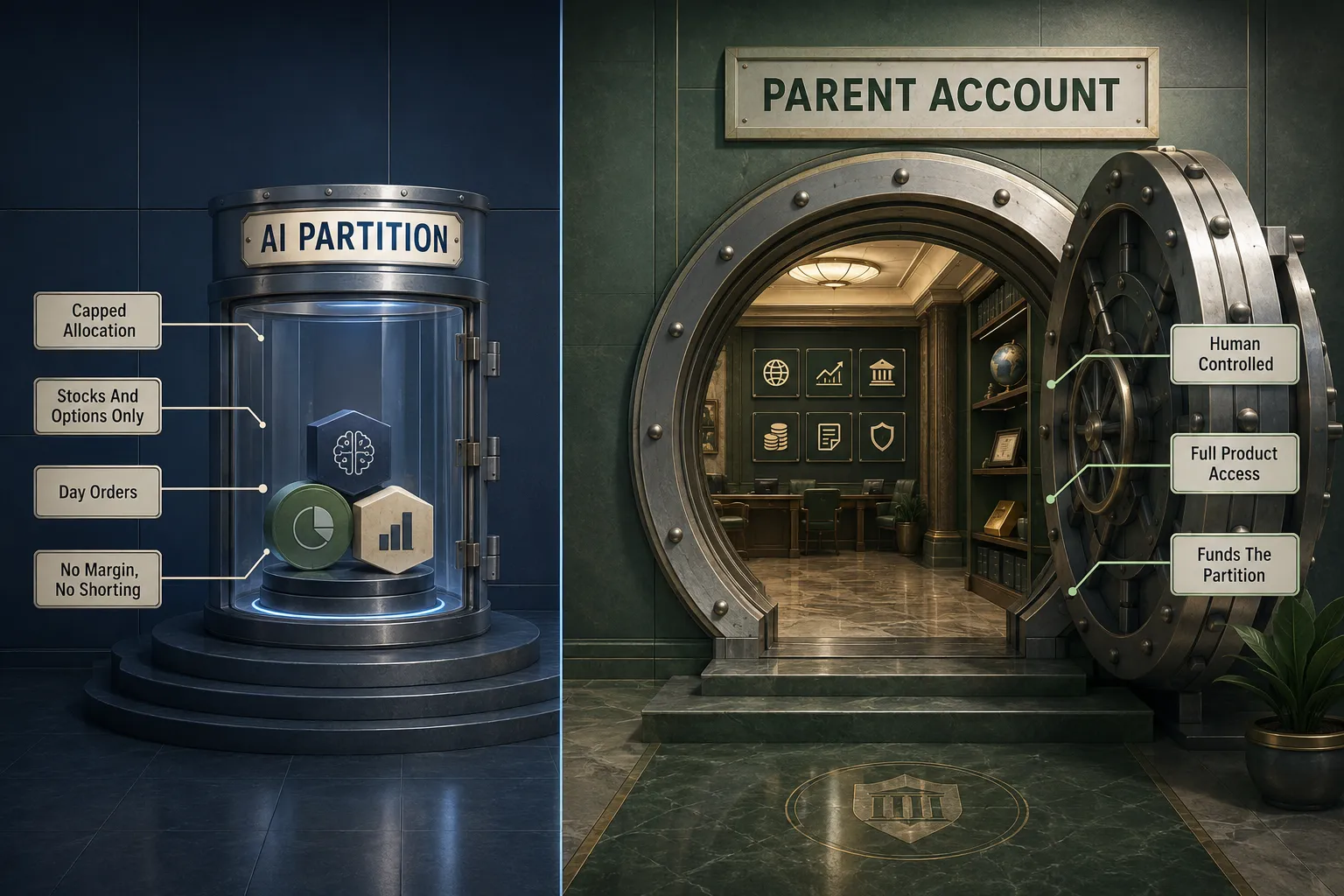
The limits stack, and the lowest one wins:
| Rule | Limit |
|---|---|
| Minimum lifetime funding | $1,000 |
| Maximum share of account equity | 10% |
| Hard ceiling across all AI Partitions | $25,000 |
| Account types at launch | Individual, non-margin |
| Funding from outside sources | Not permitted |
Run the math. A $50,000 account gives the agent $5,000. A $4 million account still gives it $25,000. No matter your account size, Autonomous Trading is a small-account experiment by design.
The partition is not a feature. It is a blast radius.
Who can use it, and what does the supervised trial require?
Eligibility is tight. Individual, non-margin accounts only. IBKR’s product pages list planned availability for eligible clients of IBKR LLC plus the U.K., Europe, Australia and Singapore, and the AI Integration is not offered in India or Japan.
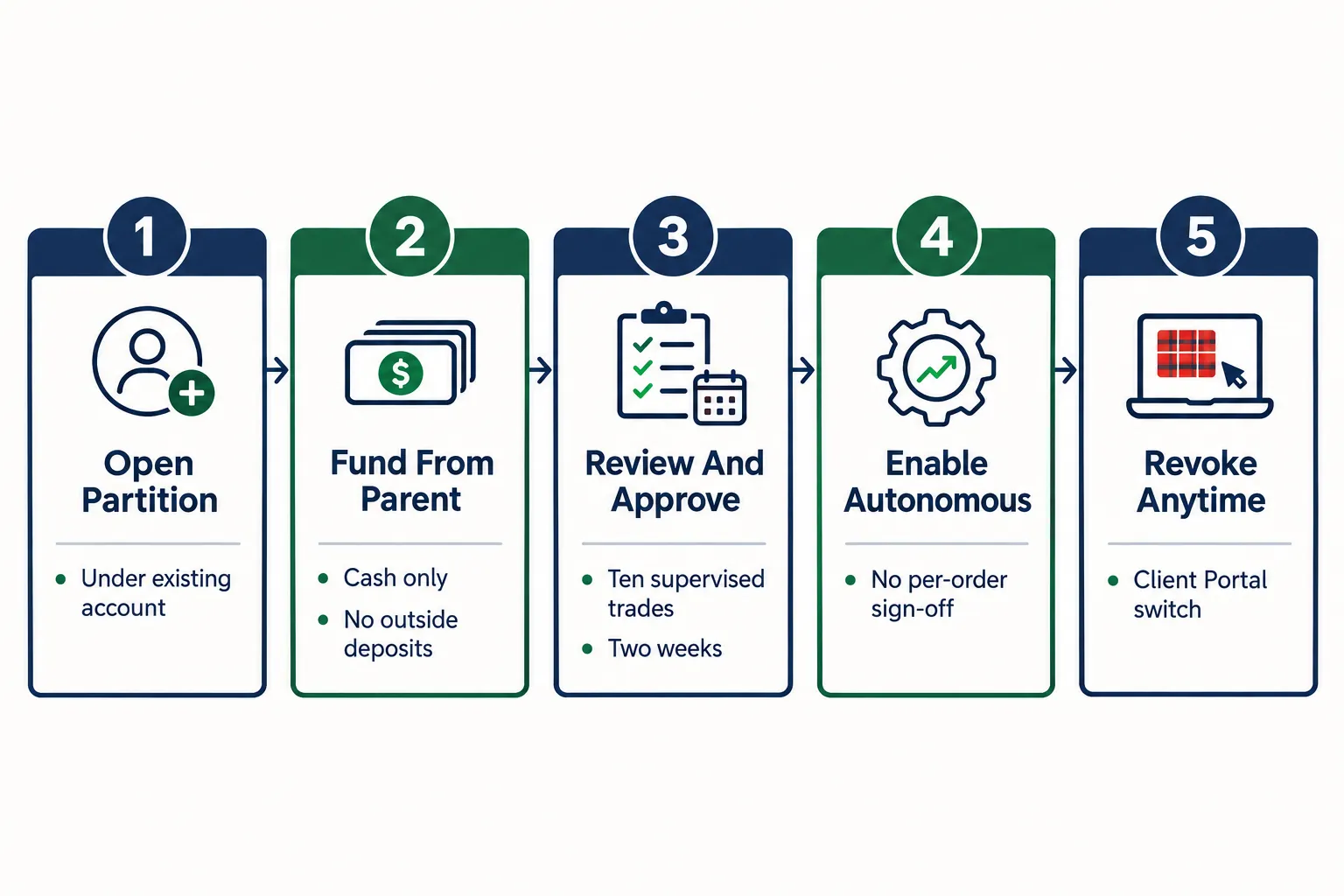
Before autonomous mode switches on, you must complete at least 10 AI-generated trades of $100 or more each, over two weeks, in Review and Approve mode. You approve every order by hand. IBKR says an eligibility test is planned as an alternative route.
Two weeks of watching the model work before you hand it the keys. That is not a bureaucratic hoop. It is the only free lesson in the product.
What can the AI trade, and what is off limits?
The 75,000+ figure describes what the agent can research and watch. What it can execute is a shorter list.
| Permitted | Excluded |
|---|---|
| Eligible stocks | Margin trading |
| Equity options | Short selling |
| Market, limit, stop, stop-limit orders | Fractional shares |
| Day time in force | Penny stocks and Canadian stocks |
Day orders only, so nothing sits overnight as a working order. No margin and no shorting means the partition can lose its balance but cannot run up a debt. You stay responsible for every fill, and you can revoke access in Client Portal at any time.
Does this change who is responsible for the trades?
No. FINRA’s 2026 oversight material says existing rules and securities laws apply when firms use generative AI. The order came from your account, so it is your order.
If the agent’s trade blows up, there is no “the robot did it” defense.
The CFTC is having the same conversation on the derivatives side at its Frontier Forum on AI trading agents on October 28.
How should a self-directed trader approach IBKR Autonomous Trading?
Treat it as a lab, not a wealth engine. It is a funded test of whether your written rules survive real fills, real spreads and real slippage.
- Paper first. Our guide to Interactive Brokers paper trading shows where the simulator stops matching reality.
- Write the rules before you connect anything. Entry, stop, position size, max trades per day. If you cannot write it in plain English, the model cannot follow it.
- Use the two-week trial as data. Log every order the agent proposed, including the ones you rejected.
- Fund the minimum. $1,000 exists for a reason. A brand-new agentic product does not deserve $25,000 in month one.
- Grade it on rules, not P&L. A winning trade that broke your rules is still a failed trade.
If your agent came out of a backtest, read our breakdown of paper trading slippage before you trust the numbers.
What should investors watch next?
- October 27, 2026: Robinhood reports Q3 results, the first numbers since its own agents launched. Expect the comparison.
- October 28, 2026: CFTC Frontier Forum on super intelligence and agentic trading.
- Coming months: IBKR’s promised eligibility test to replace the 10-trade trial, and Gemini support.
- Account expansion: If margin or retirement accounts get added, the risk profile changes completely.
- The $25,000 cap: The single most important number in the product. Watch whether it moves.
Our take
IBKR shipped the most conservative autonomous trading product any major broker has put in front of retail clients, and that is a compliment. The cash-only funding, the no-margin rule, the hard ceiling and the forced two-week trial all make the failure case survivable.
The danger is not the broker’s design. It is the trader who treats a chatbot as a strategy instead of an execution layer. A model with no rules will trade a choppy tape into the ground faster than you ever could by hand.
Your next step: write your entry, exit and sizing rules on one page, run them on paper for two weeks, then fund the $1,000 minimum and grade the agent on rule adherence for 90 days before adding a dollar. The agent does not give you an edge. Your written rules do.
Built a rule set that already runs inside an IBKR partition?
Every bot sent to us gets tested on paper before we write a word about it.
This article is for education only and is not financial advice. Trading involves risk, including loss of principal. Do your own research before using any automated tool.
Sources
- Interactive Brokers: Interactive Brokers Introduces Autonomous Trading (press release, Oct 21, 2026)
- FinanceFeeds: Interactive Brokers launches autonomous AI trading with $25,000 capital limit (Oct 22, 2026)
- FinanceFeeds: Interactive Brokers opens autonomous trading to connected AI platforms (Oct 22, 2026)
- The TRADE: Interactive Brokers rolls out autonomous AI trading (Oct 22, 2026)
- FX News Group: Interactive Brokers launches Autonomous Trading
- FINRA: Artificial Intelligence key topics
Your market edge starts with the right tool. Stay alpha.
Frequently Asked Questions
What is IBKR Autonomous Trading?
It is an Interactive Brokers feature launched October 21, 2026 that lets eligible clients authorize a connected AI platform to submit supported orders without approving each trade, inside a dedicated AI Partition of their account.
How much money can the AI trade at Interactive Brokers?
As reported at launch, an AI Partition needs at least $1,000, can hold up to 10% of account equity, and is capped at $25,000 across all partitions. Cash can only come from the parent IBKR account.
Which AI assistants work with IBKR Autonomous Trading?
IBKR names ChatGPT, Claude, Grok and Perplexity as examples of platforms connected through Model Context Protocol (MCP), with Gemini listed as coming.
Who is eligible for IBKR Autonomous Trading?
Eligible individual, non-margin accounts. Joint, retirement, advisor-managed, organizational and IBKR Lite accounts are excluded, and you must first complete 10 AI-generated trades of $100 or more over two weeks in Review and Approve mode.
Can the IBKR AI agent use margin or short stocks?
No. At launch it trades eligible stocks and equity options with market, limit, stop and stop-limit Day orders only. Margin, short selling, fractional shares and penny stocks are excluded.
Is this article financial advice?
No. This article is for education only. It explains a broker feature and does not recommend any trade, strategy or product. Do your own research and consider a licensed professional before trading.
The FullStack Alpha research desk tests AI trading bots on paper and live accounts. Reviewed and edited by Jay Rocco, Founder and Editor.
