

The FullStack Alpha research desk tests AI trading bots on paper and live accounts. Reviewed and edited by Jay Rocco, Founder and Editor.
By FullStack Alpha Editorial Team | Reviewed by Jay Rocco, Chief Editor
Are trading bots profitable? Some are, most aren’t, and almost none are as profitable as their backtest promised. The gap is caused by costs the backtest never charged, fills the backtest never missed, and a historical period the strategy was quietly fitted to. A study of 215 alternative-beta strategies by Suhonen, Lennkh and Perez found a median 73% deterioration in Sharpe ratio between backtest and live periods, and that’s professional money, not a $39-a-month retail bot. The single habit that closes most of the gap: load every cost into the test before you trust a single curve.
What You Should Know
- A study of 888 Quantopian algorithms with at least six months of out-of-sample results found backtest Sharpe ratio barely predicted live performance (R² below 0.025), and more backtesting made the gap worse. Wiecki et al., “All That Glitters Is Not Gold.”
- 215 alternative-beta strategies across five asset classes showed a median 73% Sharpe deterioration live versus backtest, with the most complex strategies falling more than 30 percentage points further than the simplest. Suhonen, Lennkh and Perez.
- The SEC’s Fiscal Year 2026 Examination Priorities names automated investment tools, AI, and trading algorithms as an exam focus, including whether firms’ claims about automated tools are fair and accurate.
- FINRA has flagged “trade execution agents,” AI systems that analyze conditions and execute trades with varying human oversight, as an emerging risk area.
- The CFTC announced on October 2, 2026 that its Innovation Task Force would hold its first Frontier Forum on October 28, 2026, focused on artificial intelligence and agentic finance.
Are Trading Bots Profitable or Do Backtests Just Make Them Look That Way?
Both things are true. Trading bots can be profitable, and backtests systematically flatter them. The honest position: are trading bots profitable in the way the marketing screenshot suggests? Almost never. Are they profitable at all? Sometimes, for a narrow set of strategies, run by people who treat the bot as a discipline tool rather than a money printer.
Here’s the mechanical reason. A backtest is a simulation where you already know what happened. Every price in it is settled history. Your bot never waited in a queue, never got a partial fill, never watched a broker’s API hang for nine seconds during a news spike. The backtest is the dress rehearsal with no audience, no stage fright, and a script you’ve already read.
The Quantopian research is the cleanest public evidence anyone has. Across 888 algorithms with real out-of-sample periods, the relationship between backtest Sharpe and live Sharpe was close to nothing. Worse, the researchers found that the more backtesting a developer did, the bigger the live gap became. More testing made the forecast worse, not better. That is a selection problem, not a skill problem.
David Bailey and Marcos López de Prado described the same thing in statistical terms: test enough indicators, parameters, assets and date ranges, and you will eventually find a beautiful result that is pure noise. Not fraud. Just math.
So when someone asks “are trading bots profitable,” the right follow-up question is: profitable net of what?
Net of spread, slippage, commissions, funding, data fees, platform subscription, and the three weeks you spent debugging a timezone bug. Most published bot results are gross. Most live accounts are net. That’s the whole story in one line.
What this does not mean: automation is useless. A bot that enforces a stop loss at 2% every single time, without arguing, without revenge trading after a red morning, is doing something most discretionary traders can’t do reliably. The edge might be behavioral rather than predictive. That still counts.
What Are the 6 Reasons Live Results Miss the Backtest?
Six causes explain most of the gap: slippage and fills, fees and funding, look-ahead bias, overfitting, regime change, and execution or infrastructure failures. The first four are modeling errors you can fix in testing. The last two are reality, and you manage them rather than solve them.
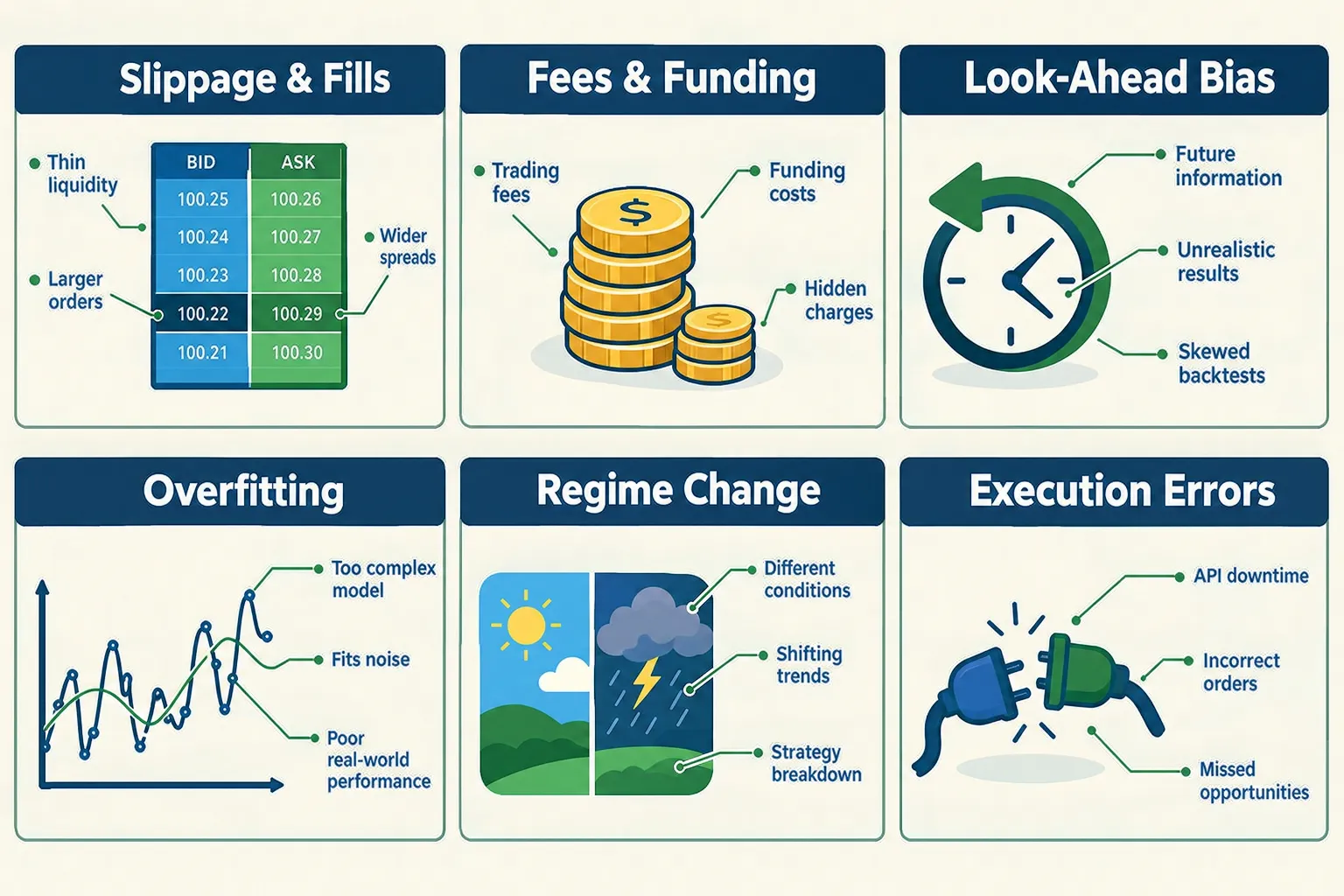
| Reason | What happens | How to spot it | Fix |
|---|---|---|---|
| 1. Slippage and fills | Backtest fills at the close or midpoint. Live orders cross the spread, sit in a queue, or fill partially at a worse price. | Live entry prices consistently worse than signal price; strategy dies when you raise turnover. | Model a realistic spread plus slippage per side. Test the strategy at 2x your assumed slippage and see if it survives. |
| 2. Fees and funding | Commissions, exchange fees, borrow cost, and perpetual funding are understated or left out entirely. | Gross and net equity curves diverge steadily rather than randomly. | Charge every real cost per side. Then check whether per-trade gross edge still clears total cost. |
| 3. Look-ahead bias | The bot uses information it couldn’t have had at decision time: a bar’s close to trade that same bar, restated fundamentals, a survivorship-cleaned ticker list. | Suspiciously high win rate, tiny drawdowns, equity curve that looks drawn with a ruler. | Timestamp every input. Trade on the next bar’s open. Use point-in-time data. See the look-ahead bias breakdown. |
| 4. Overfitting | Hundreds of parameter combinations tested; the best-looking one is selected. The bot learned noise. | Results collapse if you shift the start date by a month or change a parameter by one unit. | Out-of-sample holdout plus walk-forward testing. Fewer parameters beats more. Overfitting vs underfitting explained. |
| 5. Regime change | The market the bot was built on stopped existing. A mean-reversion bot tuned on a choppy tape gets shredded by a trending one. | Flat or negative live results starting at a clear date, with no code change. | Test across multiple regimes. Set a drawdown kill switch. Accept that some strategies have an expiry date. |
| 6. Execution and infrastructure errors | API disconnects, duplicate orders, stale data feeds, server time drift, unhandled exceptions mid-position. | Positions that don’t match the log. Orders you never intended. | Order reconciliation on every cycle, heartbeat monitoring, a hard kill switch, and a full trade log. |
Slippage and fills
Example: a scalping bot built on 1-minute bars assumes it buys at the bar close. Live, the spread on that ticker during the first 15 minutes is three cents wide and the bot is paying the ask. Bitsgap’s 2026 guidance on crypto-bot backtesting reports slippage of roughly 0.05% to 0.30% in normal conditions, widening sharply in volatility or thin books. On a strategy expecting 0.12% per trade, that’s the entire edge.
Fees and funding
BOTLAB’s worked perpetual-futures example is useful because it’s arithmetic, not opinion: a 0.055% taker fee per side, 0.015% slippage per side, and 0.005% average funding sums to roughly 0.145% round-trip cost. A strategy earning 0.10% gross per trade loses about 0.045% net on every single trade. The bot can be right about direction 70% of the time and still bleed.
Look-ahead bias
The most common version in retail code is one line long: the bot calculates a signal from today’s closing price and then executes at today’s closing price. In testing, that’s free money. Live, that trade doesn’t exist.
Overfitting
A trader adds a volatility filter, then an RSI threshold, then a day-of-week rule, then a volume gate. Each addition improves the backtest. None of them improves the live result, because each one is just carving out the specific losing trades that happened in that specific sample.
Regime change
A short-volatility bot that printed through two calm years is a different animal in a violent repricing. Nothing in the code broke. The environment did.
Execution and infrastructure errors
These are the AI trading bot failures no one includes in a case study. A websocket silently drops, the bot keeps running on stale prices, and it places four entries into a position it already holds. More on common trading bot mistakes in our why trading bots fail archive.
How Much Does Slippage Change a Backtest Result?
Enough to flip a profitable system into a losing one, and it happens faster than most people expect. Slippage is the difference between the price your signal fired at and the price you actually got. The higher the turnover, the more times you pay it, and the more a thin edge gets eaten.
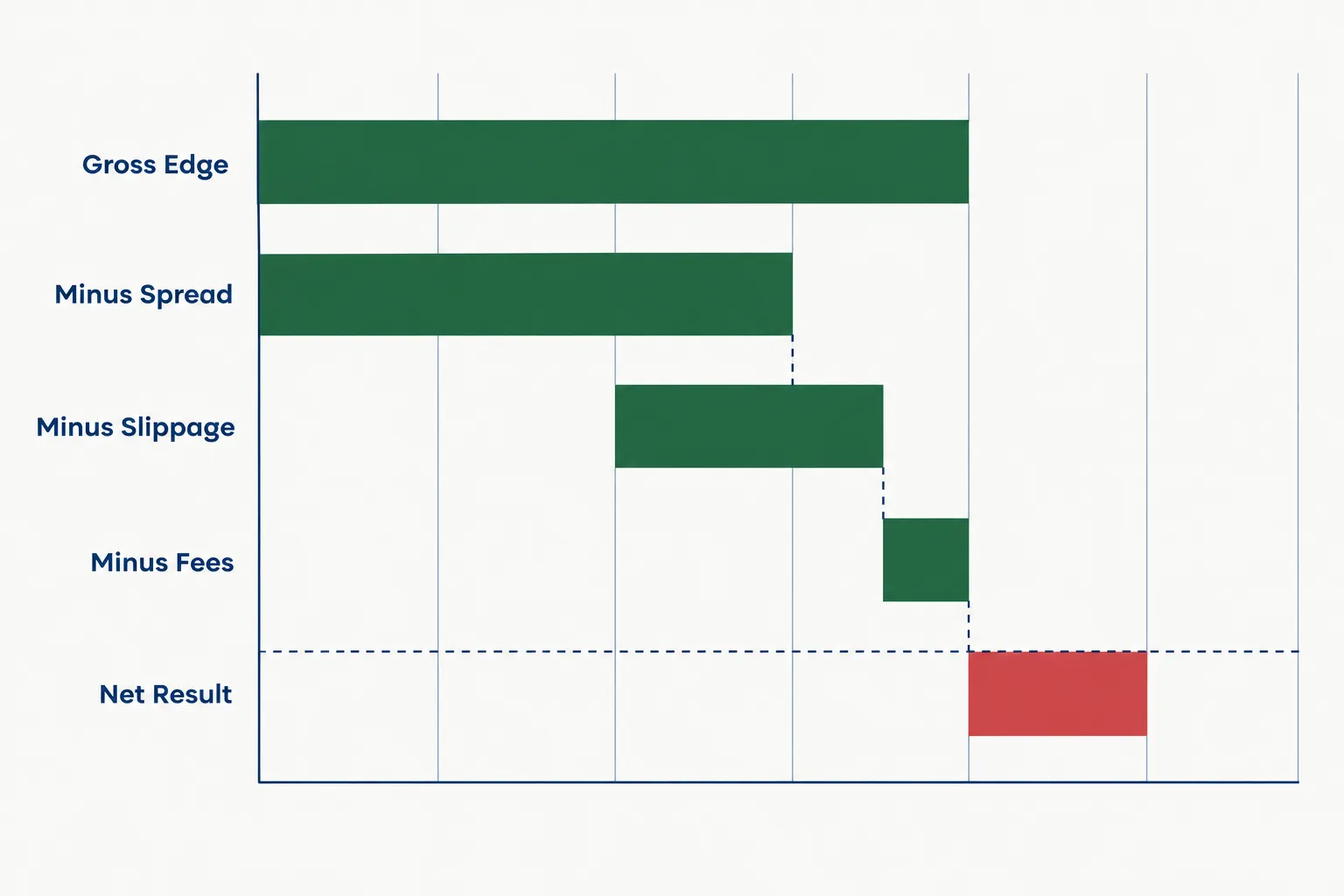
Worked example (illustrative numbers only)
These are example figures chosen to show the mechanics, not measured results from any specific bot.
Assume a bot that:
- Takes 1,200 round-trip trades per year
- Shows a gross average edge of 0.12% per trade in backtest
- Was backtested with zero slippage and zero fees
Gross backtest result: 1,200 × 0.12% = 144% of notional traded, before compounding. Looks spectacular. Now charge reality.
| Cost layer (example) | Per round trip | Annual drag (1,200 trades) |
|---|---|---|
| Gross edge | +0.120% | +144.0% |
| Spread crossed, both sides | -0.040% | -48.0% |
| Slippage, both sides | -0.030% | -36.0% |
| Commissions / taker fees | -0.040% | -48.0% |
| Net per trade | +0.010% | +12.0% |
A 0.12% edge became 0.01%. The strategy survives, barely, and only if the cost assumptions hold. Now raise slippage from 0.030% to 0.060% because you traded a lower-liquidity name or a volatile open. Net per trade goes to -0.020%, and the annual result flips to roughly -24%. Same signals. Same code. Different fill quality.
Decision rule: if doubling your slippage assumption kills the strategy, you don’t have a strategy. You have a fill-quality bet.
That’s the whole point of slippage backtesting. You aren’t trying to find the “correct” slippage number. You’re stress-testing whether the edge is thick enough to absorb being wrong about it. Our guide on paper trading versus real slippage walks through how to measure your own fills instead of guessing.
The AlgoTest YouTube channel covers slippage modeling in backtests in practical detail for anyone building their own cost assumptions, and their material is a reasonable starting point if you want to see the math applied to live order data rather than theory.
Common mistake: assuming slippage is symmetrical. It usually isn’t. You tend to get filled fast when the market is moving against you and slowly when it’s moving your way. That asymmetry is called adverse selection, and it makes real slippage worse than a flat percentage suggests.
What Did the September Trading Bot Disaster Threads Show?
Threads on r/algotrading about blown-up bots keep surfacing the same handful of failure types, and none of them are exotic. Treat anything posted there as one trader’s report, not evidence. No individual Reddit post is a dataset, and a specific September thread permalink isn’t verified here, so what follows describes the recurring pattern rather than quoting anyone.
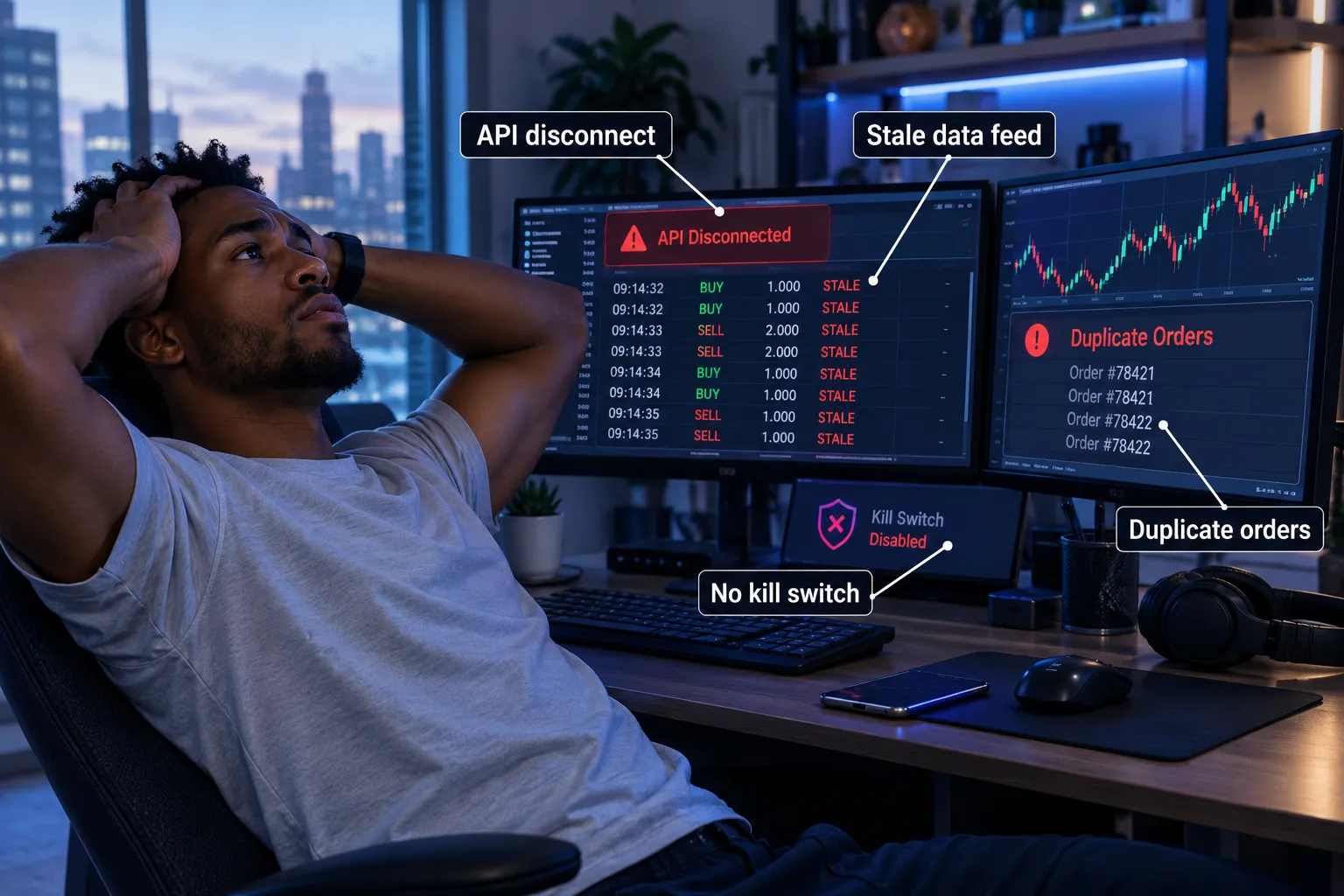
The failure types that show up again and again in r/algotrading post-mortems:
- The bot kept trading on a dead data feed. The price source froze, the bot interpreted the flat line as a signal, and it stacked positions into nothing.
- No position reconciliation. The bot’s internal state said flat, the broker said long three contracts. It doubled down.
- No kill switch. The account ran unattended through a gap and nothing stopped it at a predefined loss.
- Live sizing didn’t match test sizing. Tested on 1 contract, deployed on 5, and the drawdown scaled with it.
- Deployed straight from backtest to real money. No paper forward test, no small-size period, no out-of-sample window.
- Hidden leverage. The strategy was fine. The margin usage wasn’t.
The consistent theme: the strategy logic rarely killed the account. The plumbing did.
Why this matters for the “are trading bots profitable” question: most of these losses had nothing to do with whether the edge was real. They were engineering failures with financial consequences. A profitable signal executed by broken infrastructure produces a losing account.
Edge case worth naming: some of these threads are survivorship-inverted. People post catastrophes and quiet wins stay quiet, so forums overstate disasters the same way vendor sites overstate returns. Read both with the same suspicion. For a broader look at what the forums actually agree on, see our algorithmic trading Reddit roundup.
Do Trading Bots Lose Money More Often Than They Win?
No reliable public number exists for the share of retail trading bots that lose money. No regulator publishes one. Any vendor or blog quoting a precise percentage, “87% of bots fail,” is making it up or sourcing it from someone who did.
What is published, and worth taking seriously:
- The Quantopian study (Wiecki et al.) of 888 algorithms found backtest performance had almost no predictive power for live results, R² under 0.025. That’s not a loss rate, but it tells you backtest profitability doesn’t survive contact with live markets.
- Suhonen, Lennkh and Perez measured a median 73% Sharpe deterioration across 215 commercially offered strategies. Median means half did worse than a 73% decline.
- The SEC’s FY2026 Examination Priorities specifically flags whether firms’ representations about automated investment tools are fair and accurate, and whether controls match disclosures. Regulators don’t add that language because the marketing has been restrained.
So, do trading bots lose money? Plenty do. The honest framing is that profitability isn’t a property of “bots” as a category any more than it’s a property of “spreadsheets.” It’s a property of the specific edge, the specific cost structure, and the specific operator.
Decision rule: if a vendor publishes a win rate without publishing net costs, trade count, maximum drawdown, and whether the period was live or simulated, treat the number as marketing copy.
A useful cross-check before you commit: we ran the numbers on this in do AI trading bots actually make money, and the pattern is consistent with the academic work.
What Drawdown Should You Expect Live Versus in a Backtest?
Expect live drawdown to run deeper and last longer than the backtest showed. Every cause above compounds in the same direction: worse fills, extra costs, and a strategy slightly fitted to the past all make losing streaks longer and recoveries slower. Treat the backtest maximum drawdown as the optimistic floor, not the expected case.
Why live trading bot drawdown runs deeper:
- Costs turn small losers into bigger ones. A trade that scratched even in testing is a loss live. Streaks lengthen.
- Your backtest sample is finite. A 5-year test simply may not contain the worst stretch that strategy can produce.
- Slippage spikes exactly when you’re losing. Volatility widens spreads, and that’s the same environment generating your losses.
- You intervene. Most traders pause a bot mid-drawdown, miss the recovery leg, and lock in the worst half.
Set your own drawdown ceiling before you deploy
A practical exercise, with example numbers you should replace with your own:
- Backtest maximum drawdown: 18%
- Planning assumption: multiply by 1.5 to 2x → expect 27% to 36% live
- Account: $10,000
- Hard kill switch set at 25% ($2,500) → bot halts, no discretion, no negotiation
If you can’t emotionally sit through the doubled number, you’ve sized too big. That’s not a courage problem, it’s a position sizing problem, and the fix is arithmetic rather than willpower. Our max drawdown guide covers how to calculate and monitor it properly.
Common mistake: setting the kill switch after the drawdown starts. By then it isn’t a rule, it’s a reaction.
How Do You Close the Gap Between Backtest and Live?
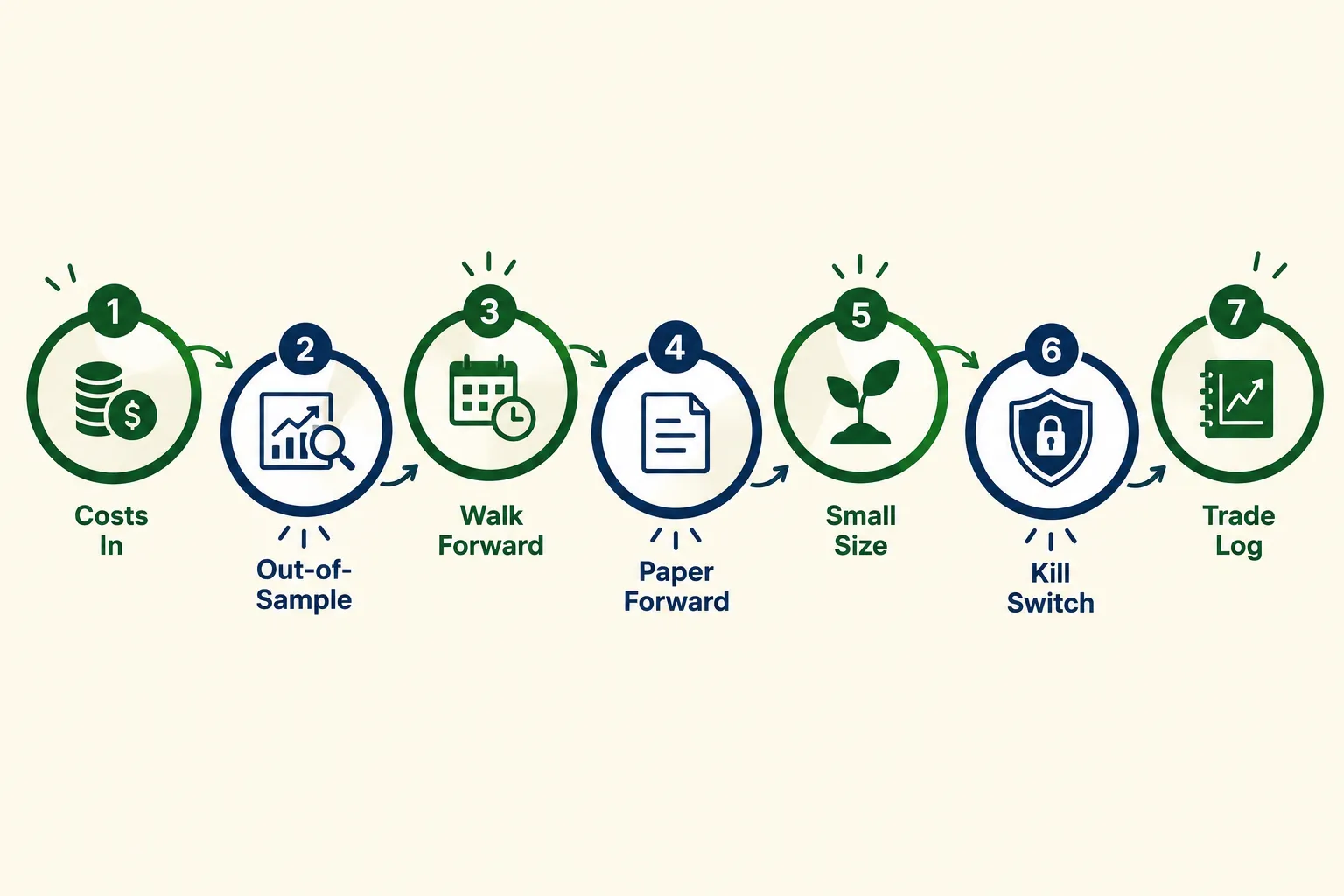
You close the gap by making the backtest pessimistic and the deployment slow. Seven steps, in order, each with a specific fix. Skipping any of them is how a promising strategy becomes a cautionary Reddit post.
-
Put every cost in, then add some. Charge commission, spread, slippage, funding, borrow, and data fees per side. Then re-run at double your slippage assumption. If the edge dies, stop here. You just saved yourself six months.
-
Hold out an out-of-sample period you never touch. Build on 2018 to 2023, lock 2024 to 2026 in a drawer, and don’t open it until the strategy is final. One look, one verdict. If you peek and then tweak, the holdout is contaminated and you’re back to overfitting.
-
Run a walk-forward test. Optimize on a rolling window, test on the window that follows, roll forward, repeat. It’s the closest simulation of how you’d actually re-tune a bot over time. If walk-forward results are dramatically worse than the single-shot backtest, the parameters were noise. See walk forward analysis.
-
Paper forward test on live data for at least a month. Not a replay, not a simulation on old bars. Live market data, live clock, live weekends and holidays and halts. This is where timezone bugs, data-feed drops, and order-logic errors surface, before they cost anything. Paper trade it first is not beginner advice. It’s engineering.
-
Deploy at embarrassingly small size. Trade the minimum your broker allows for 30 to 60 days. Your goal isn’t profit, it’s measurement: compare your actual fills to your assumed fills, trade by trade. That comparison is the only real slippage number you’ll ever have.
-
Install a kill switch before the first live order. Hard limits on daily loss, total drawdown, consecutive losses, position count, and order rate. It should run outside the strategy logic so a bug in the strategy can’t disable it. Plus a heartbeat check that flattens positions if the data feed goes quiet.
-
Log everything, reconcile daily. Timestamp, signal price, intended price, fill price, size, fees, broker position versus bot position. Reconcile against the broker every session. Your trade log is the only document that can tell you whether the bot is underperforming because the edge faded or because the plumbing is leaking.
The Jacob Amaral YouTube channel covers backtesting and bot deployment workflow for retail algo traders and is worth watching if you’re building your own validation process rather than buying someone else’s.
Decision rule: if you can’t complete steps 1 through 4 for a bot you’re considering buying, because the vendor won’t show costs, out-of-sample results, or live-versus-simulated labeling, that’s your answer on whether to buy it.
How do you know if a trading bot is a scam?
Red flags, in rough order of severity:
- Promised or “consistent” returns. No legitimate operator promises this. Regulators treat it as a hallmark of fraud.
- Backtest presented as live performance without labeling which is which.
- “Proprietary AI” with no method disclosed. Often a public language model with a dashboard on top.
- No maximum drawdown published. Returns without drawdown is half a sentence.
- Pressure to deposit to an unfamiliar exchange or send funds to a wallet rather than your own brokerage account.
- Affiliate-heavy promotion with no independent reviews anywhere skeptical.
The regulatory backdrop is tightening, not loosening. FINRA has publicly flagged autonomous trade-execution agents as an emerging risk, the SEC’s 2026 priorities cover supervision of AI used in trading, and the CFTC scheduled its first Frontier Forum on AI and agentic finance for October 28, 2026. An “AI” label removes exactly zero securities-law obligations from a vendor. Our side-by-side on legit versus scam AI trading bots goes deeper on vetting.
Manual Trading vs Bots: Which Makes More Money?
Neither wins as a category. Bots win on consistency, speed, and not revenge trading at 2:47pm. Humans win on context, adaptation, and knowing when a setup is technically valid but situationally stupid.
| Bots | Manual | |
|---|---|---|
| Rule consistency | Perfect, including when the rules are wrong | Degrades under stress |
| Reaction speed | Milliseconds | Hundreds of milliseconds, at best |
| Adapting to a new regime | Poor without re-testing | Faster, if the trader notices |
| Overtrading risk | Only if coded in | High |
| Failure mode | Silent, fast, scaled | Loud, slow, usually smaller |
| Setup cost | Real time and money up front | Mostly time |
Choose a bot if your strategy is fully rule-based, high-frequency enough that manual execution is impossible, or if your main leak is behavioral and you need the rules enforced for you.
Stay manual if your edge depends on judgment you can’t write down, you trade a handful of swing positions a week, or you haven’t yet defined your entry, exit, and stop in a way a computer could follow. If you can’t write the rule, you can’t automate it. You’ll just automate a guess.
Most serious retail traders end up hybrid: automated scanning and alerting, discretionary execution. Our swing trading tools and day trading tools pages break down which jobs are worth handing to software.
What Does a Trading Bot Cost, and What’s the Minimum to Start?
Costs run from free to several hundred dollars a month, plus data fees, plus execution costs that are usually larger than the subscription. Check the official page for any specific tool’s current pricing, since vendors change tiers frequently.
The layers you’ll actually pay:
- Platform or subscription fee. Free tiers exist and some do most of what paid tiers do. We catalogue free AI trading bots and fully automated bots separately for this reason.
- Market data. Real-time data is rarely free at the quality a bot needs. Delayed data and automation are a bad pair.
- Broker commissions and exchange fees. Per side, every trade.
- Spread and slippage. The biggest line item for most high-turnover bots, and the one no one budgets for.
- Your time. Debugging, monitoring, re-testing. Weeks, not hours.
Minimum account size
There’s no universal minimum. Practical constraints:
- US equities margin accounts carry a standard $2,000 minimum for margin. Our broker and platform reviews list what each one charges before you size a strategy around it.
- Position sizing is the real floor. If your risk rule is 1% per trade and your strategy’s typical stop implies a $40 risk, a $1,000 account can’t trade it correctly.
- Fixed per-trade costs dominate small accounts. A $4 round trip on a $200 position is a 2% hurdle before you’re right about anything.
Decision rule: your minimum is whatever lets you take a full normal-size position while risking 1% or less of the account. Below that, paper trade.
Can Beginners Profit With Trading Bots, and Do You Need to Code?
Beginners can use trading bots without coding, but profiting is harder than using. No-code platforms have removed the technical barrier entirely. They have not removed the judgment barrier, which is the one that matters.
Coding: not required anymore. Visual strategy builders, prebuilt templates, and rule-based condition editors cover most retail strategies. Coding helps with custom logic, proper cost modeling, and debugging, which is a real advantage when something breaks at 9:31am.
Profiting as a beginner is difficult for one specific reason: a beginner usually can’t tell a sound backtest from an overfitted one. The platform will happily show you a gorgeous curve built on 400 parameter combinations, and nothing in the interface will tell you it’s noise. That’s a knowledge gap, not a software gap.
If you’re new, sequence it like this:
- Learn what the strategy is actually betting on, in one sentence.
- Paper forward test for a month, minimum.
- Go live at minimum size for another month.
- Compare live fills to tested fills before scaling anything.
Platform selection matters too. Compare by what you need rather than feature count. Start with the AI trading platforms breakdown, and if you want a head-to-head, Option Alpha vs Atomik Trading shows how different two automation philosophies can be.
Crypto bots specifically
Crypto bots remain popular because exchanges offer APIs openly and markets run 24/7, which suits automation. The catch is that crypto execution costs are frequently higher than equities after spread, taker fees, and funding, and liquidity varies enormously by pair. Any “best crypto bot” list without cost modeling is a ranking of marketing budgets. Check current fees on the exchange’s own fee schedule before trusting any projected return.
What Happens to Trading Bots During Market Crashes?
Most bots perform worse than their backtest suggests during crashes, because every assumption degrades at once: spreads widen, liquidity thins, volatility breaks the parameters, and brokers sometimes restrict or halt. A bot with no crash handling will keep executing a strategy built for conditions that no longer exist.
What breaks, specifically:
- Slippage blows out. A 0.05% assumption becomes 0.50% or worse in seconds.
- Stops gap through. A 2% stop fills at 7% on a gap down. The bot doesn’t know the difference until it’s done.
- Correlations converge. A “diversified” basket of six positions becomes one position, sized six times too big.
- Leverage liquidates. Margin calls don’t wait for your logic.
- APIs fail under load. Order rejections and timeouts spike exactly when you need execution most.
Practical protections: cap total exposure rather than per-position exposure, include a volatility filter that stands the bot down above a threshold, set a daily loss kill switch, and never leave a leveraged bot running unmonitored through a scheduled catalyst. Testing across several market regimes is the only way to know how your strategy behaves when the tape gets ugly. If your sample contains no crash, your backtest hasn’t met one.
What Are the Most Common Trading Bot Mistakes?
The frequent, expensive trading bot mistakes cluster into six groups, and almost all of them are preventable before a single dollar is at risk.
- Backtesting with zero costs. Guarantees a flattering result and teaches nothing.
- Tuning until the curve looks good. That’s overfitting with extra steps.
- Going live at full size immediately. No small-size calibration period, so no real fill data.
- No kill switch. Unlimited downside combined with an unattended machine.
- Intervening mid-drawdown. Turning the bot off at the worst point, which converts a modeled drawdown into a realized loss.
- Running multiple correlated bots. Three bots, one underlying bet, triple the sizing you intended.
Two edge cases worth adding: timezone and daylight-saving bugs cause bots to trade outside intended hours twice a year, and survivorship-biased ticker lists inflate equity backtests because delisted losers aren’t in the data.
Are Trading Bots Actually Profitable Long Term?
Long-term bot profitability is possible but uncommon, and it depends more on cost discipline and maintenance than on the original signal. Strategies decay. Markets change. The bot that worked in 2023 isn’t automatically the bot that works in 2027.
What distinguishes the ones that last:
- Simple logic. The Suhonen study’s finding is pointed: the most complex strategies deteriorated by more than 30 percentage points more than the simplest ones. Complexity is a liability in live trading.
- Fat edge relative to costs. A strategy earning three times its round-trip cost tolerates being wrong about slippage. One earning 1.2x doesn’t.
- Scheduled re-validation. Quarterly walk-forward checks, not annual hope.
- Honest logging. You can only detect decay if you measured the baseline.
- Position sizing that survives the worst drawdown, not the average one.
So, are trading bots profitable over years? For a disciplined operator running a simple, well-costed strategy with real risk controls, sometimes yes. For someone deploying a vendor’s optimized backtest at full size with no kill switch, the answer is usually no, and the account tells them within a quarter.
Frequently Asked Questions
Are trading bots worth it?
They’re worth it if your edge is rule-based and your main problem is execution discipline. A bot enforces stops and sizing without arguing, which removes revenge trading and hesitation. They’re not worth it if you’re hoping the software supplies the edge you don’t have, because automation multiplies whatever process you already run, good or bad.
Which is the most profitable trading bot?
No single bot is reliably the most profitable, and anyone publishing that ranking is selling something. Profitability depends on your strategy, costs, broker fills, and account size. Judge tools on disclosed methodology, published drawdown, and whether results are labeled live or simulated rather than on advertised returns.
Can ChatGPT make a trading bot?
It can write functional code for a rule-based strategy, and plenty of traders use it that way. It cannot verify your data quality, catch look-ahead bias in your logic, or model your broker’s real fills. Treat generated code as a draft requiring full out-of-sample and paper forward testing before any live order.
Can trading bots make you a millionaire?
There’s no credible evidence supporting that as an expectation, and no regulator or published study backs the claim. Automation changes how you execute, not whether you have an edge. Any vendor implying promised or life-changing returns is making a claim the SEC specifically examines for fairness and accuracy.
Which AI trading bot is the best?
Best depends on what you’re automating: scanning, alerting, options execution, or full autonomous trading are different jobs. Compare on transparency of method, real total cost including data, usability in week one, and what unsolicited users say rather than solicited reviews. Our head-to-head of 2026 AI trading tools covers the field.
Why is my trading bot backtest so much better than live results?
Almost always costs, fills, or overfitting, in that order. Re-run the backtest with full spread, slippage, and fees charged per side, then test whether results hold on a period you never used during development. If the strategy only works on the data it was built on, the live gap is the correct answer, not a bug.
Our Take
A bot is only as profitable as its net, live, logged results. Not the curve on the sales page, not the Sharpe ratio from a 400-combination parameter sweep, not the screenshot in the Discord. Net. Live. Logged. Everything else is a simulation with good lighting.
If you take one action from this piece: before you deploy anything, re-run the backtest with double your assumed slippage and every fee charged per side. If the edge survives that, you have something worth paper forward testing. If it doesn’t, you just avoided a quarter of expensive education. Play stupid games, win stupid prizes.
Built a bot and want it evaluated against real cost assumptions? Submit it for review, then compare what you are running against the AI stock tools directory.
Stay alpha.
The FullStack Alpha research desk tests AI trading bots on paper and live accounts. Reviewed and edited by Jay Rocco, Founder and Editor.
