

The FullStack Alpha research desk tests AI trading bots on paper and live accounts. Reviewed and edited by Jay Rocco, Founder and Editor.
By FullStack Alpha Editorial Team | Reviewed by Jay Rocco, Chief Editor
An arXiv paper submitted October 7, 2026, accepted at the NeurIPS 2026 Agenthon Workshop, tested an agentic ai options trading system called SOTA that post-trains a Qwen3.8-27B model with supervised fine-tuning and then reinforcement learning. Tested on options tied to nine large-cap U.S. equities plus SPY over a six-month out-of-sample window, the market-data version produced a 18.3% total return with a reported Sharpe ratio of 1.60 and a maximum drawdown of 8.96%. The version that retained news inside the trading policy returned -2.7%. The authors’ read: news helped generate training examples, but hurt when kept inside the live decision.
What You Should Know
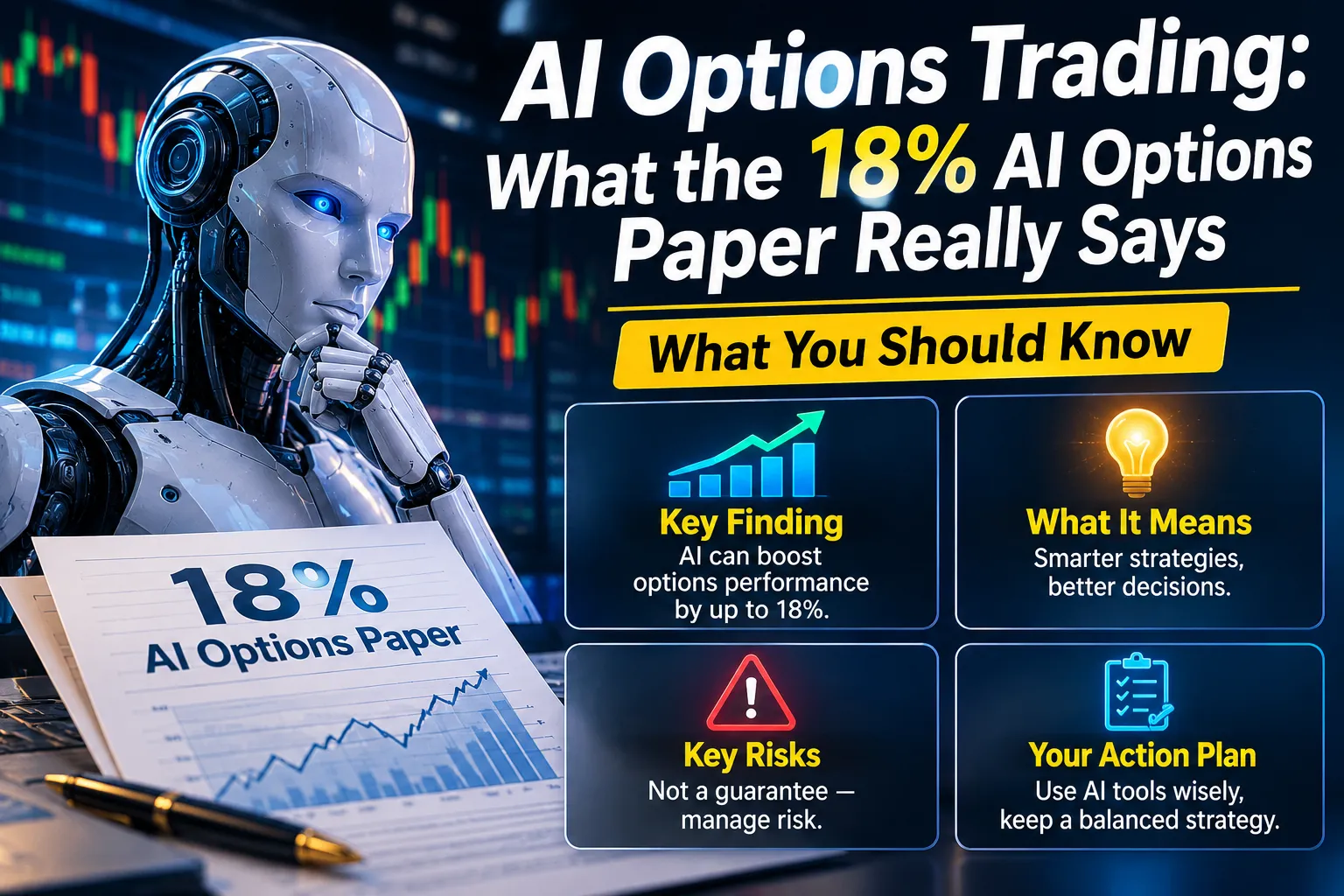
- The paper was submitted to arXiv on October 7, 2026, and accepted at the NeurIPS 2026 Agenthon Workshop.
- The headline 18.3% is a six-month total return, not annualized. The paper reports it that way, and so should anyone quoting it.
- Reported risk numbers from the paper: Sharpe 1.60, max drawdown 8.96%.
- The model chose a strategy type, not individual strikes. Deterministic resolvers handled the portfolio mechanics.
- On October 21, 2026, Interactive Brokers launched IBKR Autonomous Trading across 75,000+ listed stocks, options and ETFs, and the CFTC scheduled its first Frontier Forum session on AI and agentic finance for October 28, 2026.
What Is AI Options Trading?
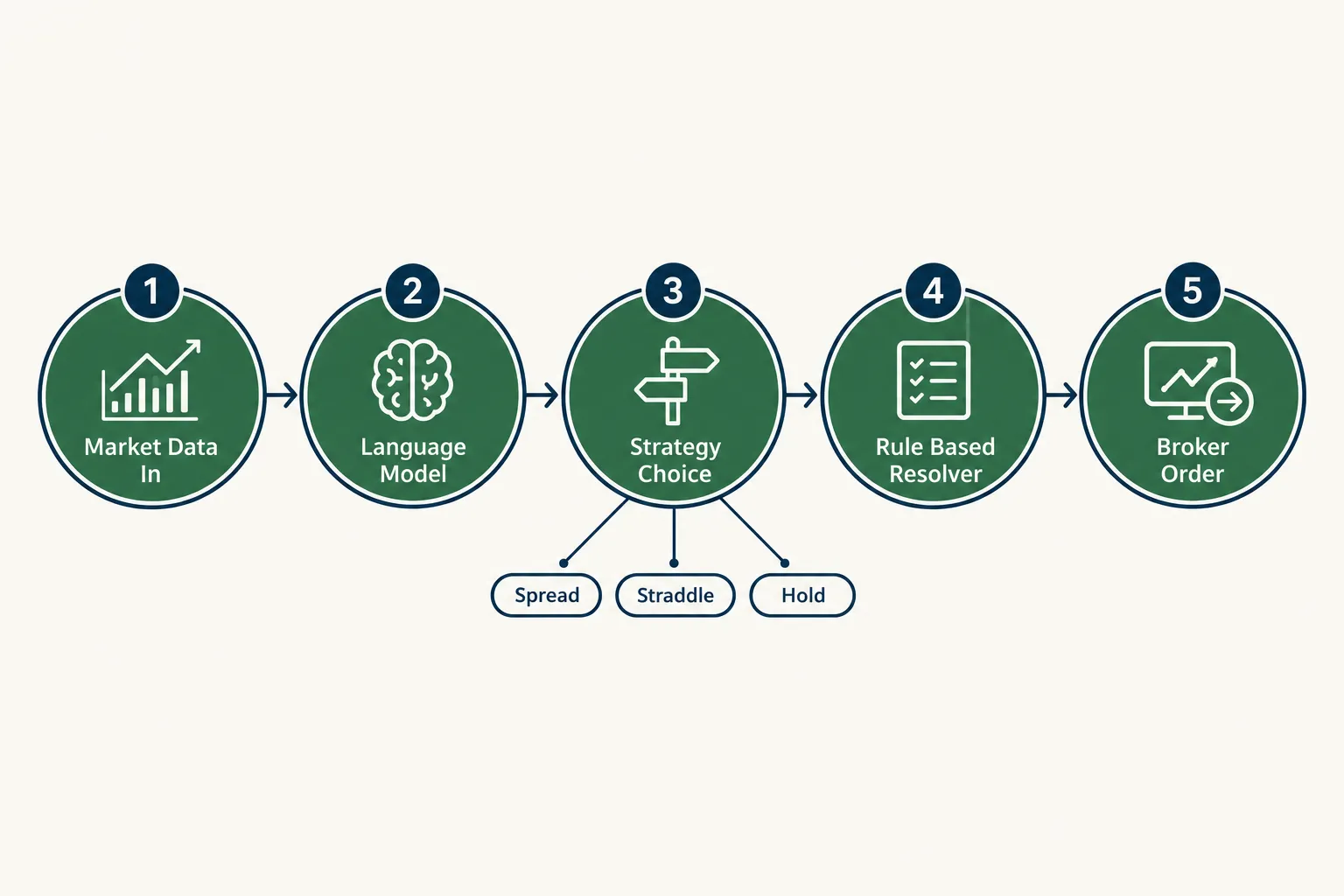
AI options trading means a machine-learning model makes or manages decisions about options positions, while rules or a human handle sizing, risk limits and execution. The model rarely picks everything. In serious setups it picks one thing well and hands the rest to code that can’t improvise.
An option is a contract giving the right to buy or sell a stock at a set price (the strike) before a set date (the expiry). That’s the instrument. The AI part is the decision layer sitting on top of it.
Three layers usually exist:
- The signal layer. A model reads price action, implied volatility (the market’s priced-in expectation of future movement) and other features, then outputs a view.
- The strategy layer. The view becomes a trade type: a long straddle (buying a call and a put at the same strike, a bet on a big move either direction), a credit spread, or nothing at all.
- The execution layer. Strikes, position sizing, delta hedging (offsetting directional exposure with shares or other options) and the stop loss. This is where rules belong, not vibes.
An ai options trading bot automates some or all of those layers. A plain options trading bot might just run a fixed condition with no learning at all, which is honestly fine and often safer. The word “AI” on a product page tells you nothing about which layer it touches.
If a tool won’t tell you which layer the model controls, assume it controls the marketing copy. We cover that gap in what you actually pay for with AI trading software.
Who this is for, and who it isn’t
- Good fit: traders who already have a written options process and want to test automation on a slice of it.
- Bad fit: anyone looking for a model to replace a process they never built. A signal without a system is just weather.
What Did the 18% AI Options Paper Actually Test?
The paper tested whether a post-trained language model could pick which options strategy to run, with fixed rules handling everything else, across ten underlyings over six months out of sample. It is a study of strategy selection under constraint, not a study of a model free-running a portfolio.
The framework deliberately shrinks the action space. The model is not asked to search thousands of contracts and independently decide strike, expiry and quantity. It makes a higher-level call, and deterministic resolvers implement it. Smaller action space, easier to constrain, easier to audit.
| Item | What the paper says |
|---|---|
| System name | SOTA, an agentic options strategy selector |
| Base model | Qwen3.8-27B, post-trained |
| Training method | Supervised fine-tuning, then reinforcement learning |
| Universe | Nine large-cap U.S. equities plus SPY |
| Test window | Six months, out of sample |
| What the AI chose | Which options strategy to deploy |
| What fixed rules chose | Portfolio implementation via deterministic resolvers |
| Market-data version result | 18.3% total return |
| News-retained version result | -2.7% |
| Reported Sharpe ratio | 1.60 |
| Reported max drawdown | 8.96% |
A widely shared r/options summary added further details (specific calendar months, win rates near 29% and 39%, a higher drawdown on the news version). Those figures are a reader’s summary, not confirmed here. For any number not in the table above, check the paper directly.
Why the design choice matters more than the number
Most retail “AI trades options” projects do the opposite: they let the model pick everything and then wonder why results are unstable. The paper’s structure is the actual lesson. Narrow the machine’s job, harden everything around it.
Common mistake: reading 18.3% as a return you could have earned. It’s a research result in a controlled framework, on ten liquid underlyings, over one window.
Why Did Reading the News Make the AI Options Trader Worse?
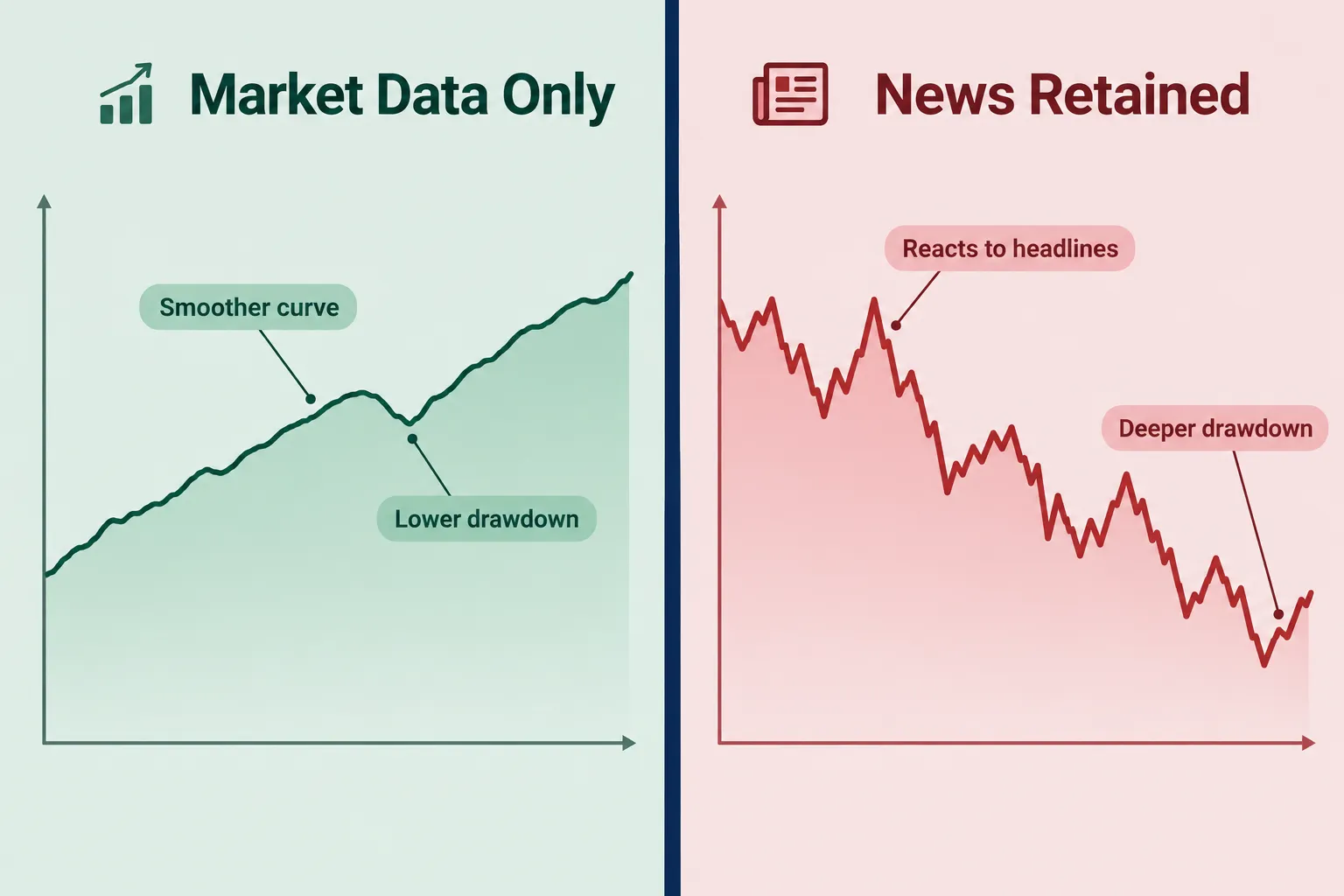
The authors report that news was useful for generating training trajectories but harmful when retained directly inside the trading policy during reinforcement learning. Same base model, same universe, same window. Add news to the live decision, and 18.3% became -2.7%.
The paper’s explanation, in plain English
News helped the system learn. It gave the training process richer examples to reason over, which shaped better behavior. But once the finished policy kept reading headlines at decision time, the headlines started driving trades instead of informing them.
Our interpretation, clearly labeled as ours
Headlines are mostly already in the price by the time a model sees them. Options compound that problem, because implied volatility usually expands before the event and collapses after it. A model reacting to a story is frequently buying the expensive side of a move that’s already happened.
There’s a human version of this, and every trader has lived it. You read a bullish article, you buy calls, the stock is flat and your position bleeds anyway because volatility deflated. That’s not a bad thesis. That’s a bad input timing problem.
More information is not more edge. Timelier, cleaner information is. Cut the noise, keep the alpha.
Edge case worth naming: this finding came from one framework on ten liquid names. It does not prove news is useless everywhere. Event-driven desks make money on news constantly. It proves that this way of wiring news into this policy made it worse.
Why Can a Low Win Rate Still Make Money in Options?
Because options payoffs are asymmetric. A strategy can be wrong most of the time and still profit if the wins are much larger than the losses. Win rate alone is a vanity metric.
The math is expectancy:
Expectancy = (Win rate x Average win) - (Loss rate x Average loss)
Worked example, and these numbers are illustrative only, not from the paper:
- Win rate: 30%, so loss rate 70%
- Average win: $400
- Average loss: $100
Expectancy = (0.30 x $400) - (0.70 x $100) = $120 - $70 = +$50 per trade
Now flip it. A 90% win rate with an average win of $50 and an average loss of $600:
Expectancy = (0.90 x $50) - (0.10 x $600) = $45 - $60 = -$15 per trade
Nine wins out of ten, and the account still shrinks. That’s the whole story of a lot of short-premium accounts that looked fine until one gap.
The payoff ratio rule
Your payoff ratio is average win divided by average loss. Pair it with your win rate:
| Win rate | Payoff ratio needed to break even (before costs) |
|---|---|
| 25% | 3.0 to 1 |
| 33% | 2.0 to 1 |
| 50% | 1.0 to 1 |
| 70% | 0.43 to 1 |
| 90% | 0.11 to 1 |
Decision rule: if you don’t know your payoff ratio, your win rate tells you nothing. Run your own numbers through the expectancy calculator before you judge any strategy, AI-driven or not.
Costs eat into every line of that table. Add commissions and the bid-ask spread and the break-even payoff ratio rises.
What Does the Paper Not Prove?
It does not prove that ai options trading is profitable in live markets for a retail trader. It’s a research result with specific boundaries, and the authors present it as such.
Here’s what sits outside the result:
- One market window. Six months is six months. Different volatility regimes produce different outcomes, and a single out-of-sample stretch is not a regime test.
- Simulated fills, not live fills. Research execution assumes orders happen. Live options orders sit inside a bid-ask spread that widens exactly when you most want out.
- Slippage and spreads on options are brutal. A liquid SPY contract is one thing. A single-name option two strikes out of the money is another. A model that looks profitable at mid-price can be unprofitable at the actual fill. That’s the core issue in paper trading slippage.
- Costs. Per-contract commissions, assignment fees, data fees and financing all compound across a high-turnover strategy.
- The model isn’t something you run at home. A post-trained 27B-parameter model with a reinforcement learning stage is a research-lab project, not a weekend build on a gaming GPU.
- Look-ahead risk is the eternal hazard in any backtest. Any data that wasn’t actually available at decision time inflates results quietly. Our write-up on look-ahead bias covers how it sneaks in.
A strong backtest is a hypothesis, not a conclusion. Treat it as the start of the testing, not the end.
Why AI trading systems fail in real markets
The failure pattern is boring and repeatable. The model fits a regime, the regime changes, and the rules around the model aren’t strict enough to force it to stop. Second failure: execution assumptions. Third: the operator overrides the system after two losses, which is revenge trading with extra steps.
Can AI Actually Predict Options Price Movements?
No model reliably predicts short-term options prices with accuracy you can lean on. What good systems do instead is estimate probabilities across many trades and let the payoff shape do the work.
Accuracy on short-horizon moves tends to sit near coin-flip levels for liquid names, which is exactly why the paper’s design matters. The system didn’t need to be right often. It needed to be structured so being right occasionally paid more than being wrong frequently cost.
- Where models help: volatility regime classification, ranking relative implied volatility, filtering out low-quality setups, flagging unusual flow.
- Where models struggle: direction over the next hour, gap risk, anything driven by an announcement no one modeled.
Treat any vendor claim of a specific prediction accuracy as vendor-claimed until it’s audited. Several of the tools we’ve checked are a public language model with a dashboard bolted on and a subscription button. We separate those in legit AI trading bots versus scams.
What’s the Difference Between AI Trading and Algorithmic Trading?
Algorithmic trading executes explicit rules a human wrote. AI trading uses a model whose decision logic was learned from data, not typed out by hand. Every AI trading system is algorithmic. Not every algorithmic system is AI.
| Algorithmic trading | AI trading | |
|---|---|---|
| Decision logic | Written by a human | Learned from data |
| Explainability | High, you can read the code | Lower, depends on model type |
| Fails when | The rule stops matching the market | The regime shifts away from training data |
| Retraining | Not applicable, you rewrite the rule | Periodic, by design |
| Audit difficulty | Easy | Harder, needs logging discipline |
Choose rules-based if you can state your edge in one sentence. Choose a model only when your edge depends on combining many weak signals you can’t hand-weight. Most retail traders are in the first camp and don’t want to hear it.
What Machine Learning Models and Data Do Professional Options Traders Use?
Gradient-boosted trees and other tabular models still dominate for feature-driven options work. Language models are newer and, as the paper shows, are most useful at the strategy-selection layer rather than the pricing layer. Deep nets appear in volatility surface modeling at large shops.
Typical inputs on a professional options desk:
- Implied volatility surface data: IV by strike and expiry, term structure, skew.
- Realized volatility across multiple lookbacks, compared against implied.
- Options chain microstructure: open interest, volume, bid-ask spread width, contract liquidity.
- Order flow: block prints, sweeps, put/call ratio.
- Underlying price action: support and resistance levels, trend state, whether the name is basing or overextended.
- Event calendar: earnings season dates, dividends, Fed meetings, expiry cycles.
How often do you need to retrain an options model?
There’s no universal schedule. Retrain on a trigger, not a calendar. Practical triggers: live performance drifting outside the backtested distribution for a defined number of trades, a volatility regime change, or a structural market change like the extended-hours options sessions U.S. exchanges moved to expand in October 2026.
Common mistake: retraining every time the model has a losing week. That’s curve-fitting to noise with a schedule attached. Set the trigger in advance, in writing.
Which AI Options Trading Bots Can Retail Traders Actually Use?
Retail access splits into three routes: a broker-level autonomous layer, a hosted no-code automation platform, or your own code against a broker API. Pricing and feature sets change often, so verify on the official page before you commit.
| Route | What it automates | AI role | Price | Date checked |
|---|---|---|---|---|
| IBKR Autonomous Trading | Order submission without per-trade approval, in a dedicated AI partition funded from the primary account; covers 75,000+ listed stocks, options and ETFs | External AI platform connected via Model Context Protocol, including ChatGPT, Claude, Grok, Perplexity; user sets instructions and safeguards in natural language | Check the official page | Launched Oct 21, 2026 |
| Option Alpha | No-code options bot building and automated execution | Automation and rules engine, see tool page for current AI features | Check the official page | See tool page |
| OptionsFlow | Options order flow scanning and alerts | Flow detection and ranking | Check the official page | See tool page |
| Self-built on a broker options API | Everything you code: signals, sizing, orders, logging | Whatever model you train or call | Broker fees plus data | Ongoing |
Two more useful comparisons if you’re shortlisting: Option Alpha versus Atomik Trading and the full ranked AI options trading tools list. On the broker side, our thinkorswim review covers the options chain and order ticket you’d actually be automating against.
The broker-level change is the big one. Letting an AI platform submit orders without per-trade approval is a different risk category than letting it suggest trades. The CFTC’s first Frontier Forum session on AI and agentic finance, scheduled for October 28, 2026, exists because regulators are asking whether current requirements cover machine-directed trading at all.
Decision rule
- Choose the broker autonomous route only if you can write your safeguards precisely and you’re comfortable funding a separate partition you’re willing to lose.
- Choose a hosted platform if you want automation without maintaining code.
- Choose self-built if you can read your own fills and debug at 3am.
Can You Build an Options Trading Bot With Python?
Yes. Building one is a weekend. Building one that survives real fills, real costs and real drawdowns takes months. Python is the standard because the data and broker libraries live there.
A realistic workflow:
- Define the strategy in writing first. Entry, exit, strike selection, max loss per trade, max positions. If you can’t write it, you can’t code it.
- Pull historical options data. This is the expensive, annoying step. Equity data is cheap. Clean historical chains are not.
- Backtest with costs included. Commissions, per-contract fees, and a conservative fill assumption. See our walkthrough on options backtesting and the free option backtesting options if your budget is thin.
- Connect a broker API in paper mode. The Alpaca options API is a common starting point for an options trading bot python project.
- Run paper for a pre-set number of trades. Not days. Trades.
- Go live with the smallest size your broker allows. Then leave it alone and let the log argue with you.
More on the general stack in our Python algorithmic trading guide.
Safety checklist before any bot touches real money
- Hard max loss per trade, enforced in code, not in your head
- Max open positions and max total notional exposure
- A kill switch you can hit from your phone
- Order type restricted to limit, never market, on wide-spread contracts
- Logging of intended price versus actual fill on every order
- A rule that halts the bot after N consecutive losses for manual review
On the YouTube tutorials
Video walkthroughs of building an options bot in Python are useful for syntax and API wiring. What a typical tutorial shows: pulling a chain, placing an order, a simple backtest loop. What it skips almost every time: realistic fill modeling, per-contract costs at scale, assignment handling, and what happens when the data feed drops mid-session. Treat the tutorial as the plumbing lesson. The risk work is on you.
How Do You Paper Test an AI Options Strategy?
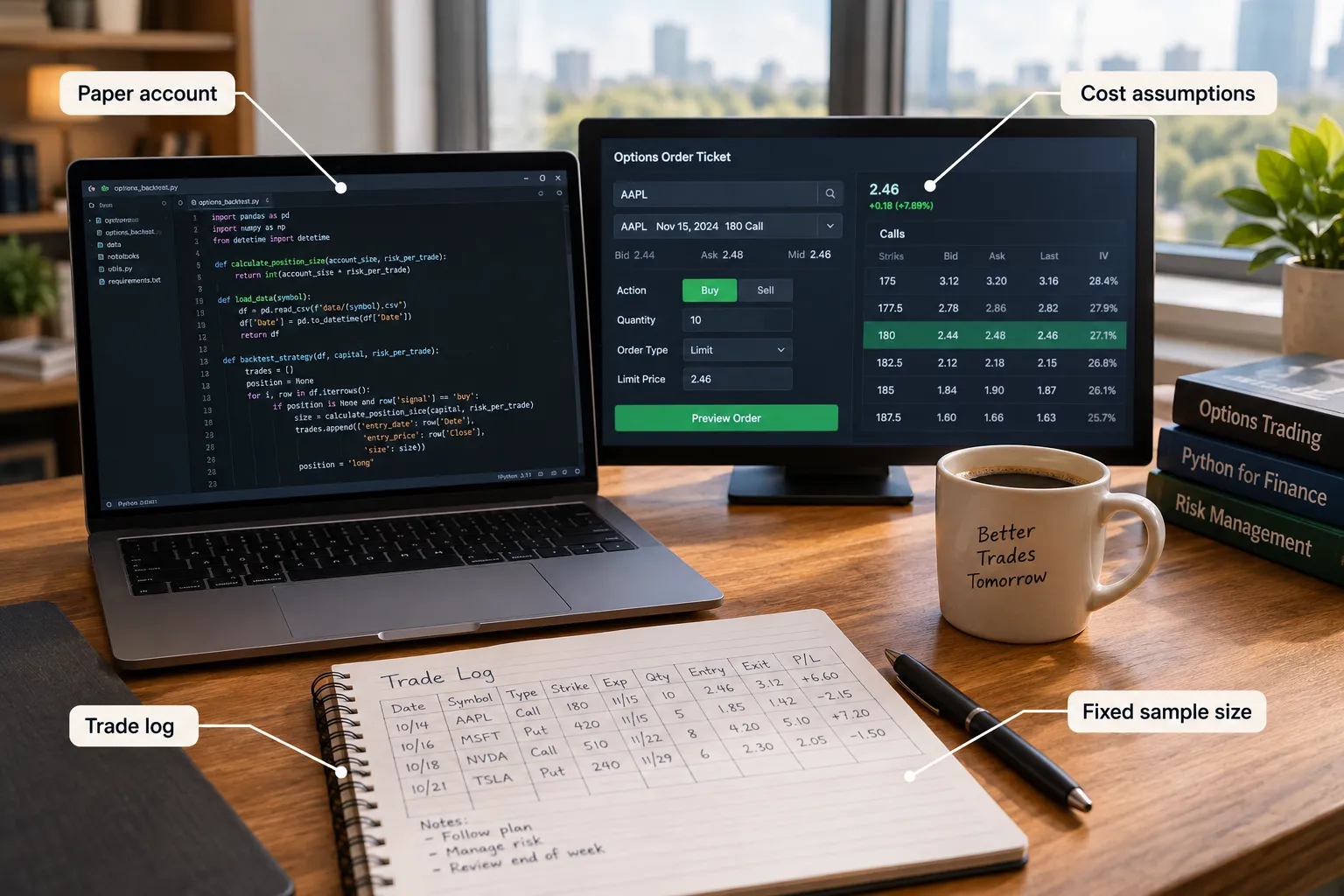
Open a paper account, define your sample size and cost assumptions before the first trade, log every trade in a fixed format, and refuse to judge the system until the sample completes. Most people quit at trade nine because they’re down.
The process:
- Set the sample size in advance. 50 trades minimum for anything with a win rate under 50%, because small samples lie loudly.
- Write the cost assumption down. Commission per contract, plus an assumed slippage haircut on every fill. Be pessimistic. If it only works at mid-price, it doesn’t work.
- Keep a fixed log. Date, underlying, strategy type, entry, exit, intended price, filled price, max adverse move, reason for exit. Same fields every time.
- Change nothing mid-test. Tweaking the parameters halfway through means you’re curve-fitting, and your results are now fiction.
- Compare against a dumb benchmark. Buy-and-hold SPY over the same window. If your bot doesn’t beat the boring thing, you built an expensive hobby.
- Then go live tiny. Paper fills are generous. The real spread will show up and take its cut.
Paper trade it first is not beginner advice. It’s the only way to find out whether your edge survives contact with costs. New to this? Start with our AI trading for beginners material before automating anything.
How Much Money Do You Need, and Can Beginners Start?
You can start paper testing with zero. For live options, the realistic floor is whatever you can afford to lose entirely, and a few thousand dollars is a workable starting account for small defined-risk positions. Options require a broker approval level, which varies by broker and by strategy.
- $0: paper account, backtesting, building the log habit. This is where most people should spend their first three months.
- Low thousands: single-contract defined-risk trades, where one bad week can’t end you. Position sizing matters more than strategy selection at this level.
- Higher balances: multi-leg strategies and hedging become practical because commissions stop dominating returns.
Can beginners use AI to trade options successfully? Some can, with a narrow definition of “use.” Using an AI scanner to build a day trading watchlist or screen swing trading setups is a reasonable starting point. Handing an autonomous agent order authority on day one is a different thing entirely.
Play stupid games with leverage you don’t understand, and the market settles up quickly.
Is AI Options Trading Actually Profitable?
For some systematic funds, yes. For the average retail trader running a bot off a tutorial, the honest answer is that most don’t make money, same as discretionary options trading. Options are where retail traders historically get hurt most, and adding automation doesn’t change the math underneath.
What separates the two groups is rarely the model. It’s execution cost, risk management, sample discipline and the willingness to shut a strategy off when it stops working.
The paper’s 18.3% is a result inside a research framework over six months on ten liquid underlyings. It is not a return anyone should expect, and the authors don’t present it that way.
Profitability in options comes from expectancy and cost control, not from the sophistication of the model picking the trade.
Frequently Asked Questions
Which is the best bot for option trading?
There’s no single best one, because the right choice depends on whether you want no-code automation, broker-level autonomy or your own Python stack. Option Alpha and similar platforms serve the no-code crowd; IBKR Autonomous Trading, launched October 21, 2026, serves those comfortable with agent-submitted orders; a self-built bot on a broker options API serves coders. Check current pricing on each official page.
Which AI is best for options trading?
No publicly available AI is reliably best at trading options, and anyone selling one should be asked for an audited track record. The arXiv paper used a post-trained Qwen3.8-27B model limited to strategy selection, not a general chatbot picking contracts. General-purpose models like ChatGPT and Claude can now connect to brokers via Model Context Protocol, but connection is not the same as edge.
Does AI trading really make you money?
Sometimes, for systematic operators with cost control and risk limits. Automation removes emotional errors but adds execution, data and model-decay risks, and a large majority of active day traders lose money regardless of tooling. Any claim of promised returns from an AI trading product is a reason to close the tab.
What trading strategy has a 90% win rate?
Short-premium strategies like far out-of-the-money credit spreads can show win rates near 90%, and that number tells you almost nothing. A 90% win rate with an average loss six times the average win loses money over time. Win rate only means something paired with the payoff ratio and the cost per trade.
Is it safe to do AI trading?
It carries the same market risk as manual trading plus operational risks unique to automation: runaway orders, data feed failures, stale models and unclear accountability. Broker-level autonomous trading is new enough that the CFTC scheduled its first Frontier Forum session on AI and agentic finance for October 28, 2026. Use hard loss limits, a kill switch and the smallest size your broker allows.
How accurate is AI at predicting short-term options moves?
Short-horizon directional accuracy for liquid options sits close to coin-flip territory for most published approaches, which is why well-designed systems rely on payoff asymmetry instead of accuracy. The arXiv paper’s framework worked by constraining the model’s job to strategy selection, with deterministic rules handling implementation. Treat any specific accuracy percentage from a vendor as unverified unless audited.
Our Take
The paper is a lesson about inputs and payoff shape. It is not a strategy to copy.
Two things in it are worth your time, and neither is the 18.3%. First: the system won by narrowing what the model was allowed to decide and hardening the rules around it. Second: adding more information, in the form of news retained in the policy, made it worse. Both findings point the same direction, which is that structure beats cleverness.
So do the boring version. Write your options rules down. Compute your expectancy with real costs. Paper test a fixed number of trades before you judge anything. Then, and only then, look at whether a model improves one specific decision in that process. Systems over hacks.
Building an AI options trading bot you think holds up? Submit it and we’ll put it through the Alpha Score. Tell us about it here.
Stay alpha.
The FullStack Alpha research desk tests AI trading bots on paper and live accounts. Reviewed and edited by Jay Rocco, Founder and Editor.
