

Jay Rocco is the Founder and Editor of FullStack Alpha. He has tested 200+ AI stock tools since 2022 and run 15+ AI trading platforms on live accounts with his own money. He reviews the software. He does not tell you what stocks to buy.
Last updated: September 29, 2026
Quick Answer
Python algorithmic trading means writing code that pulls market data, tests a rule-based strategy against history, and (eventually) sends real orders to a broker without you clicking a buy button by hand. The honest roadmap runs through six stages: learn the market basics, learn Python and data handling, build a testable strategy, backtest it against real history, paper trade it live, then risk a small amount of real money with a hard stop rule [1][3][5]. Skip the middle stages and you’re not trading a system, you’re gambling with extra steps.
On AI Stock Trading Bots: go deeper in our Build a Trading Bot guide, and see How We Test for the method behind every score.
Key Takeaways
- Python algorithmic trading is a process, not a shortcut. Data, code, and testing come before any live order [1][3].
- Most beginner guides now recommend 2 to 5 years of historical data for backtesting and at least 3 months of paper trading before funding a live account [5].
- Core libraries: pandas and NumPy for data, Backtrader, vectorbt, or PyAlgoTrade for backtesting and execution [3][5][7].
- A realistic learning timeline is 2 to 3 months to get comfortable with Python, and 6 to 12 months to run a full tested strategy live [3][5].
- Interactive Brokers, Alpaca, and similar API-first brokers let you plug Python straight into order execution once a strategy is tested [4][8].
- The gap between backtesting and live trading is where most beginners lose money: slippage, fees, and emotion don’t show up in a spreadsheet [3][9].
- This is education, not financial advice. Nothing here is a recommendation to buy or sell any specific security.
What Is Python Algorithmic Trading and How Does It Work
Python algorithmic trading is the practice of coding a defined set of rules, entry conditions, exit conditions, and position sizing, so a program can generate or execute trades without manual decision-making in the moment. The “algorithm” isn’t magic. It’s an if-then statement wearing a suit.
Here’s the actual mechanic. Your code pulls price data, checks it against a rule (say, a moving average crossover), and either logs a signal or sends an order. Python is the dominant language here because it has mature, free libraries for data, statistics, and broker connections, and because the same code that backtests a strategy can often run it live with small changes [3][5].
The part beginners miss: the code isn’t the hard part. Defining a rule you can actually test, and trusting the test results over your gut, is the hard part. Systems over hacks. A cleaner process beats a shinier indicator every time.
Best Python Libraries for Algorithmic Trading
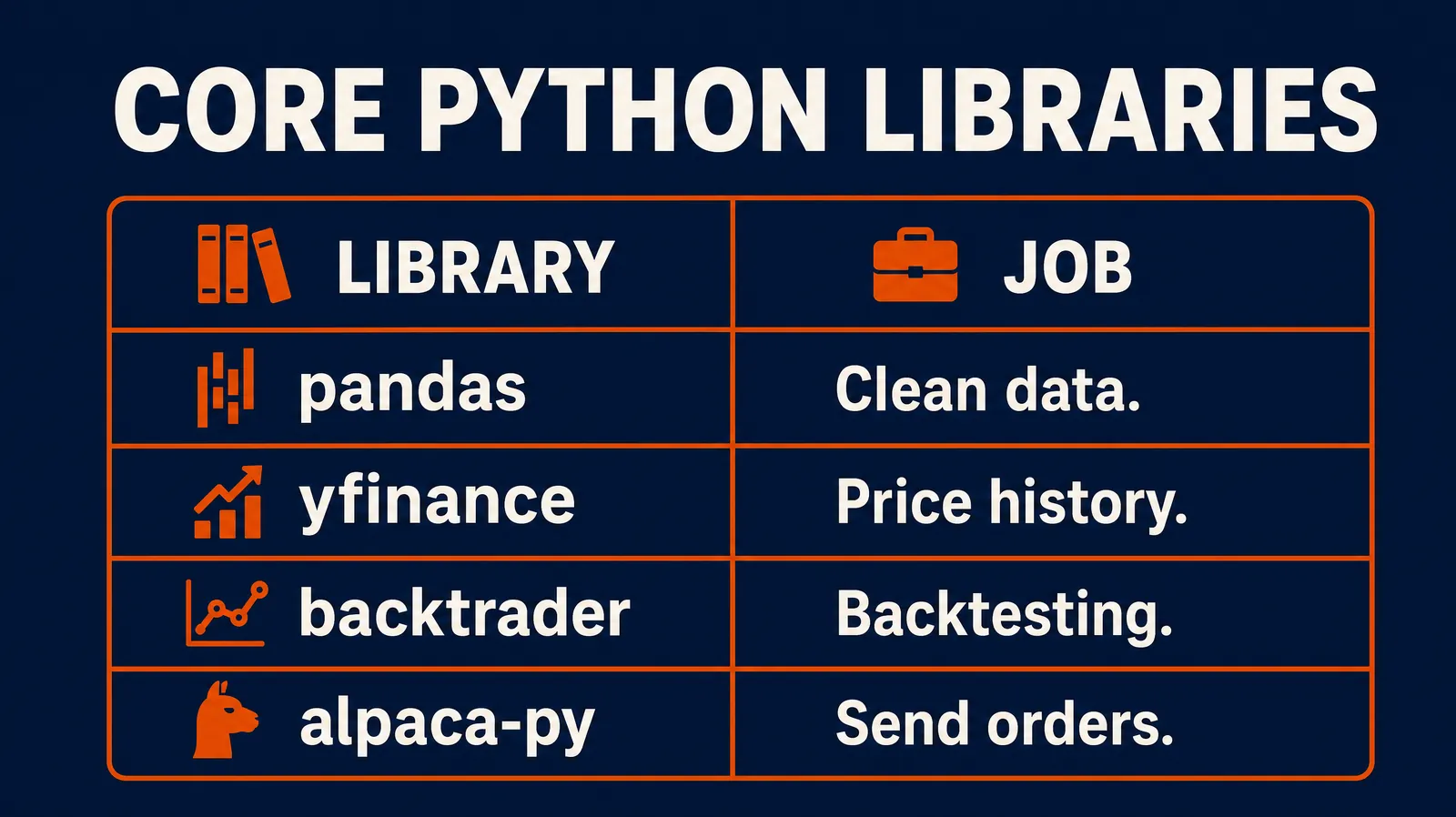
For a beginner stack, you need four things: data handling, math, backtesting, and execution. You don’t need fifteen libraries. You need four that work together.
| Layer | Common Choice | What It Does |
|---|---|---|
| Data handling | pandas | Cleans and organizes price history into a usable table |
| Numeric work | NumPy | Runs the math behind indicators and returns |
| Backtesting | Backtrader or vectorbt | Simulates your strategy against historical data |
| Execution | Broker SDK (alpaca-py, ib_async) or PyAlgoTrade | Sends paper or live orders; PyAlgoTrade bundles backtest and execution in one framework [7] |
PyAlgoTrade bridges backtest and live execution in one framework (check its maintenance status before building on it), which matters because switching tools between testing and going live is where a lot of bugs sneak in [7]. Nurp’s beginner roadmap places pandas and basic Python fluency in months one and two, then backtesting frameworks in months three and four, for a reason: you can’t test what you can’t clean [3].
Decision rule: if you’re still learning Python syntax, skip live-trading libraries entirely. Start with pandas and a spreadsheet mindset. Add backtesting tools once you can manipulate a dataframe without looking it up.
How to Get Historical Stock Data for Backtesting in Python
You get historical data through free or paid market data APIs, pulled directly into Python with pandas, and most beginner guides recommend having at least 2 to 5 years of price history before trusting a backtest [5]. Common sources include Yahoo Finance, Alpha Vantage, and broker-provided feeds like Alpaca and Interactive Brokers [4][8].
- Free tier data (Yahoo Finance, Alpha Vantage): fine for learning and early testing, often delayed or capped on request volume.
- Broker API data (Interactive Brokers, Alpaca): better quality, ties directly to the same account you’ll eventually trade live from [4][8].
- Data cleaning matters more than data volume. Gaps, stock splits, and dividend adjustments will quietly wreck a backtest if you don’t handle them.
Common mistake: testing on only the last six months of a strong trend. That’s not a backtest, that’s a highlight reel.
Backtesting vs Live Trading: What’s the Difference
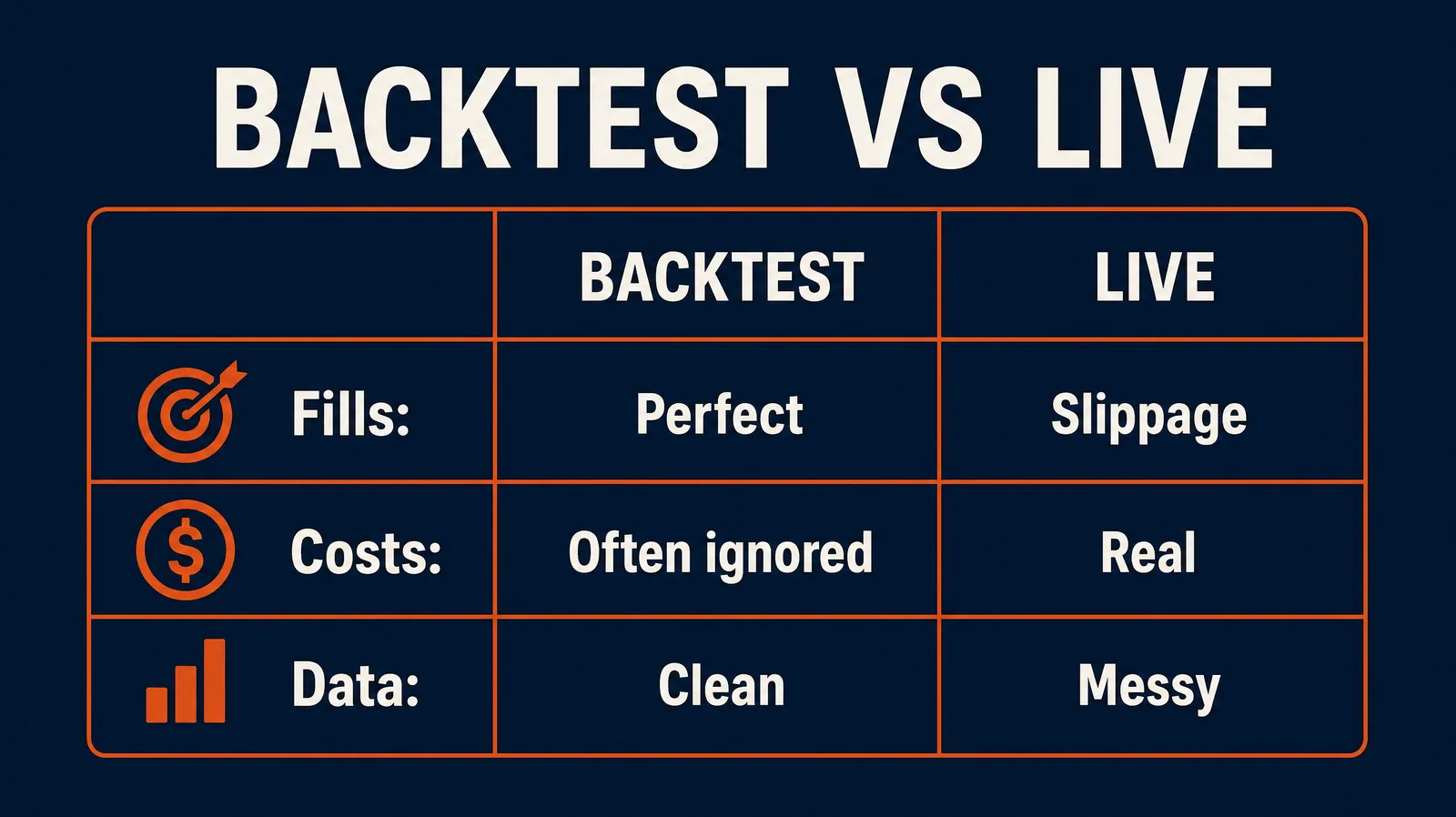
Backtesting simulates a strategy against past prices with no real money at risk. Live trading executes real orders in real time, with real slippage, real fees, and real emotion attached. They are related steps in one process, not two versions of the same thing.
| Factor | Backtesting | Paper Trading | Live Trading |
|---|---|---|---|
| Money at risk | None | None | Real capital |
| Data | Historical | Real-time (simulated fills) | Real-time (real fills) |
| Slippage/fees | Often ignored or estimated | Sometimes modeled | Always present |
| Purpose | Test the rule | Test the execution and nerves | Prove the system with skin in the game |
| Typical duration | 2 to 5 years of history [5] | 3+ months minimum [5] | Small size first, then scale |
A strategy that looks great in a backtest and falls apart in paper trading almost always has a cost problem: commissions, spreads, or bad fills eating the edge that looked fine on paper [3][9]. If you haven’t run how to backtest a trading strategy without fooling yourself, that’s the next stop before you touch a broker API. Our Backtesting guide covers the five checks every honest backtest passes.
How Much Money Do You Need, and Can Beginners Actually Make Money
You can start learning and backtesting Python algorithmic trading with zero dollars, but funding a live account with a tested strategy usually starts small, often in the hundreds to low thousands, not because of a rule but because you’re supposed to be testing execution, not chasing size. Whether you make money depends almost entirely on whether you skip the testing phases or respect them.
DXPA’s 2026 beginner guide recommends starting live capital at the smallest position size that still teaches you something, for example trading 10 shares instead of the “full” 100 the backtest used, so slippage and psychology get tested cheap before they get tested expensive [5]. That’s not caution for caution’s sake. That’s how you avoid finding out your strategy has a fatal flaw with real rent money on the line.
The base rate is brutal. A study of Brazilian futures day traders by Chague, De-Losso, and Giovannetti found that 97% of those who kept at it for more than 300 days lost money [11]. Undisciplined automation doesn’t fix that, it just loses faster. Free tools exist for exactly this reason: to let you build and test before you fund anything. If you want a straight look at whether bots actually deliver, we ran the real numbers on automated trading performance.
Python Algorithmic Trading vs Manual Trading: Which One Wins
Neither wins outright. Python algorithmic trading removes emotion and enforces consistency, manual trading keeps human judgment for situations no rule anticipated, and the right answer for most beginners is a hybrid: automate the boring, repeatable parts and keep a human veto.
Where automation wins:
- Executing the same rule the same way every time, no revenge trading after a loss.
- Running across multiple tickers without staring at a screen.
- Backtesting hundreds of variations of a rule before risking a dollar.
Where manual trading still holds an edge:
- Reading news events, earnings surprises, or sudden volume spikes a rule wasn’t coded for.
- Adjusting quickly when the tape gets choppy in ways historical data never showed.
Discipline beats prediction either way. A human who follows a written plan and a bot running a tested strategy are doing the same job, one just doesn’t get tired. For a deeper look at where retail traders get the automation pitch wrong, read what retail traders get wrong about algorithmic trading AI.
What Skills You Need and How Long Python Algorithmic Trading Takes to Learn
You need three skill sets before writing a live strategy: basic Python programming, statistics for evaluating a strategy’s real edge, and market mechanics like order types, spreads, and risk-reward. Most structured guides put total learning time at 6 to 12 months for a beginner working consistently, with 2 to 3 months just to get comfortable with core Python [3][5].
A realistic sequence looks like this:
- Months 1 to 2: Python fundamentals and pandas. Nothing trading-related yet.
- Months 3 to 4: Build or adopt a backtesting framework, learn common statistical traps like overfitting [3].
- Months 5 to 6: Learn performance metrics: expectancy, drawdown, win rate versus average win/loss size [3].
- Months 7 to 12: Paper trade, then go live small, with a defined shutdown rule if results deviate from the backtest [1][3].
Self-paced tracks like the “100 Days Of Hell With Python Algotrading” project on GitHub compress this into a faster, code-heavy sprint for motivated beginners, moving from Python basics straight through strategy building and portfolio management [10]. Before any of that, know your actual edge. Find your trading edge before risking a dollar covers the thinking that has to happen before the code does.
How to Backtest a Trading Strategy in Python
Backtesting a strategy in Python means running your rule against historical price data, accounting for costs, and checking whether the results hold up on data the rule never saw. The steps, in order:
- Write one testable hypothesis. Not “buy dips,” but “buy when RSI crosses below 30 and volume is above the 20-day average.”
- Pull clean historical data, 2 to 5 years minimum, adjusted for splits and dividends [5].
- Code the rule and run it against the full dataset, including realistic fees and slippage estimates.
- Split the data. Test on one period, validate on a period the strategy hasn’t seen (walk-forward testing) [1].
- Stress-test with Monte Carlo simulation to see how the strategy behaves under randomized order sequences [1].
- Check expectancy and drawdown, not just total return. A strategy that returns 20% with a 60% drawdown isn’t a strategy, it’s a coin flip with extra steps.
A free trading expectancy calculator is a fast way to sanity-check a backtest’s math before you trust it with real capital.
Connecting Python to a Broker API for Live Trading
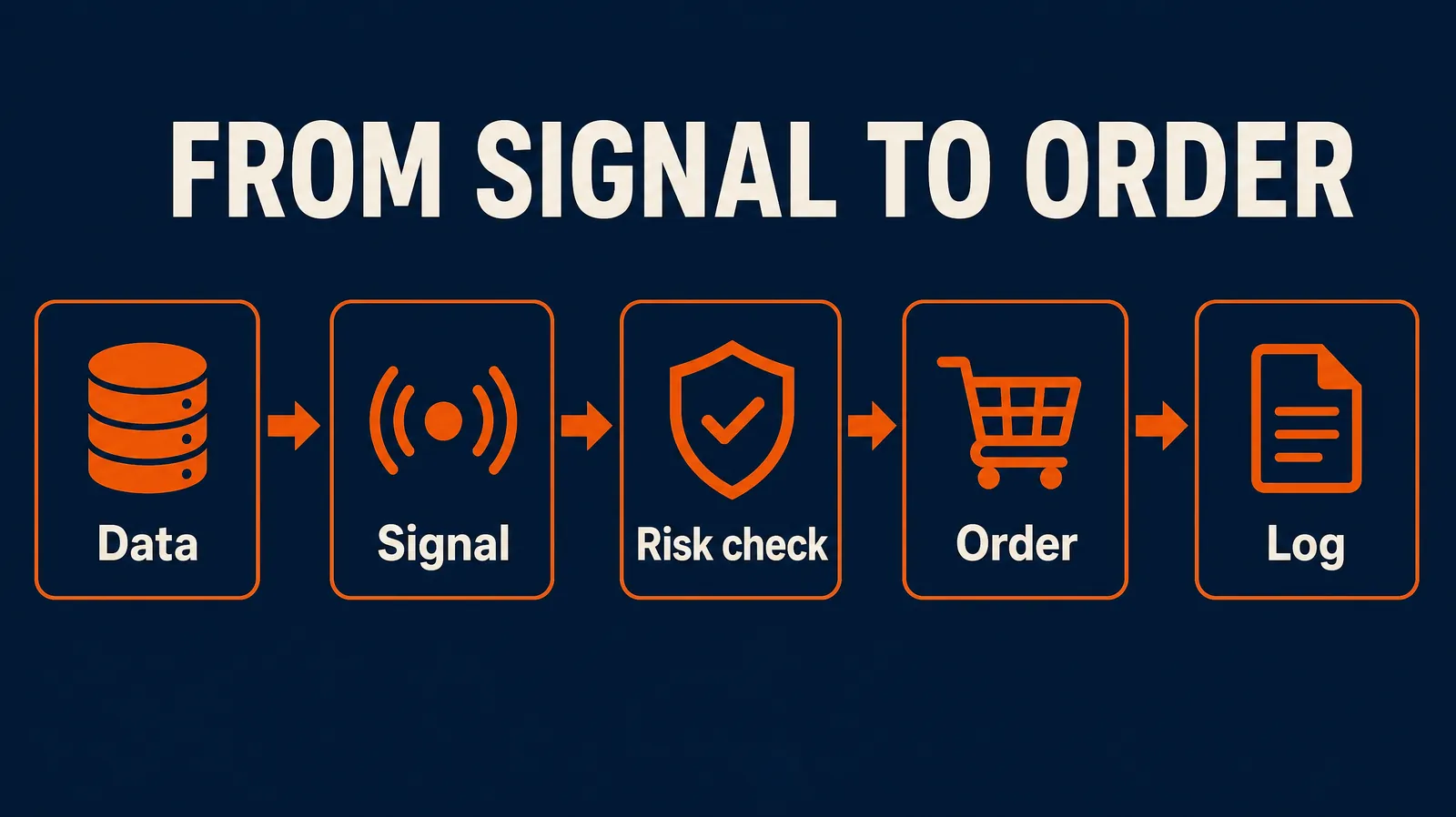
Connecting Python to a broker API means authenticating your account through the broker’s software interface, subscribing to a real-time data feed, and letting your code place orders directly instead of you clicking a trade ticket. Interactive Brokers publishes official 2026 guidance through IBKR Campus specifically covering this Python-to-execution path [4][8].
A typical live setup, based on published broker and developer walkthroughs, looks like this: subscribe to a real-time one-minute data feed, compute a signal (a simple moving average crossover is the common teaching example), and route a buy or sell order through the broker’s API when the condition triggers [9]. That’s the entire mechanical loop. The strategy logic underneath it is where all the actual work lives. Our Broker APIs guide compares the main options and the API key safety rules.
Before you flip this on: build a kill switch. A hard rule that shuts the system down if it drifts outside its backtested performance bounds, no exceptions, no “let’s see what happens next” [1]. Fully automated trading bots that skip this step are how small accounts disappear overnight.
Best Brokers for Algorithmic Trading With Python
The best brokers for Python algorithmic trading offer a documented API, real-time data access, and a paper trading environment so you can test the connection before funding it. Interactive Brokers is the most heavily documented option for Python specifically, with dedicated campus guides for authentication, data subscription, and order routing published through 2026 [4][8].
| Feature to Check | Why It Matters |
|---|---|
| Official Python API docs | Determines how much you build from scratch versus reuse |
| Paper trading environment | Lets you test the live connection with zero capital at risk |
| Real-time data access | Delayed data makes intraday strategies unreliable |
| Order types supported | Limit, stop, and bracket orders matter more than market orders for risk control |
Browse the best-rated AI trading platforms of 2026 for a side-by-side look at tools built on top of these broker connections, scored on signal quality, transparency, and cost.
Common Mistakes Beginners Make in Algorithmic Trading
The most common mistake is treating a backtest as proof instead of a hypothesis, and funding a live account before paper trading confirms the strategy survives real execution [1][5]. Second most common: sizing the first live trade the same as the backtest’s “full” position instead of starting small [5].
- Overfitting the backtest. Tuning a rule until it perfectly matches history, then watching it fail the moment new data arrives.
- Ignoring transaction costs. Fees and slippage can turn a profitable-on-paper strategy negative in practice.
- No kill switch. Letting a live bot run unsupervised with no rule for shutting it off [1].
- Overtrading the code. Automation doesn’t stop revenge trading, it just automates it faster.
For the full list, see Why Trading Bots Fail. Cut the noise, keep the alpha: fewer strategies run well, not more strategies run at once.
Algorithmic Trading Legal Issues and Regulations
Retail algorithmic trading of stocks, ETFs, and options through a standard broker account is legal in the United States, and it follows the same rules as manual trading: margin rules and standard reporting apply regardless of whether a human or a script placed the order. Regulatory guidance from FINRA covers day-trading margin requirements directly, and the SEC oversees broker-dealer conduct and market manipulation rules that apply equally to automated orders.
Where it gets more complex: running an algorithm for other people’s money crosses into investment adviser or commodity trading advisor territory, which brings registration requirements under SEC and CFTC rules. Trading your own account with your own code doesn’t trigger that. Managing someone else’s does.
Check current requirements directly at FINRA.org and SEC.gov before assuming your setup is exempt.
Education, not advice: This article explains concepts and process. It is not personalized investment advice, and it does not recommend any specific stock, ETF, option, future, or trading bot. Test any strategy on paper before risking real capital.
Our Take
Python algorithmic trading isn’t a shortcut past risk, it’s a longer, more disciplined path to the same market everyone else is trading. Data first, then code, then a backtest that survives a walk-forward test, then months on paper, then a small live position with a kill switch already built. Process over prediction, every step of the way.
Your next move: pick one testable strategy idea this week, pull two years of clean historical data, and run it through a backtest before you write a single line of live-order code. If this roadmap sounds thorough, that’s the point. It’s supposed to.
There are 200+ AI trading tools and platforms catalogued in the FullStack Alpha directory, filterable by category, price, and what they actually do.
Browse the FullStack Alpha directory of 200+ AI stock tools
This article is for education only and is not financial advice. FullStack Alpha does not sell trading signals or manage money. Some links on this page may be affiliate links.
Keep Going
More from AI Stock Trading Bots: Build a Trading Bot · Backtesting · Broker APIs.
Written and edited by Jay Rocco, Founder and Editor of FullStack Alpha. 200+ AI stock tools tested since 2022. Educational content only, not financial advice. See our Financial Disclaimer and How We Make Money.
Free weekly email
Join the FullStack Alpha newsletter
One email a week. The AI trading tools we tested, what broke, and what is worth your money. NO BS, no stock picks. Stay alpha.
Unsubscribe anytime. We never sell your email.
Stay alpha.
References
[1] Quantum Algo: Free Algorithmic Trading Course
[3] Nurp: Learn Algorithmic Trading, a Beginner’s Guide
[4] IBKR Campus: Python Development
[5] DXPA: Algorithmic Trading Introduction
[7] PyAlgoTrade documentation
[8] IBKR Campus: Algorithmic Trading
[9] Medium: Taking Your Strategy Live With Python
[10] GitHub: 100 Days Of Hell With Python Algotrading
[11] Chague, De-Losso, Giovannetti: Day Trading for a Living? (SSRN)
Frequently Asked Questions
Do I need to be a professional programmer to start Python algorithmic trading?
No. Basic Python fluency, loops, functions, and dataframe handling in pandas, is enough to build a first backtest. Most beginner roadmaps allow 2 to 3 months to reach that level.
What's the minimum amount of historical data I need for a backtest?
Most 2026 beginner guides recommend 2 to 5 years of price history, adjusted for splits and dividends, so the backtest covers different market conditions rather than one trend.
How long should I paper trade before going live?
At least 3 months is the common recommendation, long enough to see the strategy behave across different conditions without real money on the line.
Can a Python trading bot run without any supervision?
It shouldn't. Every credible roadmap includes a kill switch, a rule that shuts the system down automatically if performance drifts outside tested bounds.
Is algorithmic trading legal for individual retail traders?
Yes, for trading your own account. Managing other people's money through an algorithm can trigger investment adviser registration requirements under SEC and CFTC rules.
Which broker is easiest to connect to Python for a beginner?
Interactive Brokers has the most detailed published documentation for Python API connections, and Alpaca offers a simple official SDK with a free paper trading endpoint.
Jay Rocco is the Founder and Editor of FullStack Alpha. He has tested 200+ AI stock tools since 2022 and run 15+ AI trading platforms on live accounts with his own money. He reviews the software. He does not tell you what stocks to buy.
