

The FullStack Alpha research desk tests AI trading bots on paper and live accounts. Reviewed and edited by Jay Rocco, Founder and Editor.
By FullStack Alpha Editorial Team | Reviewed by Jay Rocco, Chief Editor
Options paper trading is available mostly through broker-native simulators, not third-party chart platforms. Schwab’s thinkorswim paperMoney, Interactive Brokers PaperTrader, and Webull’s updated 2026 simulator all let you place simulated options orders with real-time or near-real-time data, and the broker-native ones generally handle multi-leg orders like spreads and iron condors. The limit that matters most: simulated fills usually clear at or near the midpoint of the bid-ask spread with no queue ahead of you, which makes paper options look meaningfully better than the same trades live. Treat it as a mechanics lab, not a profit forecast.
What You Should Know
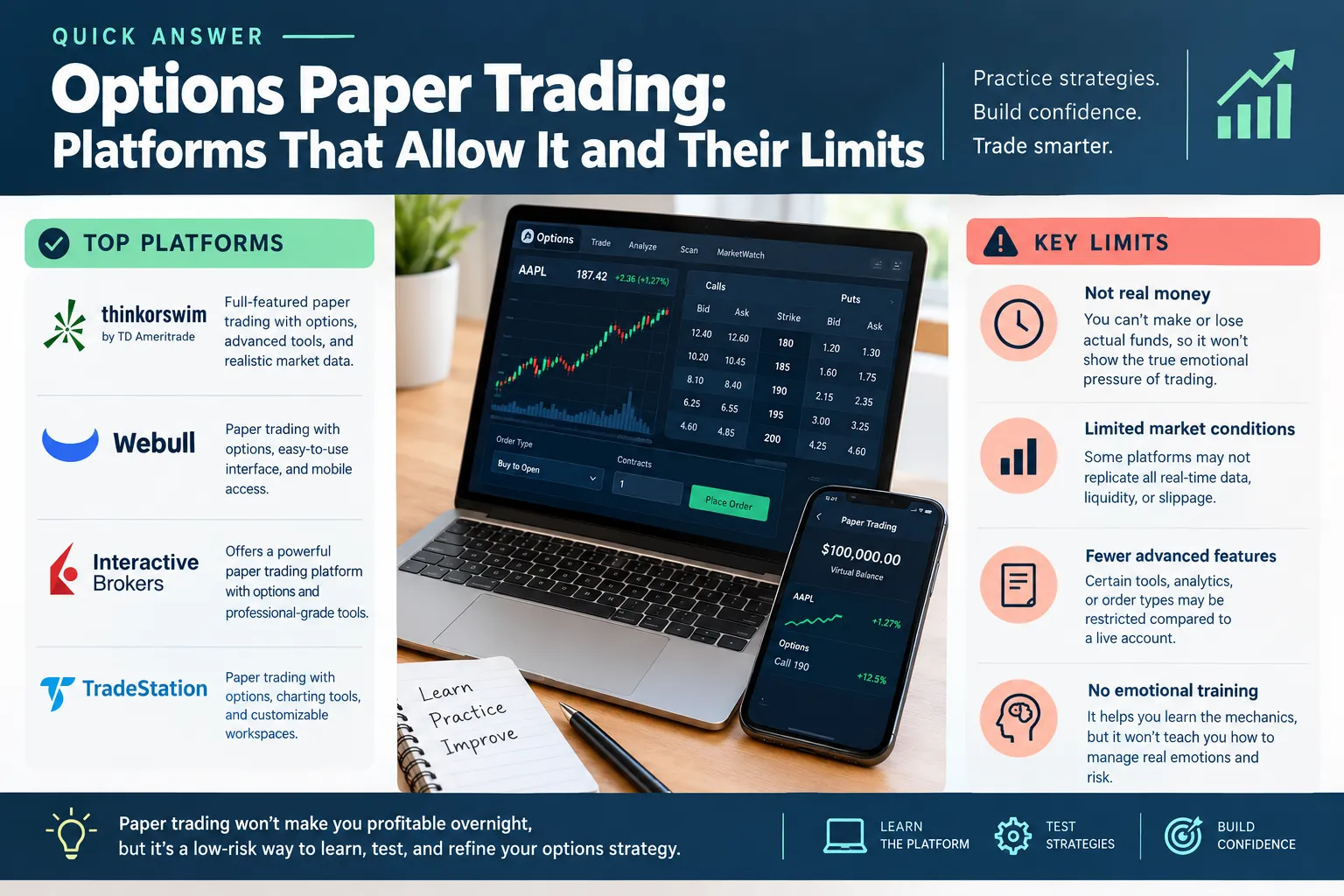
- thinkorswim paperMoney gives you $100,000 of virtual buying power with real-time data across equities, options and futures, and Schwab says the virtual balance can be adjusted. Schwab also offers a 30-day thinkorswim Guest Pass with no Schwab account required.
- Webull rebuilt its paper trading system in 2026 to cover stocks, ETFs, options, crypto, futures and event contracts, with market, limit, stop, stop-limit, trailing-stop, conditional, OCO, OTO and OTOCO orders.
- Webull’s options simulator runs regular hours only, 9:30 a.m. to 4:00 p.m. ET (some index options to 4:15). Its live side added pre- and post-market options on October 22, 2026 for 29 underlyings, limit orders only. The simulator does not match that.
- Interactive Brokers states plainly that PaperTrader fills come from the top of the book, not deep book, and that certain order types (VWAP, auction, RFQ, pegged-to-market) are unsupported.
- FINRA Regulatory Notice 26-10 took effect June 4, 2026, removing the pattern day trader designation and the $25,000 minimum equity rule in favor of risk-based intraday margin monitoring, with a transition period running to October 20, 2027.
Can You Do Options Paper Trading?
Yes. Several major U.S. brokers run simulated options accounts, and the good ones let you trade a live option chain with virtual money. What you get is a sandbox that mirrors the broker’s real order ticket: strikes, expirations, Greeks, margin math, and in most cases multi-leg orders.
A simulated options account does four things:
- Pulls real or near-real market data into a fake account balance.
- Accepts the same order types you’d use live, so your muscle memory transfers.
- Tracks P&L, margin and buying power against virtual capital.
- Routes nowhere. No exchange, no clearinghouse, no counterparty. The fill is a calculation, not a transaction.
That last point is the whole story. Interactive Brokers says it directly: PaperTrader can use real market prices and sizes, but the trades do not execute on an exchange or settle through a clearinghouse. Paper trading options is a flight simulator. It teaches the cockpit, not the turbulence.
What paper options trading actually teaches you
Mechanics. Which is not nothing.
- How a debit spread’s buying power requirement differs from a naked short put’s.
- What happens to your position when implied volatility drops after earnings.
- How theta decay feels over a two-week hold instead of how it looks in a textbook.
- Why you got assigned on the short leg of a call spread the day before an ex-dividend date.
What it cannot teach you
How you behave when real money is moving. Paper traders hold losers calmly because there’s nothing to lose. The same person down $400 live closes at the worst possible moment. That gap is the single biggest reason paper results don’t carry over, and no simulator on earth fixes it.
Observation: most new traders paper trade for a week, win, and conclude they’ve got it. Market truth: a week of simulated wins proves you can click buttons. Takeaway: paper trade it first, but judge the process, not the P&L.
Who should use options paper trading
- Anyone who has never submitted a multi-leg order and doesn’t want to learn vertical spread mechanics with a live account.
- Traders switching brokers who need to learn a new order ticket without fat-fingering a real position.
- Bot builders testing order logic before pointing code at a funded account.
Who should skip it
Experienced options traders already fluent in their platform. For them, options backtesting against historical data answers more useful questions than forward-simulating fake fills in real time.
Which Platforms Allow Options Paper Trading?
The short version: broker-native simulators lead, charting platforms lag. thinkorswim paperMoney, Interactive Brokers PaperTrader and Webull’s 2026 simulator are the three most clearly documented options paper trading environments. TradingView’s paper trading exists but its public docs don’t establish native options-chain depth, multi-leg handling or assignment modeling. Tastytrade and Alpaca each require checking the current official page before you count on options support. Our thinkorswim review goes deeper on the platform most readers end up using for this.
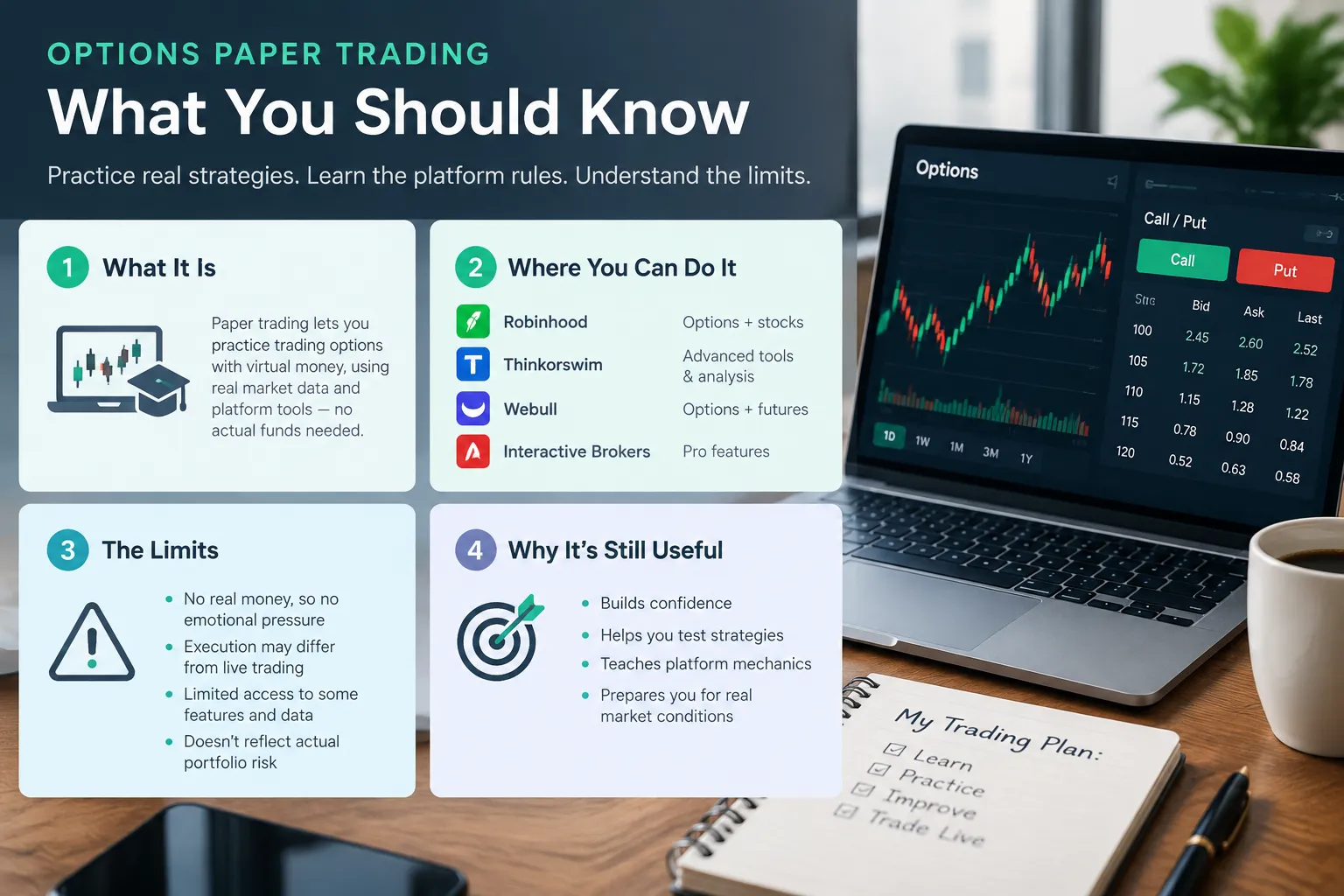
Here’s the comparison. Where a platform’s own documentation doesn’t clearly state a feature, the table says so rather than guessing.
| Platform | Options paper trading | Multi-leg orders | Data | Cost | Date checked |
|---|---|---|---|---|---|
| thinkorswim paperMoney (Schwab) | Yes, documented across equities, options, futures | Yes, full thinkorswim order ticket | Real-time per Schwab | Free; 30-day Guest Pass without an account | Oct 23, 2026 |
| Webull Paper Trading | Yes, options included in the 2026 rebuild | Documented order types include conditional, OCO, OTO, OTOCO; confirm spread entry on the official page | Regular hours only, 9:30a, 4:00p ET (index options to 4:15) | Free with a Webull account | Oct 23, 2026 |
| Interactive Brokers PaperTrader | Yes, broad multi-asset including options | Yes, IBKR supports combination orders; check official page for simulator parity | Real prices and sizes, but top of book only | Free with an IBKR account | Oct 23, 2026 |
| TradingView Paper Trading | Virtual-money trading integrated into charts; options depth not established in public docs | Check the official page | Depends on your data subscription | Free tier available | Oct 23, 2026 |
| Tastytrade | Check the official page | Check the official page | Check the official page | Check the official page | Oct 23, 2026 |
| Alpaca | Paper environment is the core of its API offering; confirm current options paper scope on the official docs | Check the official page | API-delivered | Free paper API keys | Oct 23, 2026 |
thinkorswim paperMoney: the default answer
If someone asks where to start and you only get one sentence, it’s paperMoney. Schwab positions it as a live-market simulation with options, futures, margin, charting and analytics, funded with $100,000 of virtual buying power that can be adjusted. The analytics side is the real draw: risk profile curves, probability analysis, and the same scanning tools the live platform uses.
Two caveats worth naming.
The $100,000 default is a trap for beginners. If your real account is $3,000, trading a six-figure simulator teaches position sizing habits that will destroy you live. Schwab says the balance is adjustable. Adjust it. Make it match your actual funding, to the dollar. This is the same position sizing mistake that wipes out new traders, just wearing a costume.
paperMoney data can lag the live feed. Schwab’s own guidance frames it as a simulation, not a mirror. Treat quote behavior as directionally right, not tick-accurate. More on the platform in our thinkorswim paper trading breakdown.
Webull: good, with a documented hours gap
Webull rebuilt its paper system in 2026 and it’s genuinely broad now: stocks, ETFs, options, crypto, futures and event contracts, with an order type list that runs market, limit, stop, stop-limit, trailing stop, conditional, algorithmic, OCO, OTO and OTOCO.
The gap is hours. Webull’s options paper trading documentation states it runs regular options market hours, 9:30 a.m. to 4:00 p.m. ET, with certain index options to 4:15, and does not support extended hours. Meanwhile, on October 22, 2026, Webull announced live options access from 7:30-9:25 a.m. and 4:00-4:15 p.m. ET across 29 underlying stocks and ETFs, limit orders only.
So the live product now does something the simulator can’t. If you plan to trade the pre-market options session, you cannot rehearse it on paper at Webull. Full platform notes in our Webull paper trading review.
Interactive Brokers: the most honest simulator
IBKR’s PaperTrader is the broadest multi-asset sandbox on the list, and more importantly, IBKR tells you where it lies. Its documentation states that paper fills are simulated from the top of the book without deep-book access, and that VWAP, auction, RFQ and pegged-to-market orders aren’t supported.
Top-of-book simulation means the fill engine only sees the best bid and best offer, not the full depth behind it. On a liquid SPY weekly, that’s close enough. On a $4.20 bid / $5.80 ask option on a low-float name, it’s fiction.
That disclosure is why IBKR scores well here. A simulator that names its own limits is more useful than one that quietly flatters you.
TradingView, Tastytrade and Alpaca
TradingView revised its paper trading documentation on October 22, 2026, describing it as a virtual-money environment built into the charting interface. What the public docs do not clearly establish is native options-chain handling, multi-leg entry or assignment modeling at the depth broker-native simulators provide. If your plan is practicing iron condors, check the official page before committing. For charting itself, see our TrendSpider vs TradingView comparison.
Tastytrade is an options-first broker with a strong reputation among active options traders, but its current simulator scope should be confirmed on tastytrade’s own page rather than assumed from reputation.
Alpaca built its business on a paper API, which makes it the natural pick for bot developers. Confirm the current options paper scope in Alpaca’s docs before you write order logic against it.
Why Do Paper Options Fills Look Better Than Live?
Because the simulator hands you the best half of every trade. Paper engines typically fill at or near the midpoint of the bid-ask spread, place you at the front of a queue that doesn’t exist, and ignore the liquidity problems that define real options trading. Across a hundred trades, that gap compounds into a P&L that bears no relationship to what a funded account would have produced.
Five specific mechanisms, each with an example.
1. The bid-ask spread is the real commission
The bid-ask spread is the gap between what buyers will pay and what sellers will accept. On options it’s wide, and crossing it is a cost you pay twice: once entering, once exiting.
Example: a call shows 2.00 bid / 2.20 ask. Buy at the ask and sell at the bid immediately and you’re down $20 per contract on a round trip, before commissions. On ten contracts, that’s $200 of pure friction the simulator may never charge you.
2. Mid-price fills you’d never get live
Many simulators fill at the midpoint by default. Live, a mid-price limit on a thin option sits unfilled for twenty minutes.
Example: your simulator fills that 2.00/2.20 call at 2.10. Live, you’d likely pay 2.18 after chasing. Eight cents on 20 contracts is $160, on one trade, that the paper account quietly gifted you. That’s slippage, and it’s covered properly in our paper trading slippage guide.
3. No queue, no partial fills
Real orders join a line. Paper orders teleport to the front.
Example: 50 contracts sitting at the bid ahead of you on a $0.65 strike. Live, you get 12 filled and the rest sits. Paper, you get all 50 at once. Every scaling, partial-exit and stop-ladder lesson you think you learned is invalid.
4. Wide spreads on illiquid strikes
The further out you go, the worse it gets. Far-dated, far-OTM, low-volume strikes can quote 30% wide.
Example: a January LEAP on a mid-cap quoting 3.40 bid / 4.60 ask. Paper mid-fills you at 4.00 and declares a win when it ticks to 4.20. Live, you’d have bought at 4.55 and sold at 3.60. The paper trade shows profit. The live trade is a 20% loss. Same chart, opposite outcome.
5. Assignment barely exists in simulation
Assignment is when the holder of a short option exercises it and you’re handed the stock obligation. American-style equity options can be assigned at any time, often around ex-dividend dates.
Example: you’re short a 50-strike call in a credit spread. The stock goes ex-dividend at $1.20. The call holder exercises early to capture it, and you’re suddenly short 100 shares per contract with an overnight margin call. Most simulators model assignment loosely, at expiration, or not at all. Live, this is the single most common surprise for new spread traders.
Market truth: your paper P&L is your best case, minus nothing. Live, you pay the spread, the queue and the surprises. Takeaway: mentally haircut every paper result by the spread width, both directions, before you believe it.
Can You Paper Trade Multi-Leg Options Strategies?
Mostly yes on broker-native platforms, and that’s exactly where paper trading with options earns its keep. thinkorswim paperMoney supports the full thinkorswim order ticket, which includes verticals, iron condors, straddles, strangles, butterflies and calendars. Interactive Brokers supports combination orders. Webull’s documented order type list covers conditional and bracketed structures; confirm native spread entry on Webull’s own page.
Where multi-leg paper trading breaks down:
- Leg-by-leg fills. A real spread order is one order with one net price. Some simulators fill each leg at its own midpoint, which is more generous than any market maker will be. Your paper iron condor collects $1.20 credit; live, you take $1.02.
- Early assignment on the short leg. Covered above, and it’s the specific failure mode for credit spreads and iron condors. Simulators rarely spring it on you.
- Pin risk at expiration. When the underlying closes within pennies of your short strike, you don’t know until after hours whether you’re assigned. Paper platforms tend to resolve this cleanly. Reality does not.
- Margin requirement changes. A defined-risk spread that goes bad can have its margin treatment shift when one leg goes deep in the money. Simulator margin engines are approximations.
A decision rule for multi-leg practice
Choose paper for structure, not pricing. Use the simulator to learn how to build a put credit spread, what each leg does to your risk graph, and where your breakevens sit. Do not use it to decide whether a credit of $0.85 on that structure is tradeable, because the simulator’s $0.85 isn’t real.
Common mistake with complex spreads on paper
Jumping to iron condors in week one because they “always win.” They win until one tail event, and paper trading never shows you the tail with real money attached. Run verticals until you can draw the risk graph from memory. Then add legs. For strategy tooling comparisons, see our Option Alpha vs Atomik Trading breakdown.
Can You Paper Trade Options Through an API for a Bot?
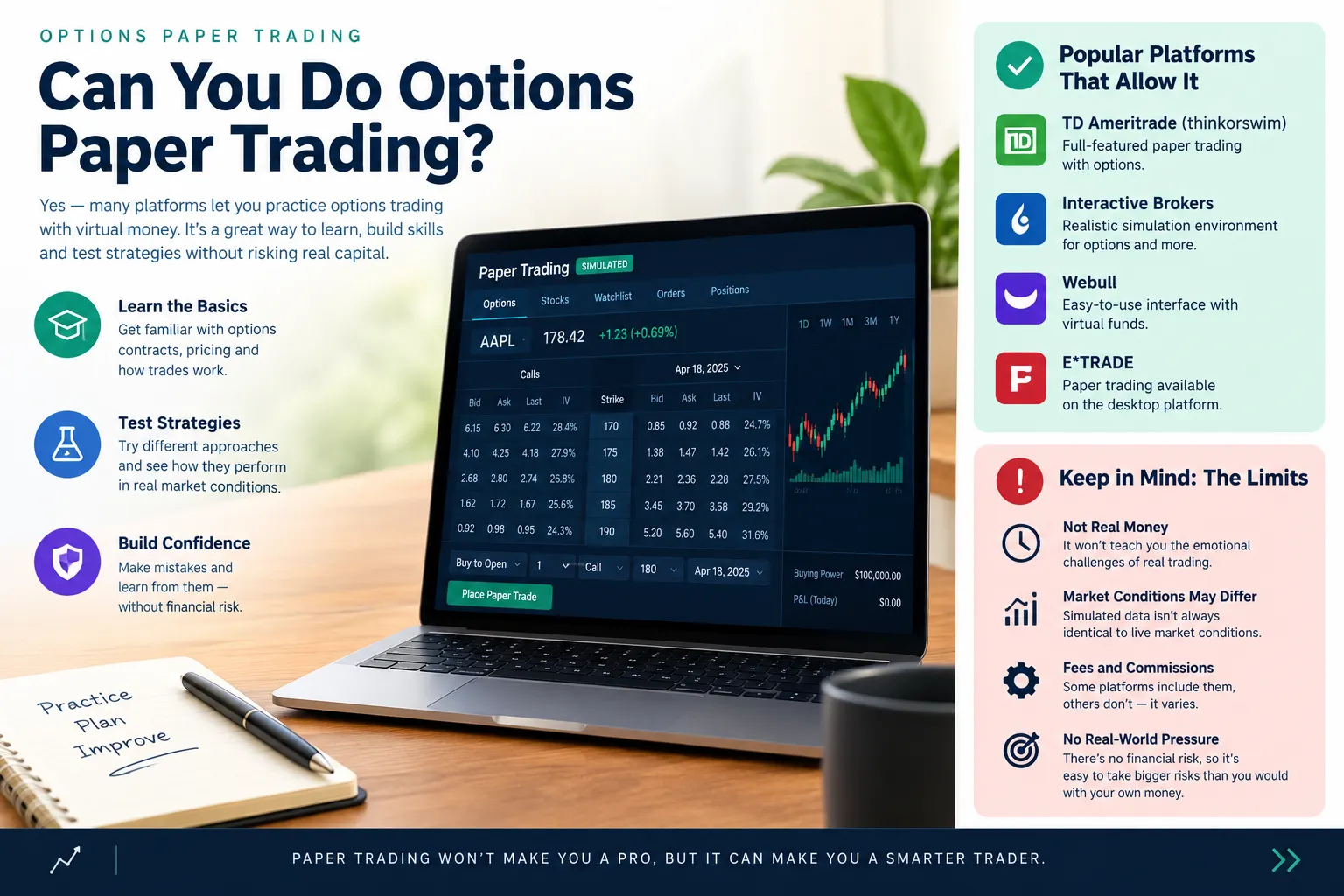
Yes, but the confirmed options paper API surface is narrower than the equities one. Alpaca built its platform around a paper trading API with free keys, and Interactive Brokers exposes PaperTrader through its API with the same connection methods as live. For options specifically, confirm current scope on each broker’s own developer documentation before writing order logic, because options endpoints have changed faster than equities endpoints over the past two years.
What to verify before building:
- Does the paper endpoint accept options symbols in the same format as live, or a different one? Format mismatches are the number one wasted weekend.
- Are multi-leg orders supported via API, or only single legs? Some brokers support spreads in the GUI and not the API.
- What’s the rate limit on the paper environment versus live? Paper limits are often tighter, which breaks scanning logic that works fine in production.
- How are fills simulated? IBKR’s top-of-book disclosure is the model here. If a broker won’t tell you, assume generous.
- Does the paper account reset? Some paper environments wipe balances on a schedule. A reset mid-test ruins a 60-day run.
For Alpaca specifics, see our Alpaca options API guide.
The bot-specific trap
Paper APIs make backtest-grade assumptions in real time, which is the worst of both worlds. You get the optimistic fills of a backtest and the slow clock of live trading. A strategy showing a 68% win rate over 400 paper trades can go negative live purely on fill quality, with every entry signal unchanged.
Fix: build a slippage penalty into your own accounting layer. Log the broker’s reported fill, then separately log what the fill would have been at the far side of the spread. Run both P&L curves side by side. If the pessimistic curve is still profitable, you have something. If only the optimistic curve works, you have a spreadsheet.
If you’re evaluating automation generally, our guide to which AI trading bots are legit versus scams covers the same skepticism applied to vendors.
How Do You Run an Honest Options Paper Test?
Treat it like a lab experiment with a pre-registered hypothesis, not a video game. The goal isn’t a big simulated number. It’s finding out whether your process survives contact with pessimistic assumptions and a sample size large enough to mean something.
Seven steps.
- Set the virtual balance to your real account size. If you’ll fund $5,000, set the simulator to $5,000. thinkorswim’s $100,000 default teaches sizing habits you can’t afford. This single adjustment is worth more than any indicator you’ll add this year.
- Pick one strategy and one underlying set. Put credit spreads on five liquid large caps. That’s it. Rotating strategies across 40 tickers produces noise, not data.
- Fill at the worse side of the spread, manually. The simulator says you got 2.10. Log 2.18 entering and 2.02 exiting. Yes, by hand, in a spreadsheet. If the strategy only works at mid, it doesn’t work.
- Log every assignment and every near-assignment. When a short leg goes in the money near ex-dividend, write down what would have happened even if the simulator ignored it. These events are where undefined-risk trades die.
- Set a minimum trade count before you judge anything. 50 closed trades is a floor, 100 is better. Anything under 30 is a coin flip with extra steps.
- Record the reason for every entry and exit before you place it. “IV rank above 40, 30 DTE, short strike at 20 delta.” If you can’t write the rule, you don’t have a system, you have a hunch.
- Compare the paper results against a backtest of the same rules. Backtesting runs your rules over historical data; paper trading runs them forward in real time. If the two disagree badly, one of them is lying and it’s usually the one with better numbers. Our options backtesting guide covers that setup.
Paper trading vs backtesting: the difference that matters
Backtesting answers “would this rule have worked historically?” Paper trading answers “can I execute this rule in real time without panicking or fat-fingering it?” Different questions, both necessary.
Backtests suffer from hindsight bias and survivorship problems. Paper trading suffers from no-money bias and fake fills. Run both. Where they agree, you’ve got something worth funding.
How long should you paper trade before going live?
Trade count, not calendar time. 50 to 100 closed trades under one documented rule set, or roughly 60 to 90 days for most swing-oriented options strategies. Anyone who tells you “two weeks” is selling something.
But the clock matters too. A strategy that only ever saw a calm, grinding uptrend hasn’t been tested. You want at least one ugly week in the sample, and ideally one earnings season.
Common mistakes in options paper trading
- Trading size you’d never trade live. Ten contracts on paper, one live. The lesson doesn’t transfer.
- Not logging losses honestly. Closing a losing paper trade and pretending it didn’t count.
- Restarting the account after a bad week. The reset button is the most dangerous feature in any simulator. Live, there’s no reset.
- Paper trading forever. At some point the fear becomes the strategy. A single contract live teaches more in a week than six months of simulation.
- Treating the paper P&L as a forecast. It isn’t one. It’s a best case.
Which Broker Is Best for Options Paper Trading?
By use case, based only on what each platform documents.
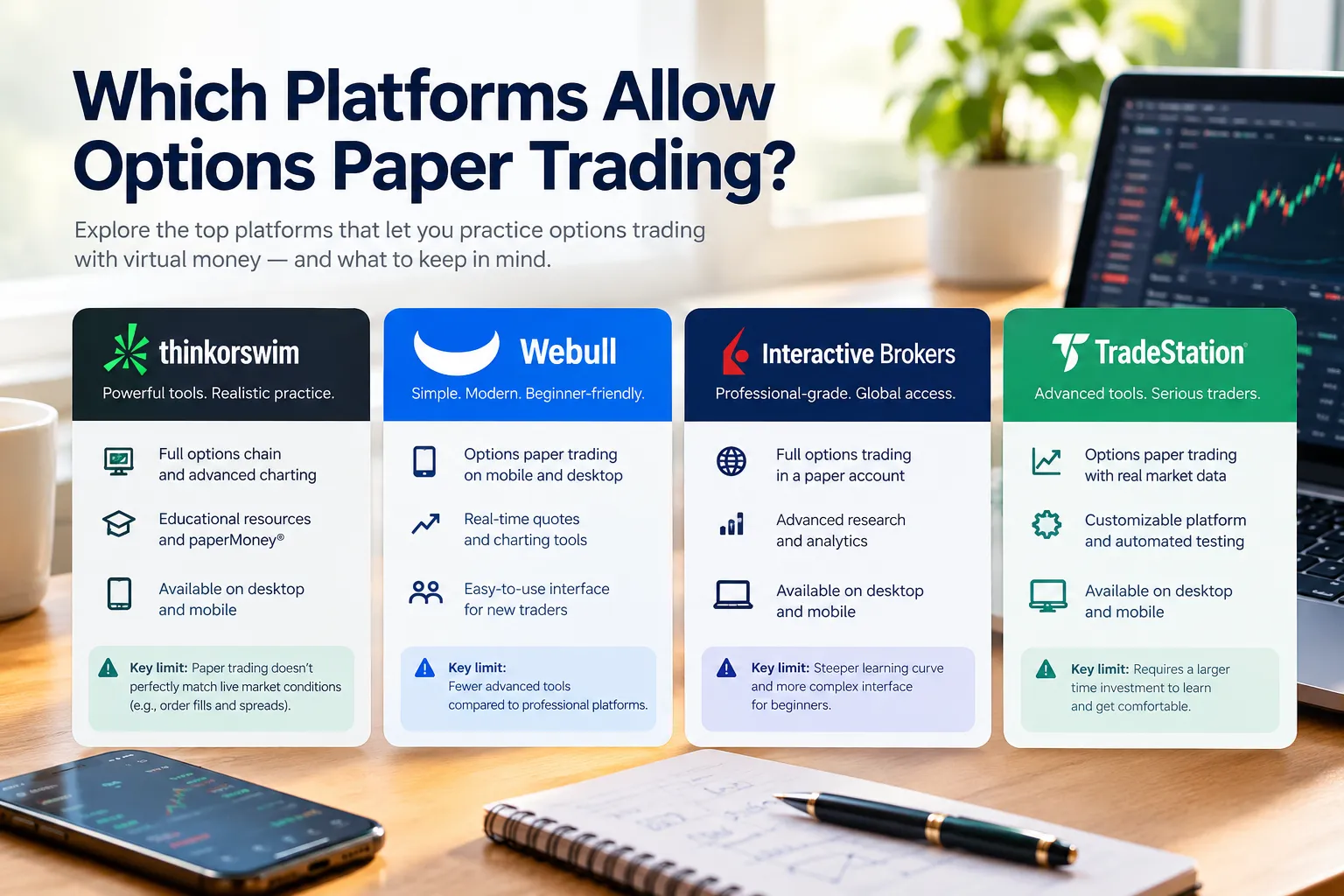
Best overall for learning option paper trading: thinkorswim paperMoney. Real-time data, options, futures and margin in one simulator, $100,000 adjustable virtual buying power, and the analytics tooling to actually understand a risk graph. The 30-day Guest Pass means you can test it without opening a Schwab account. Set the balance to your real size on day one.
Best for multi-asset and honest limits: Interactive Brokers PaperTrader. Broadest product coverage and the clearest documented disclosure about top-of-book fills and unsupported order types. Steeper interface, which is a real cost for beginners. If you want to know exactly where the simulation ends, IBKR tells you.
Best mobile-first experience: Webull. The 2026 rebuild covers stocks, ETFs, options, crypto, futures and event contracts with a broad order type list, and the app is genuinely good on a phone. Hard limit: options paper trading runs regular hours only, so you cannot rehearse the extended-hours options sessions Webull added live on October 22, 2026.
Best for bot developers: Alpaca. Free paper API keys and a developer-first design. Confirm current options paper scope in Alpaca’s docs first.
Check before relying on it: TradingView and Tastytrade. TradingView’s paper trading is real but its public documentation doesn’t establish options-chain depth, multi-leg or assignment handling at broker-native levels. Tastytrade is an excellent live options broker; confirm its simulator scope on its own page.
For a broader field, see our roundup of paper trading apps.
Does paper trading count toward pattern day trader rules?
No. Simulated trades are not real trades and never counted toward PDT. And as of June 4, 2026, the question matters less: FINRA Regulatory Notice 26-10 eliminated the pattern day trader designation and its $25,000 minimum equity requirement, replacing it with risk-based intraday margin monitoring, with a transition period running through October 20, 2027. FINRA published further interpretations on May 19, 2026 in Notice 26-11 addressing option day trades, spreads and combinations.
The simulator wrinkle: some paper platforms may still display legacy day-trading warnings and counters that no longer reflect live rules. If your paper account flags a “day trade limit,” check your actual broker’s current intraday margin policy rather than trusting the simulator’s old logic.
Are there fees for options paper trading accounts? Generally no. paperMoney, PaperTrader, Webull paper and Alpaca paper keys are free. The hidden cost is data: real-time options quotes may require a market data subscription on some platforms, and your simulator inherits whatever feed your account has. Delayed data in an options simulator is close to useless for anything intraday.
Is Options Paper Trading Worth Your Time?
Yes, for a defined window and a defined purpose. It’s worth four to twelve weeks to learn order mechanics, Greeks behavior and multi-leg construction without paying tuition to the market. It stops being worth it the moment you’re using it to avoid the discomfort of real money.
Signs you’re ready to go live:
- 50+ closed paper trades under one written rule set.
- You can state your entry trigger, exit trigger, stop and position size in one sentence, without looking it up.
- You’ve been through at least one losing week without changing the rules mid-stream.
- You’ve logged at least one assignment or near-assignment event and know what you’d do.
- Your pessimistically-filled P&L (worse side of the spread, both ways) is still break-even or better.
Signs you’re not:
- You’ve reset the paper account more than once.
- Your win rate is above 80%, which almost always means fake fills or cherry-picked logging.
- You can’t explain why your last losing trade lost.
- You’re still changing strategy every week.
The go-live protocol
Start at one contract. Not five, not “a small position.” One. Trade one contract for 20 trades minimum. Your job isn’t to make money, it’s to prove your paper process survives the adrenaline. Then scale by risk, not by confidence.
Observation: most traders skip from paper straight to full size. Market truth: the behavioral gap between $0 and $500 at risk is bigger than the gap between $500 and $5,000. Takeaway: make the first live step tiny on purpose.
Frequently Asked Questions
Where can I trade options with paper money?
Schwab’s thinkorswim paperMoney, Interactive Brokers PaperTrader and Webull’s 2026 paper trading system all support simulated options. paperMoney offers $100,000 adjustable virtual buying power plus a 30-day Guest Pass without a Schwab account. IBKR covers the broadest product set. Webull’s options simulator is limited to regular market hours.
Can you day trade on the Investopedia Simulator?
The Investopedia Simulator is a stock-market game built for education, and its features change over time, so confirm current day trading and options support on Investopedia’s own page before relying on it. For serious options paper trading, a broker-native simulator with a real option chain is the better tool.
Can I do options in paper trading?
Yes, on broker-native platforms. thinkorswim paperMoney, Interactive Brokers PaperTrader and Webull all document simulated options trading, and the broker-native ones generally support multi-leg orders like verticals and iron condors. Charting-first platforms vary, so check the official page for options-chain depth and assignment handling before committing.
Which broker is best for paper trading?
thinkorswim paperMoney for overall options learning, Interactive Brokers PaperTrader for multi-asset breadth and documented honesty about its fill limits, Webull for mobile, and Alpaca for API-driven bot testing. Pick by what you’ll actually trade live, since the point is practicing the exact platform you’ll fund.
Is options paper trading realistic?
Partly. Market data and order mechanics are realistic; fills and psychology are not. Simulators commonly fill at the bid-ask midpoint with no queue ahead of you, and Interactive Brokers states its paper fills come from the top of the book only. Expect your live results to be worse than your paper results by roughly the spread, both directions.
What’s the difference between paper trading and backtesting options?
Backtesting runs your rules over historical data to see if the edge existed. Paper trading runs your rules forward in real time to see if you can execute them. Backtests have hindsight bias; paper has fake fills and no emotional stakes. Run both and compare before funding anything.
Our Take
Paper options teach mechanics, not fills. That’s the whole verdict. Every simulator on this list will show you how a put credit spread behaves, what theta does to a 14-day position, and why assignment ruins a Thursday. Not one will show you what you’ll actually pay to get in and out, and none will show you how you behave when the number on the screen is your rent.
So use it the way a pilot uses a simulator: to make the controls boring, then get in the plane. Set the virtual balance to your real account size, fill yourself at the worse side of the spread, log 50 trades under one rule, then go live with one contract. Everything else is procrastination with a dashboard.
Run a paper options test you think holds up? Send it to us for review and we will put it through the same fill checks.
Stay alpha.
The FullStack Alpha research desk tests AI trading bots on paper and live accounts. Reviewed and edited by Jay Rocco, Founder and Editor.
