

The FullStack Alpha research desk tests AI trading bots on paper and live accounts. Reviewed and edited by Jay Rocco, Founder and Editor.
By FullStack Alpha Editorial Team | Reviewed by Jay Rocco, Chief Editor
A chatgpt trading bot is a trading program whose code was drafted by ChatGPT and then run somewhere else, usually in Python against a broker API or as a Pine Script strategy on TradingView. ChatGPT can write the entry logic, the indicator math, the backtest loop and the order-placement function in minutes. It cannot run that code, verify that the data is clean, or know that it quietly peeked at tomorrow’s close while testing. The review step that matters most: read every line that touches data timing and order size before a dollar goes near it. Skip that and you’re paying tuition to find bugs the slow way.
What You Should Know
- ChatGPT itself does not trade. OpenAI’s Help Center, as of October 2026, says eligible U.S. users can connect financial accounts and view investments, but ChatGPT cannot make trades, move money, change account settings, or open and close accounts.
- Brokers, not chatbots, added execution. Interactive Brokers announced IBKR Autonomous Trading on October 21, 2026, letting eligible clients authorize connected AI platforms (ChatGPT, Claude, Grok, Perplexity via Model Context Protocol) to submit supported orders across more than 75,000 listed stocks, options and ETFs inside a dedicated AI Partition.
- The CFTC is openly warning about AI bot fraud. Its October 2, 2026 advisory states AI cannot predict the future or sudden market changes, and flags schemes promising 100% win rates. It cites losses in the tens of millions, including a case involving nearly 30,000 bitcoin.
- Token cost is cheap and falling. OpenAI listed GPT-6 Sol at $2 per million input tokens and $10 per million output as of October 2026, with GPT-6 Luna at $0.10 and $0.50. Model calls are rarely the expensive part of a bot.
- Regulators treat AI-written strategies as algorithmic trading. ESMA’s February 26, 2026 supervisory briefing says trading is algorithmic when an algorithm determines any order parameter beyond simple routing, and that AI’s explainability problem must be handled inside compliance frameworks.
Key Takeaways
- ChatGPT is a fast first draft of a trading bot, not a finished bot.
- The standard ChatGPT product cannot place orders. Execution requires a broker integration like IBKR’s AI Partition or Robinhood’s agent account.
- The five most common ways a gpt trading bot breaks: look-ahead bias, wrong API calls, no risk limits, outdated library versions, and silent errors that swallow failures.
- A backtest without commissions, slippage and an out-of-sample window is a sales brochure, not evidence.
- Paper trade any chatgpt trading bot for at least 30 sessions before funding it.
- Jump Trading, per an October 6, 2026 OpenAI case study, uses GPT-6 Astra for coding and hypothesis validation and treats AI-generated signals as potentially wrong, subject to normal review and controlled execution.
- Beginners can learn a lot building one. Beginners should not fund one with money they need.
- Running costs are mostly data feeds, hosting and your time, not model tokens.
Can ChatGPT Build a Trading Bot?
Yes, ChatGPT can build a trading bot in the sense that matters least and the sense that matters most. It writes working code quickly. It does not run that code, validate it, or carry the loss when it’s wrong.
Ask for a Python script that buys when the 20-day moving average crosses above the 50-day and sells on a 2% stop, and you’ll get something readable in under a minute. Ask for the same logic as a Pine Script strategy for TradingView and you’ll get that too. This is the honest value of chatgpt stock trading work: it compresses the boring syntax part of building from days into minutes.
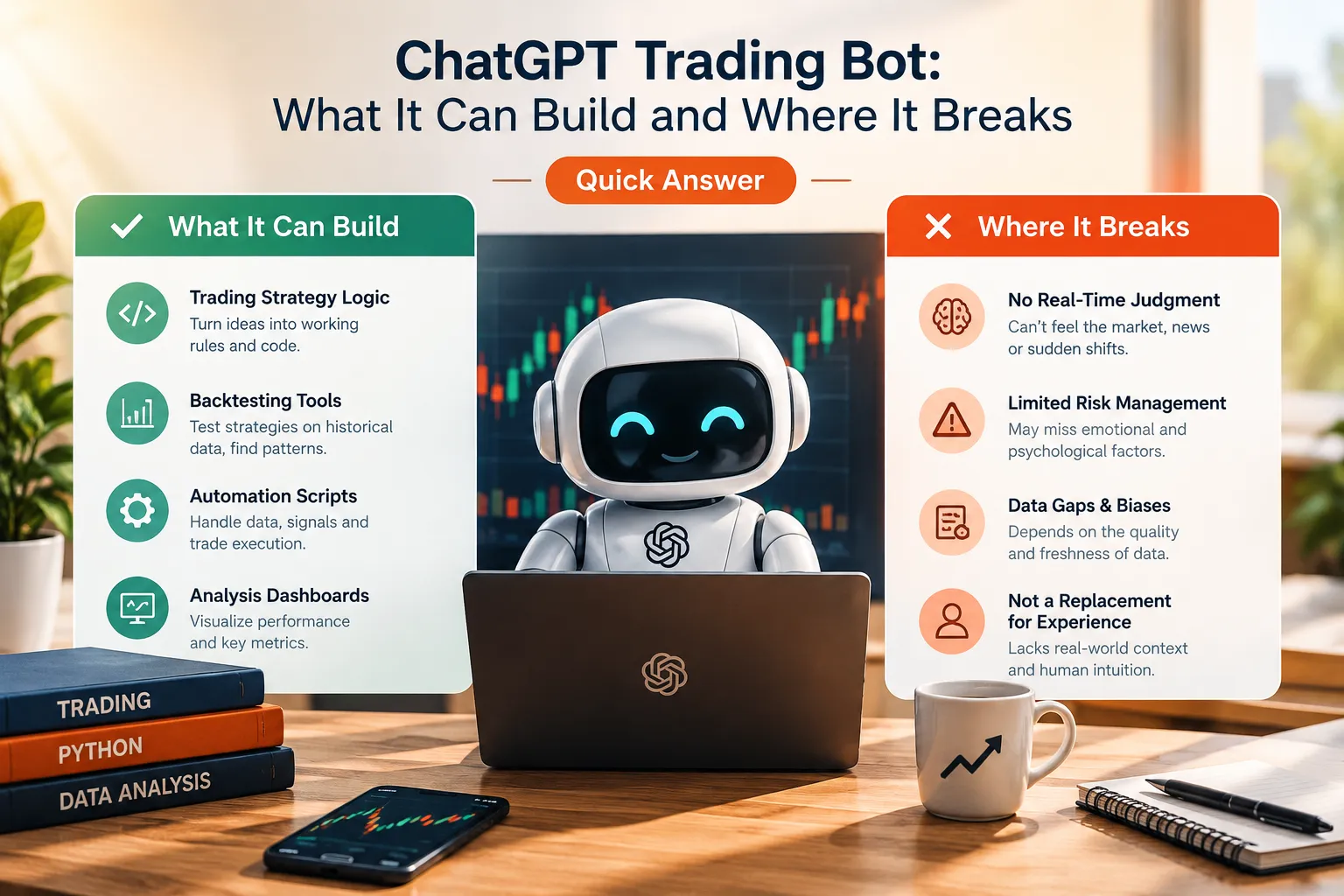
What a chatgpt trading bot can genuinely draft:
- Indicator math. RSI, ATR, VWAP, Bollinger bands, custom composites. The formulas are public and the model knows them.
- Entry and exit logic. Translating “buy the breakout from a tight consolidation on above-average volume” into actual conditional statements.
- Backtest scaffolding. A loop that walks through historical bars, tracks positions, and prints an equity curve.
- Broker API plumbing. Connecting to Alpaca’s paper trading endpoint, authenticating, submitting a bracket order.
- Data cleaning. Handling missing bars, adjusting for splits, resampling intraday data to a higher timeframe.
- Explaining its own code line by line, which is where most of the real learning happens.
What it cannot do, full stop:
- Execute. OpenAI’s documentation is explicit as of October 2026 that ChatGPT cannot make trades or move money. Any order has to go through a broker.
- Test. The model has no runtime. It cannot tell you the script crashes on the third bar.
- Know your data is correct. If your CSV has survivorship bias baked in, the model will happily backtest on it and report a beautiful curve.
- Guarantee anything. The CFTC’s October 2026 advisory exists because a lot of people sell the opposite claim.
A useful mental model: ChatGPT is a very fast junior developer who has read every trading book, has never placed a trade, and will never say “I’m not sure about this.” That last part is the dangerous one. The code arrives with the same confident tone whether it’s correct or quietly broken.
The practical takeaway: use the model to write the draft, then assume the draft is wrong until you’ve proven otherwise on data it never saw.
How Do You Build a Trading Bot With ChatGPT Step by Step?
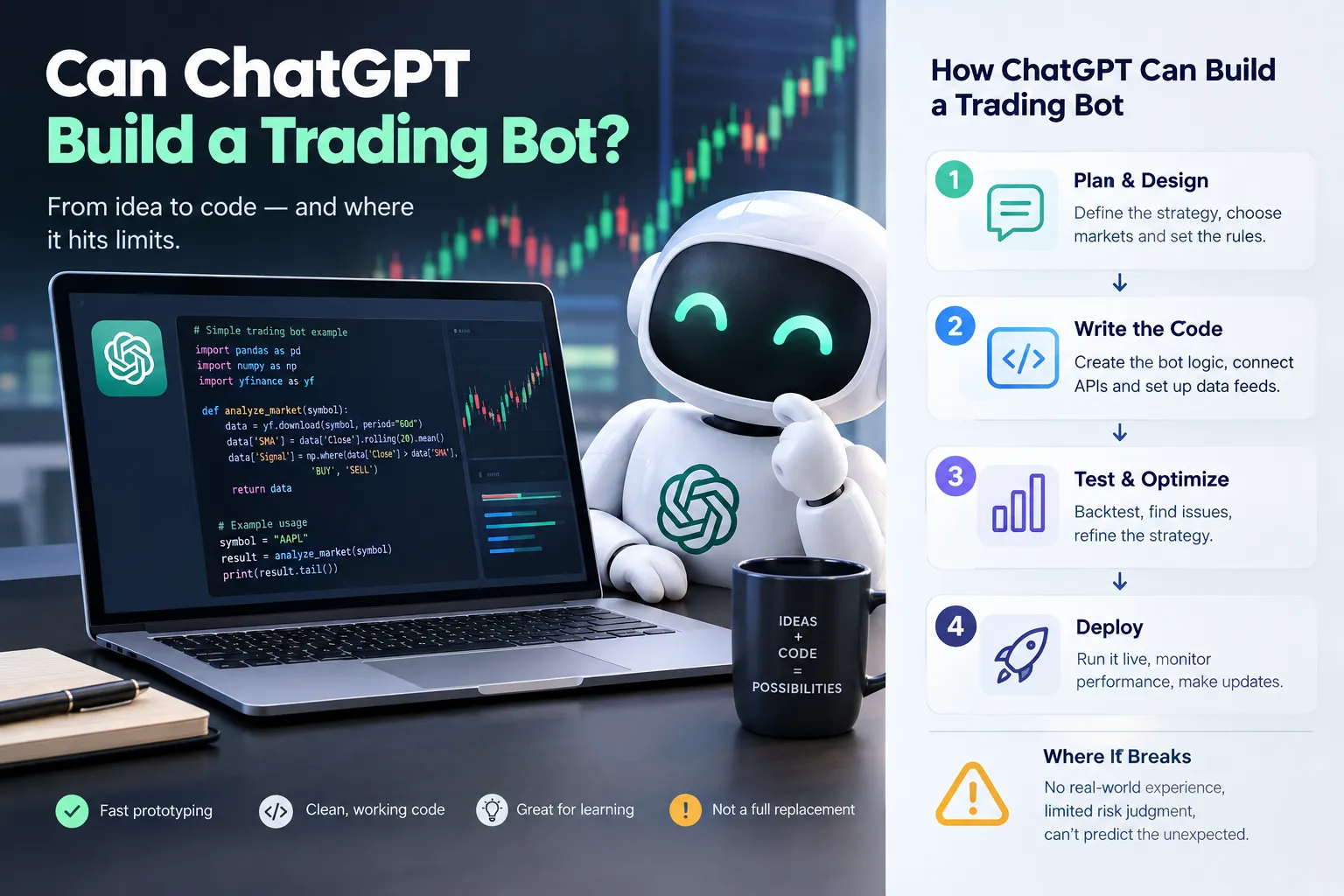
Building a trading bot with ChatGPT follows seven steps, and the order matters more than the prompts. Define the rules first, code second, test third, paper trade fourth, fund last. Most people reverse that and wonder why the account shrinks.
Here’s how to build a trading bot with chatgpt without skipping the parts that keep you solvent.
Step 1, Write the setup in plain English before you open ChatGPT. One paragraph. What triggers the entry, what triggers the exit, what’s the stop loss (the price where you admit you’re wrong and get out), how much of the account goes into one position. If you can’t write it clearly in English, the model can’t write it clearly in Python. What you should see: a rule specific enough that two people reading it would place the same trade. Common error: “buy when it looks strong.” That’s not a rule, that’s a mood.
Step 2, Pick your environment. Two realistic paths. Python with a broker API such as Alpaca, which offers a paper trading environment, or Pine Script running inside TradingView if you want charts and strategy testing in one place. Python gives you more control. Pine Script gives you faster feedback. What you should see: a working account and API keys before you write code. Common error: generating 200 lines of Python before you’ve confirmed which broker you’re actually using.
Step 3, Ask for the strategy logic alone, with no execution attached. Request a function that takes a price series and returns a signal. Nothing else. No order placement, no account access. What you should see: a short function you can read top to bottom in under a minute. Common error: asking for the whole bot in one prompt. You get a 400-line file you’ll never properly review, and reviewing it is the entire job.
Step 4, Build the backtest separately and feed it clean data. Pull historical bars from your broker or a data vendor, not from a random GitHub CSV. Then have the model write a loop that applies the signal function bar by bar. What you should see: a trade log with entry date, exit date, entry price, exit price, and P&L per trade. Common error: accepting only a summary stat. “68% win rate” tells you nothing without the trade list behind it.
Step 5, Add costs and a risk limit before you look at results. Commission, slippage (the gap between the price you wanted and the price you got), and a maximum position size. Put them in before you see the equity curve, because once you’ve seen a pretty curve you’ll be tempted to go easy on the assumptions. What you should see: performance meaningfully worse than the no-cost version. If it barely changes, your cost model is too generous. Common error: backtesting a 50-trades-per-day strategy with zero commissions.
Step 6, Paper trade it live for at least 30 sessions. Paper trading means running real-time with fake money. It catches everything a backtest can’t: API timeouts, bad fills, your script crashing at 9:31 a.m., data arriving late. What you should see: paper results roughly in the same neighborhood as the backtest. A big gap means your backtest is lying. Common error: paper trading for four days, getting three winners, and funding it.
Step 7, Fund small, with a hard kill switch. Start with an amount you’d shrug at losing entirely. Add a daily loss limit that flattens positions and stops the script. Write that limit yourself and verify it fires in testing. What you should see: the kill switch triggering on purpose in a test before it has to trigger for real. Common error: trusting the model to have included a risk limit you never asked for. It usually didn’t.
If you want the Python side in more depth, there’s a longer walkthrough on Python algorithmic trading, and a dedicated piece on writing a Pine Script strategy if TradingView is your home base.
What Did the Listed Creators Show Their ChatGPT Bots Doing?
Treat every YouTube bot result as a claim, not a verified outcome. Video creators show screen recordings, not audited statements, and the gap between those two things is where most retail money goes to die.
The pattern across build-a-bot videos is consistent enough to name:
| What’s claimed | What’s actually shown | What’s skipped |
|---|---|---|
| ”I built a profitable bot with ChatGPT” | A code editor, a prompt, a script that runs without errors | Whether it was ever funded with real money |
| ”It made X% in testing” | A rising equity curve from a backtest | Commission and slippage assumptions, the date range chosen |
| ”Fully automated” | An order confirmation on a paper account | What happens overnight, on a halt, or on an API outage |
| ”Anyone can do this in 20 minutes” | A 20-minute edited video | The hours of debugging cut from the timeline |
None of that makes the videos worthless. Watching someone build a chatgpt trading bot end to end is a genuinely efficient way to learn the structure. Just separate the teaching from the proof.
The one question to ask of any bot video: did they show a live, funded account statement across at least a few months, including the losing stretch? If the answer is no, you watched a tutorial, not a track record.
Two more tells worth clocking. First, the date range. A momentum bot backtested from 2023 to 2025 looks brilliant and says almost nothing about a choppy tape. Second, the absence of a drawdown number. Anyone who has run a bot knows their worst peak-to-trough loss by heart. If a creator can’t name it, they haven’t run it long enough.
Play stupid games with someone else’s unverified screen recording and you win the usual prize.
Where Does a ChatGPT-Coded Bot Break?
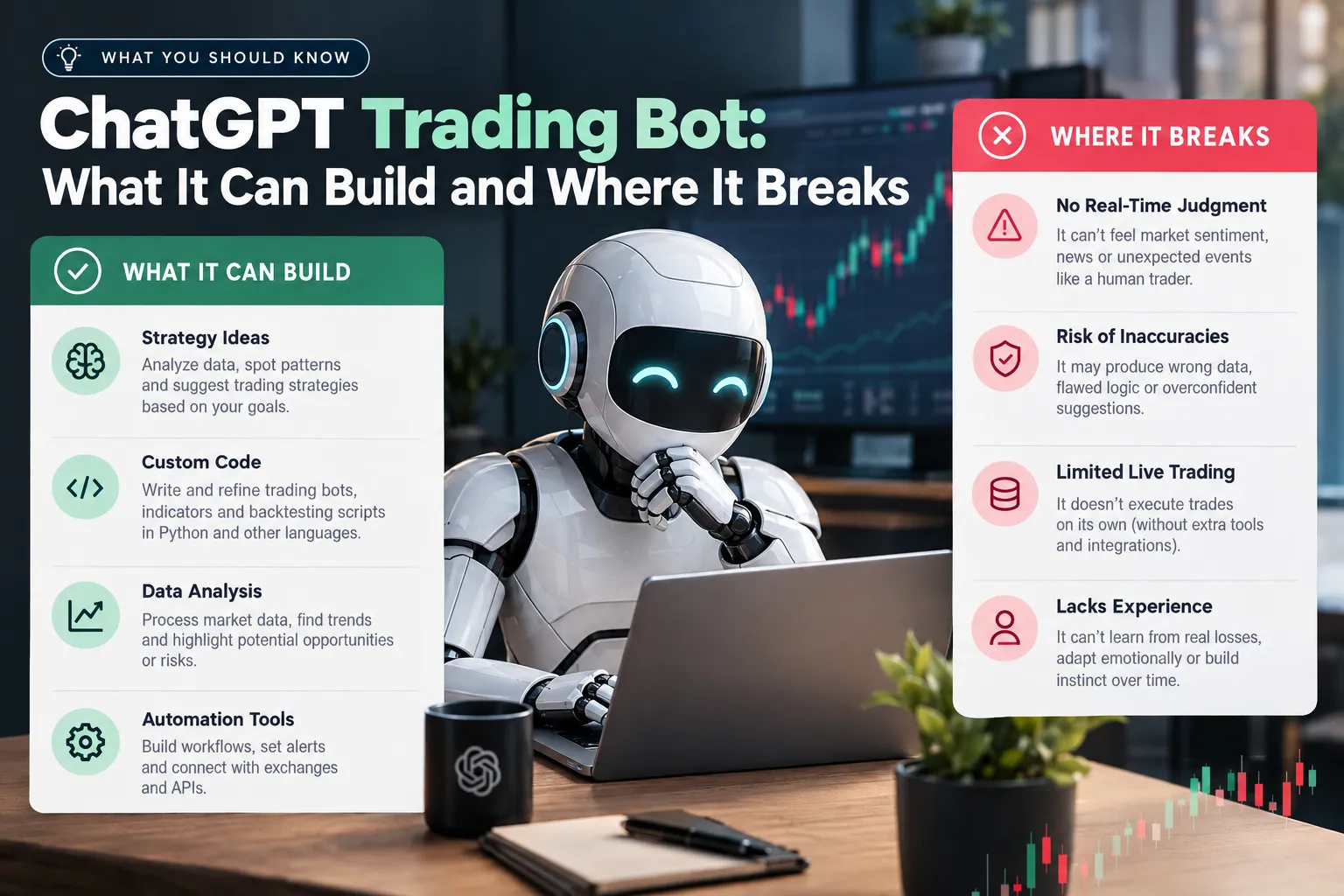
A chatgpt trading bot breaks in five predictable places, and four of them never throw an error message. The code runs fine. The results are fiction. That combination is why these failures survive all the way to a funded account.
1. Look-ahead bias
The backtest uses information that didn’t exist yet at the moment of the trade. This is the single most common killer.
Example: the model writes a backtest that computes today’s daily high and low, then decides whether to buy at today’s open. No one knew the high at the open. The equity curve looks like genius. It’s time travel.
How to catch it: at every decision point, ask what data existed at that exact timestamp. If the answer includes any bar that hadn’t closed, the result is void.
2. Wrong or outdated API calls
The model writes a broker call with a parameter that was renamed, deprecated, or never existed.
Example: submitting a bracket order with an order-class argument from an older version of a broker’s Python library. The script raises an exception at 9:30:04 and your bot is offline for the session while you’re in the shower.
How to catch it: check the broker’s current official API documentation for every endpoint used. Do not trust the model’s memory of a library version.
3. No risk limits
The model gives you what you asked for. If you didn’t ask for position sizing, you get none.
Example: a mean-reversion script that buys more every time price drops further, with no cap. That’s catching a falling knife with an unlimited budget. One gap down and the account is cooked.
How to catch it: search your own code for a maximum position size, a daily loss limit, and a stop loss. If any of the three is missing, it isn’t finished.
4. Outdated library versions
Code written against a library version from a year ago silently behaves differently in the current one.
Example: a pandas resampling call that used to label intervals one way and now labels them another, shifting every bar by one period. Your signals fire late and you never notice because nothing crashes.
How to catch it: pin your library versions and manually verify a handful of computed values against your charting platform. If the model’s RSI and TradingView’s RSI disagree on the same bar, stop and find out why.
5. Silent errors
The script wraps everything in a catch-all that swallows exceptions and keeps going.
Example: a data fetch fails, returns an empty response, and the bot treats “no data” as “no signal.” It sits idle for three weeks while you assume there were no setups. Or worse, it treats a stale price as current and trades against a number from Tuesday.
How to catch it: log every loop iteration with a timestamp and the price the bot saw. Read the log. Boring, and it’s the thing that saves you.
The common thread: every one of these produces a program that runs cleanly and lies confidently. The review step isn’t optional, it’s the product.
Does Trading With ChatGPT Work?
Trading with ChatGPT works as a research and coding assistant and does not work as an autonomous decision-maker. The evidence points the same direction from both ends of the market: the institutions using it most seriously use it for code, and the regulators are warning about everyone selling the opposite.
Jump Trading, in an OpenAI case study dated October 2026, described using GPT-6 Astra for coding, quantitative research and hypothesis validation. The key line is what they do with a signal the model generates: they treat it as informative but potentially wrong, subject to the firm’s normal review process and a controlled execution environment. A firm with that much infrastructure doesn’t hand the model the keys. You shouldn’t either. There’s a fuller breakdown of how Jump Trading uses GPT-6 Astra agents if you want the detail.
On the other end, the CFTC’s October 2, 2026 advisory on AI trading bots states plainly that AI cannot predict the future or sudden market changes. It describes schemes advertising tens of thousands of percent returns or 100% win rates, and notes fraud involving purported AI trading programs has cost customers tens of millions of dollars, including one case involving nearly 30,000 bitcoin valued at roughly $1.7 billion at the time.
FINRA’s January 27, 2026 commentary takes the technology-neutral line: “trade execution agents” that analyze conditions, generate strategies and execute transactions are still bound by existing securities laws and FINRA rules. No AI exemption. The SEC’s FY2026 examination priorities list automated investment tools, AI technologies and trading algorithms as focus areas, including whether firms’ representations about them are accurate.
And Jamie Dimon, speaking October 13-14, 2026, warned against giving autonomous agents unrestricted access to personal financial accounts, noting customers could be liable when agents make mistakes. Agree with him or not, the liability question is real and unresolved.
If you’re trying to sort real tools from the funnel, our breakdown of which AI trading bots are legit versus scams covers the tells.
Position: ChatGPT improves the speed at which you can test an idea. It does not improve the odds that the idea is good. Process over prediction.
How Do You Backtest a ChatGPT Strategy Honestly?
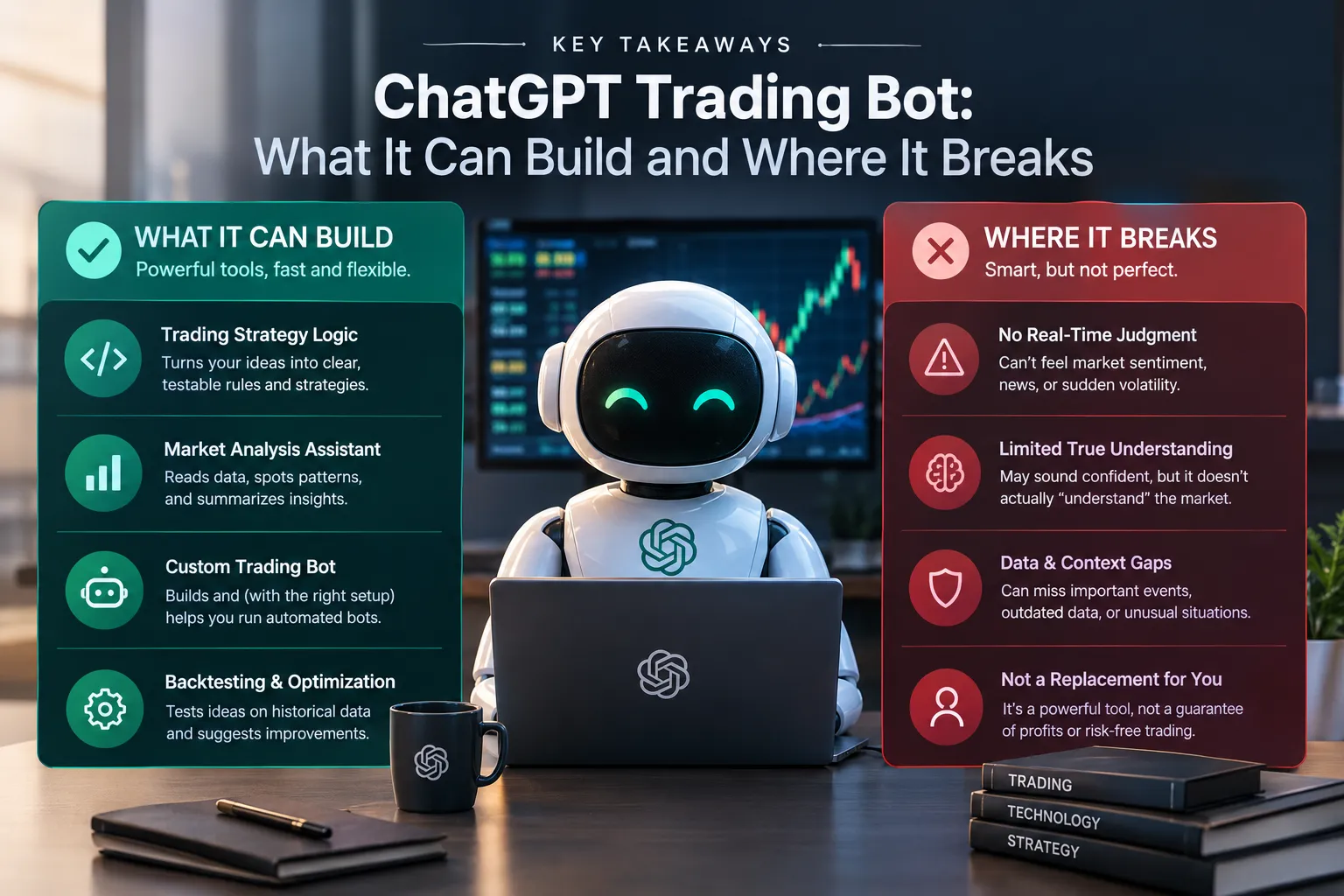
An honest chatgpt backtest strategy includes realistic trading costs, holds back data the strategy never saw, and produces a trade-by-trade log you can audit. Miss any of the three and you’ve built a machine for confirming what you already believed.
The honest backtest checklist:
- Include commissions and fees. Use your broker’s actual published schedule. Check the official page for current rates rather than guessing.
- Model slippage. Assume you get a worse fill than the printed price, especially on low float names (small share counts available to trade, which move hard on modest volume) and anything outside regular hours.
- Split the data. Build and tune on one period, then test once on a later period you never touched. One shot. If you keep going back to adjust and retest, that holdout is burned.
- Keep a trade log. Every entry, every exit, every size, every reason. Summary stats hide the three outlier trades carrying the whole result.
- Report the worst drawdown. Peak-to-trough decline. If you can’t sit through it emotionally, the strategy’s returns are theoretical.
- Count the trades. Twelve trades is an anecdote. If your sample is tiny, say so instead of reporting a win rate to one decimal place.
- Test a dead period. Run it through a sideways, choppy stretch. Trend strategies look like magic in trends. That’s not insight.
A decision rule: if backtest results and paper trading results diverge by more than you can explain, trust the paper trading and go find the bug. The backtest is where lies live, because it’s the only one of the two where you controlled the assumptions.
The most common self-inflicted wound is overfitting, which means tuning parameters until the historical curve looks perfect. Twenty settings tested on the same data will produce one that looks brilliant by accident. That’s not a strategy, it’s a coincidence with a backtest attached.
How Much Does It Cost to Run a ChatGPT Trading Bot?
Model tokens are the cheapest line item. The real cost of a chatgpt trading bot is market data, hosting, and the hours you spend debugging it.
OpenAI’s pricing as of October 2026 lists GPT-6 Sol at $2 per million input tokens and $10 per million output tokens, with GPT-6 Luna at $0.10 and $0.50. Those cuts, roughly 50% versus prior GPT-5.6 promotional pricing, make frequent market summarization and multi-agent workflows affordable. But a bot that generates code once and then runs a fixed script barely touches the model at all after day one.
Where the money goes:
- Market data. Real-time quotes cost real money, especially for intraday and options. Delayed data is free and useless for day trading. Check each vendor’s current page.
- Hosting. A small cloud instance running 24/5 so your bot doesn’t depend on your laptop staying awake. Modest, but not zero.
- Broker costs. Commissions, options contract fees, data entitlements, margin rates. Varies by broker.
- Subscriptions. A charting platform, a scanner, a backtest engine. This is where tool creep eats budgets quietly.
- Your time. The biggest one no one prices. Expect weeks, not an afternoon.
For a full cost breakdown with current numbers, see how much a trading bot costs. And if you’re evaluating paid platforms, our piece on what you pay for versus what you get in AI trading software is the reality check.
Decision rule: if your expected edge per trade is smaller than your round-trip cost per trade, the bot is a subscription to losing money efficiently.
Can ChatGPT Predict Stock Prices Accurately for Day Trading?
No. ChatGPT cannot predict stock prices, and the CFTC said as much in writing on October 2, 2026: AI cannot predict the future or sudden market changes.
Language models predict the next plausible token based on patterns in training text. That’s a different problem from forecasting a price series driven by order flow, news, liquidity and a few thousand other participants reacting in real time. Ask a model where a stock closes tomorrow and it will produce a confident-sounding number. The confidence is a feature of how it writes, not evidence about the market.
Day trading makes the mismatch worse. Intraday moves hinge on speed, fills and reading the tape (watching real-time order flow and prints). A model generating a paragraph has no latency advantage and no view of the book.
What it’s useful for intraday:
- Summarizing an earnings release faster than you can read it
- Explaining why a sector is moving, from information you supply
- Writing the scanner filter that builds your watchlist
- Reviewing your own trade log and flagging patterns in your behavior, like revenge trading after a loss
What it’s not useful for: telling you where price goes next. If a tool claims it can, you’ve found marketing, not a model.
Is a ChatGPT Trading Bot Safe, or Will It Drain My Account?
A chatgpt trading bot is as safe as the risk limits you wrote into it and the account permissions you granted. The code has no sense of self-preservation. If you don’t cap position size, it won’t cap it for you.
The safer architectures now exist at the broker level. Interactive Brokers’ Autonomous Trading, announced October 21, 2026, confines authorized AI activity to a dedicated AI Partition with its own eligibility and safeguards. Robinhood’s May 2026 launch let customers connect third-party agents to a separate account, and its September 29, 2026 announcement described embedded Robinhood Agents operating within user-defined limits. Telegram’s Walt app, on October 20, 2026, added AI-controlled perpetual futures trading where agents can open and close positions and set take-profit or stop-loss orders, but, per Walt, cannot withdraw or transfer funds.
The pattern is the same everywhere: isolate the money, cap the authority.
Your safety checklist:
- Trade in a dedicated account, never your main one
- Confirm the integration cannot withdraw or transfer funds
- Set a hard daily loss limit that flattens positions and halts the script
- Cap maximum position size as a fixed percentage of that account
- Keep API keys out of shared files and off public repositories
- Review the broker’s current permission settings yourself rather than relying on a summary
The real risk isn’t a rogue AI. It’s a mundane bug placing 100 shares instead of 10 because of a units mistake, repeating every minute, while you sleep. Boring failures drain accounts far more often than dramatic ones.
What Stocks and Crypto Can a ChatGPT Trading Bot Trade?
Whatever your broker supports and permits for automated access. The model doesn’t limit the instrument. The account does.
Interactive Brokers’ October 21, 2026 announcement covers more than 75,000 listed stocks, options and ETFs worldwide for eligible clients using supported order types through its AI Partition. Walt’s October 20, 2026 feature covers crypto perpetual futures. Alpaca’s API supports U.S. equities and, depending on account type, crypto. Pine Script strategies on TradingView run against whatever instruments that platform charts.
Practical constraints worth respecting:
- Liquidity beats availability. A bot can place an order in a thin small-cap. Getting filled at a sane price is a separate question.
- Options add complexity. Multi-leg orders, assignment and expiration are where AI-written code gets sloppy fast.
- Crypto runs 24/7. No overnight gap risk, but no circuit breakers and no closing bell forcing you to stop. Overtrading risk goes up.
- Futures have leverage baked in. Leverage magnifies the cost of every bug.
Decision rule: start with liquid large-cap equities or major ETFs. If a bot can’t make money in the easiest instruments to trade, it won’t rescue itself in the hardest ones.
ChatGPT vs Claude for Building a Bot
Both ChatGPT and Claude write usable trading code, and both are supported by the same broker integrations. Interactive Brokers’ October 21, 2026 announcement names ChatGPT, Claude, Grok and Perplexity as compatible through the Model Context Protocol, and Walt’s October 20, 2026 feature supports ChatGPT, Claude and its own Mira agent.
| ChatGPT | Claude | |
|---|---|---|
| Broker support (IBKR, Oct 21 2026) | Supported via MCP | Supported via MCP |
| Walt app support (Oct 20 2026) | Supported | Supported |
| Published API pricing | OpenAI lists GPT-6 Sol at $2 / $10 per million tokens as of Oct 22, 2026 | Check Anthropic’s official pricing page |
| Named institutional case study | Jump Trading, GPT-6 Astra, Oct 6 2026 | Check Anthropic’s published customer pages |
| Our testing method | Same strategy brief, same review checklist, same bug categories | Same |
Beyond confirmed facts, pick by workflow rather than brand loyalty. Run your identical strategy brief through both, then review both outputs against the five break points above. Whichever produces fewer look-ahead errors and more explicit risk handling wins for your use case. We cover the other side in detail in our Claude trading bot breakdown.
Decision rule: the model matters less than your review discipline. A careful builder with the weaker model beats a careless one with the stronger model, every time.
Is a ChatGPT Trading Bot Suitable for Beginners?
Building one is excellent for beginners. Funding one is not.
The build process teaches things no course does: that a strategy needs exact rules, that costs matter more than you think, that most ideas don’t survive honest testing. That’s a cheap education when it’s done on paper.
Build one if you: want to learn how strategies work, can read code well enough to follow it, and are willing to paper trade for a month before funding.
Don’t fund one if you: can’t explain every line it executes, haven’t survived a losing streak manually, or need the money for anything.
Better sequence for a beginner: trade the rules by hand for 30 sessions first. If you can’t follow your own rules manually, automating them just means losing faster with fewer chances to intervene. Start with free tools before paying for anything, and build from there.
What Happens When a ChatGPT Trading Bot Glitches?
It depends entirely on what you built in advance, because a glitching bot does not stop politely. It either freezes mid-position or keeps firing orders into a market that’s moved.
The four failure modes and what to do:
- Script crash with an open position. The bot is dead, your position isn’t. Fix: set a stop loss at the broker, not just in your code. Broker-side stops survive your script dying.
- API connection drops. The bot can’t see prices or confirm fills. Fix: a heartbeat check that alerts you after a set number of failed calls.
- Duplicate orders. A retry loop resubmits an order that succeeded. Fix: unique client order IDs on every submission, and a position reconciliation check before each new order.
- Stale data. The feed stops updating, the bot trades a price from twenty minutes ago. Fix: reject any price with a timestamp older than your threshold and halt.
Non-negotiable: a manual kill switch you can hit from your phone, plus the broker’s phone number saved. When the tape is moving fast, the cheapest fix is flattening everything and debugging after the close.
Are There Better Alternatives to ChatGPT for Algo Trading?
For most retail traders, yes. A purpose-built platform is faster to get working than a bot you code and maintain yourself.
Alternatives worth comparing:
- Rules-based automation platforms that let you define entries, exits and risk through an interface instead of code. Less flexible, far fewer bugs.
- Charting platforms with built-in strategy testing, where the data and backtest engine come pre-wired. See our TrendSpider versus TradingView comparison.
- Screeners that feed a manual process. Automate the search, keep the decision. Our take on the swing trading stock screener replacing manual picks covers that route.
- Full AI trading platforms, compared head to head in our best AI trading tools of 2026 breakdown.
Choose a platform if you want to trade, not maintain software. Choose a chatgpt trading bot if you want full control over the logic and are genuinely willing to debug it.
Common Mistakes People Make With ChatGPT Trading Bots
The mistakes repeat with remarkable consistency.
- Trusting code they can’t read. If you can’t explain a function, you can’t supervise it.
- Skipping paper trading because the backtest looked good.
- No stop loss, because the prompt never mentioned one.
- Overfitting until the historical curve is perfect and the future is hopeless.
- Running it on the main account instead of an isolated one.
- Copying code from a video without checking the library versions or API endpoints.
- Adding a second bot before the first one has proven anything. Tool overload is just overtrading with extra steps.
- Never reading the logs. The bug was visible on day two.
The fix for all of them is the same: one strategy, one account, one month of paper trading, one log you read.
Frequently Asked Questions
Can ChatGPT build trading bots?
Yes, ChatGPT can write the code for a trading bot, but it cannot run or execute it. It drafts strategy logic, indicators, backtests and broker API calls in Python or Pine Script. Execution requires a separate broker integration, and OpenAI’s documentation confirms ChatGPT itself cannot place trades or move money.
Does trading with ChatGPT work?
It works for research, coding and analysis, not for autonomous decisions. Jump Trading’s October 2026 case study describes using GPT models for coding and hypothesis validation while treating AI-generated signals as potentially wrong and subject to normal review. The CFTC warns that AI cannot predict markets.
Do any AI trading bots work?
Some automate a defined strategy reliably, which is different from making money. A bot executes rules consistently and removes emotion. Whether it profits depends entirely on whether the underlying strategy has an edge after costs. The CFTC’s October 2026 advisory specifically flags bots claiming risk-free returns or 100% win rates as fraud indicators.
How much does a trading bot cost?
Model tokens are minor. OpenAI listed GPT-6 Sol at $2 per million input tokens as of October 22, 2026. The larger recurring costs are real-time market data, cloud hosting, broker commissions and any platform subscriptions. Check each provider’s official pricing page for current figures.
Which AI bot is best for stock trading?
There’s no single best, and anyone naming one without naming your strategy is selling something. Interactive Brokers supports ChatGPT, Claude, Grok and Perplexity through MCP as of October 21, 2026. Pick based on your broker, your instruments and your willingness to maintain code.
Can ChatGPT predict stock prices?
No. The CFTC stated in October 2026 that AI cannot predict the future or sudden market changes. Language models predict plausible text, not price. Treat any confident price forecast from a model as writing, not analysis.
Is a chatgpt trading bot legal?
Automated trading is legal for retail traders through supported broker APIs. ESMA’s February 2026 briefing confirms AI-driven strategies count as algorithmic trading for regulated firms, and the SEC’s FY2026 exam priorities cover automated investment tools. Individual retail obligations differ from firm obligations, so check your broker’s terms.
Our Take
ChatGPT is a fast first draft of a trading bot. It is not a finished bot, and treating it like one is how small accounts get cooked by bugs no one reviewed.
Use it to compress weeks of coding into an afternoon. Then spend the week you saved doing the part that protects you: reading the data timing, adding the risk limits, running the honest backtest, paper trading for 30 sessions. The model writes the code. You own the outcome.
Related: every bot we’ve reviewed lives on AI Stock Trading Bots, and if Alpaca is your broker for the Python route, read our Alpaca review on AI Stock Picker App first.
Built a bot worth looking at, or want us to pull one apart? Submit it for review. More build guides live in our build a trading bot category.
Cut the noise, keep the alpha.
Stay alpha.
The FullStack Alpha research desk tests AI trading bots on paper and live accounts. Reviewed and edited by Jay Rocco, Founder and Editor.
