

The FullStack Alpha research desk tests AI trading bots on paper and live accounts. Reviewed and edited by Jay Rocco, Founder and Editor.
By FullStack Alpha Editorial Team | Reviewed by Jay Rocco, Chief Editor
Can AI predict the stock market? Not reliably, and none of the four creator experiments scored below proves otherwise. AI Pathways ran Claude for a month, Nate Herk handed GPT 6 Astra $10,000, Trading with DaviddTech gave a bot $100 for 22 hours, and Pushkar Raj Thakur posted one month of algo profit and loss. Every one of those is a creator claim, and we have not verified any of the results independently. What none of them showed is the thing that actually matters: enough trades, with real costs, on data the model never saw, repeated by someone else.
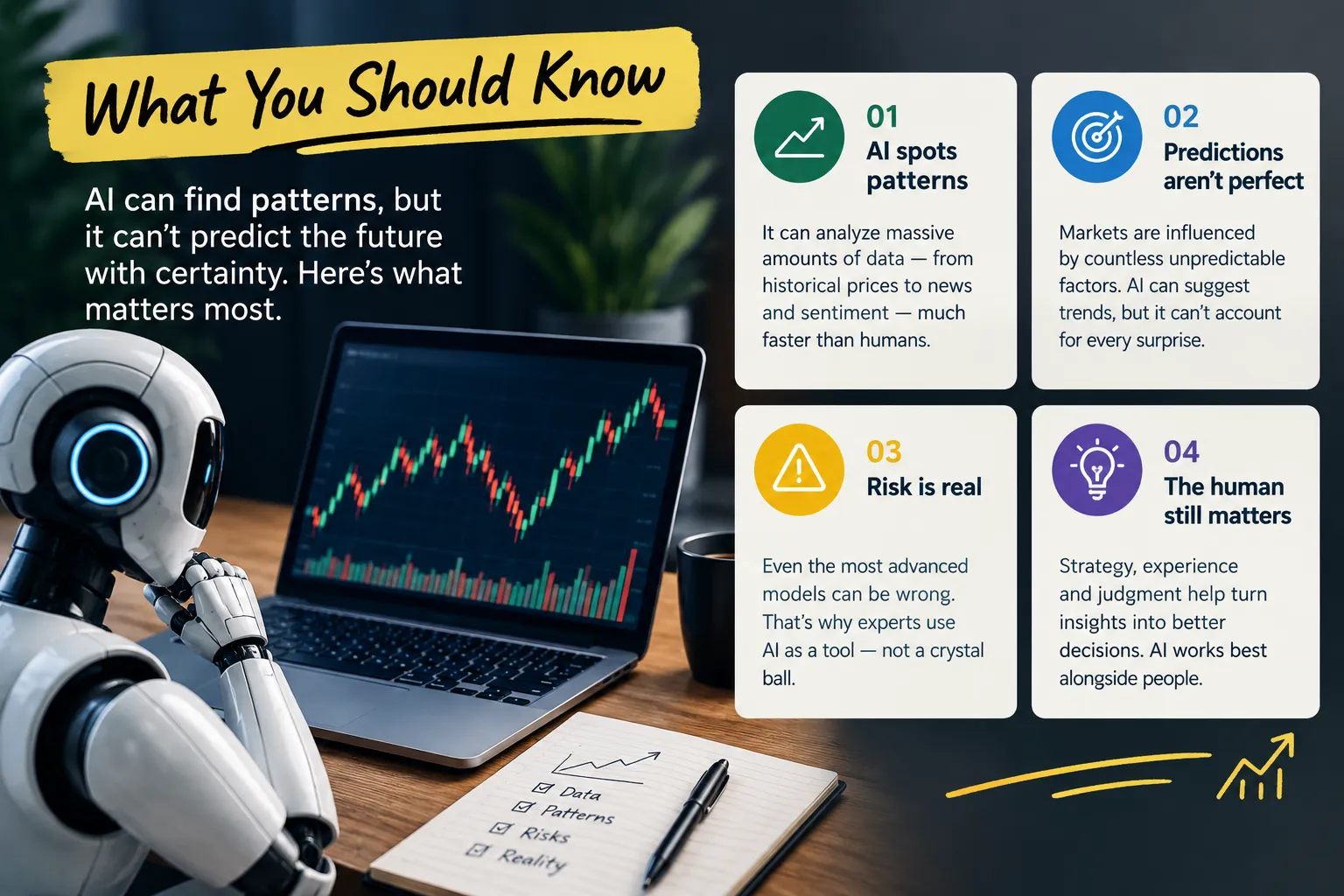
What You Should Know
- The best-designed public test we found is Zerodha’s. Sandeep Rao, writing in In The Money by Zerodha, ran 31 live trading days from March 24 to May 12, 2026, feeding Claude, GPT and Gemini the same structured daily Nifty 50 report.
- Top actionable accuracy in that test was 62.9%. Claude Opus 4.6 called the next-day open direction correctly on roughly 19 of 31 afternoon forecasts made at 3:15 p.m.
- The headline 83% to 89% accuracy number from the same test is not tradable. Those forecasts were made minutes before the open, after overnight U.S. moves and GIFT Nifty pricing were already visible. The author says so himself.
- Brokers are shipping autonomous AI trading now. Robinhood announced Robinhood Agents on September 29, 2026, and Interactive Brokers announced IBKR Autonomous Trading on October 21, 2026, covering more than 75,000 global stocks, options and ETFs.
- Regulators already treat this as a compliance problem. The SEC’s Fiscal Year 2026 Examination Priorities names automated investment tools, AI technologies, trading algorithms and alternative data as review areas, including whether AI claims are fair and accurate.
Can AI Predict the Stock Market or Just Describe It?
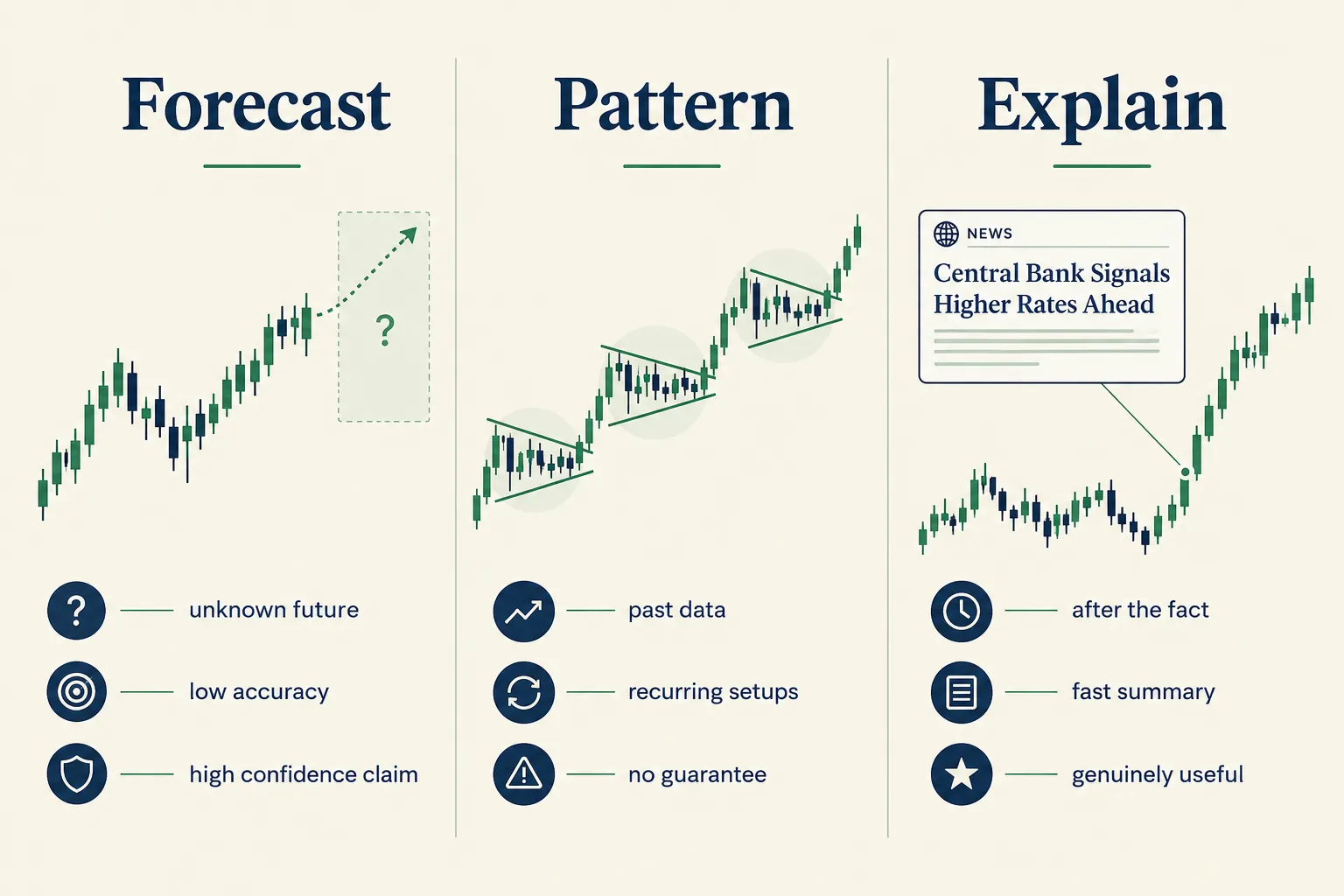
AI is very good at describing markets, decent at finding patterns in them, and poor at forecasting where prices go next. Those are three different jobs, and almost every misleading claim online comes from collapsing them into one.
Describing is the easy part. A model can read an 80-page 10-K, 400 news headlines and a volatility surface in seconds and tell you what happened and probably why. That’s genuine work, and it saves hours. Tools built on that premise, like the ones covered in our breakdown of the AI stock news tool that explains why your stock just moved, are solving a real problem.
Pattern-finding sits in the middle. Machine learning is built to spot recurring structure: tight consolidation before a breakout, volume signatures that precede a gap fill, factor clusters that tend to outperform. The structure is real. The problem is that it decays. Once enough capital trades a pattern, the pattern stops paying. That’s not a bug in the model, it’s how markets work.
Forecasting is where it falls apart. Price is the output of millions of people reacting to information that didn’t exist yesterday. A model trained on the past can only tell you what rhymed before.
A pattern that worked for three years and stopped is not a broken model. It’s a crowded trade.
So can ChatGPT pick stocks? It can produce a list of tickers that fit criteria you describe, and it can summarise the bull and bear case on each one. That’s a research assistant. It is not a forecast, and treating its output as one is where small accounts get hurt. If you want to see how the published accuracy figures get massaged, read our piece on why the AI stock prediction accuracy number lies.
The practical split:
| Job | Can AI do it well? | What it’s worth to you |
|---|---|---|
| Summarise filings, news, earnings calls | Yes | Hours saved per week |
| Screen for conditions you define | Yes | Faster watchlist building |
| Find historical patterns | Partly | Hypotheses, not signals |
| Predict tomorrow’s close | No | Nothing you should size on |
| Predict a crash date | No | Negative, if you act on it |
Practical takeaway: use AI where the answer already exists in data somewhere. Stop using it where the answer hasn’t happened yet.
What Did the 4 Creator Experiments Claim?
Four public experiments get cited constantly whenever someone asks whether AI can predict the stock market. Each one is a creator claim. We have not verified any of the results, the account statements, or the trade logs, and in most cases the creators didn’t publish them either.
Here’s what each one set out to do and what was left out of frame.
AI Pathways: Claude trading for a month
The creator says they let Claude run a trading process for roughly a month and reported the outcome at the end. What’s visible is the premise and the headline result. What isn’t visible in the public write-up: a trade-by-trade log, whether commissions and spread were deducted, whether position sizes were fixed, and whether the model saw price data it had already been trained on.
A month is roughly 21 trading days. If the strategy fires once or twice a week, that’s maybe eight trades. Eight trades tells you almost nothing about an edge. You could flip a coin eight times and go 6-2.
Nate Herk: GPT 6 Astra with $10,000
The creator says he set up GPT 6 Astra with a $10,000 allocation and documented what it did. The useful part of this format is that a real dollar figure forces real decisions about sizing. The weak part is identical to every other single-account demo: one account, one time period, one market regime, no control group.
We cover the setup mechanics in more depth in our write-up on GPT 6 Astra trading. Treat the headline number as a claim until there’s a statement behind it.
Trading with DaviddTech: $100 over 22 hours
The creator says he ran a bot with $100 for 22 hours. Twenty-two hours is not a sample, it’s an anecdote with a timer on it. On a $100 account, fees and spread eat a percentage of capital that would be rounding error at $10,000. Any result, up or down, is dominated by noise and cost.
That’s not a dig at the creator. Short-format content needs short-format tests. It just can’t answer the question in the title.
Pushkar Raj Thakur: one month of algo PnL
The creator says he shared one month of profit and loss from an algorithmic strategy. Monthly PnL screenshots are the most common format in retail trading content and the least informative. A profit and loss figure with no trade count, no maximum drawdown, no position sizing rule and no benchmark comparison is a number without a denominator.
The claims, side by side
| Creator | Setup | Length | Claimed result | What was not shown |
|---|---|---|---|---|
| AI Pathways | Claude running a trading process | ~1 month | Creator-reported outcome for the period | Full trade log, costs, benchmark, out-of-sample proof |
| Nate Herk | GPT 6 Astra with $10,000 | Documented run | Creator-reported account performance | Broker statement, drawdown, repeat run |
| Trading with DaviddTech | Bot with $100 | 22 hours | Creator-reported short-run result | Any meaningful sample size, fee impact at $100 |
| Pushkar Raj Thakur | Algorithmic strategy | 1 month | Creator-reported monthly PnL | Trade count, drawdown, sizing rules, buy-and-hold comparison |
Every cell in the right-hand column is the same category of missing information. That’s the finding.
One experiment that was built properly: Zerodha’s. Sandeep Rao gave Claude Sonnet, Claude Opus, GPT and Gemini an identical structured daily report (trend, momentum, volatility, price structure) and asked each to call whether the Nifty 50 would open higher or lower the next day, plus the expected gap size. It ran 31 live trading days. Claude Opus 4.6 hit 62.9% on the actionable 3:15 p.m. forecast. That’s a real number from a real design, and it’s roughly 19 right out of 31.
Sixty-three percent directional accuracy on a gap call is interesting. It is not a strategy, because gap direction says nothing about gap size, slippage, or whether you could have filled at that price.
Practical takeaway: before you believe any creator result, find the trade count. If it isn’t published, the number is decoration.
How Do the Experiments Score on Sample Size, Costs and Repeatability?
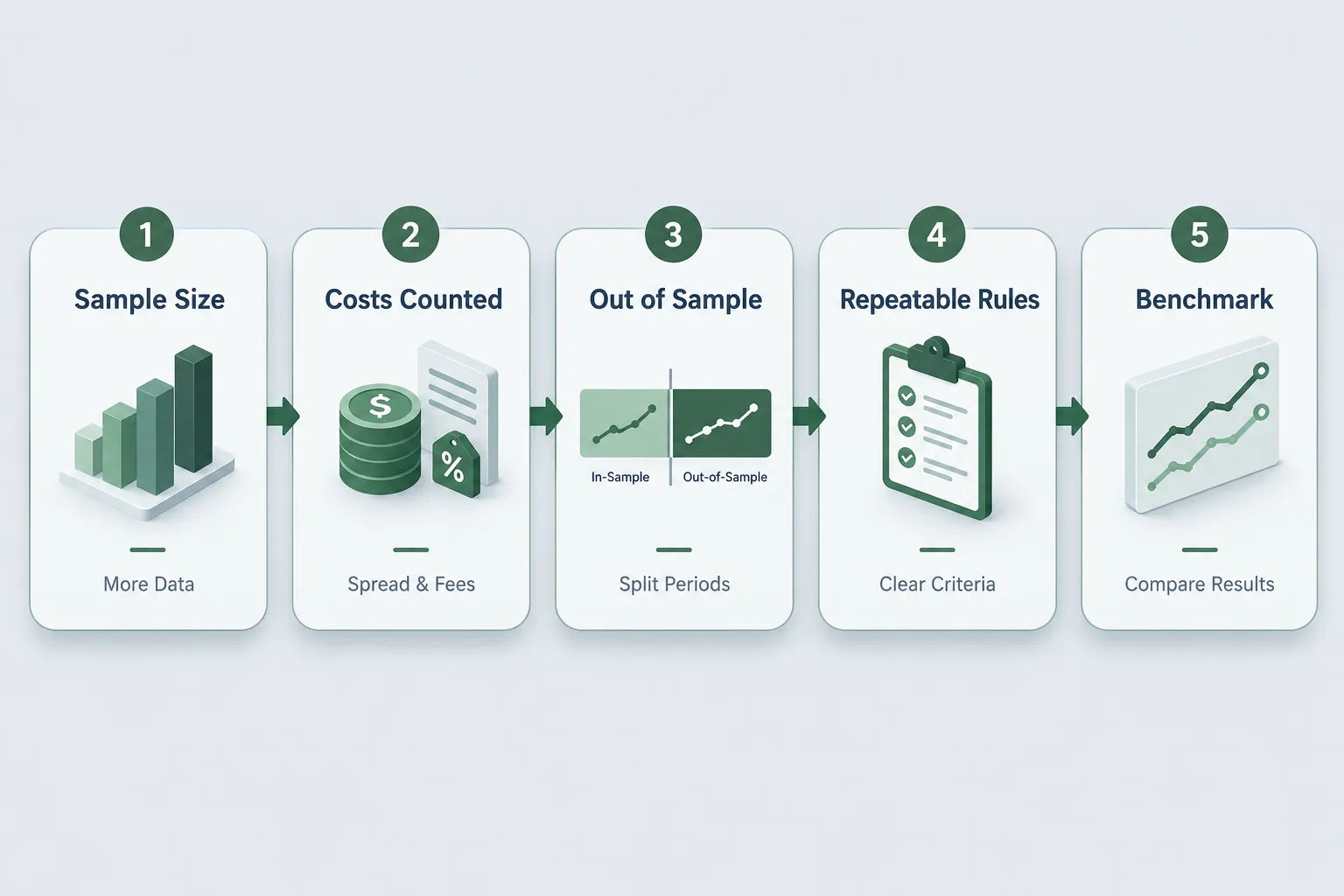
We scored all four experiments out of 5 on what was publicly shown, not on whether the creator is honest or competent. These are our judgments of the evidence presented, labeled as such.
The scoring method
Five criteria, one point each:
- Sample size. At least 30 trades, or 30+ decision days. Below that, randomness dominates.
- Costs counted. Commissions, spread, slippage and data fees deducted from results, and stated.
- Out of sample. The model tested on price data it had not seen in training or in a prior backtest. This is where look-ahead bias quietly destroys most published results.
- Repeatable. The rules are written down tightly enough that a stranger could run the same test and get a comparable answer.
- Benchmarked. Compared against buy and hold over the same window, not against zero.
Five out of five means you could act on the finding. Two or below means you learned something about the creator’s workflow, not about markets.
The scorecard
| Experiment | Trades or days | Costs counted | Out of sample | Repeatable | Score /5 |
|---|---|---|---|---|---|
| AI Pathways (Claude, ~1 month) | ~21 trading days, trade count not published | Not stated | Unclear | Partly, premise is clear but rules aren’t | 2 |
| Nate Herk (GPT 6 Astra, $10,000) | Not published | Not stated | Unclear | Partly | 2 |
| Trading with DaviddTech ($100, 22 hours) | Under one full day | Not stated, and material at $100 | No | No | 1 |
| Pushkar Raj Thakur (1 month algo PnL) | Not published | Not stated | Unclear | No | 1 |
| Zerodha / Sandeep Rao (reference case) | 31 live trading days, 4 models | Not applicable, forecast-only test | Yes, live forward test | Yes, method published | 4 |
Zerodha loses the fifth point because a directional gap forecast was never converted into a costed, executable strategy with a benchmark. The author doesn’t pretend otherwise, which is exactly why it scores highest.
Note what separates a 4 from a 1: not better AI. Better test design. The Zerodha run used the same models everyone else uses.
Common mistake: assuming a longer test automatically beats a shorter one. A six-month backtest with look-ahead bias baked in is worse than a clean 31-day forward test, because it’s confidently wrong instead of honestly limited.
Edge case worth naming: a creator who loses money and publishes the full log scores higher with us than one who makes money and publishes a screenshot. Process over prediction.
Practical takeaway: when you watch the next AI trading video, run this five-point check in your head before the outro. Most results collapse at criterion one.
Can ChatGPT Trade Stocks and Pick Winners?
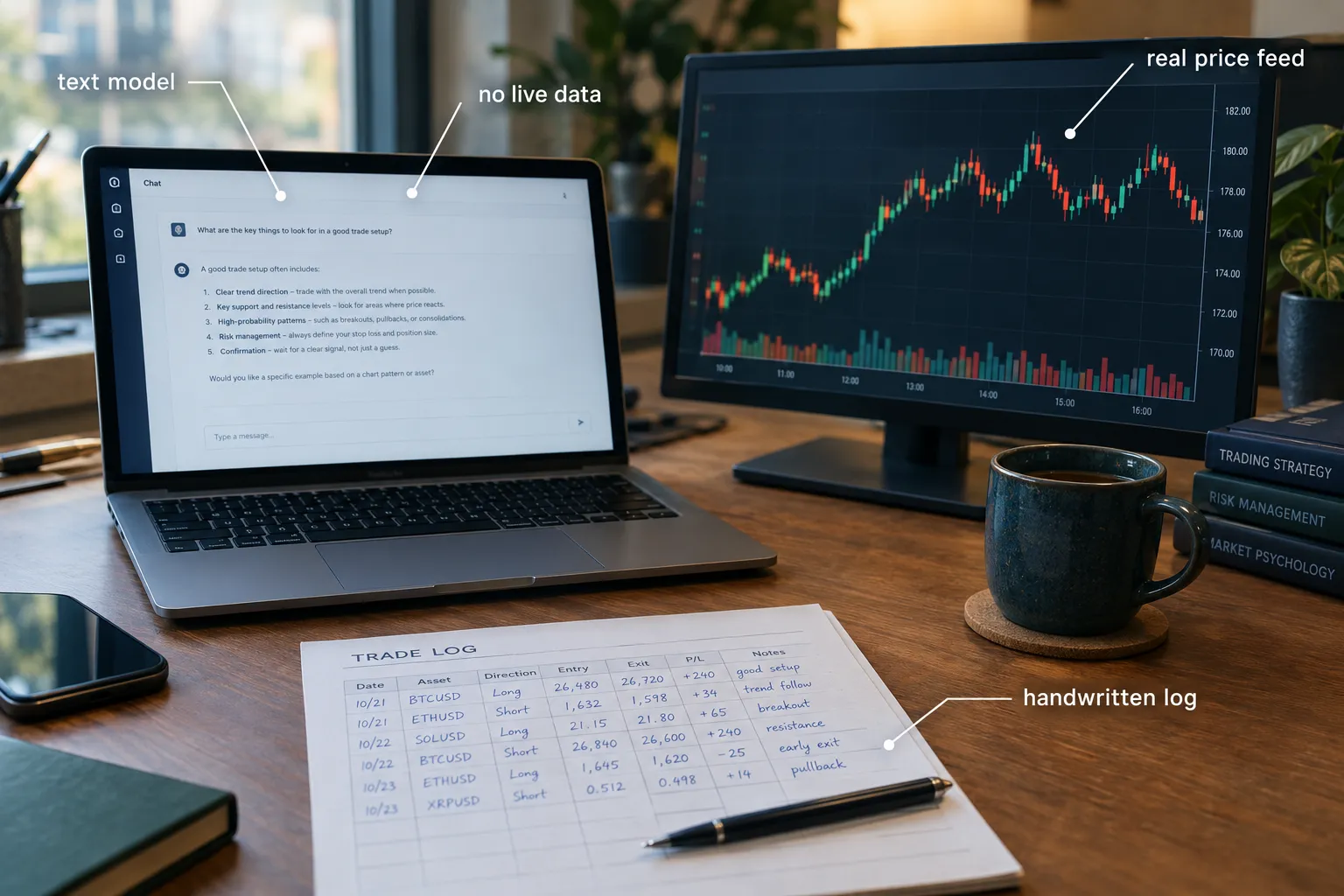
Can ChatGPT trade stocks? Not by itself. A language model has no broker connection, no live price feed and no order routing. It only places trades when a human wires it into an execution layer, and then the model is a decision input, not the trader.
What changed in 2026 is who’s building that wiring. Robinhood announced Robinhood Agents on September 29, 2026, letting users pick a model, set instructions and limits, and have it research and place equity, options and crypto orders inside dedicated agentic accounts. Interactive Brokers followed on October 21, 2026 with IBKR Autonomous Trading, which the company says covers more than 75,000 global stocks, options and ETFs with a separate AI trading partition and user-defined controls. The plumbing is now retail-available. The forecasting problem is unchanged.
What a language model genuinely does well with markets
- Reads and summarises filings, transcripts and news faster than you can
- Translates a vague idea into testable screening criteria
- Writes and debugs strategy code, which is why Python algorithmic trading got much more accessible
- Explains why a name gapped, in plain English
- Pressure-tests your thesis by arguing the other side
What it does badly, structurally
- Numbers. Token prediction is not arithmetic. It will produce a confident price target with no model behind it.
- Recency. Unless it’s connected to live data, it’s reasoning from a stale snapshot.
- Calibration. It rarely says “I don’t know.” Confidence and accuracy are unrelated in its output.
- Novel regimes. A rate shock or a liquidity event with no historical analogue is exactly where it’s weakest.
So can ChatGPT pick stocks? It can hand you a shortlist that fits stated criteria. That’s a screener with better manners. Our tested breakdowns of actual screening tools live in the best AI stock screeners roundup, and if you want to test the concept without paying, start with the free AI stock prediction tools.
Decision rule: use a language model for anything where the answer is already recorded somewhere. Use rules, position sizing and a stop loss for anything where the answer hasn’t happened yet.
What Does Published Research Say About AI Stock Prediction?
Honest answer: we’re not going to pad this section with half-remembered academic citations. The named, findable, current public work we can point to is the Zerodha experiment by Sandeep Rao, published in In The Money by Zerodha, and the regulatory documents from the SEC and FINRA. Everything else circulating in this space is either paywalled, unaudited, or a vendor backtest dressed up as a study.
What the verifiable sources actually say:
Zerodha, 2026. Four frontier models, identical structured inputs, 31 live trading days from March 24 to May 12, 2026. Best actionable result: Claude Opus 4.6 at 62.9% directional accuracy on the 3:15 p.m. next-open call. The morning forecasts hit 83% to 89%, and the author explicitly flags that those were made after overnight U.S. moves and GIFT Nifty data were visible, minutes before the open. That’s not prediction, that’s reading a scoreboard that’s already lit.
SEC, Fiscal Year 2026 Examination Priorities. The Commission names automated investment tools, AI technologies, trading algorithms and alternative data as examination focus areas. Examiners will assess whether firms’ AI representations are fair and accurate, whether algorithms match investor profiles and stated strategies, and whether supervision and monitoring controls exist.
FINRA, Artificial Intelligence guidance. FINRA’s position is that its rules are technology-neutral. Supervision, books and records, fair dealing, suitability and communications obligations apply to generative AI exactly as they apply to anything else. On October 15, 2026, SEC records show approval of an amended FINRA Rule 2210 on public communications, driven in part by the speed and volume of AI-generated retail content.
There’s also a public leaderboard, AI Stock Challenge, reporting figures as of October 16, 2026: GPT-5 at +28.2%, Claude Sonnet 4.6 at +23.8%, Gemini 3.5 Flash at +10.4%, Grok at +1.9%, GPT-6 Astra at +0.1%, Gemini 3.1 Pro at -10.3%, against roughly +3.0% for the S&P 500 on some entries. The site describes itself as an educational paper-trading benchmark, not investment advice. Without knowing start dates, constraints, rebalance rules and benchmark windows, that spread is a scoreboard, not evidence of skill. We dug into the agent-versus-index framing in our ClawStreet AI agents vs the S&P 500 post.
When the same family of models spans -10.3% to +28.2% over the same window, you’re looking at variance, not alpha.
Practical takeaway: demand the same three things from any study you’re shown: the date range, the cost assumptions, and whether it was forward-tested or backtested. Missing any one of the three, skip it.
Are Trading Bots Profitable and Is Algorithmic Trading Profitable?
Is algorithmic trading profitable? For some institutions, yes, consistently, and that’s a matter of public record. Are trading bots profitable for retail buyers of off-the-shelf systems? Mostly no, and the reasons are structural rather than mysterious.
Split it by who’s running the thing.
Funds and proprietary desks
Quantitative funds and market-making firms have been running systematic strategies profitably for decades. They’re not predicting prices in the way retail imagines. They’re capturing spread, exploiting microstructure, arbitraging related instruments, and doing it with colocation, direct feeds, execution teams and risk systems. Their edge is largely infrastructure and cost. You cannot buy that for $49 a month.
Do hedge funds use AI? Yes, openly, for signal generation, alternative data processing, execution optimisation and risk modelling. That’s different from a model being told to pick tomorrow’s winners.
Retail DIY
A self-built bot can work, and it’s the honest path. You write rules, backtest them properly, forward-test on paper, then run small. The usual outcome is a system that’s modestly positive before costs and roughly flat after them, until you cut the trade frequency. Over-trading is what kills most retail algorithms, because every round trip pays the spread.
The failure modes repeat: curve-fitting to past data, no out-of-sample test, ignoring slippage, and abandoning the system after three losing trades. That last one isn’t a technical problem.
Signal sellers and bot vendors
This is where the money leaks. Someone selling a bot subscription makes money whether the bot makes money. There’s no shared downside. Ask for an audited live track record with drawdown, and watch how often it doesn’t exist. Our standing answer on the category sits in do AI trading bots work, and the broader question of whether AI trading is legit gets the same treatment.
Is AI stock prediction a scam? The technology isn’t. Plenty of products built on top of it are. The scam marker isn’t AI, it’s the absence of verifiable results plus a promise of returns. The SEC’s 2026 priorities exist precisely because “AI-powered” became a marketing phrase faster than it became a capability.
Is AI stock prediction accurate for day trading? This is the hardest case. Intraday, you’re fighting latency, spread and firms with better hardware. A model that’s right 60% of the time on direction still loses money if the average loser is bigger than the average winner, or if your fills are four seconds late. If you want to know how late your reaction actually is, there’s a trader reaction time test you can run in a minute.
Can AI predict stock market crashes? No. Crashes are reflexive, triggered by leverage and liquidity cascades that have no reliable historical template. A model can flag elevated risk conditions, which is useful. It cannot date the event. Anyone who says they can has an alert service to sell you.
Decision rule: if the person selling the system isn’t risking their own capital in it on the same terms, assume you’re the product.
What Data Do AI Models Use, and How Much Do They Need?
AI stock models typically run on four data types: price and volume history, fundamentals from filings, textual data like news and transcripts, and alternative data such as card spending, satellite imagery or web traffic. The quantity needed depends entirely on the holding period.
A rough guide, not a rule:
- Intraday models need tick or minute data, and they need a lot of it, often years, because each day only produces a handful of independent signals.
- Swing models (days to weeks) usually want 5 to 10 years of daily bars to cover at least one bull and one bear phase.
- Factor and fundamental models want decades, because the thing they’re measuring moves slowly.
The hard limit isn’t rows of data, it’s regimes. Ten years of daily data looks like 2,500 observations, but if all ten years were a bull market with falling rates, you have one regime, not 2,500 independent lessons. That’s why models trained on 2010-2021 broke in 2022.
How much do AI stock prediction services cost?
Pricing moves constantly, so check the official page for any tool before you buy. The general bands as of late 2026:
| Tier | Typical offering | Who it fits |
|---|---|---|
| Free | Basic screeners, delayed data, limited scans | Anyone testing the concept, see the free AI stock screeners |
| Entry paid | Daily scores, watchlists, news summaries | Swing traders with a defined process |
| Mid tier | Real-time scanning, alerts, backtesting | Active traders running multiple setups |
| Pro / data | Direct feeds, API access, alternative data | Systematic traders building their own |
Our scored reviews of individual tools, including the Danelfin AI stock score track record check, publish the five-pillar breakdown before any link, so you can see where a tool is weak as well as strong.
Common mistake: paying for a mid-tier scanner before you’ve written down a single rule about entry, exit and position sizing. The tool isn’t the bottleneck. The process is.
What Other Methods Predict Stocks Besides AI?
The established alternatives are technical analysis, fundamental valuation, quantitative factor models, options-implied pricing and macro frameworks. None of them predicts reliably either, which is the point most AI marketing skips.
AI stock prediction vs traditional technical analysis. Both read the same price history. Technical analysis uses a human applying a small number of rules to support and resistance, trend and volume. Machine learning applies thousands of weighted relationships at once. The machine finds more patterns, including fake ones. The human finds fewer, but knows why each one is there. In a choppy tape, both get chewed up.
| Method | What it’s actually measuring | Honest limitation |
|---|---|---|
| Technical analysis | Price action, support and resistance, trend | Subjective, patterns fail often |
| Fundamental valuation | What a business is worth | Says nothing about timing |
| Quant factor models | Value, momentum, quality, size exposures | Factors go through long dead periods |
| Options-implied | What the market is pricing for volatility | Priced, not predicted |
| Macro frameworks | Rates, liquidity, credit conditions | Right thesis, wrong timing, repeatedly |
| AI / machine learning | All of the above, faster | Overfits, decays, can’t explain itself |
The useful move is combining them. A factor screen narrows the universe, price action times the entry, and position sizing decides how much it matters when you’re wrong. If you’re building that stack, the best AI stock predictors directory and the glossary of 200+ market terms are both free starting points.
Practical takeaway: stop asking which method predicts best. Ask which method tells you fastest when you’re wrong. That’s the one worth paying for.
What Mistakes Do People Make Trusting AI for Stocks?
The most expensive mistake is treating a confident output as a calibrated one. A model will give you a price target in the same tone whether it has strong evidence or none at all.
The repeat offenders:
- Skipping position sizing. A 60% win rate with no sizing rule still blows up an account. Size first, signal second.
- No stop loss. The model doesn’t know when to quit. You have to.
- Backtest worship. Any strategy can be tuned to look perfect on past data. Without out-of-sample testing, you’ve fitted noise.
- Look-ahead bias. Using information in a backtest that wasn’t available at the time. Silent, common, fatal.
- Revenge trading after an AI call fails. The model was wrong once. Your reaction can be wrong five times in an hour.
- Tool stacking. Six scanners open and still no written rules. That’s analysis paralysis with a subscription bill.
- Trusting a vendor win rate. If it isn’t audited, it’s a marketing figure. Label it vendor-claimed and move on.
- Confusing a tracking number with a tradable one. Zerodha’s 83% to 89% morning accuracy was real and completely unusable. Know which one you’re looking at.
Play stupid games, win stupid prizes. The games here are “I’ll size up because the model sounded sure” and “I’ll skip the stop because the backtest was clean.”
Practical takeaway: write three rules before your next AI-assisted trade. Max risk per trade as a percent of account. Where the stop goes. What makes you exit a winner. Those three beat any model upgrade.
How Do You Test an AI Prediction Claim Yourself?
You test it the way the Zerodha experiment did: fixed rules, live forward data, enough repetitions, and a benchmark. It takes about eight weeks and costs nothing but discipline.
The checklist:
- Write the rules before you start. Entry condition, exit condition, stop loss, position size. If you can’t write it in six lines, it isn’t a system.
- Open a paper trading account. Paper trade it first, every time. Most brokers offer one free. No real money touches this.
- Fix the inputs. Give the model the same structured information every single day, same time, same format. Changing inputs mid-test invalidates the result.
- Log every single call. Date, time, input, model output, what actually happened, and whether you’d have been filled. A spreadsheet is enough. A portfolio and events tracker works too.
- Count costs honestly. Deduct commission, estimated spread and slippage from every trade. On small accounts this is the difference between a positive and negative result.
- Hit a minimum of 30 trades or 30 decision days. Below 30, you’re measuring luck. Zerodha used 31 days and was right to call that a minimum, not a proof.
- Benchmark against buy and hold. Same capital, same window, just buying the index. If your AI system doesn’t beat that after costs, it isn’t adding anything.
- Run it again, cold. Different two-month window, same rules, no tweaking. If the result doesn’t survive, you fitted the first period.
- Record the drawdown. The worst peak-to-trough loss during the test. If you couldn’t stomach it live, the strategy is wrong for you regardless of the return.
- Only then go live, small. Smallest size your broker allows, for another 30 trades.
Edge case: if your strategy only produces four signals a month, a 30-trade test takes seven months. That’s not a reason to shorten the test. It’s a reason to accept you’re running a slow system and plan accordingly.
Quick example. Say you ask a model each day at 3:15 p.m. whether SPY opens up or down tomorrow, and you log it for 31 days. You get 19 right, matching Zerodha’s best. Before you celebrate: you still need the gap size to be big enough to cover the spread, and you need to have been filled at the open print. Direction alone pays nothing.
Frequently Asked Questions
Can ChatGPT pick stocks?
It can produce a shortlist that matches criteria you give it, but it cannot forecast prices. Without a live data connection it reasons from a stale snapshot, and it will state a price target with the same confidence whether or not it has evidence. Use it to narrow a universe, then apply your own rules.
Which AI model is best for prediction?
No model is reliably best, and the published comparisons disagree with each other. In Zerodha’s 31-day Nifty 50 test, Claude Opus 4.6 led the actionable afternoon forecast at 62.9% accuracy. On the AI Stock Challenge paper-trading leaderboard as of October 16, 2026, GPT-5 led at +28.2%. Different tests, different winners, which is the real answer.
How is AI being used in trading right now?
Mostly for research, summarisation, screening, code generation and execution routing. As of late 2026 it’s also being wired into order placement directly: Robinhood announced Robinhood Agents on September 29, 2026, and Interactive Brokers announced IBKR Autonomous Trading on October 21, 2026. Execution automation is not the same as prediction.
What trading strategy has a 90% win rate?
Strategies with very high win rates exist, usually involving selling options premium or taking tiny profits on frequent trades, but they pair that win rate with rare, large losses. A 90% win rate with a 10x average loss is a losing system. Always ask for the average win size alongside the win rate.
Do AI trading bots work?
Some do, mostly those built and maintained by the person running them, with costs counted and modest trade frequency. Off-the-shelf subscription bots sold with unaudited performance claims generally don’t survive real costs. Demand a live, audited track record including maximum drawdown before paying anything.
Is AI stock prediction a scam?
The technology isn’t, but a lot of products built on it are mis-sold. The SEC’s Fiscal Year 2026 examination priorities specifically cover whether firms’ AI representations are fair and accurate. The warning signs are promised returns, no audited record, and “proprietary AI” with no explanation of method.
Can AI predict stock market crashes?
No. Crashes come from leverage unwinds and liquidity cascades with no reliable historical template. A model can flag elevated risk conditions, which has some value for sizing down. It cannot name a date, and any service claiming it can is selling fear.
Our Take
AI sorts information faster than any human on a trading desk ever could. That’s real, it’s useful, and it’s worth paying for. What no short creator test has shown, including all four scored here, is that AI can predict the stock market in a way you can size positions on. A month of profit and loss is a story. Thirty-one logged, costed, forward-tested decisions with a benchmark is evidence, and almost no one publishes that.
Use the model to build the watchlist. Use your rules to take the trade. Discipline beats prediction, every quarter, in every regime.
Built a bot or a prediction system you think holds up? Send it in and we’ll run it through the scorecard, and if you’d rather read the tools judged one at a time first, our scored tool and broker reviews publish the five-pillar breakdown before any link.
Stay alpha.
The FullStack Alpha research desk tests AI trading bots on paper and live accounts. Reviewed and edited by Jay Rocco, Founder and Editor.
