

The FullStack Alpha research desk tests AI trading bots on paper and live accounts. Reviewed and edited by Jay Rocco, Founder and Editor.
By FullStack Alpha Editorial Team | Reviewed by Jay Rocco, Chief Editor
GPT 6 Astra trading means using OpenAI’s GPT-6 Astra, a general model launched September 3, 2026 for coding, computer use and research, to research, build or run a trading bot. OpenAI does not sell it as a trading product. We compared four public tests: Nate Herk’s seven-day, $10,000 real-money run, AI Pathways’ bot-building walkthrough, Lewis Jackson’s seven-part trading evaluation and the TradeRank contest, where GPT-6 Astra finished Season 9 in 11th of 18 at -2.18%. None of them shows GPT 6 Astra trading with a repeatable edge; what they show is a strong coding and research assistant that still needs your rules, your risk limits and your benchmark.
Key insights
- GPT-6 Astra API pricing is $10 per million input tokens and $50 per million output tokens, with Fast mode at 2x, per OpenAI’s model page. An always-on trading agent can cost more than it earns on a small account.
- On TradeRank’s simulated $10,000 contest, GPT-6 Astra made 4 trades in 28 days with a 25% win rate and a -2.35% max drawdown, finishing just ahead of Claude Fable 5.1 (-2.29%).
- Nate Herk’s real-money test ended up routing actual orders through a separate Grok bot after the agent traded too cautiously, so it was a two-model pipeline, not a pure Astra run.
- OpenAI’s benchmarks (OSWorld 2.0 at 72.6%, Terminal-Bench 4.0 at 57.9%) measure software tasks, not trading results.
- Decision rule: use Astra to write and audit code, and judge any GPT 6 Astra trading claim by its trade log, fees and benchmark, never by a screen recording.
What Is GPT 6 Astra and Why Are Traders Testing It?
GPT-6 Astra is OpenAI’s top general model in 2026, built for complex reasoning, coding, computer use, research and documents. Traders test it because it can write bot code, browse, operate software and call tools, which is most of what a trading bot needs besides an edge.
Here is what the official and launch-day sources confirm:
- Launch: OpenAI shipped GPT-6 Astra on September 3, 2026, per DataNorth’s launch report and ComputingForGeeks. Access went first to organizations in OpenAI’s Daybreak program and a limited set of enterprises, then to paid ChatGPT tiers and the API over the following days. Enterprise admins have to switch it on.
- API model:
gpt-6-astra, with a 1,050,000-token context window, 128,000 max output tokens and an April 30, 2026 knowledge cutoff, per OpenAI’s model page. - Tools: computer use, web search, file search, code interpreter, hosted shell, MCP and more are supported through the API.
- Rate limits: not available on the Free tier; the Build tier starts at 5,000 requests and 1,000,000 tokens per minute.
The knowledge cutoff is the first trading trap. Without a live data tool, the model’s sense of “current” stops in April 2026. Any price it quotes from memory is stale by definition.
What the benchmarks do and do not tell you
OpenAI’s launch numbers, as reported by DataNorth and ComputingForGeeks:
| Benchmark | GPT-6 Astra | GPT-5.6 Sol | Claude (best listed) |
|---|---|---|---|
| OSWorld 2.0 (computer use) | 72.6% | 65.7% | 70.2% (Opus 5) |
| Terminal-Bench 4.0 (terminal and coding) | 57.9% | 37.3% | 55.8% (Fable 5.1) |
| Humanity’s Last Exam, with tools | 57.2% | Not listed | 65.0% (Fable 5.1) |
| Artificial Analysis Intelligence Index v4.1.1 | 61.2 | Not listed | 65.7 (Fable 5.1) |
Two things jump out. Astra leads on computer use and terminal work, which is exactly what bot plumbing needs. Claude Fable 5.1 leads on the two broad reasoning measures. And every figure comes from OpenAI’s own launch materials, which DataNorth says should be treated as directional until independent testers confirm them.
An earlier draft of this article quoted an “Agents’ Last Exam” score. We could not find it in either launch report, so we removed it.
None of these benchmarks touch trading. A model that can drive a terminal well is not automatically good at reading a choppy tape. That gap is the whole story behind GPT 6 Astra trading.
How Do the 4 Public Tests Compare for GPT 6 Astra Trading?
Four public tests looked at GPT 6 Astra trading from four angles: a real-money challenge, a build tutorial, a structured evaluation and a rules-based contest. No two used the same capital, rules or scoring.
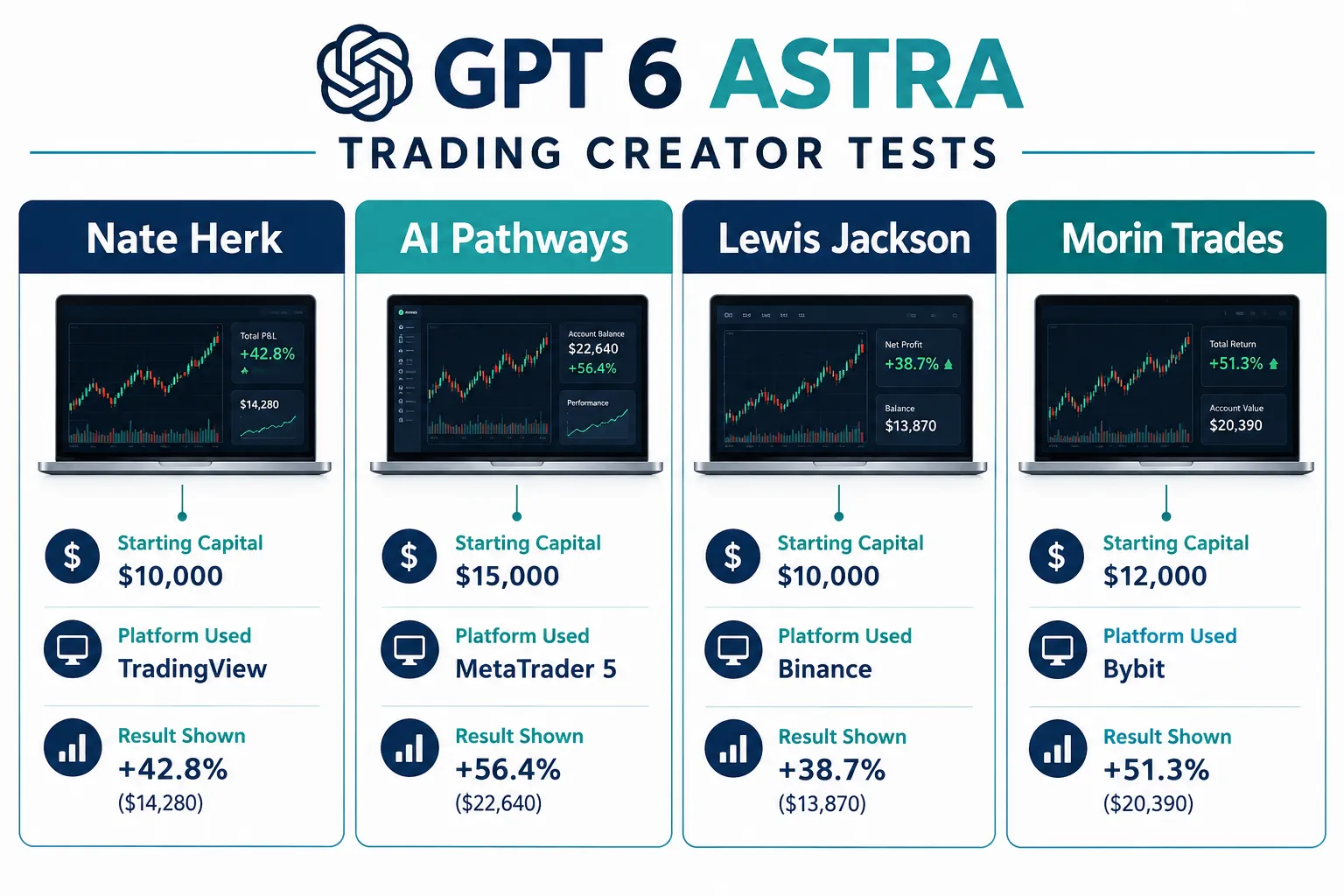
| Test | What it did | Money | Published result | What was skipped |
|---|---|---|---|---|
| Nate Herk (YouTube, Sep 28, 2026) | Codex plus GPT-6 Astra traded stocks for seven trading days, trying to beat the S&P 500 | $10,000 real money | Daily check-ins in the video; final numbers only in the video | Sample size; a clean solo-Astra read (orders went through a Grok bot) |
| AI Pathways (YouTube, Sep 16, 2026) | Walkthrough on using Astra to find strategies and build bots, in nine steps | Not stated | None | Any account result, broker, fills |
| Lewis Jackson Investing (YouTube, Sep 17, 2026) | Seven tests: research, strategy creation, backtesting, audit and fraud detection, hidden data validation, position sizing, plus a Fable 5.1 comparison | Not stated | Scored in the video; none in the description | Live trading, fees, out-of-sample run |
| TradeRank Season 9 | Astra traded a simulated $10,000 against 17 other models for 28 days | Simulated | 11th of 18, -2.18%, 4 trades, 25% win rate | Real fills, sample size |
Nate Herk: real money, seven days, two models
Herk’s video, “I Gave GPT 6 Astra $10,000 to Trade Stocks…And This Happened”, is the most concrete of the four. Per its description, he gave Codex and GPT-6 Astra $10,000 in real money for seven trading days with the goal of beating the S&P 500, and checked in at the end of every trading day. The description says the actual trades were handed to a Grok bot, the strategy changed when the agent traded too cautiously, and on day six a Fed rate hike pulled the portfolio down.
That is honest, and it is also the limit. Seven trading days is a weather report, not a climate. And once orders run through a second model, you are testing a pipeline, not Astra’s trading judgment. The final figures are in the video’s “Final Results” chapter; we could not confirm them from a text source, so we do not quote them here.
AI Pathways: a build tutorial, not a result
AI Pathways’ “How To Actually Use GPT-6 Astra For Trading (Everyone’s Wrong)” walks through strategy methodology, Astra setup and nine build steps. The description names no broker, says nothing about paper or real money and reports no results. It carries a disclaimer that results are not guaranteed and the video is for education. Useful for mechanics. Zero evidence of an edge.
Lewis Jackson: the most structured evaluation
Lewis Jackson’s “GPT-6 Astra Is INSANE for Trading (Full Test)” runs Astra through seven tests: market research, strategy creation, backtesting, audit and fraud detection, hidden data validation, position sizing and a final test, with a Claude Fable 5.1 comparison in the middle. That is the right shape for an evaluation, because it tests the jobs a model actually does for a trader. The description reports no scores and links to his paid course ($29 a month), so weigh the title accordingly.
TradeRank: the only same-rules comparison
TradeRank’s Season 9 ran 28 days, September 12 to October 10, 2026. Each model got $10,000 of simulated capital, a 60-asset list (10 cryptocurrencies and 50 large US stocks), one decision cycle every 24 hours, up to 10 open positions and a 0.1% fee per trade.
GPT-6 Astra’s line:
- Rank 11 of 18, return -2.18%, P&L -$218.12
- 4 trades, 25% win rate
- Max drawdown -2.35%, fees $13.73
For context, Claude Fable 5.1 finished 12th at -2.29% with 5 trades, Grok 4.6 finished 3rd at +1.76% on a single trade, and the winner, Nemotron 3.5 Lightning, made +3.84% on 4 trades. When the winner made four trades in a month, the leaderboard is mostly telling you about a handful of coin flips.
Earlier versions of this story named a fourth creator, Morin Trades, and cited a viral post claiming an Astra crypto system turned $43.47 into $41,495.53. We could not find either on any page we could fetch, so both are out. A claimed result with no ledger is not a result.
Can GPT 6 Astra Code a Trading Bot?
Yes. GPT-6 Astra can write a working trading bot: data pulls, signal logic, order calls to a broker API and logging. It cannot decide your risk limits, verify your data feed or guarantee the code behaves the same live as it did in a test. That part is still your job.
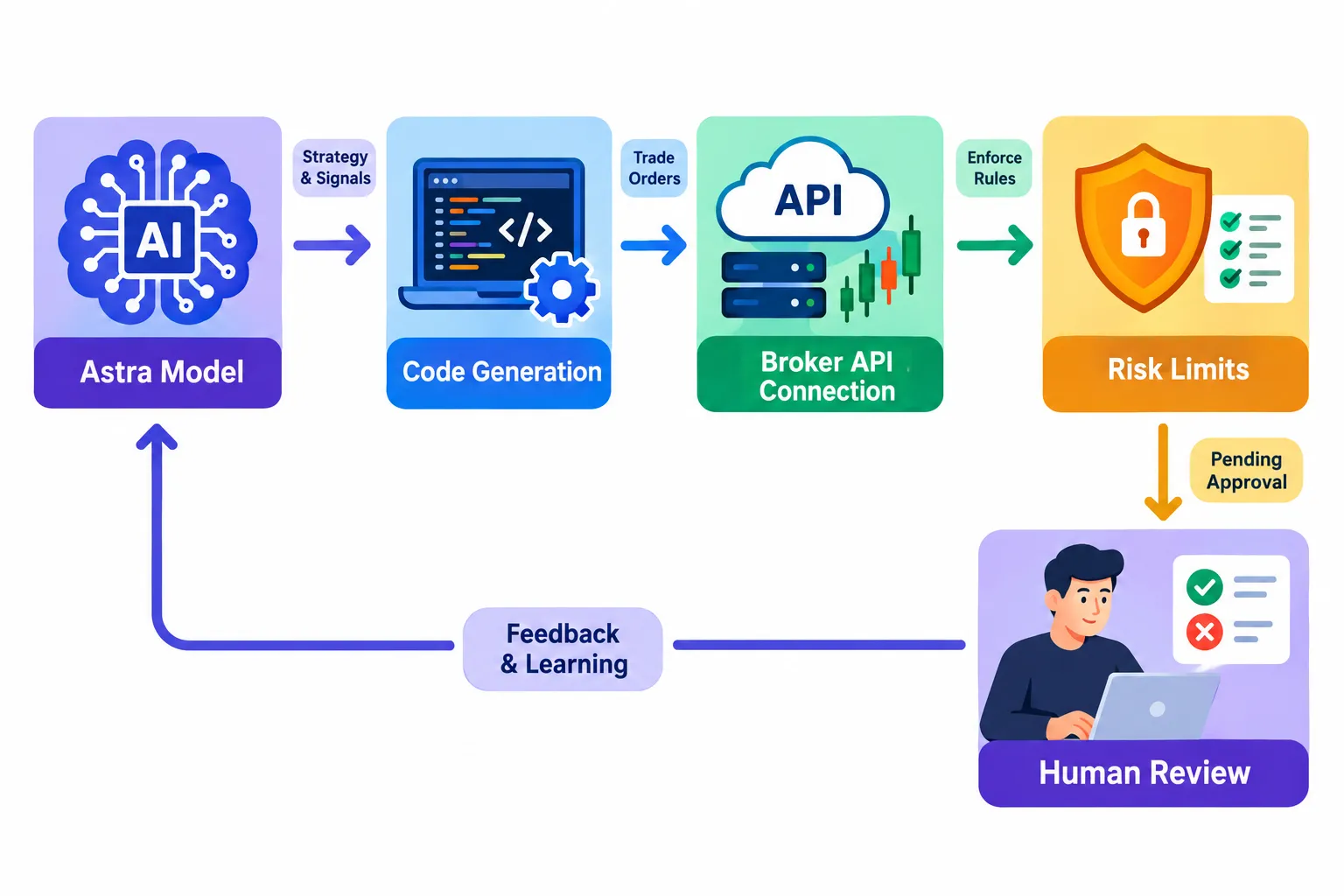
The benchmarks back the coding claim (57.9% on Terminal-Bench 4.0), and the API supports the tools a bot builder wants: code interpreter, hosted shell, MCP and function calling. OpenAI also lists an Alpaca plugin for ChatGPT business workspaces that can summarize balances, buying power and open positions. Its own example asks the model to “restate the order details and ask me to confirm” before submitting, which tells you the confirmation step is your prompt, not a built-in guardrail.
Where a human has to step in, every time:
- Data quality. Astra can write the data pull. It cannot tell you whether your feed is delayed or mis-timestamped. Alpaca’s free tier, for example, uses the IEX feed, not the full consolidated tape, and the paid SIP feed costs extra.
- Risk limits. Astra will write a stop-loss function if you ask. It will not pick the number, and it will not stop you from skipping it.
- Look-ahead bias. AI-written backtests often peek at future data by accident. Read our guide on look-ahead bias in AI-written backtests before you trust any equity curve Astra hands you.
- Execution. Herk’s test is the warning: the agent that writes the plan is not always the agent that sends the order. Know exactly which component places trades, and log it.
Decision rule: if you cannot explain in one sentence what your bot’s stop does and when it fires, you are not ready to run it with real money. Start in a paper account. Our Alpaca API for beginners guide gets you from keys to a first paper order.
What Do All 4 GPT 6 Astra Trading Tests Leave Out?
All four tests skip the numbers that decide whether a strategy survives: model cost, sample size, live fills, out-of-sample results and, in three of four, a benchmark. That is not a knock on the creators. It is what a short demo is.
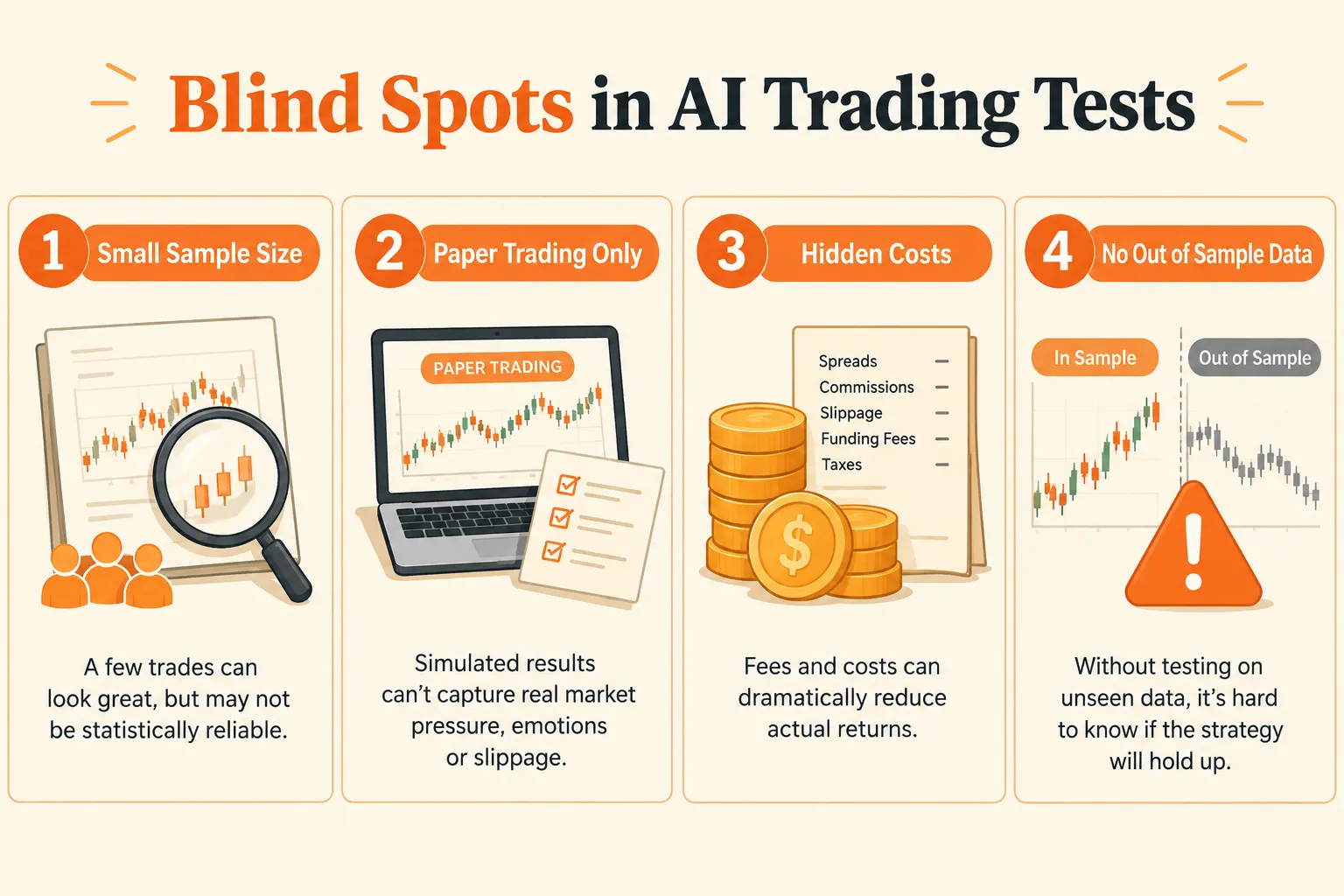
- Model cost. None of the tests report what their Astra usage cost. See the worked example below.
- Sample size. Seven trading days (Herk), four trades (TradeRank). You need far more than that to separate skill from luck.
- Live fills. Only Herk used real money, and his orders ran through another bot. Simulated fills in a contest or paper account flatter every strategy, because they skip queue position and partial fills.
- Out-of-sample results. No test reran an unchanged setup on a fresh stretch of time. That is the single most important test in trading research, and it is the one demos skip because it often fails.
- Benchmark discipline. Herk named the S&P 500 and TradeRank tracks BTC and SPY for context. The two tutorials name none.
Worked example: the API bill as a performance hurdle
Here is why cost belongs in every GPT 6 Astra trading test. Take a modest agent that runs three sessions a trading day (pre-market, midday, close). Assume each session reads 200,000 input tokens (news, filings, positions, prior notes) and writes 20,000 output tokens.
Using OpenAI’s standard rates:
- Input: 0.2 million x $10 = $2.00
- Output: 0.02 million x $50 = $1.00
- Per session: $3.00
- Per month: $3.00 x 3 sessions x 21 trading days = $189
On a $10,000 account, $189 is a 1.89% monthly hurdle before the bot breaks even, or roughly 22.7% a year. Switch on Fast mode (2x) and the hurdle doubles to $378 a month. Let a single prompt grow past 272,000 input tokens and OpenAI charges 2x input and 1.5x output on that whole request. Batch and Flex processing cost half the standard rate, which is the cheaper choice for overnight research that does not need instant answers.
Your token counts will differ. The point does not: on a small account, the model bill can be bigger than the edge. Measure tokens per session in your logs from day one.
How Does GPT 6 Astra Compare With Claude and ChatGPT for Trading Bots?
GPT-6 Astra is a ChatGPT and API model, so the real comparison is Astra versus Claude (and other models), and the honest answer is that no model has an audited trading record. The published numbers show where each is stronger on software and reasoning tasks, not who trades better.
| Factor | GPT-6 Astra | Claude Fable 5.1 | What it means for a bot |
|---|---|---|---|
| Terminal-Bench 4.0 | 57.9% | 55.8% | Close on coding and terminal work |
| Humanity’s Last Exam, with tools | 57.2% | 65.0% | Claude ahead on broad reasoning |
| TradeRank Season 9 | 11th, -2.18%, 4 trades | 12th, -2.29%, 5 trades | A statistical tie on tiny samples |
| Audited live trading record | None found | None found | Neither has one |
The TradeRank row is the most useful one in the table, and it says almost nothing: two models, nine trades between them, 0.11 percentage points apart. That is noise. For a fuller breakdown of models for bot builders, see our best AI for trading comparison, and for a Claude-first build, our coming Claude trading agent guide.
Where Astra is already used in trading products: TrendSpider put GPT-6 Astra inside its Sidekick AI on Plus and Max plans, covered in our TrendSpider GPT-6 Astra report, and Jump Trading lets Astra agents research for days with human review at the gate, per our Jump Trading story. Notice the pattern at both firms: Astra researches, humans approve.
Decision rule: choose Astra if your bottleneck is writing and operating code or driving software. Choose Claude if your bottleneck is reasoning through messy research. Either way, the model does not supply the edge. Your rules do.
How Should You Use GPT 6 Astra in a Trading Workflow?
Use GPT 6 Astra trading tools for the jobs the model has shown it does well: writing code, auditing code, reading long documents and operating software. Keep it away from the jobs that need an edge it has not proven: picking direction and sizing positions.
Good jobs for Astra:
- Write the plumbing. Data pulls, order wrappers, logging, alerting. Ask for tests with every function. Terminal-Bench is where Astra scores best.
- Audit a backtest. Paste your backtest code and ask: “List every line where this code could use data that would not have been known at the time of the trade. Then list every place fees, slippage or borrow costs are missing.” Lewis Jackson’s evaluation included an audit and hidden-data test for exactly this reason.
- Read long filings. A 1,050,000-token context window holds a stack of 10-Ks. Ask for the specific numbers with page references, then check them.
- Stress-test your rules. Give it your written strategy and ask for the five market conditions most likely to break it, with a historical example of each. Verify the examples.
- Draft, never send. Have it draft an order ticket (ticker, side, size, limit, stop, rule that triggered it) for you or your deterministic code to accept or reject.
Jobs to keep away from it:
- Deciding direction on its own, with no written rule behind the call.
- Setting position size from its own confidence.
- Holding live broker keys with no human or code gate in front of the order.
Spotting a fake GPT 6 Astra trading claim
The same model that writes clean code also makes polished screenshots easy. When a post claims an Astra bot turned a small sum into a fortune, ask for three things: the broker or wallet statement, every trade with timestamps, and the fees. The SEC, NASAA and FINRA investor alert on AI fraud lists the tells: promised returns, pressure to fund fast and claims an AI system cannot lose. A real test, like Herk’s, shows the bad days too.
Where Can a GPT 6 Astra Trading Bot Connect to a Broker?
A GPT 6 Astra trading bot reaches a broker the same way any agent does: through the broker’s API, through an MCP connector, or by driving a website with computer use. What it is allowed to do depends on the broker, and the rules differ more than the models do.
What we confirmed on broker pages in 2026:
- Robinhood. Per Robinhood’s agents overview, external AI agents can connect through Robinhood’s Trading MCP and trade only in a dedicated Agentic account you fund. Trade approvals are on by default and can be turned off. Robinhood says it does “not control, supervise, monitor, recommend, or audit agents” and that you are responsible for your agent’s trades.
- Alpaca. A plain REST API with a free paper environment, plus the Alpaca plugin OpenAI lists for ChatGPT workspaces. This is the cleanest place to test a coded bot.
- eToro. Its AI connectors cover ChatGPT, Claude, Grok and Grok Bot with approval required on every proposed action, but are not available to clients in the US, Australia or Singapore.
Computer use is the risky path. Astra’s OSWorld score means it can click through a brokerage website. That does not mean it should. A model driving a browser can misread a field, click the wrong button or keep going after a page changes. If a broker offers an API or MCP connector with scoped permissions, use that instead, and keep the login out of any agent’s session when you are not testing.
Who is responsible when the agent is wrong
You are. Every broker page we read puts responsibility for agent trades on the account holder. OpenAI’s Alpaca plugin example puts the confirmation step in your prompt. That is why the systems in this article that held up best (TradeRank’s fixed rules, Jump Trading’s human review gate) keep a rule or a person between the model and the order.
How Can You Run Your Own GPT 6 Astra Trading Test?
The only responsible way to test GPT 6 Astra trading yourself is on paper, for a fixed window, with a benchmark and a stop rule written before day one. Here is a plan built from what the four tests did right and what they skipped.
Step 1: Set the frame before you touch a keyboard.
- Paper starting balance: $10,000, so you can compare with Herk and TradeRank.
- Benchmark: SPY over the same window.
- Length: at least 20 trading days. Seven was not enough for Herk to draw conclusions.
- Universe: a fixed list of tickers you do not change mid-test.
Step 2: Separate the jobs.
- Let Astra do research and write the code.
- Let deterministic code enforce position size, stops and a daily loss limit.
- Decide who places orders (your code, a second bot or you) and write it down. Herk’s pivot to a Grok bot is fine, but it has to be in the log.
Step 3: Connect to a paper account.
- Alpaca’s paper trading environment is free, uses real-time quotes and simulates fills; paper-only accounts get IEX data.
- Keep live keys out of the agent’s reach until the test is over.
Step 4: Log everything, daily.
- Every entry, exit, reason, size and fill.
- Tokens used and dollars spent per session, so you can run the hurdle math above on real numbers.
- Every time Astra hedges, refuses or changes its mind.
Step 5: Set a stop rule.
- For example, end the test early at -10% on the paper account. Do not keep running it hoping it recovers.
Step 6: Score it against the benchmark and the bill.
- Net result after fees and API cost versus SPY over the same days.
- Then decide: repeat unchanged on a new window (the out-of-sample test), change one thing, or kill the idea.
Common mistake: skipping the paper phase because a video looked convincing. A screen recording of code running is not a funded account surviving a month of choppy tape. And never give an agent unattended access to a live account; see our guide to AI trading agent risks for why the kill switch should sit outside the agent.
Frequently Asked Questions
What is GPT 6 Astra trading?
GPT 6 Astra trading is using OpenAI’s GPT-6 Astra model to research, code or run a trading bot. Astra is a general model for coding, computer use and research, launched September 3, 2026, and OpenAI does not market it as a trading product. Every Astra trading bot is something a user or developer builds.
Has GPT-6 Astra made money trading?
Not on any public record with enough trades to judge. On TradeRank’s simulated Season 9 contest it finished 11th of 18 at -2.18% after 4 trades, and Nate Herk’s seven-day real-money test routed orders through a separate Grok bot. Neither is long enough to show an edge.
How much does GPT-6 Astra cost for a trading bot?
The API costs $10 per million input tokens and $50 per million output tokens, with Fast mode at 2x and Batch at half price. A bot running three 200,000-token sessions a trading day would spend about $189 a month at standard rates. On a $10,000 account, that is a 1.89% monthly hurdle before any profit.
Is GPT-6 Astra better than Claude for trading?
No model has an audited trading record, so there is no proven winner. OpenAI’s launch numbers put Astra ahead on terminal and computer-use tasks and Claude Fable 5.1 ahead on broad reasoning tests. On TradeRank Season 9 they finished 11th and 12th, 0.11 points apart, which is noise.
Can GPT-6 Astra place trades on its own?
It can call broker APIs, MCP connectors or drive a website with computer use, but the broker sets the rules. Robinhood limits external agents to a dedicated Agentic account with approvals on by default, and says you are responsible for your agent’s trades. Keep a code or human gate in front of every order.
How do I test a GPT 6 Astra trading bot safely?
Paper trade it for at least 20 trading days against SPY, with deterministic code enforcing size and stops. Log every trade, every refusal and every dollar of API cost. Then rerun the unchanged setup on a new window before risking real money.
Are viral GPT-6 Astra trading profit screenshots real?
Treat them as unverified until you see a broker or wallet statement, every trade with timestamps and the fees. We could not find any ledger behind the biggest viral Astra profit claims we checked in 2026. The SEC, NASAA and FINRA AI fraud alert lists promised returns and pressure to fund fast as warning signs.
Our Take
Four tests, four setups, zero proof that GPT 6 Astra trading beats an index fund over any stretch that matters. Herk’s real-money run is the most honest of the four, and even it turned into a two-model pipeline over seven days. TradeRank’s contest is the fairest, and it put Astra in 11th place on four trades. The tutorials show what Astra can build, not what it can earn.
That split is the lesson. Astra is a strong coding and research assistant with a real API bill. Use it to build and audit your system, keep risk in code, and make it beat both SPY and its own token costs on paper before a dollar goes live. For more tested tools and plain-English bot breakdowns, start at AI Stock Trading Bots, and to compare the broker side, see the Alpaca tool profile.
For our full verdict on the broker most Astra builders paper test against, read the FullStack Alpha Alpaca review.
Ran your own Astra test with a full trade log? Send it to us and we will review it.
Stay alpha.
The FullStack Alpha research desk tests AI trading bots on paper and live accounts. Reviewed and edited by Jay Rocco, Founder and Editor.
