The FullStack Alpha research desk tests AI trading bots on paper and live accounts. Reviewed and edited by Jay Rocco, Founder and Editor.
Published November 19, 2026 | By FullStack Alpha Editorial Team | Reviewed by Jay Rocco, Chief Editor
Quick Answer
Anthropic, the AI lab behind Claude, priced its initial public offering at $83 per share and begins trading on Nasdaq under the ticker ANT on Thursday, November 19, 2026, according to ABC News and CNBC. The S-1 shows explosive revenue growth alongside very large paper losses driven largely by non-cash accounting items, not by runaway operations. Whether the Anthropic IPO is a reasonable position depends almost entirely on holding period: short-duration traders and multi-year investors face completely different risk profiles on day one.
This story is part of our AI trading news coverage at AI Stock Trading Bots, where we track the tools, brokers and rules that affect bot traders.
Key Takeaways
- Anthropic priced at $83 per share ahead of its November 19, 2026 debut, per ABC News.
- The S-1 is the primary source document. Everything in this guide traces back to the filing or to major outlets reporting on it.
- Claude’s consumer subscription is ad-free by policy, which Anthropic positions as a trust advantage over ad-supported rivals.
- Enterprise usage-based billing, not consumer subscriptions, drives the bulk of revenue.
- Headline losses near $80 billion to $104 billion are dominated by convertible note fair value changes, a non-cash item, as InvestmentNews reported.
- Interest income on the company’s enormous cash balance materially offsets the operating loss.
- Customer concentration improved: two customers were roughly a quarter of 2025 revenue, with no single customer above 10% in 2026.
- Hyped IPOs historically trade well below their first-day highs before stabilising, so entry timing matters more than conviction.
- Lock-up expiry, typically 90 to 180 days, is a scheduled supply event worth marking on a calendar.
What is the Anthropic IPO and when does it trade?
Anthropic’s IPO is the public listing of the AI research company behind the Claude model family, priced at $83 per share with trading starting Thursday, November 19, 2026. The company announced its investor roadshow ahead of the listing, and the offering has been widely covered by CNN Business, BBC News and the Associated Press.
For traders, a listing of this size matters for mechanical reasons:
- Liquidity spikes on day one, which narrows spreads and makes size easier to move.
- Volatility is elevated because there is no established price history and no reliable support or resistance.
- Options, borrow availability and index inclusion all arrive later, not at the open.
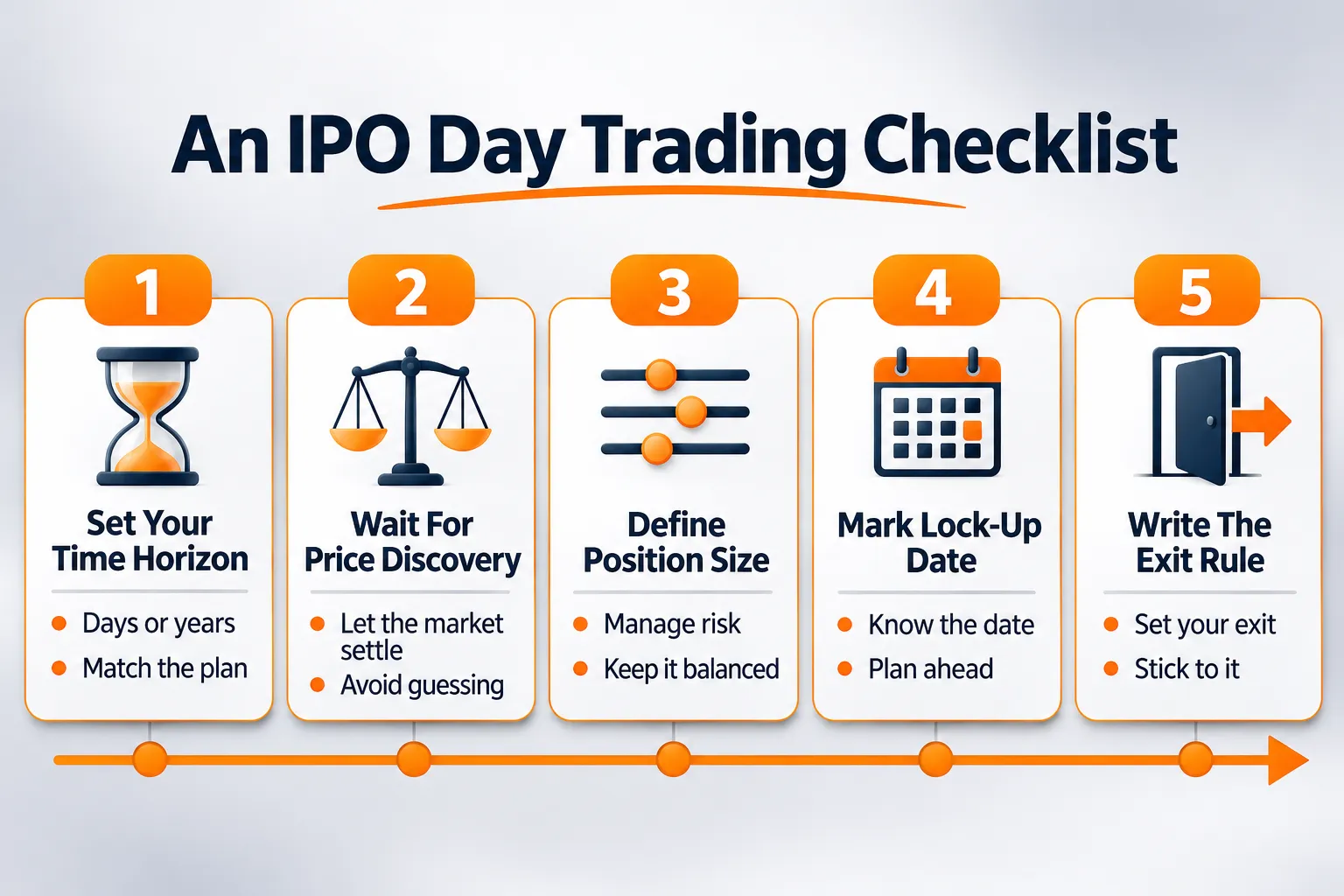
A useful decision rule: if the plan is to hold for days, the opening auction and the first hour are the event. If the plan is to hold for years, there is no urgency at all, because the float expands substantially once insider lock-ups expire.
Common mistake: treating the IPO price and the opening print as the same thing. Allocated institutions buy at the IPO price. Retail buyers at the open frequently pay a meaningful premium to it.
New to trading around events like this? Start with our AI trading for beginners guide before putting real money behind any rule.
Why does the S-1 matter more than headlines?
The S-1 registration statement filed with the Securities and Exchange Commission is the only disclosure the company is legally accountable for, which makes it the correct starting point for anyone researching the Anthropic IPO. News coverage summarises it, but summaries drop the footnotes where the accounting actually lives.
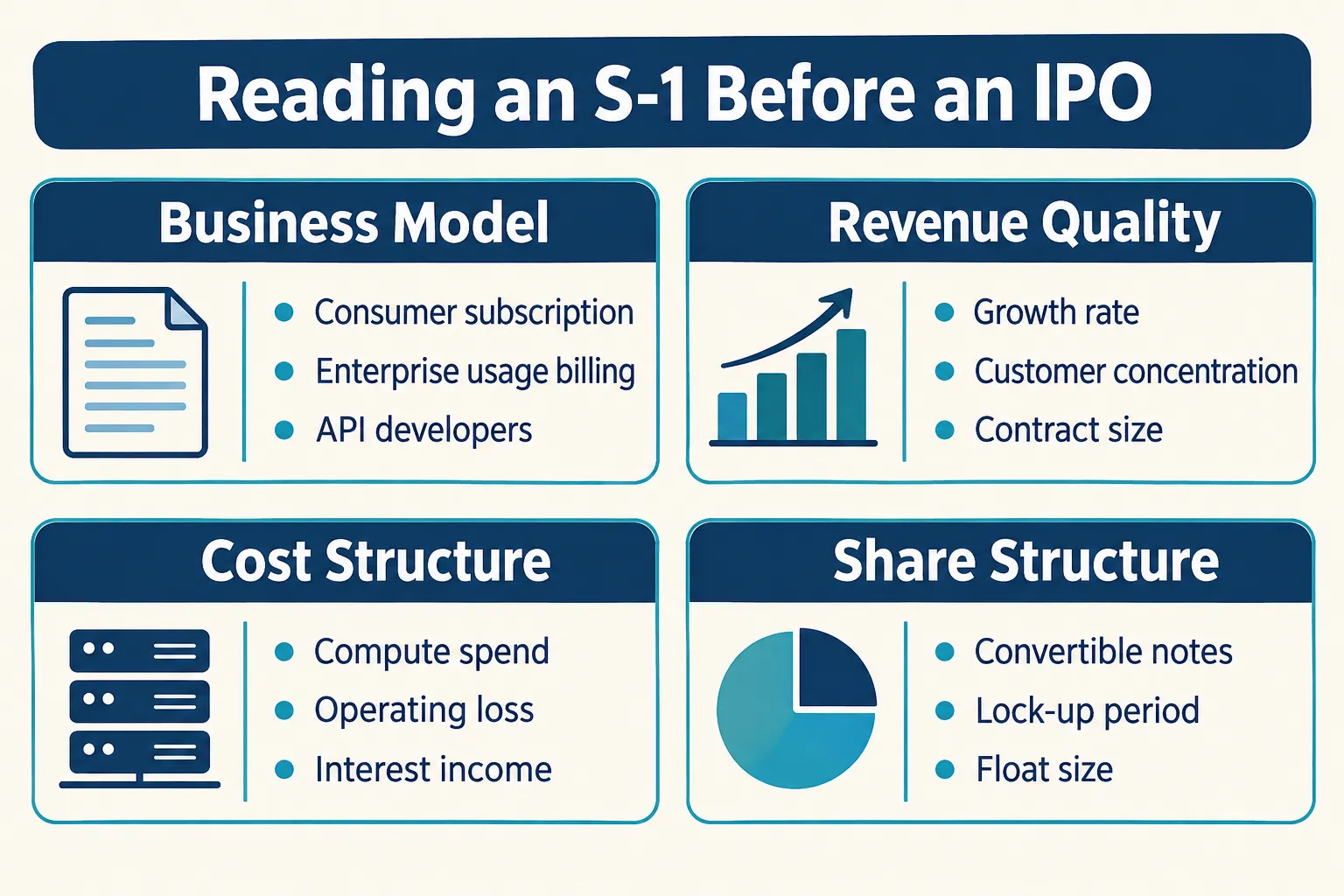
What to read first in any S-1, in order:
- Risk factors, especially customer concentration, compute dependency and competition.
- Management’s discussion of revenue, so growth is understood in context.
- The statement of operations, line by line, including non-operating items.
- Share capital and dilution, including convertible instruments.
- Use of proceeds and lock-up terms.
Edge case worth noting: visually polished S-1 documents (the SpaceX filing was unusually image-heavy) can create a halo effect. Presentation quality has no relationship to financial quality.
Traders building a repeatable research process often pair primary filings with screening software. The comparison coverage at AI Stock Picker Apps breaks down which tools actually parse filings versus which simply resurface headlines.
How does Anthropic make money?
Anthropic earns revenue from three channels: consumer Claude subscriptions at a flat monthly rate, enterprise and API contracts billed on usage, and partnerships with cloud and infrastructure providers. Enterprise usage is the commercially significant piece.
The contrast with consumer-first AI products is structural:
- Flat-rate consumer subscriptions cap revenue while compute costs scale with heavy users.
- Usage-based enterprise billing scales revenue directly with consumption, so a heavy customer is a profitable customer rather than a cost problem.
- Anthropic has stated it will not run advertising inside its consumer product, a positioning point covered in reporting on the company’s AI safety framing.
That makes consumer Claude function partly as a distribution channel. Individuals adopt it personally, then advocate for it at work, where the billing model changes entirely.
Enterprise scale disclosed in the filing includes more than 11,000 businesses spending above $100,000 annually, roughly 1,900 spending above $1 million, and about 250 spending above $10 million. A $20 consumer plan and a seven-figure enterprise contract are not the same business.
Curious what Claude actually does with a brokerage connection? We walk through it in our Claude and Alpaca paper account setup, and the wider Claude trading bot guide covers what works and what does not.
How serious is the customer concentration risk?
Concentration was a genuine risk in 2025 and has improved since. Two customers, identified in the filing only as Customer A and Customer B and widely assumed to be large cloud partners, accounted for roughly 24% of revenue in 2025. In 2026, no single customer exceeded 10% of revenue.
Why concentration matters for an IPO buyer:
- A single contract renegotiation can reset a growth narrative in one quarter.
- Strategic customers who are also investors have incentives that differ from ordinary buyers.
- Concentration often resolves either through genuine diversification or through the largest customer building in-house.
Decision rule: if concentration above 20% of revenue would make a position unholdable, treat the 2026 improvement as necessary but watch it quarterly rather than assuming it is permanent.
What is the circular financing concern in AI?
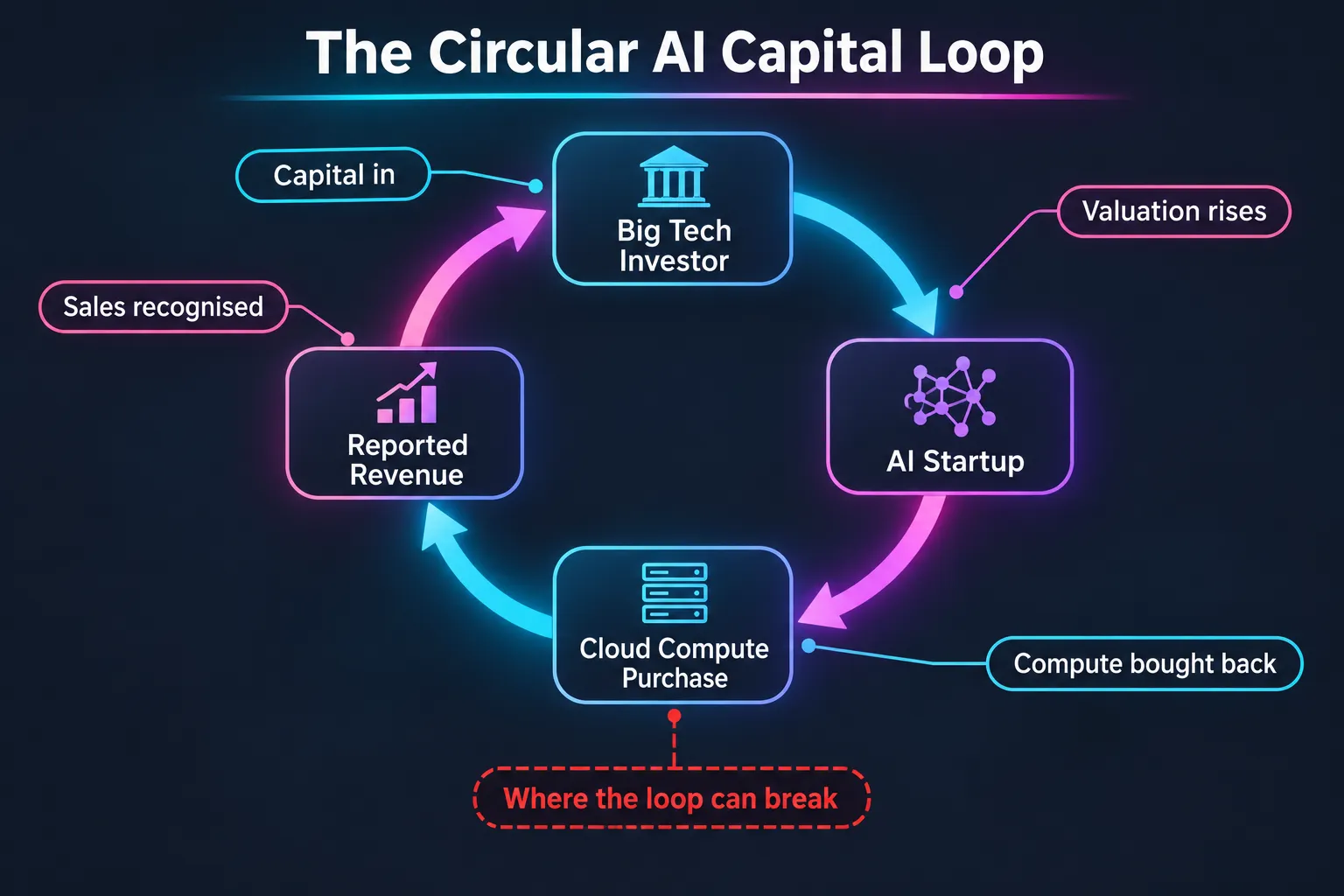
The criticism is that large technology companies invest in AI startups, the startups spend that capital on the investor’s cloud or chips, and the resulting revenue flatters the investor’s own results. Both legs of the loop can look like growth without new outside demand.
Two variations circulate:
- Capital recycling: investor funds the startup, startup buys compute from the investor, investor books revenue.
- Usage recycling: investor adopts the startup’s product, payments boost the startup’s valuation, which raises the carrying value of the investor’s stake.
The counterpoint in the current cycle is that the binding constraint is supply, not demand. Data centre capacity, advanced chips and grid power are the limiting factors. Demand for inference has not been the bottleneck.
What would falsify the bull case: enterprise contract growth slowing while compute capacity expands. That combination would indicate demand, not supply, became the constraint.
Why is Anthropic losing tens of billions on paper?
The enormous headline loss is mostly an accounting artefact, not cash burned. InvestmentNews paired the filing’s growth story with a loss in the tens of billions, and the dominant driver is the change in fair value of convertible notes and derivative liabilities. As the company’s valuation rose, the accounting value of those instruments rose with it, producing a large non-cash charge.
The operating picture is far narrower. Approximate figures from the filing:
| Period | Revenue | Operating result |
|---|---|---|
| 2023 | $41 million | Operating loss near $551 million |
| 2024 | $386 million | Operating loss in the low billions |
| 2025 | About $4.5 billion | Operating loss, narrowing relative to revenue |
| Nine months to Sep 30, 2026 | About $33 billion | Operating loss roughly $1.2 billion |
Revenue grew close to tenfold in consecutive periods while operating expenses grew more slowly in percentage terms. An operating loss of roughly $1.2 billion on about $33 billion of revenue is a margin problem measured in low single digits, not an existential one.
Two caveats before extrapolating:
- Nine-month comparisons exclude a quarter, which can distort seasonality.
- Repeating a tenfold growth rate at this revenue base is not a base case.
Does interest income change the profitability picture?
Yes, materially. Anthropic earned roughly $2.3 billion in interest income over the nine months to September 30, 2026, which exceeds the operating loss for the same period. Excluding convertible note fair value movements, the company was close to breakeven or better on a pre-tax basis.
Why this nuance gets missed:
- Interest income sits below the operating line, so operating-loss headlines ignore it.
- Companies with very large cash balances from private rounds earn meaningfully more interest than peers while rates stay elevated.
- Interest income is not operating leverage. It can shrink if rates fall or if cash is deployed into data centres.
Comparison point: a company carrying large debt shows interest expense below the operating line instead, which widens total loss. Same line, opposite direction.
Treat interest income as a cushion that buys time, not as evidence of a profitable core business. Screening tools that separate operating from non-operating items are worth preferring, and the platform comparisons cover which ones present that breakdown clearly.
How have recent hyped IPOs actually traded?
Recent large listings show a familiar pattern: a sharp opening pop, a multi-day squeeze, then a drawdown as lock-ups approach and index flows normalise. The SpaceX listing, the largest by capital raised, squeezed roughly 50% from the $150 area to above $200 within days, then gave much of it back over the following months.
What that implies for the Anthropic IPO:
- Short-duration traders are playing volatility, not valuation.
- Buy-and-hold investors who buy the open frequently sit underwater before any thesis plays out.
- Lock-up expiry, usually 90 to 180 days post-listing, is a scheduled increase in tradable supply.
Historically, heavily promoted IPOs often decline substantially from their early highs before finding a durable base. The exact percentage varies by cohort and period, so treat any single average as directional rather than precise.
Quick example of the horizon problem: a trader buying the open and exiting in three days, and an investor buying the same print and holding three years, can both be rational, but only one of them should care about the first hour’s tape.
Who should and should not consider buying at the open?
Day-one participation suits traders with a defined exit rule, position sizing discipline and tolerance for wide spreads. It suits long-term investors poorly, because better entries are statistically common in the months after a hyped listing.
Consider participating at the open if:
- The holding period is measured in hours or days.
- A stop or exit rule is written before the bell, not after.
- Position size is small enough that a 30% adverse move is survivable.
Consider waiting if:
- The intention is a multi-year core position.
- Valuation discipline matters more than participation.
- Full financials for a complete fiscal year as a public company would change the decision.
Common mistakes around the Anthropic IPO: using market orders in the first minutes, assuming the IPO price acts as support, and sizing a speculative position like a core holding.
If you run any rule-based entry or exit on a fresh listing, test it first. A paper trading run shows how your rules behave in wide-spread, no-history conditions before real money is involved, and forward testing vs backtesting explains why a fresh listing breaks most historical tests.
How should AI tools be used to research this listing?
AI screeners and research assistants are useful for extracting disclosures quickly, but they are poor at judging accounting quality on a filing this unusual. Use them for retrieval and comparison, not for conclusions.
Practical uses:
- Pull risk factors and customer concentration language straight from the S-1.
- Compare revenue growth and gross margin against listed AI infrastructure and software peers.
- Track post-IPO price behaviour, volume and lock-up dates in one place.
Where they fail: large non-cash fair value charges confuse many automated scoring models, which flag the company as deeply unprofitable when the operating picture says otherwise. Verify any model output against the filing, and run it through our AI trading bot red flags checklist before trusting a tool with real money.
Related reading: compare feature sets across the full tool directory, review options-focused tools if planning to trade volatility once contracts list, and check alternatives before paying for any subscription. For bot-specific picks, see our best AI trading app roundup.
Building a bot that trades new listings? Show us how it handles volatility. Every bot we review gets tested on messy days like an IPO open, and you can read how we test first. Submit your bot: https://aistocktradingbots.com/contact/?topic=submit-bot
This article is educational commentary, not investment advice. No outcome is promised. More coverage lives on the AI Stock Trading Bots homepage.
Sources
- Anthropic, roadshow launch announcement, 2026. anthropic.com.
- CNBC, Anthropic IPO date and price range, 2026. cnbc.com.
- CNBC, Anthropic IPO offering price, 2026. cnbc.com.
- BBC News, Anthropic listing coverage, 2026. bbc.com.
- ABC News, Anthropic announces $83 per share IPO price, 2026. abcnews.com.
- Associated Press, Anthropic IPO report, 2026. apnews.com.
- CNN Business, Anthropic IPO and Wall Street AI demand, 2026. cnn.com.
- InvestmentNews, Anthropic IPO filing pairs explosive growth with an $80B loss, 2026. investmentnews.com.
- CBS News Minnesota, Anthropic IPO plans and AI safety, 2026. cbsnews.com.
Your market edge starts with the right tool. Stay alpha.
Frequently Asked Questions
When does Anthropic start trading?
Thursday, November 19, 2026, on Nasdaq under the ticker ANT.
What is the Anthropic IPO price?
$83 per share, as reported by ABC News and CNBC on November 18, 2026.
Is Anthropic profitable?
Not on a GAAP basis. Operating loss over the nine months to September 2026 was roughly $1.2 billion on about $33 billion of revenue, with interest income of roughly $2.3 billion partly offsetting it.
Why is the reported loss so large?
Changes in the fair value of convertible notes and derivative liabilities, a non-cash charge that rises as the company's valuation rises.
When does the lock-up expire?
Lock-ups typically run 90 to 180 days after listing. Confirm the exact date in the prospectus.
Should beginners buy on day one?
Day-one buying suits short-horizon traders with written exit rules. Investors building a long-term position generally have no reason to rush.
The FullStack Alpha research desk tests AI trading bots on paper and live accounts. Reviewed and edited by Jay Rocco, Founder and Editor.