

The FullStack Alpha research desk tests AI trading bots on paper and live accounts. Reviewed and edited by Jay Rocco, Founder and Editor.
Published November 9, 2026, 7:55 a.m. ET. By FullStack Alpha Editorial Team | Reviewed by Jay Rocco, Chief Editor
Quick answer: On November 6, 2026, Delaware fintech Tactfolio Inc. launched a platform that lets AI assistants build, backtest and save rules-based stock strategies over MCP, then run them automatically through a connected Alpaca account. The catch is the point: the AI cannot authorize live trading. A human reviews and activates every strategy, and automated strategies run on a daily schedule, not intraday.
Key facts
- Launch date: November 6, 2026, announced by Tactfolio Inc. through GlobeNewswire (New Castle, Delaware).
- What it does: a visual strategy builder, natural-language strategy creation with AI help, historical backtests with trading costs and drawdowns, paper trading, and automated execution.
- AI connection: MCP (Model Context Protocol, the open standard that lets chat assistants such as Claude call outside tools). Assistants can create, test and save strategies.
- The gate: per the release, AI assistants cannot independently authorize live trading. Users must review and activate.
- Broker: Alpaca only. Users connect their own Alpaca account and decide which strategies are active.
- Timeframe: daily schedule only. No high-frequency or intraday trading.
- Price: free strategy-building and backtesting options. Paid tiers were not detailed.
What exactly did Tactfolio launch on Nov 6, 2026?
Tactfolio is selling the rules layer. You describe an idea in plain English, such as buying the strongest sector ETFs when they trade above their 200-day average, and the platform turns it into structured blocks you can read, test and edit.
You can do that two ways. Drag blocks around in the visual builder, or let an MCP-connected AI assistant assemble the rules, run backtests, compare versions and save revisions. Then the assistant stops.
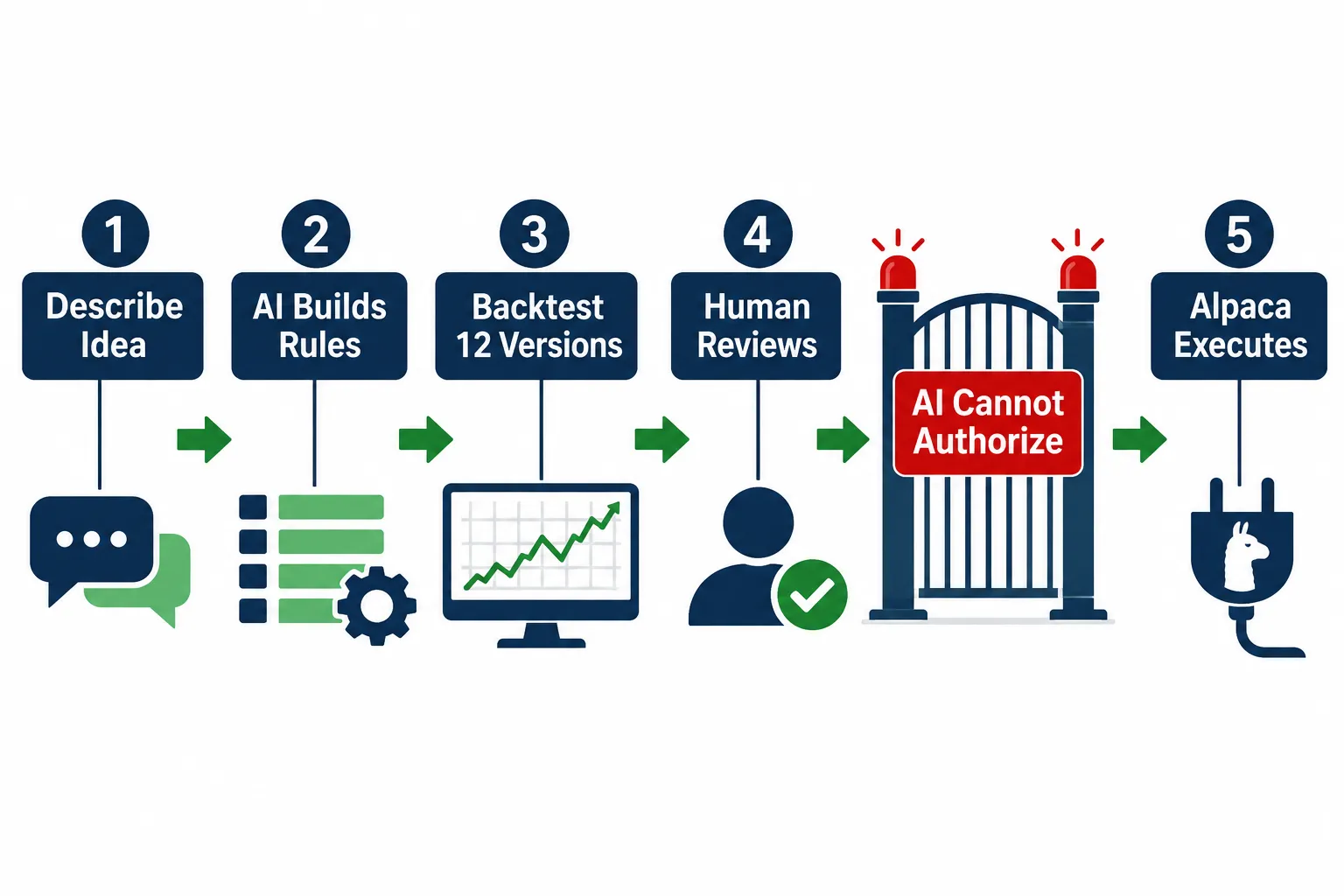
Strategies can come from four places: rules you build yourself, AI-generated strategies, strategies shared by other users, and a library of established approaches you can modify and backtest.
Here is why that matters. Most retail traders do not lose money because they cannot code a moving-average crossover. They lose because they have no rules and no exit. A tool that forces an idea into readable rules is solving the right problem.
Why does it matter that the AI cannot authorize live trades?
Because the alternative is handing a language model the keys to your brokerage account and hoping nothing weird happens.
Look at the rest of 2026. Robinhood Agents can trade without a fresh sign-off on each order. Interactive Brokers launched autonomous AI trading with an agent allowance. The industry keeps treating “no human in the loop” as the achievement.
Tactfolio went the other way. The AI does the assembly work. You flip the switch.
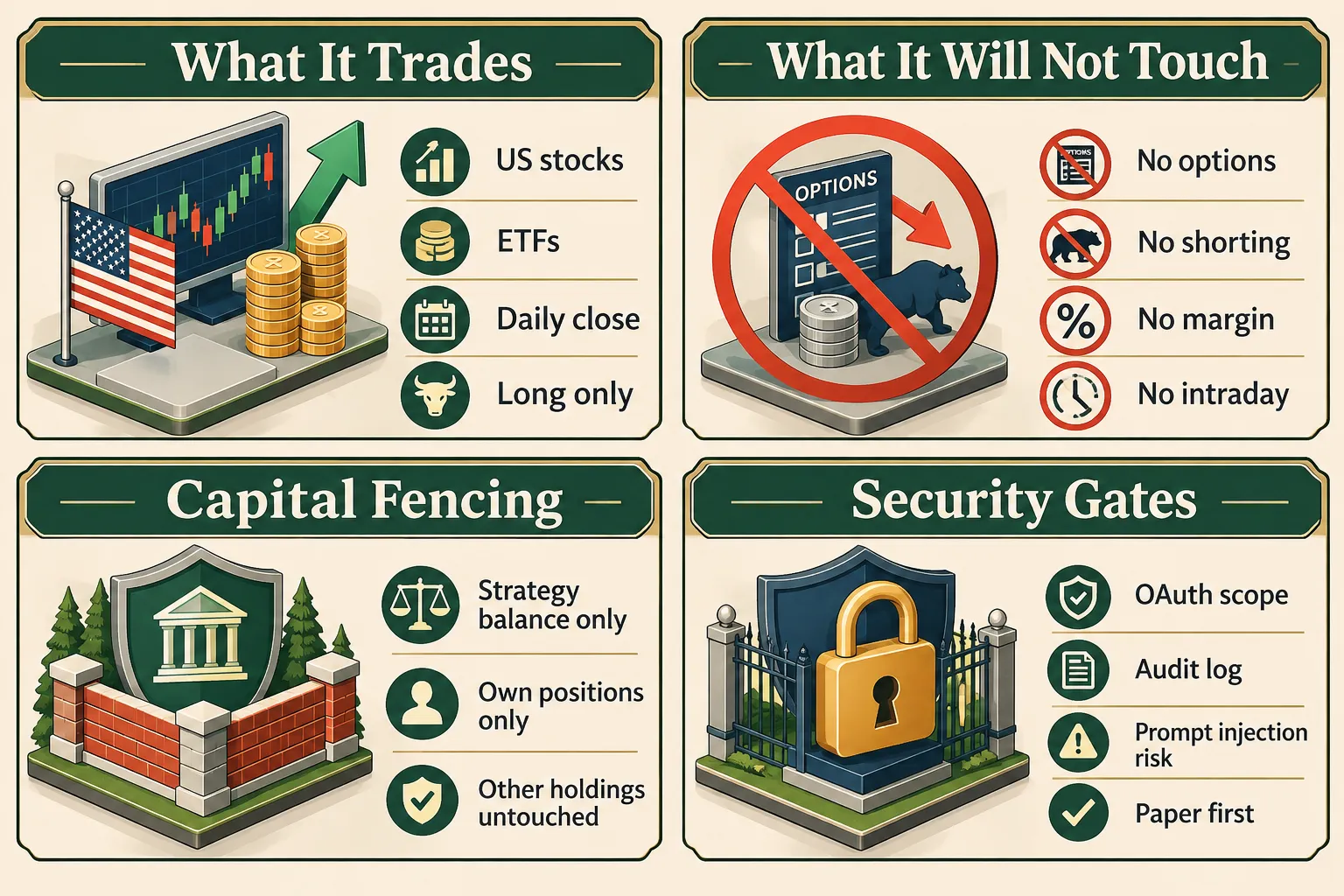
The security case is real. Prompt injection, where text a model reads gets treated as an instruction, is the known weak spot of agent setups. A poisoned headline should never become an order. A 2026 arXiv study on MCP servers reported that roughly 13% of examined servers behaved differently than their documentation described. A human approval gate, scoped permissions and an audit trail are not paranoia. They are the minimum.
Alpaca’s own approach rhymes with this. Its MCP server defaults to paper trading, and moving to live money takes live credentials and a deliberate config change.
How does Tactfolio compare to other AI strategy builders?
Tactfolio is days old, so there is no public track record, no review pile and no community verdict yet. Here is the landscape on paper.
| Feature | Tactfolio | Composer | Alpaca MCP (direct) |
|---|---|---|---|
| Strategy input | Natural language plus visual blocks | Visual blocks plus AI chat | Code or assistant calls |
| Timeframe | Daily schedule only | Daily rebalance | Whatever you build |
| Broker | Alpaca only | Own brokerage | Alpaca |
| Can AI go live on its own? | No, human activates | Human approves | Yes, once you switch to live keys |
| Track record | None yet | Established | Depends on your code |
If you want breadth, Tactfolio is not your tool yet. If you want a single-broker sandbox with a human gate built in, it fits. Our Composer review covers the closest established rival.
What are the real limits on Tactfolio strategies?
The fine print is the product, so read it.
- Daily only. Automated stock strategies run on a daily schedule. Day traders should look elsewhere.
- Alpaca only. If your account sits at Schwab or IBKR, you are out for now. Our guide to picking a broker with a trading API lists the options.
- Eligibility is undefined. The release says “eligible users” can connect Alpaca but does not spell out who qualifies.
- Pricing is vague. Free building and backtesting options exist. The cost of automated execution was not stated.
- Backtests are hypothetical. Tactfolio says so itself: historical results do not guarantee future performance.
Want options automation instead? Alpaca supports some of it, with hard boundaries. We mapped those in what the Alpaca options API lets you automate.
Does a good backtest mean the strategy works?
No. A backtest is a rehearsal against a crowd that already left the theater.
Overfitting is when you tune a strategy until history looks perfect and then watch it fall apart on real money. It is the most common way retail algo traders fool themselves. Our explainer on overfitting vs underfitting shows how it happens.
An AI assistant that can run backtest after backtest in seconds makes this worse, not better. Ten tries feels like research. Two hundred tries is data mining.
The fix is boring. Hold back recent data, test on it once, then forward test on paper before a dollar goes live.
What should investors watch next?
- Live versus backtest results. Whether Tactfolio publishes any comparison of user strategies running live against their backtests, and how it measures them.
- Pricing for automation. Watch for a public price list for automated execution beyond the free building and backtesting tiers.
- Broker expansion. A second broker beyond Alpaca would be the first real sign this grows from a niche tool into a platform.
- Connector stability. MCP integrations are young. A connector outage during a scheduled daily run is a real operational risk worth tracking.
- Regulator attention. The CFTC has warned that AI cannot predict markets and that promised high returns from AI bots are a fraud red flag. Agent-specific trading rules from the SEC or FINRA have not landed yet.
Our take
The headline feature is a restriction, and that is refreshing. Every other week a company announces an autonomous trading agent as if removing the human were the win. Tactfolio built the gate on purpose.
But do not confuse good architecture with good returns. A clean permission model lowers the odds that software does something you never authorized. It does nothing about the odds that your strategy is simply wrong. Only one of those problems is solved by code.
Our position: worth a paper account if you already use Alpaca and trade daily-timeframe systems. Worth switching brokers for? Not yet. Systems beat hacks, and a system earns real capital only after it earns a track record.
Next step: build one strategy you can explain in a single sentence, write down the position size and exit rule first, and paper trade it for 30 trading days before any live money. If it only works after you re-tune it, it does not work. Then run it past our AI trading bot red flags checklist.
A human gate protects your account. It does not prove the strategy.
FullStack Alpha has tested more than 200 AI stock tools since 2022, and we score them on what they do live, not what the landing page says.
Compare tested AI trading tools before you connect one to your broker
This article is for education only. It is not financial, investment or trading advice. Automated trading can lose money, backtests are hypothetical, and you should do your own research before connecting any tool to a brokerage account.
Sources
- Tactfolio Inc. launches AI-compatible platform for building, backtesting, and automating trading strategies (GlobeNewswire, Nov 6, 2026)
- Tactfolio release republished by Yahoo Finance (Nov 6, 2026)
- Tactfolio
Your market edge starts with the right tool. Stay alpha.
Frequently Asked Questions
Can Tactfolio's AI place live trades by itself?
No. The AI can create, test and save strategies, but a human must review and activate them before any live trading.
What is MCP in plain English?
Model Context Protocol is an open standard that lets AI assistants such as Claude call outside tools directly, within the permissions you grant.
Which broker does Tactfolio support?
Alpaca only at launch. Eligible users connect their own Alpaca account and choose which strategies are active.
Can Tactfolio day trade?
No. Automated stock strategies run on a daily schedule, not intraday or high-frequency.
Is Tactfolio free?
Tactfolio offers free strategy-building and backtesting options. Pricing for automated execution was not detailed at launch.
Is this article financial advice?
No. It is education only. Do your own research and paper trade before connecting any tool to a live account.
The FullStack Alpha research desk tests AI trading bots on paper and live accounts. Reviewed and edited by Jay Rocco, Founder and Editor.
