

Look ahead bias is the number one reason an AI-written backtest prints a beautiful equity curve and then bleeds out in live trading. Auditing for look ahead bias comes down to a single question you can ask any line of code: did the program know something the trader could not have known yet? A language model writing Python has no concept of time. It has a dataframe, and every column in that dataframe looks equally available.
Quick Answer
Look-ahead bias occurs when a backtest uses information that was not available at the moment the trade decision was made. In AI-generated code it usually shows up as a missing .shift(1) on a signal, indicators computed on the full price series before any train and test split, fills at the signal bar’s own close, or a survivorship-biased ticker list. The fix is mechanical: audit the data loader, audit every time index, re-run the strategy on history truncated at each decision point, and replay the result in an event-driven engine. Free tools exist for all four steps.
Key Takeaways
- The CFA Institute’s 2026 backtesting material defines look-ahead bias as a simulation using information unavailable when the historical decision would have been made. Causality, not code style, is the test.
- A September 30, 2026 paper, the QuantCode Model study, pushed one fine-tuned model to 83.5% successful backtests across 400 Backtrader tasks. “Successful” means the code ran, not that the logic respected time.
- The same study found domain specialization backfired in places: final success after repair fell from 47.5% to 32.5% with continued pretraining alone.
- A September 2026 survey of agentic trading systems, Agentic Quantitative Trading, reviewed 20 systems: all treated signal discovery as core, only 4 covered all five pipeline stages, and only 2 treated all five as core.
- On r/algotrading, the thread Do you trust Vibe-Coded Backtesters? drew 67 comments on September 26, 2026, with look-ahead the dominant objection.
- Research in the Journal of Financial Data Science shows GPT sentiment analysis can carry look-ahead bias because the model may have seen the outcome during training.
- Event-driven engines (nautilus_trader, QuantConnect LEAN) make look-ahead harder to write than vectorized ones. They do not make it impossible.
Why do AI-written backtests look too good to be true?
Because a code-generating model is rewarded for producing a program that executes and returns a number, not one that honors the arrow of time. Fluent Python plus a clean dataframe equals a Sharpe ratio nobody has stress tested.
The benchmark data backs this up. QuantCode-Bench, submitted April 16, 2026, formalized trading-code evaluation across 400 tasks pulled from Reddit, TradingView, StackExchange and GitHub. Its authors name trading-logic operationalization, API usage and semantic alignment as the real limits of current models. Syntax is the easy part.
The agentic survey goes further: strong forecasting or language ability does not reliably translate into live trading performance. Among 17 of 20 systems that mixed architectural patterns and 15 of 17 multi-agent systems that relied on aggregation, only 2 used explicit gating. Aggregation generates more ideas. It verifies nothing about temporal causality.
Market truth: an AI assistant will write you a strategy that beat the market in a universe where you could read tomorrow’s newspaper.
Look ahead bias
Look-ahead bias is the use of future information in a historical simulation. Look-ahead bias occurs the moment your decision rule touches a value that had not printed yet, even by one second. Call it lookahead bias in backtesting, call it future-function leakage, the mechanism is identical.
The cleanest way to picture it: you decide to buy at 9:30 a.m. using the closing price at 4:00 p.m. that same day. Nobody is that lucky. Your code just was.
Example of look-ahead bias
For example, look-ahead bias shows up in a single line: df['signal'] = df['close'] > df['sma20'], then returns = df['signal'] * df['pct_change']. The signal and the return share the same row, so the trade is filled on the bar that created it. One .shift(1) separates a fantasy from a backtest. Obside’s breakdown of look ahead bias in backtesting walks the same failure with timestamps.
Look ahead bias in time series forecasting
In time series forecasting the leak hides in preprocessing. Scaling, normalizing, imputing missing values, or computing a rolling z-score on the full history before splitting train and test all push out-of-sample statistics backward in time. Fit every transformer on the training sample only, then apply it forward.
What are the most common ways look ahead bias sneaks into Python backtesting code?
Six patterns cause most of it, and an AI assistant writes all six without blinking. Memorize the list and you will catch the majority of leaks in under ten minutes of reading.
- Shift errors in pandas. A stray
.shift(-1), or a missing.shift(1)on the signal column. The negative shift is the loudest tell. - Indicators computed on the full series before the train and test split, which bleeds future data into in-sample statistics.
- Using the daily high or low to trigger an intraday fill. Your program knew the day’s range before the day happened.
- Filling at the signal bar’s close instead of the next bar’s open.
- Survivorship-biased ticker lists. Today’s index members, backtested across a decade of delistings.
- Resampling that leaks future bars. A
resample('1D').last()on intraday data stamps the day’s final value at the day’s open.
Scraped data adds its own mess. If the price history came out of an HTML table, stray text placeholders can get parsed as values and quietly forward-fill into a signal. Clean the data before you clean the logic.
Look ahead bias examples in machine learning models
Machine learning multiplies the surface area. Target encoding across the whole dataset, k-fold cross-validation on time-ordered rows, feature selection run on all data, and restated fundamentals that were revised months after the original filing. Large language model sentiment scores carry a special version of the problem: the model may already know how the stock performed. The Journal of Financial Data Science paper on GPT sentiment treats that memorized-outcome risk as the core finding.
How do you audit an AI-written backtest step by step?
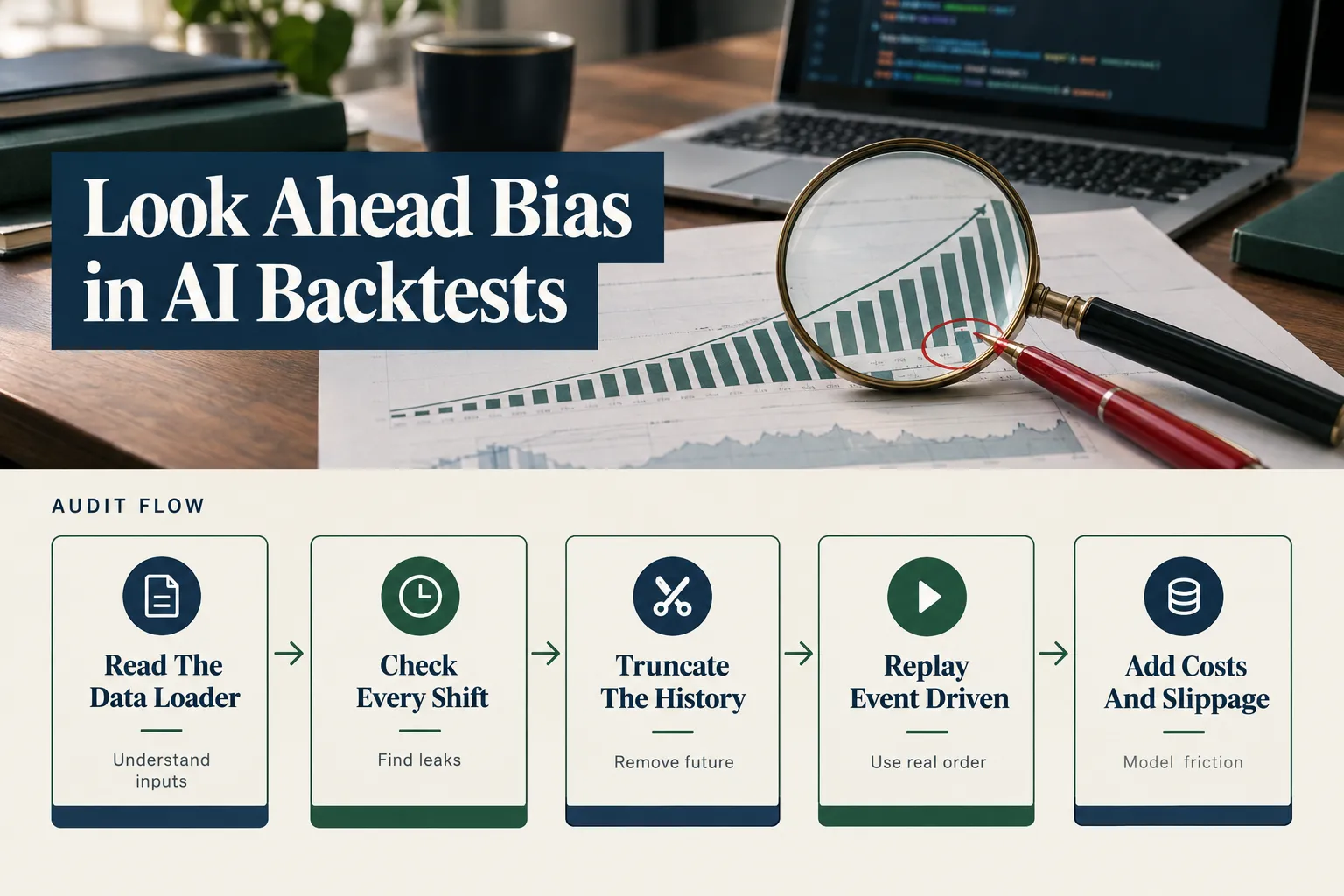
Audit in five passes, in this order, and never trust the equity curve until all five are done. AI Broker HQ’s review of backtesting pitfalls sequences the work the same way: data first, results last.
- Read the data loader first. Where did the data come from, is it adjusted, and does the ticker universe include delisted names? FOR Traders’ notes on avoiding bias in backtesting puts the universe question ahead of the strategy question.
- Grep for every shift, rolling, resample, fillna, and merge. Any
shift(-n)is guilty until proven innocent. Anyfillna(method='bfill')is a backward fill, which is literally future data. - Run the truncated-data test. BigMoveAlgo’s walkthrough on lookahead bias recommends re-running the strategy on history cut off at each historical decision point and comparing the signal with the full-data run. If the signals differ, you have a leak.
- Replay it event-driven. Feed bars one at a time. If performance collapses, the vectorized version was cheating.
- Add costs. Commissions, spread, slippage and borrow. Read our notes on how paper trading hides slippage before you believe any fill price.
Is my backtest suffering from look ahead bias? Five tells
- A Sharpe above 3 on daily bars with no leverage.
- A win rate above 70% with a positive expectancy per trade.
- Equity curve with almost no drawdown through 2020 or 2022.
- Performance that barely changes when you add realistic costs.
- Results that fall apart the moment you shift signals by one bar.
Look ahead bias in walk forward testing
Walk-forward testing reduces leakage only if the retraining window is strictly causal. Refitting on a window that ends after the test period starts, or selecting the best parameter set using full-sample results and then “confirming” it walk-forward, reintroduces the bias through the back door. AlphaPilot’s guidance on avoiding backtest overfitting and DigiQT’s list of overfitting mistakes both flag parameter selection as the leak everyone forgets.
Which python backtesting library makes look ahead bias harder to write?
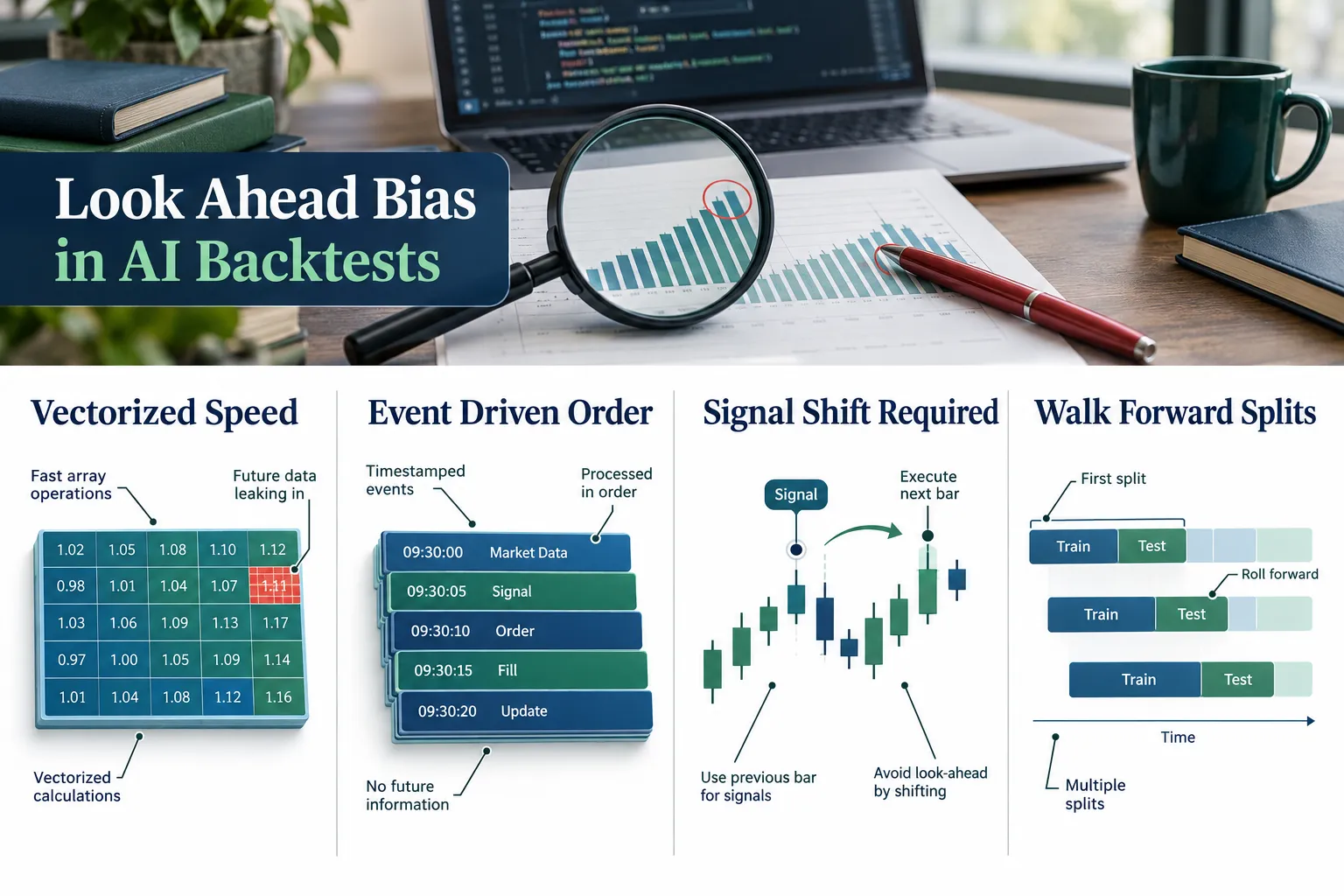
Event-driven frameworks make it harder, because they hand your code one bar at a time and physically withhold the future. Vectorized libraries are faster and more dangerous, since the entire series sits in memory at once. Not all backtesting frameworks treat time the same way, and look ahead bias lives in that difference.
If you searched for backtesting py, you want the backtesting.py package: the simplest bar-by-bar option, and the one most likely to fill on the next bar by default.
| Library | Design | Look-ahead risk | Best for | Cost |
|---|---|---|---|---|
| backtesting.py | Bar-by-bar, simple API | Low to medium, next-bar fills by default | First real backtest after a spreadsheet | Free, open source |
| vectorbt | Vectorized arrays | High, you must shift signals yourself | Fast parameter sweeps over a large sample | Free core, paid PRO tier |
| nautilus_trader | Event-driven, order-level | Low, order events are timestamped | Intraday and execution modeling | Free, open source |
| QuantConnect LEAN | Event-driven, cloud or local | Low, data feed is time-sliced | Research with institutional data | Free plan with unlimited backtesting |
The vectorized approach remains the fastest way to sweep ten thousand parameter sets. Speed is exactly why it leaks: one unshifted column and the whole sweep is fiction. Compare the engines in our guide to free backtesting software and the deeper write-up on QuantConnect LEAN.
Decision rule: choose an event-driven engine if you cannot yet read a pandas shift chain and say out loud what time it is on every row.
How is look ahead bias different from survivorship bias and overfitting?
All three inflate backtest results, and they do it through different mechanisms. Look-ahead is a time problem, survivorship is a universe problem, overfitting is a search problem.
| Bias | What leaks | Typical cause | Detection |
|---|---|---|---|
| Look-ahead bias | Future information | Missing shift, close-based fills, restated fundamentals | Truncated-data test, event-driven replay |
| Survivorship bias | Dead companies | Current index membership as the ticker list | Count delistings in your universe |
| Overfitting | Your own search effort | Thousands of parameter trials, one winner reported | Deflated Sharpe, walk-forward |
Work from Bailey, Borwein, López de Prado and Zhu on the probability of backtest overfitting argues ordinary holdout testing breaks down once you search many configurations. Their follow-up work on the Deflated Sharpe Ratio corrects for that selection effect. In an AI coding workflow, every reprompt, bug fix and feature tweak is another trial. Reporting only the final version understates the search by an order of magnitude.
Is a glossary definition enough to catch look ahead bias?
No. The pages that rank for this term are mostly finance glossaries and course sites, including WSO (Wall Street Oasis), which sells financial modeling and interview prep. Their definitions are accurate and conceptual. They are written for an interview answer, not for a Python audit.
That gap matters. A glossary tells you look ahead bias happens when the data was not yet available. It will not tell you that your resample dropped a bar boundary or that your signal column is missing a shift.
| Resource | What it teaches | What it will not do | Cost |
|---|---|---|---|
| Finance glossary entries (WSO, CFA refreshers) | The definition and the concept | Audit backtest code for look ahead bias | Free to read |
| Financial modeling and interview prep courses | Excel modeling, DCF, valuation, interview answers | Validate a trading program’s time index | Varies by provider, check the official pricing page |
| QuantConnect LEAN, nautilus_trader | Event-driven execution and data handling | Teach finance fundamentals or modeling | Free plans available |
Top 5 favorite features of an audit-first backtest stack
The five features that actually catch leaks, ranked by how much a retail quant gets from each.
- Time-sliced data feed. The engine refuses to hand you a future bar. LEAN and nautilus_trader both do this.
- Next-bar fill as the default. backtesting.py gets this right out of the box.
- Truncated-history replay. Re-run the same program on data cut at each decision point.
- Automated leak scans. Open-source backtest projects on GitHub now include audit skills that check for future functions, look-ahead bias, overfitting, execution realism and costs, then output a health report.
- Reliability benchmarks over return-only reporting. The agentic survey documents a shift toward leakage tests, counterfactuals and return attribution through benchmarks like FinLake-Bench, AutoRedTrader and KTD-FIN.
What we like, what we don’t like
The audit-first approach costs you time and kills most of your favorite strategies. That is the feature, not the bug.
What we like
- Free and open source across the whole stack: backtesting.py, vectorbt core, nautilus_trader, LEAN’s free plan with unlimited backtesting.
- Leak audits are deterministic. Same test, same answer, every time.
- Automated skills now exist, per the agent skills write-up on conducting backtest validation.
What we don’t like
- vectorbt gives you no guardrails. One unshifted signal column and the whole sample is worthless, and the library will not warn you.
- backtesting.py struggles with multi-asset portfolios and complex order types, so it outgrows itself fast.
- nautilus_trader and LEAN both carry a real learning curve. Expect days, not hours.
- Audit tools have their own assumptions. Their tests need review too.
What do real users say?
Skepticism toward AI-written backtests is now the default on r/algotrading, and look-ahead is the specific objection.
“A classic backtest platform does not protect from mistakes like ideal entries or survivorship bias or in sample mistakes. I learned this with quantconnect.” u/matyjazz666, r/algotrading
The same pushback dominated a September 14, 2026 r/Trading thread on using Claude plus raw market data instead of a paid backtester. Cheaper data access is real. Lookahead bias in backtesting was the first thing commenters named.
Competitors and alternatives
If you would rather not audit Python at all, three alternatives exist, each with a trade.
- No-code platforms. See Composer and whether you can build a bot without code. The engine handles timing, you give up flexibility.
- Hosted research platforms. The QuantConnect review covers the free tier and the data catalog.
- Options-specific engines. Options data has its own leak paths, covered in our options backtesting guide.
Either way, read what retail traders get wrong about algorithmic trading AI first.
Our Take
Use the AI assistant to write the plumbing, then audit the time index yourself. That split, machine for syntax, human for causality, is the only workflow the current benchmark data supports.
FullStack Alpha’s position: treat every AI-written backtest as guilty of look-ahead bias until a truncated-history test clears it. Start with Python algorithmic trading fundamentals, then see what an assistant can and cannot do in our Claude trading bot breakdown, and pressure test the result against how to backtest a strategy without fooling yourself. Mitigating look-ahead bias is not glamorous. It is the difference between a system and a screenshot.
Systems over hacks. Play stupid games with your time index, win stupid prizes with your capital.
Built a bot worth auditing? Submit it and we will run it through the same leak checklist. Submit your bot
Conclusion
Detecting look-ahead bias is a reading exercise, not a math exercise. Open the data loader, follow every timestamp, shift the signals, truncate the history, replay it one bar at a time, then add costs. Five passes, and most AI-generated strategies will not survive the third. That is useful information, not a failure, because the alternative is finding out with live capital that your program was quietly trading tomorrow’s news.
Next step: take your most profitable backtest, add .shift(1) to every signal column, and re-run it. If the edge disappears, you just saved an account. FullStack Alpha exists to make that test routine. Treat look ahead bias as the default suspect, not the rare exception.
This article is education, not financial advice.
Your market edge starts with the right tool. Stay alpha.
Frequently Asked Questions
What is look ahead bias?
Look ahead bias is the use of information in a historical simulation that was not available when the trade decision was made. The CFA Institute frames it as a causality failure. Practical examples include deciding a trade with today's closing price, using restated fundamentals, or filling an order on the same bar that generated the signal.
What is lookahead bias in backtesting?
Lookahead bias in backtesting means your code sees the future. Typical causes: a missing .shift(1) on signals, indicators computed on the full price series before splitting train and test, daily high or low values triggering intraday fills, and resampling that stamps a later value at an earlier timestamp. It inflates returns and hides drawdowns.
What are 5 signs of cognitive bias?
Five common signs: you only seek data that confirms your existing view, you recall winning trades more vividly than losers, you treat recent price action as permanent, you hold losers to avoid admitting a mistake, and you rewrite the past so the outcome feels like it was obvious. Each one distorts how you read a backtest.
What are five types of biases?
Five biases that break backtests: look-ahead bias (future data), survivorship bias (dead companies missing from the universe), selection bias (cherry-picked periods or symbols), data-snooping or overfitting bias (too many trials, one reported winner), and confirmation bias (you keep the run that agreed with you). The first three are data problems, the last two are process problems.
What is hindsight bias in simple terms?
Hindsight bias is the feeling that an outcome was predictable once you already know it happened. After a crash, the warning signs look obvious. Before it, they looked like noise. In backtesting, hindsight bias is what makes a leaking strategy feel validated instead of suspicious, so you stop auditing too early.
Can an AI coding assistant catch look ahead bias?
Sometimes, if you ask it directly and point it at specific lines. Open-source audit skills on GitHub scan for future functions, look-ahead bias, overfitting and execution realism. Treat the output as a first screen only. The assistant that wrote the leak is not a neutral reviewer of its own work.
Does vectorbt prevent look ahead bias?
No. vectorbt is vectorized, so the whole price series is available to every calculation at once, and shifting signals correctly is entirely your responsibility. That design makes it extremely fast for large parameter sweeps and extremely easy to leak future data. Event-driven engines like nautilus_trader and LEAN withhold future bars structurally.
Contributing writer at AI Stock Trading Bots.
