

The FullStack Alpha research desk tests AI trading bots on paper and live accounts. Reviewed and edited by Jay Rocco, Founder and Editor.
November 10, 2026, 8:00 a.m. ET | By FullStack Alpha Editorial Team | Reviewed by Jay Rocco, Chief Editor
Quick answer
At 9:06 a.m. Seoul time on November 10, 2026, the Korea Exchange buy sidecar froze KOSPI program buy orders for five minutes after KOSPI 200 futures ran up at least 5% and held there for a full minute. KOSDAQ followed around 9:10 a.m.
Manual orders kept flowing the whole time. Only the machines got benched. If your bot has no rule for that, it will do something expensive.
Key facts
- What fired: the KOSPI buy sidecar at 9:06 a.m. KST, with KOSPI 200 futures at 821.04, up 5.76%. Program buy orders were suspended for five minutes. The market itself never stopped.
- KOSDAQ too: its sidecar needs two conditions at once, KOSDAQ 150 futures up 6% and the KOSDAQ 150 spot index up 3%, both held for one minute. It fired around 9:10 a.m.
- The move: KOSPI opened at 5,247.22, up 4.55%, touched 5,300.92 and closed at 5,239.13, up 4.39%. KOSDAQ closed at 667.61, up 4.48%.
- The count: reported as the 58th KOSPI sidecar of 2026 and the 28th on the buy side. The KOSPI tally has already passed the 26 recorded during the 2008 financial crisis.
What exactly is the Korea Exchange buy sidecar, and what did it halt?
A sidecar is a short cooling-off measure, not a shutdown. When futures move violently, KRX suspends program orders pointing the same way. Five minutes, then release.
On the KOSPI side, the trigger is a KOSPI 200 futures move of at least 5% from the reference price that holds for one minute. On November 10 that condition hit six minutes into the session.
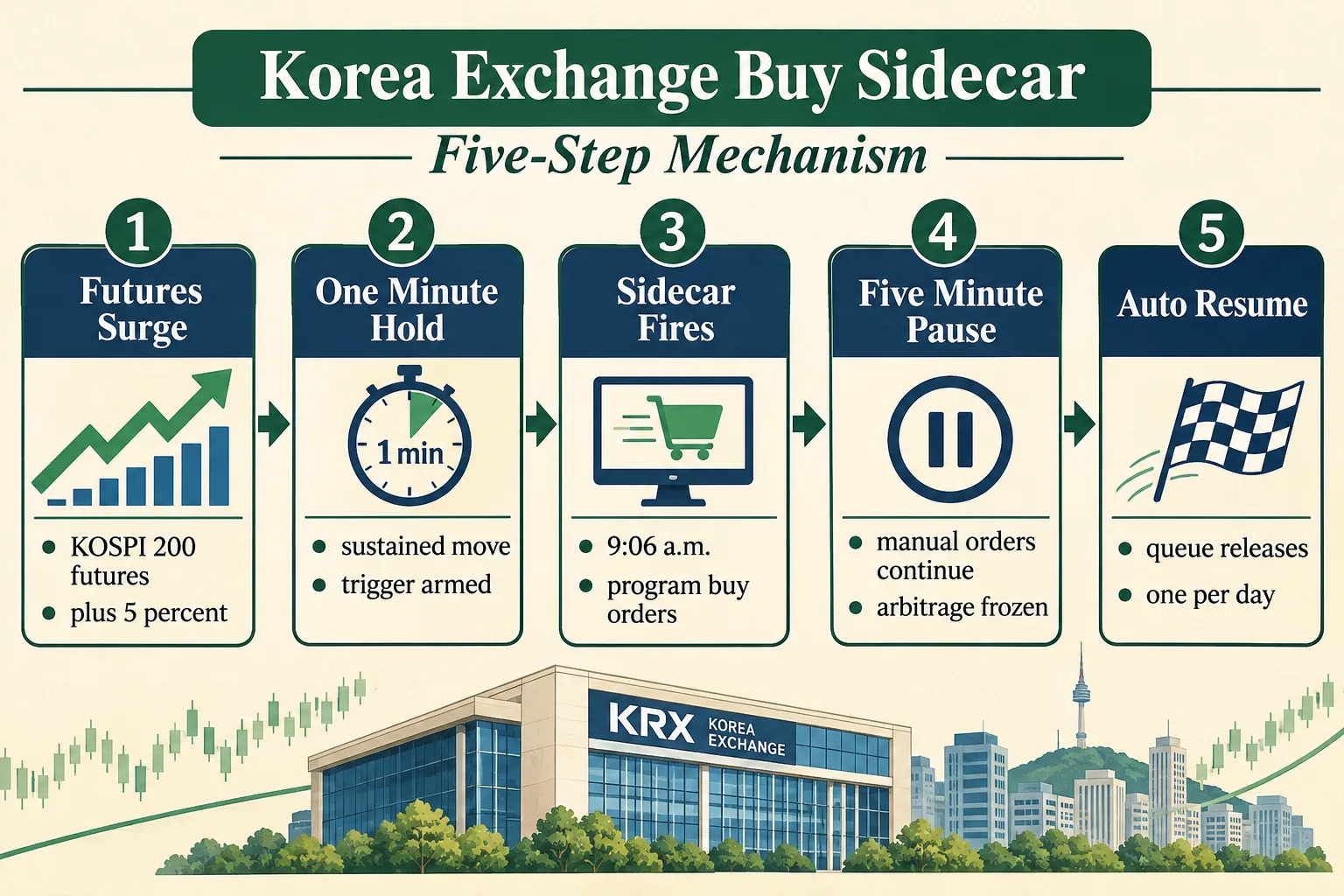
The part most retail traders miss: manual orders kept going the entire time.
Under the KRX market guide, sidecars run in the regular session only, generally once per market and direction per day. Narrow, predictable, written down. Which means codeable.
Why does KRX count so much automated trading as program trading?
Because the definition is wider than it sounds. It covers index arbitrage, and also any computer-submitted basket of more than 15 KOSPI stocks.
Read that again if you run a basket strategy. Sixteen tickers fired from a script is program trading under the Korean rulebook, whether or not you think of yourself as a quant.
| Mechanism | What triggers it | What it stops | Duration |
|---|---|---|---|
| KOSPI buy sidecar | KOSPI 200 futures up 5%+, held 1 minute | Program buy orders | 5 minutes |
| KOSDAQ buy sidecar | KOSDAQ 150 futures up 6% and spot up 3%, held 1 minute | Program buy orders | 5 minutes |
| KRX circuit breaker | Larger spot index decline thresholds | All trading | 20 minutes plus reopen auction |
| US LULD pause | Price outside the band for 15 seconds | All trading in that security | 5 minutes |
A sidecar is selective. Your bot is benched. The guy on his phone is not.
What triggered the 5% KOSPI jump?
Three down sessions, then a US risk rally. On November 9, the Dow added 2.15%, the S&P 500 2.35%, the Nasdaq 2.74% and the PHLX Semiconductor Index 6.85%. Oil fell.
Korea is a semiconductor index wearing a national flag. Samsung Electronics closed up 4.74% at KRW 198,000. SK hynix gained 6.69% to KRW 1.2 million.
How did the market react?
Flows told the rest of the story. At the close, foreign investors bought a net KRW 365.9 billion and institutions KRW 489 billion, while individuals sold a net KRW 1.3 trillion.
Individuals sold into the biggest up day of the week. That is a human problem, and the reason exit rules belong on paper before the gap.
What does the sidecar mean for algorithmic traders in practice?
Five failure modes show up every time a sidecar fires. None of them are exotic.
1. The blind retry loop. Your script resubmits a sidelined order again and again. When the halt lifts, a stack of duplicates can go live at once.
2. The stale fill. Priced at 9:05, filled at 9:11, 50 index points later. That is chasing.
3. The hedge gap. Running a long cash leg against a futures hedge? The futures leg keeps trading while the program leg is frozen. For five minutes you are naked, and your risk engine may not know it.
4. Misread rejection codes. Some bots read an exchange restriction as a broker error and trip a kill switch. Others keep hammering.
5. The reopen stampede. Queued buy orders release at the same second into the thinnest tape of the morning. No spread cap, no protection.
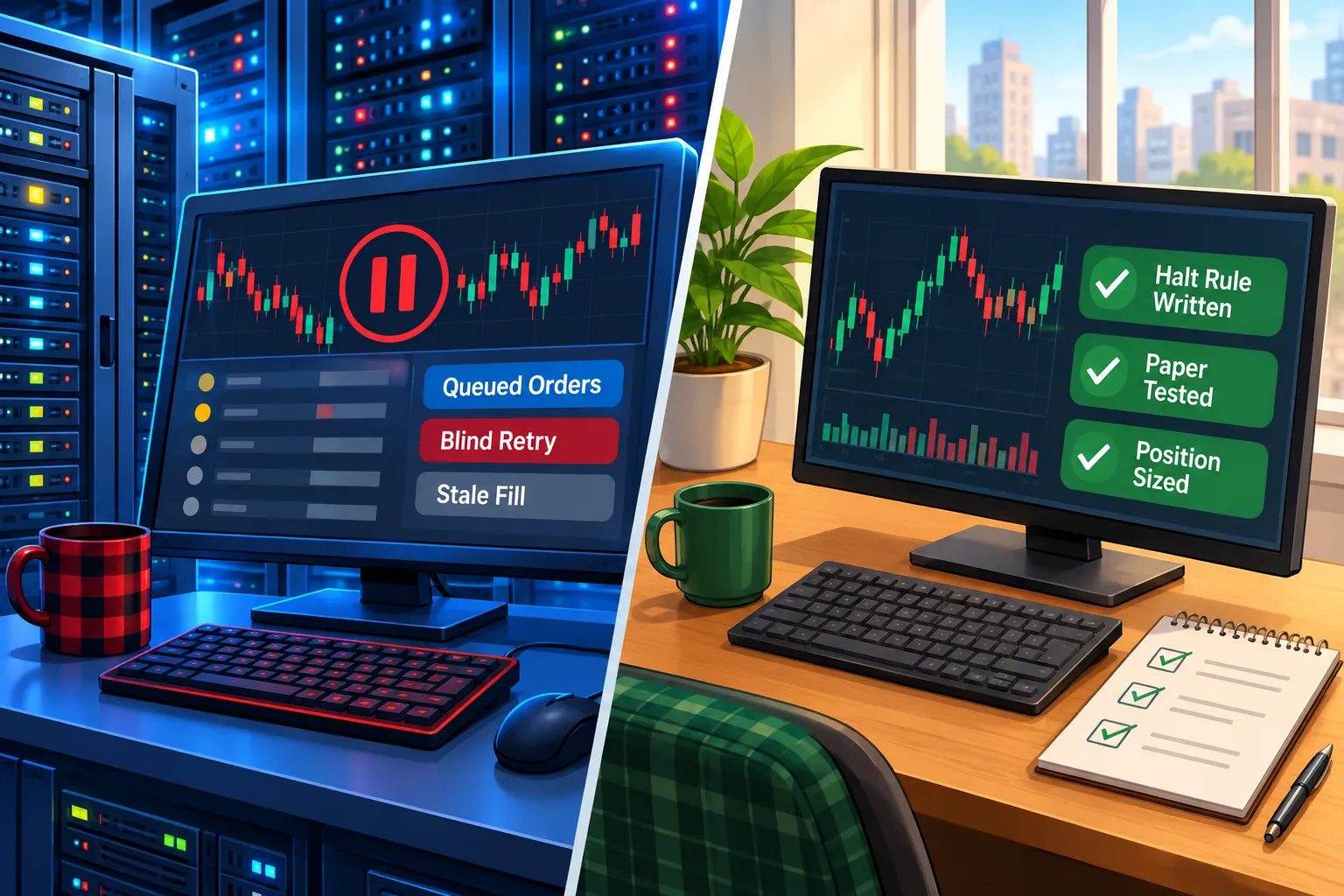
One sidecar a year is trivia. Fifty-eight is a market regime. If your backtest never modeled a five minute program-order freeze, your backtest was describing a market that no longer exists. We saw the US version of this lesson when Blue Ocean ATS halted overnight trading for 2 hours 43 minutes.
How should bot traders rewrite their rules after November 10?
Write an explicit halt state. Three states, not two: trading, halted and recovering. In halted, cancel resting program orders. In recovering, wait a set number of seconds before accepting a fill.
Cap the retry count. Two attempts, then stop and log. A bot that retries forever is not persistent. It is broken.
Add a spread and slippage gate. If the reopen spread is wider than normal, skip the trade. You will miss some good fills and every terrible one.
Size for the gap, not the average day. A 5% index move with a five minute blind spot widens your effective stop distance. Check it against your max drawdown limit before the next open.
Test the halt path on paper. Simulate a rejection, a freeze and a reopen, and watch what your code does. New to this? Start with what paper trading is and a 30-day test, then run a forward test before going live.
What should investors watch next?
- Daily KRX sidecar counts through year end 2026. The 58-activation pace sets the base rate for how often your automation gets benched.
- KOSDAQ 150 futures versus spot. KOSDAQ needs both legs to move, so divergence between them is an early tell.
- The US semiconductor tape overnight. The PHLX Semiconductor Index jumped 6.85% on November 9, hours before the Korean gap.
- US October CPI, due November 10 ET. A hot print that lifts Treasury yields could stall the rally that set off this sidecar.
Our take
The sidecar is not the villain. It is a five minute speed bump built because machines move an index faster than a risk desk can read a screen. Any system that cannot survive five minutes of no fills was not a system. It was a streak.
The real lesson from November 10 is asymmetry. Manual traders kept trading. Program orders did not. Automation bought speed and paid for it with a rule that only applies to automation. That is a fair trade, if you know it exists.
The bots that were fine had a halt rule, a retry cap and size small enough that five minutes of silence was annoying, not fatal. Process beats prediction. In Korea this year, 58 times. If you want the honest version of what automation delivers, read why live bot results miss the backtest.
Your next step: open your bot’s order-rejection handler today and read it line by line. If it has no halt state, write one before the next session.
Does your bot know what to do when the exchange says no?
Every bot sent to us gets checked against real exchange and broker rules before we publish a word about it.
This article is for education only. It is not financial advice, and nothing here is a recommendation to buy or sell any security. Trading with automated tools carries risk, including the loss of your capital.
Sources
- Korea Exchange (KRX) global site, market rules and sidecar guidance
- The Kyunghyang Shinmun: KOSPI jumps 4 to 5%, buy-side sidecar triggered (Nov 10, 2026)
- Bloomingbit: Kospi jumps 5.22% early, buy sidecars trigger on Kospi and Kosdaq (Nov 10, 2026)
- The Asia Business Daily: KOSPI, KOSDAQ surge early, buy sidecars triggered (Nov 10, 2026)
- Digital Today: KOSPI, Kosdaq surge, buy sidecars triggered in both markets
- TradingKey: Kospi surges over 5%, Nikkei gains 3% (Nov 10, 2026)
Your market edge starts with the right tool. Stay alpha.
Frequently Asked Questions
Did the November 10 sidecar stop all trading on KOSPI?
No. It froze program buy orders for five minutes from about 9:06 a.m. KST, and manual orders kept trading normally.
How is a sidecar different from a circuit breaker?
A sidecar restricts program orders in one direction for five minutes, while a circuit breaker halts all trading on the index for longer after a larger drop.
Does a basket of 16 stocks count as program trading in Korea?
Under the KRX definition, computer-submitted baskets of more than 15 KOSPI stocks count as program trading, so check how your broker classifies your orders.
Can the sidecar fire more than once a day?
Under the published KRX market guide it is generally limited to one activation per market and direction per day, during the regular session only.
How often have sidecars fired in 2026?
November 10 was reported as the 58th KOSPI sidecar of 2026 and the 28th on the buy side, more than the 26 recorded during the 2008 crisis.
Is this article financial advice?
No. It is education about market rules and bot risk controls, not a recommendation to buy or sell anything.
The FullStack Alpha research desk tests AI trading bots on paper and live accounts. Reviewed and edited by Jay Rocco, Founder and Editor.
