

The FullStack Alpha research desk tests AI trading bots on paper and live accounts. Reviewed and edited by Jay Rocco, Founder and Editor.
By FullStack Alpha Editorial Team | Reviewed by Jay Rocco, Chief Editor
A Kalshi trading bot is software that reads Kalshi’s market data and places orders on event contracts automatically through Kalshi’s official API. Kalshi supports automation in the clearest way a venue can: it publishes developer documentation, API keys, WebSocket streams, FIX connectivity and published rate-limit tiers. These are regulated event contracts settling at 0 or 100, not stocks, so there’s no dividend, no partial recovery, and no “it’ll come back.” The biggest risk isn’t the code. It’s building a fast machine on top of an edge you never proved existed.
What You Should Know
- Kalshi publishes an official API covering market data, order placement, cancellation, amendment, RFQs and account state, with SDKs and FIX support, documented at docs.kalshi.com.
- On September 24, 2026, Kalshi added Ed25519 API-key support alongside RSA-PSS across REST, WebSocket and FIX, and raised read and write limits by 20% for the Premier, Paragon, Prime and Prestige tiers.
- Rate limits use separate read and write token buckets. Published event-contract budgets run from 200 read / 100 write tokens per second at Basic up to 12,000 read / 9,600 write at Prestige. Most requests cost 10 tokens.
- Batching does not save you tokens. Kalshi states a 25-order batch costs the same as 25 single orders, roughly 250 tokens for creates, and the whole batch must fit the available bucket balance.
- Standard event-contract fees on Kalshi’s public fee schedule generally run about $0.07 to $1.75 per 100 contracts depending on price and series, using a formula based on 0.07 × C × P(1-P), rounded up. Check the official fee page before you model anything.
What Is a Kalshi Trading Bot and How Does It Work?
A Kalshi trading bot is a program that connects to Kalshi’s API, watches event-contract markets in real time, and submits buy or sell orders based on rules you define. No human clicking. The bot reads, decides, and acts in milliseconds.
The thing that trips people up: Kalshi isn’t a stock exchange. It’s a CFTC-regulated designated contract market for event contracts. Each contract asks a yes-or-no question about a real-world outcome and settles at $1.00 if the answer is yes, $0.00 if no. Price moves between those two poles and gets quoted in cents, so a contract at 62 cents is the market saying roughly a 62% chance.
That binary structure changes everything about how a prediction market bot behaves.
How the pieces fit together:
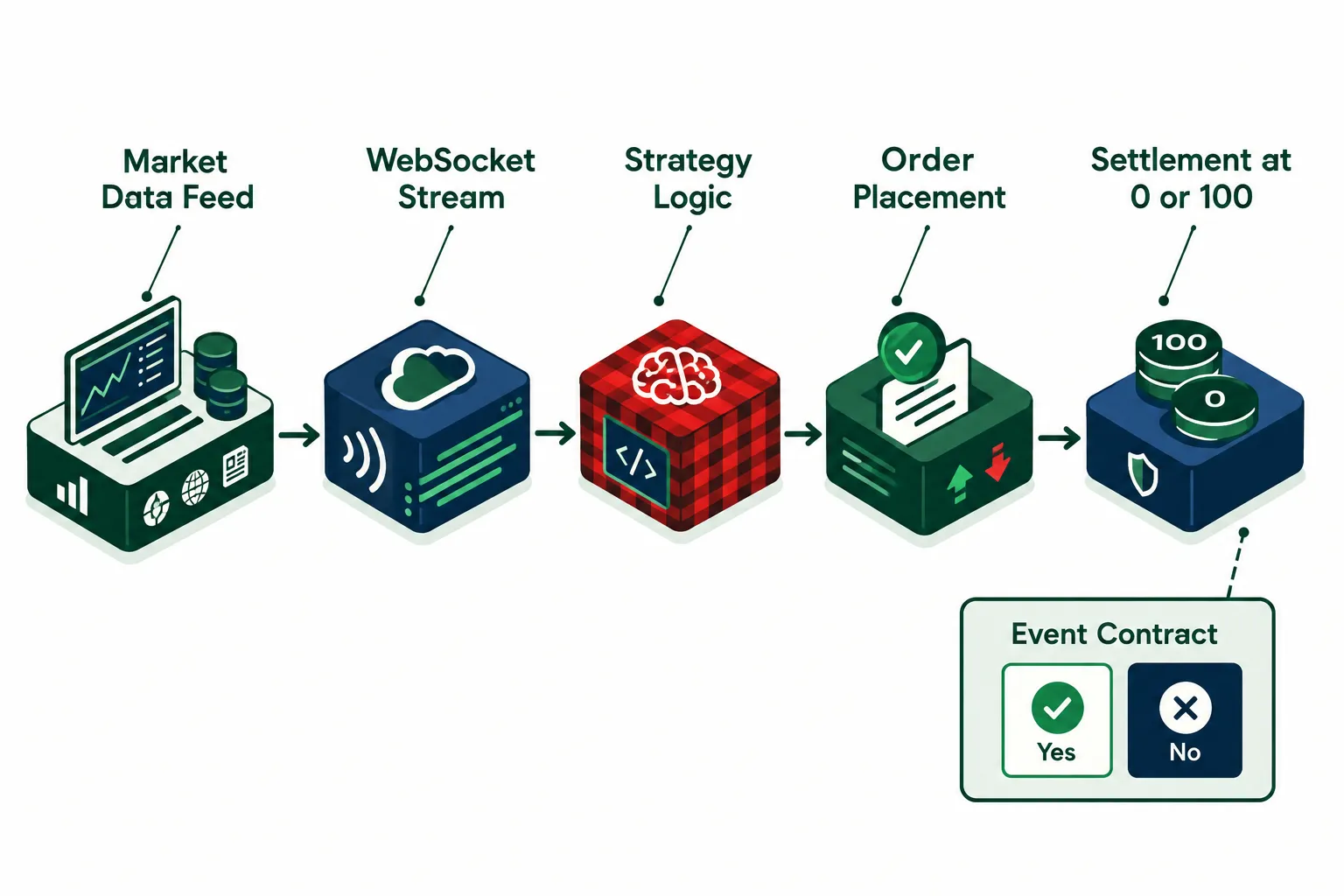
- Market data in. The bot subscribes to order-book and ticker streams over WebSocket, or polls REST endpoints. Kalshi’s October 22, 2026 changelog added cross-connection
clockfields to order-book messages, which helps bots keep their internal state in sync with the exchange. - State tracking. It maintains its own copy of the book: top-of-book bid, ask, sizes, its own resting orders, fills and position.
- Strategy logic. Market making (quote both sides, earn the spread), arbitrage (same event priced differently across series or venues), or signal-driven entries based on outside data.
- Order management. Place, amend, cancel. Kalshi supports all three through the API.
- Risk controls. Max position per market, max daily loss, kill switch. If your bot doesn’t have these, it isn’t a bot, it’s a liability with a login.
Decision rule: if you can’t describe your strategy’s edge in one sentence that includes why someone on the other side is willing to lose money to you, don’t automate it yet. You’re not building a bot, you’re building a faster way to find out you were wrong.
Common mistake: treating a binary contract like a stock position. There’s no averaging down into a thesis here. At expiry it’s 100 or 0, and your average cost is irrelevant to whether you were right.
Does Kalshi Allow Trading Bots, and Do They Violate the Terms of Service?
Automated trading through Kalshi’s official API is permitted in the practical sense that Kalshi builds and maintains the infrastructure for it. The company publishes developer documentation at docs.kalshi.com covering automated market-data consumption, order placement, cancellation, amendment, RFQs and account-state management, offers SDKs and FIX connectivity, and sells tiered rate-limit access. A venue that didn’t want bots wouldn’t ship a FIX gateway.
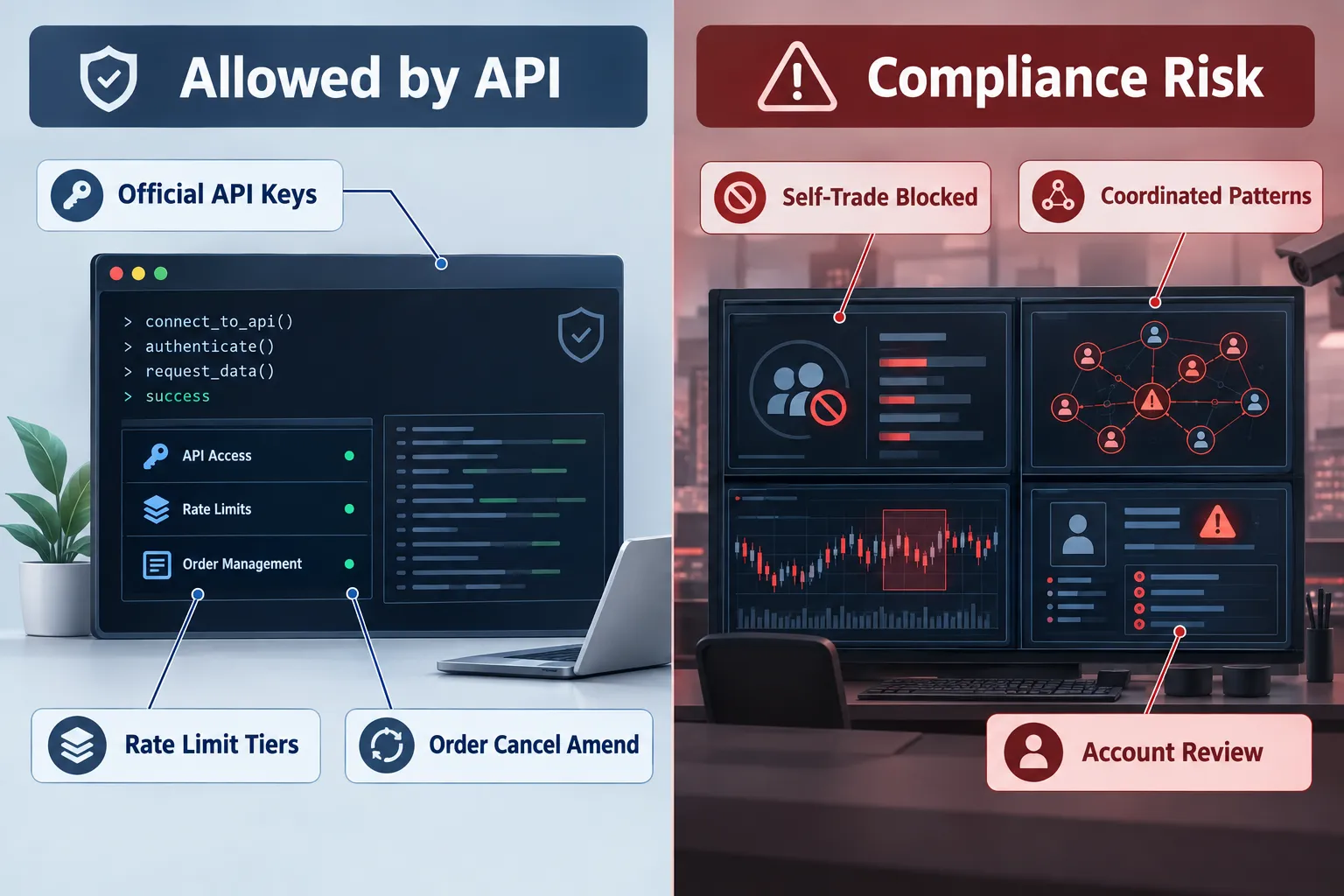
That’s the permission. The conduct rules are a separate question, and they’re where accounts get flagged.
What Kalshi has said publicly about prohibited behavior: in its September 22, 2026 response to volume scrutiny, Kalshi stated that self-trading is mechanically blocked on the platform and that pre-arranged trading with another participant is prohibited and surveilled. Read that twice if you’re planning to run multiple accounts or coordinate with a friend’s bot. Even where two accounts belong to genuinely different people, activity patterns that look like coordinated wash trading can create compliance exposure.
Does Kalshi detect automated trading? Kalshi doesn’t need to detect your bot. It issued the API key. What it surveils is behavior: self-matching, pre-arranged trades, and patterns inconsistent with genuine market participation. Rate-limit throttling is automatic, not a punishment.
Why a Kalshi bot account gets flagged or suspended, in rough order of likelihood:
- Order patterns that resemble self-trading or matched trades between related accounts.
- Hammering endpoints past your tier’s token budget, repeatedly, after throttling.
- Identity, funding or eligibility issues unrelated to the bot (jurisdiction, verification).
- Behavior tied to volume-incentive gaming. Kalshi’s incentive activity has already drawn press scrutiny, and a September 30, 2026 CNBC report noted Kalshi bitcoin and ether perpetual-futures volume at roughly 42 times and 66 times open interest. Kalshi denied wash trading and attributed the activity to many users plus arbitrage and market-making.
The honest answer on terms of service: Kalshi’s member rules and user agreement are the binding documents, and they change. Read the current versions on kalshi.com before you deploy capital, and re-read them after any announced rule update. Do not rely on a Reddit thread or a YouTube video for what the rules say today. Check the official page.
How Does the Kalshi API Work for Bot Builders?
Kalshi’s API gives you authenticated REST endpoints, WebSocket streaming market data, and FIX connectivity, all gated by a tiered token-bucket rate limiter with separate read and write budgets. You sign requests with an API key tied to your account.
Authentication. As of September 24, 2026, Kalshi supports Ed25519 keys alongside RSA-PSS across REST, WebSocket and FIX. If you generate a key, write down which type it is and test your signing library in a throwaway script before production. Half the “my Kalshi trading bot won’t connect” posts are signature-format problems, not logic problems.
Rate limits, properly understood. This is the part most builders model wrong:
| Concept | What Kalshi documents |
|---|---|
| Bucket structure | Separate read and write token buckets |
| Basic tier budget | 200 read / 100 write tokens per second |
| Prestige tier budget | 12,000 read / 9,600 write tokens per second |
| Typical request cost | 10 tokens, though cancellations and some endpoints differ |
| Burst capacity | Above Basic, many write buckets hold up to three seconds of budget, allowing a short burst of roughly 3× the per-second rate |
| Batching | No discount. A 25-order batch costs the same as 25 singles, about 250 tokens for creates, and must fit the current bucket balance |
Worked example from Kalshi’s own documentation: a Premier account with a 1,200-token-per-second write budget sustains roughly 120 default-cost order writes per second. That’s your ceiling for quote updates, and it’s a real constraint for any market-making design.
Sharding matters now. Kalshi’s October 2026 changes introduced exchange sharding and routing. Bots need to track exchange_index because balances, orders, fills, positions and transfers can live across different exchange instances. Cross-shard transfers may run in multiple steps and may not be atomic if a later step fails. Build for partial failure or you’ll eventually find money in a state you didn’t plan for.
Fields get removed. On October 1, 2026, Kalshi removed the deprecated liquidity_dollars field from market responses. Any bot still reading it can silently misread liquidity, which is the worst kind of bug because nothing errors. Kalshi now points developers to top-of-book size fields such as yes_bid_size_fp and yes_ask_size_fp. The October 22 changelog also expanded order and fill filters to as many as 100 tickers and added balance-bucket and corporate-action handling. Useful features, plus migration work for anything already running.
Is there a demo environment? Kalshi has historically offered a separate testing environment for developers. Whether it’s live, what it’s called and what it supports changes, so check the current developer docs rather than trusting an old tutorial.
On Kalshi trading bot GitHub repos: public repositories exist, mostly wrappers, starter clients and strategy skeletons. Treat them as plumbing, not profit. Useful: authentication handling, WebSocket reconnect logic, order-state management. Dangerous: any repo with a backtest chart in the README and no discussion of fees or slippage. And never paste your API key into code you haven’t read line by line. A key with write access is a key that can empty an account.
How Are Creators Connecting AI to a Kalshi Trading Bot?
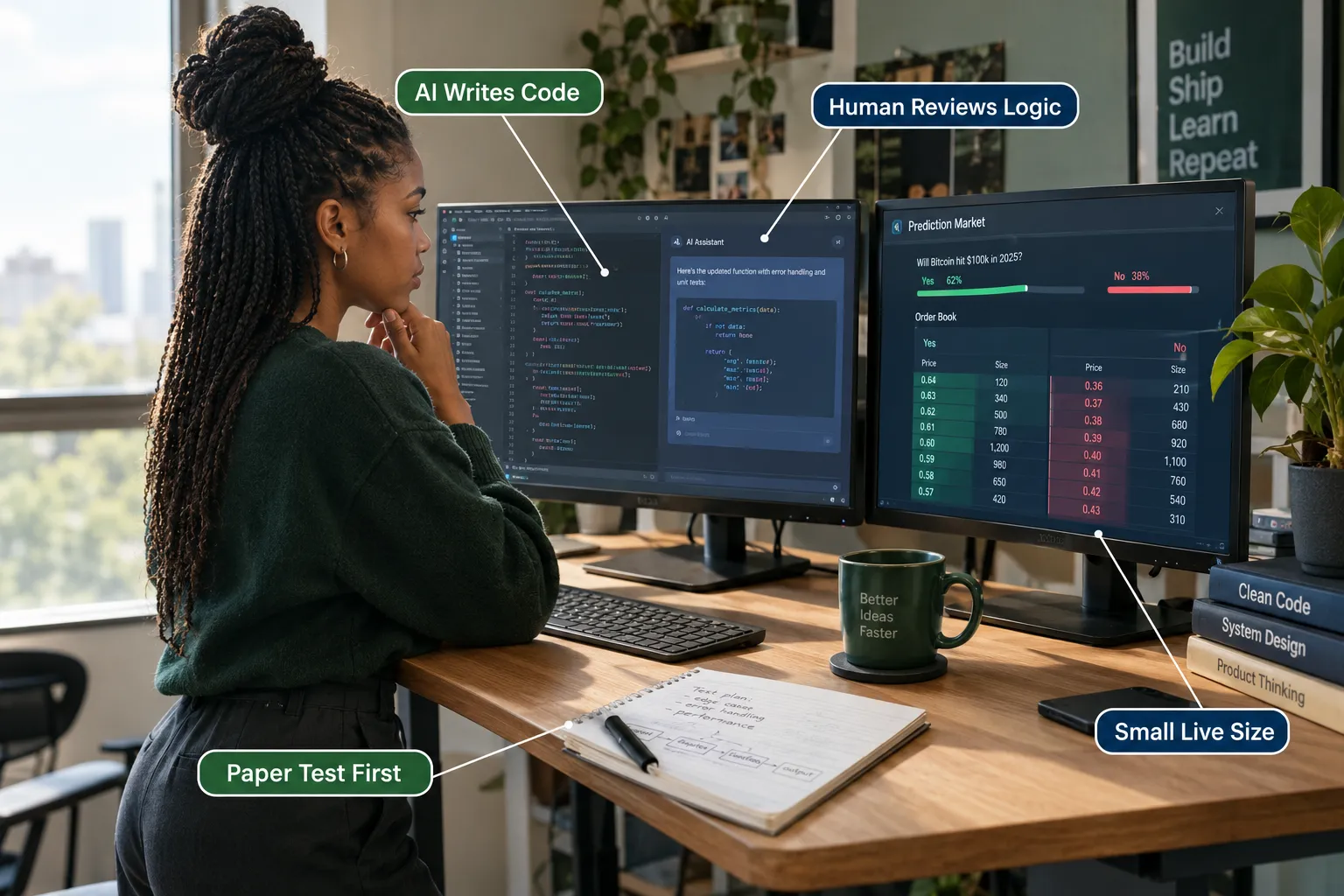
The current wave of Kalshi AI trading bot content involves pointing a large language model at Kalshi’s API docs and having it write the client, the strategy scaffolding and the risk checks. The build gets done in an afternoon. The edge does not.
TC Trading has published build-along videos in this format. Watch them for what they are:
https://www.youtube.com/watch?v=vT0qMNgOkxo
Treat anything stated in a build video as a creator claim, not a verified result. The useful framework for watching any of them:
| What’s claimed | What’s usually shown | What’s usually skipped |
|---|---|---|
| ”I built a Kalshi bot with AI” | Working auth, live market data, an order going through | Fee drag per round trip, realistic slippage on thin books |
| ”It’s profitable” | A short screen-recorded run or a backtest curve | Out-of-sample testing, sample size, drawdown, variance |
| ”Anyone can do this” | The code generation step | Months of monitoring, API migrations, failed orders, tax handling |
On the prediction market trading bot Claude pattern specifically: AI coding assistants are genuinely good at the boring parts. Signature generation, reconnect logic, parsing an order book, writing the state machine that reconciles fills. That’s real time saved. What an AI assistant cannot do is tell you whether a market is mispriced. It will happily write a confident strategy function around an assumption you never tested, because it’s completing a pattern, not pricing risk.
If you’re going down this road, read our breakdown of red flags in AI trading bot marketing and the write-up on the fake Claude trading bot scam first. There’s an entire cottage industry selling “AI-built” bots that are a public model with a dashboard and a subscription button. For a legitimate version of the same idea on a different venue, the IBKR API with Claude walkthrough shows what the honest version of this workflow looks like.
Decision rule: let the AI write the infrastructure. You write the strategy and the risk limits. If you can’t explain every line of the logic that decides when to buy, you don’t own that bot, it owns you.
What Does the 72 Million Trade Analysis Say About Why Bettors Lose?
Part Time Larry, a developer-focused finance channel, has published an analysis walking through a large dataset of prediction-market and sports-betting trades, framed around the question of why most participants lose. The headline figure circulating is roughly 72 million trades.
Credit where it’s due: that’s the creator’s analysis as presented in the video, and the underlying dataset and methodology should be checked in the video description rather than taken from a summary like this one.
The patterns highlighted in that kind of analysis line up with everything we already know about retail trading behavior, which is exactly why they’re worth repeating:
- Favorite-longshot bias. Participants systematically overpay for low-probability contracts, the 3-cent and 5-cent “it could happen” tickets, and underpay for high-probability ones. The lottery ticket feels cheap. It isn’t.
- Fee drag compounds against high turnover. Every round trip pays. A strategy that’s right 53% of the time can still bleed out if it trades constantly.
- Recency and narrative chasing. Prices move on the loudest news, not the best-calibrated estimate, and most participants trade the headline.
- No position sizing. Concentration in a handful of correlated event markets, which is the same mistake as holding five tech stocks and calling it diversified.
Why this matters for anyone building a bot: if the average participant loses to bias and fees, then a bot’s only real job is to be less biased and cheaper per decision. A bot that automates favorite-longshot bias just loses faster and more consistently. Play stupid games.
Quick example: buying 100 contracts at 4 cents on a long-shot event costs $4.00 in premium. The contract settles at zero most of the time by construction. Doing that 50 times a week isn’t a strategy, it’s a subscription to losing.
Is Trading on Kalshi Legal, and What Has the CFTC Said?
Yes. Kalshi operates as a CFTC-regulated designated contract market, meaning its event contracts are listed on a federally regulated exchange rather than offshore. That regulatory status is the single biggest structural difference between Kalshi and most prediction-market platforms, and it’s why US-based bot builders can connect an API without wondering which jurisdiction they’re in.
The regulatory picture around event contracts is still moving, though, and anyone running automation should track it rather than assume today’s rules are permanent. Two live threads worth following: our coverage of the CFTC event contracts and swaps proposal and the separate piece on CFTC perpetual stock index futures.
Recent Kalshi-specific developments worth knowing:
- On October 12, 2026, Kalshi filed or posted a notice terminating its Large Volume OTC Swap Trading Program. Check Kalshi’s regulatory notices page for the current status and what it means for any strategy that touched that program.
- Kalshi’s volume-incentive activity has drawn scrutiny following reports of unusually repetitive trading in ether perpetual futures. Kalshi has denied wash trading.
What this means for you, practically: legality of the venue is settled. The specific contracts listed, the incentive programs attached to them, and the conduct rules governing automated participation are not static. A bot deployed in March on a rule set from January is an unforced error.
Edge case: state-level disputes over sports-related event contracts have been active. If your strategy depends on a particular contract series existing, build in the possibility that it gets delisted or restricted in some states with little warning.
What Are the Real Risks of a Kalshi Trading Bot?
The risks are mostly structural, not technical, and every one of them has a fix you can implement before you fund the account.
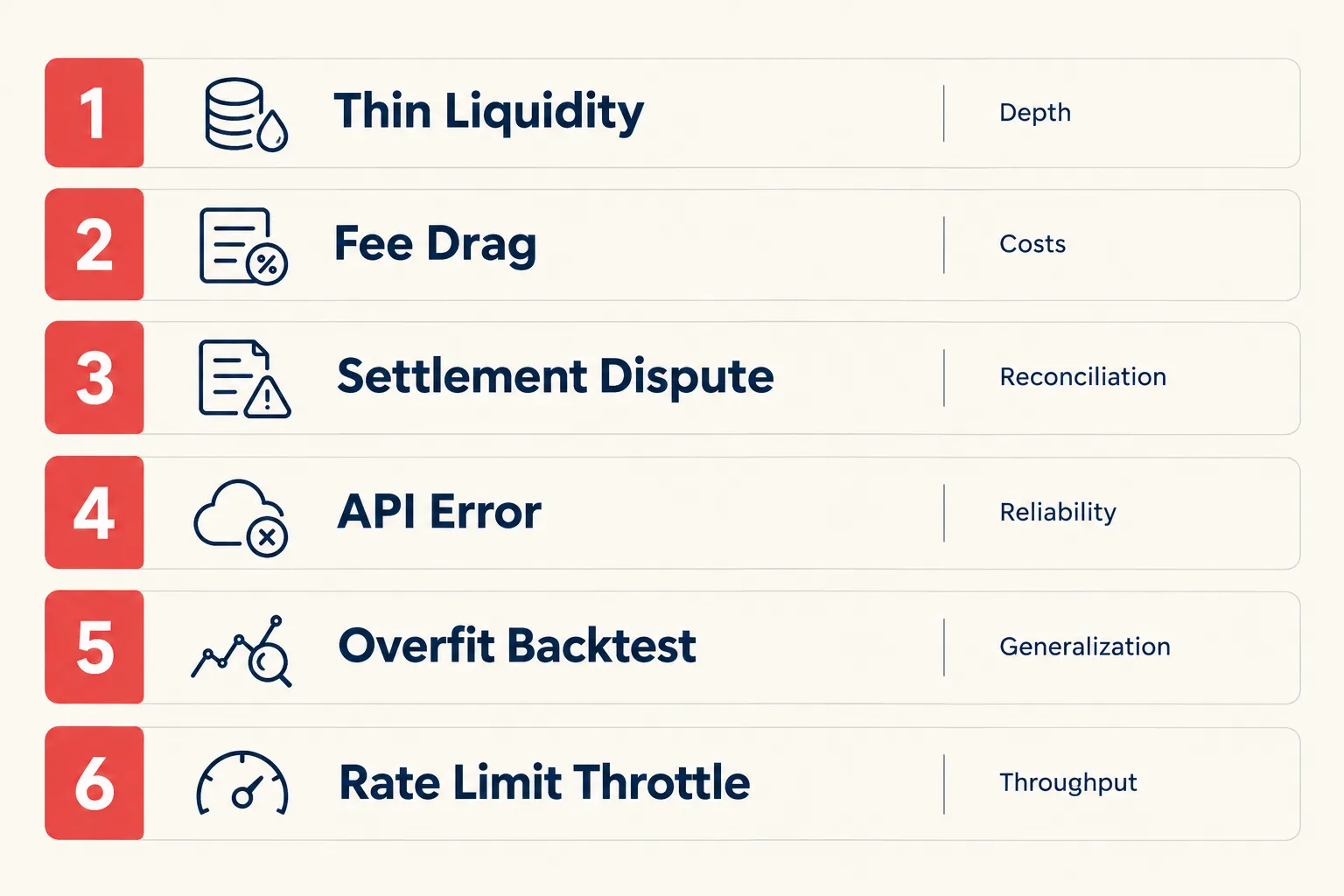
1. Thin liquidity. Many event markets have a wide spread and shallow top-of-book size. Your backtest assumes you got filled at the mid. Reality gives you the ask.
Fix: size orders against actual displayed depth using yes_bid_size_fp and yes_ask_size_fp, never a dollar liquidity estimate. Use limit orders. Set a maximum acceptable spread and skip markets wider than it.
2. Fee drag. Kalshi’s standard event-contract fee follows a formula based on 0.07 × C × P(1-P), rounded up, with published fees generally in the range of about $0.07 to $1.75 per 100 contracts depending on price and series. The P(1-P) term means fees peak near 50 cents, exactly where most active strategies live. Fix: model the fee on every simulated trade before you believe any backtest. If the edge disappears after fees, it was never an edge.
3. Settlement and resolution disputes. Event contracts resolve on a defined source. Ambiguous real-world outcomes happen, and resolution can be slower or different than you assumed. Fix: read the settlement source and rules for every single series your bot touches. Don’t let a bot trade a market whose resolution criteria you haven’t read.
4. API errors and partial failures. Cross-shard transfers may run in multiple steps and may not be atomic. Removed fields like liquidity_dollars fail silently. Rate-limit throttling drops orders you thought went through.
Fix: reconcile positions against the exchange on every loop, not from local state. Log every request and response. Build an automatic kill switch for any unexpected state.
5. Overfitting to past events. This is the big one for prediction markets. Elections, Fed meetings and weather events are not repeatable samples. A strategy tuned on 2024 election markets has close to zero evidence behind it for 2026. Fix: demand a large, out-of-sample dataset of similar, recurring contracts. If your strategy only has twelve historical instances, you have a story, not a system.
6. Account limits and compliance exposure. Position limits, tier-based rate limits, and surveillance for patterns resembling coordinated or pre-arranged trading. Fix: one account, one operator, no coordination. Stay inside your token budget. Don’t chase volume incentives with round-trip trades that produce no economic position.
On Kalshi trading bot Reddit threads: r/algotrading and r/Kalshi discussions are genuinely useful for API quirks, authentication problems and honest reports of what didn’t work. They are useless as evidence that a strategy is profitable. The negative skew that makes Reddit good for bug reports makes it terrible for performance claims in both directions. Verify any permalink before you trust a screenshot.
The most common mistake with prediction market bots: automating before proving the edge. People spend six weeks on infrastructure and six minutes on the strategy, because the infrastructure gives visible progress and the strategy gives uncomfortable questions. A bot is a multiplier. Multiply a negative edge by 400 trades a day and you’ve just built the fastest losing machine you’ll ever own.
How Much Does a Kalshi Bot Cost, and What Fees Apply?
The bot software can cost nothing. The trading costs money on every fill, and the infrastructure costs money every month. Model all three.
Trading fees. Kalshi’s public fee schedule lists standard event-contract fees generally from about $0.07 to $1.75 per 100 contracts, driven by the 0.07 × C × P(1-P) formula and varying by series. Maker/taker treatment and series-specific exceptions exist, so pull the current numbers from kalshi.com/fee-schedule rather than any blog, including this one.
API access tiers. Rate-limit tiers run from Basic through Prestige, with the September 24, 2026 update raising read and write limits 20% for Premier, Paragon, Prime and Prestige. Pricing and qualification for higher tiers aren’t something to guess at. Check the official page.
What else you’ll actually pay:
- A VPS or cloud instance so the bot runs when your laptop sleeps, typically a low monthly cost for a small instance.
- Any external data feed your signal depends on, which is often the largest line item.
- Your time, which is the cost everyone forgets to count. API migrations like the October 2026 sharding and field changes are unpaid maintenance work.
Decision rule: if your expected edge per contract is smaller than the fee on that contract, stop. You’re funding the exchange’s quarter, not your account.
Can You Actually Make Money With a Kalshi Trading Bot?
Some participants do, and most don’t. A Kalshi trading bot makes money only when it has a genuine, repeatable pricing edge that survives fees, spread and slippage. The automation itself produces no return.
The strategies with an actual mechanical reason to work:
Market making. Quote both sides, capture the spread, manage inventory. Real edge, real competition, and it demands fast, reliable infrastructure plus tight risk limits. This is where the write-rate budget matters, and where a Premier-tier ceiling of roughly 120 order writes per second becomes a design constraint rather than trivia.
Cross-market arbitrage. The same underlying outcome priced inconsistently across related contracts or structurally equivalent series. Short-lived, capital-intensive, and increasingly crowded.
Calibration edges. Systematically fading favorite-longshot bias, where cheap long shots are overpriced relative to their true frequency. Slow, unglamorous, and requires enough historical instances to prove the bias exists in that specific contract series.
Latency and news reaction. Reacting to a scheduled data release faster than the book adjusts. Real, but you’re racing people with better infrastructure than you.
Kalshi bot vs manual trading: which makes more money?
Neither, inherently. The bot wins on speed, consistency and the ability to watch 200 markets at once. The human wins on judgment in ambiguous situations, which is a lot of what event contracts are.
| Dimension | Bot | Manual |
|---|---|---|
| Speed and coverage | Far better | Limited |
| Emotional discipline | No revenge trading, by design | Human problem |
| Handling ambiguous resolution | Poor | Better |
| Adapting to a rule change | Breaks until you fix it | Adapts same day |
| Scaling a proven edge | Strong | Weak |
| Scaling a flawed edge | Catastrophic | Self-limiting, you get tired |
Choose a bot if you’ve already traded the strategy manually for a meaningful sample and the results are positive after fees. Stay manual if you’re still figuring out which markets you understand.
How long does it take to see results with a Kalshi bot?
Expect weeks to build, then months of small-size live running before you have any statistically meaningful read. Event markets are lumpy. A strategy tied to weekly economic releases gives you maybe 50 observations a year, which is not enough to distinguish skill from luck. A high-frequency market-making bot generates data faster but exposes infrastructure flaws faster too.
Anyone showing you a profitable two-week track record is showing you variance. Discipline beats prediction, and patience beats both.
Who Should Use a Kalshi Bot, and Who Shouldn’t Bother?
Build one if you can write and debug production code yourself, you’ve already documented an edge in a specific contract series, and you have capital you can afford to lose entirely. Skip it otherwise.
Good fit:
- Developers with real software engineering experience who treat the bot as a system with monitoring, logging and failure handling.
- Traders who’ve manually traded a specific Kalshi series long enough to have an opinion grounded in data.
- Market makers with the infrastructure and the risk discipline to manage inventory.
Bad fit:
- Anyone who’d be buying a bot rather than building one. If someone’s selling you a profitable Kalshi bot, ask why they’re not just running it.
- Anyone who hasn’t read the fee formula.
- Anyone who wants a bot to fix a discipline problem. Overtrading with a script is still overtrading.
- Anyone trading money they need.
Edge case worth naming: experienced equities algo traders often underestimate how different binary settlement is. There’s no “wait for it to recover.” Your position hits 0 or 100 on a date, and correlation across related event contracts can be close to 1 in ways equity correlation never is.
What Are the Best Alternatives to Kalshi Trading Bots?
If automated event-contract trading isn’t the right fit, several adjacent paths give you more data, more liquidity and more forgiving mechanics.
- Automated trading on equities or options through a regulated broker API. Deeper liquidity, far more historical data for honest backtesting, and continuous price movement instead of binary settlement. Our guide to how to automate your trading covers the setup.
- Manual prediction-market trading at small size. Slower, but you learn how a series actually resolves before you let software size the bets. Our prediction market tools roundup is a starting point for what’s available.
- Signal and screening tools instead of execution bots. Let software find the setup, keep the decision human. Lower blow-up risk, and it builds judgment you’ll need later. Our platform and broker reviews cover which ones hold up under testing.
- Paper or sandbox testing first, on whatever venue offers it. Paper trade it first is advice people give because they learned it the expensive way.
More reading across the automation space sits in our trading automations category.
How Do You Test a Kalshi Bot Without Losing Money?
Test in a demo environment if one is currently available, then move to the smallest live size the exchange allows, and let it run long enough to produce a real sample. No shortcuts here.
The testing sequence:
- Paper or demo first. Check Kalshi’s current developer docs for what testing environment exists. Run authentication, order placement, cancellation, amendment and reconnect handling until nothing surprises you.
- Live, minimum size, for at least 30 days. One or two contracts per trade. You’re testing the plumbing and the real fee drag, not chasing return.
- Log everything. Timestamp, ticker, side, price, size, fee, fill status, and the reason the bot took the trade. If you can’t explain a fill three weeks later from your logs, your logging is broken.
- Write a stop rule before you start. Fixed dollar drawdown or a fixed number of consecutive failures. Written down, coded in, and automatic. A kill switch you have to press manually is a kill switch you won’t press.
- Review weekly against the log, not against your P&L. Did the bot do what you told it to? Separate “the logic executed correctly” from “the trade made money.” Those are different questions and conflating them is how people keep broken bots alive.
No return promises here, and you shouldn’t accept any from anyone else either.
Frequently Asked Questions
Does Kalshi allow trading bots?
Yes, in the practical sense that Kalshi provides and maintains official order-entry APIs, streaming market data, SDKs and FIX connectivity for automated trading. The current user agreement and member rules on kalshi.com govern conduct, and Kalshi has publicly stated that self-trading is mechanically blocked and pre-arranged trading is prohibited and surveilled.
Is trading on Kalshi legal?
Yes for eligible US users. Kalshi operates as a CFTC-regulated designated contract market, so its event contracts are listed on a federally regulated exchange. Specific contract series and state-level availability can change, and the CFTC’s position on certain event-contract categories is still developing, so verify current availability before building around any series.
Do Kalshi bots actually work?
Some do, most don’t, and the deciding factor is the strategy rather than the code. A bot executes faster and more consistently than a human but creates no edge on its own. Market making, cross-market arbitrage and calibration strategies have mechanical reasons to work. Automating a losing strategy just loses faster.
Does Kalshi have an API?
Yes. Kalshi publishes documentation at docs.kalshi.com covering REST, WebSocket and FIX access for market data, order placement, cancellation, amendment, RFQs and account state. Authentication supports Ed25519 keys as of September 24, 2026, alongside RSA-PSS, with tiered token-bucket rate limits.
Is a Kalshi trading bot the same as a stock trading bot?
No. Kalshi trades binary event contracts that settle at $1.00 or $0.00 on a defined date, not shares with continuous pricing. There’s no averaging down into a recovery, liquidity is typically far thinner, fees follow a formula that peaks near 50 cents, and resolution depends on a specified real-world source.
Can my Kalshi bot account get suspended?
Yes. The most likely triggers are activity resembling self-trading or pre-arranged trading between related accounts, repeated abuse of rate limits after throttling, and eligibility or verification issues. Running one account, staying inside your tier’s token budget, and avoiding coordinated order patterns handles most of it.
Our Take
A Kalshi trading bot speeds up your mistakes exactly as fast as it speeds up your edge, and most people building one have far more of the former. The API is genuinely good, the documentation is real, and the venue is regulated. None of that creates a reason for someone else to hand you money on a binary contract. Prove the edge manually, at small size, with a log you’d be willing to show someone. Then automate it.
Built a Kalshi bot and want it reviewed honestly, with real numbers and real criticism? Submit it for review, and read the rest of our tested automation breakdowns at AI Stock Trading Bots.
Stay alpha.
The FullStack Alpha research desk tests AI trading bots on paper and live accounts. Reviewed and edited by Jay Rocco, Founder and Editor.
