

The FullStack Alpha research desk tests AI trading bots on paper and live accounts. Reviewed and edited by Jay Rocco, Founder and Editor.
By FullStack Alpha Editorial Team | Reviewed by Jay Rocco, Chief Editor
Do AI trading bots work? Some do something useful, most do nothing special, and a few are outright fraud. The viral 30-day live tests you see on YouTube usually show a small account, a handful of trades, and a tidy green number at the end. What they almost never show is costs, drawdown, or proof the orders were actually filled at a real broker. A 30-day window is a weather report, not a climate study, and the research that runs longer and cleaner keeps landing in the same place: general AI smarts don’t automatically convert into trading skill.
What You Should Know
- On September 29, 2026, the SEC announced fraud actions alleging Cryptoaiml and TSAI Pro misappropriated more than $15 million from retail investors, with TSAI marketing “AI” bots and guaranteed profits the SEC says never existed.
- The SEC’s Cryptoaiml complaint involved claims of 98% accuracy AI signals, with investigators alleging there was no real platform and no actual trades.
- The AI-Trader benchmark tested six mainstream large language models and found weak returns and poor risk management. In its U.S. equity test, GPT-5 returned 1.56% against 1.87% for the QQQ benchmark.
- LiveTradeBench ran 21 LLMs for 50 days on live market data and concluded that high scores on general AI leaderboards did not predict better trading outcomes.
- The FIDES study generated 40 strategies from four models across eight liquid U.S. ETFs. Only 2 of 40 beat buy-and-hold out of sample in 2023-2024.
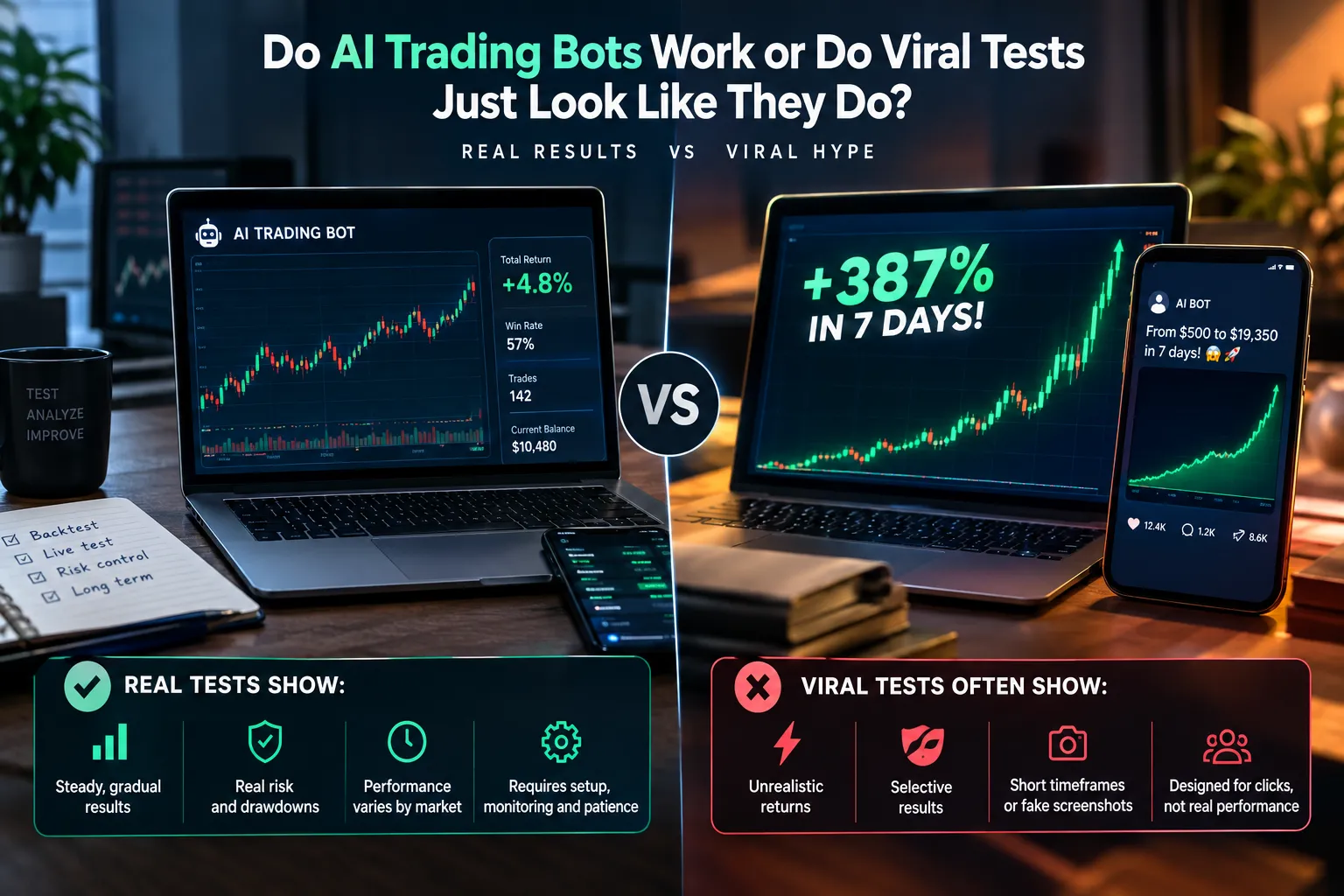
Do AI Trading Bots Work or Do Viral Tests Just Look Like They Do?
Do AI trading bots work in the way a 30-day YouTube test suggests? No. The tests are too short, too small, and too cheap to prove anything durable. They can prove a bot runs. They cannot prove it has an edge.
Three structural problems break almost every viral live test:
1. The window is too short. Thirty days is roughly 21 trading sessions. One decent trend, one earnings season beat, one lucky gap fill, and the curve looks like genius. The same bot in a choppy tape three weeks later looks like a random number generator with a subscription fee.
2. The sample is too small. Twelve trades is not a sample. It’s an anecdote with a chart attached. You can’t separate skill from noise at that count, and neither can the creator.
3. The costs are missing. Commissions, spread, slippage, data fees, model API calls, and taxes get quietly left out. A strategy that “makes 8%” gross can be flat or negative net. That’s not a rounding error. That’s the whole answer.
So are ai trading bots legit? As a category, partly. Automation is real, broker APIs are real, and plenty of professional desks have run rule-based systems for decades. What isn’t legit is the implication that a frictionless, hands-off money machine exists and a creator stumbled onto it over one month with a $500 account.
A 30-day live test answers “did this work recently?” It never answers “does this work?”
The uncomfortable part: a bot can be perfectly honest, well coded, and still show you a green month that means nothing. Fraud isn’t the only failure mode. Randomness is the bigger one, and it’s much harder to spot because no one’s lying to you.
Practical takeaway: treat every short live test as a demo, not evidence. Demos show the thing turns on. You still have to check whether it drives.
What Did the Viral AI Trading Tests Actually Claim?
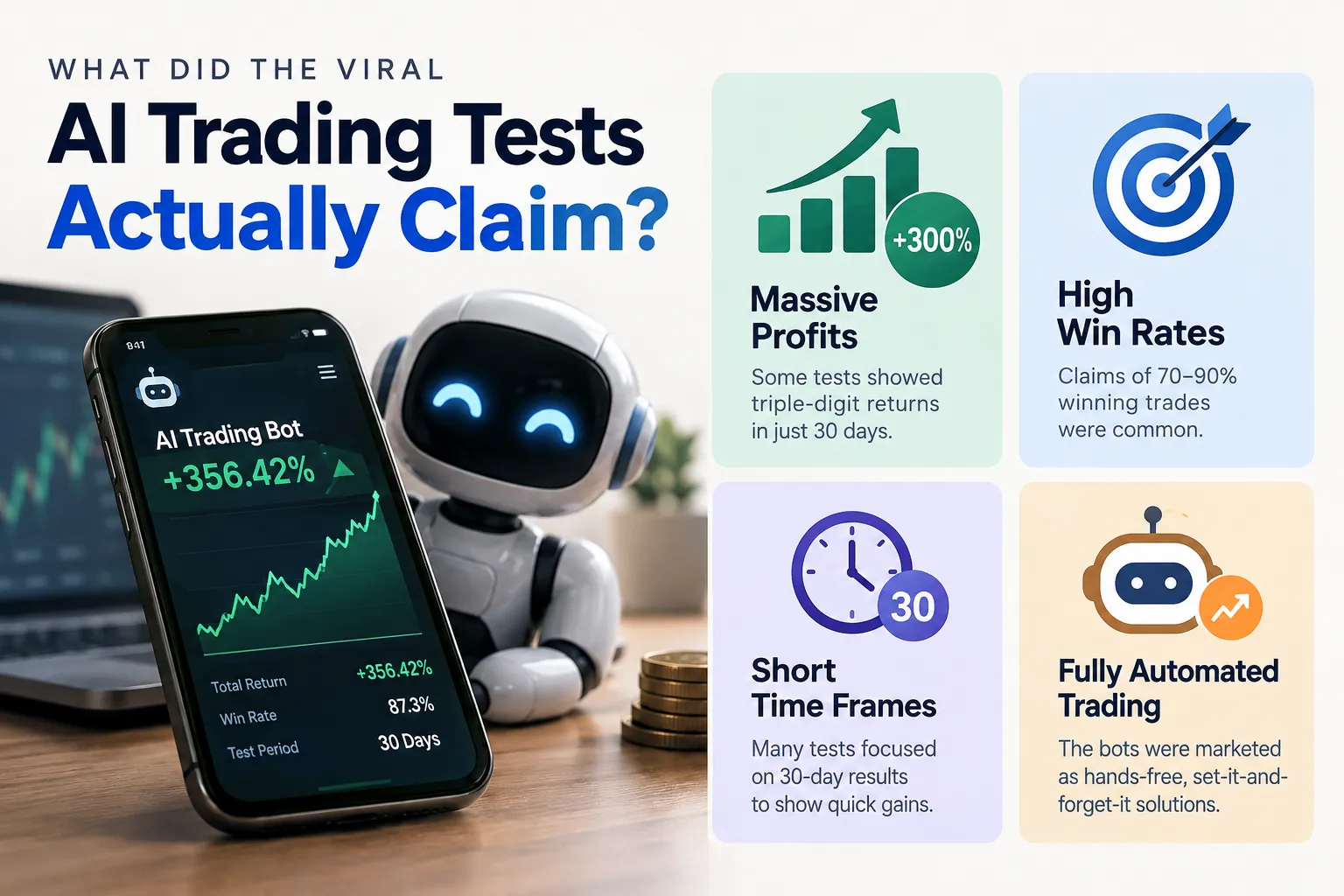
The popular creator tests fall into three buckets: a trader running a bot on a funded account, a “let Claude trade for 30 days” experiment, and a “I gave ChatGPT 72 hours and $X” video. Every result below is a creator claim. We have not verified any of them against brokerage statements.
Here’s the honest state of the genre. Creators like Jev (and a long list of similar channels) run bots live on camera, post a running P&L, and publish a result at the end of a window. Claude-based tests typically wire an Anthropic model into a broker or paper account, let it make one decision cycle per day, and film the log. ChatGPT tests are usually shorter, sometimes 72 hours, often with a few hundred dollars and a handful of tickers.
The common shape of these tests
| Test type | Typical account size | Length | Claimed result | What was not shown |
|---|---|---|---|---|
| Creator bot run (e.g. Jev-style live bot video) | Small funded or demo account, creator-stated | ~30 days | Net positive, creator says | Fill timestamps, slippage, fees netted out, max drawdown |
| Claude 30-day test | Simulated or small live account | 30 days | Varies by creator; often a modest gain | Number of trades, benchmark comparison, API cost |
| ChatGPT 72-hour test | Few hundred dollars, creator-stated | 3 days | Fast percentage gain or loss | Sample size of 3 days is statistically meaningless |
| TradeRank-style public leaderboard | $10,000 simulated per model, 22 AI models as of Oct 22, 2026 | Ongoing | Ranked daily | Simulated, not verified brokerage fills |
The TradeRank leaderboard deserves a nod because it’s the most transparent of the bunch: identical $10,000 simulated accounts across crypto and U.S. equities, common data, fees, position limits, and one decision cycle per day. That’s a far better design than a single creator’s cherry-picked month. It’s still simulated, which means no real fills, no real queue position, no real partial executions.
Common mistake readers make: assuming a bigger name means a better test. A test run by a channel with 800,000 subscribers has the same statistical power as one run by your cousin. Audience size isn’t sample size.
Edge case worth flagging: some creators re-run a test after a losing month and only publish the winning one. You’d never know. That’s survivorship bias baked into the content pipeline, and it’s why our rolling coverage of whether AI trading bots work treats every single-video result as a claim until there’s a statement behind it.
For a closer look at the model-specific experiments, see our breakdown of the Claude trading bot tests.
How Long Is a Live Test Before It Means Anything?
A useful live test needs enough trades to separate skill from luck and enough calendar time to cover more than one market regime. As a rule of thumb: at least 100 closed trades across at least two distinct market environments, with 6 to 12 months of calendar time for most swing and day strategies.
That’s not a statistical law. It’s a practical floor, and here’s the reasoning.
Why trade count matters more than days
A bot that takes one trade a week hits 30 days with four results. Four. You could flip a coin four times and call yourself a quant. A bot that takes five trades a day hits 100 trades in a month, which is better on sample size but still only covers one regime.
So the honest version of the rule is two-part:
- Sample size: 100+ closed trades before the win rate means anything.
- Regime coverage: the test must include at least one trending stretch and one choppy or declining stretch.
Both. Not either.
Why market regime is the silent killer
Most bots are implicitly long-biased momentum systems wearing an AI costume. They buy strength. In a rising tape, that’s printing. In a choppy tape, the same logic buys every bull trap and gets stopped out on the reversal, over and over, until the account is down 30% and the creator stops uploading.
LiveTradeBench’s 50-day design was materially stronger than a backtest: streaming prices and news, real portfolio allocation instead of isolated buy/sell labels, markets with shifting liquidity and volatility. And the researchers still flagged that 50 days is too short to prove durable alpha. If a published benchmark with 21 models says that about itself, a solo creator with 30 days and one account should say it too.
Decision rule: if a test is shorter than 100 trades or covers only one kind of tape, downgrade the result to “interesting, unproven.” Do that automatically, before you look at the P&L.
Quick example: a bot shows +11% over 30 days on 9 trades during a market that rose 6% in the same stretch. The bot added 5 points of relative return on nine coin flips. That’s inside the range of random. It isn’t evidence of anything.
What Costs Do the Tests Leave Out?
Almost all of them. The five costs that quietly eat a bot’s returns are commissions, bid-ask spread and slippage, market data fees, model API fees, and taxes. A gross return with none of these subtracted is a marketing number.
The five cost buckets
- Commissions and contract fees. Many U.S. equity brokers advertise zero commission on stocks, but options contracts, futures, and regulatory fees still apply. Check the official fee schedule for your specific broker rather than trusting a creator’s screenshot.
- Spread and slippage. Slippage is the gap between the price you expected and the price you got. A bot that trades a low float name on a fast move can slip badly. Backtests assume perfect fills. Reality doesn’t.
- Market data. Real-time Level 1 and Level 2 feeds cost money. Delayed data makes an intraday bot useless. This is the cost people forget first.
- Model API fees. An LLM-driven bot calling a frontier model on every decision cycle has a recurring bill. One decision a day is cheap. Scanning 500 tickers every five minutes is not. We break the full stack down in how much a trading bot costs.
- Taxes. Short-term gains are taxed as ordinary income in the U.S. A bot that churns positions generates short-term gains by design. Check current IRS rules or a tax professional for your situation.
How to net costs out yourself
Run this on any claimed result:
- Start with the claimed gross return in dollars, not percent.
- Subtract (number of trades × per-trade commission and fees).
- Subtract an estimated slippage haircut. For liquid large caps, a conservative starting assumption is a few basis points per side. For thin, low-float names, assume much more and test it in paper trading first.
- Subtract the monthly cost of data, software subscription, and model API calls for the test period.
- Compare the remaining number to simply holding the index over the same window.
Step 5 is the one that kills most claims. If a bot nets 1.4% in a month where the S&P gained 2%, the bot didn’t work. It underperformed with extra steps, extra risk, and extra cost.
Common mistake: comparing a bot’s return to zero instead of to a benchmark. Zero isn’t your alternative. Buying an index fund is.
This mirrors the AI-Trader finding almost exactly. GPT-5 at 1.56% against QQQ at 1.87% isn’t a disaster, but it isn’t an edge either. In A-shares, two models lost 3.53% and 3.86% with Sortino ratios of −1.54 and −1.40 (a Sortino ratio measures return against downside volatility, and negative numbers mean the downside wasn’t paid for).
If you want the full ledger on subscription tools, our guide to what you pay for versus what you get with AI trading software lays out where the money actually goes.
What Do Regulators Say About AI Trading Bot Claims?
Regulators have moved from warning to enforcement. The clearest recent example: on September 29, 2026, the SEC announced actions alleging that Cryptoaiml and TSAI Pro misappropriated more than $15 million from retail investors through online platforms marketing AI trading bots.
What the SEC alleged
- TSAI Pro allegedly marketed AI bots with guaranteed profits. The SEC says the bots did not exist and that deposited funds were not used to generate returns.
- Cryptoaiml allegedly claimed its AI-generated signals achieved 98% accuracy. Investigators alleged there was no genuine trading platform, no actual trades, and no real profits.
Read that second one twice. The performance wasn’t overfit. It wasn’t optimistic. It was allegedly fabricated. There’s a growing category of enforcement around “AI washing,” which is slapping an AI label on a product to raise money, and it’s being treated as securities fraud.
We cover these filings in detail in our post on the SEC’s fake AI trading bot charges.
What other regulators are doing
- CFTC has long warned retail traders about automated systems promising guaranteed profits in futures and forex, particularly where the operator controls the deposit. Check the CFTC’s investor advisories on its official site for current language.
- FINRA publishes investor alerts on trading-related fraud and on the use of AI by member firms. Check FINRA.org for the current versions rather than relying on a summary.
- FTC has pursued cases involving deceptive earnings claims in money-making schemes generally, including AI-branded ones. Check the FTC’s official releases for specifics before citing any number.
Internationally, ASIC announced new safeguards on September 24, 2026 covering testing, monitoring, governance, and market-conduct controls for trading algorithms, including machine-learning systems. The rules are expected to take effect in 2028 after an 18-month transition. ASIC’s explanatory material names a risk that matters directly to retail bot users: adaptive AI systems can change their behaviour in response to market conditions, which makes outcomes less predictable than fixed rule-based algorithms and raises the need for ongoing monitoring and shutdown controls.
Translation for a retail trader: a bot that learns can drift. The thing you tested in September may not be the thing running in December. You need a kill switch and you need to check on it.
Decision rule: if any promotional material uses the words “guaranteed,” “risk-free,” or quotes an accuracy figure above about 70% with no audited statement behind it, stop reading. That combination is the single most common feature of the enforcement cases.
Are AI Trading Bots Legit and Are Trading Bots Profitable?
Do ai trading bots work depends entirely on which of four very different things you’re looking at. Lumping them together is how people get hurt. Here’s the split.
1. Outright scam bots
These take custody of your money and show you a dashboard. No real orders. No real broker. Withdrawals get delayed, then blocked, then a “tax” is demanded. The SEC’s September 2026 actions describe exactly this pattern. Zero legitimacy. Zero profitability. The entire product is the dashboard.
Red flag cluster: custody of funds, promised returns, referral commissions, a Telegram group, and an accuracy stat with no audit. Our full list lives in AI trading bot red flags.
2. Signal sellers
These sell alerts, not execution. Some are honest educators. Many publish winners and bury losers. Legitimacy: mixed. Are trading bots profitable in this category? Unknowable, because the entry and exit you get is never the entry and exit they posted. You’re buying someone else’s screenshot.
3. Broker-connected automation tools
These connect to a real brokerage account via API, place real orders, and you keep custody at a regulated broker. Names in this category include platform tools reviewed across our directory, such as Atomik Trading. Legitimacy: generally real. Profitability still depends entirely on the strategy you put inside them. The tool executes. It doesn’t decide whether the idea was any good.
This is the honest centre of the market. A broker-connected bot is a power tool, and a power tool in untrained hands is how people lose fingers.
4. DIY bots you build yourself
You write the rules, you run the backtest, you connect the API, you eat the outcome. Legitimacy: total, since you’re the only party involved. Profitability: low base rate, same as discretionary trading, with the added hazard that you can automate a bad idea at scale and lose faster.
FIDES tested whether an LLM’s written explanation, its trading code, and its reported results described the same strategy. Across 40 strategies from four models on eight liquid U.S. ETFs, only 2 of 40 beat buy-and-hold out of sample in 2023-2024. That’s a 5% hit rate against the simplest possible alternative.
The honest summary: do ai trading bots work as execution infrastructure? Yes, routinely. Do ai trading bots work as a source of reliable alpha for a retail account? The published evidence says mostly no, and the burden of proof sits with anyone claiming otherwise.
More on where the line sits in our piece on whether AI trading is legit.
What Is the 5 Question Test for Any AI Trading Claim?
Run these five questions on every video, ad, landing page, and Discord pitch you see. If a claim can’t answer all five, it hasn’t earned your attention, let alone your money.
1. What was the account size, and was it real?
A $200 demo account behaves nothing like a $20,000 funded account. Position sizing changes, slippage changes, and psychology changes. Demo fills are fantasy fills.
2. How long was the test, and how many trades?
Days are the wrong unit. Ask for the closed trade count. Under 30 trades, the result is noise. Under 100, it’s suggestive at best.
3. Were costs netted out?
Commissions, fees, spread, slippage, data, API, and the subscription itself. “Gross return” is the most expensive two words in retail trading.
4. What was the maximum drawdown?
Drawdown is the largest peak-to-trough loss during the test. A bot that ends +12% after being down 40% mid-test is not a 12% bot. It’s a 40% risk you survived. Almost no viral test publishes this number, which tells you something.
5. Is there proof of live fills?
Timestamped brokerage statements or a verified third-party track record. Not a screen recording of a dashboard. Not a spreadsheet. A dashboard is a picture of a number, and anyone can draw a picture.
| Question | Red flag answer | What a good answer looks like |
|---|---|---|
| Account size | ”I started with a demo” or no figure given | A stated, real, funded account with a broker named |
| Time and trade count | ”30 days” with no trade count | ”68 closed trades over 4 months across two regimes” |
| Costs | Gross return only, no fee mention | Net return after commissions, slippage, data and API |
| Drawdown | Not mentioned anywhere | A stated max peak-to-trough loss and when it happened |
| Proof of fills | A dashboard screenshot | Timestamped brokerage statements or audited track record |
Edge case: a creator answers all five honestly and the result is still mediocre. That’s a good outcome for you as a reader, because it’s the first honest data point you’ve seen. Honest mediocre beats dishonest spectacular every day of the week.
Common mistake: asking question 3 but not question 4. Costs tell you whether the strategy survives friction. Drawdown tells you whether you would have survived the strategy. Different question, equally important.
How Do You Run Your Own Safe 30 Day Test?
Paper trade it first, log every trade in a fixed format, set a hard stop rule before you start, and define what “pass” and “fail” mean on day zero. A 30-day test you run yourself won’t prove an edge, but it will tell you whether the bot is operationally safe and whether you can live with it.
The setup, step by step
- Paper trade for the first 30 days. No exceptions. Paper trading is a simulated account with real market data and no real money. It won’t model slippage perfectly, but it will show you whether the bot does anything insane at the open.
- Fix your position size before you start. Same risk per trade, every trade. If you change sizing mid-test, you’ve destroyed your own data.
- Write a stop rule. Example: “If the account draws down 10% from its starting value, the test ends and the bot is off.” Decide this when you’re calm, not when you’re down 8% and bargaining.
- Keep a fixed log. One row per trade: date, ticker, entry, exit, size, reason for the signal, result, and whether the bot followed its own rules. Spreadsheet is fine. Consistency matters more than tooling.
- Record the benchmark. What did SPY or QQQ do over the same 30 days? Write it down on day one so you can’t move the goalposts later.
- Define pass and fail in advance.
- Pass: the bot followed its rules, took enough trades to evaluate, had drawdown you can tolerate, and beat the benchmark net of all estimated costs.
- Fail: any rule violation, any drawdown past your stop rule, fewer than roughly 20 trades to evaluate, or underperformance versus simply holding the index.
- If it passes, extend the paper test. Don’t fund it at 30 days. Run it to 90 and through a different tape. Then fund it small.
What this test can and cannot tell you
It can tell you: whether the bot executes cleanly, whether the latency is acceptable, whether it chases overextended moves, how it behaves during earnings season, and whether you can sit through its losing streaks without revenge trading.
It cannot tell you: whether it has a real edge. Thirty days is not enough and never will be. Anyone who says otherwise is selling.
A reaction-time check is a useful side experiment here too, because a bot’s whole pitch is speed. If your manual alert-to-click time is already fast on the setups you trade, automation is buying you less than you think. Try the trader reaction time test and see where you land.
No promised returns here. The goal of a 30-day test is elimination, not confirmation. You’re trying to find reasons to throw the bot away cheaply, before it costs you real money.
What Market Conditions Work Best for AI Trading Bots?
Trend-following and momentum bots do best in persistent, directional, liquid markets with normal volatility. They do worst in choppy, mean-reverting, low-volume tape and during volatility shocks where correlations snap.
Conditions that favour most retail bots:
- A clear, sustained trend in the instrument being traded
- Normal to elevated volume, so fills are predictable
- Liquid large caps or major ETFs where spreads are tight
- Stable intraday patterns, not holiday-week ghost volume
Conditions that break them:
- Choppy, range-bound tape, where every breakout is a bull trap and every bounce is a dead cat bounce
- Low float, thin names, where slippage eats the edge before the thesis plays out
- Gap-heavy earnings season, if the bot wasn’t designed to flatten before a print
- Fed days, CPI releases, and other scheduled volatility events
Decision rule: if the bot has no explicit rule for what to do during earnings or a scheduled macro print, it will take the trade. Assume it will. Add the rule yourself or turn it off those days.
This matters more for AI bots than for fixed rule-based systems, which is exactly what ASIC flagged. An adaptive model can re-weight itself based on recent conditions, which means the thing that worked in a trending September may behave differently in a choppy November without anyone changing a line of code.
Should You Use an AI Bot or Trade on Your Own, and What Are the Alternatives?
Use a bot if you already have a written, tested strategy and want to remove execution error. Trade manually if you don’t yet have a strategy, because automating a vague idea just makes you wrong faster.
Bot versus manual, side by side
| Factor | AI trading bot | Manual trading |
|---|---|---|
| Speed | Faster than any human on execution | Limited by your reaction time |
| Discipline | Never revenge trades, never oversizes | Depends entirely on you that day |
| Adaptability | Weak in conditions it hasn’t seen | Strong, if you’re experienced |
| Transparency | Often a black box | You know exactly why you entered |
| Failure mode | Silent, compounding, automated | Loud, emotional, usually self-limiting |
| Setup cost | Subscription, data, API fees, build time | Broker account and your time |
The silent failure mode is the one to respect. A human having a bad day stops trading. A bot having a bad day keeps going until the capital runs out.
Alternatives worth considering first
- AI-assisted screeners instead of AI execution. Let the machine find candidates and let your brain decide. Our head-to-head on the best AI trading tools of 2026 covers the field.
- A better screener workflow. Most traders don’t need a bot. They need a tighter watchlist and fewer tabs. The stock screener for swing trading piece walks through that.
- Free tools before paid ones. Plenty of the useful stuff costs nothing. Start with the free AI trading bots directory before you subscribe to anything.
- Index investing for the core. Boring, low cost, and the benchmark every bot has to beat anyway.
Choose a bot if: you have a documented strategy, 100+ trades of your own data, and a specific execution problem you can name. Skip the bot if: you’re hoping it will supply the strategy. It won’t.
What Success Rate Can You Actually Expect from AI Trading Bots?
No one can give you an honest expected success rate, and that’s the answer. Any specific figure you see in an ad is either a backtest, a cherry-picked window, or invented. The SEC’s 98%-accuracy case is the extreme version of exactly this.
What the published research suggests is a sober range:
- In the AI-Trader U.S. equity test, the best LLM slightly underperformed the QQQ benchmark over the evaluation window.
- In A-shares, the tested models posted losses with negative Sortino ratios.
- LiveTradeBench found that general LLM leaderboard rankings did not predict trading performance across 21 models over 50 days.
- FIDES found 2 of 40 model-generated strategies beat buy-and-hold out of sample.
- A July 2026 Backtrader-Bench preprint found tool-augmented frontier models hit 90% accuracy on a 30-question algorithmic-trading benchmark versus 73% for the best no-tool baseline. That measures coding and reasoning competence, not profitability. Being good at writing a strategy is not the same as the strategy making money.
A September 2026 review by EBC Financial Group summed up the industry position fairly: AI is increasingly capable of reading filings, scanning instruments, and writing trading code, but evidence that these capabilities produce persistent after-cost returns stays mixed.
So the honest expectation: assume no edge until a long, costed, drawdown-disclosed record proves otherwise. Then size as if you might still be wrong.
Frequently Asked Questions
Are AI trading bots any good?
Some are genuinely good at execution and screening, and almost none are proven at generating returns. Broker-connected automation tools that place real orders through a regulated broker are legitimate software. The strategy you load into them determines the outcome, and the published benchmarks on model-driven strategies are underwhelming.
Is there an AI trading bot that works?
There are AI trading bots that work mechanically, meaning they execute orders reliably and cut human error. There is no publicly verified retail bot with an audited, long-run, after-cost record of beating a simple index. If someone claims one, ask for timestamped brokerage statements and max drawdown.
Do trading bots really make money?
Some do over some periods, and most don’t after costs. Fees, spread, slippage, data, and taxes turn a lot of gross winners into net losers. FIDES found only 2 of 40 AI-generated strategies beat buy-and-hold out of sample, which is the cleanest number currently available on this question.
How do trading bots work?
A trading bot takes market data, applies a set of rules or a model output to generate a signal, then sends an order to a broker through an API. AI bots replace part of that rule set with a model, often a large language model reading news and prices. The execution layer is the same either way.
How do I know if an AI trading bot is a scam?
Promised returns, custody of your deposit, an accuracy claim above roughly 70% with no audit, referral commissions, and pressure to fund fast. The SEC’s September 2026 cases against Cryptoaiml and TSAI Pro allege that exact pattern, including an alleged 98% accuracy claim with no real trades behind it.
What is the easiest passive income to make?
Trading bots are not passive income, and treating them that way is how accounts get wiped. Genuinely low-effort options tend to be boring: index funds, high-yield savings, and employer retirement matching. A bot requires monitoring, a kill switch, and ongoing cost accounting, which makes it a job with extra steps.
Our Take
Do AI trading bots work? As tools, yes. As automatic money, no, and no 30-day viral test will ever prove otherwise because the format can’t carry that much weight. A short window with a small account and no cost accounting is entertainment with a chart. The benchmarks that run longer and cleaner keep finding the same thing: strong models aren’t automatically strong traders, and the simplest alternative, just holding the index, beats most of what gets generated.
Run the five-question test on the next claim you see. Paper trade before you fund. Define your stop rule on day zero. Systems over hacks, every time.
Got a bot you want us to put through the 30-day process properly, with costs and drawdown published? Submit it here and we’ll put it on the testing list. Everything we’ve already run lives at aistocktradingbots.com.
Stay alpha.
The FullStack Alpha research desk tests AI trading bots on paper and live accounts. Reviewed and edited by Jay Rocco, Founder and Editor.
