

The FullStack Alpha research desk tests AI trading bots on paper and live accounts. Reviewed and edited by Jay Rocco, Founder and Editor.
By FullStack Alpha Editorial Team | Reviewed by Jay Rocco, Chief Editor
A day trading bot is software that opens and closes positions inside a single session using pre-set rules or a model. It automates the mechanical parts well: scanning, order entry, bracket exits, trailing stops, position sizing, daily loss limits, and trade journaling. What breaks first is everything between your backtest and your fill: slippage, latency, wide opening spreads, trading halts, rejected orders, market data costs, and margin rules you didn’t read. The test before real money is boring and non-negotiable. Run the bot on paper for a fixed number of trades you set in advance, log every fill, subtract realistic costs, and compare live fills to simulated ones.
What You Should Know
- FINRA’s 2026 Annual Regulatory Oversight Report, published December 2025, added a dedicated section on generative AI, covering supervision, controls, and retention duties at broker-dealers.
- FINRA’s January 27, 2026 blog post on AI agents names “trade execution agents” directly: systems that analyze conditions, generate strategies, and execute trades with varying human oversight.
- ESMA’s February 2026 supervisory briefing on algorithmic trading confirms that software deciding whether, when, at what price, or in what size to trade counts as algorithmic trading. Occasional human clicking doesn’t exempt you.
- MiFID II Article 17 requires algorithmic traders in the EU to run pre-set trading thresholds, capacity limits, and controls that prevent erroneous orders and disorderly markets.
- FINRA Rule 2270, the day-trading risk disclosure, warns plainly that under some market conditions liquidating a position at a reasonable price can be difficult or impossible, and that system failures cause losses.
What Is a Day Trading Bot?
A day trading bot is a program that opens and closes positions within one trading session, following rules you wrote or a model you trained, without you clicking the button each time. Nothing mystical. It’s a checklist that runs at machine speed.
Day trading bots come in three rough flavors, and the differences matter more than the marketing does.
Rules-based bots. You define the conditions. “If the stock gaps up more than 2% on above-average volume, and price breaks the first five-minute high, buy 100 shares with a stop at the five-minute low and a target at two times risk.” Every input is visible. Every decision is traceable. MetaTrader’s Expert Advisors are the classic example on the retail side: scripts that watch the market and trade automatically when auto-trading is switched on.
An AI day trading bot. Instead of hard rules, a model estimates something from data: a probability of continuation, a classification of regime, a sentiment read on a headline. The output still has to become an order, so a rules layer still sits underneath. The model guesses; the rules execute.
Hybrid day trading AI bot setups. A model filters the watchlist, a human approves the trade, and the bot handles the exits. This is the version that works best for most retail traders, and it’s the one almost no one sells, because “software that closes your trades correctly” doesn’t make a good thumbnail.
The one line that matters: a day trading bot is an execution tool wearing a prediction costume. It’s genuinely excellent at execution. The prediction part is where people lose money.
Worth being precise about one thing: automation isn’t a regulatory gray zone. ESMA’s February 2026 briefing spells out that if software determines whether to trade, the timing, the price, the quantity, or how an order is managed after submission, that’s algorithmic trading, full stop. Retail traders in the US face a lighter touch, but your broker’s terms of service still govern what you’re allowed to run.
If you’re new to the category, start with the fundamentals in our trading bot basics explainer before you start comparing products.
What Can a Retail Day Trading Bot Actually Automate?
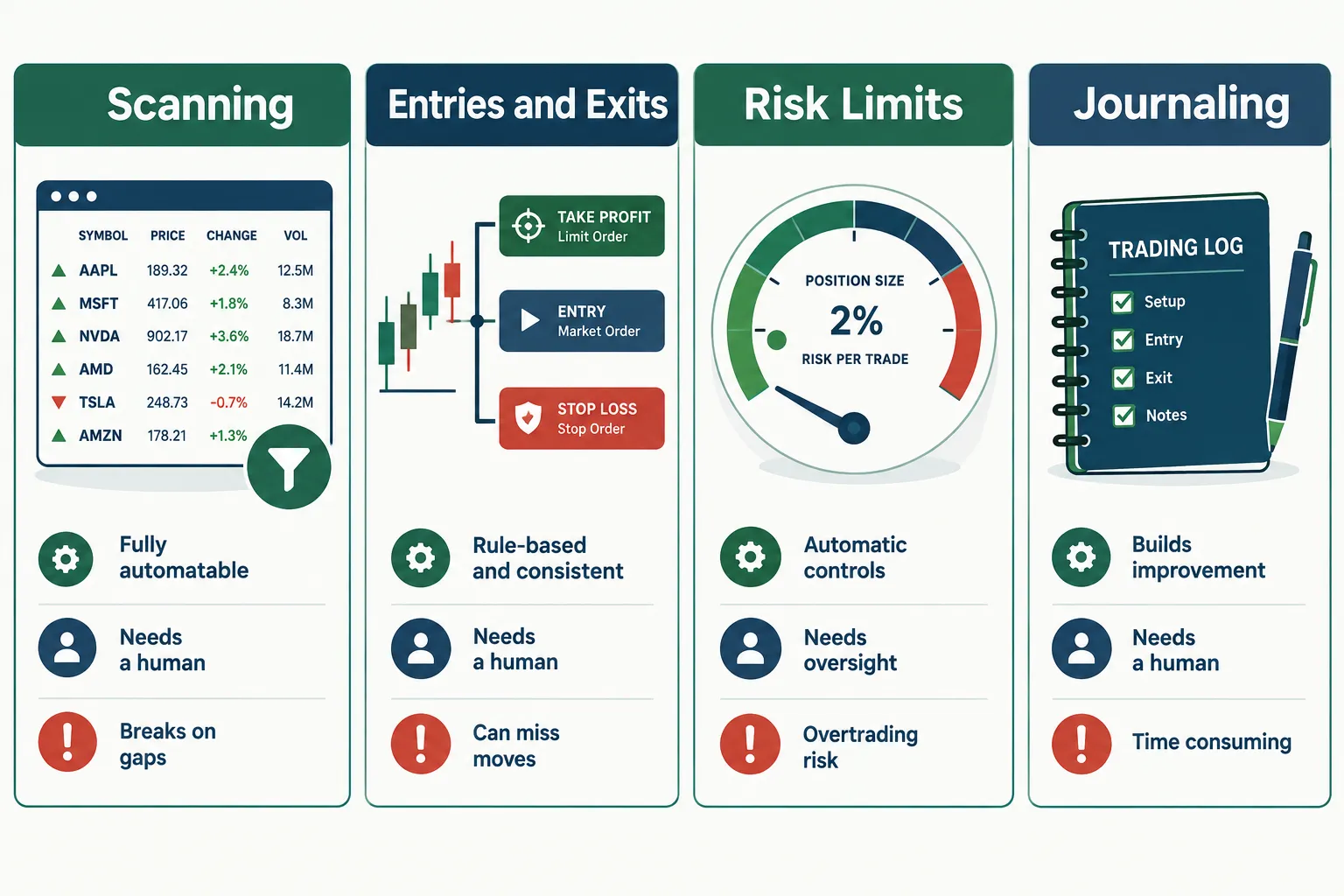
A day trading bot reliably automates anything deterministic: scanning, order submission, stop placement, position sizing math, time-based exits, and record keeping. It automates judgment badly. Anything requiring context about why the market is moving still needs you.
Here’s the honest split.
| Task | Can automate | Needs a human | Main risk if automated |
|---|---|---|---|
| Scanning the universe for setups | Yes, fully | No | Stale or delayed data surfaces a move you can’t catch |
| Building the watchlist | Yes | Occasional review | Filter drift: your scan catches junk after a volatility regime change |
| Entries on mechanical triggers | Yes | Rarely | Fills at a worse price than the trigger, especially at the open |
| Stop loss placement | Yes, and you should | No | Gaps and halts jump straight through the stop |
| Profit targets and bracket exits | Yes, and you should | No | Partial fills leave you with an unprotected remainder |
| Position sizing from account equity | Yes, and you should | No | Equity refresh lag sizes the next trade off a stale balance |
| Daily loss limit / kill switch | Yes, and you absolutely should | No | Only fails if you let yourself override it |
| News and earnings filters | Partly | Yes | A headline gets read fast and understood wrong |
| Deciding a day is untradeable | Barely | Yes | Bot trades a choppy tape all session and bleeds on spreads |
| Trade journaling and stats | Yes, fully | Review weekly | None, really. This is free value |
Three observations from that table.
The risk controls automate better than the signals. Position sizing based on account equity, maximum open exposure, stop distance, daily loss caps, one-trade-per-signal logic: all deterministic, all testable, all more valuable than a fancier model. They limit the damage from model error, duplicate orders, and abnormal volatility. Most people get this backwards and spend six weeks tuning an indicator while running no exposure cap at all. If you’re fuzzy on the math, read the position sizing mistake that wipes out most new traders.
News filtering is where AI oversells itself. A language model can summarize a headline in 400 milliseconds. It cannot reliably tell you whether an earnings beat was already priced in, how positioning is skewed, or whether the real move is in the sector ETF. A headline-driven bot can trade quickly in exactly the wrong direction, then do it again on the duplicate wire story three seconds later.
Journaling is the most underrated automation in retail trading. Every fill, timestamp, slippage amount, and R-multiple written to a file with no effort from you. That dataset is how you find out which setup actually prints and which one you just like.
Decision rule: if the task has a right answer you could write on an index card, automate it. If the answer starts with “it depends on what the market’s doing,” keep your hands on it.
What Does the 1.75M-View Fully Automated Bot Video Claim?
There’s a widely circulated YouTube video on building a fully automated trading bot that retail traders keep citing as proof the whole thing works. Watch it for the mechanics. Treat every result in it as a claim, not a verified outcome.
Video: Building a fully automated trading bot on YouTube.
Important caveat on sourcing: check the video page yourself for the exact channel name and the current view count before you quote either. Figures and attributions circulating secondhand, including the frequently repeated 1.75M-view number, should be confirmed on the live page on the date you’re writing or reading. We have not independently verified any performance figure stated in the video.
With that said, the typical “fully automated bot” video follows a predictable structure, and the gaps are the same every time. Here’s the audit pattern to apply to this one and to every other build-a-bot video you watch.
| Claim style | What’s usually shown | What usually gets skipped |
|---|---|---|
| ”The bot trades on its own” | Live screen recording of orders firing on a chart | Order rejections, partial fills, reconnect logic after a dropped session |
| ”Here’s the backtest” | An equity curve climbing left to right | Commission, exchange fees, realistic spread, slippage, queue position |
| ”It’s profitable” | A short live window, often days or weeks | Full drawdown history, losing months, the parameter versions that failed |
| ”Anyone can build this” | A code walkthrough in a notebook | Market data subscription costs, hosting, broker API approval |
| ”The strategy is simple” | One indicator crossover or a breakout rule | Why that parameter set was chosen over the dozens tested |
The one skipped item that kills more accounts than the rest combined is backtest overfitting. A peer-reviewed review of machine-learning equity experiments identifies transaction costs and backtest overfitting as the dominant reasons impressive simulations fail live, crediting the concept of investment backtest overfitting to work by David Bailey and co-authors. Tune a strategy’s parameters forty times against the same stretch of history, and the model learns the random quirks of that sample. It’s memorizing, not learning.
The edge case no one films: the day the data feed drops for ninety seconds while a position is open. In the video, the bot is always online. In your account, it won’t be.
Watch these videos for the plumbing: how to connect to a broker API, how to structure a bracket order, how to handle a reconnect. That’s real, teachable craft. Just don’t import the P&L along with the code. For a broader sanity check on vendor and creator claims, see our breakdown of which AI trading bots are legit versus scams.
Why Do Slippage and Latency Hit Day Trading Bots Hardest?
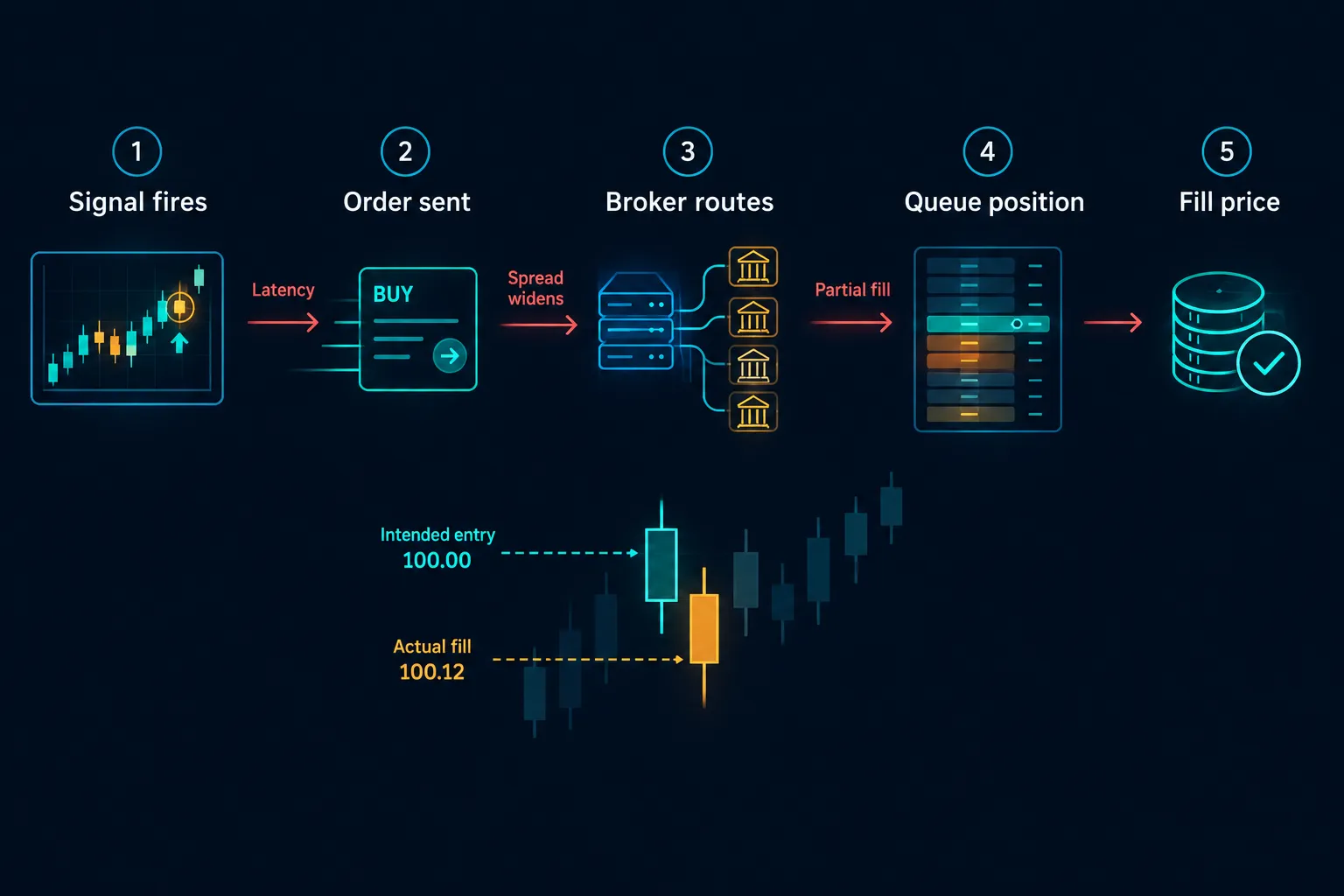
Day trading bots suffer most from slippage and latency because intraday targets are small. When you’re risking 30 cents to make 60, losing 8 cents on entry and 8 cents on exit eats more than a quarter of your edge. A swing trader holding for six days barely notices the same 16 cents.
Four specific failure points, with an example each.
1. Small targets, proportionally huge costs. A bot targeting 0.4% per trade on a $50 stock is chasing 20 cents. A one-cent spread, a one-cent slip on entry, and another on exit is 15% of the gross target gone before commission. Run that 1,200 times a year and the arithmetic decides your results, not the signal.
2. Spreads at the open. The first few minutes of the session have the widest spreads of the day. A low float name that trades a penny wide at 11am might be eight cents wide at 9:31. Opening range breakout bots live exactly in that window, which is why their live results so often trail their backtests. Our paper trading slippage walkthrough shows how to measure the difference instead of guessing at it.
3. Fast fills and queue position. A limit order isn’t a fill. It’s a place in line. If your bot posts a limit at the bid and 40,000 shares are ahead of it, you get filled when the price is moving against you, and you don’t get filled when it isn’t. Backtests that assume limit orders always fill at the posted price are describing a market that doesn’t exist.
4. Order routing and latency. A retail broker’s API sits several hops from the exchange. Between your signal firing and the order reaching the book, the price moved. Market makers don’t wait for you. If your strategy only works when you get the exact trigger price, it doesn’t work. Curious where you personally sit? Our trader reaction time test makes the lag obvious.
Common mistake: assuming a faster VPS fixes this. Shaving 40 milliseconds off a retail setup doesn’t put you in a race you were ever going to win. The fix is strategy design, not hardware. Build setups with targets large enough that a few cents doesn’t matter.
Price your costs into the strategy before you code it. If the edge survives double your expected slippage, you have something. If it only works at perfect fills, you have a screensaver.
How Does the Pattern Day Trader Rule Affect a Bot?
The pattern day trader rule governs margin, not software. It has never cared whether a human or a day trading bot placed the order. Four or more day trades in five business days in a margin account flags you as a pattern day trader, and historically that triggered a minimum equity requirement.
Status check. FINRA Regulatory Notice 26-10, published April 20, 2026, replaced the day trading margin requirements in their entirety, including the pattern day trader designation and its $25,000 minimum equity requirement, with new intraday margin standards under Rule 4210 effective June 4, 2026. Firms that need longer may phase implementation in through October 20, 2027, which means two brokers can apply different intraday margin rules right now. Read your own broker’s margin disclosure before you build account assumptions into anything. Brokers can and do impose stricter house rules than the regulator requires, so your broker’s page is the binding answer regardless of what the rule says.
What’s stable enough to plan around:
- Cash accounts are outside the day trading margin framework entirely, but settlement constrains you. Stock trades settle T+1 as of the 2024 SEC settlement cycle change, so capital recycles slower than a bot might assume. Trading unsettled funds triggers good-faith violations.
- Margin accounts are where the day trade counting applies, and where a bot can rack up round trips far faster than you realize. A bot that enters and exits twice before lunch has used two of your round trips.
- Futures accounts have never been subject to the PDT framework. That’s part of why automated strategies migrated to index futures.
- Non-US brokers operate under their own rules. In the EU, MiFID II Article 17 obligations around pre-set limits and erroneous-order prevention are the bigger consideration.
Build this into the bot, not your memory: a hard counter that tracks round trips over a rolling five-business-day window and refuses new entries at your limit. It’s twenty lines of code and it prevents a restriction that locks your account for 90 days.
Edge case worth naming: a bot that gets partially filled, exits, then re-enters the same name can log round trips you never intended. Count fills, not intentions.
What Does Data and Platform Cost a Day Trading Bot?
Running a day trading bot costs more than the software line item. Market data, exchange fees, platform access, and hosting all stack, and real-time data is usually the line that surprises people. Delayed data is free. Delayed data is also useless for intraday automation.
| Item | Free option | Paid option | How to confirm |
|---|---|---|---|
| Real-time US equity data | Broker-provided delayed or limited real-time feeds | Consolidated or direct feeds through a data vendor | Check your broker’s market data page on the date you subscribe |
| Exchange fees (non-professional) | Some brokers waive or absorb for active accounts | Per-exchange monthly fees billed through the broker | Exchange fee schedules are published; your broker passes them through |
| Professional data designation | N/A | Substantially higher than non-professional rates | Your broker’s market data agreement defines who counts as professional |
| Charting and backtest platform | TradingView free tier, broker-native tools | Paid charting tiers, dedicated backtest software | Vendor pricing page, checked on the day |
| Hosting / VPS | Run it on your own machine | Cloud instance near the broker’s data center | Cloud provider pricing page |
| Broker commissions | Zero-commission equities at several US brokers | Per-share or per-contract pricing | Broker commission schedule |
We’re deliberately not printing dollar figures here. Market data pricing changes, broker waivers change, and a stale number in an article is worse than no number. Check the official page for every line before you budget. For a structured breakdown of the categories, see our guide to how much a trading bot costs, and for the subscription side, what you actually pay for with AI trading software.
The mistake: budgeting the software and forgetting the data. A bot running on a 15-minute delayed feed is doing historical research in real time. Dressed up nicely, but still history.
Decision rule: if your total monthly running cost is a meaningful fraction of your account’s realistic monthly expectancy, the economics don’t work no matter how good the strategy is. A $3,000 account paying $150 a month in data and hosting needs a 5% monthly return just to break even on overhead. That’s not a strategy problem. That’s a math problem.
What Is the Best AI Day Trading Bot for Retail Traders?
There is no single best AI day trading bot, and anyone naming one without asking what you trade is selling something. The right answer depends on whether you code, which market you trade, and whether you want signals or full execution.
By use case, based only on what’s verifiable about each category:
If you want full automation and you can code. Broker APIs with Python wrappers give you the most control and the least black box. You own every rule, which means you can audit every loss. The tradeoff is that you’re also your own ops team at 9:31am. Our directory of fully automated AI trading bots covers what’s available.
If you want automation without writing code. Visual rule-builders and no-code bot platforms handle entries, exits, and brackets through a UI. You give up edge-case control, and you inherit whatever the platform’s execution logic does when something unusual happens. Read the docs on how the platform handles rejected orders before you fund it.
If you want AI assistance but keep the decision. Scanner-plus-alert tools that surface candidates and let you approve the trade. This is the setup that fits the most retail traders honestly. Our ranked list of the best AI trading tools put head to head covers the field, with day trading tools broken out separately and our guide to AI day trading tools covering how to judge them.
If you’re not sure you want day trading at all. Slower timeframes forgive execution errors. Compare swing trading tools before you commit to the intraday version.
The filter we’d apply to any vendor: can you see the method, or is it “proprietary AI” and then silence? A tool that publishes its factors and is upfront about what the model can’t do earns trust. A public language model with a dashboard bolted on, sold as proprietary AI, does not. That category is crowded.
Are there any free day trading bots that actually work? Some, with caveats worth stating plainly. Open-source frameworks and broker paper-trading APIs genuinely work for building and testing, and they cost nothing. What’s not free is the real-time data that makes them useful intraday, and the hosting that keeps them online. Free bots with a signal service attached are usually a funnel for a paid tier or a broker referral. Browse what’s actually free in our free AI trading bots listing, then check what the free tier excludes before you depend on it.
What’s the Difference Between Day Trading and Swing Trading Bots?
Day trading bots and swing trading bots differ in one way that drives everything else: time in market. A day trading bot flattens before the close, so it never carries overnight gap risk but absorbs every cent of intraday execution cost. A swing bot holds for days, so gaps are its main threat and slippage barely registers.
| Factor | Day trading bot | Swing trading bot |
|---|---|---|
| Holding period | Minutes to hours, flat by close | Days to weeks |
| Trades per year | Hundreds to thousands | Dozens |
| Slippage sensitivity | Extreme, it’s the dominant cost | Minor relative to target size |
| Overnight gap risk | None, by design | The primary risk |
| Data requirement | Real-time, low latency | End-of-day often sufficient |
| Margin rule exposure | Day trade counting applies | Generally not applicable |
| Uptime requirement | Must be online all session | Can check in once a day |
| Realistic for a $3K account | Costs are brutal at that size | More workable |
Decision rule: if you can’t commit to a reliable always-on setup with real-time data, build a swing bot. The same strategy logic, applied to daily bars, is dramatically more forgiving of the things that break. Our breakdown of stock screeners for swing trading covers the tooling side.
What Happens When Your Bot Glitches, Gaps, or Hits a Halt?
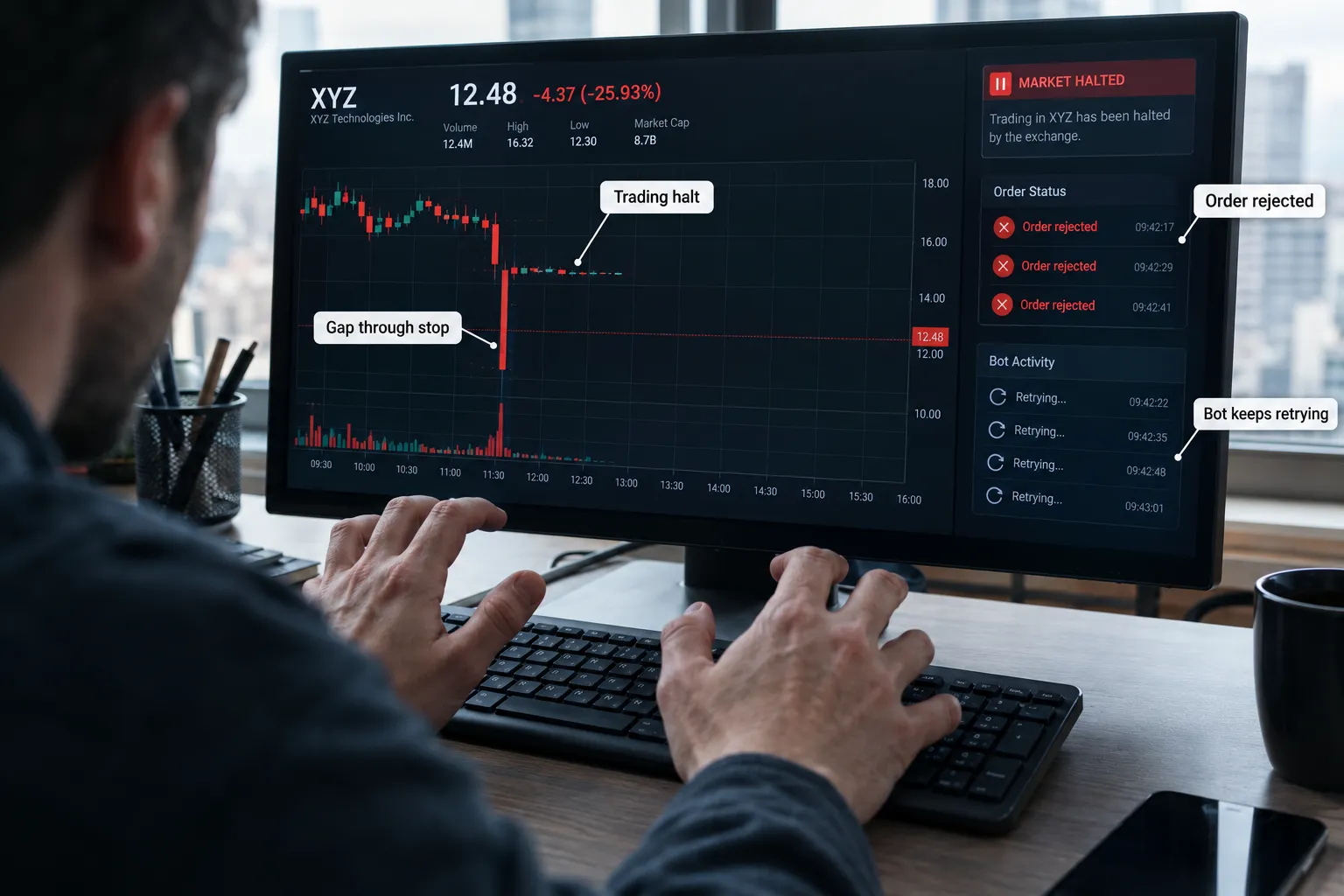
When a day trading bot glitches mid-trade, you’re left holding an unmanaged position while the software thinks it’s managing one. That’s the scenario to design for, because it will happen. FINRA Rule 2270’s day-trading disclosure says it outright: system failures can cause losses, and under some market conditions liquidating at a reasonable price may be difficult or impossible.
The four most common live failures, and what each actually does to your account.
1. Connection drops with a position open. The bot’s stop was held locally, not at the broker, so no stop exists at the exchange. Price moves. No one’s watching. Fix: place protective orders at the broker as native bracket orders, so they survive your software dying.
2. The duplicate order. Signal fires, order submits, acknowledgment lags, bot assumes failure and resubmits. Now you’re in double size with a stop built for half. Fix: idempotent order IDs and a position reconciliation check before every submission.
3. A trading halt. Volatility halts stop the stock entirely. Your stop can’t fill because there’s no market. When it reopens, it reopens somewhere else, often well through your level. A bot that keeps retrying a rejected order during a halt will hammer the API and may get rate-limited or flagged.
4. The gap. Overnight or intraday news gaps price straight past your stop. The stop becomes a market order at whatever the next print is. A 1% planned risk becomes 6% actual. Fix: cap position size so that a worst-case gap is survivable, and filter out names with scheduled catalysts.
What happens during a market crash or circuit breaker? Market-wide circuit breakers halt all trading at defined S&P 500 decline thresholds, and trading simply stops. Your bot cannot exit. Cannot hedge. Cannot do anything but wait, with full exposure. Check the current threshold levels on the exchange’s official page rather than trusting a number from a forum post.
The kill switch is the single most valuable thing you will build. One condition, one action: if realized daily loss exceeds X, cancel all orders, flatten all positions, stop taking signals until tomorrow. MiFID II Article 17 requires exactly this kind of pre-set limit from EU algorithmic traders. It’s good discipline whether a regulator is asking or not.
Day Trading Bot vs Manual Trading: Which Actually Wins?
Neither wins outright. A day trading bot beats a human at consistency, speed, and never getting bored. A human beats a bot at context, regime change, and recognizing that today is not a day to trade. The traders who do best automate the mechanical half and keep the judgment half.
| Dimension | Day trading bot | Manual trader |
|---|---|---|
| Rule consistency | Perfect, executes every time | Degrades after losses and over long sessions |
| Reaction speed | Milliseconds | Hundreds of milliseconds at best |
| Revenge trading | Impossible unless you coded it | The most common account killer |
| Reading an unusual tape | Poor, trades the rule regardless | Good, with experience |
| Handling a breaking headline | Fast but often wrong on direction | Slower, better at context |
| Skipping a bad day | Needs an explicit filter | Natural, if you have discipline |
| Fatigue | None | Real, and it shows after 11am |
The real advantage of automation is behavioral, not analytical. A bot cannot move its stop because it “feels like it’s coming back.” It cannot double down to get even. Overtrading, revenge trading, and widening a stop are the three habits that empty small accounts, and a bot is structurally incapable of all three. That’s worth more than any signal improvement.
The real disadvantage is that it will execute a broken rule flawlessly, forever. A human notices the tape has gone choppy and sits out. A bot takes the same losing breakout eleven times before lunch.
Decision rule: automate your exits and your risk limits first, even if you keep entering manually. That split captures most of the behavioral benefit with the least technical risk. More on building that hybrid in our guide to automating your trading.
Can a Day Trading Bot Actually Make Money, or Is It Hype?
Some automated strategies are profitable. Most retail day trading bots are not, and the reason is usually costs and overfitting rather than a bad idea. No bot guarantees anything, and anyone showing you a smooth upward equity curve as proof is showing you a backtest, not a track record.
The commonly repeated claim that a large majority of day traders lose money circulates constantly online. Treat it as a popular claim, not a verified statistic, unless whoever cites it names the specific study and links it. Plenty of people repeat the number. Very few can source it.
What the peer-reviewed literature does support is narrower and more useful: in machine-learning equity experiments, transaction costs and backtest overfitting are the two dominant reasons strategies that look strong in simulation fail in live markets. That’s not an opinion about retail traders. It’s an observation about the method.
Three honest conditions for a day trading bot to have a chance:
- The edge survives doubled costs. Model your spread, commission, and slippage at twice what you expect. If it’s still positive, continue.
- You didn’t tune it to death. If you tested dozens of parameter combinations and kept the best one, you found a historical coincidence. Hold out a period of data the strategy has never seen and test once.
- The operational side is solid. Native broker brackets, reconnect handling, duplicate-order protection, kill switch. A profitable strategy with bad plumbing is still a losing account.
Who should use an automated bot: traders with a written, mechanical strategy they’ve already traded manually with documented results, who can either code or carefully configure a no-code platform, and who have enough capital that fixed monthly costs don’t eat the edge.
Who shouldn’t: anyone who hasn’t defined a setup yet, anyone hoping automation will supply the edge they don’t have, anyone funding this with money they need, and anyone who’d override the bot after two red days. Play stupid games.
How Do You Backtest and Test a Day Trading Bot Without Losing Real Money?
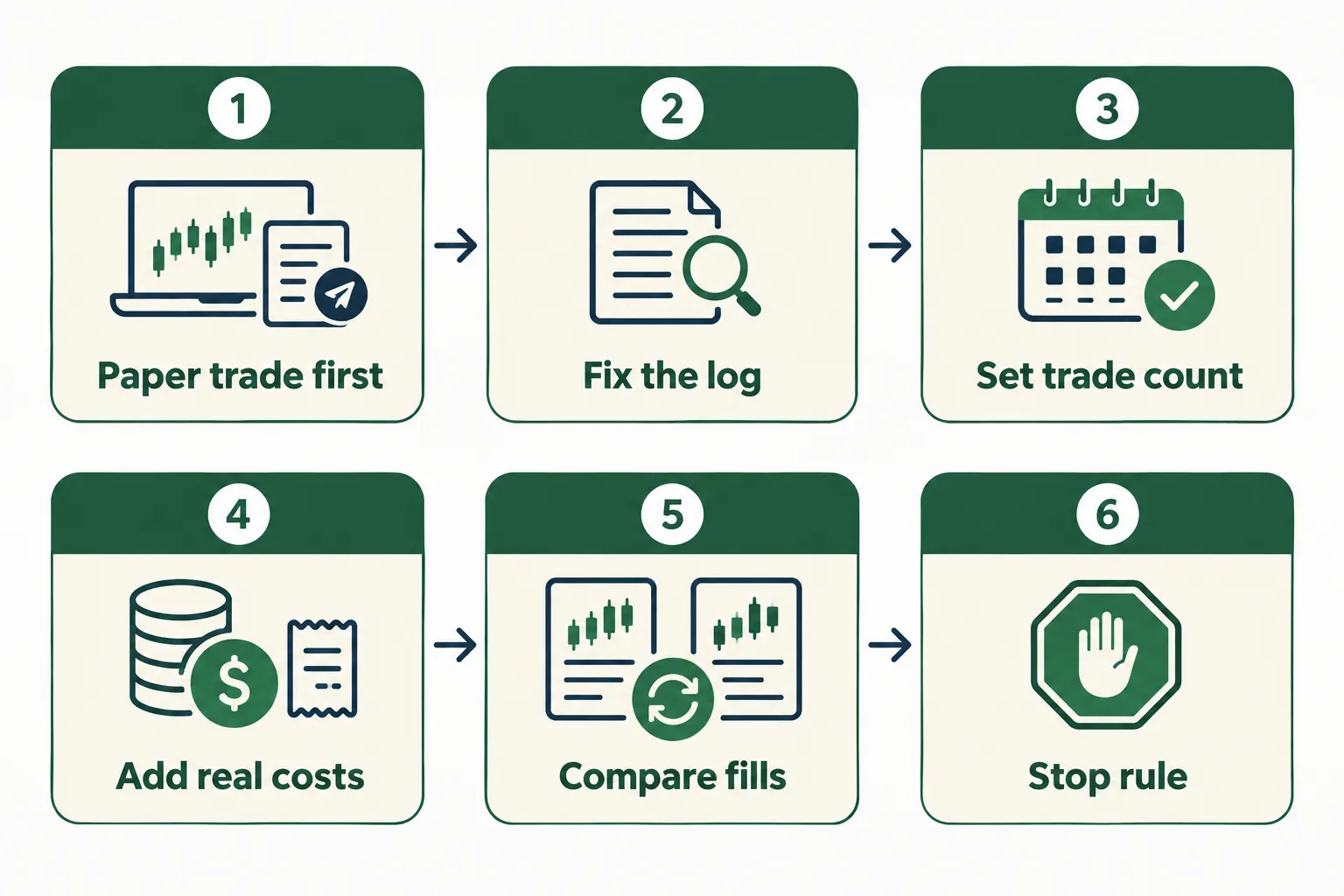
Test in paper first, against a fixed trade count you commit to in advance, with real costs subtracted, and a pre-written rule for when you shut it off. Changing the plan halfway through is how a test becomes a story.
The sequence that works:
- Write the strategy down before you code it. Entry condition, stop, target, size, max trades per day, time filters. If you can’t write it in ten lines, it isn’t a rule, it’s a feeling.
- Backtest on out-of-sample data. Develop on one period, validate on a period you never looked at. Resist the urge to go back and adjust after a disappointing validation. That’s how overfitting happens.
- Include costs in the backtest, aggressively. Commission, exchange fees, full spread crossing, and a slippage assumption at the pessimistic end.
- Paper trade live for a pre-committed number of trades. Pick the number first, 50 or 100, and don’t stop early because the first ten went well. Broker paper APIs let you run the exact same code against simulated fills.
- Log everything in a fixed format. Timestamp, symbol, signal price, fill price, slippage, exit reason, R-multiple. The slippage column is the most important number in the file, because it’s the gap between your backtest fantasy and reality.
- Compare paper fills to backtest fills. If paper is already worse than simulated, live will be worse still. Paper fills are often optimistic.
- Define your stop rule in writing. “If max drawdown exceeds X or the live expectancy is below half the backtest after 50 trades, I turn it off and go back to development.” Written in advance, no negotiation.
- Go live tiny. Minimum viable size for another 50 trades. Live fills are the only honest data you’ll ever get.
A good first strategy to test is the opening range breakout, because it’s simple, fully mechanical, and brutally exposed to exactly the slippage problem you need to measure. Our ORB strategy walkthrough lays out the rules you’d automate.
Biggest mistakes people make with trading bots, in order of frequency: no kill switch, stops held in software instead of at the broker, parameters tuned until the curve looked nice, costs excluded from the backtest, no reconnect logic, running real money before a single paper trade, and overriding the bot after a losing streak, which means you don’t have a system, you have a very expensive suggestion engine.
Do You Need to Know Coding to Use a Day Trading Bot?
No. Plenty of no-code platforms let you build automated rules through a visual interface. But if you can’t read what your bot is doing at some level, you’re trusting a vendor’s execution logic with your money and no way to audit it.
Three tiers, honestly described:
- No code. Rule builders and strategy wizards. Fast to start. You’re bound by what the platform supports, and you inherit its behavior during edge cases like rejections and halts. Read the documentation on error handling before funding.
- Light code. Platform-specific scripting such as Pine Script on TradingView or MQL for MetaTrader. Enough control for most retail strategies without full engineering. This is the sweet spot for the majority of traders.
- Full code. Python against a broker API. Total control, total responsibility. You handle reconnects, rate limits, state reconciliation, and logging yourself.
Which brokers actually allow day trading bots? Several US brokers publish documented trading APIs intended for automated use, and others explicitly prohibit it in their terms. The answer changes, so verify it directly: look up your broker’s API documentation and its customer agreement, and check whether automated order entry is permitted, whether API keys require separate approval, and what the rate limits are. Check the official page. FINRA’s 2026 oversight report puts third-party risk and supervision of AI tools squarely on broker-dealers, which means brokers are paying closer attention to what connects to their systems, not less.
Common mistake: assuming a broker that offers an API endorses automated trading. Some offer APIs for data and portfolio access while restricting automated execution. Read the agreement, not the marketing page.
Frequently Asked Questions
Does a trading bot work?
A trading bot works as an execution tool. It reliably does what you told it to do, every time, without hesitation or emotion. Whether it makes money depends entirely on whether the rules you gave it have an edge after costs. The bot adds consistency, not profitability. A losing strategy automated is just a losing strategy that loses faster.
Can AI do my day trading?
AI can automate the mechanical parts, including scanning, order entry, stops, and sizing. It cannot reliably judge whether today’s tape is worth trading or what a headline actually means for price. FINRA’s January 2026 note on AI agents describes trade execution agents operating with varying levels of human oversight, and the oversight part is doing a lot of work in that sentence.
Is ChatGPT good for trading?
A general language model is useful for writing and debugging strategy code, explaining concepts, and summarizing filings. It’s unreliable as a signal source. It doesn’t have real-time market data by default, it can produce confident wrong answers, and it has no model of liquidity or positioning. Use it as a coding assistant, not a trade picker.
Which AI trading bot is the best?
There isn’t one, and the question should be which bot fits your market, your coding ability, and your account size. The filter that matters: does it publish its method and name what it can’t do, or does it say “proprietary AI” and stop talking? Transparency is the single best predictor of whether a tool is real.
How do you make algo trading software?
Write the strategy as explicit rules first, then pick an environment: Pine Script for charting-platform automation, MQL for MetaTrader, or Python against a documented broker API. Build the risk layer before the signal layer, place protective orders natively at the broker, add a daily loss kill switch, and test on paper for a pre-set number of trades before funding it.
Can a day trading bot run while I’m asleep?
For US equities, no, because the session is closed and after-hours liquidity is thin. For futures or a global strategy, yes, but only if your infrastructure is genuinely reliable and your protective orders live at the broker rather than in your script. A bot running unattended without native stops is an unmanaged position.
Our Take
Automate the checklist and the exits first. Not the decision to trade.
That’s the whole position. The part of day trading that machines do well is the part you’re worst at: sizing correctly every single time, honoring the stop when it hurts, closing at the bell, logging the trade, and refusing the eleventh entry after ten losers. The part machines do badly is deciding whether the setup in front of you is real. Most people automate that backwards, then blame the tool.
Build the risk layer. Place your stops at the broker. Write the kill switch. Paper trade a fixed count with costs included. Then, and only then, think about whether a model should pick the entries.
Got a day trading bot you’ve actually run with real money and real logs? We want to see it. Submit it for testing here and we’ll put it through the same five pillars everything else on the site goes through.
Stay alpha.
The FullStack Alpha research desk tests AI trading bots on paper and live accounts. Reviewed and edited by Jay Rocco, Founder and Editor.
