

The FullStack Alpha research desk tests AI trading bots on paper and live accounts. Reviewed and edited by Jay Rocco, Founder and Editor.
By FullStack Alpha Editorial Team | Reviewed by Jay Rocco, Chief Editor
Run claude vs chatgpt for trading on the same five tasks and the split tends to fall along product design, not magic: Claude from Anthropic is built around long documents, code discipline and connected institutional data feeds, while ChatGPT from OpenAI ships a wider toolset including charts, calculators, audio transcription and a personal-finance connector that went to Free and Go users in the US on October 2, 2026. For reading a messy chart screenshot or building an interactive scenario model, open ChatGPT. For grinding through a 10-K, writing backtest code that actually runs, or auditing your risk rules, open Claude. Neither should place a live order, and neither predicts price. Score them yourself with the same prompt, same data, fresh chat, written rubric.
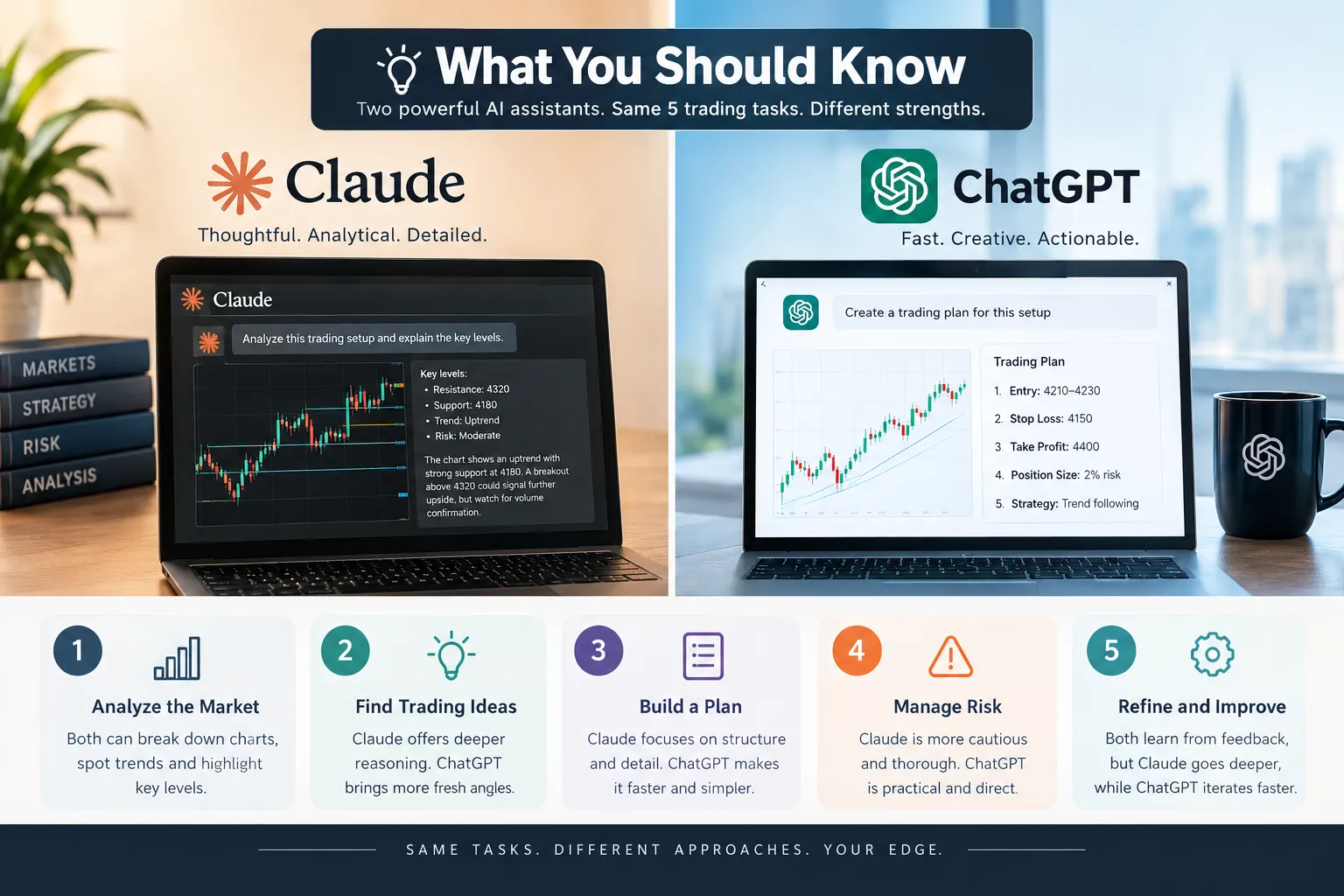
What You Should Know
- OpenAI states plainly that ChatGPT cannot place trades, move money, pay bills, file taxes, or act as an investment adviser. That’s from OpenAI’s own release notes covering the personal-finance feature expansion on October 2, 2026.
- GPT-6 and Intelligent UI launched October 7, 2026, adding charts, calculators and interactive elements inside responses. Rolled to Plus, Pro, Business and Enterprise first.
- Anthropic’s Claude for Financial Services lists integrations with FactSet, Morningstar, PitchBook, S&P Global, Daloopa, Snowflake, Databricks, Box and Palantir, with links back to source material for verification.
- Barclays expanded its Anthropic collaboration on October 1, 2026. In Global Markets, Claude reportedly helps classify, enrich and route roughly 120,000 incoming emails per day. Email routing. Not trade generation.
- Jump Trading’s Lucas Baker, Head of LLM R&D, said on October 6, 2026 that GPT-6 Astra expanded the scale of quant-research workflows they can hand to agents, while stressing the work stays probabilistic and human-reviewed.
Key Takeaways
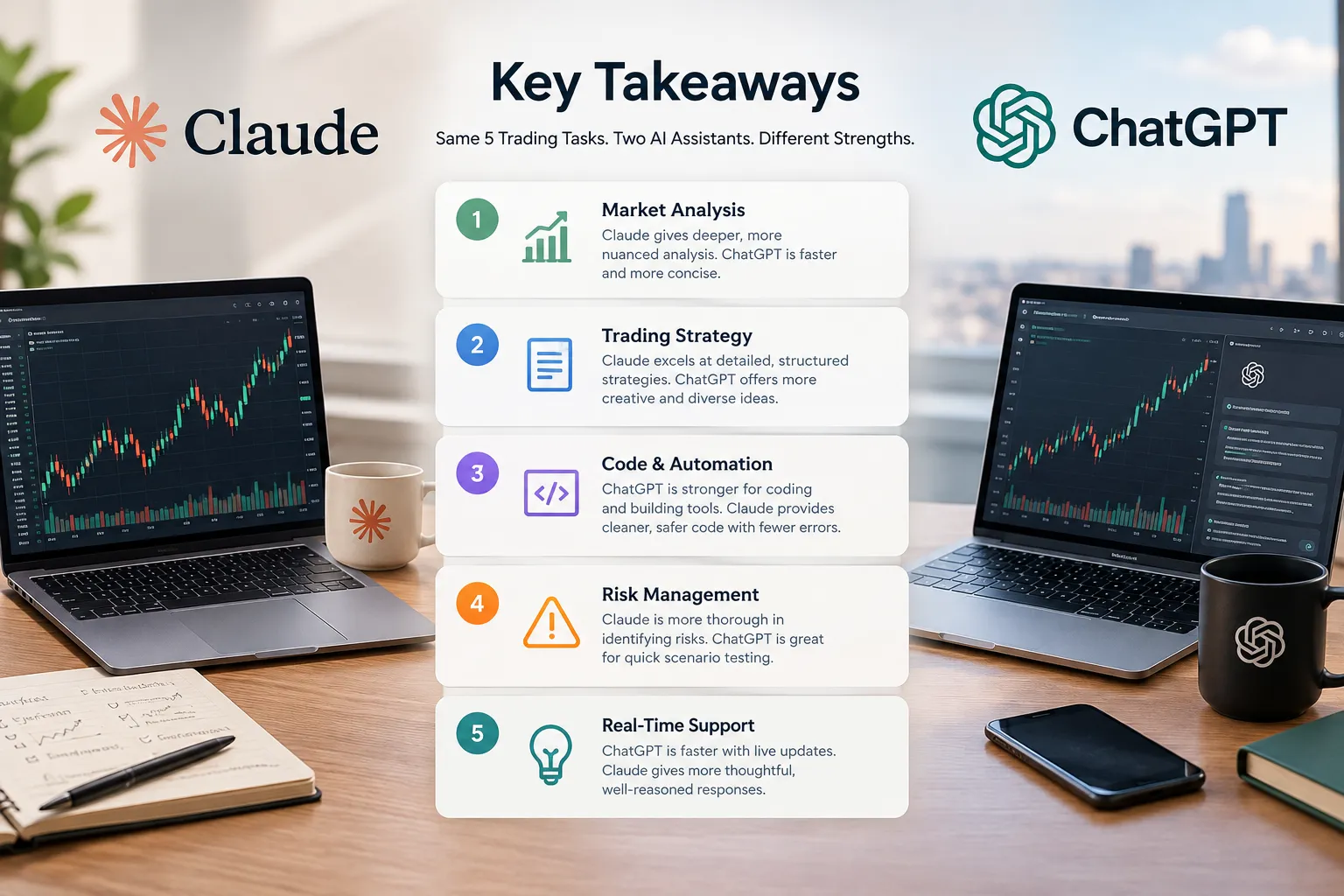
- The claude vs chatgpt for trading question has no single winner. It has five task-level winners, and you should test all five yourself.
- Neither model has native, guaranteed real-time market data in a consumer chat window. Both can be stale. Verify every price against your broker or TradingView.
- ChatGPT’s October 2026 updates (GPT-6, Intelligent UI, audio uploads, personal-finance connector) make it the broader generalist workbench.
- Claude’s finance play is enterprise plumbing: connected institutional data, source-linked answers, long-context document work.
- No one has published an audited study showing either chatbot generates profitable trades. Vendor case studies measure workflow speed, not returns.
- The riskiest setup is an AI connected to live order flow with no human approval step. That’s where accounts die.
- Score fairly: same prompt, same data, fresh chat every time, and a written rubric you wrote before you saw any output.
- Check pricing on the official Anthropic and OpenAI pages before you subscribe. Plans move fast and screenshots go stale.
Claude vs ChatGPT for Trading, Which Should You Use?
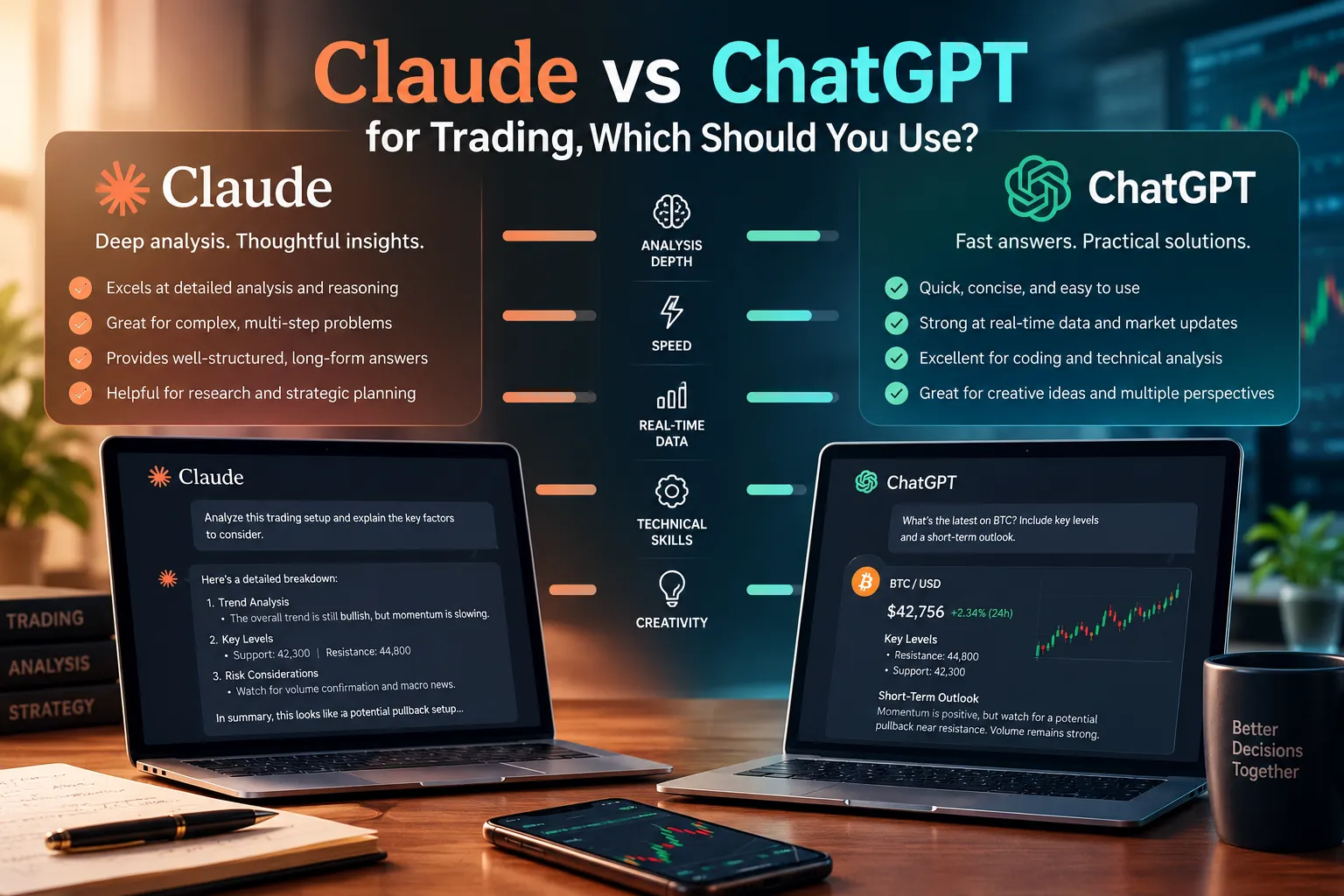
Pick by task, not by brand loyalty. The honest answer to claude vs chatgpt for trading in 2026 is that these two products have drifted apart in design, and the drift tells you where each one fits.
ChatGPT has gone wide. GPT-6 arrived October 7, 2026 with what OpenAI calls Intelligent UI, which lets a single response combine text, visuals, calculators, charts and interactive elements. GPT-6 Pro got an October 2026 update adding faster responses, better tool use and parallel agents that work on different parts of a task at once. Audio uploads landed October 6, 2026, so paid users can transcribe and summarize recordings. For a retail trader, that stack reads like: upload an earnings call recording, get a summary, build a scenario calculator in the same thread.
Claude has gone deep and institutional. Anthropic’s Financial Analysis Solution, broadened in October 2026, is designed to pull market feeds together with enterprise data from Databricks and Snowflake, and it links back to source material so a human can verify a claim. The integration list reads like a sell-side desk’s software budget: FactSet, Morningstar, PitchBook, S&P Global, Daloopa, Palantir. Barclays expanded its Claude deployment on October 1, 2026, including roughly 120,000 emails per day classified and routed in Global Markets.
That last number matters for a reason most people get backwards. Barclays isn’t using Claude to pick trades. It’s using Claude to handle the administrative sludge around trades. Bridgewater’s Aaron Linsky, CTO of AIA Labs, described Claude in Anthropic’s own materials as helping generate Python code, build visualizations and iterate through complex financial analysis. Useful. Also a testimonial from a partner, not an audited result.
So the position, by task:
- Chart screenshot read: ChatGPT, because the multimodal and interactive-output stack is wider right now.
- Backtest or indicator code: Claude. Code output tends to be cleaner and the long-context window handles a full strategy spec without dropping requirements.
- Risk and position-size audit: Claude, with a hard rule you supply. Neither model should invent a sizing rule.
- News and filing summary: Claude when you paste the source document, ChatGPT when you need the search-and-synthesize path plus audio.
- Order script: Neither, unsupervised. Both, in paper mode, with a human pressing the button.
Common mistake: picking one subscription and forcing every task through it. The two cost roughly the same as one mid-tier screener. Running both for 30 days on real tasks beats reading another forum thread about claude vs chatgpt for trading.
What Are the 5 Tasks and How Do You Score Them Fairly?
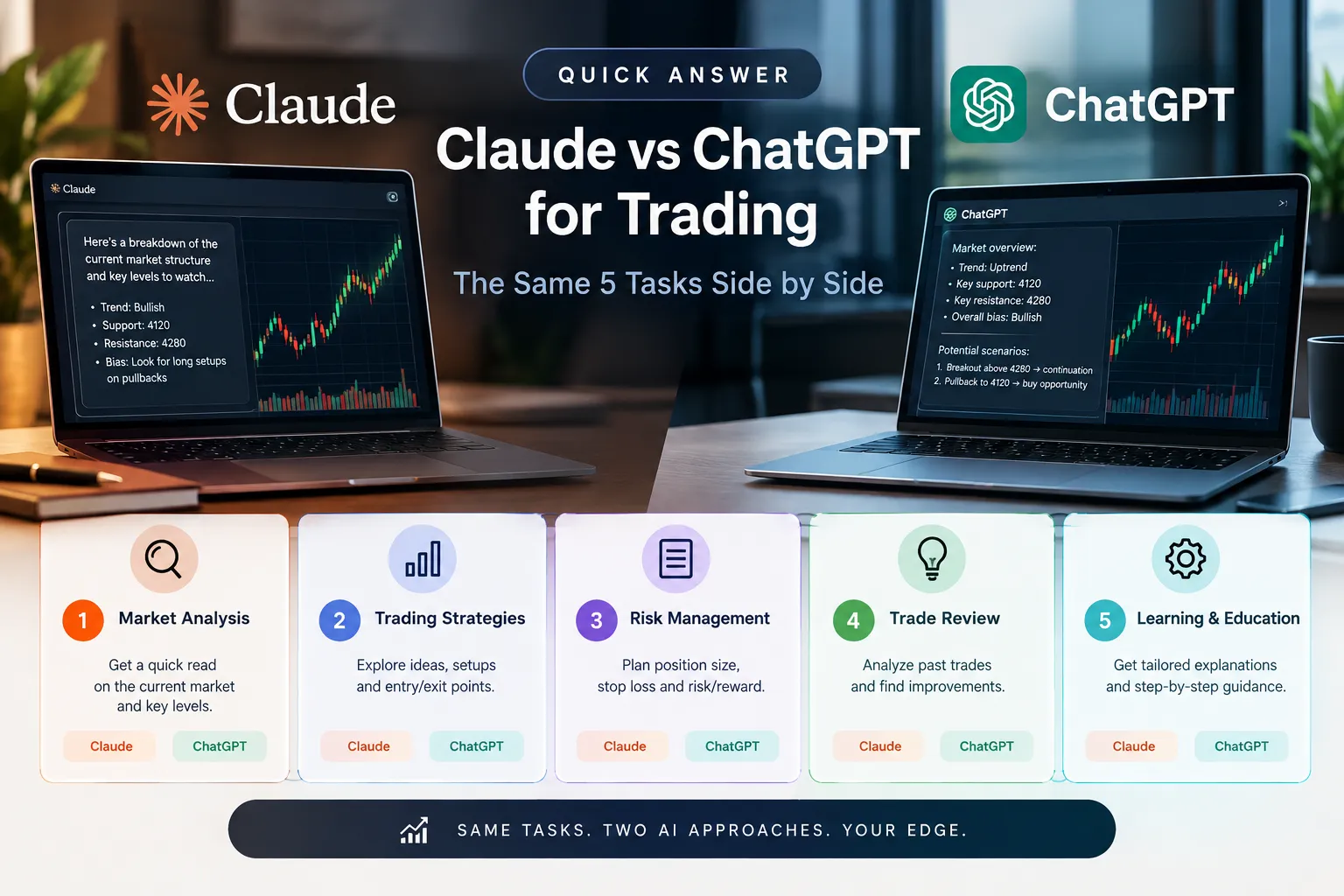
Use five tasks that map to real trading work, run each one identically on both models, and score against a rubric you wrote before you saw a single output. This is a method for you to run. FullStack Alpha has not run these tasks and is not reporting measured results here.
Why a rubric first? Because without one, you score on vibes, and both models write confident prose. Confidence is not accuracy.
The five tasks
1. Chart read. Upload the same clean chart screenshot of one ticker, same timeframe, no annotations. Ask for support and resistance (the price levels where buying or selling has repeatedly shown up), the trend direction, and whether the stock is basing (trading sideways in a tight range before a move) or overextended (stretched far from its average price).
2. Backtest code. Give a written strategy spec in plain English. Ask for Python that pulls data, applies the rules, and outputs win rate, average win, average loss and max drawdown. Specify the library.
3. Risk check. Give account size, entry price, stop-loss level and your fixed risk-per-trade rule. Ask for share count and total dollar risk. This task is arithmetic with a rule you supplied, so there is exactly one right answer.
4. News summary. Paste the same earnings release or 8-K into both. Ask for the five facts that could move price, each with the line it came from.
5. Order script. Ask for a broker-API script that places a bracket order (entry plus stop plus target) in paper-trading mode only, with a human confirmation step before submission.
The scoring rubric
Score each task 0 to 5 on four things, so 20 points per task:
| Criterion | What earns a 5 | What earns a 0 |
|---|---|---|
| Accuracy | Every factual claim checks out against the source | Invented a price, level or filing detail |
| Followed the spec | Did exactly what was asked, nothing extra | Ignored a constraint or swapped the library |
| Showed its work | Named the source line or the formula | ”Based on technical analysis” with no detail |
| Usable as-is | Code runs, numbers are actionable | Needs a full rewrite |
Rules that keep the test fair
- Fresh chat every single time. Memory and prior context contaminate results. This is the number one reason home tests are garbage.
- Identical prompt text, pasted, not retyped. One extra adjective changes output.
- Identical data. Same screenshot file, same pasted document, same numbers.
- Run each task three times per model. A single run tells you about variance, not quality.
- Verify before scoring. Check prices against your broker. Run the code. Do the risk math on paper.
Edge case worth planning for: one model refuses a task on compliance grounds. That’s a real result, not a failed test. Note it and move on. Refusing to generate a live-order script without a confirmation step is the correct behavior.
If you want a parallel method for the chart-read task specifically, our walkthrough on AI chart analysis covers what a good read looks like before you grade one.
How Do Claude and ChatGPT Compare Task by Task?
Here’s the structure for a chatgpt vs claude stock analysis comparison, written as criteria rather than invented scores. Fill the last column in yourself.
| Task | What a good answer includes | Common failure | How to check it |
|---|---|---|---|
| Chart read | Named price levels with a reason, trend direction, clear statement of what would invalidate the read | Confident levels that don’t exist on the chart; describing a pattern that isn’t there | Open the chart. Does the quoted level line up with an actual swing high or low? |
| Backtest code | Runs without edits, names the data source, outputs win rate, average win/loss and max drawdown, handles missing data | Silent look-ahead bias (using data the strategy wouldn’t have had at the time); hallucinated library functions | Run it. Then check one trade by hand against the chart. |
| Risk check | Share count, total dollar risk, stop distance, and the arithmetic shown | Inventing a sizing rule you never gave; rounding that quietly doubles risk | Recalculate on paper. It’s one division. |
| News summary | Five facts, each tied to a specific line in the document you pasted | Pulling a number from training data instead of your document; smoothing a bad quarter into neutral language | Ctrl+F every number in the source. |
| Order script | Paper endpoint, explicit human confirmation, error handling, no hardcoded credentials | Live endpoint by default; no stop attached to the entry | Read every line before running. If you can’t read it, don’t run it. |
Where the design difference shows up
Long documents. Claude’s long-context handling is the thing finance users cite most. A 200-page filing in one pass, with Anthropic’s Financial Analysis Solution linking back to source material for verification, is a different workflow from chunking a document across ten prompts.
Interactive output. GPT-6’s Intelligent UI can return a working calculator or chart inside the answer. For scenario work (“what if my stop is 4% instead of 2% across 40 trades”), that’s genuinely faster than reading a paragraph of arithmetic.
Parallel work. GPT-6 Pro’s October 2026 update added parallel agents handling different parts of a task. In theory: one agent on the filing, one on news, one on valuation assumptions, one on risk factors. In practice, you still have to verify all four outputs, so the time saved is smaller than the marketing implies.
Audio. ChatGPT’s October 6, 2026 audio upload feature transcribes and summarizes recordings. Earnings calls, your own trade debriefs. OpenAI warns transcripts contain errors, which matters when a transcription mangles a guidance number.
Decision rule: if the task starts with a document, open Claude. If the task starts with an image or needs a calculator, open ChatGPT. If the task starts with “what will this stock do,” close both and go look at the price action.
For a wider field than two chatbots, our roundup of the best AI trading tools of 2026 put head to head covers purpose-built tools rather than general-purpose models.
What Did the Creator Tests Find?
Several YouTube creators have run informal claude vs chatgpt for trading comparisons. Treat every result as a claim, not a verified finding. None of these are controlled studies, none publish full prompts and data, and none have been independently replicated.
What to watch for when you review any creator test, including ones from channels like Michael Automates and Gas Fee TV:
| What to check | Why it matters |
|---|---|
| Was the prompt shown in full on screen? | A prompt you can’t read is a result you can’t reproduce. |
| Was each model given a fresh chat? | Carried-over context inflates one side. |
| Was the same data given to both? | Different screenshots or date ranges invalidate the comparison. |
| How many runs per task? | One run per model is anecdote. |
| Was the output verified against a source? | ”It sounded right” is not scoring. |
| Was the creator paid or affiliated? | Disclosure changes how you weight the verdict. |
What creator tests almost always skip: forward testing. A model that explains yesterday’s move beautifully has told you nothing about tomorrow. Backward-looking narration is the easiest thing a language model does, and it is close to worthless for trading.
What they also skip: cost of being wrong. A test that counts “correct calls” without tracking what a wrong call would have cost in dollars is scoring a trivia game, not a trading process. Risk-reward is the whole point. A tool that’s right 60% of the time and wrong catastrophically 40% of the time will clean out your account.
If a video shows a model producing a sequence of winning calls, ask one question: over how many trades, and what was the max drawdown? If the answer isn’t on screen, it wasn’t measured.
The same skepticism applies to tools built on top of these models. Plenty of products are a public language model with a dashboard bolted on and a subscription button. Our breakdown of which AI trading bots are legit vs scams covers how to tell the difference before you pay.
One more thing creator tests rarely mention: the model’s answers change between runs. Ask the same chart question three times and you may get three different support levels. That’s not a bug you can prompt your way out of. It’s how these systems work. Play stupid games with a single-run test and you’ll win a stupid conclusion.
How Do Pricing, Limits and Broker Connectors Differ?
Check the official pages before you subscribe. Anthropic and OpenAI both changed plans and limits multiple times during 2026, and any price written in an article is stale within weeks.
| What to check | Where to check it | Note |
|---|---|---|
| Claude plan tiers and price | Anthropic’s official pricing page | Check the official page |
| ChatGPT plan tiers and price | OpenAI’s official pricing page | Check the official page |
| Usage limits per plan | Both official pricing pages | Message caps and model access vary by tier and change often |
| Which models each tier includes | Official pages | GPT-6 rolled to Plus, Pro, Business and Enterprise from October 7, 2026 before wider release |
| Broker connector availability | The broker’s own announcement page | Connector support is broker-side, not model-side |
| Date checked | Your own notes | Write it down. Prices move. |
What is confirmed about access as of the October 2026 updates:
- ChatGPT’s personal-finance feature expanded to Free and Go users in the US on October 2, 2026. It can connect financial accounts and help you understand spending, investments and financial plans. OpenAI states it cannot place trades, move money, pay bills, file taxes or act as an investment adviser.
- GPT-6 and Intelligent UI began rolling out October 7, 2026, starting with Plus, Pro, Business and Enterprise.
- Audio uploads became available to paid users and workspaces on October 6, 2026.
- Anthropic’s Financial Analysis Solution is an enterprise offering built around connected data platforms, not a consumer chat tier.
On broker connectors and MCP
MCP (Model Context Protocol) is an open standard for letting an AI model talk to external tools and data sources. It’s the plumbing that would let a chat window read your watchlist or place a paper order. Availability depends entirely on whether a specific broker has shipped and published a connector.
Rule: if the broker hasn’t announced it on its own site, it doesn’t exist. Third-party “connectors” that ask for your broker login credentials are a security problem wearing a product costume. A legitimate integration uses API keys with scoped permissions you control and can revoke.
Our guides on eToro MCP connectors for Claude, ChatGPT and Grok and the IBKR connector with AI saved screeners cover what’s actually shipped versus what’s marketing.
Does Claude have access to real-time market data?
Not inherently in a consumer chat window. Anthropic’s enterprise financial product is designed to combine market feeds with enterprise data from platforms like Databricks and Snowflake, with source links for verification. A standard Claude subscription is not that product.
Same caveat for ChatGPT. Browsing and connected accounts can surface current information, but there is a gap between “can retrieve a quote” and “has a live, low-latency market data feed.” Assume every price either model gives you is stale until your broker confirms it. Our TradingView platform review covers where a real data feed starts and a chat answer stops. A quote that’s four minutes old during power hour is a history lesson, not a trade.
Where Does Gemini Fit for Stock Trading?
Gemini is Google’s model family, and gemini stock trading sits in the same category as the other two: a general-purpose assistant that can read, summarize and code, not a market data terminal or an execution system.
What’s defensible to say without inventing capability claims:
- Gemini is a general-purpose large language model, not a trading platform.
- Like Claude and ChatGPT, it does not have a guaranteed live market data feed in a consumer chat interface.
- Its practical trading uses are the same three: summarizing documents, writing code, and structuring your own thinking.
- For current pricing, model tiers and any finance-specific integrations, check Google’s official product pages. Anything else is guesswork.
The same scoring method in this article works on three models as easily as two. Add a third column to your rubric and run the same five tasks. If Gemini wins a task outright in your own testing, use it for that task.
What doesn’t change with a third model: none of them predict price. Adding a model to the rotation adds a second opinion, not an edge. Three confident wrong answers are worse than one, because the agreement feels like confirmation.
What Should Neither Model Do for You?
Four hard lines. Cross them and the tool stops being a research assistant and starts being a liability.
1. Place unsupervised orders. OpenAI says outright that ChatGPT cannot place trades or move money. Where people get into trouble is bolting a model onto a broker API themselves and letting it run. Example: a script that reads a model’s output and submits a market order when it sees the word “buy.” The model hallucinates once at 9:31am, the script fires, and you own 400 shares of something you never evaluated. Jump Trading, a firm with resources you don’t have, explicitly treats AI-generated signals as potentially wrong inputs into a broader execution and risk-control system with human review of critical outputs. If they won’t let it run unsupervised, you shouldn’t either.
2. Supply prices or levels. Example: you ask for the 50-day moving average on a ticker and get a number that sounds plausible and is wrong by 3%. You size a position off it, your stop sits in the wrong place, and you get stopped out on noise. Pull every price from your broker or charting platform. The model is for interpretation, never for quotes.
3. Decide position size without a rule you wrote. Example: “how many shares should I buy?” with no risk parameter returns a number pulled from nowhere. The correct prompt gives the model your account size, your fixed risk percentage, your entry and your stop, and asks it to do the division. One right answer, checkable in your head. If the model is choosing your risk, you don’t have a risk management process, you have a slot machine with better grammar.
4. Hide costs. Example: a model writes a backtest that ignores commissions, slippage (the gap between your expected fill price and your actual fill) and the bid-ask spread. The strategy shows a 58% win rate in the script and loses money live. Always ask for cost assumptions to be stated explicitly, then check they’re realistic for your broker and the stocks you trade.
There’s a fifth line that’s less about the models and more about the market around them: products claiming to be an official Claude or ChatGPT trading bot, usually with a screenshot of returns and a Telegram link. Neither Anthropic nor OpenAI sells an autonomous retail trading bot. Our write-up on the fake Claude trading bot scam covers the pattern. Anything promising a risk free return is lying, and that’s not a judgment call, it’s arithmetic.
How often do these tools get trading predictions wrong?
Often enough that no one publishes a reliable number, and that silence is the answer. There is no audited, independently verified accuracy rate for consumer chatbot price predictions. Vendor case studies measure different things entirely: Anthropic reports an early AIG underwriting deployment compressed review time by more than 5× and improved data accuracy from 75% to over 90%. That’s underwriting workflow, self-reported by Anthropic, and it says nothing about trading.
Jump Trading’s framing is the useful one. Baker noted that in quant trading, a prediction slightly better than a coin flip can be valuable at scale. At scale, across thousands of trades, with institutional risk controls. That is not the same as asking a chatbot what AAPL does tomorrow and acting on it. You don’t have scale. You have 12 trades a month and a $6,000 account.
Should you rely only on Claude or ChatGPT for trading decisions?
No. Use either as one input into a written process you’d follow whether the model existed or not. If your entry rules, stop placement and position sizing live in a document you wrote, a model’s opinion is a second read. If they don’t, the model becomes your plan by default, and a plan you can’t state in one sentence isn’t a plan.
A reasonable stack: a stock screener for swing trading to surface candidates, a charting tool to verify the setup, and a model to pressure-test your thesis and catch what you missed.
Can you actually make money using Claude or ChatGPT for trading?
There’s no published evidence that either chatbot generates profitable trades on its own, and both companies avoid that claim. What’s documented is time saved on research tasks. Whether that converts into better results depends entirely on whether you had a profitable process to speed up in the first place. Faster research on top of no system just gets you to the wrong trade sooner.
Which handles volatile markets and fast trades better?
Neither, and the reason is structural rather than a quality gap. Chat-based models have response latency measured in seconds and no guaranteed live data feed. On a fast-moving day, a quote can be meaningfully stale before the answer finishes rendering.
For intraday work, the model’s job is before the open and after the close: building the watchlist, defining levels, writing the plan, reviewing what went wrong. During the session, you need execution tools and alerts, not a conversation. Our day trading tools breakdown covers what belongs in that seat.
Is Claude better for crypto trading than ChatGPT?
No confirmed capability difference supports that claim for crypto specifically. Both models face identical limitations: no guaranteed real-time feed, no execution, no verified predictive accuracy. Crypto’s 24/7 trading and thinner liquidity on smaller tokens make the stale-data problem worse, not better. FullStack Alpha doesn’t cover crypto, and the honest general answer is that the asset class doesn’t change the tool’s limits.
Which Is the Best AI for Stock Trading by Use Case?
A clear pick per task, based on confirmed product capability rather than claimed performance. Choosing the best ai for stock trading means choosing per job, not per brand.
| Use case | Pick | Why |
|---|---|---|
| Reading a chart screenshot | ChatGPT | GPT-6 multimodal plus Intelligent UI interactive output, rolled out October 7, 2026 |
| Writing or debugging backtest code | Claude | Long-context handling of a full strategy spec; Bridgewater’s AIA Labs CTO cited Python generation and iteration |
| Digesting a 10-K or 8-K | Claude | Long documents in one pass; Anthropic’s finance product links back to source material |
| Scenario math and what-if models | ChatGPT | Calculators and charts rendered inside the response |
| Earnings call audio | ChatGPT | Audio upload and transcription added October 6, 2026 for paid users |
| Auditing your risk rules | Claude | Follows an explicit spec tightly, with the rule you supply |
| Picking tomorrow’s winner | Neither | No model has verified predictive accuracy on individual price moves |
Honest framing on the best ai for trading question: the model is the cheapest part of the stack and the least differentiating. Your edge comes from your rules, your watchlist discipline, and your willingness to cut losers fast. A sharper model accelerates a good process and accelerates a bad one just as efficiently.
For the broader field, including purpose-built scanners and screeners rather than general chatbots, see our ranked best AI trading platforms for 2026 and the best AI for trading breakdown.
Frequently Asked Questions
Can ChatGPT do stock trading?
No. OpenAI states in its October 2, 2026 release notes that ChatGPT cannot place trades, move money, pay bills, file taxes or act as an investment adviser. The personal-finance feature can connect accounts and help you understand spending and investments, but execution stays with your broker and the decision stays with you.
Which is the best AI to use for trading?
It depends on the task, which is the only honest answer to claude vs chatgpt for trading. ChatGPT is stronger for chart screenshots, interactive scenario math and audio transcription. Claude is stronger for long filings, code output and following a written risk spec. Test both on your own five tasks for 30 days.
Which is better, Claude or ChatGPT?
Neither wins outright for trading work. ChatGPT has the wider toolset after the October 2026 GPT-6 and Intelligent UI release. Claude has the deeper finance plumbing, with connected institutional data and source-linked verification. Pick per job and keep both open if the budget allows.
Why are people switching from ChatGPT to Claude?
The confirmed product reasons are long-context document handling, code output quality, and Anthropic’s finance-specific integrations with FactSet, Morningstar, S&P Global and PitchBook. Enterprise deployments like Barclays, expanded October 1, 2026, add credibility. Anything beyond that, including claims about prediction accuracy, is unverified.
What can Claude do that ChatGPT can’t?
Through Anthropic’s Financial Analysis Solution, Claude can be connected to institutional data platforms including Databricks, Snowflake, FactSet and Palantir, with links back to source materials for verification. That’s an enterprise offering, not a consumer chat feature, so a standard subscription doesn’t include it.
Can I connect Claude or ChatGPT directly to my trading platform?
Only where the broker has shipped and publicly announced a connector, usually via MCP (an open standard for connecting AI models to external tools). Check the broker’s own site. Never hand your broker login to a third-party tool, and keep a human approval step on every order.
Our Take
Open Claude first when the task starts with a document or a code spec. Open ChatGPT first when it starts with an image, a calculation, or an audio file. Keep both away from your order button. That’s the whole position on claude vs chatgpt for trading, and it’ll hold until one of them ships something genuinely new, which in 2026 means roughly next month.
The thing no one selling you an AI subscription wants to say: the model isn’t the variable that decides whether you make money. Your rules are. Run the five-task test, write down which model won which task, and put that on a sticky note next to your monitor. Then go work on your stop placement.
Building or testing an AI trading tool yourself? Submit it for review.
Stay alpha.
The FullStack Alpha research desk tests AI trading bots on paper and live accounts. Reviewed and edited by Jay Rocco, Founder and Editor.
