

The FullStack Alpha research desk tests AI trading bots on paper and live accounts. Reviewed and edited by Jay Rocco, Founder and Editor.
By FullStack Alpha Editorial Team | Reviewed by Jay Rocco, Chief Editor
An ai trading strategy is a set of entry, exit and position-sizing rules that an AI model writes, searches for, or helps refine, then gets tested against historical price data. The widely shared “9,000 Claude backtests” figure comes from a creator video (AI Pathways), not an audited study, so treat every result in it as a claim rather than a finding. Running thousands of tests is exactly how false winners get manufactured: test enough rules and some will look brilliant purely by luck. Before you copy any AI-generated strategy, check one thing first, whether the winning result survived a sealed out-of-sample period with real costs applied. If that answer isn’t available, the number on the screen means nothing.
What You Should Know
- The best-documented public AI strategy benchmark right now is Strategy Arena’s October 2026 Bitcoin test: 12 models, 23 runs, 6,570 research candles, 6,576 sealed candles, 10 basis points of fees per side.
- Claude Sonnet 5 produced the single strongest main strategy in that benchmark (EMA 40/200, +239.81% sealed, 26.43% max drawdown) versus +201.82% for buy-and-hold with a 53.45% drawdown.
- Only 7 of 23 submitted strategies beat buy-and-hold after risk adjustment (return divided by max drawdown, where buy-and-hold scored 3.78).
- The “9,000” figure appears in a creator-produced transcript describing a Claude Code workflow, with no published trade ledger, strategy registry or statistical correction.
- A September 2026 academic review by Linsen Zhu and Mengqing Cai, covering research through August 31, 2026, concluded public evidence does not establish an AI architecture delivering persistent, cross-regime net alpha.
What Is an AI Trading Strategy and How Does It Actually Work?
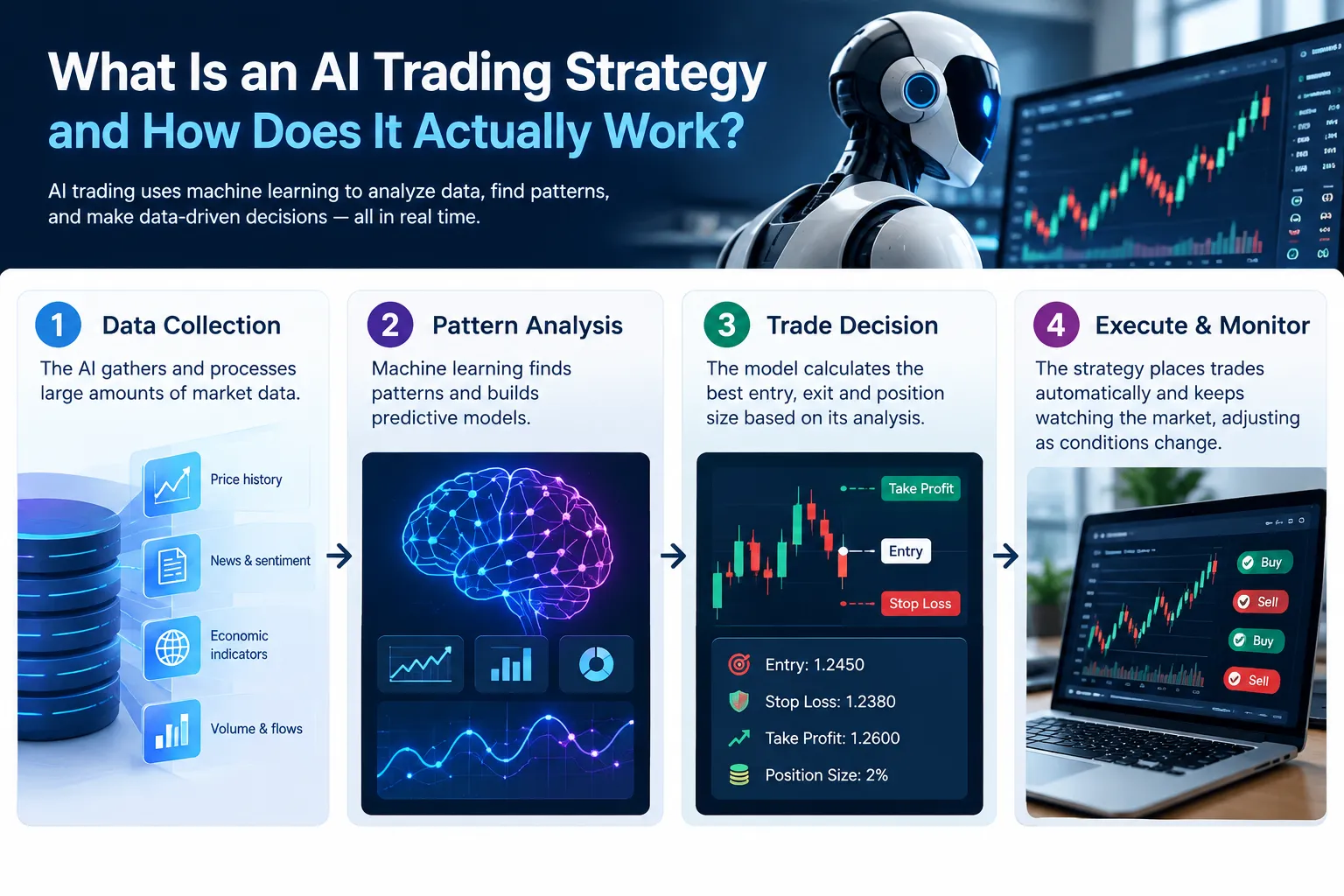
An ai trading strategy is a rule set, written or discovered by an AI model, that tells you when to buy, when to sell, how much to risk and when to stand aside. The AI part is the authorship and the search. The strategy part is still just rules.
That distinction matters more than anything else in this article.
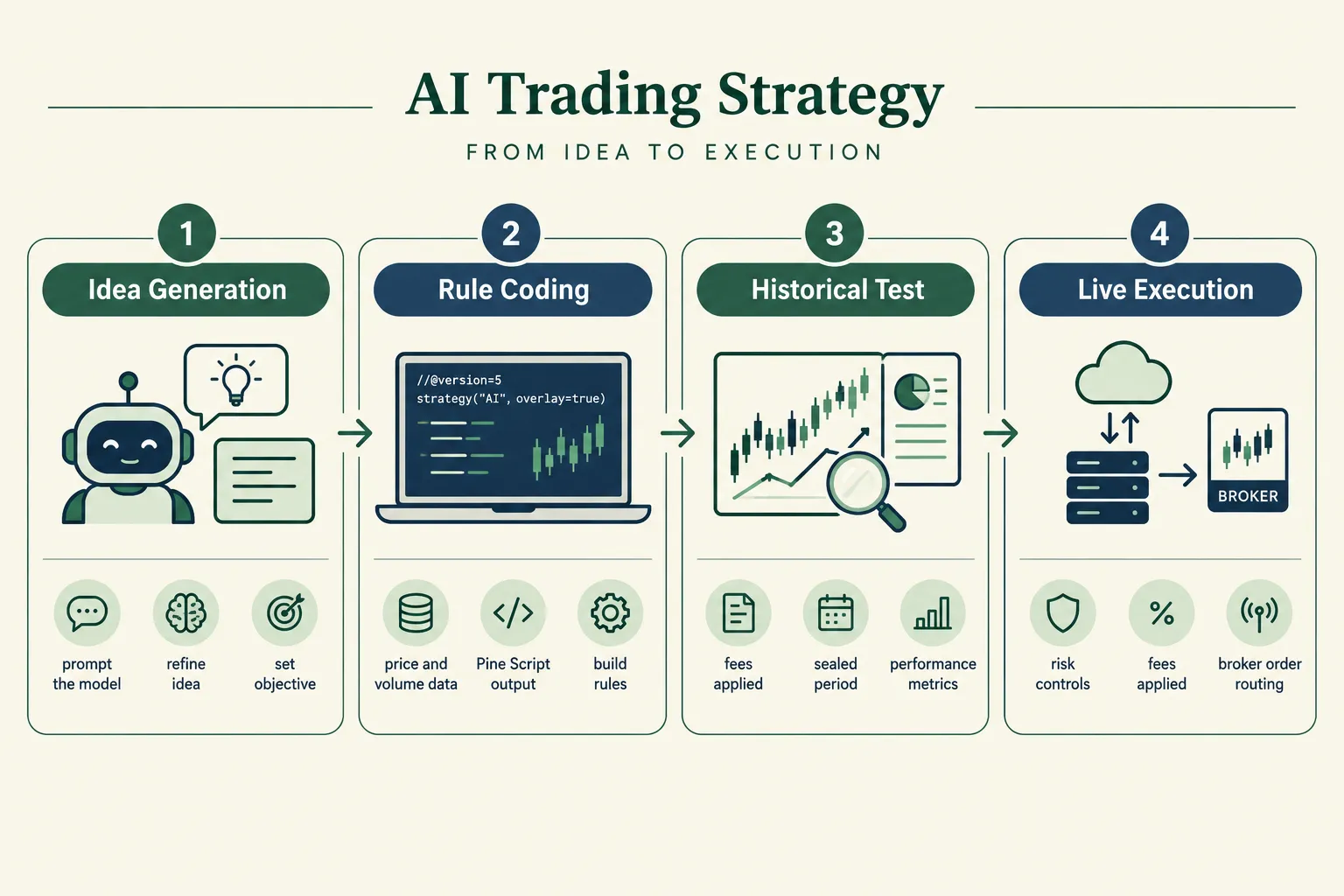
The four stages of any ai trading strategy
- Idea generation. You describe a market behavior (“momentum after a tight consolidation”) and the model proposes rules. Tight consolidation means price trading in a narrow range before a move.
- Rule coding. The model turns that into code, usually Pine Script for TradingView, or Python against a broker API.
- Backtesting. The rules run against historical data to produce an equity curve, a win rate and a maximum drawdown. Drawdown is the worst peak-to-trough loss the strategy took.
- Execution. Live orders, with slippage, fees and your own nerves attached.
Most of the hype in ai trading lives in stage one. Most of the money is lost in stages three and four.
What the AI is actually doing
It is not predicting the market. It is searching a space of rule combinations and reporting which ones scored best on data it already has. That’s pattern fitting, and pattern fitting on the past is cheap. Price action from 2015 is a known quantity. Next Tuesday isn’t.
Nasdaq’s Brandon Tepper made a related point in an October 23, 2026 interview: AI’s most immediate value for investors is better access to and interpretation of market intelligence, built on “clean, trusted, and accurate data.” Not autonomous prediction. Research infrastructure that used to sit behind a professional terminal is now reachable from a phone. That’s real. It also doesn’t mean your rule set is profitable.
Market truth: the AI writes the strategy faster than you can. It does not know whether the strategy works.
Takeaway: treat every AI output as a hypothesis in need of a test, not an answer. If you want the plumbing side of this, see the walkthrough on no-code trading strategy builders before you start writing Pine Script.
What Did the 9,000 Claude Backtests Claim?
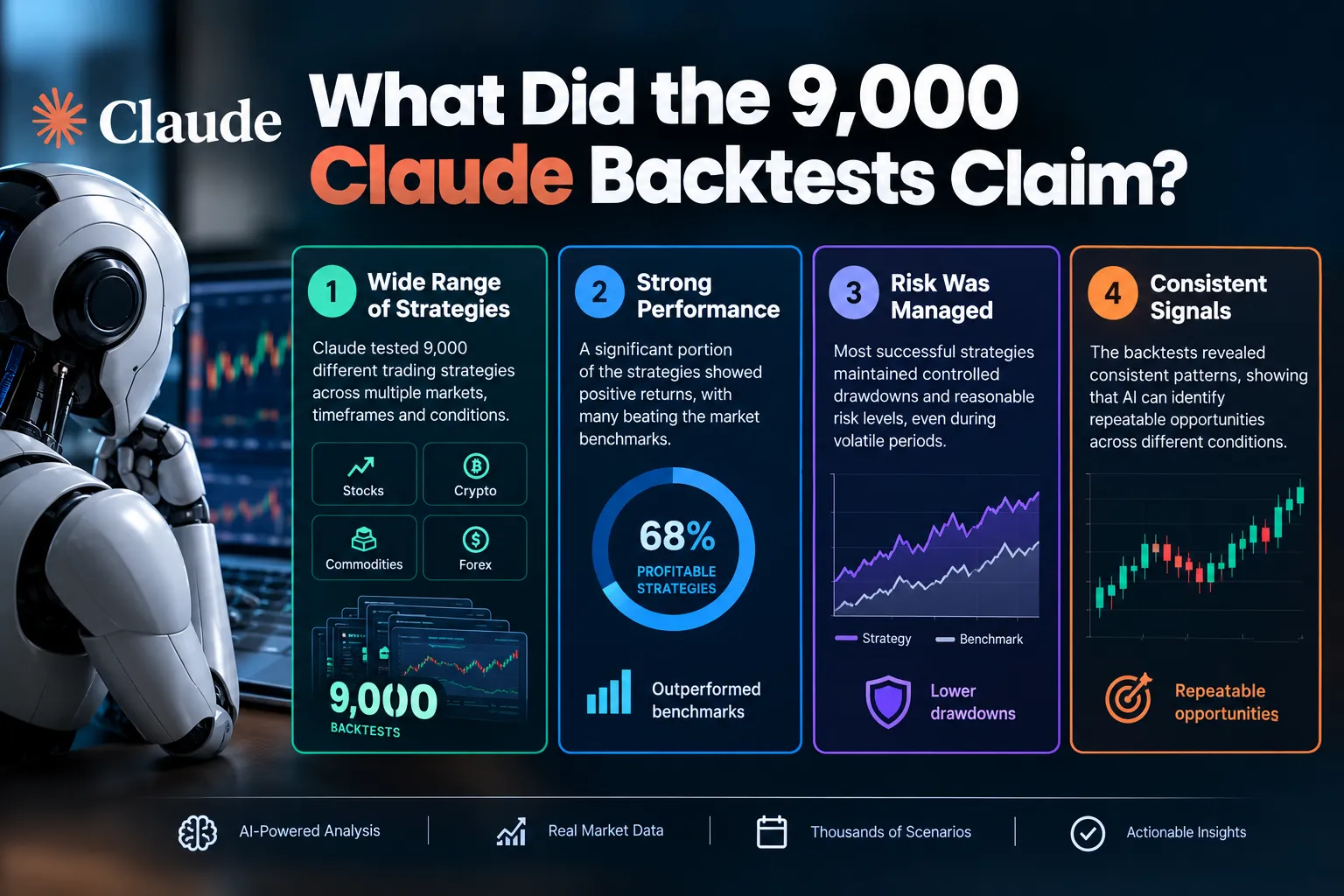
The 9,000 figure comes from a creator-produced video transcript associated with the AI Pathways channel, describing a Claude Code workflow that ran a large batch of strategy tests. It is a creator’s claim, not an audited result. No trade ledger, strategy registry, code audit or statistical correction has been published alongside it.
Here’s what the transcript describes, credited as shown.
The method, as claimed
- Development window: 2010 to 2022, used for building and tuning strategies.
- Sealed window: 2023 onward, reserved as out-of-sample data the model wasn’t supposed to look at.
- Costs included: fees, financing and dividends, which is more rigorous than most retail backtests.
- Tooling: Claude Code, Anthropic’s command-line coding agent, orchestrating the test runs.
Reserving a sealed period is the right instinct. Including financing and dividends is the right instinct. Credit where it’s due.
What was not shown
This is where the audit gets uncomfortable.
| What a verifiable claim needs | Was it published? |
|---|---|
| Full list of every strategy tested | Not provided |
| Trade-by-trade ledger for winners | Not provided |
| Multiple-comparison correction | Not described |
| Independent code review | Not performed |
| Proof all 9,000 tests executed | Not provided |
Without the first and third rows, the headline number is unusable. If you test 9,000 rule sets and show me the best one, you’ve shown me a lottery winner, not a system. The thing I need to know is how many tickets were bought and what the losers looked like.
A second “9,000” that isn’t backtests at all
Worth flagging, because the two get mashed together online. A separate creator transcript describes a product called Trading Kit as having a community of roughly 9,000 AI traders and close to 200,000 strategies backtested. Those are promotional user and volume figures. Different claim entirely. Anyone citing “9,000 Claude backtests” may actually be half-remembering a community size.
Market truth: a number with no denominator and no ledger is marketing, not evidence.
Takeaway: when a video quotes a backtest count, ask for the registry of all tests. If it doesn’t exist, downgrade the whole result to entertainment.
Why Does Testing 9,000 Strategies Create False Winners?
Because luck scales. Test enough random rules and some of them will post a beautiful equity curve purely by chance, with zero predictive power. Statisticians call this the multiple comparisons problem. Traders call it getting fooled.
The worked example (labeled example numbers, not real results)
Say you build a coin-flip strategy generator. Each strategy is pure noise, no edge whatsoever. On any single 5-year test, assume a 1-in-100 chance that noise alone produces a result that looks like a strong edge.
- Test 10 strategies: expect roughly 0.1 fake winners. You’d probably see none.
- Test 100 strategies: expect roughly 1 fake winner.
- Test 9,000 strategies: expect roughly 90 fake winners.
Ninety strategies, all garbage, all showing a “statistically significant” edge. Now imagine the creator posts the single best of those 90. The chart looks spectacular. The underlying logic is a coin.
This is the whole problem with mass-testing an ai trading strategy. More tests don’t find more edge. They find more noise that looks like edge.
Why AI makes this worse, not better
A human trader tests maybe 20 variations before they get bored. Claude Code can run hundreds in an afternoon. The search speed went up 50x. The number of markets, and the amount of genuine signal inside them, did not.
So the ratio of lucky results to real results gets worse as the tooling gets better. That wasn’t on most people’s 2026 bingo card.
How the professionals handle it
- Correct your threshold. If you ran 1,000 tests, demand far stronger evidence from the winner than you would from a single pre-registered test.
- Pre-register the hypothesis. Write down what you expect to work, and why, before you run anything. “I tested everything and this won” is not a hypothesis.
- Log every test. Including the embarrassing ones. The denominator is the information.
- Check the family, not the member. If 8,997 of your 9,000 strategies lost money, the three winners are suspects, not heroes.
This is the gap between overfitting and underfitting, and it’s worth understanding the mechanics properly in the overfitting vs underfitting breakdown.
Takeaway: before you trust a winner, divide by the number of attempts. The honest headline is never “this strategy returned X.” It’s “this strategy returned X, out of 9,000 tried.”
What Does the Strategy Arena Benchmark Actually Show About AI Trading?
Strategy Arena’s October 2026 experiment is the most useful public evidence available right now, and it’s far more modest than the 9,000-test narrative. Twelve AI models got identical Bitcoin 4-hour data, an identical tool environment, and a hard cap of 80 tool calls per run. Twenty-three runs total.
The setup
- Research period: October 1, 2020 to September 30, 2023. Models could study and search this freely.
- Sealed period: October 1, 2023 to September 30, 2026. Untouched until submission.
- Data volume: 6,570 research candles, 6,576 sealed candles.
- Costs: 10 basis points per side, applied.
A sealed period plus enforced costs plus a call budget. That’s a controlled experiment, which is exactly what the 9,000-test claim lacks.
What Claude did
Claude Sonnet 5 produced the strongest individual main strategy in the field: an EMA 40/200 crossover returning +239.81% over the sealed period with a 26.43% maximum drawdown. Bitcoin buy-and-hold over the same stretch returned +201.82% with a 53.45% drawdown. Better return, half the pain.
Then a second Sonnet run produced +108.19% with a 37.27% drawdown. Same model, same data, same rules of engagement, wildly different output.
That run-to-run spread is the finding. The benchmark doesn’t show a stable Claude capability. It shows variance.
The risk-adjusted scoreboard
Strategy Arena ranked by return divided by maximum drawdown. Buy-and-hold scored 3.78. Only 7 of 23 submitted main strategies beat it: Claude Sonnet 5 once, Gemini twice, Xiaomi twice, DeepSeek once, Muse once.
Sixteen of twenty-three lost to doing nothing, after adjusting for the drawdown you’d have to sit through.
What the models converged on
This part is almost funny. Six runs independently landed on short-versus-long moving-average crossovers, things like SMA 11/209, SMA 12/210, EMA 40/200. Eleven runs used a long-average regime filter, holding BTC while price stayed above roughly a 170 to 300 candle average.
Twelve frontier AI models, given a sealed research problem, largely rediscovered trend following. A technique documented since the 1950s. The trend is your friend, apparently, even when the researcher is a language model.
On Claude’s actual working scale: Sonnet 5 used 43 tool calls in one run and 35 in another. Claude Opus 5.5 used 27 and 32. Claude Fable 5.1 used 55 and 45. Gemini’s biggest session ran 57 backtests and seven sweeps across 71 calls. Those are dozens of tests per session, not thousands.
Takeaway: the best-documented Claude research sessions on record involve tens of backtests under supervision, and the winning strategies look like 1960s trend following. Set your expectations there, not at 9,000.
Can You Really Make Money With an AI Trading Strategy, and Is AI Better Than Human Traders?
Some AI-generated strategies have beaten buy-and-hold in controlled, sealed tests. Whether that translates to your account, after your fees and your slippage and your behavior, is a separate and much less documented question.
The September 2026 review by Linsen Zhu and Mengqing Cai, covering research through August 31, 2026 across equities, ETFs, centralized crypto, perpetual futures and on-chain markets, reached a blunt conclusion: public evidence does not establish a general AI architecture capable of persistent, cross-regime, capacity-aware net alpha. Net alpha meaning returns above a benchmark after all real costs, at a size that actually matters.
Their core warning is the one to tape to your monitor: prediction, backtest profitability, and deployable net alpha are three different claims. A model can be good at the first and still fail the third.
Where AI genuinely beats a human
- Speed of search. It’ll test 40 parameter variants while you’re making coffee.
- Coverage. It can scan the full Russell 3000 for a setup. You can watch maybe 40 tickers.
- Consistency. It doesn’t revenge trade after a loss. It doesn’t chase a gap at 9:31 because of FOMO.
- Text extraction. Pulling signal from earnings calls and filings at volume is a real, documented strength.
Where humans still win
- Context. The model doesn’t know the Fed meets Wednesday unless you tell it.
- Regime awareness. It optimizes on the market it saw. Markets change.
- Knowing when to stop. A human can decide the tape is too choppy to trade. A bot keeps firing.
Decision rule
Choose an ai trading strategy if you already have a defined process and want to test it faster and wider. Skip it if you’re hoping the model will supply the discipline you don’t have. It won’t. Discipline beats prediction, and no model sells discipline.
For the tool-by-tool comparison, the best AI trading tools of 2026 head-to-head covers what each one actually does.
Why Do Most AI Trading Bots Fail in Real Markets?
They fail in the gap between the backtest and the fill. Zhu and Cai name the failure chain precisely: data timing, model selection, portfolio construction, execution, costs, capacity, and persistence. Break any link and the paper profit evaporates.
The seven places it breaks
- Data timing. The backtest used revised data, or today’s index constituents applied to 2018. Survivorship bias, baked in.
- Model selection. You picked the winner out of hundreds. See the previous section.
- Portfolio construction. The test assumed equal weights you’d never actually hold.
- Execution. Fills at the midpoint. Real fills are worse, especially in low float names where the spread is wide.
- Costs. Omitted funding, borrow costs, or commission. Crypto perps carry funding every eight hours and it compounds against you.
- Capacity. It works on $5,000 and breaks on $500,000 because your own order moves the price.
- Persistence. It worked in 2021. The regime changed. No one told the bot.
The edge case no one plans for
Your bot is fine for four months, then a halt, an outage, or an API disconnect leaves a position open with no stop loss attached broker-side. That’s not a strategy failure. That’s an infrastructure failure, and it’s the one that empties accounts fastest.
Fix: put your stop at the broker, not in your script. If the script dies, the stop survives.
And before any of this matters, make sure you’re evaluating a real product. The market is full of fakes, and the fake Claude trading bot scam breakdown covers the tells.
Takeaway: audit the whole chain from point-in-time data to realized net return. A profitable backtest with a broken execution assumption is a loss with good graphics.
How Do You Backtest With Claude Properly?
Properly means costs applied, a sealed out-of-sample window you genuinely don’t peek at, walk forward analysis, and a written log of every test. A claude code backtest is only as honest as the constraints you put around it before you start.
The seven-step method
- Write the hypothesis first. One sentence. “Breakouts from tight consolidation on above-average volume outperform over 10 trading days.” Date it. This is your pre-registration.
- Split the data before you touch it. Pick your development window and your sealed window and commit. Strategy Arena used three years in, three years sealed. That’s a reasonable shape.
- Load real costs. Commission, spread, slippage, and for leveraged or perpetual products, financing. Strategy Arena used 10bp per side on BTC. Equities differ. Check your broker’s actual schedule rather than guessing.
- Run the development test. Let Claude Code iterate here. Cap the number of iterations in advance, say 30, and log every single one.
- Walk forward. Optimize on months 1 to 12, test on month 13. Roll forward. Repeat. Walk forward analysis is the closest a backtest gets to simulating how you’d actually have traded, because each test period was genuinely unknown when the parameters were set.
- Open the sealed window once. One shot. If it fails, the strategy is dead. Re-tuning after you’ve seen sealed data destroys the seal and you’re back to overfitting.
- Log everything. Test ID, date, rule set, parameters, result, verdict. The log is your denominator.
A practical setup to backtest with Claude
Claude writes Pine Script well enough to get a TradingView strategy running in one pass, and it’s reasonable at Python against a broker API. If you’re going the broker route, the IBKR API with Claude walkthrough covers the connection side.
For the TradingView path specifically, the backtesting on TradingView guide covers the platform’s quirks, and the Pine Script strategy guide covers writing the code itself, and our TradingView platform review covers what each tier actually gives you. Pricing for TradingView tiers changes, so check the official page rather than trusting a number in any article, including this one.
Common mistake: asking Claude to “improve” a strategy after a weak sealed result. The moment you do that, your sealed data becomes development data. There is no undo.
Takeaway: a backtest with claude is a discipline problem wearing a technology costume. The constraints you set before the first run determine whether the output means anything. There’s a fuller treatment in how to backtest a trading strategy without fooling yourself.
What Should You Verify Before Copying an AI Trading Strategy?
Six checks, each with a fix. Run all six before a dollar of real money touches the strategy. If any one fails, the strategy isn’t ready, regardless of how good the equity curve looks.
1. Trade count
Check: How many trades generated the result? Under 30 and the sample is too small to mean anything. Under 10 and it’s an anecdote. Fix: Extend the test period or loosen the entry filter until you have 100+ trades, then re-evaluate.
2. Costs
Check: Were commission, spread, slippage and financing included? Most retail backtests silently assume zero. Fix: Re-run with double your expected costs. If the edge dies, it was never an edge, just a fee-free fantasy.
3. Drawdown
Check: What’s the maximum peak-to-trough loss, and how long did it last? A 26% drawdown is survivable. A 53% drawdown will make you quit at the bottom, and quitting at the bottom is how the strategy fails even when the strategy was fine. Fix: Size positions so the worst historical drawdown costs you an amount you can watch without flinching. Then assume the real one will be worse.
4. Out-of-sample
Check: Was there a sealed period, and was it opened exactly once? Fix: If no sealed test exists, carve one out now and run it before trading. One shot.
5. Look-ahead bias
Check: Does any rule use data that wasn’t available at the moment of the trade? Closing price used for a 10:30am entry, restated earnings, index membership determined later. This is the single most common silent killer in automated backtests. Fix: Walk through three individual trades manually, bar by bar, and confirm every input existed at that timestamp. Details in the look-ahead bias guide.
6. Data source
Check: Where did the price history come from, and is it adjusted for splits and dividends? Free data is frequently wrong in ways that flatter a backtest. Fix: Re-run the same strategy on a second data source. If the results differ materially, trust neither until you know why.
Then paper trade it first
Thirty days minimum, live data, no real money. If the paper results diverge sharply from the backtest, you’ve found your execution gap before it cost anything.
Play stupid games with an unverified backtest, win stupid prizes.
Can Claude Do Stock Analysis Well Enough to Build a Strategy?
Claude is strong at the parts of claude stock analysis that are language and code problems, and unreliable at the parts that are prediction problems. Use it for the first. Verify everything in the second.
Where it’s genuinely useful
- Code generation. Pine Script, Python, backtest scaffolding. Fast and mostly correct, though it invents function signatures occasionally.
- Filing and transcript summarization. Pulling guidance changes out of a 90-page 10-K is real work it does well.
- Rule articulation. Turning “I buy strong stocks that pull back” into testable, unambiguous conditions.
- Devil’s advocate. Ask it to break your own strategy. It’s surprisingly good at naming the failure modes.
Where it guesses
- Numbers it hasn’t been given. It’ll state a P/E or a price with confidence and be wrong. Feed it data; don’t ask it to recall data.
- Forward prediction. It has no edge on where price goes. No one does, and the model’s fluency makes its guesses sound more credible than they are.
- Regime judgment. It can’t tell you the tape has changed character unless you show it the evidence.
On claude opus trading specifically: in Strategy Arena, Opus 5.5 used 27 and 32 tool calls across its runs, fewer than Sonnet 5’s 43 and 35, and neither Opus run cracked the seven strategies that beat buy-and-hold risk-adjusted. More capable at reasoning doesn’t translate directly into better strategy output. Different job.
Takeaway: Claude is a research assistant and a code generator. Treat it as an analyst who’s fast, tireless, well-read and occasionally makes things up with total confidence.
Do You Need Coding Skills, and What Does This Cost?
You don’t need to code to run an ai trading strategy anymore, but you do need to read code well enough to spot a bug. Costs range from zero to a few hundred dollars a month depending on how much you automate.
The no-code path
Visual strategy builders let you assemble rules from blocks. Fine for testing ideas. The limit shows up when you want something the block library doesn’t support. Options are catalogued in our fully automated AI trading bots directory.
The AI-assisted path
Claude writes the Pine Script, you read it and check it. This is where most self-directed traders land in 2026, and it’s the best risk-reward of the three. You don’t need to write code, you need to audit it. Different skill, much faster to learn.
The full-code path
Python, a broker API, your own execution layer. Maximum control, maximum ways to break something at 3am.
What it costs
Pricing moves constantly, so verify on each official page rather than any article. The rough shape:
- Charting and backtesting platforms: free tiers exist and are usable; paid tiers add data depth, more concurrent alerts and faster bar replay. The Finviz Elite vs free comparison shows how that upgrade decision actually plays out.
- AI model API usage: billed per token. A heavy backtesting session runs real money; a light one costs less than a coffee. Check Anthropic’s current pricing page.
- Market data: often the biggest hidden line item, especially real-time and depth-of-book.
- Execution platforms and bots: wide range. Start with the free AI trading bots list before you subscribe to anything.
Decision rule: choose the no-code path if you’re validating whether you even like systematic trading. Choose AI-assisted if you have a defined setup and want it tested properly. Choose full-code only if you’ve already run something live for six months.
Is AI Algorithmic Trading Legal, and How Does It Compare to Technical Analysis?
Yes, algorithmic and AI-assisted trading is legal for retail traders in the US and most major markets, provided you’re trading your own money through a registered broker and not manipulating the market.
The regulatory shape
- Trading your own account with a bot: legal. Your broker’s API terms govern what you can do.
- Managing other people’s money with it: that’s investment advisory activity, with registration requirements. Different universe entirely.
- Publishing signals or selling a bot: may create disclosure or advisory obligations depending on structure and claims. Check SEC and FINRA guidance, or an attorney, before you sell anything.
- Prohibited regardless of the tool: spoofing, layering, wash trading, trading on material non-public information. The AI doesn’t change the rule and won’t be the one charged.
- Pattern day trader rule: FINRA Regulatory Notice 26-10, published April 20, 2026, replaced the day trading margin requirements, including the pattern day trader designation and its $25,000 minimum equity requirement, with new intraday margin standards under Rule 4210 effective June 4, 2026. Firms may phase implementation in through October 20, 2027, so confirm the current state with your own broker, whose house rules can be stricter than the regulation.
AI vs traditional technical analysis
Honestly? Less different than the marketing suggests. Strategy Arena’s models, given free rein on sealed Bitcoin data, converged on moving average crossovers and regime filters. That is traditional technical analysis. Support and resistance, trend, the same structures chart readers have used for decades.
| Traditional TA | AI-generated strategy | |
|---|---|---|
| Speed of testing | Slow, manual | Fast, hundreds of variants |
| Overfitting risk | Lower (fewer tests) | Much higher (more tests) |
| Transparency | You know why each rule exists | Often opaque, “the search picked it” |
| Breadth | Limited by your attention | Full market scan |
| Discipline required | High | Also high, just hidden |
The honest read: AI is a faster search over the same ideas, with a bigger overfitting tax attached. Used with a sealed test and a log, that speed is a genuine advantage. Used without, it’s a machine for generating confident nonsense.
How long should you backtest?
Long enough to include at least two different market regimes. For equities, 10+ years covers a bull run, a crash and a recovery. For crypto, Strategy Arena’s three-years-research plus three-years-sealed is a defensible minimum given the shorter history. Under two years of data, on any asset, you’re measuring one regime and calling it a law.
Frequently Asked Questions
Can you actually make money with an ai trading strategy?
Some have, in controlled sealed tests, but durable live-capital results are poorly documented publicly. The 2026 Zhu and Cai review found no public evidence of an AI architecture producing persistent net alpha across regimes at meaningful capacity. Your realistic edge is speed and coverage, not prediction.
What trading strategy has a 90% win rate?
Strategies with very high win rates typically take tiny gains and occasional catastrophic losses, so win rate alone tells you almost nothing. A 90% win rate with a 10x average loser is a losing system. Judge risk-reward and maximum drawdown instead.
Can Claude backtest a trading strategy?
Yes. Claude Code can write and run backtest scripts, generate Pine Script for TradingView, and iterate on parameters. In Strategy Arena’s logs, Claude Sonnet 5 used 43 and 35 tool calls across two sessions. It handles the mechanics; you supply the constraints.
How do you know if a backtest is overfit?
It fails on sealed out-of-sample data, or its performance collapses when you nudge a parameter by 10%. A genuine edge degrades gracefully. An overfit one falls off a cliff because it was tuned to specific historical noise.
Which AI is best for building a trading strategy?
In Strategy Arena’s October 2026 benchmark, Claude Sonnet 5 produced the single strongest sealed-period strategy, but only 7 of 23 runs across all 12 models beat buy-and-hold risk-adjusted, and results varied heavily run to run. No model is reliably best. Your testing discipline matters more than your model choice.
How many backtests is too many?
There’s no fixed limit, but every additional test raises the bar the winner must clear. Log the total count. If you ran 500 tests, the best result needs far stronger evidence than a single pre-registered test would.
Our Take
The more strategies you test, the harder you have to interrogate the winner. That’s the whole lesson of the 9,000-backtest story, and it runs opposite to how the claim is usually sold. Mass testing isn’t a shortcut to an edge. It’s a machine for producing convincing coincidences, and an ai trading strategy pulled from the top of a 9,000-row leaderboard is a suspect until the sealed test clears it.
The twelve frontier models in Strategy Arena, given a clean problem and real costs, mostly rediscovered trend following. That’s not a failure. That’s a useful reality check on what the technology is for.
Build the log. Seal the data. Check the costs. Then paper trade it first.
Built something worth looking at, or found a bot that doesn’t hold up? Send it over for review. For the wider field, Claude trading bot coverage tracks what’s actually running.
Cut the noise, keep the alpha.
Stay alpha.
The FullStack Alpha research desk tests AI trading bots on paper and live accounts. Reviewed and edited by Jay Rocco, Founder and Editor.
