

The FullStack Alpha research desk tests AI trading bots on paper and live accounts. Reviewed and edited by Jay Rocco, Founder and Editor.
By FullStack Alpha Editorial Team | Reviewed by Jay Rocco, Chief Editor
A stock trading bot is software that reads market data, applies a set of rules, and sends orders to your broker through an API without you clicking anything. Most retail setups cost somewhere between nothing and a few hundred dollars a month once you add up data, platform fees, hosting and any AI model calls, so price the whole stack before you fund it. The first check is not the backtest. It’s whether the thing has a hard max-loss rule and a kill switch you can hit from your phone. Run it in paper trading first, then fund it small.
What You Should Know
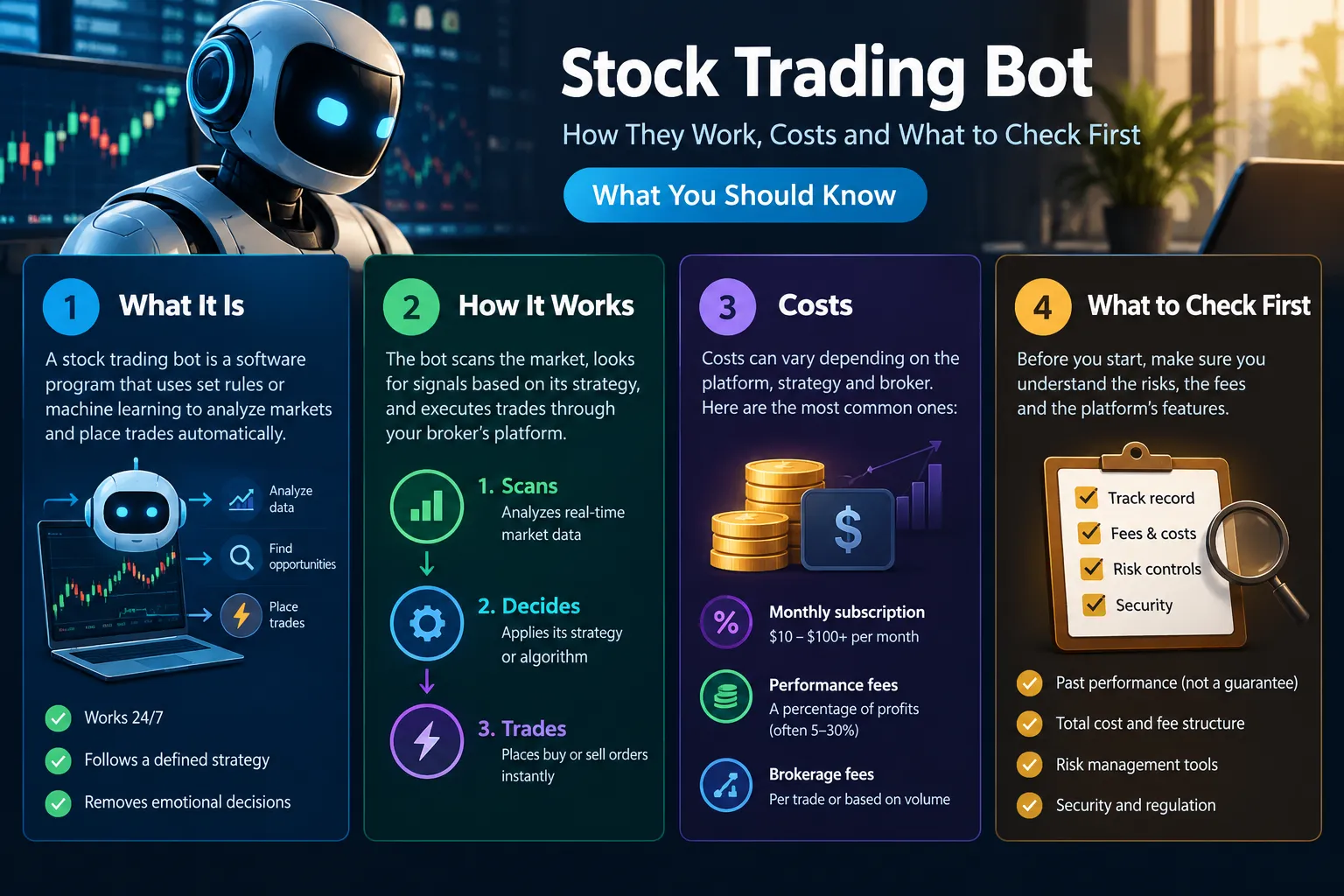
- The pattern-day-trader rule changed. FINRA Regulatory Notice 26-10, published April 20, 2026, replaced the old pattern-day-trader designation and its $25,000 minimum-equity requirement with new intraday margin standards under Rule 4210, effective June 4, 2026.
- Brokers are still catching up. FINRA allows firms to phase implementation through October 20, 2027, so two brokers may apply different intraday-margin rules right now. Check your broker’s current policy directly.
- Existing rules still cover AI. FINRA’s 2026 Annual Regulatory Oversight Report states that FINRA rules and securities laws apply when firms use generative AI exactly as they apply to any other tool, with controls expected around algorithmic trading, market access and model risk.
- Fake bots are an active enforcement area. On September 30, 2026, the SEC announced charges against multiple entities over schemes totaling at least $15 million, including allegations that investors were told they could earn money renting AI trading bots when, per the SEC, no genuine bots were trading.
- Published platform pricing exists and should be checked. Composer’s fee schedule, updated September 2026, lists a free Starter plan, a $10-per-month Advanced plan and a Pro plan at $384 a year, plus pass-through regulatory charges. Verify the current tiers and any month-to-month Pro price on Composer’s own pricing page before you subscribe.
What Is a Stock Trading Bot and How Does It Work?
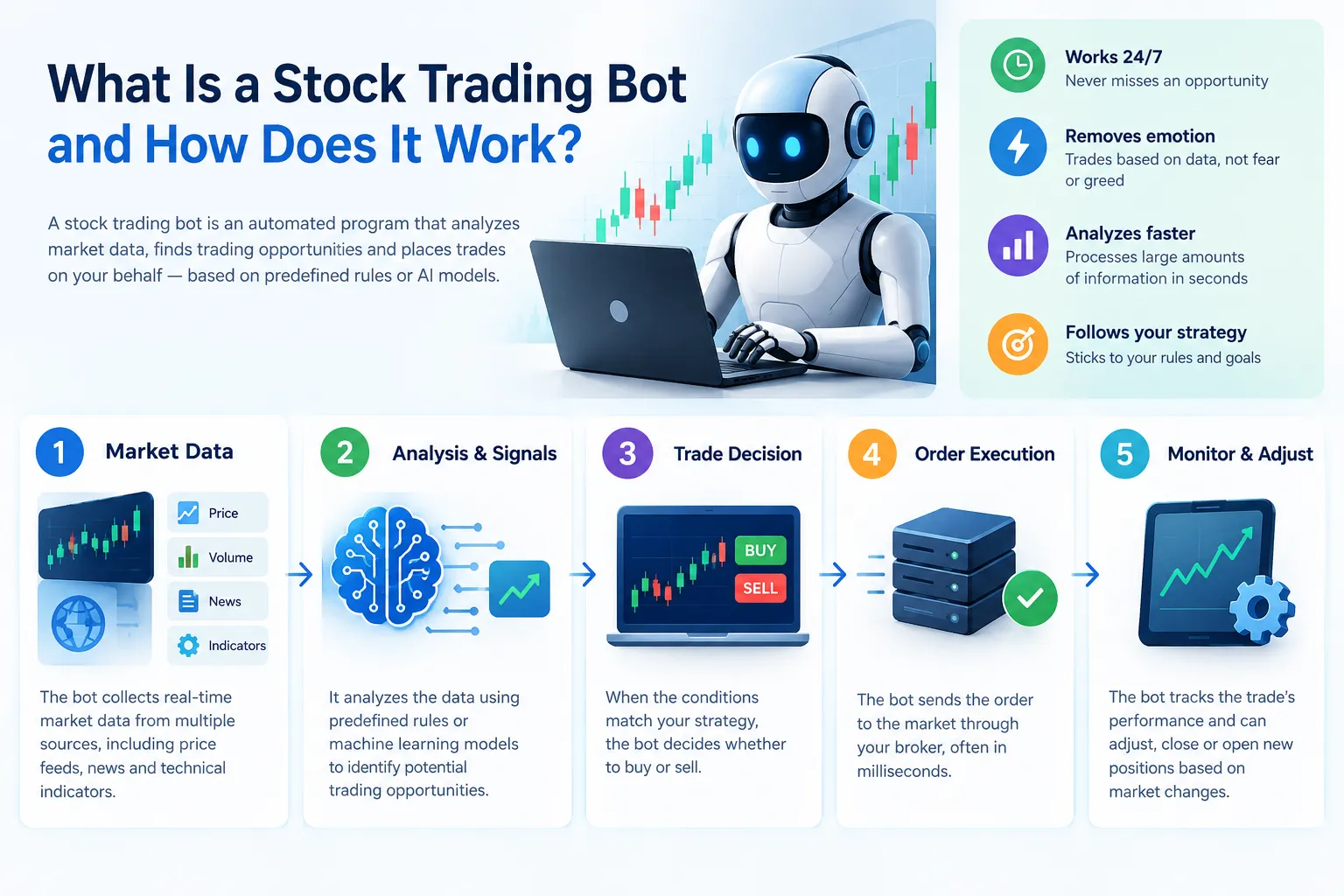
A stock trading bot is an automated decision-and-execution pipeline. It takes in price data, runs that data through a rule or a model, decides whether to act, then submits an order to a broker and writes down what it did. That’s it. No crystal ball, no secret desk.
Strip away the marketing and almost every trading bot for stocks has the same five parts.
1. Market data in. Prices, volume, sometimes fundamentals or news headlines. Delayed data makes a day-trading bot useless. Real-time data usually costs money.
2. Signal generation. The part that says something is happening. Could be a moving-average crossover. Could be a machine-learning model ranking 3,000 tickers. Could be a language model reading an earnings call transcript. Different engines, same job: turn data into a yes or no.
3. Risk rules. How much per position, what stop loss, how many open trades, what the max daily loss is. This layer is boring and it’s the one that keeps your account alive. Position sizing is the difference between a bad week and a dead account.
4. Order construction. Market or limit, what size, what time in force. A limit order that never fills is not a trade. A market order in a thin, low-float name is an invitation to get a terrible print.
5. Broker execution and logging. The order goes out over a broker API, the fill comes back, and the bot records entry, exit, size and reason. If a bot can’t show you its log, you don’t have a system. You have a slot machine with a dashboard.
Where AI actually sits in the stack
Here’s the part the ads blur. A stock trading bot does not have to contain any AI at all. A 50/200 moving-average crossover bot is pure arithmetic from the 1970s and it is still, technically, a bot.
AI shows up in three places when it’s real:
- News and language processing. Reading filings, transcripts and headlines faster than a human can, then scoring sentiment. Our rundown of AI stock news tools that explain why a stock just moved covers what that looks like in practice.
- Pattern classification. Labeling chart structures (basing, tight consolidation, breakout) without a human eyeballing 400 charts.
- Predictive ranking. Scoring a universe of stocks by probability of outperformance over some window.
What AI mostly doesn’t do is remove risk. FINRA has a name for vendors who exaggerate or fabricate AI capability: AI washing. It’s on their published list of warning signs for auto-trading services. If a landing page says “proprietary AI” and refuses to say anything else, treat that as a product description of the marketing department, not the model.
Practical takeaway: before you care whether a bot is smart, ask whether it’s auditable. A rule you can read beats a model you can’t.
What Kinds of Stock Trading Bots Exist?
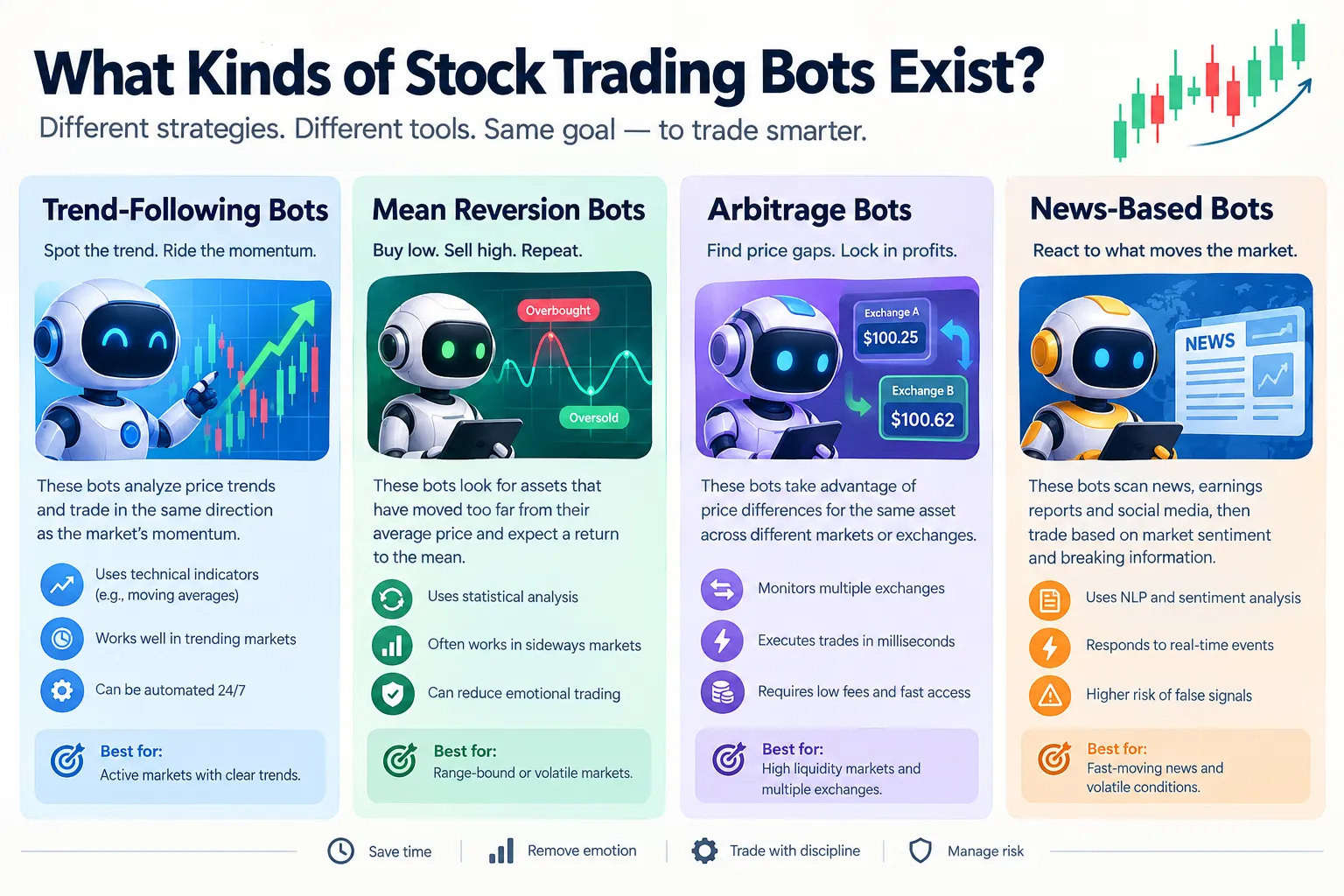
There are roughly five categories of bot for stock trading on the retail market, and they fail in completely different ways. Pick the failure mode you can live with.
| Type | How it works | Who it suits | Main risk |
|---|---|---|---|
| Rule-based | Fixed if-then logic on price, volume or indicators. No learning. | Beginners and anyone who wants to audit every decision | Breaks when the regime changes. A trend rule gets shredded on a choppy tape |
| AI signal model | Machine-learning model ranks or scores stocks, bot trades the top names | Intermediate traders who already understand risk sizing | Overfitting. A model tuned on 2021 data can look brilliant and trade like a tourist |
| Language-model agent | An LLM reads news, filings or your prompt and proposes or places trades | Experimenters, researchers, people testing ideas | Non-reproducible. Same prompt, different answer. Model version changes silently |
| Copy or signal service | A third party sends signals, your account mirrors them | People who want hands-off exposure to someone else’s process | You inherit their risk appetite, their drawdowns and their incentives |
| Broker-built agent | Automation offered inside the broker’s own platform | Traders who want one login, one support desk, fewer moving parts | Limited flexibility. You trade what the broker’s tooling allows |
Decision rule: if you cannot explain in one sentence why the bot entered a trade, downgrade the category. Rule-based beats AI signal beats LLM agent on explainability, and explainability is what lets you fix a losing system instead of abandoning it.
A common mistake: treating a copy-trading service as a bot. It isn’t. It’s an outsourcing arrangement with an execution layer. The signal risk lives with a stranger.
For a wider view of the category map, our breakdown of AI trading bot types goes deeper on each, and the fully automated AI trading bots list catalogues what’s currently shipping.
Should You Build or Buy a Stock Trading Bot?
Buy if you want to be trading within a month. Build if your edge is the strategy itself and no off-the-shelf platform can express it. Most people should buy first, learn what they actually need, then decide whether building is worth the hours.
| Factor | Build it yourself | Buy a platform |
|---|---|---|
| Control | Total. Any logic you can code, any data source, any order type | Bounded by what the platform supports. Custom logic may be impossible |
| Cost shape | Low cash, high time. Data feed, hosting and maybe a model API | Predictable subscription, often with a free tier to test |
| Time to first live trade | Weeks to months, realistically, including debugging the broker connection | Hours to days on a no-code platform |
| Skills needed | Python, API handling, error handling, basic statistics, version control | Strategy thinking. Little or no code on most consumer platforms |
| Support when it breaks at 9:31am | You. At 9:31am. With the market open | A support desk, docs, and other users who hit the same bug |
When building actually makes sense
- Your strategy needs a data source no one’s platform carries.
- You want full control of order routing and timing.
- You already write code for a living and the learning curve is a weekend, not a quarter.
- You intend to run multiple uncorrelated systems and want them in one codebase.
When building is a trap
- You’ve never written a backtest. You’ll build a beautiful machine around a strategy that has no edge.
- You’re hoping the coding project replaces the strategy work. It doesn’t. The bot is the delivery truck, not the cargo.
- You can’t host it reliably. A bot running on a laptop that sleeps at 2pm is worse than no bot.
The honest middle path: most retail traders should start on a no-code or low-code platform with a free tier, run it in paper trading, and only move to custom code once they’ve got a strategy they can describe in plain English and a log that proves it does something. Our walkthrough of AI trading software and what you actually pay for versus what you get is worth reading before any subscription.
Edge case: if you want automation purely to stop yourself from revenge trading, you don’t need a bot. You need bracket orders and a rule that you don’t touch the platform after a loss. Automation of discipline is cheaper than automation of decisions.
What Does a Stock Trading Bot Really Cost Each Month?
The subscription price on the landing page is rarely the real number. Budget the full stack: market data, broker or API access, platform subscription, hosting, and model API calls if the bot uses a language model.
The five cost layers
1. Market data. The single most underestimated line item. Free delayed data is fine for a weekly rebalance and worthless for intraday. Real-time consolidated equity data and exchange fees vary by provider and by whether you’re classified as a professional or non-professional user. Check the official page of your data provider, because professional classification can multiply the bill.
2. Broker or API access. US equity commissions at most major retail brokers are $0 per trade, but that is not the whole cost. Data subscriptions, options contract fees, margin rates and regulatory pass-throughs all apply. Our Alpaca API pricing breakdown covers how one popular API broker structures this.
3. Platform subscription. This is where published numbers exist. Composer publishes a free Starter plan, Advanced at $10 per month, and Pro at $384 a year on its own pricing page. For any other platform, check the official pricing page before you commit, and note the date you checked.
4. Hosting. A bot that must run during market hours needs to live somewhere reliable. A small cloud instance is the usual answer. Prices depend on provider and region, so check the official page.
5. Model API calls. If your stocks trading bot calls a large language model to digest news or score sentiment, you pay per token. A bot scanning 200 headlines a day costs meaningfully more than one checking five. Metered, variable, and easy to forget until the invoice lands.
The pass-through charges almost no one budgets
On top of the subscription, SEC and FINRA regulatory fees are charged on the sale of securities and passed through to you. The current rates live in the platform’s own fee schedule and in FINRA’s published rates, so read those rather than a number in an article. Tiny per trade. Not tiny if your bot turns the portfolio over forty times a month.
That’s the quiet killer of high-turnover automation: a strategy with a 0.4% edge per trade and 0.3% of combined slippage, spread and fees isn’t a strategy. It’s a tip jar for the market.
Our full how much does a trading bot cost guide breaks the stack down line by line.
How much money do you need to start a stock trading bot?
Enough that fixed monthly costs don’t eat the account, and enough that position sizing isn’t absurd. The arithmetic matters more than any minimum.
If your stack costs $60 a month and you fund with $2,000, you need 3.6% a year just to break even on fees before you’ve made a dollar. Same stack on $20,000 needs 0.36%. Same bot, completely different hurdle.
The regulatory floor also moved. FINRA Regulatory Notice 26-10 replaced the $25,000 pattern-day-trader minimum with intraday margin standards under Rule 4210 effective June 4, 2026, with broker phase-in running to October 20, 2027. If your bot day trades on margin, your buying power and eligibility now depend more directly on intraday exposure, and your broker may not have implemented the change yet. Ask them. Don’t assume.
Practical takeaway: write down your total monthly stack cost, divide by your account size, and multiply by 12. If that number makes you uncomfortable, you’re either underfunded or over-subscribed.
What Did the Creator Builds Show?
Short version: YouTube bot-building videos are useful for understanding the plumbing and close to useless as evidence a strategy works. Treat everything in them as a claim, not a result.
A pattern repeats across the genre, and it’s worth naming before you watch another one.
The claim: someone builds an automated stock trading bot, often in Python, often connected to a broker API, and shows it running.
What’s typically shown: the code, the API connection, a backtest equity curve, and sometimes a handful of live or paper trades over days or weeks.
What’s typically skipped: out-of-sample testing, slippage and commission modeling, the strategy’s performance in a different market regime, how many versions were discarded before the one on camera, and what the drawdown looked like. A few weeks of trades is not a sample. It’s an anecdote with a timestamp.
Creators in this space, including channels like LosingLoonies, Ray Fu and Humbled Trader, have published videos covering automated trading and bot construction. Watch them for the mechanics: how the API handshake works, how orders get constructed, where errors show up. Do not watch them for the strategy. A public strategy with a public edge stops having an edge roughly the moment it goes public.
Three questions to ask of any bot build video
- Did they show the net equity curve, after commissions and slippage, or the gross one?
- Was the test period separated into training and out-of-sample windows, or was the whole thing fitted on the same data?
- How long did it run live, with real money, and what was the worst drawdown during that run?
If a video can’t answer all three, you’ve watched a tutorial, not a track record. That’s fine. Just file it correctly.
A related trap: performance claims from vendors rather than creators. FINRA’s investor guidance on auto-trading services flags advertisements promising consistent monthly returns above 10%, beginner-friendly full automation, and “risk-free” AI as warning signs. The September 30, 2026 SEC action involving alleged AI-bot rental schemes is the enforcement version of that warning. If somebody is renting you a bot with guaranteed profits, the product is the rental, not the bot.
Which Brokers Let a Stock Trading Bot Connect?
Several US brokers publish APIs that let a bot place orders, and most offer a paper-trading environment to test against first. The three most commonly used by retail builders are Alpaca, Interactive Brokers and Schwab.
| Broker | Public API | Paper trading | Our guide |
|---|---|---|---|
| Alpaca | Yes, API-first brokerage built around programmatic access | Yes. Alpaca documents a free real-time paper-trading simulation environment that does not transact real securities | Alpaca API for beginners |
| Interactive Brokers | Yes, via the TWS API and related interfaces | Yes, through a paper account | Interactive Brokers TWS API and our Interactive Brokers review |
| Charles Schwab | Yes, through its developer platform | Check the official developer portal for current sandbox availability | Schwab API guide |
For anything not listed here, check the broker’s own developer documentation rather than a third-party roundup. API availability and terms change, and some brokers restrict programmatic access by account type or region. Our broader list of brokers with an API tracks the field.
Choosing between them
- Choose Alpaca if you’re building from scratch and want documentation written for developers first.
- Choose Interactive Brokers if you need breadth: multiple asset classes, international markets, and institutional-grade routing.
- Choose Schwab if you already custody there and want one relationship instead of two.
Common mistake: granting a bot full trading permissions on the same account that holds your long-term positions. Open a separate account for automation. If the bot misfires at 9:31am, you want the blast radius contained.
A word on paper trading
Alpaca’s documentation describes paper trading as a free real-time simulation that doesn’t transact real securities. That’s exactly what it’s good for, and exactly where its limits sit. Simulated fills don’t reproduce live liquidity, queue position, price impact, borrow availability for shorts, or the specific feeling of watching real money drop 4% in eleven minutes.
Paper trade it first. Then fund small. Treat the first funded month as a second test, not a launch.
What Are the 5 Checks Before You Fund a Stock Trading Bot?
Five checks, each with a fix. If a bot fails any of them, it doesn’t get your money yet.
1. The net backtest, not the gross one. The check: does the equity curve include commissions, spread, slippage and realistic fills, and does it report drawdown, turnover and exposure rather than only cumulative return? The fix: rerun the test with a conservative slippage assumption and a commission line. If the edge vanishes, the edge was never there. Also separate training, validation and out-of-sample periods, and confirm no look-ahead bias (the model using information it couldn’t have had at the time of the trade). Survivorship bias matters too: a backtest on today’s index members ignores every company that got delisted.
2. A forward test on live data. The check: has the bot run forward, in paper or tiny size, on data it was never fitted to, for long enough to see a losing stretch? The fix: 30 trading days minimum in paper, then a funded month at a position size where a total loss would annoy you rather than hurt you. The point isn’t profit. The point is finding out what breaks.
3. A hard max-loss rule. The check: is there a daily and a total loss limit, enforced in code, that stops the bot rather than relying on you noticing? The fix: set a daily max loss and an account-level drawdown ceiling. Write both into the bot’s risk layer, not into a sticky note. And test the kill switch before you need it, not during the one hour you need it.
4. Broker permissions scoped tight. The check: what exactly can the API key do? Place orders? Withdraw funds? Access other accounts? The fix: use the narrowest permission set the broker offers, trade in a separate account from your long-term holdings, rotate keys, and never paste a live key into a tutorial repo or a Discord. If a platform asks for withdrawal permissions to “manage” your account, that’s your answer.
5. An exit plan written before entry. The check: what specific condition makes you shut this bot down permanently? The fix: define it numerically in advance. “If drawdown exceeds X% or the strategy underperforms a simple buy-and-hold benchmark over six months, it’s off.” Decided in advance, this is a rule. Decided mid-drawdown, it’s panic with a spreadsheet.
Before any of this, run the vendor through our AI trading bot red flags list and the comparison of which AI trading bots are legit versus scams. Play stupid games, win stupid prizes.
Why Do Stock Trading Bots Lose Money or Fail?
Most bots fail for one of four reasons, and only one of them is a bad strategy. The other three are engineering and psychology.
Overfitting. The model was tuned until the backtest looked gorgeous. A strategy with eleven parameters fitted on four years of data has memorized the past, not learned anything about the future.
Execution decay. The backtest filled at the mid-price. Reality fills at the spread, sometimes worse, sometimes partially, sometimes not at all. Add trading halts, API outages and delayed data and a 12% backtest can print 2% live. A profitable backtest and a profitable account are separated entirely by the execution layer.
Regime change. A trend-following bot built during a two-year uptrend meets a choppy tape and bleeds out in small losses. Nothing is broken. The weather changed.
Human interference. The most common failure of all. The operator overrides the bot after three losses, turns it off at the bottom of the drawdown, or turns it back on after it’s already recovered. You automated the entries and kept the emotions. That’s the worst of both.
Can a stock trading bot work in a bear market?
Only if it was designed for one. A long-only bot in a sustained downtrend has two honest outcomes: sit in cash or lose money. Shorting introduces borrow costs, borrow availability and unlimited theoretical loss, which is a different risk profile entirely.
Decision rule: ask what the bot does when it finds no valid setup. If the answer is “trades anyway,” it will hand you its worst year in the first bad market. If the answer is “sits in cash,” you’ve got a system with an off switch built in, which is rarer than it should be.
Stock Trading Bot vs Manual Trading: What’s the Difference?
A bot executes the same rule the same way every time. A human executes the same rule differently depending on sleep, last week’s loss and whether the position is already red. That consistency is the entire argument for automation.
| Stock trading bot | Manual trading | |
|---|---|---|
| Consistency | Identical execution every time | Varies with mood, fatigue and recent results |
| Speed | Milliseconds to seconds | Seconds to minutes |
| Coverage | Can watch hundreds of tickers at once | Realistically a watchlist of 10 to 30 |
| Adaptability | Only adapts if you code it to | Can read context, news and unusual conditions |
| Failure mode | Fails silently and repeatedly | Fails loudly and emotionally |
| Discipline | Built in | Earned, slowly, usually expensively |
A bot’s silent failure is the underrated risk. A human who makes a bad trade feels it. A bot making the same bad trade 40 times before you check the log costs more and feels like nothing until you open the statement.
Hybrid is where most serious retail traders land: automation handles scanning and alerting, the human handles the final decision. Our coverage of AI stock alert apps that buzz your phone before the move and the swing trading tools list both sit in that middle ground.
Is a Stock Trading Bot Good for Beginners, and Do You Need to Code?
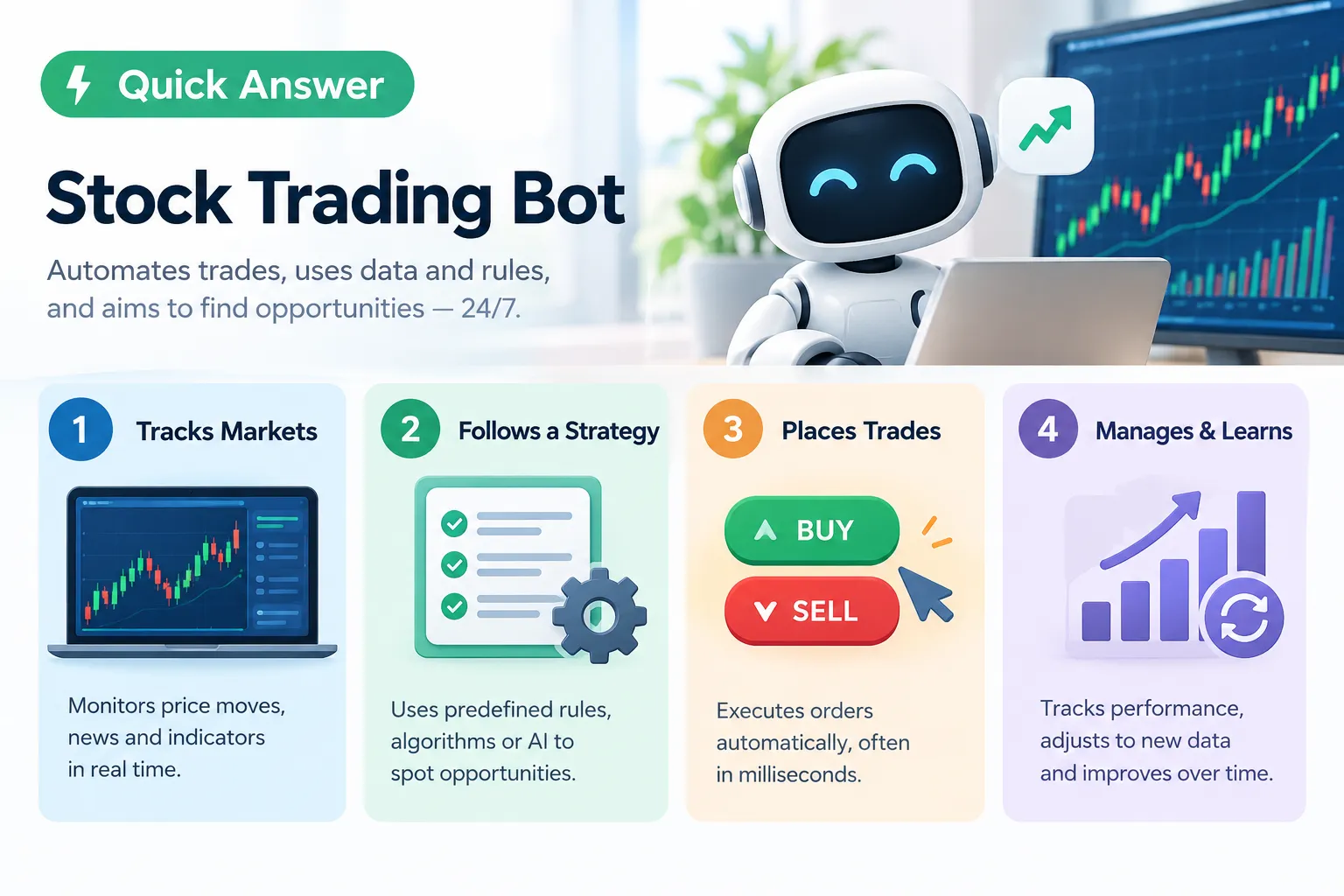
A bot is good for a beginner only if they already have a strategy worth automating. You don’t need coding skills to run one, but you do need a strategy you can state in a sentence.
No-code platforms let you assemble logic from blocks: condition, action, risk rule. Plenty of people run real automation without writing a line of Python. Coding becomes necessary when you want a custom data source, custom order logic, or a system no visual builder can express.
Where beginners get hurt: automation multiplies whatever you give it. Give it a bad strategy and it executes that bad strategy at scale, fast, without the hesitation that might have saved you.
The sequence that actually works:
- Learn one setup properly. One. Breakout from a tight consolidation, or a pullback to support. Define entry, stop and target.
- Trade it manually for 30 days, journaling every trade.
- Only then encode it, paper trade the encoded version, and compare the bot’s trades to the ones you’d have taken by hand.
- Fund it small.
If step 2 shows the setup doesn’t work, congratulations: you just saved yourself a subscription, a hosting bill and three months.
Start with the free side of the market. The free trading tools and calculators and free AI trading bots pages both exist so you can test the idea before you test your wallet.
Are Stock Trading Bots Legal, and What About the Rules?
Yes. Automated trading in your own account at a registered US broker is legal. The legal problems come from the people selling bots, not from the act of running one.
Three things worth knowing:
- Existing rules apply to AI. FINRA’s 2026 Annual Regulatory Oversight Report states plainly that FINRA rules and securities laws apply when firms use generative AI just as they apply to other tools, with attention to algorithmic trading controls, market access, supervision and model risk. That’s aimed at firms, but it tells you the regulatory posture.
- Unregistered auto-trading services are a flagged risk. FINRA’s investor guidance warns about services advertising consistent monthly returns above 10%, beginner-friendly automation, or risk-free AI, and names AI washing as a major warning sign.
- Enforcement is live. The SEC’s September 30, 2026 announcement covered alleged schemes totaling at least $15 million, including claims that investors could earn money renting AI trading bots when, per the SEC, no real bots were trading and deposited funds weren’t used as represented.
Decision rule: if the bot trades your money in your account at your broker, you’re in normal territory. If you’re sending money to someone else so their bot can trade on your behalf, you’ve left the bot category and entered the “is this person registered” category. Check first.
What Is the Best AI Stock Trading Bot?
There isn’t one best AI stock trading bot, and anyone who names one without asking what you trade is selling something. The right answer depends on your use case, so here’s the position by use case.
- If you’re learning and want zero spend: start with a free tier and paper trading. A free plan plus a paper account at an API broker teaches you more in a month than any review will.
- If you want no-code strategy automation: a visual strategy builder with a published fee schedule. Composer publishes its plans and pass-through fees openly, which is the transparency bar others should meet.
- If you’re building custom logic: an API-first broker. Alpaca’s documentation and free paper-trading environment are built for exactly this.
- If you need breadth across asset classes: Interactive Brokers, via the TWS API.
- If you want AI ranking rather than execution: you probably want a screener or scoring tool, not a bot. Our best AI stock screeners roundup and the Danelfin review checking the AI stock score’s real track record cover that side.
The filter that beats any ranking: pick the ai stock trading bot that publishes its pricing, documents its method, offers paper trading, and lets you export a trade log. Every tool that fails those four is a black box with a subscription button, no matter how good the chart on the homepage looks.
Frequently Asked Questions
Does a trading bot work?
A trading bot reliably executes whatever rule you give it, which is different from making money. The automation works. Whether the strategy inside it has an edge after commissions, spread and slippage is a separate question that only a net backtest plus a forward test can answer.
Is it legal to create a trading bot?
Yes, building and running a bot to trade your own account at a registered US broker is legal. The legal risk sits with selling bots or managing other people’s money, which can trigger registration requirements. FINRA has warned specifically about unregistered auto-trading services.
How is AI being used in trading?
Mainly for processing language (news, filings, transcripts), classifying chart patterns, and ranking large universes of stocks by predicted outperformance. FINRA’s 2026 oversight report confirms existing rules and controls apply to generative AI use the same as any other technology.
Can ChatGPT make a trading bot?
A language model can write functional code for a simple bot, and many people have used one to scaffold a broker API connection. It cannot verify your strategy has an edge, cannot guarantee the code handles errors safely, and should never be given live trading permissions without a tested kill switch and a reviewed risk layer.
How much does an AI trading bot cost?
Costs stack across data, broker access, platform subscription, hosting and model API calls. Composer lists a free Starter plan, $10 per month Advanced and $384 a year Pro on its pricing page, plus regulatory pass-throughs. For every other platform, check the official pricing page and note the date.
Do I still need $25,000 to day trade with a bot?
Not under the new framework. FINRA Regulatory Notice 26-10 replaced the pattern-day-trader $25,000 minimum-equity requirement with intraday margin standards under Rule 4210, effective June 4, 2026. Brokers may phase implementation through October 20, 2027, so confirm your own broker’s current policy.
Our Take
Price the full monthly stack and pass the five checks before a single dollar goes in. Not the subscription. The stack: data, broker, platform, hosting, model calls, and the pass-through fees that look like rounding errors until your bot turns the portfolio over forty times a month.
Then run the five checks. Net backtest. Forward test. Hard max-loss rule. Tight broker permissions. A written exit plan with a number in it.
Most people skip straight to funding because paper trading is boring and the backtest looked great. Those two sentences explain a majority of retail bot failures. A bot is an amplifier. It makes a good process cheaper to run and a bad process faster to execute. Decide which one you’re handing it.
Built a bot worth other traders seeing, or found one that cleared all five checks? Submit it for review and we’ll put it through the same test.
Stay alpha.
The FullStack Alpha research desk tests AI trading bots on paper and live accounts. Reviewed and edited by Jay Rocco, Founder and Editor.
